TagEnvironmental Impact Statement(328)
-
 2025-12-20
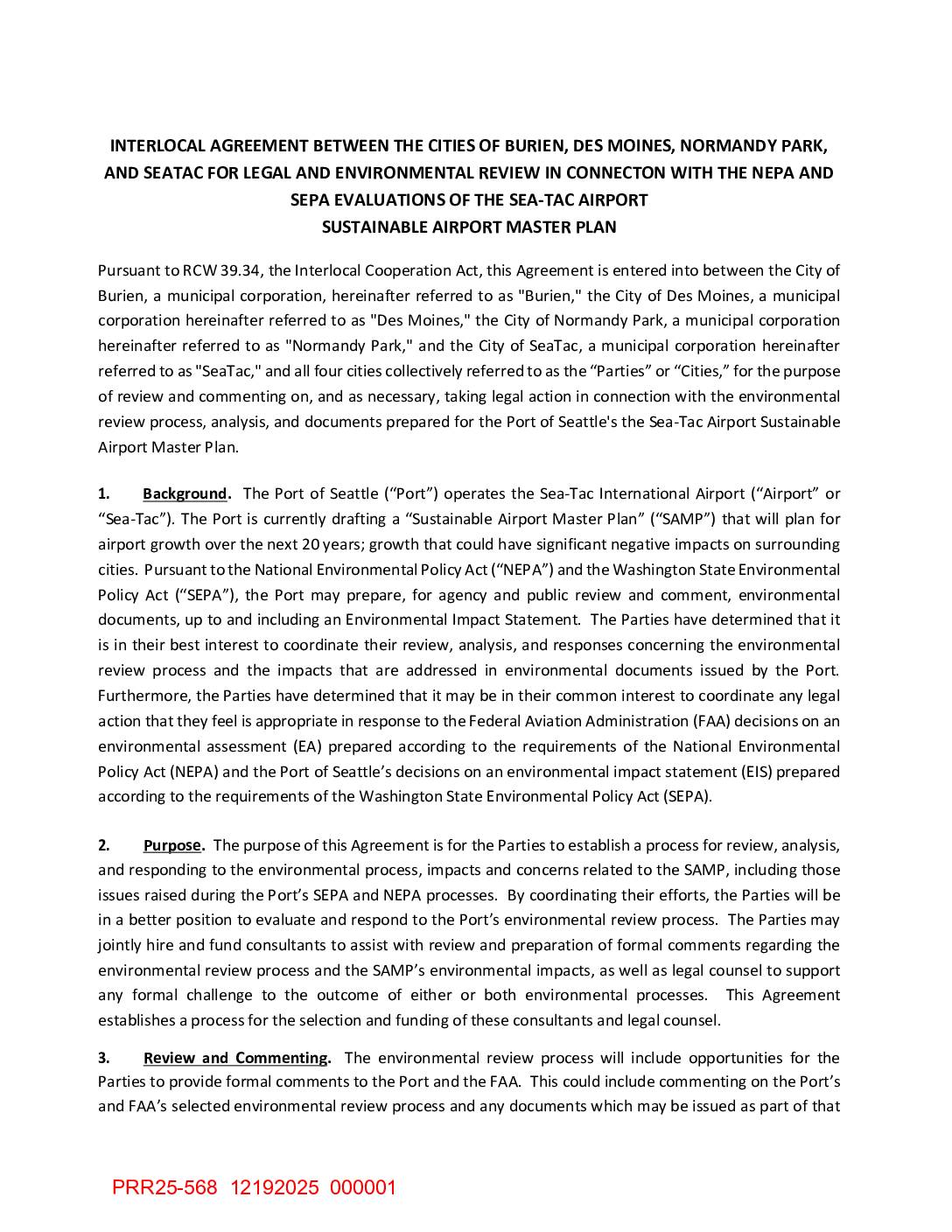
Interlocal agreement between the cities of Burien, Des Moines, Normandy Park, and SeaTac for legal and environmental review in connection with the NEPA and SEPA evaluations of the Sea-Tac Airport Sustainable Airport Master Plan
The cities of Burien, Des Moines, Normandy Park, and SeaTac have entered into a formal interlocal agreement to coordinate their review of, and potential legal challenges to, the Port of Seattle's Sustainable Airport Master Plan, which could bring significant growth and environmental impacts to their communities over the next 20 years. Under the agreement, the four cities will jointly hire environmental consultants and legal counsel, share costs proportionally based on population, and issue unified comment letters during the NEPA and SEPA review processes. The City of SeaTac is designated as the lead administrator for contracts and finances, while all four cities must unanimously agree before filing any joint legal appeal. -
 2025-12-08
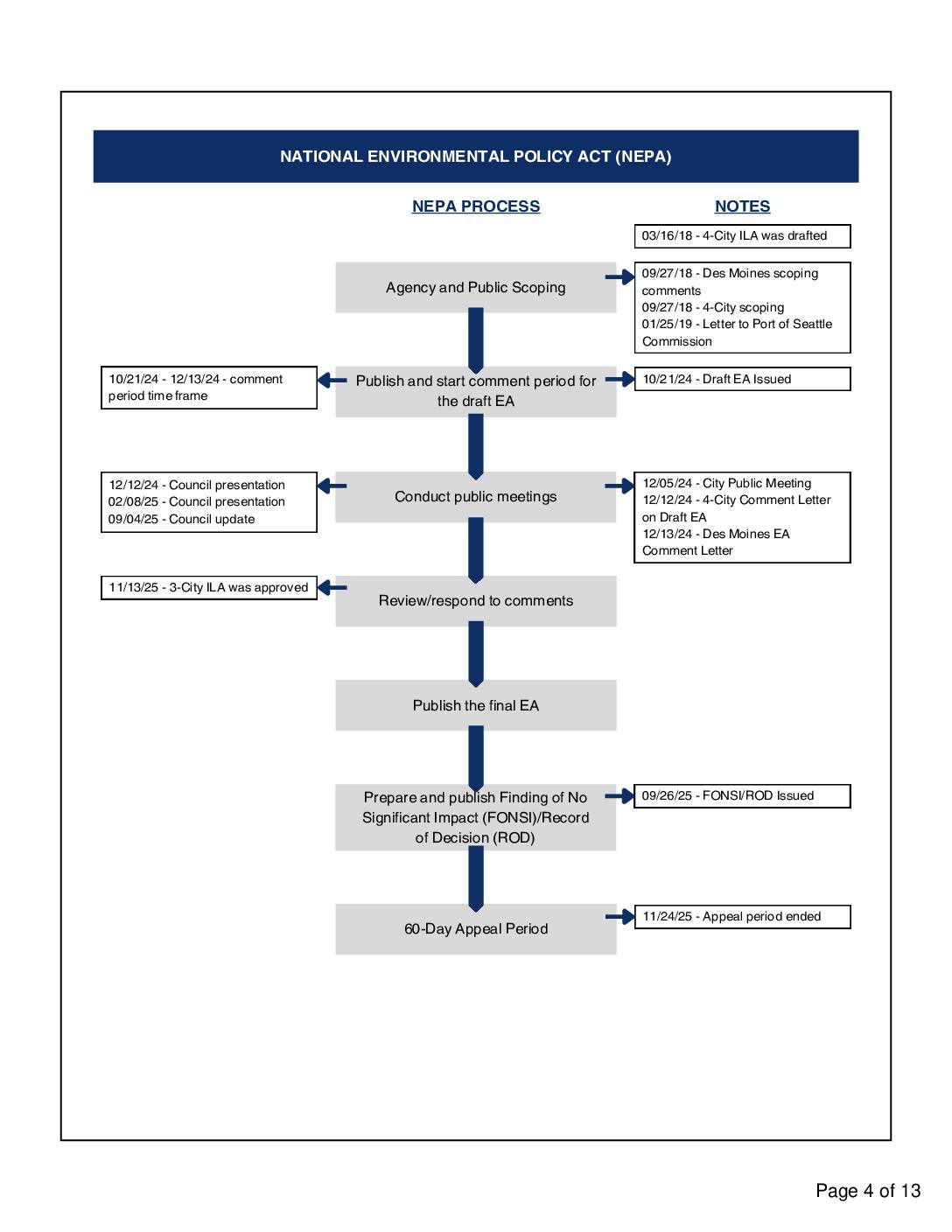
NEPA and SEPA Process Timeline: Des Moines Airport Advisory Committee
This document outlines the federal (NEPA) and state (SEPA) environmental review processes related to Sea-Tac Airport, tracing key milestones from initial scoping in 2018 through the issuance of a Finding of No Significant Impact (FONSI) in September 2025 and a subsequent court appeal filed in November 2025. The NEPA process involved public comment periods, city council presentations, and a 4-city interlocal agreement, while the SEPA process determined the project required a full Environmental Impact Statement (EIS), with a Draft EIS expected in Q1 2026. Together, these timelines reflect years of coordinated efforts by multiple cities to formally challenge and scrutinize the environmental impacts of airport operations and expansion. -
 2025-12-01
2025 Report: Overburdened Communities Highly Impacted by Air Pollution
A report by the Washington State Department of Ecology’s Air Quality Program examining overburdened communities that are highly impacted by air pollution. The document includes publication information, contact details for regional offices, and ADA accessibility information. -
 2025-11-24
Respondents’ motion for vacatur
This is a legal filing in the U.S. Court of Appeals for the D.C. Circuit in which the U.S. Environmental Protection Agency asks the court to vacate its own previously issued air quality standard, arguing that EPA lacked the statutory authority to revise the standard without completing a full review process. The case centers on National Ambient Air Quality Standards (NAAQS) under the Clean Air Act, not airport noise policy. This document does not contain information relevant to Sea-Tac Airport noise policy. -
 2025-11-13
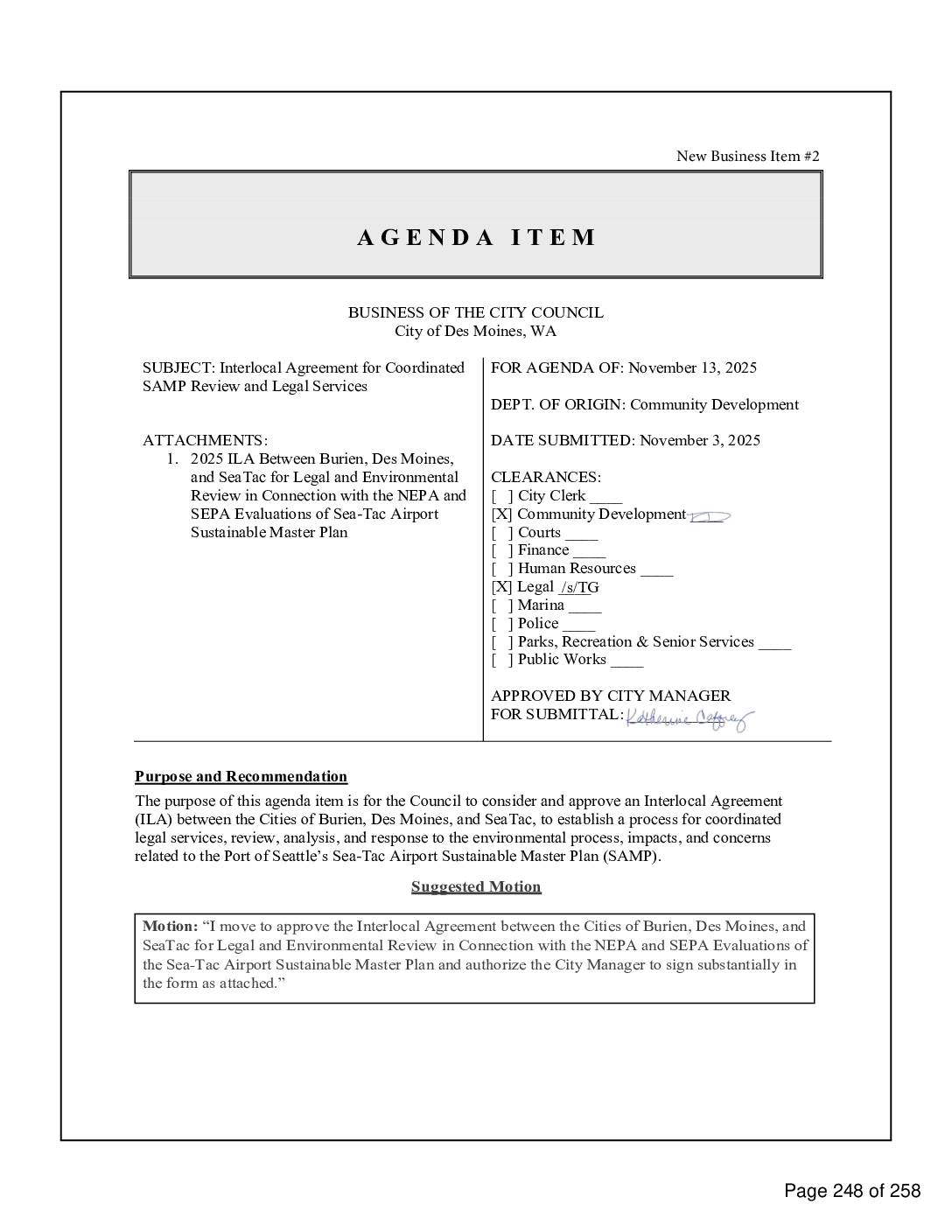
Interlocal agreement between the cities of Burien, Des Moines, and SeaTac for legal and environmental review in connection with the NEPA and SEPA evaluations of the Sea-Tac Airport Sustainable Airport Master Plan
The cities of Burien, Des Moines, and SeaTac are joining forces under a formal Interlocal Agreement to coordinate their review of and legal response to the Port of Seattle's Sea-Tac Airport Sustainable Airport Master Plan (SAMP), which could bring significant noise and environmental impacts to surrounding communities. The agreement, considered by Des Moines City Council on November 13, 2025, allows the three cities to jointly hire environmental consultants and legal counsel to analyze and formally challenge the airport expansion's environmental review under both federal (NEPA) and state (SEPA) law. A Draft Environmental Impact Statement from the Port is expected in early 2026, with the overall process estimated to conclude by December 31, 2028. -
 2025-11-12
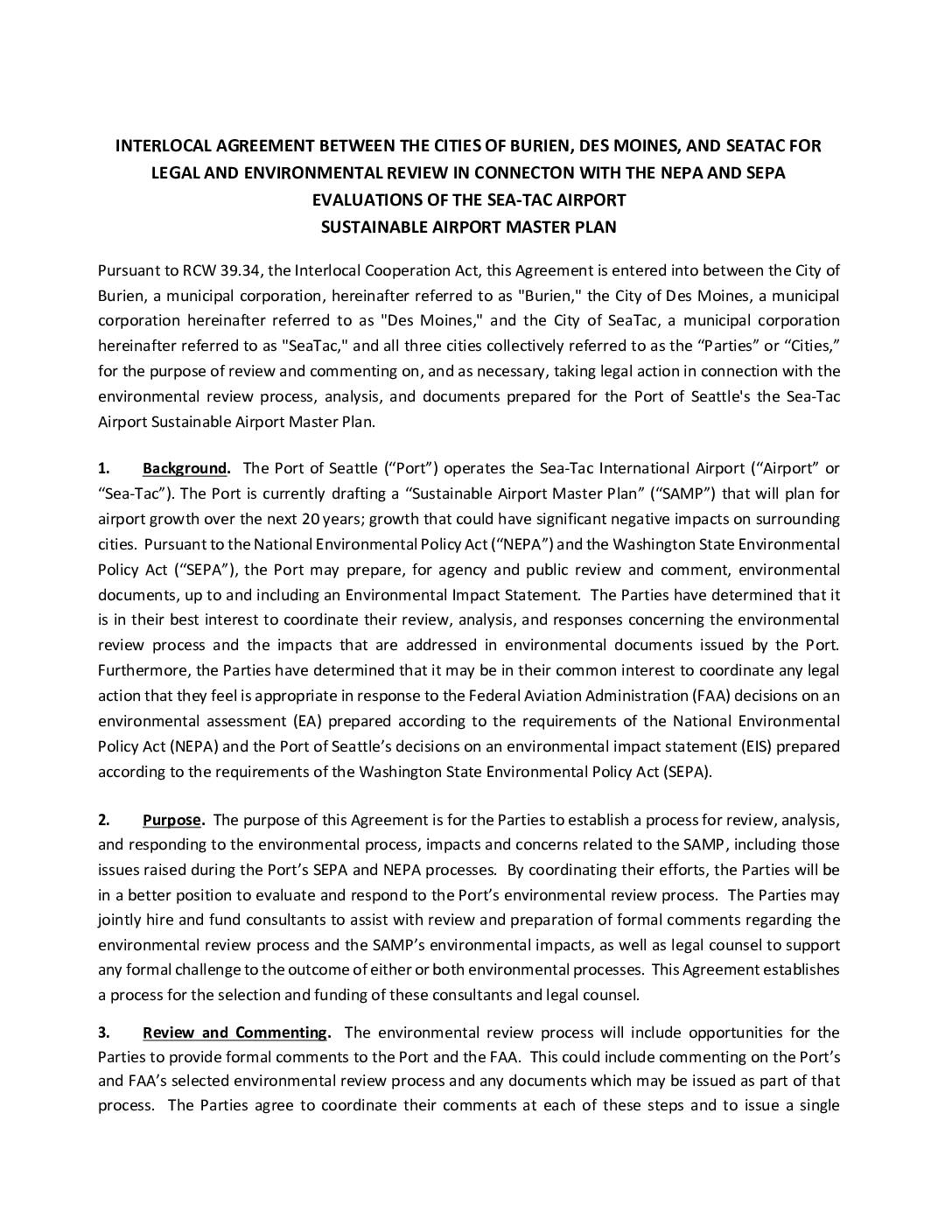
Interlocal Agreement Between the Cities of Burien, Des Moines, and Sea-Tac for Legal and Environmental Review in Connection with the NEPA and SEPA Evaluations of the Sea-Tac Airport Sustainable Airport Master Plan
The cities of Burien, Des Moines, and SeaTac have entered into a formal agreement to coordinate their review of, and potential legal challenges to, the Port of Seattle's Sustainable Airport Master Plan, which could significantly impact surrounding communities over the next 20 years. The three cities agreed to share costs proportionally based on population, jointly hire environmental consultants and legal counsel, and issue unified comment letters during the NEPA and SEPA environmental review processes. Key provisions require unanimous agreement to file a joint appeal and a two-city majority to continue litigation at each subsequent stage. -
 2025-11-03
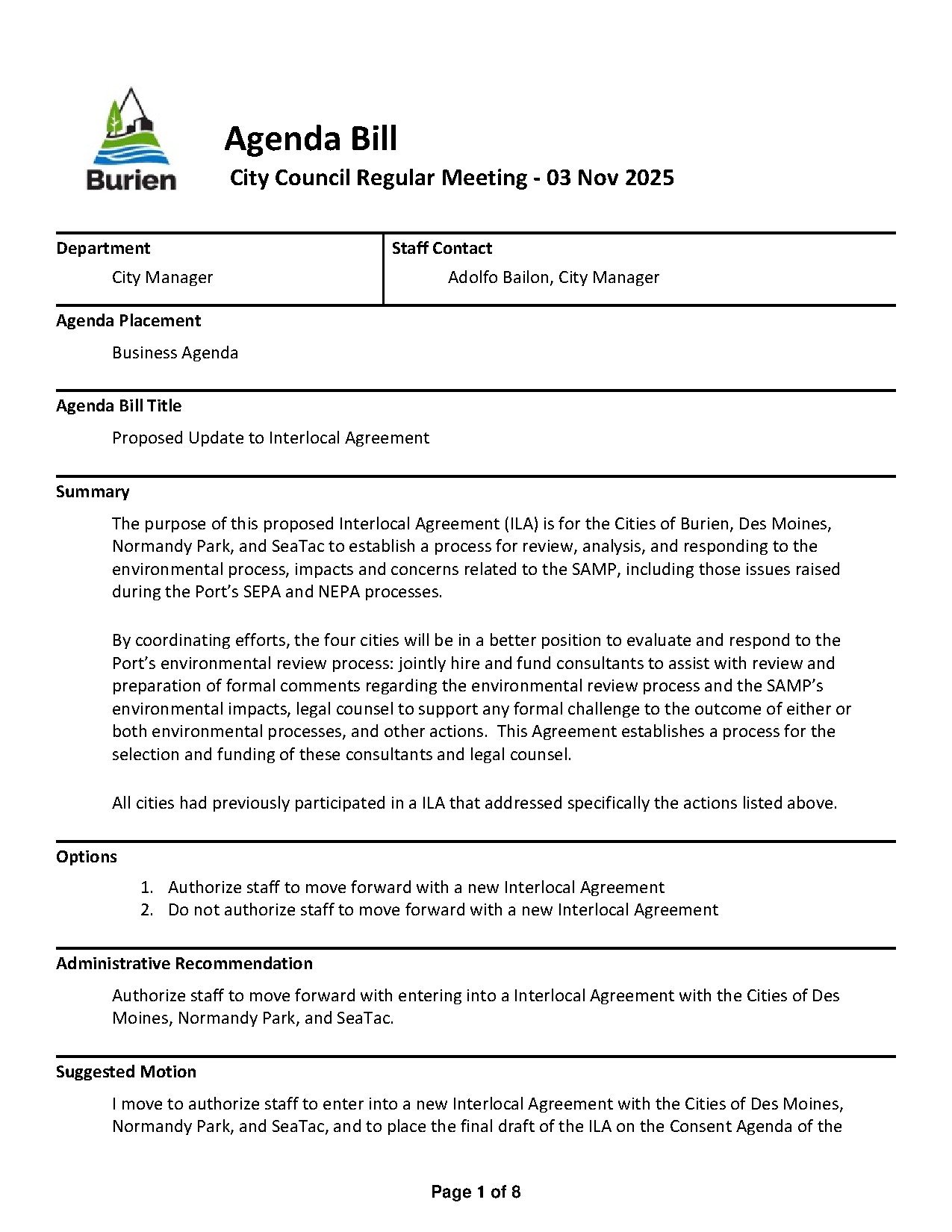
Proposed update to Interlocal Agreement
The cities of Burien, Des Moines, Normandy Park, and SeaTac are proposing a formal Interlocal Agreement to coordinate their response to the Port of Seattle's Sustainable Airport Master Plan (SAMP), which could bring significant growth and environmental impacts to surrounding communities over the next 20 years. Under the agreement, the four cities would jointly hire consultants and legal counsel to review environmental documents, submit formal comments during the SEPA and NEPA review processes, and potentially mount legal challenges to FAA or Port decisions. Burien's share of costs is estimated at approximately $100,000. -
 2025-10-24
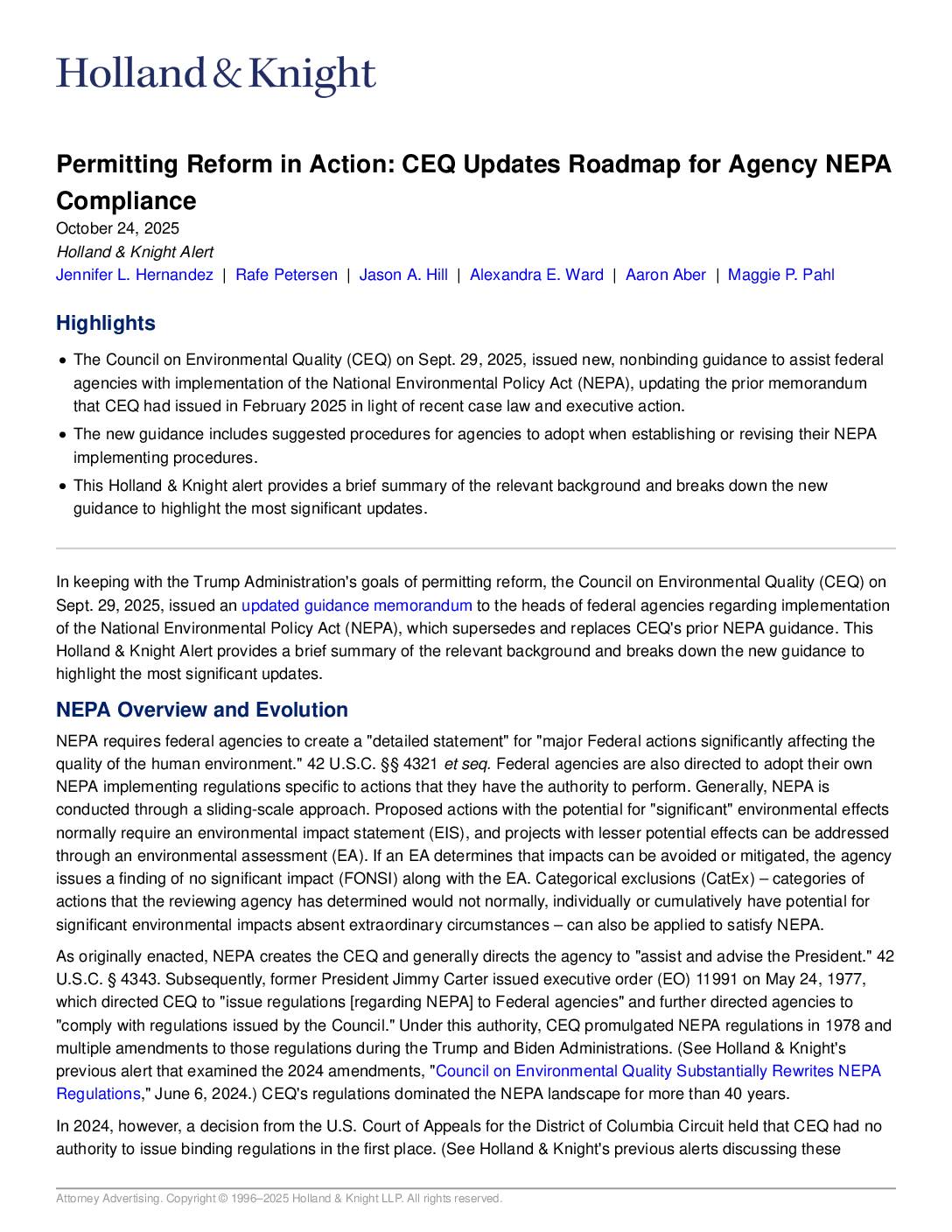
Permitting Reform in Action: CEQ Updates Roadmap for Agency NEPA Compliance
In September 2025, the Council on Environmental Quality (CEQ) issued updated non-binding guidance to federal agencies on how to conduct environmental reviews under the National Environmental Policy Act (NEPA), replacing earlier guidance from February 2025. The update streamlines the permitting process by incorporating a recent Supreme Court ruling limiting the scope of required environmental analysis, removing climate change and environmental justice considerations, and introducing an optional fee-based program that cuts review timelines in half. Agencies are encouraged to revise their own NEPA procedures using a provided template while continuing existing review processes without delay. -
 2025-09-30
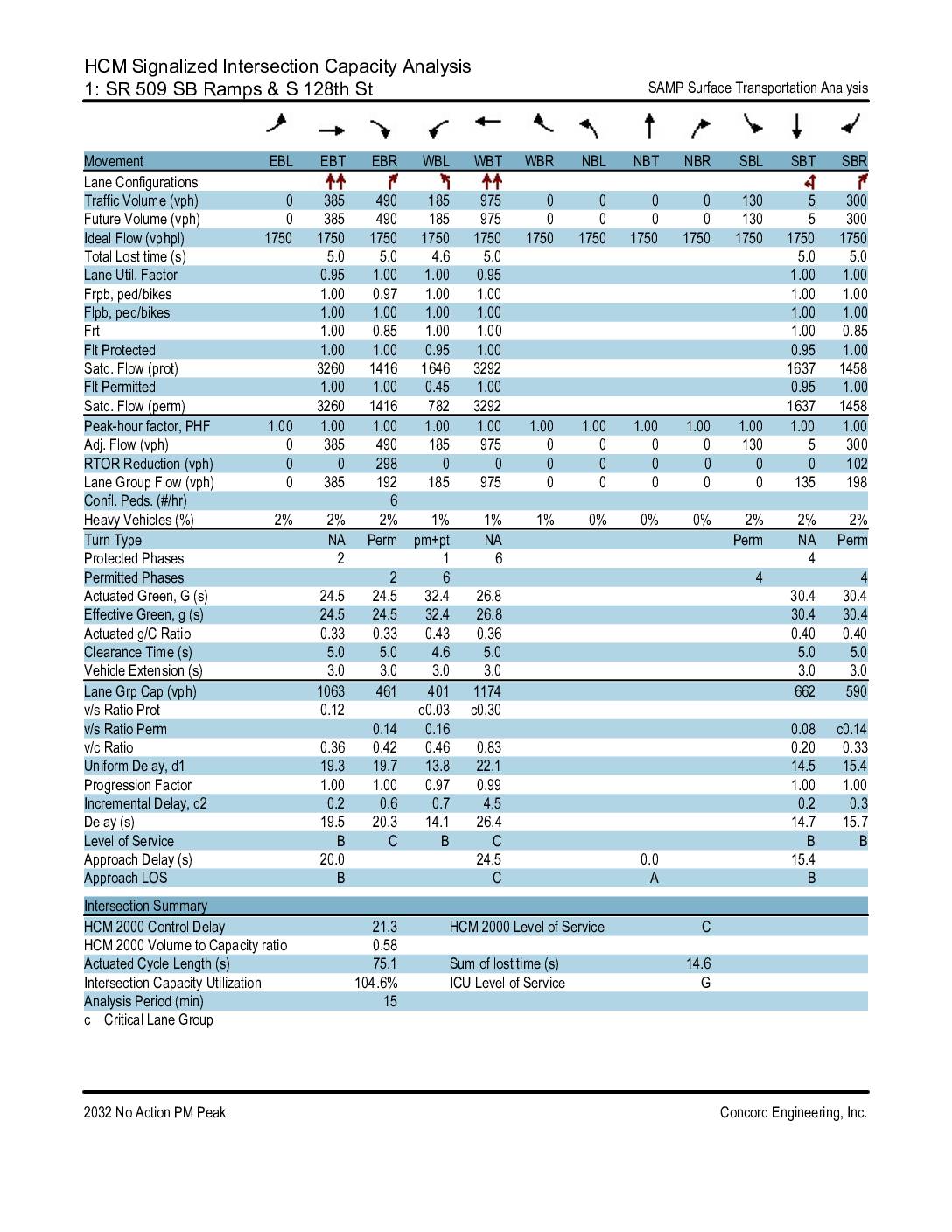
HCM Signalized Intersection Capacity Analysis: SR 509 SB Ramps, NB SR 509 Ramps, and Des Moines Way S at S 128th St — 2032 No Action PM Peak
This traffic engineering report analyzes three signalized intersections along S 128th Street near SR 509 in the Sea-Tac area under projected 2032 No Action conditions during the PM peak hour. The study finds that the SR 509 ramp intersections are operating well over capacity, with an Intersection Capacity Utilization of 104.6% and an ICU Level of Service G, while the Des Moines Way S intersection operates more acceptably at 63.3% ICU. Overall intersection control delays range from approximately 19 to 27 seconds, with most approaches functioning at Level of Service B or C. -
 2025-09-08
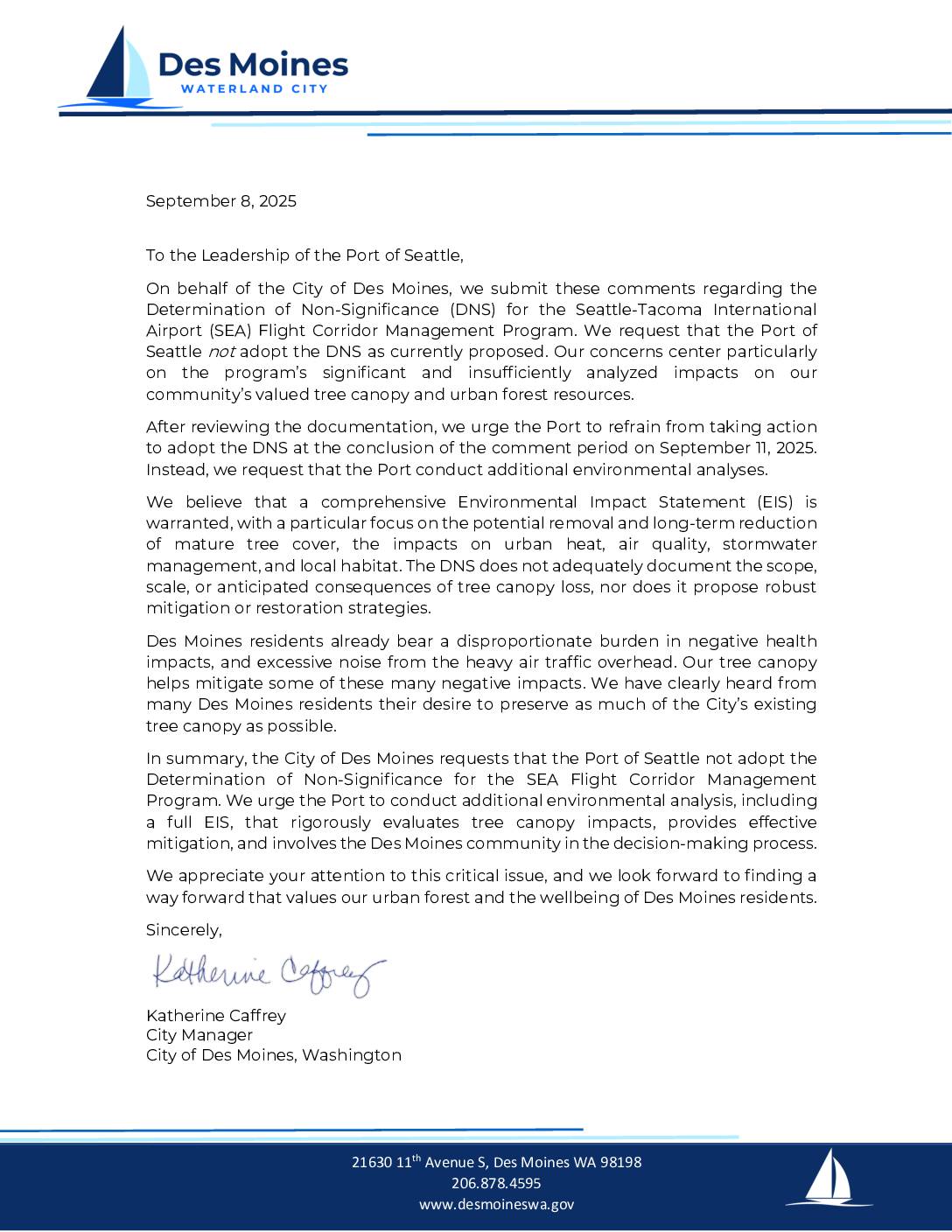
City of Des Moines letter opposing DNS for SEA Flight Corridor Management Program
The City of Des Moines, Washington, formally requests that the Port of Seattle reject the Determination of Non-Significance (DNS) for the Sea-Tac Airport Flight Corridor Management Program, arguing that it fails to adequately assess impacts on the city's tree canopy and urban forest. City Manager Katherine Caffrey urges the Port to instead conduct a full Environmental Impact Statement (EIS) examining tree removal, urban heat, air quality, stormwater, and habitat effects. The letter emphasizes that Des Moines residents already face disproportionate noise and health burdens from airport traffic, making tree canopy preservation especially critical to their wellbeing.