Skip to content
  • STNI
  • Statistics
    • Ops and Passengers
      • King County International Airport (Boeing Field) Annual Operations
    • Financials
    • Aviation fuel uplift in the State of Washington 2018 – 2025
      • Aviation Fuel Tax Revenue in the State of Washington 1983-2025
      • Aviation Fuel Uplift at Sea-Tac Airport
    • Air Quality Monitoring
    • Flight Tracking
      • Flow and Flight Tracks
      • Five Year Comparison
      • Busiest Hours and Days
    • SEL Noise Reports & Graphs
      • About The Permanent Noise Monitors
      • Minutes of Quiet by Noise Monitor
      • Noise Events mapped
      • Noise Events (SEL)
    • Runways
    • Employees
    • Real Estate
      • Port Properties and Trees mapped
    • Parking
  • Events
  • Protest
    • Regular Events
    • Legislation 2026
    • Complain about a particular flight
    • Advocacy Organizations
    • Media Outlets
    • People
    • The Port of Seattle
      • Commission Meetings
      • Public Records Requests
      • StART
      • Highline Forum
    • Contact Your Electeds
  • Resources
    • FAQs
      • FAA Occurrences/Accidents/Indents
    • The SAMP
      • SAMP Public Comment Template
        • Two versions of Appendix K: NEPA/SEPA 2018 vs 2023
      • SAMP NTP: 31 projects by the numbers
      • SEPA Draft EIS (2026)
      • SAMP Record of Decision/FONSI (2025)
      • SAMP Draft EA (October 2024)
      • 2018 Scoping
    • Port Packages
      • Port Package Property Costs
      • Port Packages mapped
      • The Port Package Explainer
      • So you want a (first-time) Port Package? Start here
      • Port Package Looker Upper
      • How do I determine if I have a Port Package or Avigation Easement?
      • Progress on Port Package Update legislation
      • Having a Port Package Problem?
      • Port Package Site Visit Follow-Up
    • Document Library
    • Explainers
      • The Airport Law Cheat Sheet
      • The Grant Explainer
    • External Articles
    • History
      • Timeline
      • The Sea-Tac Communities Plan
        • Sea-Tac Communities Plan – Planning Maps
      • PSRC Third Runway Decision Process
    • Studies
    • Videos
  • Stories
  • Mission
  • Subscribe
  • Contact
Scroll down to content

Get InformedStay Informedx

I understand that you will never share my information with anyone, you will only use it to keep me updated on relevant events and that I may unsubscribe at any time.

STNI

STNISea-Tac Noise.Info

  • Solve for Sea-Tac. Solve for every airport.
  • Since 2016, working to obtain justice for everyone living under the flight path.
  • Less Noise. Cleaner Air. Better Public Health. Compensation.
  • Everything you think you know about the airport is wrong.

TagEnvironmental Impact Statement(325)

Advanced Search Options

  • Dates
  • Media
    • External Articles
    • Images
    • PDFs
    • Video
    • Audio
  • Order By
  • 1992-11-06

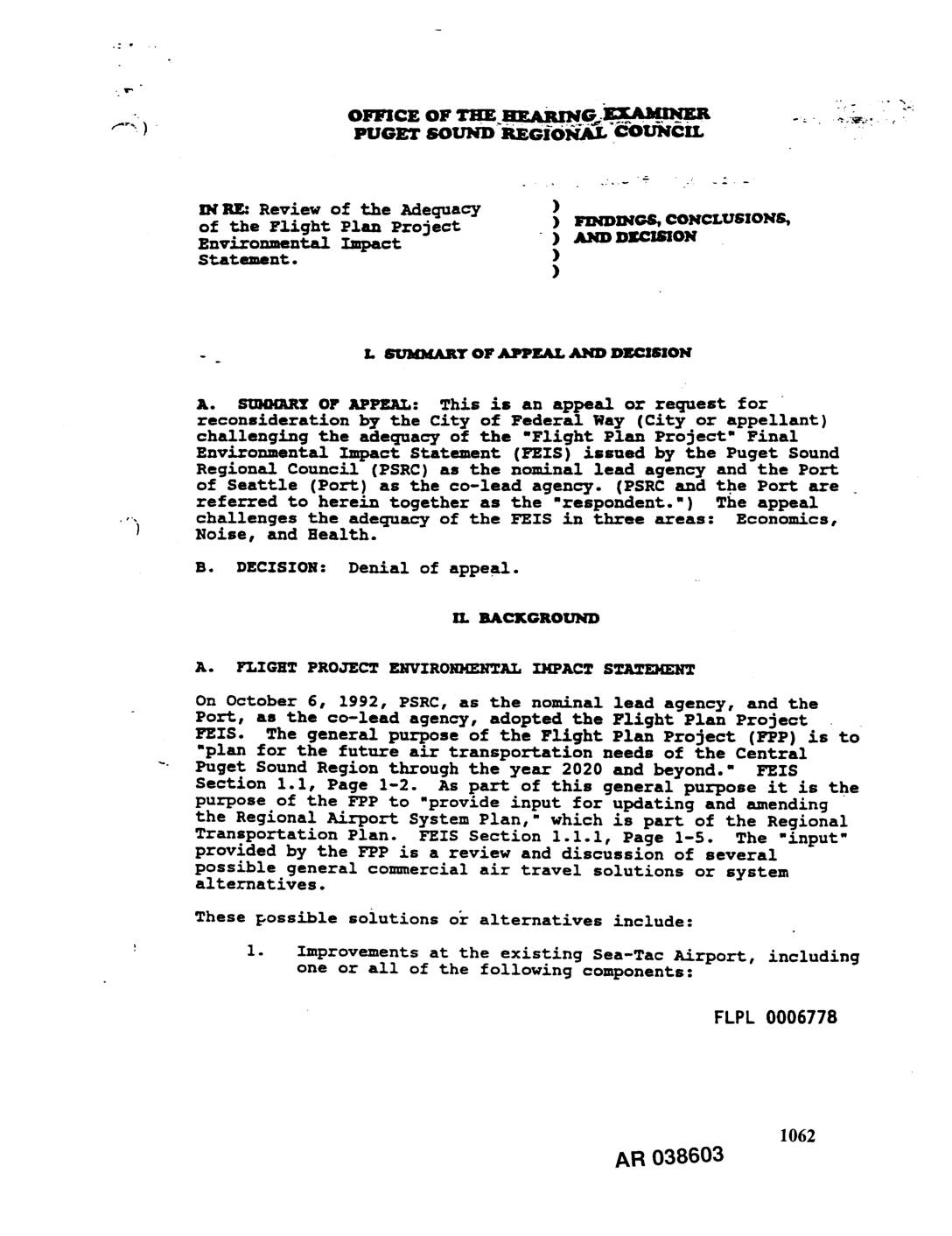
    EXH AR038603: Findings, Conclusions, and Decision — City of Federal Way Appeal of Flight Plan Project EIS Adequacy

    Office of the Hearing Examiner, Puget Sound Regional Council (PSRC) Findings, Conclusions, and Decision on City of Federal Way appeal (filed November 6, 1992) challenging adequacy of the Flight Plan Project Final Environmental Impact Statement (FEIS) issued by PSRC as nominal lead agency and Port of Seattle as co-lead agency. Appeal challenges FEIS adequacy in
    TagsACC, Environmental Impact Statement, Federal Way, Flight Plan Project, Pollution Control Hearings Board, Puget Sound Regional Council, Third RunwayFolderBox 16
  • 1992-10-29

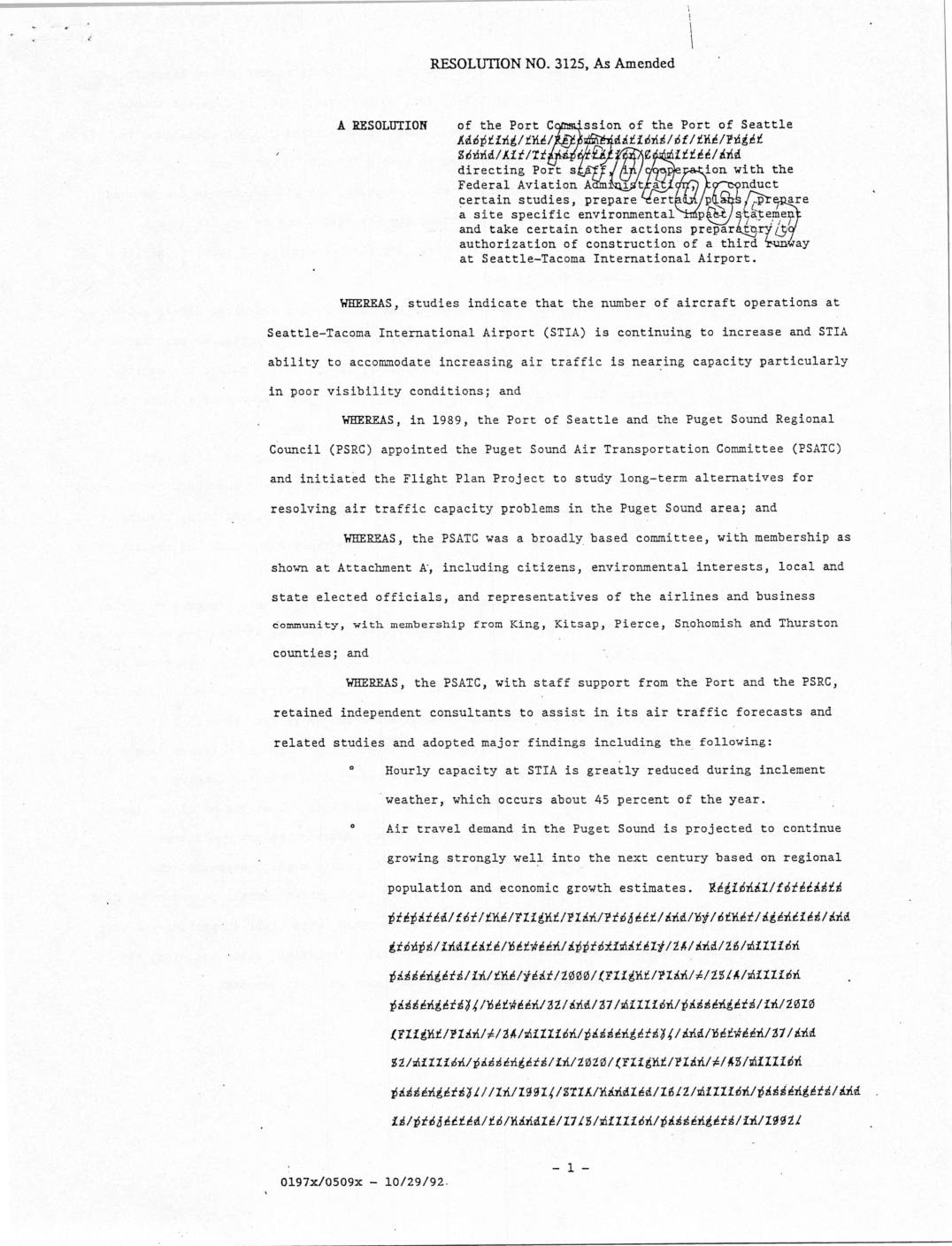
    Resolution No. 3125, as amended

    Resolution No. 3125, adopted by the Port of Seattle Commission in 1992, authorizes planning and environmental studies for the construction of a third runway at Seattle-Tacoma International Airport (Sea-Tac) to address growing air traffic demand and capacity limitations, particularly during poor weather conditions. The resolution follows a two-year study by the Puget Sound Air Transportation Committee (PSATC), which recommended a phased multiple-airport system, including a new dependent runway at Sea-Tac by 2000. The Port also called for broader regional solutions, including a fast rail link between Portland and Vancouver airports and diversion of cargo-only carriers to alternative airport sites.
    TagsEnvironmental Impact Statement, Flight Plan Project, Port Of Seattle Commission, Puget Sound Regional Council, Third RunwayFolderResolutions
  • 1992-06-27

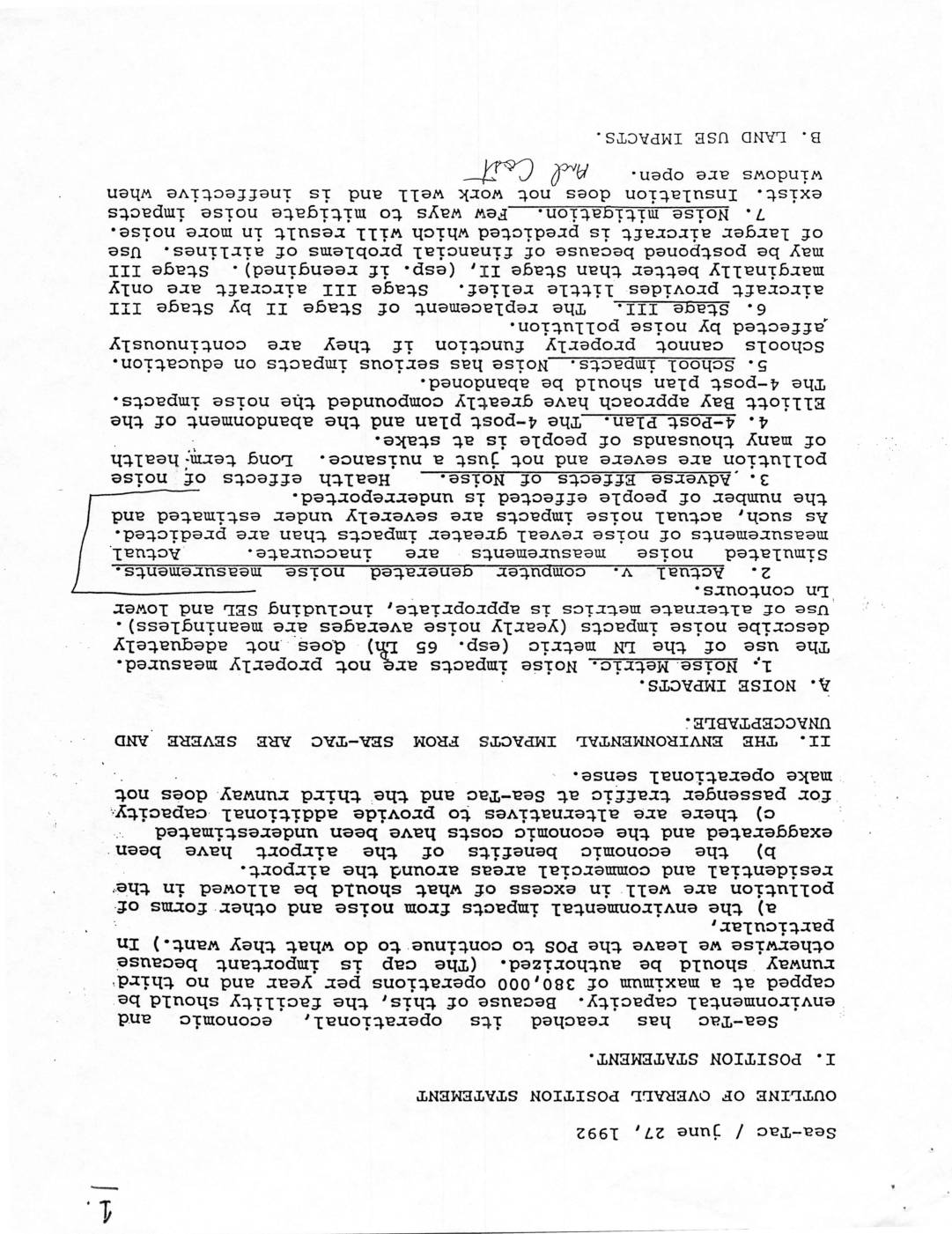
    Outline of overall position statement: Sea-Tac, June 27, 1992

    A 1992 position statement argues that Seattle-Tacoma International Airport (Sea-Tac) has reached its operational, economic, and environmental capacity and should be capped at a maximum of 380,000 operations per year with no third runway authorized. The document contends that noise impacts on surrounding communities are severely underestimated, that a third runway would make no operational or economic sense, and that alternatives such as demand management, use of existing regional airports, and improved transportation systems should be pursued instead.
    CategoriesCorrespondence TagsAirport Expansion, Environmental Impact Statement, Noise Pollution, RCAA, Sea-Tac Airport, Third RunwayFolderRCAA
  • 1992-04-09

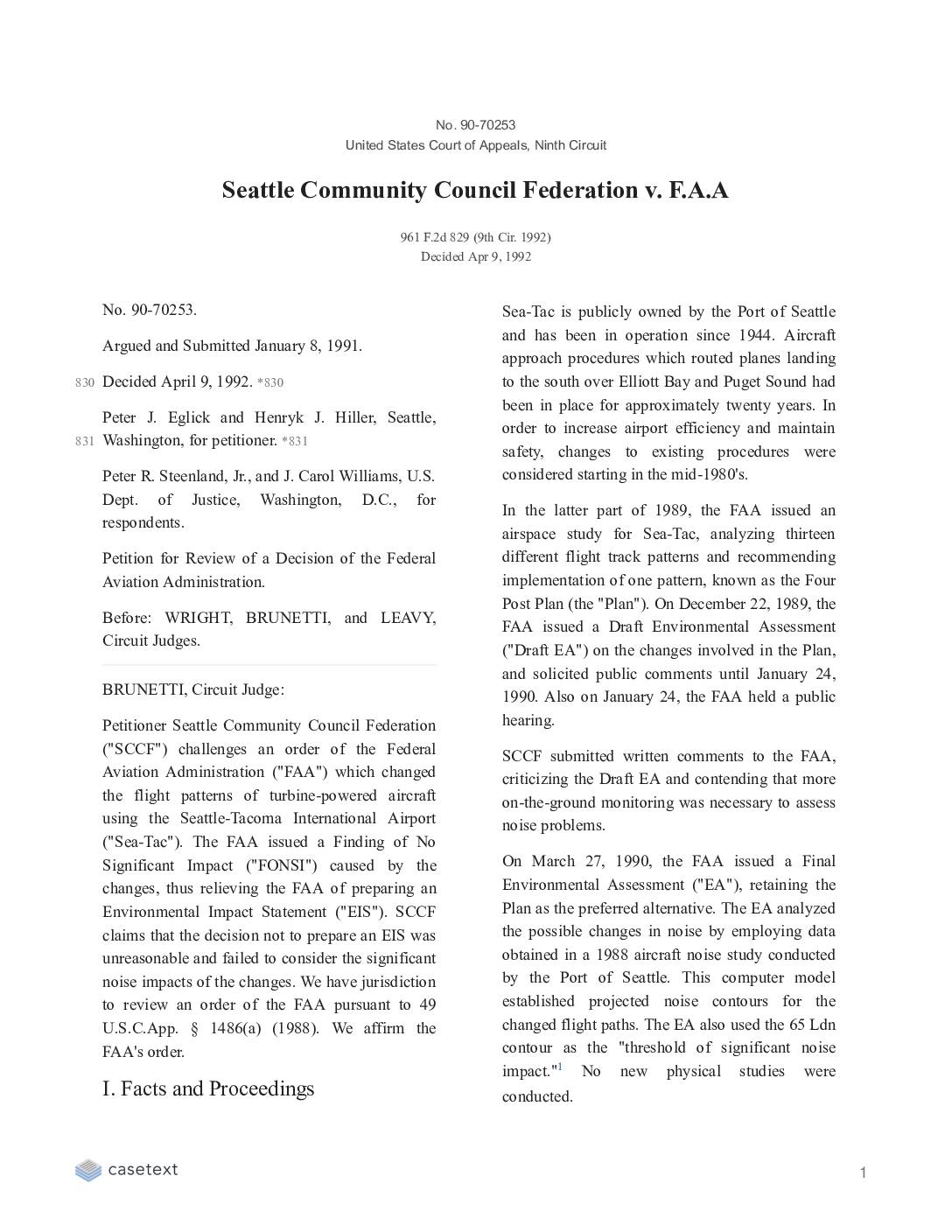
    Seattle Community Council Federation v. F.A.A., 961 F.2d 829 (9th Cir. 1992)

    In 1992, the Ninth Circuit Court of Appeals upheld the FAA's decision to change flight patterns for turbine-powered aircraft at Seattle-Tacoma International Airport without preparing a full Environmental Impact Statement. The FAA had issued a Finding of No Significant Impact based on a computer noise model using the 65 decibel day-night sound level as the threshold for significant noise impact, which the court found to be a reasonable approach. The Seattle Community Council Federation had challenged the decision, arguing that the FAA failed to adequately assess the noise effects on surrounding communities.
    TagsEnvironmental Impact Statement, FAA, Four Post Plan, NEPA, SCCF, Seattle Community Council FederationFolderFour Post Plan
  • 1992-01-01

    EXH AR037747: Flight Plan Project Draft Final Report and Technical Appendices (Including Draft Programmatic Environmental Impact Statement)

    AR037747. Draft Final Report of the Puget Sound Air Transportation Committee’s Flight Plan Project, January 1992, sponsored by the Puget Sound Regional Council and Port Of Seattle with FAA grants. Study findings and draft recommendations for long-term air carrier system needs of the Puget Sound Region, including a Draft Programmatic Environmental Impact Statement. Committee chaired
    TagsACC, Environmental Impact Statement, FAA, Flight Plan Project, Pollution Control Hearings Board, Port Of Seattle, Puget Sound Regional CouncilFolderBox 16
  • 1987-12-01

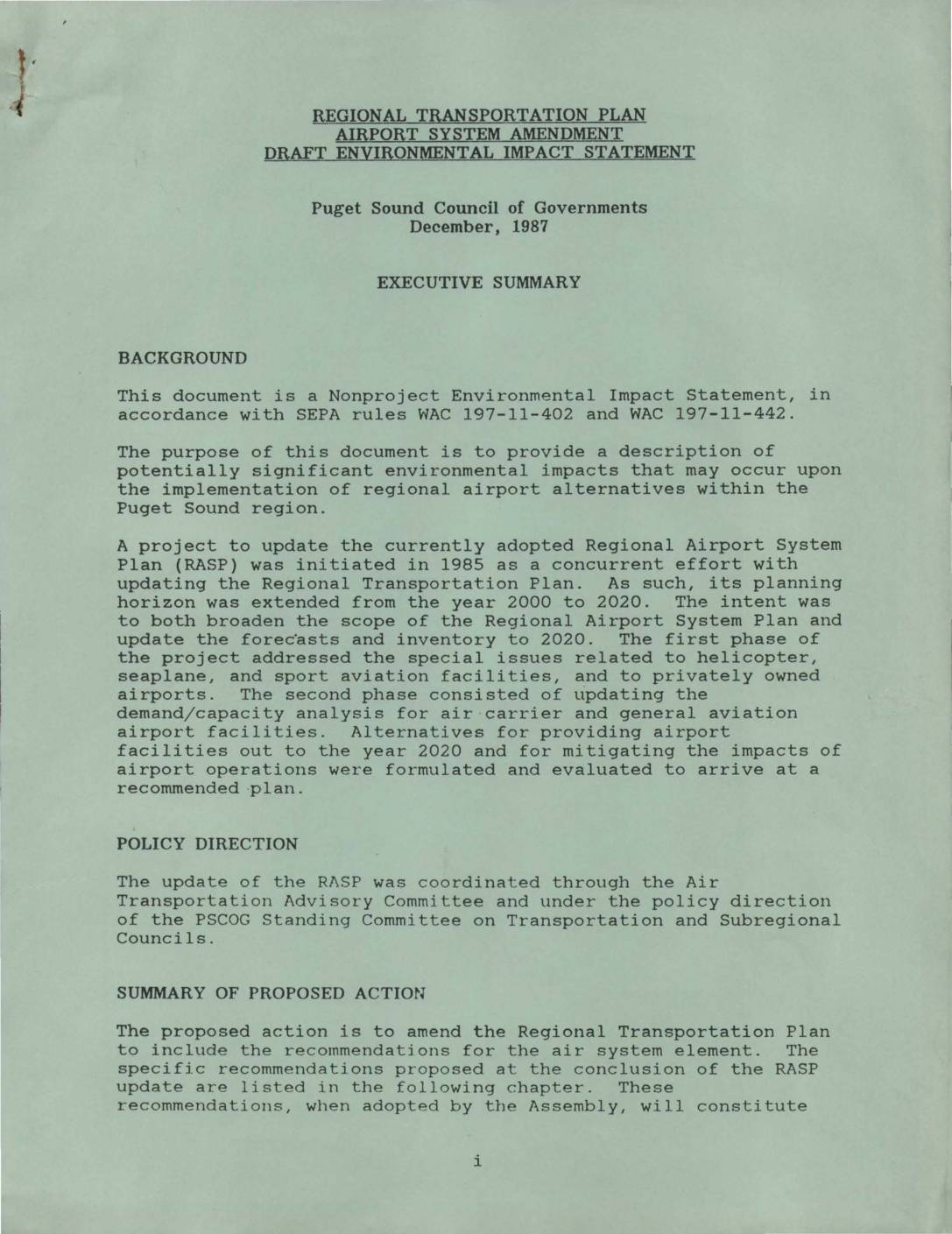
    RASP 1988 DEIS Executive Summary

    This 1987 Draft Environmental Impact Statement from the Puget Sound Council of Governments evaluates alternatives for expanding and managing the regional airport system through the year 2020, assessing their potential environmental and economic impacts. The study found that all alternatives would generate significant impacts to both natural and human environments, with the key difference being whether those impacts would be concentrated at existing airports or spread across new locations. Extensive mitigation measures were identified as necessary for any chosen alternative, and no single option was found to be clearly superior to the others.
    TagsEnvironmental Impact Statement, PSCOG, Puget Sound Council of Governments, RASP, Regional Airport System PlanFolderPuget Sound Regional Council
  • 1981-11-27

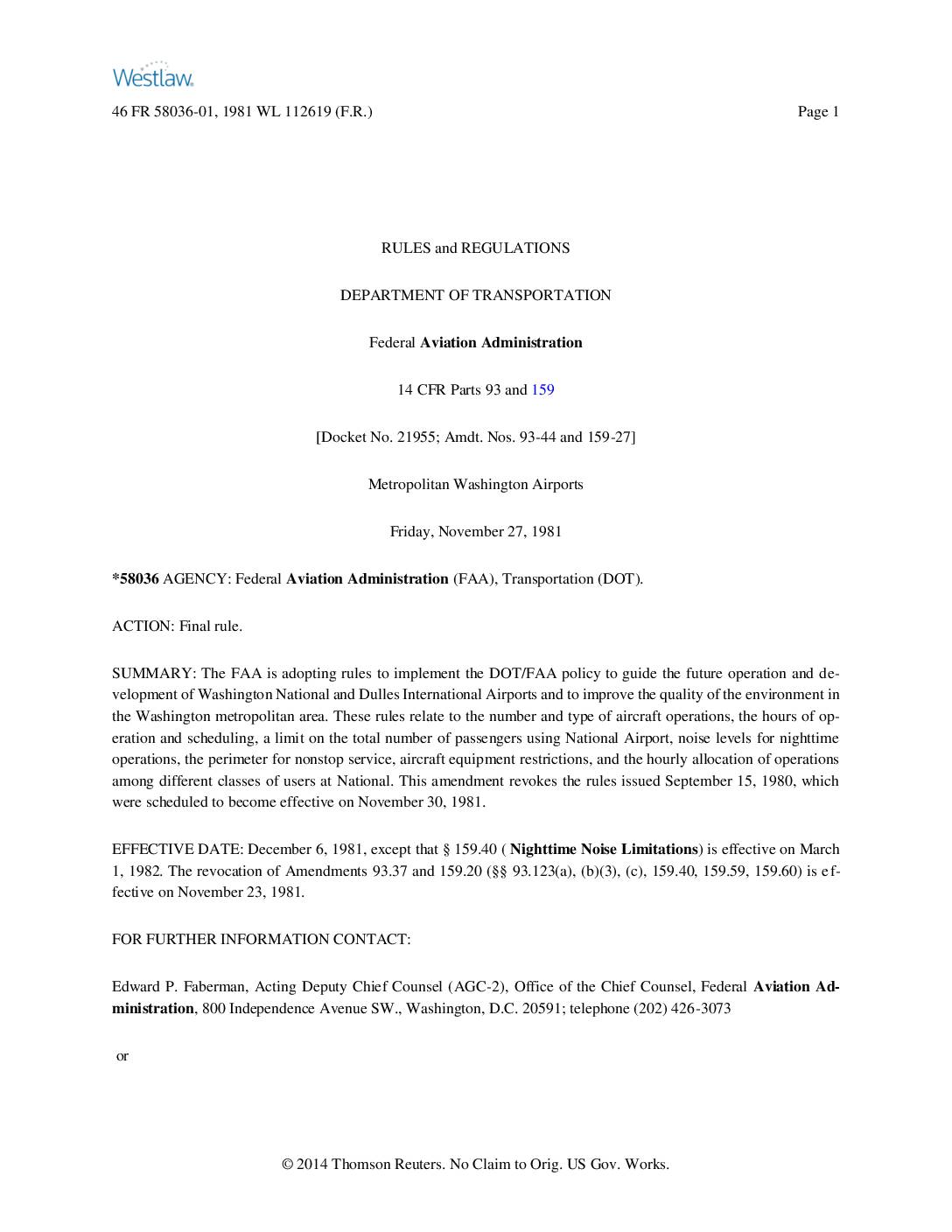
    Metropolitan washington airports

    Federal Aviation Administration final rule implementing DOT/FAA policy to guide the future operation and development of Washington National and Dulles International Airports. The rules address aircraft operations, scheduling, passenger limits, noise restrictions, and the perimeter for nonstop service at National Airport.
    TagsEnvironmental Impact Statement, FAA, Reagan National AirportFolderReagan D.C.
  • 1980-08-01

    Highline Community Plan: Draft Supplemental Environmental Impact Statement

    This August 1980 Draft Supplemental Environmental Impact Statement from King County's Division of Planning outlines proposed zoning changes for the Highline Community Plan, covering areas surrounding Seattle-Tacoma International Airport including White Center, Burien, and nearby neighborhoods. The document maps land proposed for rezoning across multiple subareas, with changes including downzones to single-family residential, conversions to multi-family or mixed use, and designations of land for potential future rezones. It serves as a planning tool to guide land use decisions in communities directly affected by airport noise and related impacts.
    TagsEIS, Environmental Impact Statement, Highline Community Plan, King County, Land Use, SEPAFolderHighline Community Plan
  • 1980-03-04

    Proposed Highline Communities Plan Area Zoning: Transmittal Letter from King County Planning Division

    A March 1980 memo from King County's Planning Division manager Karen Rahm notifies recipients about the Proposed Highline Communities Plan Area Zoning, a zoning framework designed to implement the land use guidelines of the 1977 Highline Communities Plan. The memo states that a supplemental draft Environmental Impact Statement was being prepared and would be published in Spring 1980, after which the zoning proposal would be sent to the County Council for adoption. Handwritten notes on the reverse reference page 56, suggesting a potential rezoning from SR to ML (Medium Light industrial) with consideration of buffer zones around ML areas.
    TagsEnvironmental Impact Statement, Highline Community Plan, King County, King County Council, Land Use, NEPAFolderKing County
  • 1979-04-12

    Initial development of the Westside General/Corporate Aviation Facility, Sea-Tac International Airport: Final environmental impact statement

    This April 1979 Final Environmental Impact Statement, prepared by the Port of Seattle's Planning and Research Department, evaluates the proposed initial development of a general and corporate aviation facility on the west side of Sea-Tac International Airport. The document was issued in compliance with Washington State's Environmental Policy Act of 1971 and incorporates findings from an earlier 1977 EIS related to a Weyerhaeuser corporate aviation facility on the same site. It was distributed to government agencies, citizen groups, and interested individuals to assess the environmental effects of the proposed development.
    TagsEIS, Environmental Impact Statement, General AviationFolderEnvironment

Posts pagination

Page 1 … Page 30 Page 31 Page 32 Page 33
Sidebar On/Off

Upcoming Events

  • Stay Grounded Event: Night trains, not night planes!
    Add to CalendarMSunday Sep 13: 12:00am
    Ntnnp social media3

    For the past two years, more than 220 initiatives from 15 countries have declared September 13th as the International day for the ban of night flights at airports. In parallel, activists across Europe have been gathering for pyjama parties for night trains – coordinated in 2024 and 2025 by Back on Track and Stay Grounded.

    [...]
  • Burien Airport Committee Meeting September 15, 2026
    Add to CalendarMTuesday Sep 15: 6:00pm
    400 SW 152nd St, Burien, WA 98166
    Burien airport committee 15 sep 2026 agenda pdf pdf

    a) Part 150 Noise Study (Emily Inlow-Hood) — 15 minutes
    b) SAMP Update and Next Steps (Brian Davis and Sarah Moore) — 15 minutes
    c) Legislative Updates — 10 minutes
       • SCA (Sarah Moore)
       • Work with Sen. Orwall (Brian Davis)
    d) StART Reorganization (Jeff Harbaugh and Karen Veloria) — 10 minutes

    [...]

[See all...]


Help study childhood asthma. Get free HEPA filter!

read more...

Issues

Sea-Tac Airport is currently undergoing the largest and longest expansion in its history, collectively known as the Sustainable Airport Master Plan (SAMP). Some of it you can already hear, but you’re probably not aware of what it all means. Here’s what you need to know.
read more...

Read This!

As the source for federal transportation grants, the Puget Sound Regional Council was charged with developing a system to meet the growing need for commercial aviation. When the search for a second airport failed, they authorized the Port of Seattle to build the Third Runway, with a mandate to develop a noise abatement and mitigation program. In their effort to stop the Third Runway, the ACC argued over every detail of the Port's efforts--including property buyouts and sound insulation. The dispute was meant to be settled by a three member Expert Arbitration Panel. This is their final report. It finds 2-1, that the Port's program was insufficient in several respects. Despite that, funding for the Third Runway was approved by the PSRC, and the 'Port Package' program, proceeded largely unchanged. Expert Arbitration Panel's final decision finding that the Port of Seattle had not shown sufficient reduction in real on-the-ground noise impacts to satisfy noise reduction conditions required for approval of a third runway at Sea-Tac International Airport. The majority decision concluded the Port's noise abatement programs were insufficient despite being impressive in scope.
continue...

The Podcast!

Subscribe to the only podcast devoted to policies, politics, history, impacts for people living under the flight path everywhere. It’s definitely not just about noise!
  • Sea-Tac Noise.Info
  • Connect with STNI

    • Subscribe
    • Port Package Problem?
    • Donate
    • Podcast
    • Socials
      • Facebook
      • X (Twitter)
      • Bluesky
      • Instagram

    "Relationship between aircraft noise contour area and noise levels at certification points" — , 2003

  • Learn

    • Frequently Asked Questions
    • Explainers
    • Youtube
    • Research Requests
    • Make a complaint
  • Goals

    Fulfill the promises of 1976:
    • Compensation
    • Reduced noise
    • Improved air quality
    • Environmental remediation
Login/Register
©2026•Data Privacy

Message

We use cookies to provide basic functionality. We also provide access to search engines in order to provide site analytics. We do not sell or share your data.
V V