Skip to content
  • STNI
  • Statistics
    • Ops and Passengers
      • King County International Airport (Boeing Field) Annual Operations
    • Financials
    • Aviation fuel uplift in the State of Washington 2018 – 2025
      • Aviation Fuel Uplift at Sea-Tac Airport
    • Air Quality Monitoring
    • Flight Tracking
      • Flow and Flight Tracks
      • Five Year Comparison
      • Busiest Hours and Days
    • SEL Noise Reports & Graphs
      • About The Permanent Noise Monitors
      • Minutes of Quiet by Noise Monitor
      • Noise Events mapped
      • Noise Events (SEL)
    • Runways
    • Employees
    • Real Estate
      • Port Properties and Trees mapped
    • Parking
  • Events
  • Protest
    • Regular Events
    • Legislation 2026
    • Complain about a particular flight
    • Advocacy Organizations
    • Media Outlets
    • People
    • The Port of Seattle
      • Commission Meetings
      • Public Records Requests
      • StART
      • Highline Forum
    • Contact Your Electeds
  • Resources
    • FAQs
      • FAA Occurrences/Accidents/Indents
    • The unSustainable Airport Master Plan
      • SAMP Public Comment Template
        • Two versions of Appendix K: NEPA/SEPA 2018 vs 2023
      • SAMP NTP: 31 projects by the numbers
      • SEPA Draft EIS (2026)
      • SAMP Record of Decision/FONSI (2025)
      • SAMP Draft EA (October 2024)
      • 2018 Scoping
    • Port Packages
      • Port Package Property Costs
      • Port Packages mapped
      • The Port Package Explainer
      • So you want a (first-time) Port Package? Start here
      • Port Package Looker Upper
      • How do I determine if I have a Port Package or Avigation Easement?
      • Progress on Port Package Update legislation
      • Having a Port Package Problem?
      • Port Package Site Visit Follow-Up
    • Document Library
    • Explainers
      • The Airport Law Cheat Sheet
      • The Grant Explainer
    • External Articles
    • History
      • Timeline
      • The Sea-Tac Communities Plan
        • Sea-Tac Communities Plan – Planning Maps
      • PSRC Third Runway Decision Process
    • Studies
    • Videos
  • Stories
  • Mission
  • Subscribe
  • Contact
Scroll down to content

Get InformedStay Informedx

I understand that you will never share my information with anyone, you will only use it to keep me updated on relevant events and that I may unsubscribe at any time.

STNI

STNISea-Tac Noise.Info

  • Solve for Sea-Tac. Solve for every airport.
  • Since 2016, working to obtain justice for everyone living under the flight path.
  • Less Noise. Cleaner Air. Better Public Health. Compensation.
  • Everything you think you know about the airport is wrong.

TagAviation Emissions(100)

Advanced Search Options

  • Dates
  • Media
    • External Articles
    • Images
    • PDFs
    • Video
    • Audio
  • Order By
  • 2017-11-23

    Introduction to the ICAO Engine Emissions Databank

    The ICAO Engine Emissions Databank is an international reference database tracking exhaust emissions—including smoke, hydrocarbons, carbon monoxide, and nitrogen oxides—from commercial turbojet and turbofan aircraft engines. It compiles certified emissions data measured during a standardized Landing/Take-Off (LTO) cycle below 3,000 feet, making it relevant for assessing local air quality impacts at airports like Sea-Tac. The databank is regularly updated to reflect new engine certifications and design changes, though its fuel-flow figures are not intended for comparing overall engine fuel efficiency.
    Tagsaircraft, Aviation Emissions, ICAO, International Civil Aviation Organization, Noise
  • 2017-10-19

    H.R. 4087 – Protecting Airport Communities from Particle Emissions Act

    H.R. 4087, the 'Protecting Airport Communities from Particle Emissions Act,' introduced in October 2017, directs the FAA to study ultrafine particles (tiny airborne particles under 100 nanometers) around the 20 busiest U.S. airports, including their health effects on surrounding communities. The study must examine particle sources, concentration patterns, and health impacts such as heart disease, asthma, and nervous system disorders, with special attention to disproportionate effects on communities of color and economically vulnerable residents. The FAA is required to coordinate with the EPA and Department of Health and Human Services and report findings to Congress within two years.
    TagsAviation Emissions, FAA, Health, Ultrafine Particulates
  • 2017-07-26

    Air quality initiatives at Sea-Tac Airport

    This 2017 presentation by Port of Seattle Sustainability Manager Leslie Stanton outlines air quality initiatives at Seattle-Tacoma International Airport, covering pollution sources, reduction programs, and the Port's environmental goals. It highlights that while the Port has limited regulatory authority, it is pursuing innovative strategies to cut emissions, including efforts around ultrafine particulates and climate-related particulate matter reductions. The presentation also reviews existing air quality studies and identifies next steps for improving air quality in and around Sea-Tac Airport.
    TagsAviation Emissions, Highline Forum, Port Of Seattle, Sea-Tac Airport, Ultrafine Particulates
  • 2017-04-15

    Inventory of U.S. greenhouse gas emissions and sinks: 1990–2015

    This EPA report tracks U.S. greenhouse gas emissions and sinks from 1990 to 2015, covering sources such as transportation, agriculture, industry, and waste. It was published by the U.S. Environmental Protection Agency in 2017 and is available for download on the EPA website. Note: this document does not appear to contain information relevant to Sea-Tac Airport noise policy.
    TagsAviation Emissions, Climate, Environmental Protection Agency, EPA, FAA, Greenhouse gases
  • 2017-04-01

    Fast facts 1990–2015: National-level U.S. greenhouse gas inventory

    This EPA report summarizes U.S. greenhouse gas emissions data from 1990 to 2015, showing that total emissions reached 6,587 million metric tons of CO2 equivalent in 2015, a 2.3% decrease from 2014 levels. Carbon dioxide makes up the largest share at 82% of emissions, with electricity generation and transportation being the biggest contributing economic sectors at 29% and 27% respectively. The report includes detailed emissions breakdowns by gas type, economic sector, and fuel source, along with unit conversion tables and global warming potential values for reference.
    TagsAviation Emissions, Climate, Environmental Protection Agency, EPA, FAA, Greenhouse gases
  • 2016-11-17

    Timothy Larson UW DEOHS seminar flyer — mobile monitoring of traffic emissions and jet aircraft impacts

    Flyer for a University of Washington Environmental Health Seminar titled 'Using Mobile Monitoring to Study Both Real-World Traffic Emission Factors and Impacts from Jet Aircraft,' presented by Timothy Larson, PhD, MSCHE. The event was held Thursday, November 17, 2016, 12:30–1:20 p.m. at Magnuson Health Sciences Center T, Room HSB T435.
    TagsAviation Emissions, DEOHS, Timothy Larson, University Of Washington, UWDEOHS
  • 2016-07-15

    Air Quality Criteria Pollutant Emissions Inventory Task 2.8: Working Paper – Documentation of Assumptions

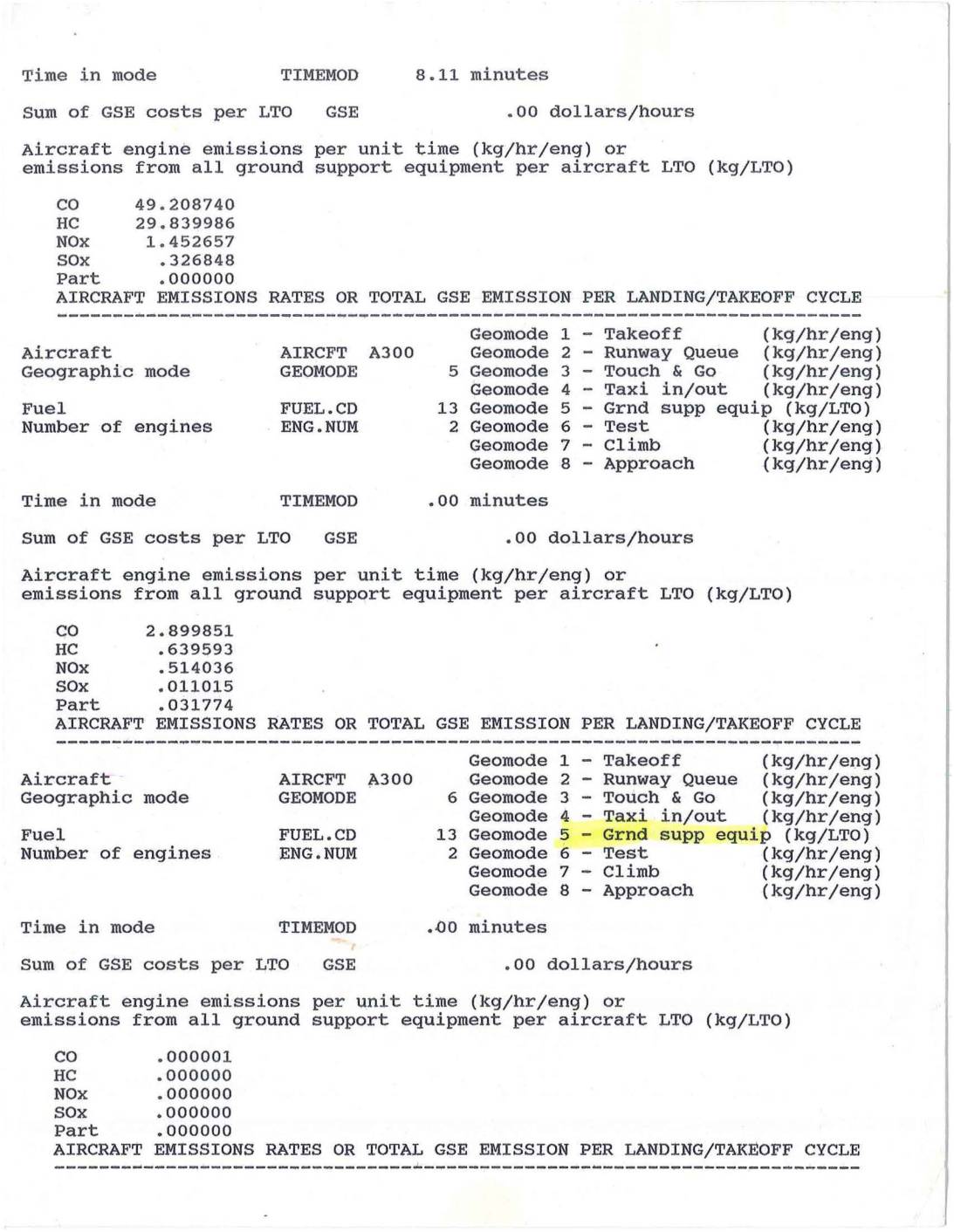
    This 2016 working paper documents the methods and assumptions used to build an air quality emissions inventory for Seattle-Tacoma International Airport as part of the Sustainable Airport Master Plan. Using the FAA's EDMS modeling software, analysts estimated pollution from sources including aircraft engines, ground support equipment, parking, and stationary facilities such as generators and boilers. Aircraft operation data for 2014 was gathered from multiple sources, including FAA tower records, airline guides, and the Port of Seattle's own noise monitoring system.
    TagsAviation Emissions, EDMS, EPA, Leigh-Fisher, pollution, Port Of Seattle, SAMP, Sustainable Airport Master Plan
  • 2015-11-01

    The Aviation Sector’s Climate Action Framework

    This 2015 report from the Air Transport Action Group (ATAG) outlines the aviation industry's framework for addressing its climate impact, noting that while air transport carries over 3.3 billion passengers annually and supports 3.5% of global GDP, it also accounts for roughly 2% of human-induced CO2 emissions. The document presents the industry's strategies for balancing continued air traffic growth with the obligation to reduce greenhouse gas emissions. It represents a collaborative effort across airlines, airports, air navigation service providers, and aircraft manufacturers to pursue sustainable development goals.
    TagsAviation Emissions, Climate, IATA, ICAO, Sustainable Aviation
  • Atag 2015 aviation sector climate action framework pdf
    2015-11-01

    The Aviation Sector’s Climate Action Framework

    ATAG (Air Transport Action Group) November 2015 report outlining the aviation industry’s climate action framework. Covers aviation’s contribution of approximately 2% of global human-induced CO2 emissions, carbon offsetting strategies, sustainable aviation fuels (SAF), and industry-wide emissions reduction goals. Includes data on 3.3 billion annual passengers, 60 million jobs supported, and 3.5% of global GDP. Published
    TagsAviation Emissions, Climate, IATA, ICAO, Sustainable Aviation
  • 2014-05-29

    Childhood asthma and chronic lung disease elevated near Logan Airport, state study finds

    Two studies highlight serious air pollution concerns near major U.S. airports. A 2014 Massachusetts state health study found that children living near Boston's Logan Airport are up to four times more likely to develop asthma symptoms, while nearby adults are nearly twice as likely to suffer chronic lung disease. A 2015 NJIT study reinforced these concerns nationwide, finding pollution levels up to 10 times higher within nine square miles of airports—with Seattle-Tacoma Airport specifically cited for carbon monoxide levels exceeding federal guidelines.
    TagsAviation Emissions, Boston/Logan Airport, Health, Logan International Airport

Posts pagination

Page 1 … Page 7 Page 8 Page 9 Page 10
Sidebar On/Off

Upcoming Events

  • StART SEA Stakeholder Advisory Round Table
    Add to CalendarMWednesday Aug 26, 5:00pm - 7:00pm
    Zoom (Virtual Meeting)
    START meetingagenda 2026826 final 0 pdf

    Meeting Objectives Introduce the primary feedback themes identified by StART members regarding StART’s Operating Procedures and determine areas that may warrant future discussion. 5:00 PM – Welcome Meeting Management Welcome Lead: Andrés Mantilla, Facilitator, Uncommon Bridges; Wendy Reiter, Airport Managing Director, POS 5:15 PM – Dinner: All participants eat. 5:30 PM – StART Operating Procedures

    [...]
  • Commercial Aviation Work Group
    Add to CalendarMThursday Sep 3, 10:00am - 1:30pm
    Virtual Meeting (Zoom)
    Cawg agenda sep 3 26 virtual pdf

    Meeting Agenda 10:00 a.m. – 10:15 a.m. | Welcome – Evan Nordby, Chair a. Introductions and Agenda Reviewb. Status of appointments and non-voting member invitationsc. Other updates as necessary 10:15 a.m. – 11:00 a.m. | Is it practical and legal to operate the western Washington [Puget Sound] airports as a single airport system? – Consultant

    [...]

[See all...]


Help study childhood asthma. Get free HEPA filter!

read more...

Issues

Sea-Tac Airport is currently undergoing the largest and longest expansion in its history, collectively known as the Sustainable Airport Master Plan (SAMP). Some of it you can already hear, but you’re probably not aware of what it all means. Here’s what you need to know.
read more...

Read This!

As the source for federal transportation grants, the Puget Sound Regional Council was charged with developing a system to meet the growing need for commercial aviation. When the search for a second airport failed, they authorized the Port of Seattle to build the Third Runway, with a mandate to develop a noise abatement and mitigation program. In their effort to stop the Third Runway, the ACC argued over every detail of the Port's efforts--including property buyouts and sound insulation. The dispute was meant to be settled by a three member Expert Arbitration Panel. This is their final report. It finds 2-1, that the Port's program was insufficient in several respects. Despite that, funding for the Third Runway was approved by the PSRC, and the 'Port Package' program, proceeded largely unchanged. Expert Arbitration Panel's final decision finding that the Port of Seattle had not shown sufficient reduction in real on-the-ground noise impacts to satisfy noise reduction conditions required for approval of a third runway at Sea-Tac International Airport. The majority decision concluded the Port's noise abatement programs were insufficient despite being impressive in scope.
continue...

The Podcast!

Subscribe to the only podcast devoted to policies, politics, history, impacts for people living under the flight path everywhere. It’s definitely not just about noise!
  • Sea-Tac Noise.Info
  • Connect with STNI

    • Subscribe
    • Port Package Problem?
    • Donate
    • Podcast
    • Socials
      • Facebook
      • X (Twitter)
      • Bluesky
      • Instagram

    "Assurances: Non-airport sponsors undertaking noise compatibility program projects" — , 2022

  • Learn

    • Frequently Asked Questions
    • Explainers
    • Youtube
    • Research Requests
    • Make a complaint
  • Goals

    Fulfill the promises of 1976:
    • Compensation
    • Reduced noise
    • Improved air quality
    • Environmental remediation
Login/Register
©2026•Data Privacy

Message

We use cookies to provide basic functionality. We also provide access to search engines in order to provide site analytics. We do not sell or share your data.
V V