TagAviation Emissions(88)
-
 2018-12-19
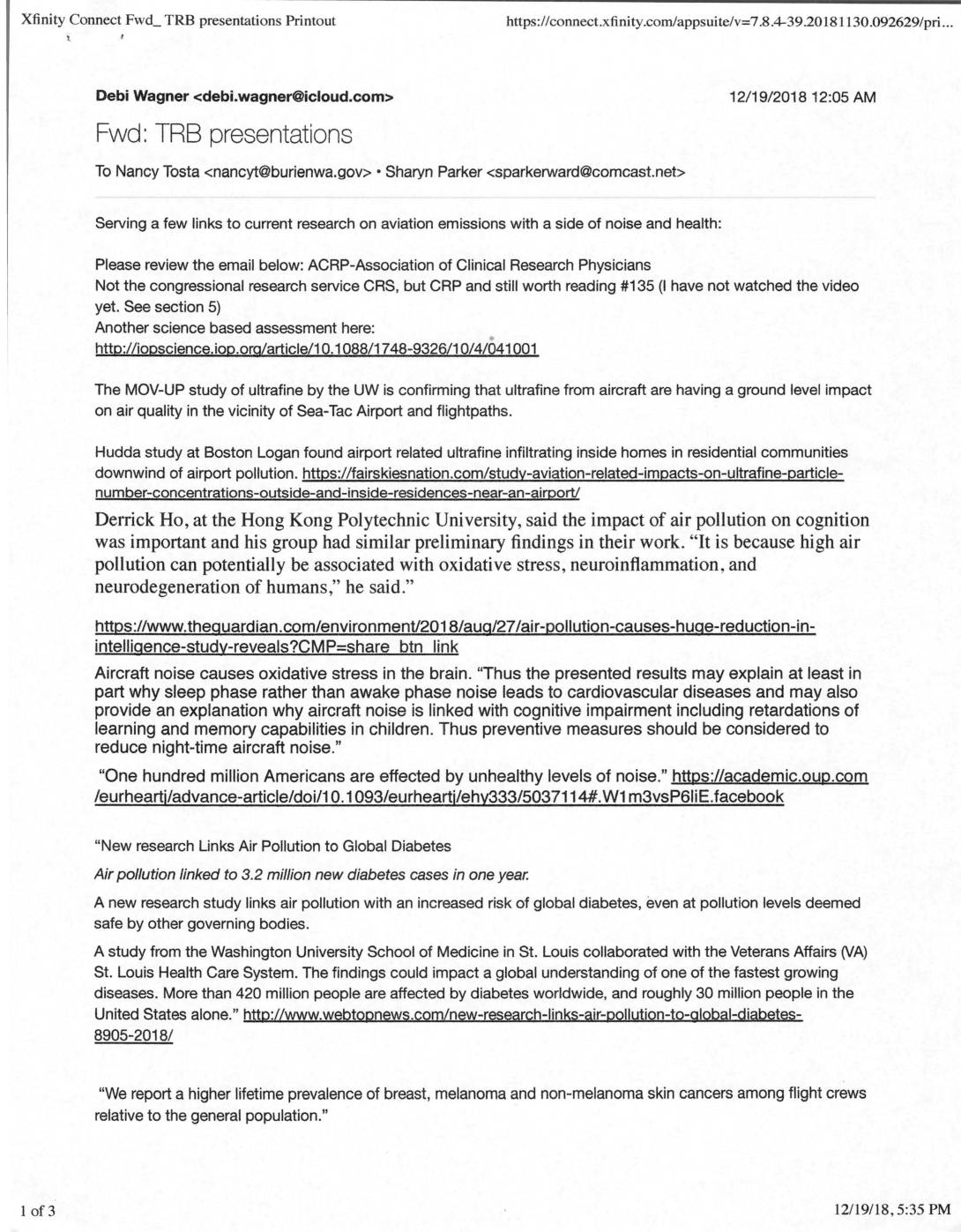
Fwd: TRB presentations
A December 2018 email chain forwarded by community advocate Debi Wagner to Burien city officials shares research links connecting aviation emissions and aircraft noise to serious public health concerns, including ultrafine particle pollution, cognitive impairment, cardiovascular disease, and cancer. The email references studies such as the University of Washington's MOV-UP study confirming ground-level ultrafine particle impacts near Sea-Tac Airport, as well as EPA Region X recommendations for resources on airport air quality and public health. The correspondence highlights growing community and regulatory interest in understanding the health effects of airport operations on neighborhoods surrounding Sea-Tac. -
 2018-12-19
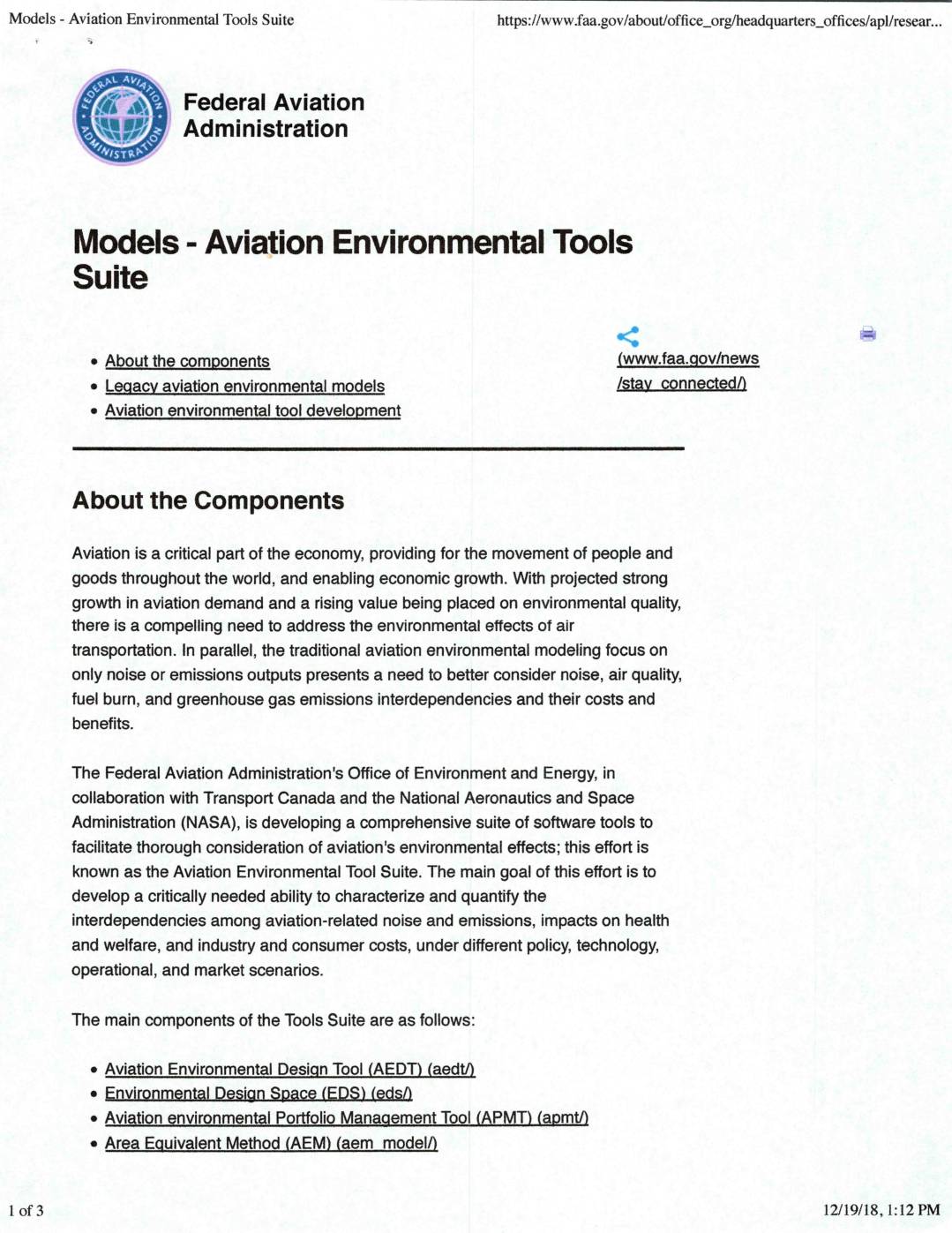
Models – Aviation Environmental Tools Suite
The FAA, in collaboration with NASA and Transport Canada, has developed a suite of software tools called the Aviation Environmental Tool Suite to assess the environmental impacts of aviation, including noise, air quality, fuel burn, and greenhouse gas emissions. The suite's main components include the Aviation Environmental Design Tool (AEDT), Environmental Design Space (EDS), and the Aviation environmental Portfolio Management Tool (APMT), which together help quantify the relationships between aviation-related noise, emissions, and costs. These tools are designed to support policy, technology, and operational decision-making at local, regional, national, and international levels, and are released to the public only after rigorous validation testing. -
 2018-12-19
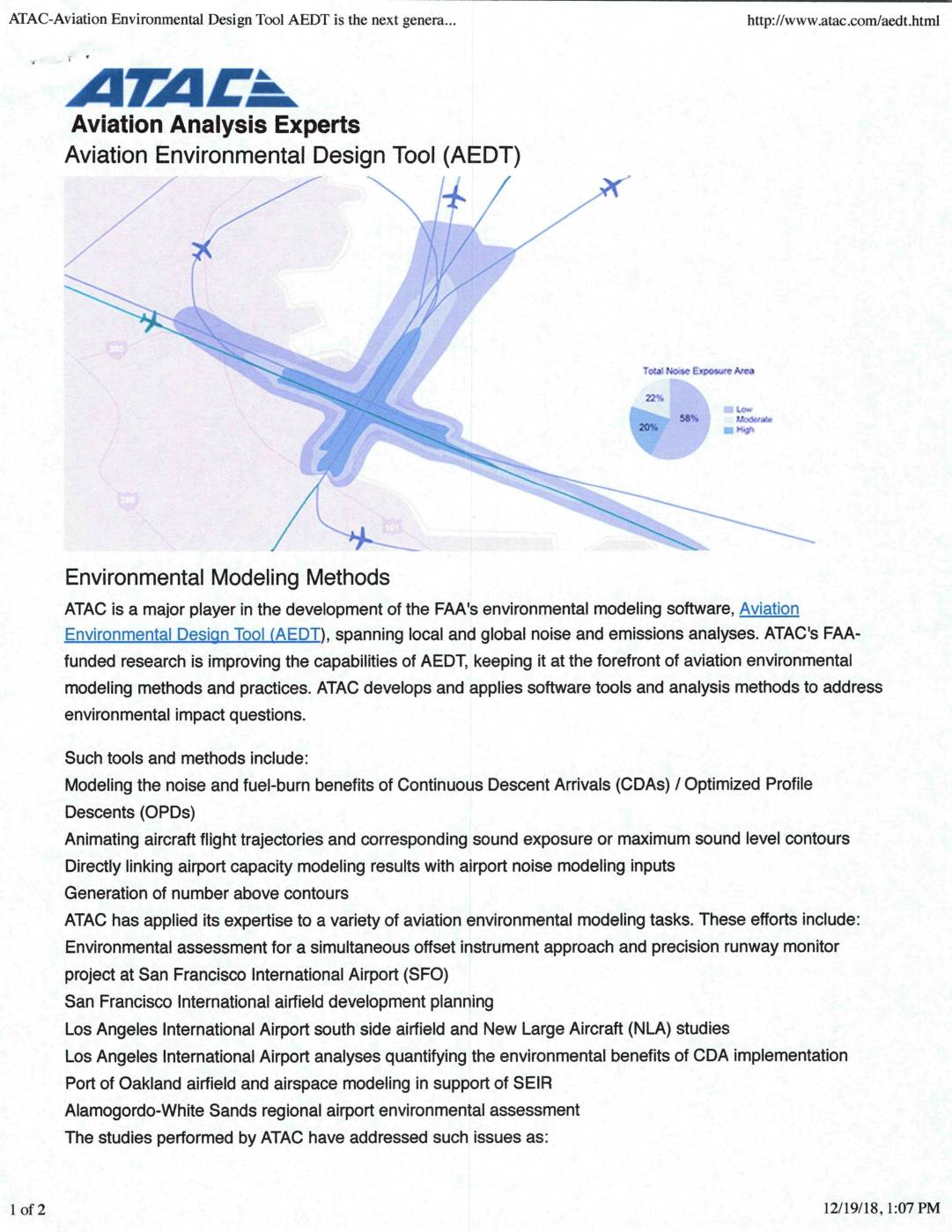
Aviation Environmental Design Tool (AEDT)
ATAC Corporation, an aviation analysis firm based in Santa Clara, CA, plays a major role in developing the FAA's Aviation Environmental Design Tool (AEDT), which models aircraft noise and emissions at both local and global scales. The document also includes a letter from the FAA's Seattle Airports District Office congratulating an airport on the approval of its Part 150 Noise Compatibility Program, a formal plan aimed at reducing or eliminating incompatible land uses around the airport. The FAA notes that approval of the program does not guarantee federal funding, and encourages the airport to periodically review and update the plan as conditions change. -
 2018-10-01
Noise of the Future
A 2018 Boeing presentation by Senior Manager Robert Stoker outlines the aviation industry's progress in reducing aircraft noise and fuel consumption, noting roughly a 90% reduction in noise footprint and 70% improvement in fuel efficiency since the 1950s. The document highlights Boeing's current fleet — the 737 MAX, 747-8, 787, and 777X — each delivering significant reductions in both noise footprint (ranging from 30% to 60% smaller) and fuel/CO2 emissions compared to the models they replace. -
 2018-06-24
Declaration of Mary L. Vigilante in Opposition to Plaintiffs’ Amended Motion for Class Certification
Bearse v. Port Of Seattle -
 2018-03-19
Continuous Lower Energy, Emissions and Noise (CLEEN) Program: Aircraft Technology Update
The FAA's Continuous Lower Energy, Emissions and Noise (CLEEN) program is a public-private partnership aimed at reducing aircraft fuel burn, emissions, and noise through new engine and aircraft technologies and alternative jet fuels. Running in three phases from 2010 through 2025, the program sets increasingly ambitious targets, including up to a 75% reduction in NOx emissions and a 40% reduction in fuel burn by 2026. These advancements are relevant to communities near busy airports like Sea-Tac, as the program's noise reduction goals include a 25 dB cumulative reduction relative to Stage 5 standards. -
 2017-11-23
Introduction to the ICAO Engine Emissions Databank
The ICAO Engine Emissions Databank is an international reference database tracking exhaust emissions—including smoke, hydrocarbons, carbon monoxide, and nitrogen oxides—from commercial turbojet and turbofan aircraft engines. It compiles certified emissions data measured during a standardized Landing/Take-Off (LTO) cycle below 3,000 feet, making it relevant for assessing local air quality impacts at airports like Sea-Tac. The databank is regularly updated to reflect new engine certifications and design changes, though its fuel-flow figures are not intended for comparing overall engine fuel efficiency. -
 2017-10-19
H.R. 4087 – Protecting Airport Communities from Particle Emissions Act
H.R. 4087, the 'Protecting Airport Communities from Particle Emissions Act,' introduced in October 2017, directs the FAA to study ultrafine particles (tiny airborne particles under 100 nanometers) around the 20 busiest U.S. airports, including their health effects on surrounding communities. The study must examine particle sources, concentration patterns, and health impacts such as heart disease, asthma, and nervous system disorders, with special attention to disproportionate effects on communities of color and economically vulnerable residents. The FAA is required to coordinate with the EPA and Department of Health and Human Services and report findings to Congress within two years. -
 2017-07-26
Air quality initiatives at Sea-Tac Airport
This 2017 presentation by Port of Seattle Sustainability Manager Leslie Stanton outlines air quality initiatives at Seattle-Tacoma International Airport, covering pollution sources, reduction programs, and the Port's environmental goals. It highlights that while the Port has limited regulatory authority, it is pursuing innovative strategies to cut emissions, including efforts around ultrafine particulates and climate-related particulate matter reductions. The presentation also reviews existing air quality studies and identifies next steps for improving air quality in and around Sea-Tac Airport. -
 2017-04-15
Inventory of U.S. greenhouse gas emissions and sinks: 1990–2015
This EPA report tracks U.S. greenhouse gas emissions and sinks from 1990 to 2015, covering sources such as transportation, agriculture, industry, and waste. It was published by the U.S. Environmental Protection Agency in 2017 and is available for download on the EPA website. Note: this document does not appear to contain information relevant to Sea-Tac Airport noise policy.