Skip to content
  • STNI
  • Statistics
    • Ops and Passengers
      • King County International Airport (Boeing Field) Annual Operations
    • Financials
    • Aviation fuel uplift in the State of Washington 2018 – 2025
      • Aviation Fuel Uplift at Sea-Tac Airport
    • Air Quality Monitoring
    • Flight Tracking
      • Flow and Flight Tracks
      • Five Year Comparison
      • Busiest Hours and Days
    • SEL Noise Reports & Graphs
      • About The Permanent Noise Monitors
      • Minutes of Quiet by Noise Monitor
      • Noise Events mapped
      • Noise Events (SEL)
    • Runways
    • Employees
    • Real Estate
      • Port Properties and Trees mapped
    • Parking
  • Events
  • Protest
    • Regular Events
    • Legislation 2026
    • Complain about a particular flight
    • Advocacy Organizations
    • Media Outlets
    • People
    • The Port of Seattle
      • Commission Meetings
      • Public Records Requests
      • StART
      • Highline Forum
    • Contact Your Electeds
  • Resources
    • FAQs
      • FAA Occurrences/Accidents/Indents
    • The unSustainable Airport Master Plan
      • SAMP Public Comment Template
        • Two versions of Appendix K: NEPA/SEPA 2018 vs 2023
      • SAMP NTP: 31 projects by the numbers
      • SEPA Draft EIS (2026)
      • SAMP Record of Decision/FONSI (2025)
      • SAMP Draft EA (October 2024)
      • 2018 Scoping
    • Port Packages
      • Port Package Property Costs
      • Port Packages mapped
      • The Port Package Explainer
      • So you want a (first-time) Port Package? Start here
      • Port Package Looker Upper
      • How do I determine if I have a Port Package or Avigation Easement?
      • Progress on Port Package Update legislation
      • Having a Port Package Problem?
      • Port Package Site Visit Follow-Up
    • Document Library
    • Explainers
      • The Airport Law Cheat Sheet
      • The Grant Explainer
    • External Articles
    • History
      • Timeline
      • The Sea-Tac Communities Plan
        • Sea-Tac Communities Plan – Planning Maps
      • PSRC Third Runway Decision Process
    • Studies
    • Videos
  • Stories
  • Mission
  • Subscribe
  • Contact
Scroll down to content

Get InformedStay Informedx

I understand that you will never share my information with anyone, you will only use it to keep me updated on relevant events and that I may unsubscribe at any time.

STNI

STNISea-Tac Noise.Info

  • Solve for Sea-Tac. Solve for every airport.
  • Since 2016, working to obtain justice for everyone living under the flight path.
  • Less Noise. Cleaner Air. Better Public Health. Compensation.
  • Everything you think you know about the airport is wrong.

TagArmy Corp of Engineers(124)

Advanced Search Options

  • Dates
  • Media
    • External Articles
    • Images
    • PDFs
    • Video
    • Audio
  • Order By
  • 2002-12-05

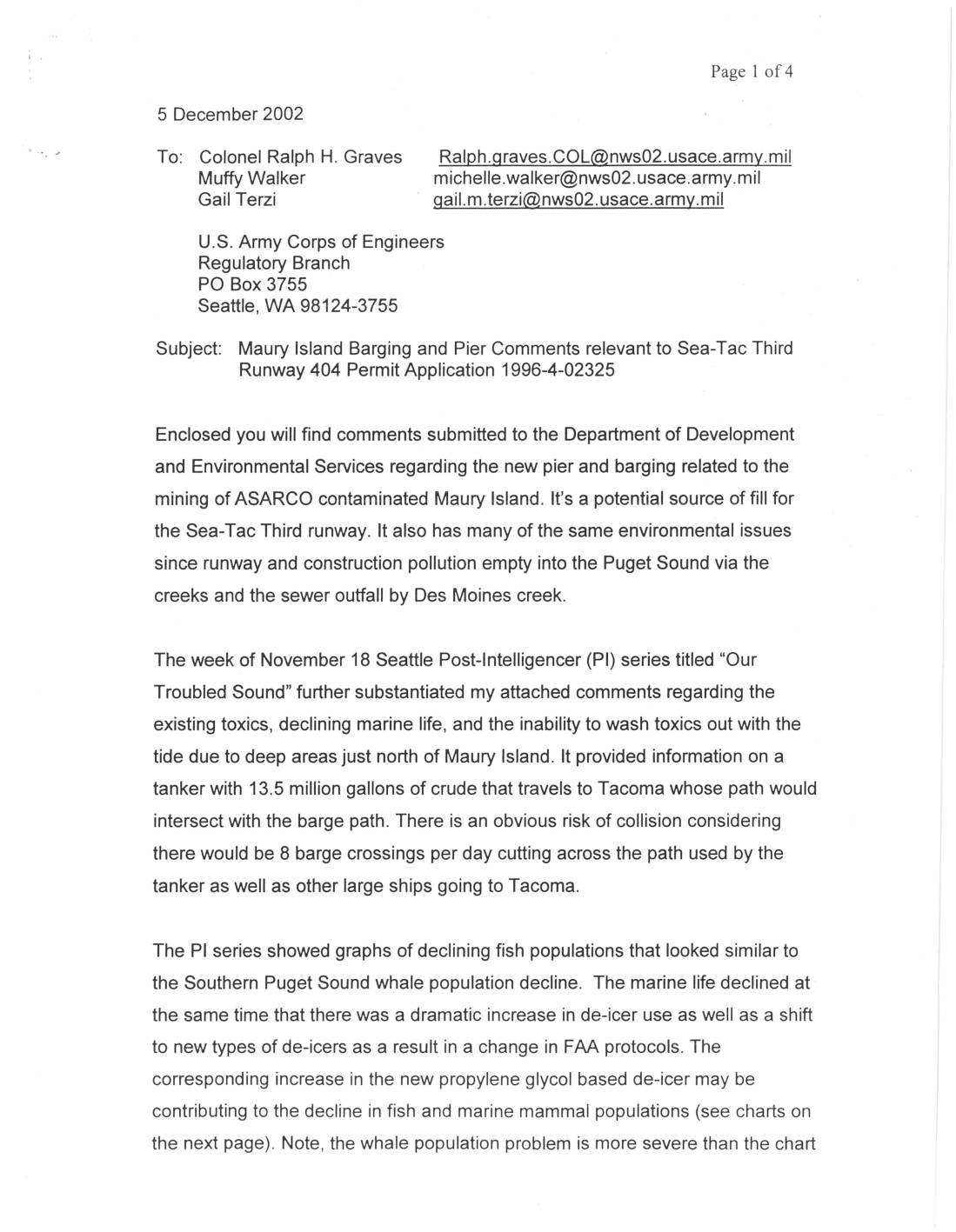
    Maury Island Barging and Pier Comments Relevant to Sea-Tac Third Runway 404 Permit Application 1996-4-02325

    A December 2002 letter to the U.S. Army Corps of Engineers raises environmental and public health concerns about the Sea-Tac Airport Third Runway project, arguing that construction pollution, ASARCO-contaminated fill material, and increased de-icing fluid use may be harming Puget Sound marine life, including orca populations. The author also warns of collision risks between barges transporting runway fill material and large tankers crossing the same waters. The letter calls for denial of the third runway permit, citing the absence of any cumulative air pollution or health hazard analysis and questioning the project's necessity given declining air and marine cargo traffic.
    TagsArmy Corp of Engineers, Deicing, Fill Dirt, Puget Sound, Third Runway
  • 2002-10-23

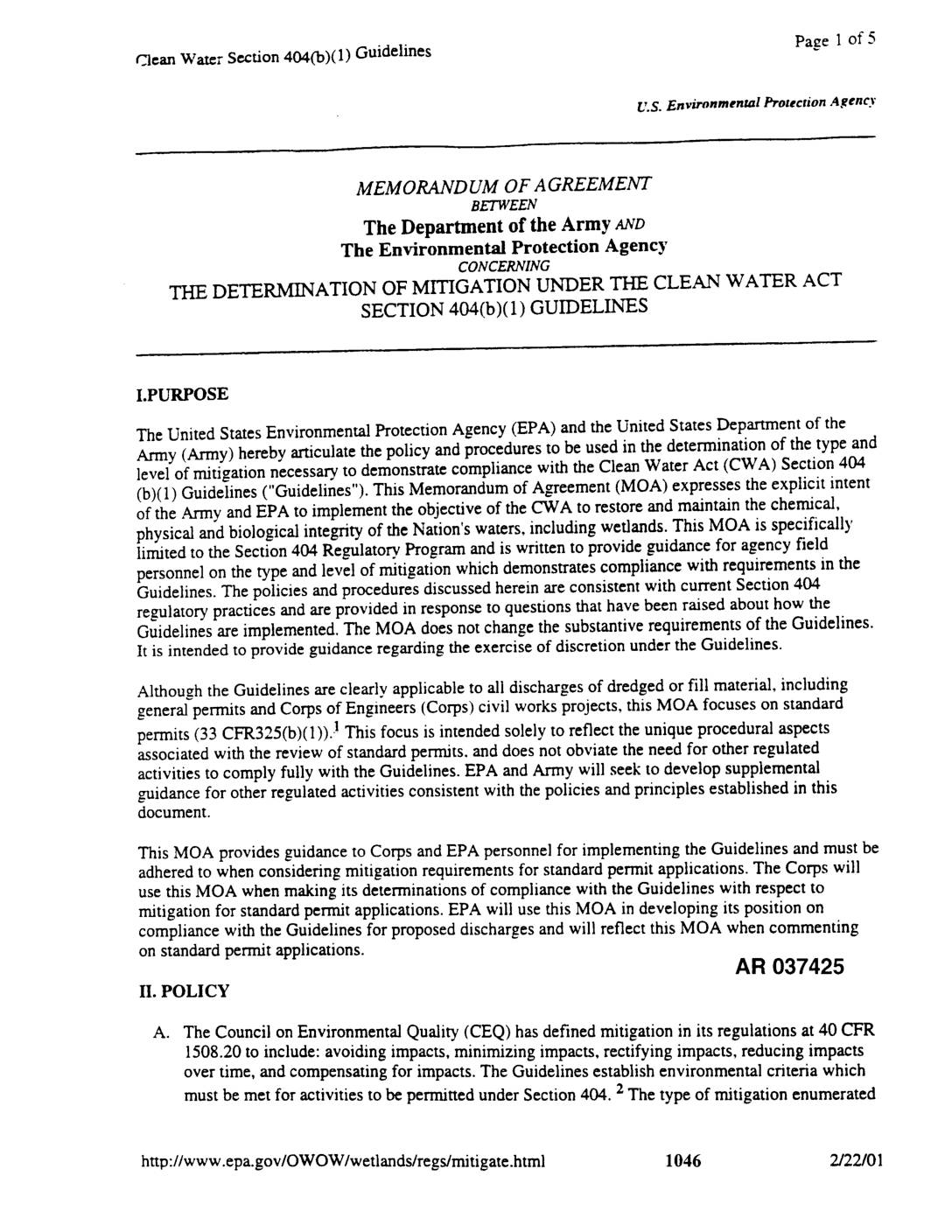
    EXH AR037425: Memorandum of Agreement Between the Department of the Army and the Environmental Protection Agency Concerning the Determination of Mitigation Under the Clean Water Act Section 404(b)(1) Guidelines

    Memorandum of Agreement (MOA) between the U.S. Department of the Army and the U.S. Environmental Protection Agency (EPA) articulating policy and procedures for determining type and level of mitigation required under Clean Water Act (CWA) Section 404(b)(1) Guidelines. AR037425. Covers three mitigation types: avoidance, minimization, and compensatory mitigation; establishes no net loss of wetlands goal;
    TagsACC, Army Corp of Engineers, CEQ, Clean Water Act, Environmental Protection Agency, NEPA, Pollution Control Hearings Board
  • 2002-10-22

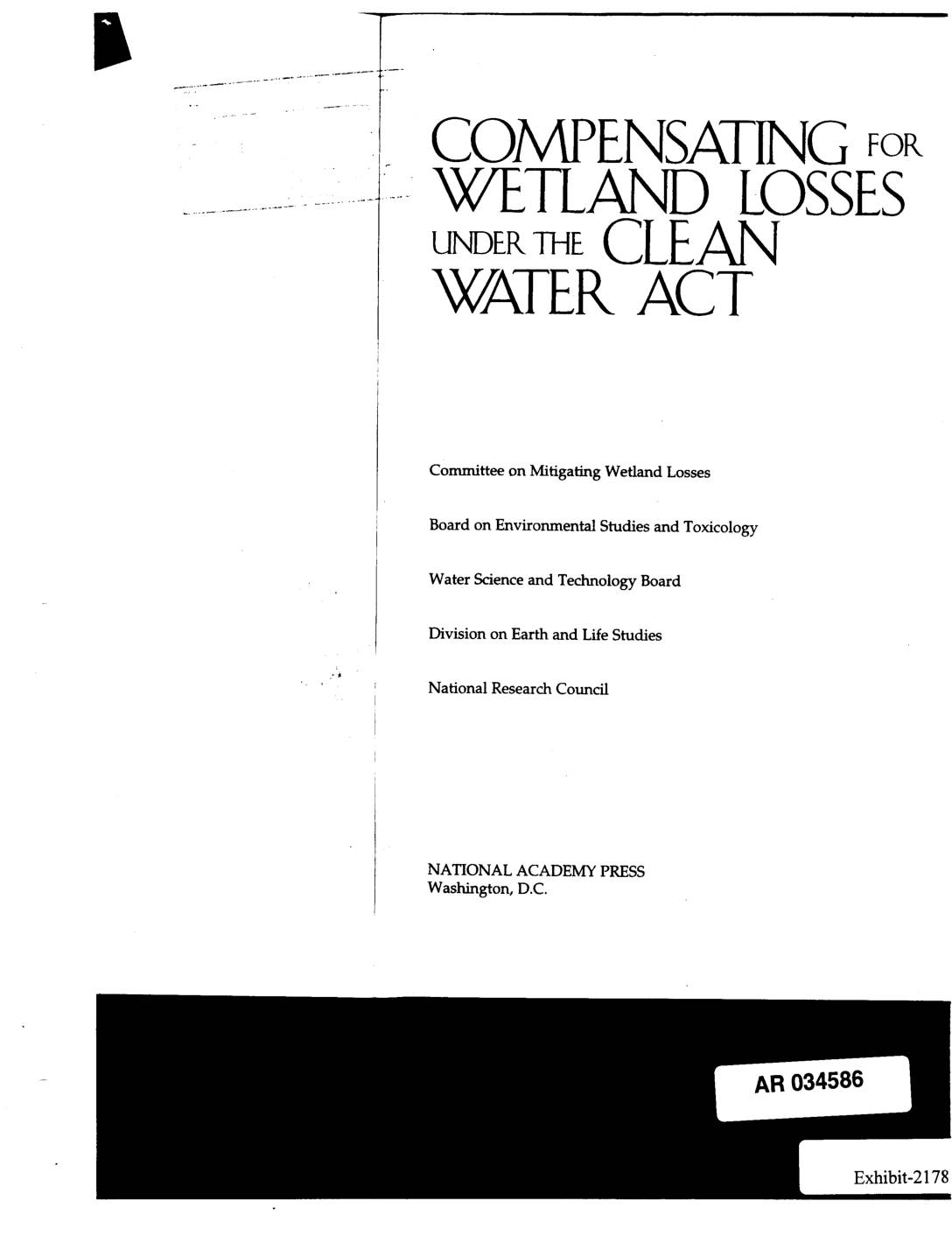
    EXH AR034586: Compensating for Wetland Losses Under the Clean Water Act

    National Research Council publication by the Committee on Mitigating Wetland Losses, Board on Environmental Studies and Toxicology, and Water Science and Technology Board titled ‘Compensating for Wetland Losses Under the Clean Water Act.’ AR034586, Exhibit-2178. Covers mitigation compliance standards including jurisdictional hydrology, wetland delineation, hydrological performance standards, design standards for mitigation sites, USACE wetland filling
    TagsACC, Army Corp of Engineers, Clean Water Act, Environment, National Academies of Sciences, Pollution Control Hearings Board, Water Quality
  • 2002-10-22

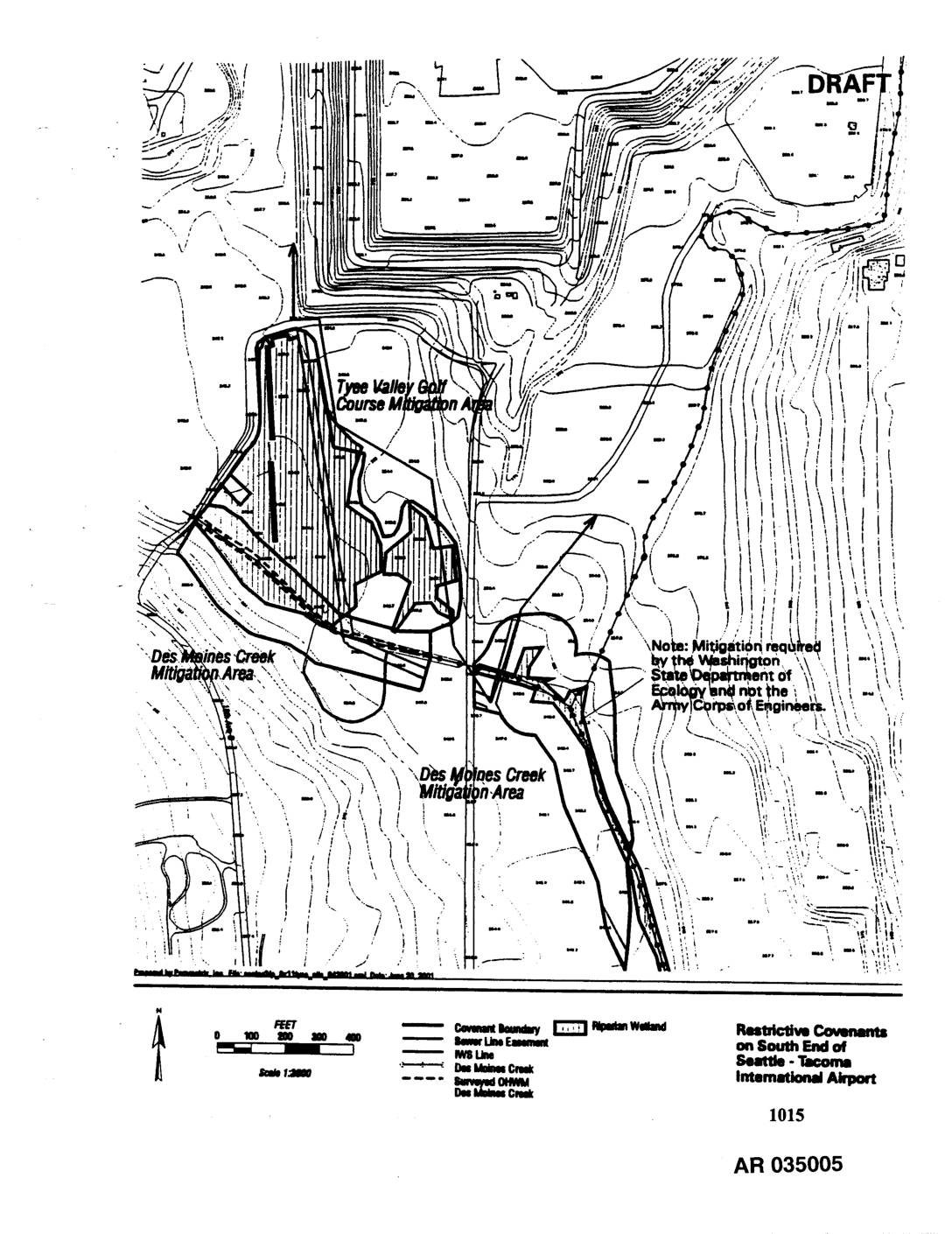
    EXH AR1015: Restrictive Covenants on South End of Seattle-Tacoma International Airport — Draft Map

    Draft map (AR 035005, Exhibit 1015) showing restrictive covenant boundaries, sewer line easements, IWS line, Des Moines Creek, and surveyed OHWM on the south end of Seattle-Tacoma International Airport. Identifies the Tyee Valley Golf Course Mitigation Area and Des Moines Creek Mitigation Area, with a note that mitigation was required by the Washington State Department
    TagsACC, Army Corp of Engineers, Des Moines Creek, Ecology, Map, Pollution Control Hearings Board, Sea-Tac Airport
  • 2002-10-21

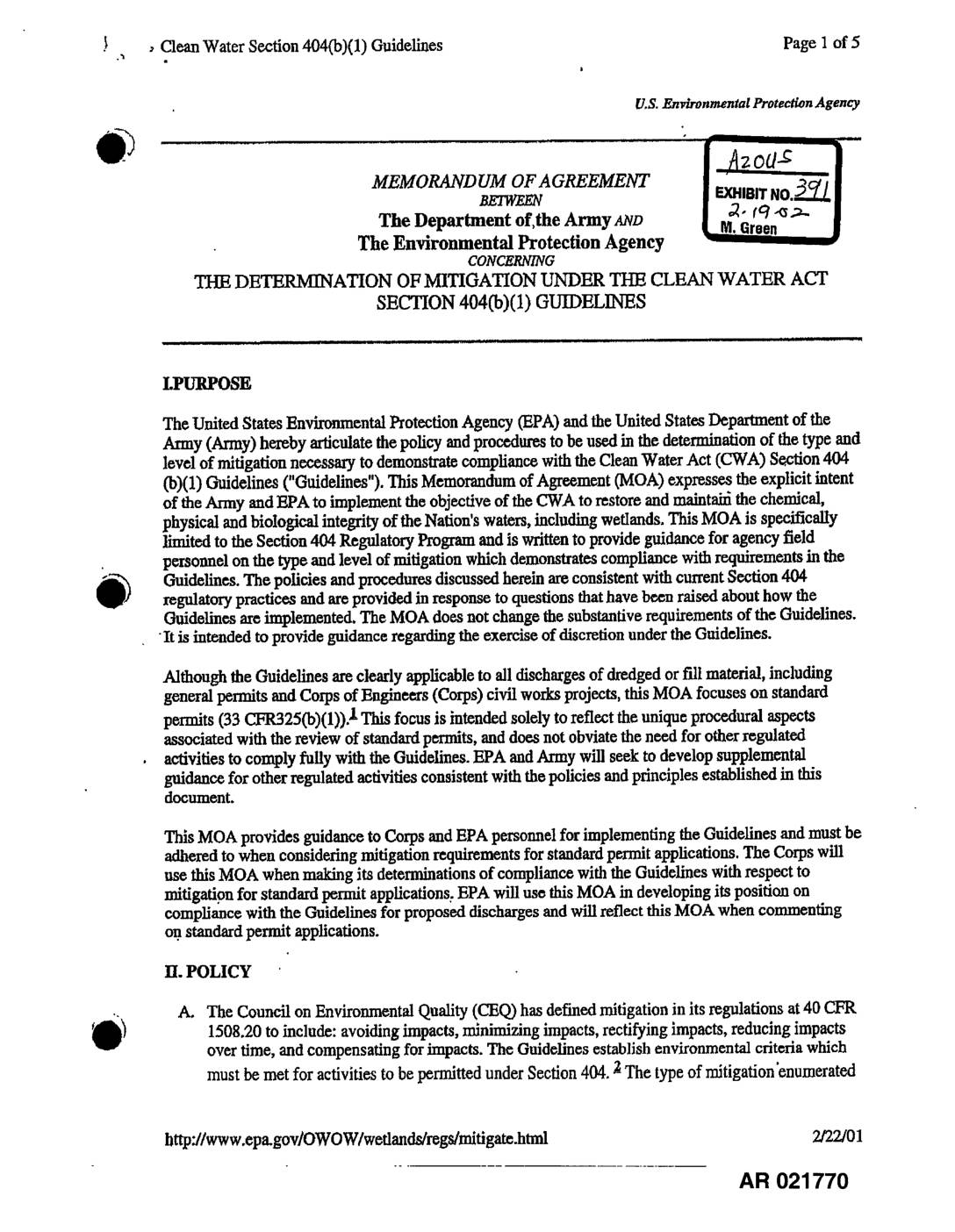
    EXH 391: Army-EPA MOA – Mitigation Determination Under CWA Section 404(b)(1)

    This 2001 Memorandum of Agreement between the U.S. Army and the EPA outlines the policies and procedures for determining what types of mitigation are required when issuing permits for discharging dredged or fill material into waters under Clean Water Act Section 404. It establishes a three-step mitigation sequence — first avoiding impacts, then minimizing unavoidable impacts, and finally providing compensatory mitigation for any remaining harm — with a goal of no overall net loss of wetlands. The document provides guidance to Army Corps of Engineers and EPA field personnel on how to evaluate standard permit applications in compliance with these environmental protection standards.
    TagsACC, Army Corp of Engineers, Clean Water Act, EPA, NEPA, Pollution Control Hearings Board
  • 2002-10-21

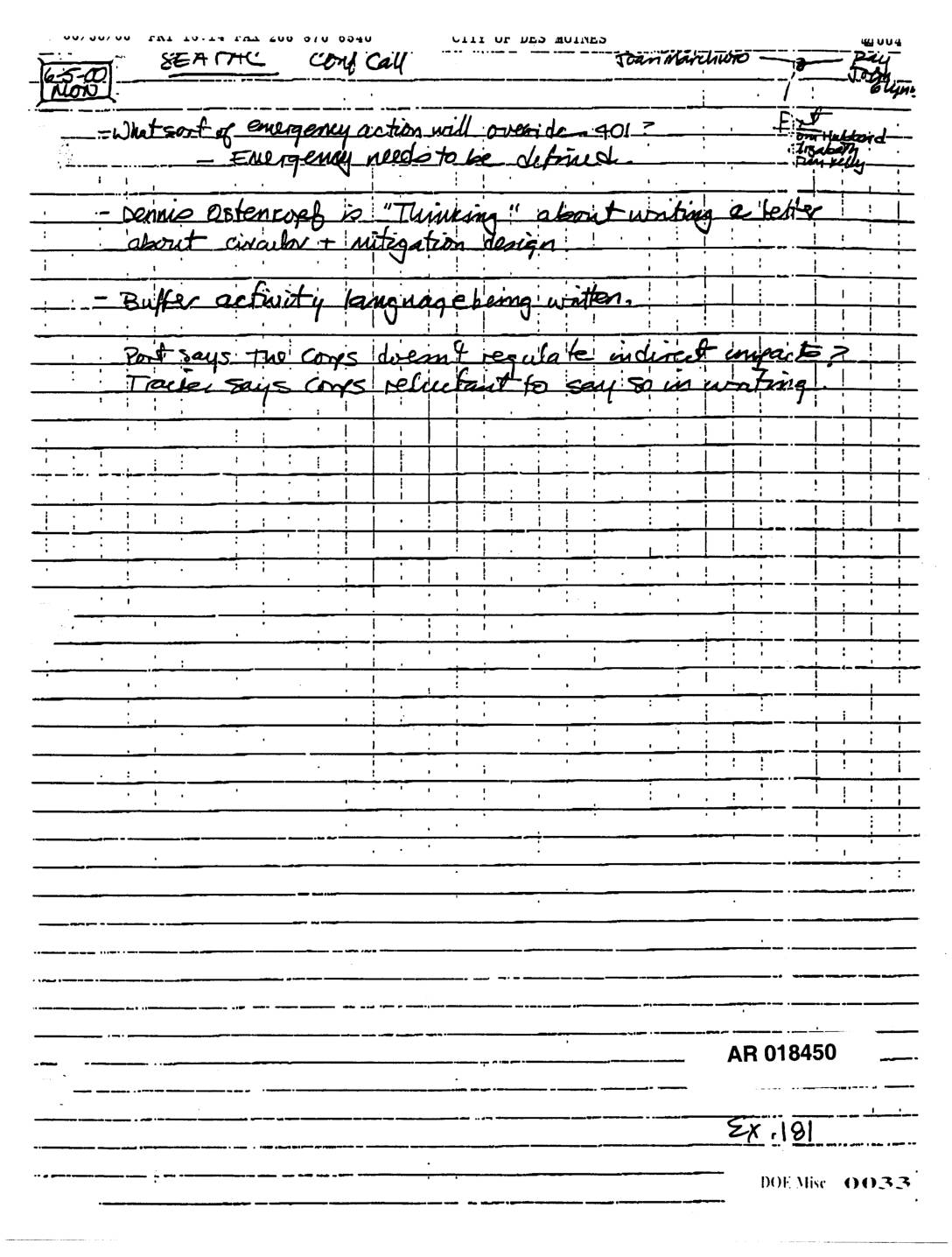
    EXH AR018450: Handwritten Conference Call Notes — Seattle and Des Moines, Army Corps Indirect Impacts and Mitigation

    AR 018450 (DOE Misc 0033, Exhibit 191). Handwritten notes from a conference call between Seattle and City of Des Moines discussing what emergency action will override Section 401, Army Corps of Engineers regulation of indirect impacts, buffer activity language, and mitigation design. Dennis Ostencorp referenced as thinking about writing a letter on circular and mitigation
    TagsACC, Army Corp of Engineers, Des Moines, Handwritten Notes, Noise Mitigation, Pollution Control Hearings Board, Sea-Tac Airport
  • 2002-10-21

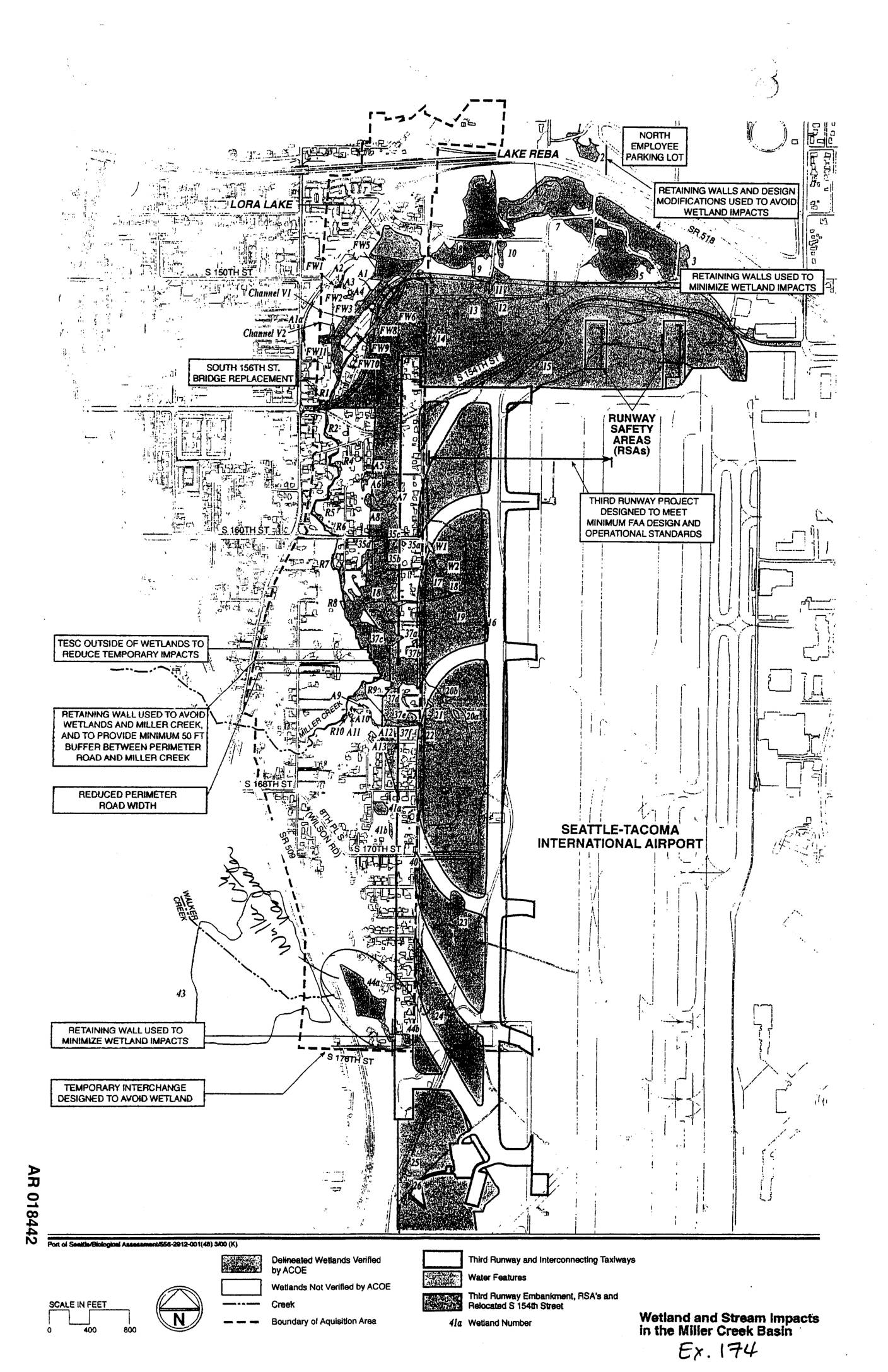
    EXH AR018442: Wetland and Stream Impacts in the Miller Creek Basin — Sea-Tac Airport Third Runway Project

    Exhibit AR018442 is a detailed map of wetland and stream impacts in the Miller Creek Basin associated with the Seattle-Tacoma International Airport Third Runway project. The map shows delineated wetlands verified by the Army Corps of Engineers (ACOE), wetlands not verified by ACOE, water features, Third Runway embankment, Runway Safety Areas (RSAs), relocated S 154th
    TagsACC, Army Corp of Engineers, Environmental Impact Statement, Miller Creek, Pollution Control Hearings Board, Sea-Tac Airport, Third Runway
  • 2002-03-18

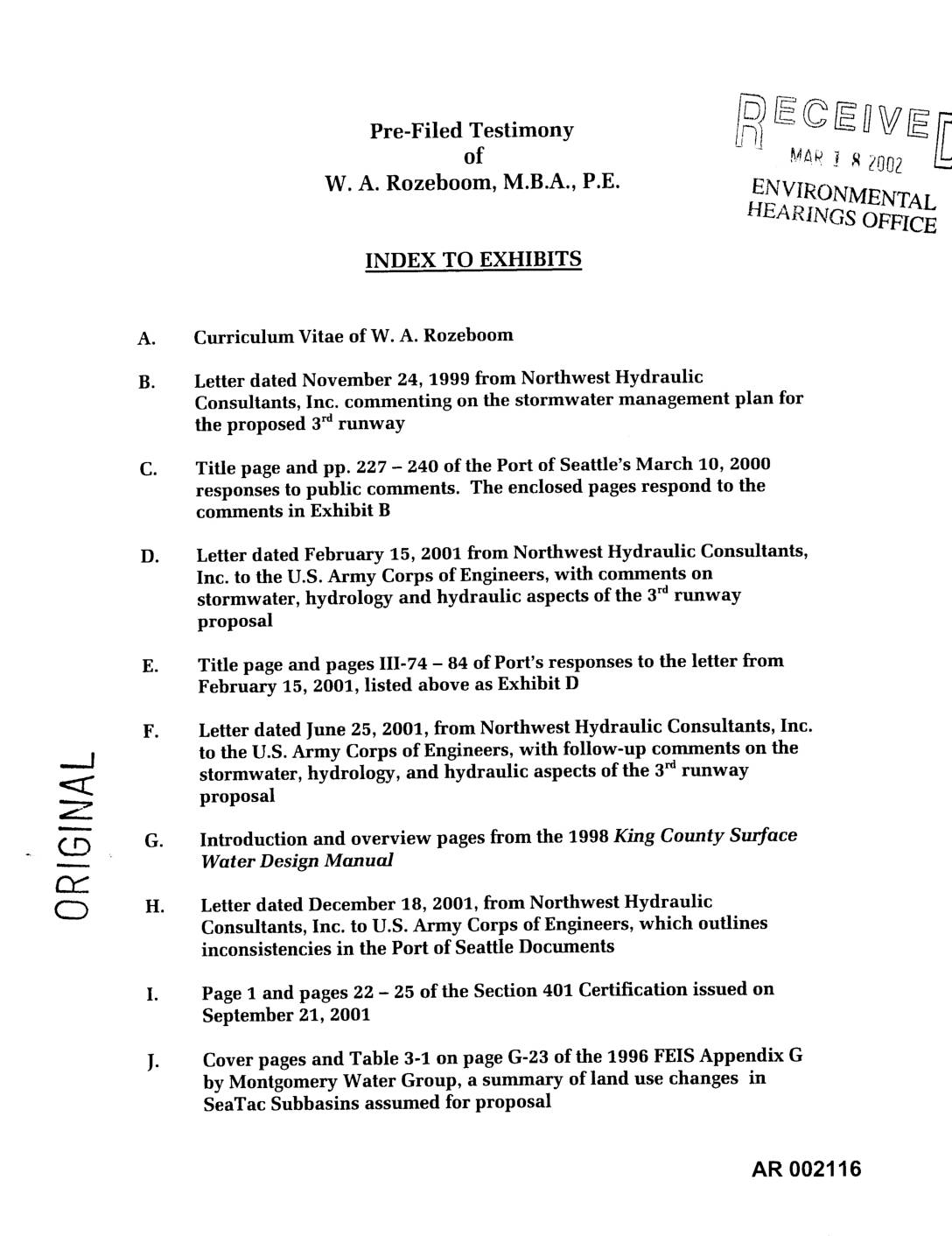
    PCHB AR002116: Pre-Filed Testimony of W. A. Rozeboom, M.B.A., P.E. — Index to Exhibits

    Pre-filed testimony of W. A. Rozeboom, M.B.A., P.E. submitted to the Environmental Hearings Office (PCHB), received March 18, 2002, consisting of an index to exhibits A through P. Exhibits include Northwest Hydraulic Consultants letters to U.S. Army Corps of Engineers (November 1999, February 2001, June 2001, December 2001) commenting on stormwater, hydrology, and hydraulics of
    TagsACC, Army Corp of Engineers, PCHB, Pollution Control Hearings Board, Port Of Seattle, Stormwater, Third Runway
  • 2002-02-07

    EXH 329: GeoSyntec Letter to USACE — Third Runway Low Flow Analysis Comments

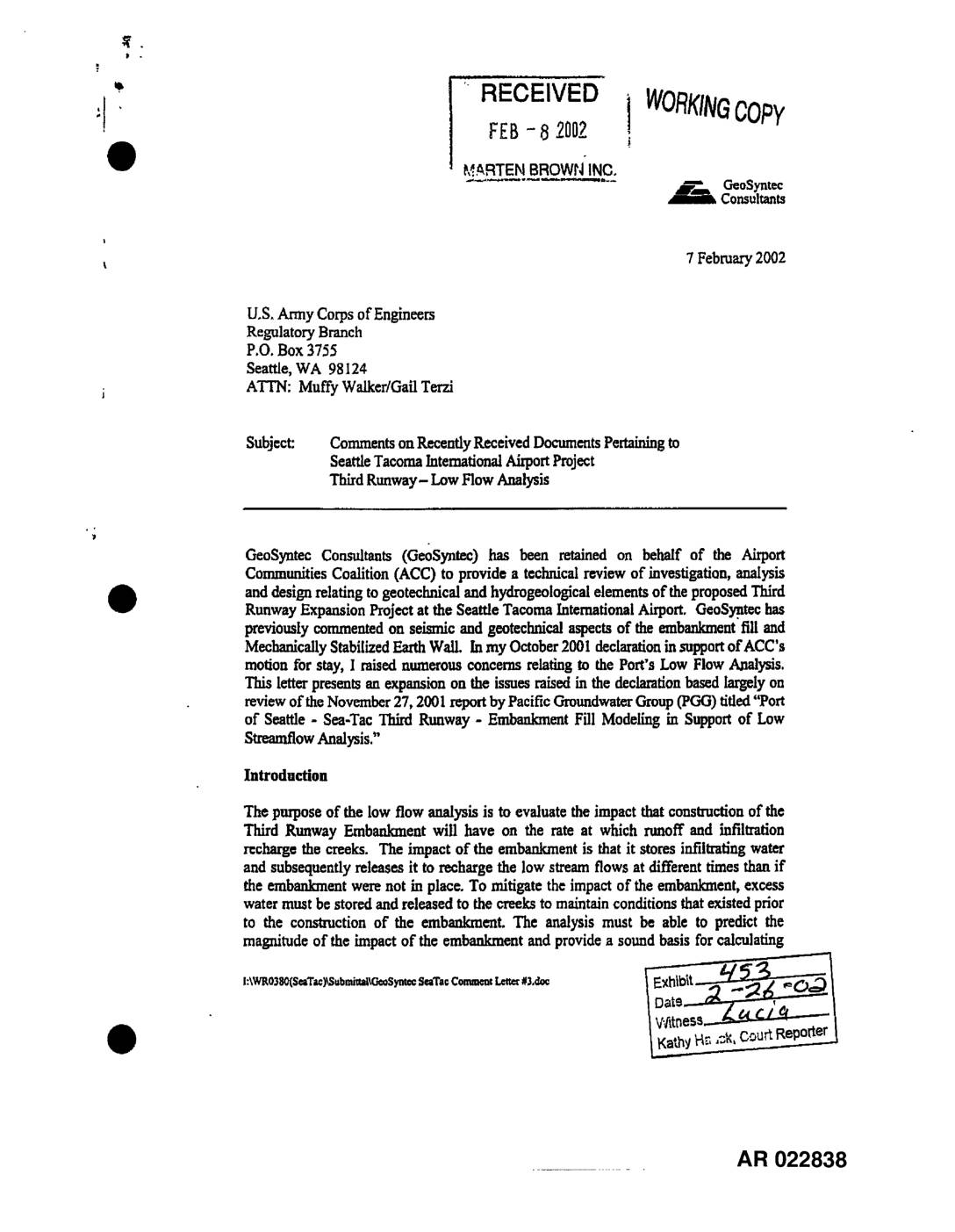
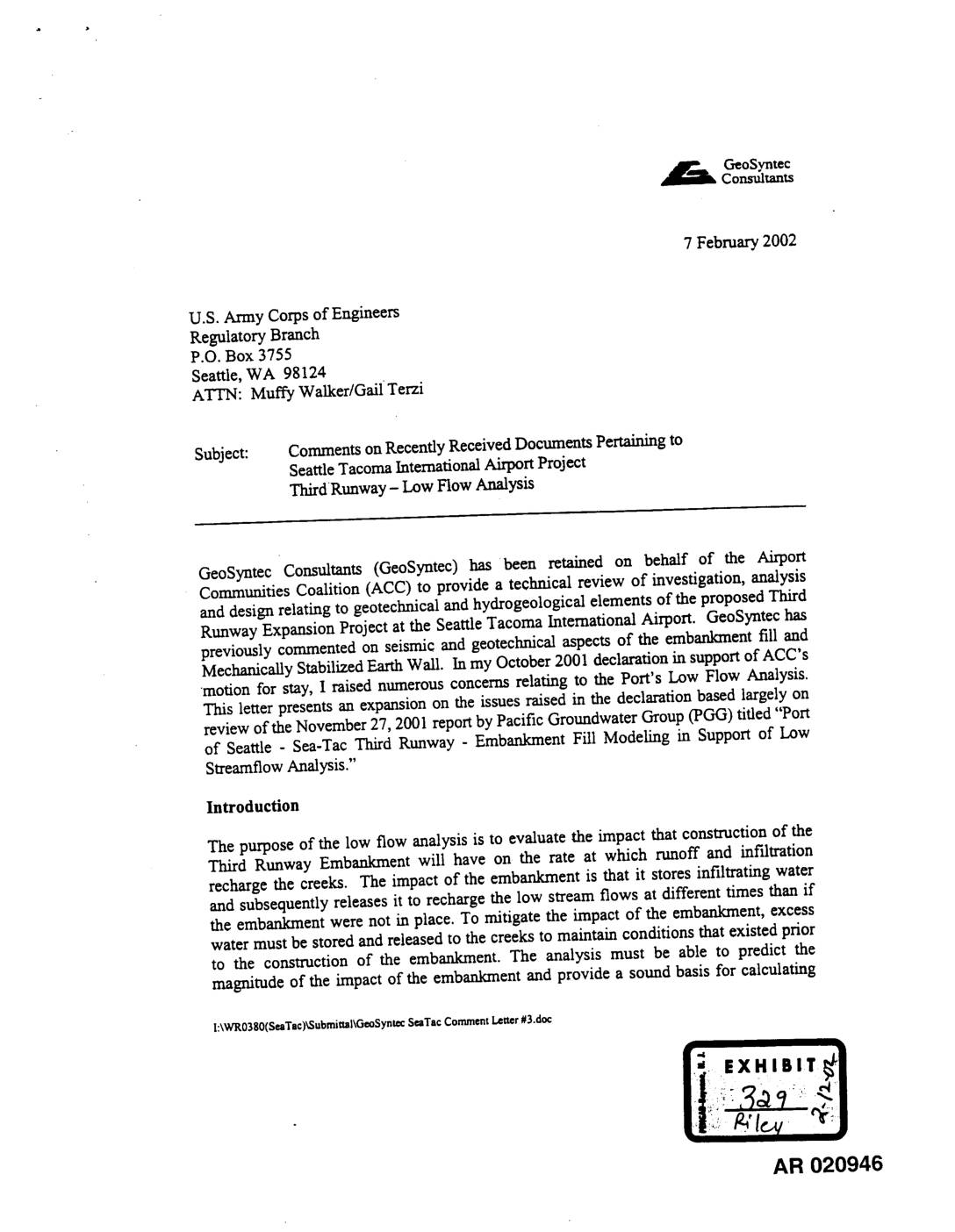
    A February 2002 technical letter from GeoSyntec Consultants, written on behalf of the Airport Communities Coalition, raises concerns about the Port of Seattle's low flow analysis for the Sea-Tac Airport Third Runway expansion project. The letter argues that the Port's analysis fails to account for the years-long delay before water would flow through the new embankment fill into drainage systems feeding nearby creeks, potentially leaving those creeks without adequate water during the critical early years of operation. GeoSyntec concludes that the Port has not demonstrated the project's storage vaults are properly sized, and that the underlying computer models are unreliable due to lack of calibration and flawed assumptions about soil hydraulic conductivity.
    TagsACC, Army Corp of Engineers, Pollution Control Hearings Board, Port Of Seattle, Third Runway
  • 2002-02-07

    EXH AR024316: GeoSyntec Comments Third Runway Low Flow Analysis ACC Technical Review Letter

    A February 2002 technical letter from GeoSyntec Consultants, submitted to the U.S. Army Corps of Engineers on behalf of the Airport Communities Coalition, raises serious concerns about the Port of Seattle's water flow analysis for the proposed Sea-Tac Third Runway expansion. The letter argues that the Port's analysis fails to account for the years-long delay before water would flow through the new embankment fill into drainage systems, potentially leaving nearby creeks without adequate water during the critical early years of operation. GeoSyntec concludes that the storage vaults designed to protect creek water levels may be significantly undersized due to flawed modeling assumptions and an overestimation of how quickly water would move through the embankment soil.
    TagsACC, Army Corp of Engineers, Pollution Control Hearings Board, Port Of Seattle, Third Runway

Posts pagination

Page 1 Page 2 Page 3 Page 4 Page 5 … Page 13
Sidebar On/Off

Upcoming Events

  • StART SEA Stakeholder Advisory Round Table
    Add to CalendarMWednesday Aug 26, 5:00pm - 7:00pm
    Zoom (Virtual Meeting)
    START meetingagenda 2026826 final 0 pdf

    Meeting Objectives Introduce the primary feedback themes identified by StART members regarding StART’s Operating Procedures and determine areas that may warrant future discussion. 5:00 PM – Welcome Meeting Management Welcome Lead: Andrés Mantilla, Facilitator, Uncommon Bridges; Wendy Reiter, Airport Managing Director, POS 5:15 PM – Dinner: All participants eat. 5:30 PM – StART Operating Procedures

    [...]
  • Commercial Aviation Work Group
    Add to CalendarMThursday Sep 3, 10:00am - 1:30pm
    Virtual Meeting (Zoom)
    Cawg agenda sep 3 26 virtual pdf

    Meeting Agenda 10:00 a.m. – 10:15 a.m. | Welcome – Evan Nordby, Chair a. Introductions and Agenda Reviewb. Status of appointments and non-voting member invitationsc. Other updates as necessary 10:15 a.m. – 11:00 a.m. | Is it practical and legal to operate the western Washington [Puget Sound] airports as a single airport system? – Consultant

    [...]

[See all...]


Help study childhood asthma. Get free HEPA filter!

read more...

Issues

Sea-Tac Airport is currently undergoing the largest and longest expansion in its history, collectively known as the Sustainable Airport Master Plan (SAMP). Some of it you can already hear, but you’re probably not aware of what it all means. Here’s what you need to know.
read more...

Read This!

As the source for federal transportation grants, the Puget Sound Regional Council was charged with developing a system to meet the growing need for commercial aviation. When the search for a second airport failed, they authorized the Port of Seattle to build the Third Runway, with a mandate to develop a noise abatement and mitigation program. In their effort to stop the Third Runway, the ACC argued over every detail of the Port's efforts--including property buyouts and sound insulation. The dispute was meant to be settled by a three member Expert Arbitration Panel. This is their final report. It finds 2-1, that the Port's program was insufficient in several respects. Despite that, funding for the Third Runway was approved by the PSRC, and the 'Port Package' program, proceeded largely unchanged. Expert Arbitration Panel's final decision finding that the Port of Seattle had not shown sufficient reduction in real on-the-ground noise impacts to satisfy noise reduction conditions required for approval of a third runway at Sea-Tac International Airport. The majority decision concluded the Port's noise abatement programs were insufficient despite being impressive in scope.
continue...

The Podcast!

Subscribe to the only podcast devoted to policies, politics, history, impacts for people living under the flight path everywhere. It’s definitely not just about noise!
  • Sea-Tac Noise.Info
  • Connect with STNI

    • Subscribe
    • Port Package Problem?
    • Donate
    • Podcast
    • Socials
      • Facebook
      • X (Twitter)
      • Bluesky
      • Instagram

    "2026 05 26 rm 11b presentation SAMP ntp draft SEPA EIS page 21" — , 2026

  • Learn

    • Frequently Asked Questions
    • Explainers
    • Youtube
    • Research Requests
    • Make a complaint
  • Goals

    Fulfill the promises of 1976:
    • Compensation
    • Reduced noise
    • Improved air quality
    • Environmental remediation
Login/Register
©2026•Data Privacy

Message

We use cookies to provide basic functionality. We also provide access to search engines in order to provide site analytics. We do not sell or share your data.
V V