TagACC(1548)
-
 2002-10-22
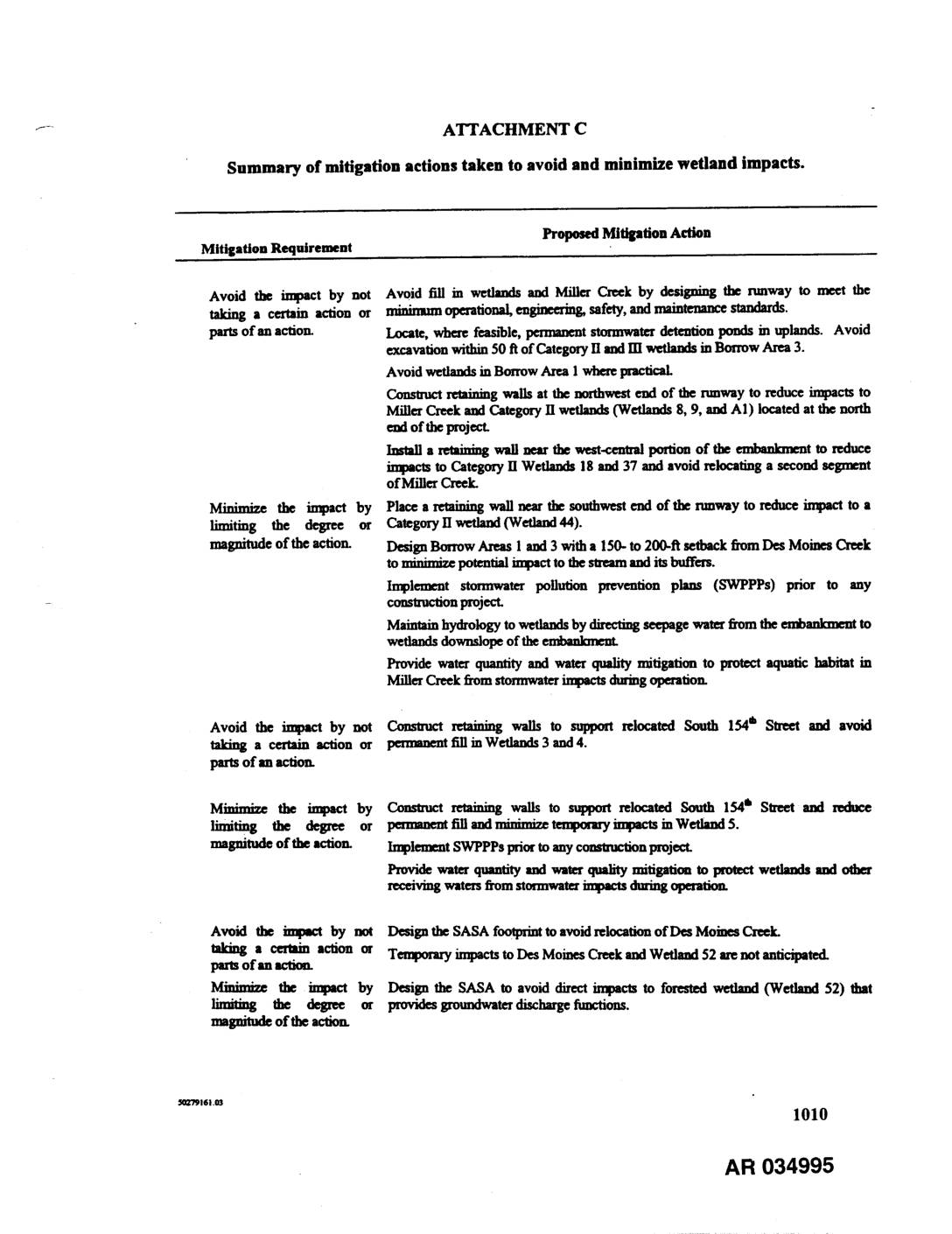
EXH AR034995: Summary of Mitigation Actions Taken to Avoid and Minimize Wetland Impacts
Attachment C summarizing proposed mitigation actions to avoid and minimize wetland impacts for a runway project at Sea-Tac Airport area. Document details mitigation requirements and actions for Miller Creek, Des Moines Creek, Category II and III wetlands (Wetlands 3, 4, 5, 8, 9, 18, 37, 44, 52, A1, and Borrow Area wetlands B1, B4–B10, B15a, -
 2002-10-22
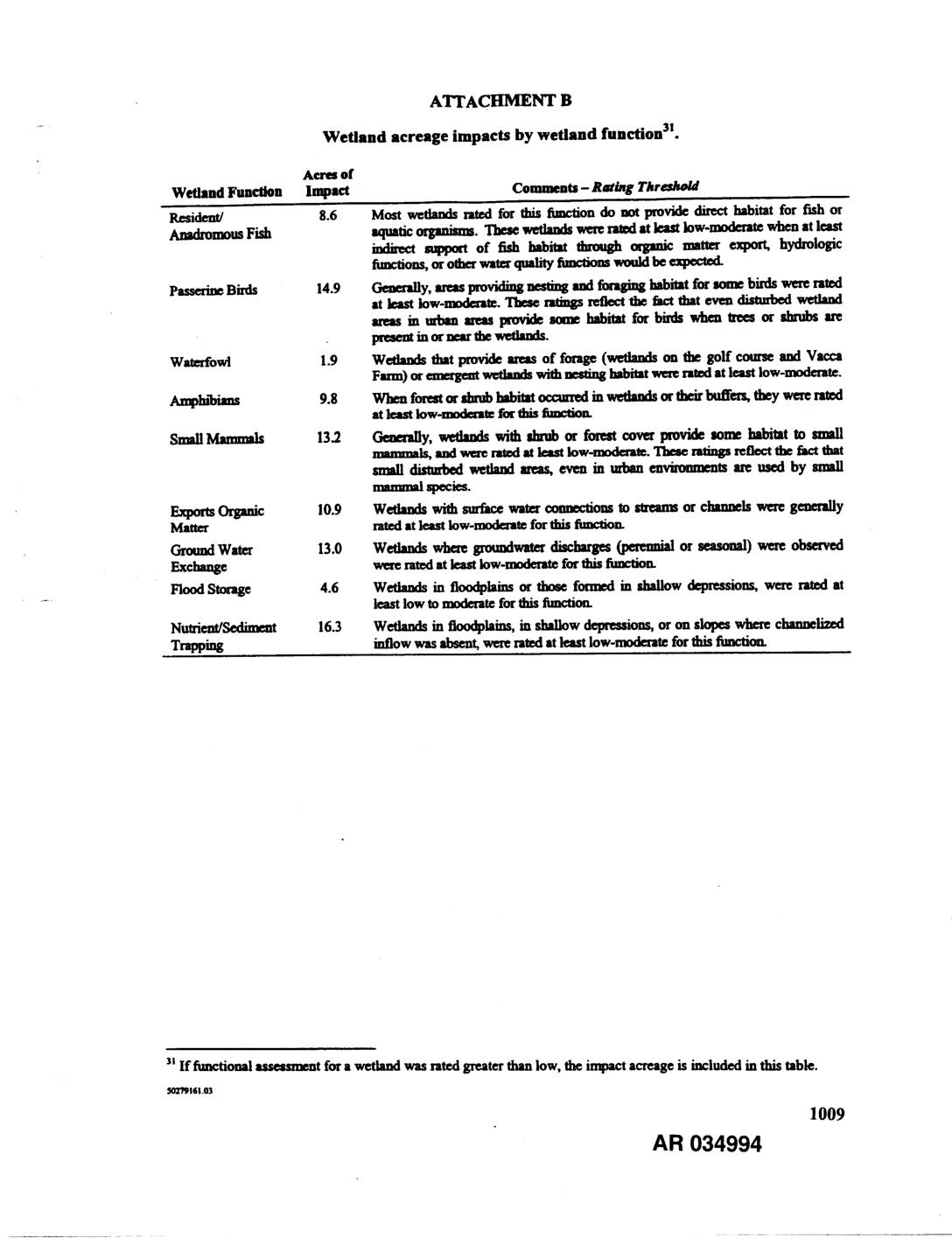
EXH AR034994: Attachment B — Wetland Acreage Impacts by Wetland Function
Attachment B table summarizing wetland acreage impacts by wetland function, associated with AR034994. Lists nine wetland functions including Resident/Anadromous Fish (8.6 acres), Passerine Birds (14.9 acres), Waterfowl (1.9 acres), Amphibians (9.8 acres), Small Mammals (13.2 acres), Exports Organic Matter (10.9 acres), Ground Water Exchange (13.0 acres), Flood Storage (4.6 acres), and Nutrient/Sediment Trapping (16.3 acres). -
 2002-10-22
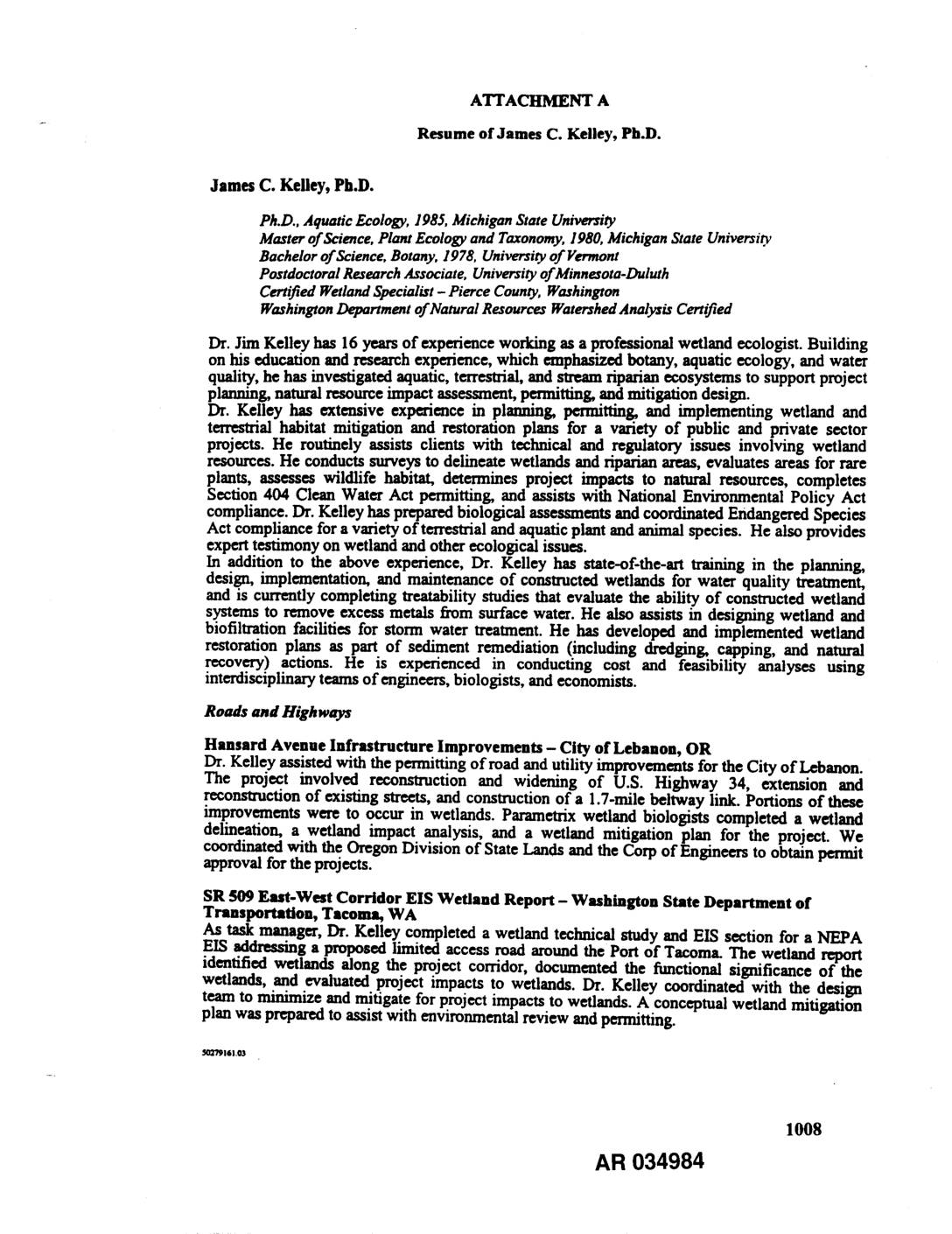
EXH AR034984: Resume of James C. Kelley, Ph.D. — Wetland Ecologist, Parametrix
Resume of James C. Kelley, Ph.D., wetland ecologist with Parametrix, covering 16 years of professional experience in aquatic ecology, wetland delineation, mitigation planning, NEPA compliance, Section 404 Clean Water Act permitting, and Endangered Species Act compliance. Projects include SR 509 East-West Corridor EIS Wetland Report for Washington State Department of Transportation (Port of Tacoma), Port -
 2002-10-22
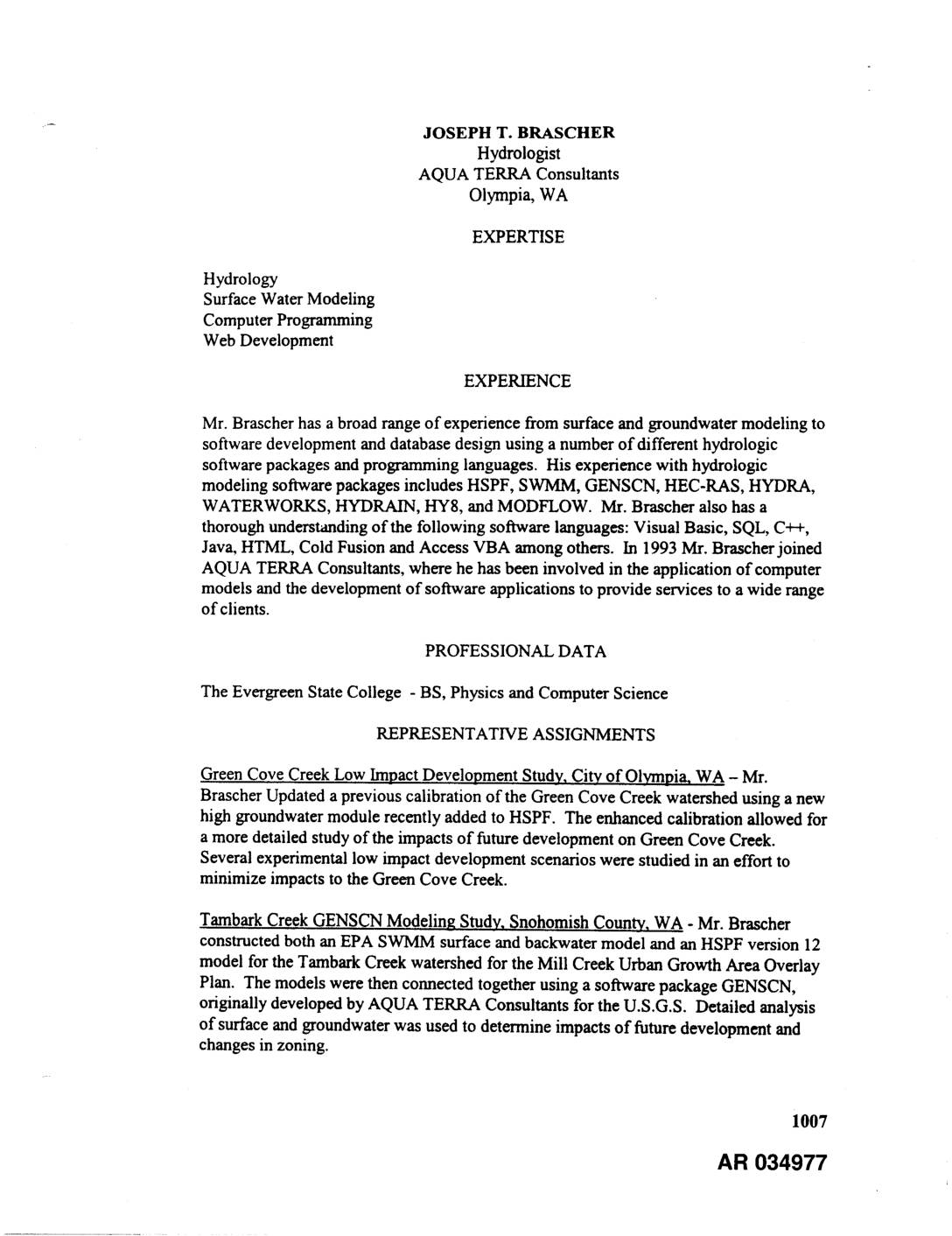
EXH AR034977: Resume of Joseph T. Brascher, Hydrologist, AQUA TERRA Consultants
Resume of Joseph T. Brascher, Hydrologist at AQUA TERRA Consultants, Olympia, WA. Details expertise in hydrology, surface water modeling, computer programming, and web development. Experience with hydrologic modeling software packages including HSPF, SWMM, GENSCN, HEC-RAS, HYDRA, WATERWORKS, HYDRAIN, HY8, and MODFLOW. Representative assignments include Green Cove Creek Low Impact Development Study (City of Olympia), Tambark -
 2002-10-22
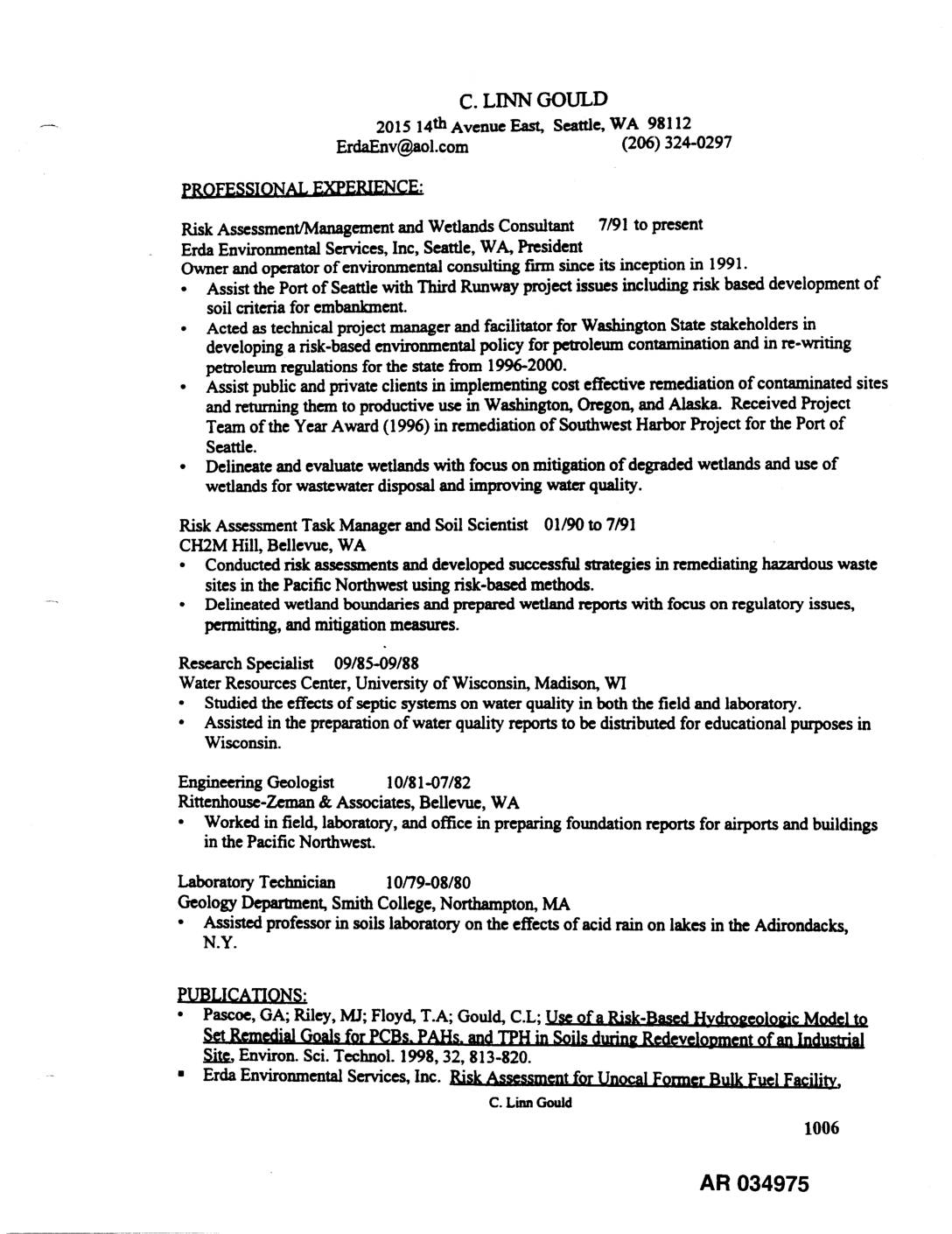
EXH AR034975: Curriculum Vitae of C. Linn Gould, Erda Environmental Services
Curriculum vitae of C. Linn Gould, President of Erda Environmental Services, Inc., Seattle, WA. Gould worked as Risk Assessment/Management and Wetlands Consultant from 1991 onward, including work for the Port of Seattle Third Runway project (risk-based soil criteria for embankment), Washington State petroleum contamination risk-based environmental policy (1996-2000), and remediation of the Southwest Harbor Project -
 2002-10-22
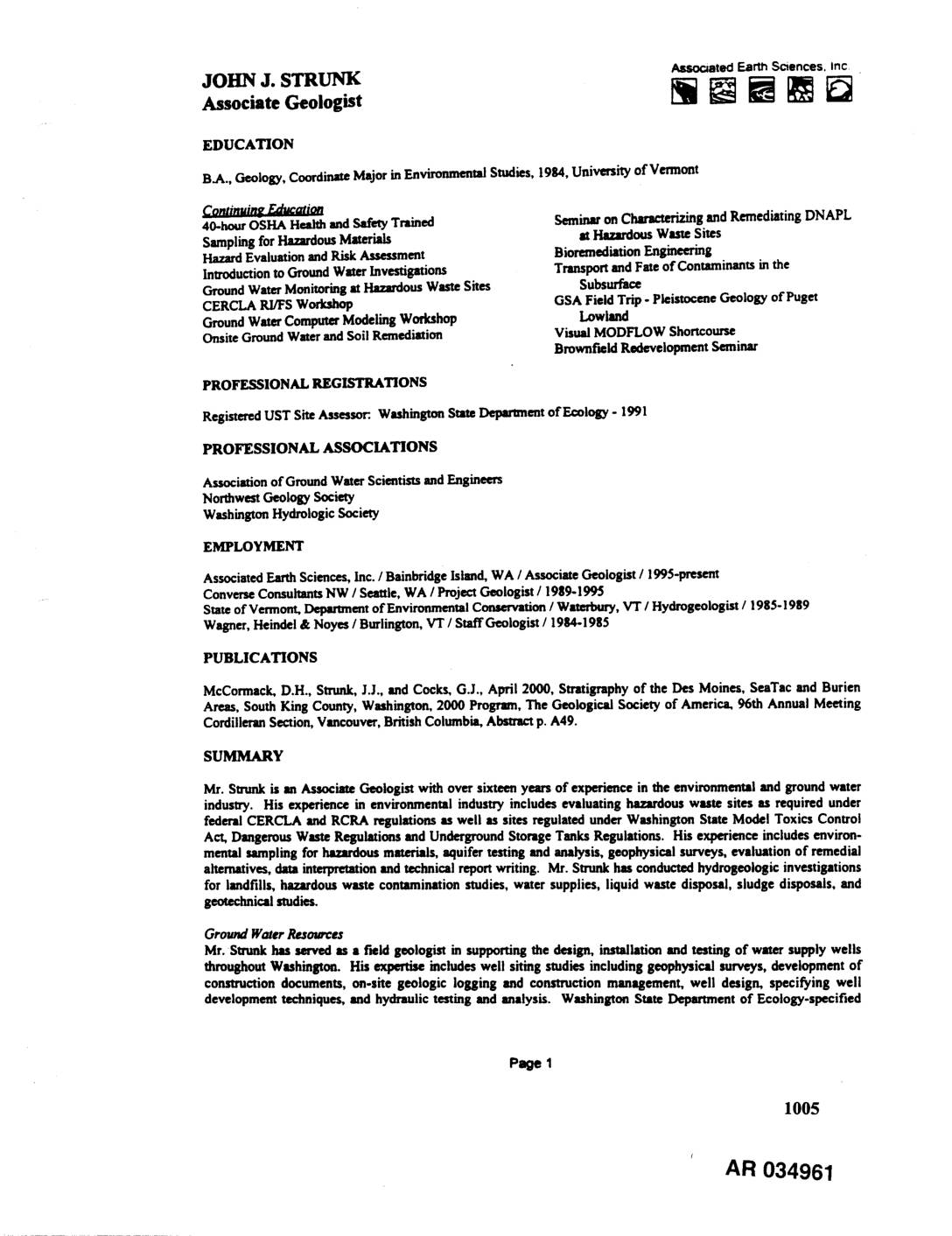
EXH AR034961: John J. Strunk, Associate Geologist — Resume, Associated Earth Sciences, Inc.
Resume of John J. Strunk, Associate Geologist at Associated Earth Sciences, Inc. (AESI), Bainbridge Island, WA. Over sixteen years of experience in environmental and ground water industry. Projects include Area-Wide Ground Water Study at Seattle-Tacoma International Airport (Sea-Tac Airport) under MTCA Agreed Order between Ecology and Port Of Seattle; Third Runway project support regarding ground -
 2002-10-22
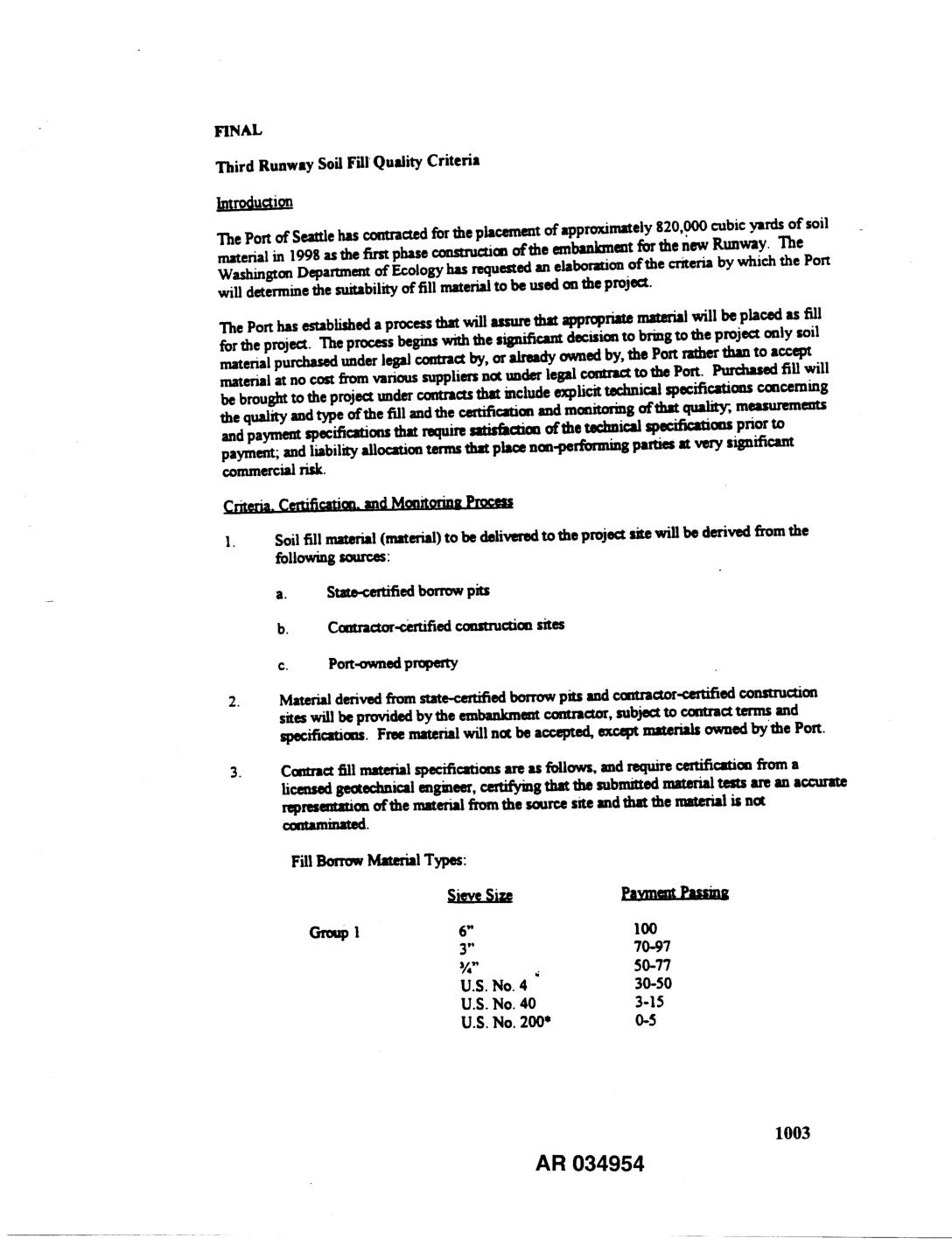
EXH AR034954: Third Runway Soil Fill Quality Criteria
Port Of Seattle document establishing soil fill quality criteria for Third Runway embankment construction in 1998, covering approximately 820,000 cubic yards of fill material. Specifies Fill Borrow Material Types (Group 1, Group 2, Group 3) with sieve size gradation requirements (6″, 3″, ¾”, U.S. No. 4, U.S. No. 40, U.S. No. 200), MTCA Method A -
 2002-10-22
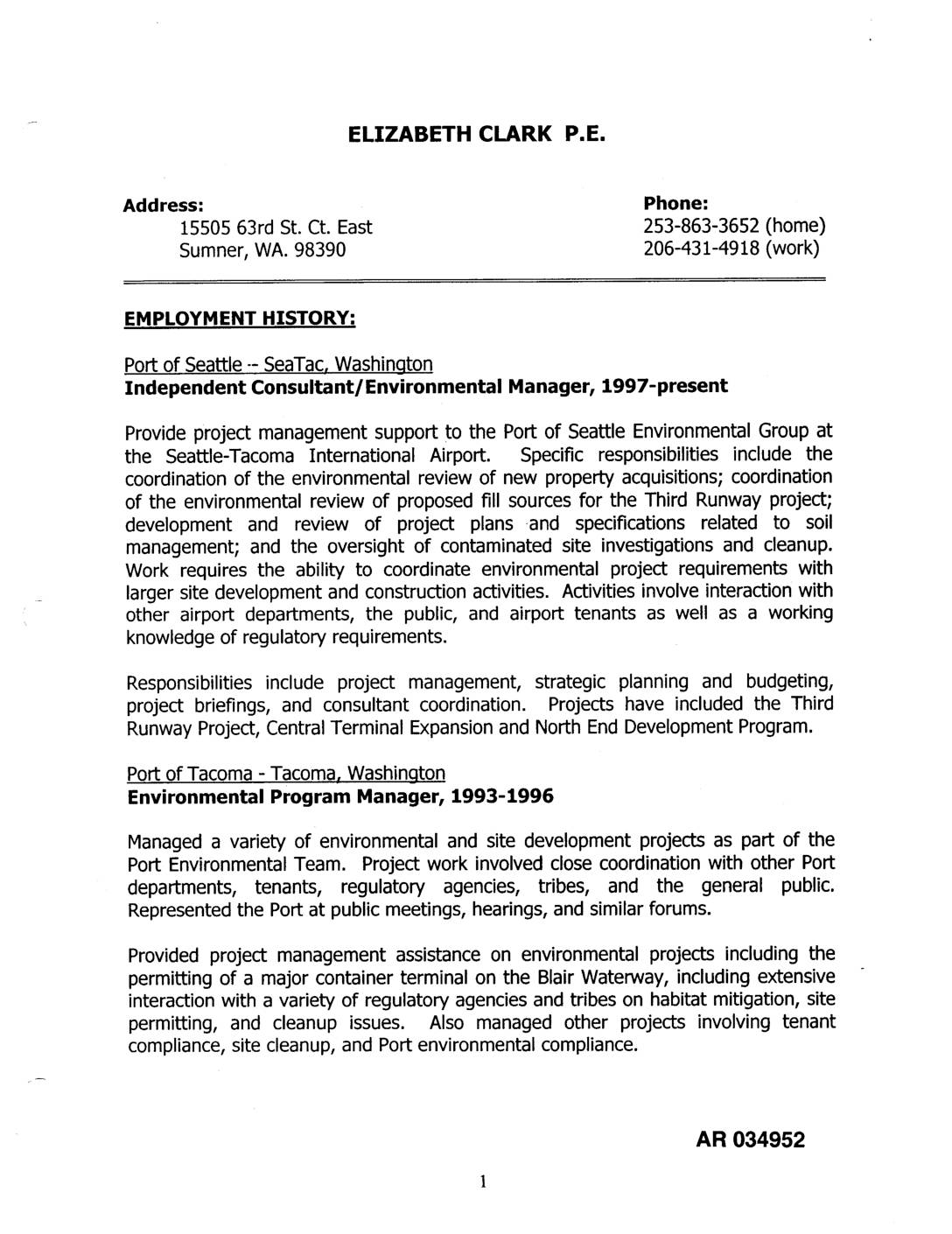
EXH AR034952: Resume of Elizabeth Clark P.E., Independent Consultant/Environmental Manager
Resume of Elizabeth Clark P.E., licensed civil engineer in Washington State, detailing employment as Independent Consultant/Environmental Manager for Port of Seattle at Seattle-Tacoma International Airport (1997-present), Environmental Program Manager for Port of Tacoma (1993-1996), and Project Engineer/Tacoma Branch Manager at Landau Associates Inc. (1985-1993). Covers contaminated site investigations, soil management, Third Runway project, Central Terminal -
 2002-10-22
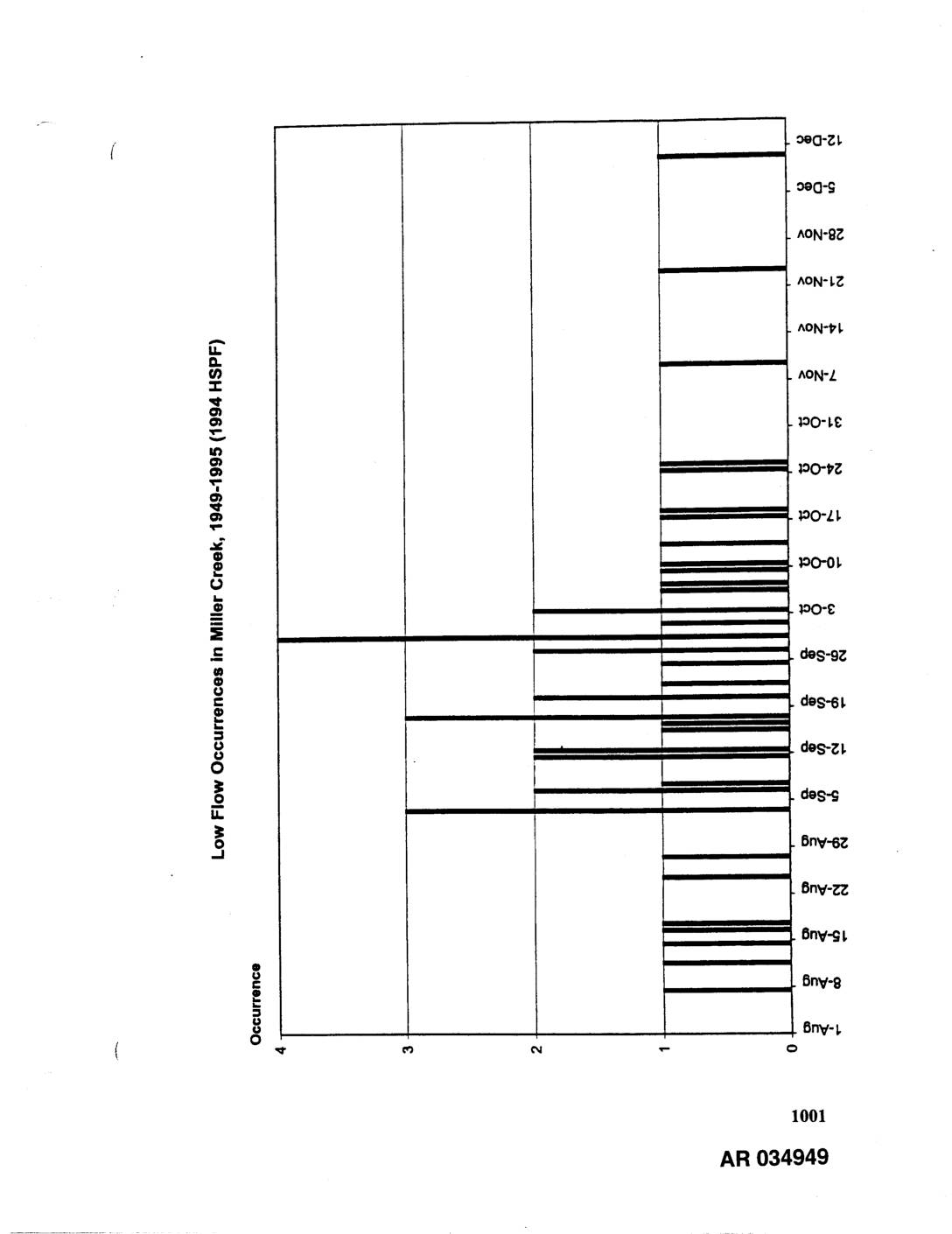
EXH AR034949: Low Flow Occurrences in Miller Creek, Des Moines Creek, and Walker Creek, 1949-1995 (1994 HSPF)
Three bar charts showing 7-day low flow occurrences modeled using 1994 HSPF (Hydrological Simulation Program Fortran) for the period 1949-1995. Charts cover Miller Creek, Des Moines Creek, and Walker Creek, displaying occurrence counts (0-4) by date ranging from summer through winter months (June through December). AR034949-AR034951. Related to stormwater hydrology and low flow analysis for -
 2002-10-22
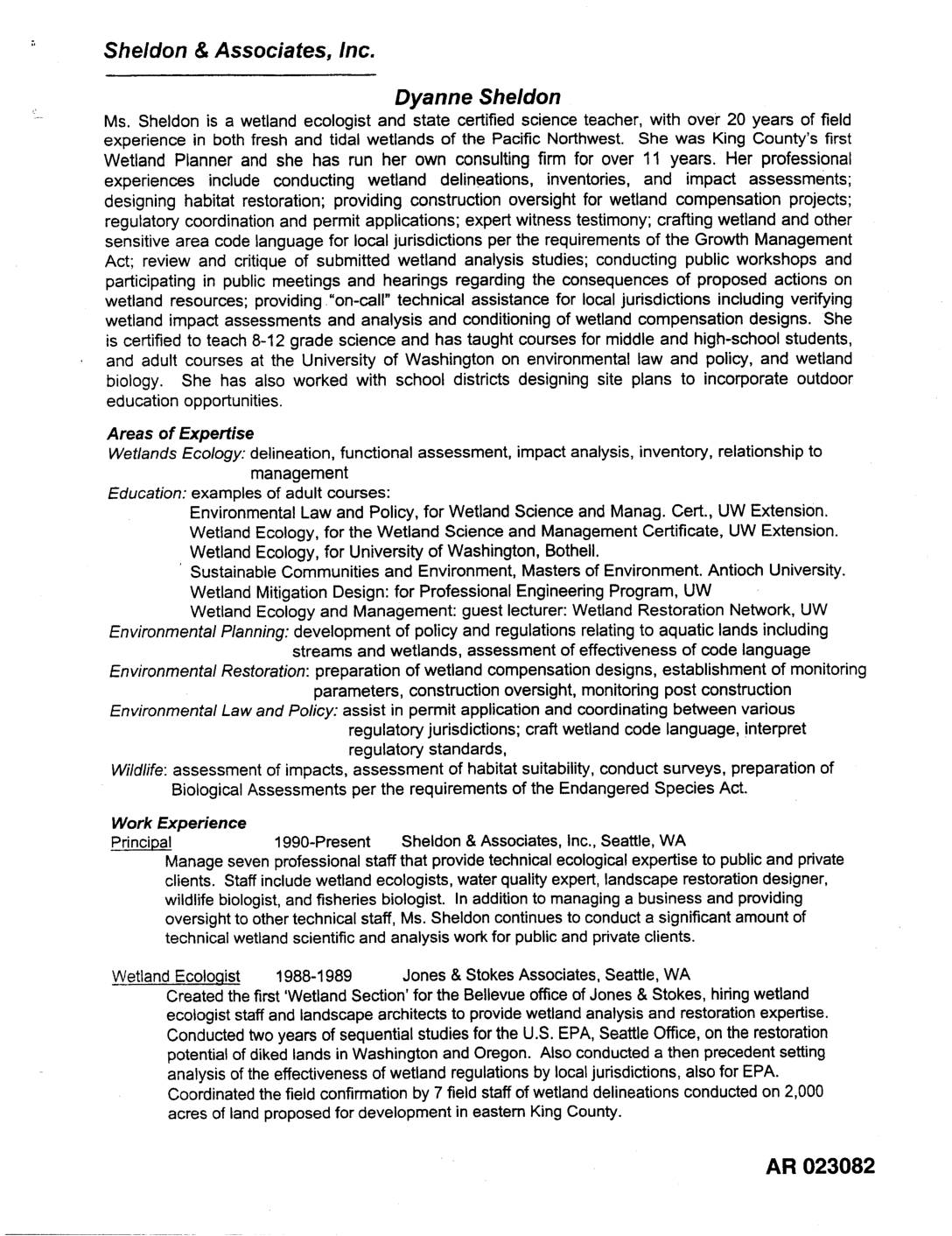
EXH AR023082: CV Dyanne Sheldon, Wetland Ecologist, Sheldon & Associates Inc.
This document is the professional curriculum vitae of Dyanne Sheldon, principal of Sheldon & Associates, Inc., a Seattle-based wetland ecology consulting firm. Among her relevant work, she co-authored both the Sea-Tac Airport Wetland Inventory and the Sea-Tac Airport Wetland Management Plan in 1991 for the Port of Seattle's Environmental Management Section. Her broader expertise spans wetland delineation, habitat restoration, environmental planning, and regulatory compliance across the Pacific Northwest.