The most requested documents–and all related-content
This page is an attempt to solve a problem we’ve had since the beginning: how to get visitors to study documents and all the related content which often provides the necessary context. For example, most studies are meant to be read by specialists. If you are a layperson, you may only be interested in the ‘one-pager’. This page shows you both.
The Effect of Elevated Train Noise On Reading Ability
Discussion
The Effects of Aircraft Noise and Road Traffic Noise on Reading Comprehension and Attention: The Ranch Study
The Flight Plan Project Final Environmental Impact Statement
Discussion
Outline
The Sea-Tac Communities Plan
Overview
The draft Sea-Tac Communities Plan (STCP) (known as “the Redbook” was delivered to the King County Council and Port of Seattle Commissioners in January 1975 after eighteen months of work and a $641,000 grant from the FAA. The authors were the Policy Advisory Committee, a twelve member group of citizens, King County, Port staff, educators and academics led by Director of Aviation Don Shay.
Background
The STCP was a response to public outcry over the dramatic increases in noise and pollution following the opening of the Second Runway (now known as 16C or the center runway.)
This HistoryLink 1article does a pretty good job of condensing the situation into a few sentences. What the article does not mention is that this was a unique moment in American environmental law. The STCP was developed shortly after the creation of the Environmental Protection Agency (EPA) and the National Environmental Protection Act (NEPA.) To put it bluntly: the regulatory climate of the era made it much easier for communities to sue airports. And boy did they ever.
Significance
From the airport communities perspective the STCP may be the single most important document in history. In the end it became the community mitigation for the Second Runway–and the only meaningful voluntary mitigation of any expansion in the history of Sea-Tac Airport.
But the Sea-Tac Communities Plan was meant to be much more. It was a comprehensive long term plan to address both the needs of residents and realistic growth forecasts of the airport. It was the first, and only time, the Port, the prevailing jurisdictions, citizens and multiple federal agencies (eg. Federal Aviation Administration, Housing and Urban Development) worked collaboratively.
From the Peat, Marwick first year audit of the plan, The Sea-Tac Success Story
As one of the first airport sponsors in the country to be sued… the Port had little or no guidance from elsewhere as to how to deal with the problem(s). In the absence of such guidance, what may be termed a “let them sue” approach was essentially followed by the Port during the period from 1957 to 1972. Under this approach, every lawsuit was contested in court. If the Port won, no further action would be taken…
Only a first step…
Readers often find the language of the STCP somewhat underwhelming. It was never meant to be a detailed set of regulations and policy prescriptions. Rather it was meant to be the beginning of a process that would include comprehensive noise monitoring, air quality monitoring, revenue sharing, land use–every aspect of community impacts we now consider crucial in any airport development issue. And all of it would be developed with input from community advisory groups.
The first step was the adoption of the plan in 1976 by the King Council as Ordinance #2883 and by the Port Commission as Resolution #2626. Each document acknowledges the STCP as the shared comprehensive land use plan for the area.
The most well-known next step was another three year group effort resulting in the Highline Community Plan of 1979. It’s purpose was to develop an implementation of the land use portion of the STCP.
Not exactly to plan…
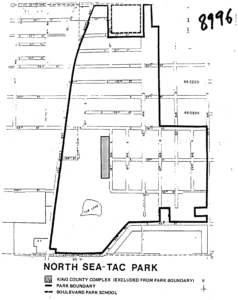
But no part of the STCP implementation went exactly ‘to plan’. The one major milestone reached that looks anything like the original vision is what is now known as North Sea-Tac Park. Frankly, the FAA and the Port of Seattle were so ‘collaborative’ in the beginning because they had to be so. As responsibility for environmental regulation of airports was transferred from the EPA and to the FAA, both the Port of Seattle and the FAA became tougher for all communities to deal with.
*Still, what remains of the STCP is the single biggest compensation and community benefit in Sea-Tac Airport history.
One key takeaway is that both the Port and the FAA considered the agreement to be reasonable and workable. Don Shay was no tree-hugger. The document provides straight forward cost assessments and more importantly, ways to pay for everything. The STCP puts the lie to the argument that the Port is always financially constrained by FAA rules from doing more.
The STCP was far from perfect. Aspects of the Second Runway were ruinous for many homeowners and businesses. Highline Schools, once considered among the best public school districts in the state, has never recovered.
It’s not just that reality fell so far short of the vision. And it’s not that almost no one remembers it today–though it was less than fifty years ago. From our point of view, the most troubling thing about the STCP is that almost every resident and local elected today would struggle to believe that such a working group could have existed in the first place.
Summary Of Key Recommendations
In a letter to the King County Council, Don Shay presents the twelve key recommendations which became the roadmap for next steps. Most of which were carried forward… until they weren’t.
| Recommendation | Outcome |
|---|---|
| The Port of Seattle and King County should formally recognize the Plan as the official guide for future development and improvement by the Sea-Tac/Communities Area. This recognition should be accomplished by resolution, ordinance or other such appropriate action | X |
| The Port Commission should adopt the suggested Sea-Tac International· Airport Master Plan with the concurrence of the Federal Aviation Administration. | X |
| The County Council should adopt the Sea-Tac/Communities Plan as the official Middle Plan for this portion of King County. | X |
| The Port of Seattle should assume primary responsibility for the implementation a comprehensive noise remedy program as outlined by the Sea-Tac/Communities Plan. Such a program would involve property acquisition, purchase assurance, noise insulation, avigation easements, and property advisory services. Maximum FAA financial assistance via the Airport Development Aid Program (ADAP) should be obtained by the POS. | X |
| King County should assume primary responsibility for the implementation of drainage, water quality, park and recreation program improvements identified as part of the Sea-Tac Communities Plan. Both the Port and County should work closely with the State Highway Department and other transportation agencies in the planning, programming and execution of needed service road and/or access improvements. | X |
| King County should assume primary responsibility for the implementation of overall land use change within Conversion and Reinforcement Areas as identified outlined by the Plan. | X |
| Future land use conversions in appropriate areas around the Sea-Tac Airport should be oriented to, and result in a more. economic use of property, an increased tax base, improved job opportunities, and a greater use of available community facilities wherever possible. | X |
| Every effort should be made to have HUD/FHA . reflect the Plan in its mortgage insurance policies and practices. | X |
| The Port and County should see necessary changes in the Federal ADAP legislation (now under consideration by the Congress) which would (a) increase the Federal share of such grants, and (b) permit. ADAP funding of the various noise remedy programs set forth in the Sea-Tac/Communities Plan. | X |
| The Port of Seattle should seek necessary changes in the Washington Aircraft Noise Impact Abatement Act of 1974 so as to permit noise remedy and other improvement programs reflected by the Plan to be fully implemented. Change is particularly needed with respect . to the area subject to the provisions of this Act. | X |
The Port and County should adopt a Post-Plan Coordination Program to include, as a minimum:
| X |
| Both the Port of Seattle and King County should agree to fulfill staffing and budgetary needs required to carry out the Plan as appropri ate, and in keeping with available resources | X |
The STCP was negotiated in a world which no longer exists. But that has nothing to do with the feasibility of such an agreement. It just means that every stakeholder has been responding to individual and perverse incentives rather than compromising to do what is best for the communities.
Over time, both the FAA and the Port have become more difficult negotiating partners. But that is not because they have to be. It is because transferring environmental regulatory authority to the FAA gave them more options to choose profit over community–and they took all of them.
And in 1976 “the Highline Community”, meant “King County”. Now, it means six separate municipalities who frequently squabble over individual concerns rather than coming together with the understanding that the airport is the only issue. That too was a choice.
In short, the STCP was the right system. It may require more will now to carry forward in the current environment, but regardless it’s still the right system.
The Sea-Tac Communities Plan (1975)
- Part 1 Overview Of The Plan (explainer)
- Part 2 Use Of The Report (explainer)
- Part 3 Background (explainer)
- Part 4 Trends And Forecasts (explainer)
- Part 5 The Environment (explainer)
- Part 6 Plans, Policies And Programs (explainer)
- Part 7 Implementation (explainer)
- Part 8 References (explainer)
- Handwritten Project Cost Worksheets not technically a part of the official document, but tightly related (explainer)
Reading through any government document from 1975 can be almost like slogging through Shakespeare. The contemporary reader will be confronted with any number of acronyms and groups and terms like ‘ADAP’, Forward Thrust, ‘Zone 3’ and ‘Post Plan’ that will likely be unfamiliar. We’re working on it. However, despite those challenges, it is otherwise in plain language and very well-written. Some of the science may be outdated (ultrafine particulates were not measurable at the time) but all the main policy concerns it discusses are the same as one would discuss today, including land use, economics and environment. And the STCP does so with much greater clarity than almost every paper we’ve read concerning more recent airport expansions.
A note on the scan. There were 150 numbered copies in three ring binders with the plastic cover above. We have three (3) complete copies. The Port of Seattle has another. The Washington State Archives has several sections from another copy. We’ve also seen PDFs of various fragments on-line. As far as we know, this is the only scan of a complete version. Apparently, there are differences in material between copies. We chose to present this one because it’s the last version date we’ve found before the initial presentation of the Plan to the Port Commission, King County Council and public. Finally, all OCRed documents suffer from various ‘glitches, this one more than most due to the high number of graphics and different type styles.
Brochure
A full-color piece distributed throughout the airport communities as part of the outreach program. If you read nothing else, read this as it describes the aspirations quite well.
Important Milestones
| 1975 | Advisory Committee Recommendation to King County Council 12 Key Recommendations |
| 1976 | Transfer of control of Port of Seattle property to King County: |
| 1979 | Highline Community Plan
Port of Seattle implements first Noise Monitor Network |
| 1985 | Port of Seattle Commission Resolution 2643 (Amends #2626 to include a budgeted sound insulation program) |
| 1987 | Port of Seattle Commission re-commits to North SeaTacPark |
| 1987 | North SeaTac Park Phased Development Plan |
| 1992 | North SeaTac Park Master Plan Update |
Related
| 1997 | Sea-Tac Aiport Mitigation Study
|
*We are careful to distinguish community benefit. The Port of Seattle, Highline Schools and the majority of electeds will absolutely gush about the $150,000,000 agreement for schools, the storm water systems and various economic development and non-profit grant programs. The careful reader will note several features of all these payments: other than the school insulation, the sum total of all these ‘grants’ has been only about $1,000,000 (the vast majority of these being paid from our own property taxes) and none of these went to the communities. At best they are small programs eg. tree planting or to help design a building at the Des Moines Marina.
†This section was developed independently of the original plan and outside the PAC. This version is from the Port of Seattle’s copy.
1We’ve made no secret that we’re usually reluctant to quote from HistoryLink on matters concerning Sea-Tac airport. But this particular article does a pretty good job of succinctly describing the circumstances leading up to its creation
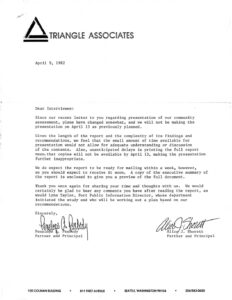
Triangle Associates Community Assessment (Executive Summary) 04/09/1982
Discussion
Ultrafine particle monitoring (Seattle/Chinatown and Sea-Tac Airport) HDC2 11 12 42
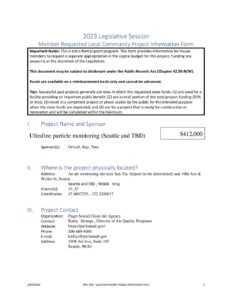
Discussion
Ultrafine particles: unique physicochemical properties relevant to health and disease
Hyouk-Soo Kwon, Min Hyung Ryu & Christopher Carlsten Experimental & Molecular Medicine volume 52, pages318–328 (2020)Cite this article 15k Accesses 98 Citations 82 Altmetric Metricsdetails Abstract Ultrafine particles (UFPs) are aerosols with an aerodynamic diameter of 0.1 µm (100 nm) or less. There is a growing concern in the public health community about the contribution of UFPs to human health. Despite their modest mass