Skip to content
  • STNI
  • Statistics
    • Ops and Passengers
      • King County International Airport (Boeing Field) Annual Operations
    • Financials
    • Aviation fuel uplift in the State of Washington 2018 – 2025
      • Aviation Fuel Uplift at Sea-Tac Airport
    • Air Quality Monitoring
    • Flight Tracking
      • Flow and Flight Tracks
      • Five Year Comparison
      • Busiest Hours and Days
    • SEL Noise Reports & Graphs
      • About The Permanent Noise Monitors
      • Minutes of Quiet by Noise Monitor
      • Noise Events mapped
      • Noise Events (SEL)
    • Runways
    • Employees
    • Real Estate
      • Port Properties and Trees mapped
    • Parking
  • Events
  • Protest
    • Regular Events
    • Legislation 2026
    • Complain about a particular flight
    • Advocacy Organizations
    • Media Outlets
    • People
    • The Port of Seattle
      • Commission Meetings
      • Public Records Requests
      • StART
      • Highline Forum
    • Contact Your Electeds
  • Resources
    • FAQs
      • FAA Occurrences/Accidents/Indents
    • The unSustainable Airport Master Plan
      • SAMP Public Comment Template
        • Two versions of Appendix K: NEPA/SEPA 2018 vs 2023
      • SAMP NTP: 31 projects by the numbers
      • SEPA Draft EIS (2026)
      • SAMP Record of Decision/FONSI (2025)
      • SAMP Draft EA (October 2024)
      • 2018 Scoping
    • Port Packages
      • Port Package Property Costs
      • Port Packages mapped
      • The Port Package Explainer
      • So you want a (first-time) Port Package? Start here
      • Port Package Looker Upper
      • How do I determine if I have a Port Package or Avigation Easement?
      • Progress on Port Package Update legislation
      • Having a Port Package Problem?
      • Port Package Site Visit Follow-Up
    • Document Library
    • Explainers
      • The Airport Law Cheat Sheet
      • The Grant Explainer
    • External Articles
    • History
      • Timeline
      • The Sea-Tac Communities Plan
        • Sea-Tac Communities Plan – Planning Maps
      • PSRC Third Runway Decision Process
    • Studies
    • Videos
  • Stories
  • Mission
  • Subscribe
  • Contact
Scroll down to content

Get InformedStay Informedx

I understand that you will never share my information with anyone, you will only use it to keep me updated on relevant events and that I may unsubscribe at any time.

STNI

STNISea-Tac Noise.Info

  • Solve for Sea-Tac. Solve for every airport.
  • Since 2016, working to obtain justice for everyone living under the flight path.
  • Less Noise. Cleaner Air. Better Public Health. Compensation.
  • Everything you think you know about the airport is wrong.

TagWater Quality(478)

Advanced Search Options

  • Dates
  • Media
    • External Articles
    • Images
    • PDFs
    • Video
    • Audio
  • Order By
  • 1999-06-13

    Exhibit 2106: ATG MI Sea-Tac Third Runway — Email Chain on Water Quality Standards and 401 Permit Review for Des Moines Creek

    Email chain (AR 033708–033710) among Washington State Department of Ecology staff Paula Ehlers, Tom Luster, and Raymond Hellwig, with ATG staff Tom McDonald and Joan Marchioro, dated June 1–13, 1999, regarding the Port Of Seattle third runway proposal and 401 water quality certification for Des Moines Creek. Discusses antidegradation requirements under Washington Water Quality Standards
    TagsACC, Clean Water Act, Des Moines Creek, Pollution Control Hearings Board, Port Of Seattle, Third Runway, Water Quality
  • 1999-06-13

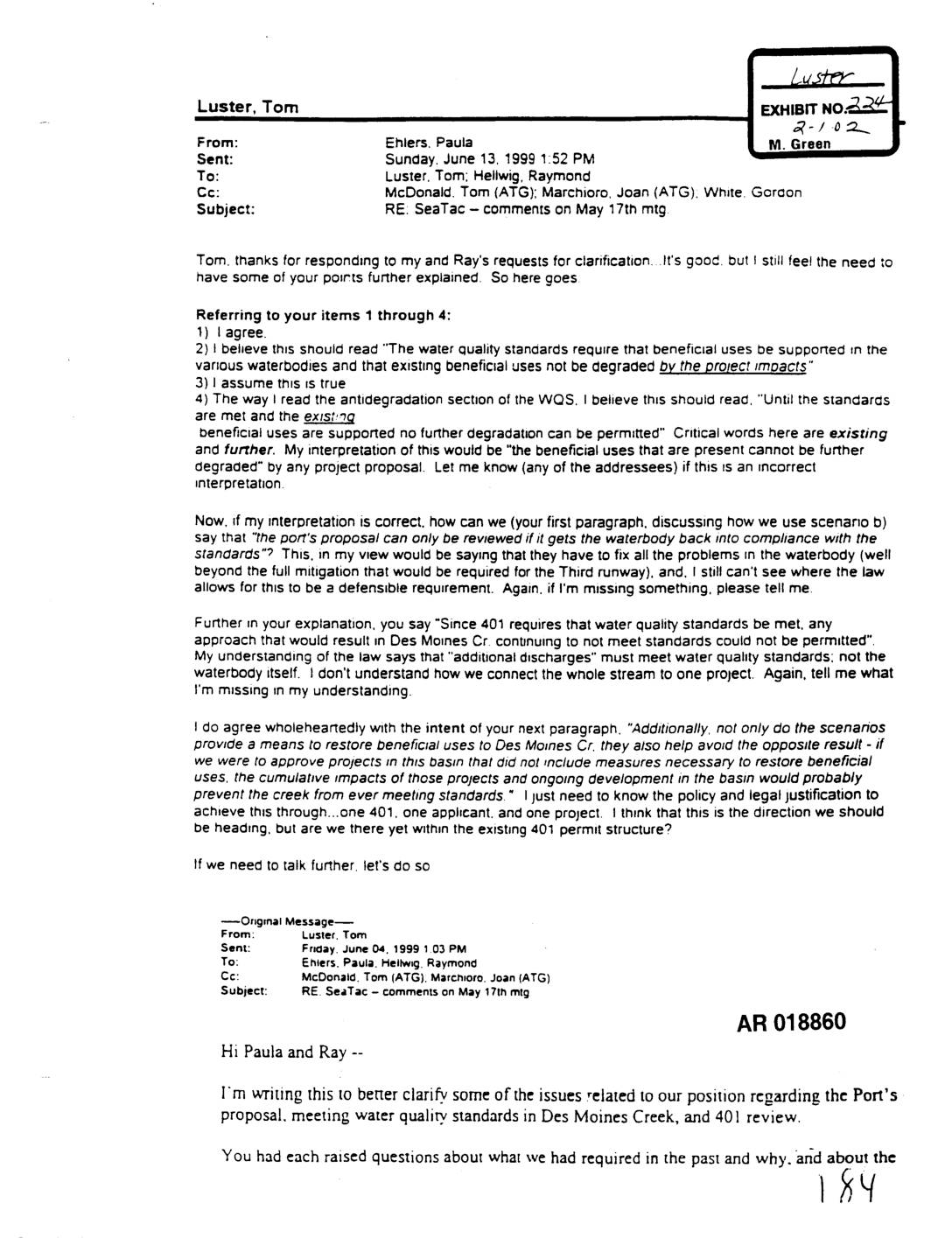
    Exhibit 224: Email Chain RE: Sea-Tac – Comments on May 17th Meeting, Water Quality Standards and 401 Certification for Des Moines Creek

    This 1999 email exchange between Washington State Department of Ecology staff debates the legal basis for requiring the Port of Seattle to restore water quality in Des Moines Creek as a condition of receiving a Section 401 water quality certification for the Sea-Tac Airport third runway project. The central question is whether Ecology can require a single applicant to fix broader watershed problems that pre-exist their project, or whether mitigation can only address the applicant's direct project impacts. Staff ultimately conclude that under antidegradation requirements, no further degradation of the creek can be permitted until existing beneficial uses are restored, meaning the Port's mitigation plan must include measures such as flow augmentation and stormwater controls to bring the creek into compliance with water quality standards.
    TagsACC, Des Moines Creek, Ecology, PCHB, Pollution Control Hearings Board, Third Runway, Water Quality
  • 1999-06-01

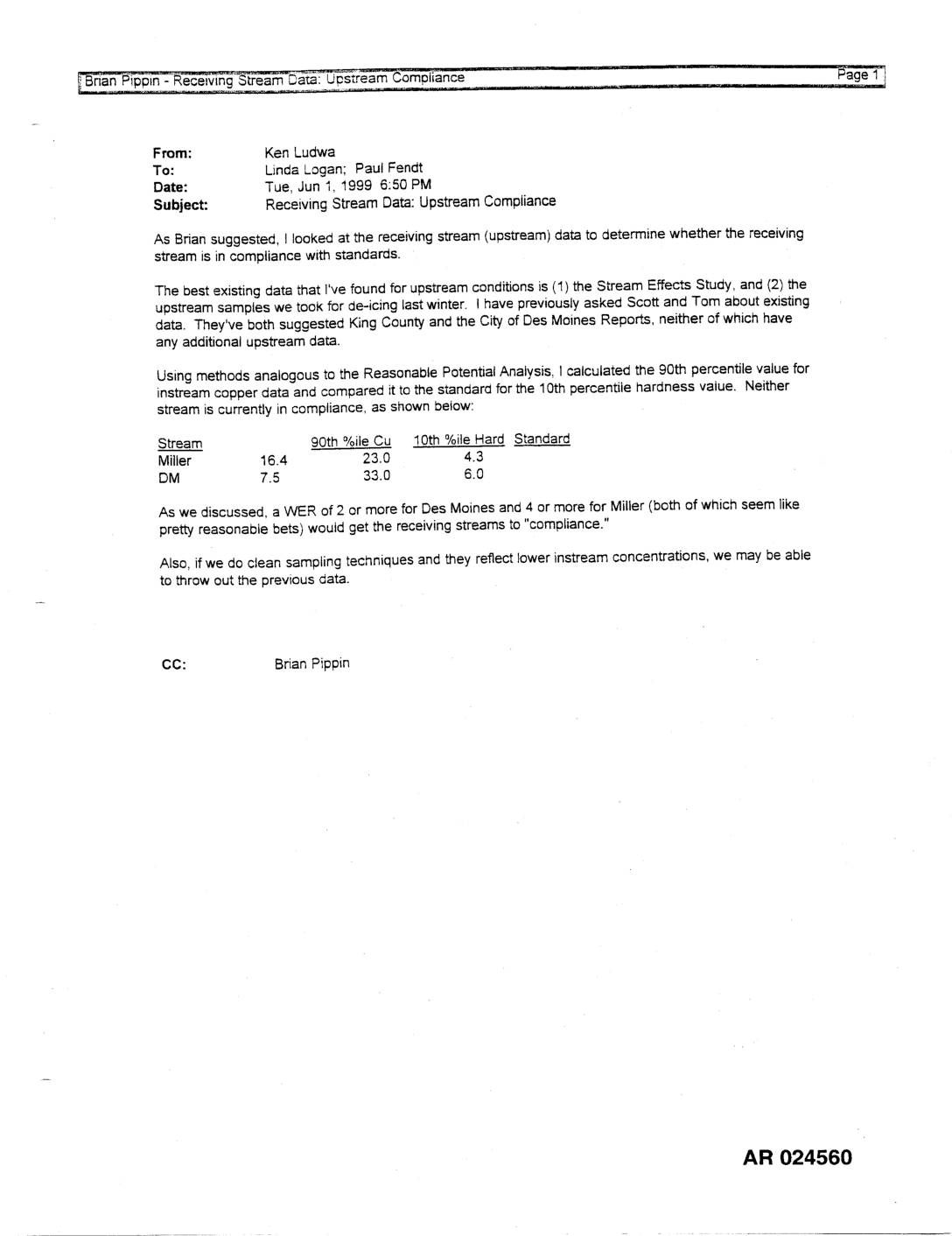
    EXH AR024560: Internal Email — Upstream Compliance Data, Miller Creek & Des Moines Creek

    A 1999 internal email from Ken Ludwa to airport staff reports that upstream water quality data for Miller Creek and Des Moines Creek shows both streams exceed copper concentration standards, meaning neither is currently in compliance. The analysis suggests that applying a Water Effect Ratio (WER) adjustment of 2 or more for Des Moines Creek and 4 or more for Miller Creek could bring the streams into apparent compliance with water quality standards. The email also raises the possibility of conducting new clean sampling to potentially replace the existing non-compliant data.
    TagsACC, Des Moines Creek, Miller Creek, PCHB, Pollution Control Hearings Board, Third Runway, Water Quality
  • 1999-05-28

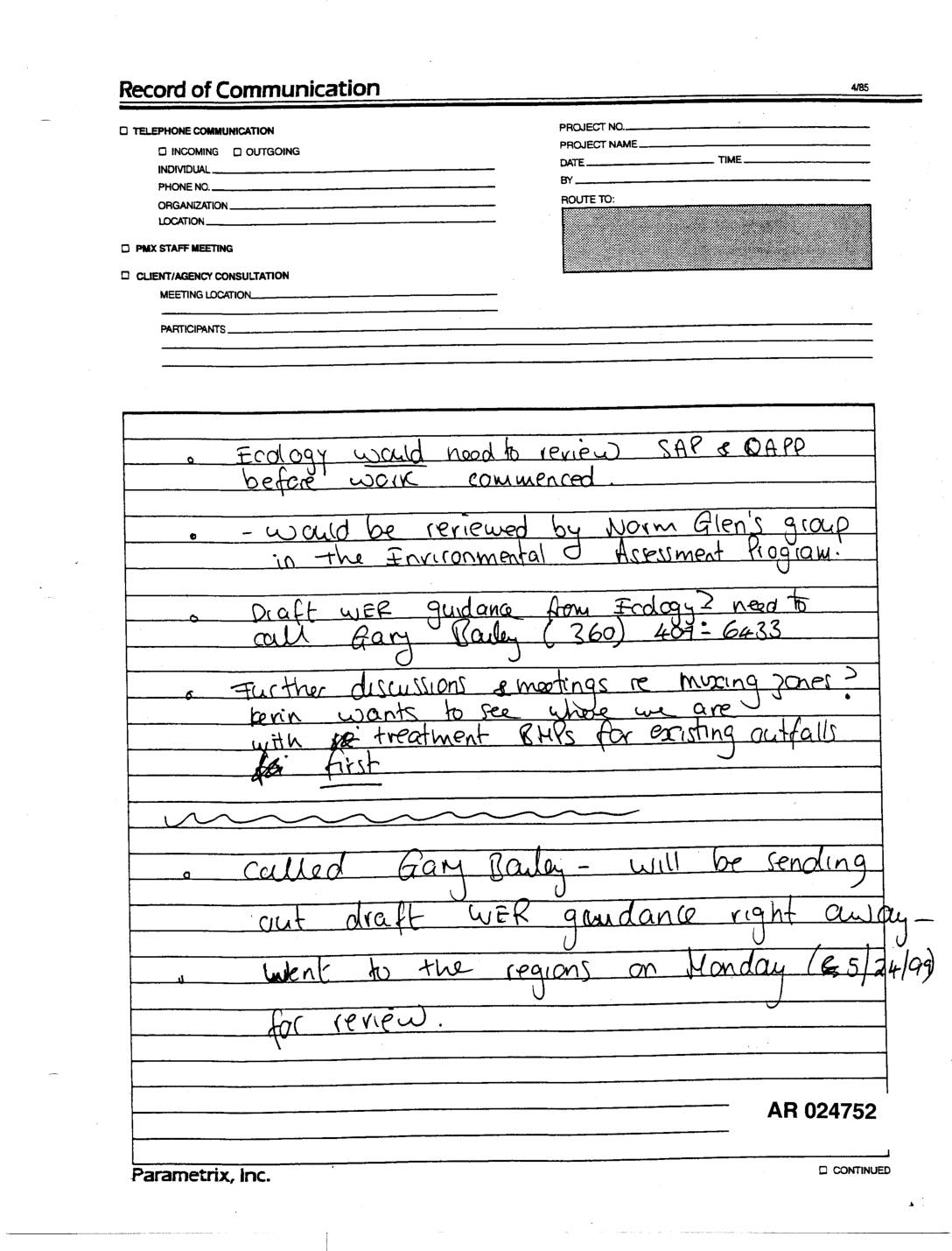
    EXH AR024752: Ecology Review of SAP/QAPP and WER Guidance for Port Discharges

    These internal communication records from Parametrix, Inc. (dated around May 1999) document discussions between environmental consultants and Washington State Department of Ecology staff regarding sampling and analysis protocols for port discharge outfalls. Key topics include the need for Ecology to review a Site Assessment Plan (SAP) and Quality Assurance Project Plan (QAPP) before work commenced, the applicability of clean sampling techniques for measuring copper concentrations in discharge water, and the distribution of draft Water Effluent Regulations (WER) guidance to regional offices for review.
    TagsACC, Ecology, PCHB, Pollution Control Hearings Board, Port Of Seattle, Third Runway, Water Quality
  • 1999-05-14

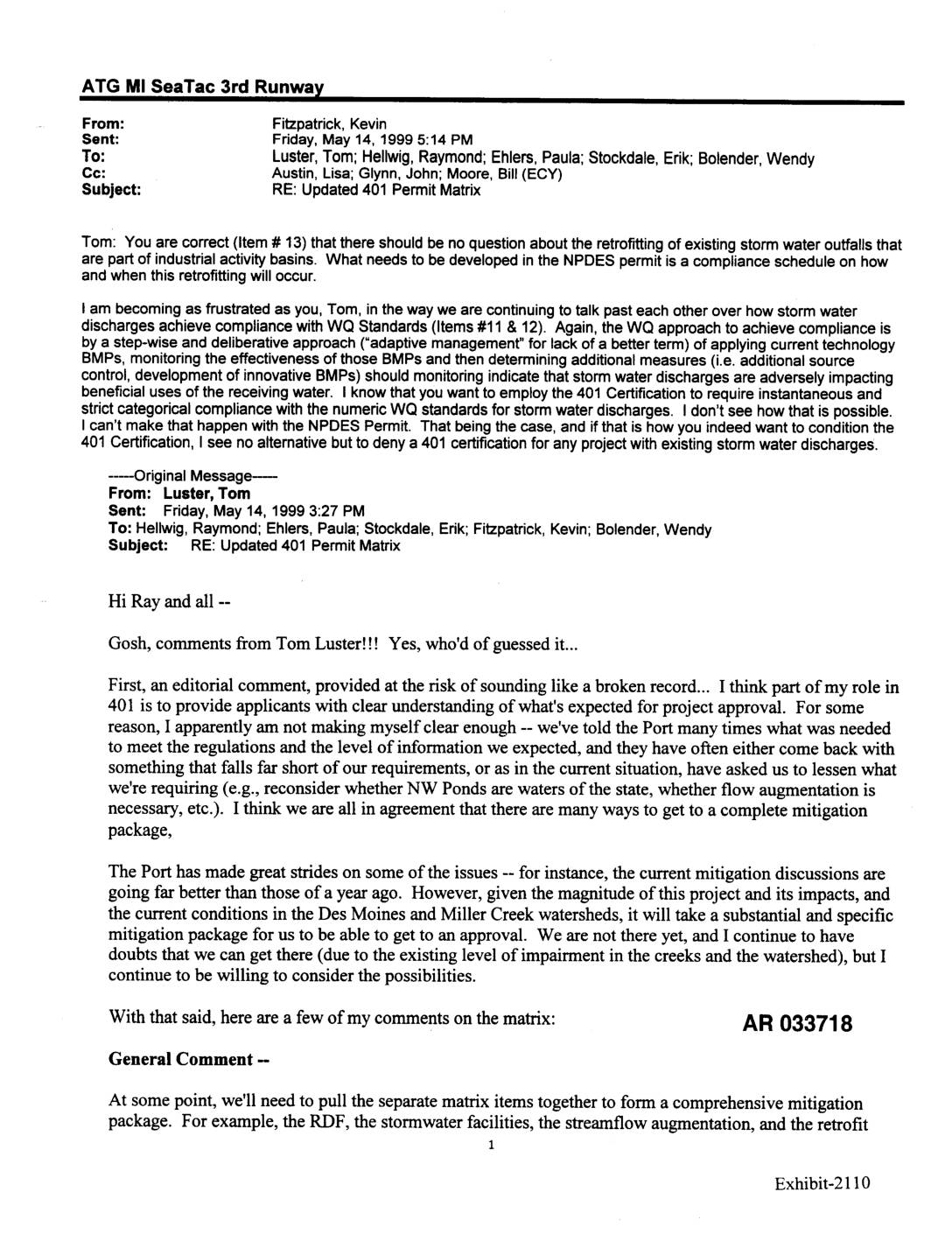
    Exhibit 2110: AR 033718 — Ecology Internal Email Chain on 401 Certification and Stormwater for Sea-Tac Third Runway

    Exhibit 2110, AR 033718. Internal Washington State Department of Ecology email chain dated May 14, 1999, among Kevin Fitzpatrick, Tom Luster, Raymond Hellwig, Paula Ehlers, Erik Stockdale, Wendy Bolender, Lisa Austin, John Glynn, and Bill Moore regarding the 401 Certification and NPDES permit matrix for the Sea-Tac Airport Third Runway project. Key issues include stormwater
    TagsACC, Ecology, NPDES, Pollution Control Hearings Board, Stormwater, Third Runway, Water Quality
  • 1999-05-14

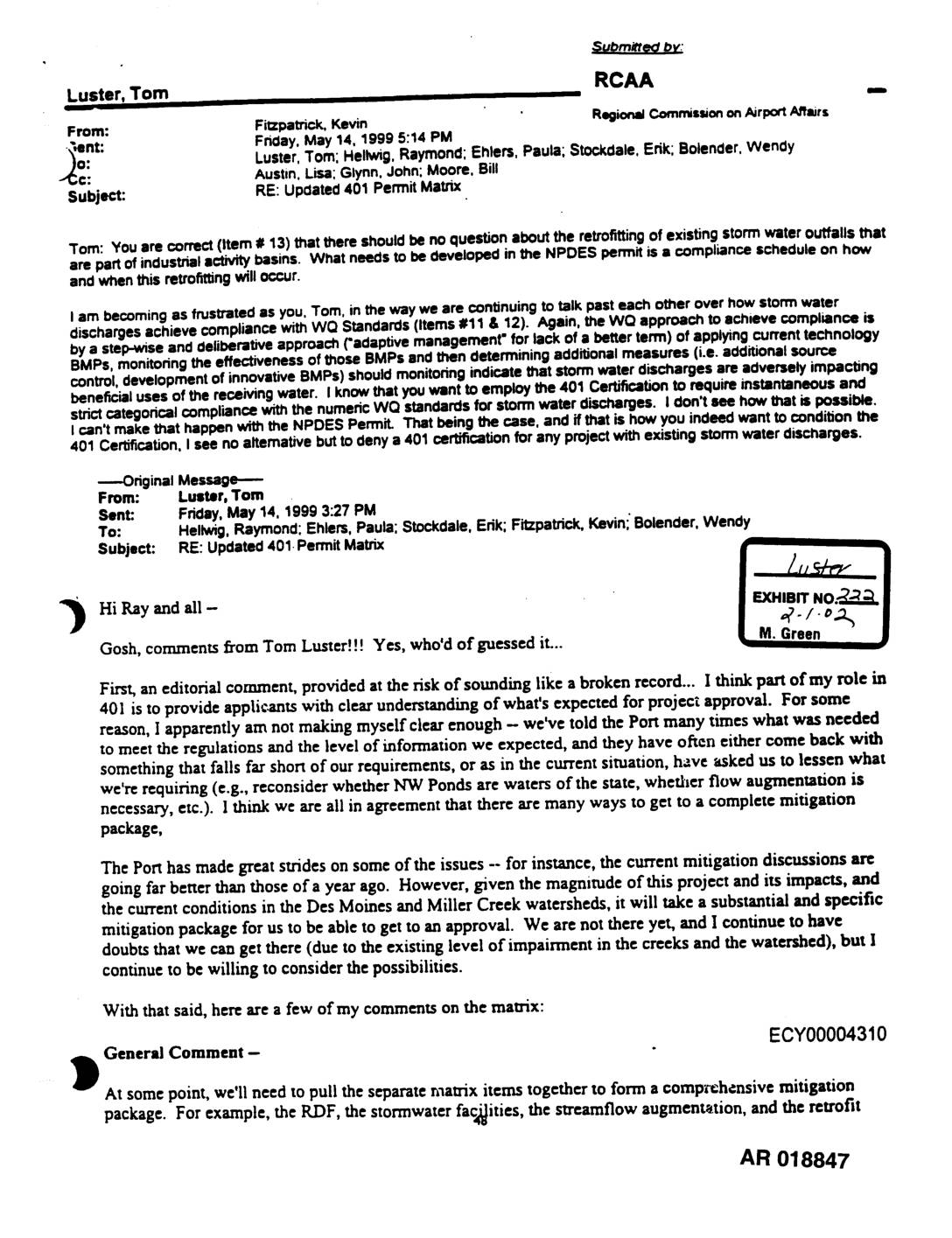
    Exhibit 222: Email Chain RE: Updated 401 Permit Matrix — Luster (Ecology) and Fitzpatrick on Stormwater, NPDES, and Water Quality Standards for Sea-Tac Third Runway

    This 1999 email chain between Washington State Department of Ecology officials discusses the 401 Water Quality Certification process for a major Port of Seattle project affecting Des Moines and Miller Creek watersheds near Sea-Tac Airport. Key disputes include stormwater discharge compliance with water quality standards, required mitigation measures such as riparian buffers and stream flow augmentation, and the retrofitting of existing stormwater outfalls. Officials warn that the creeks are already hydrologically impaired, with flood and erosion conditions far exceeding pre-development levels, making it difficult to approve the project without a comprehensive and specific mitigation package.
    TagsACC, Des Moines Creek Basin Plan, Ecology, NPDES, Pollution Control Hearings Board, Third Runway, Water Quality
  • 1999-05-10

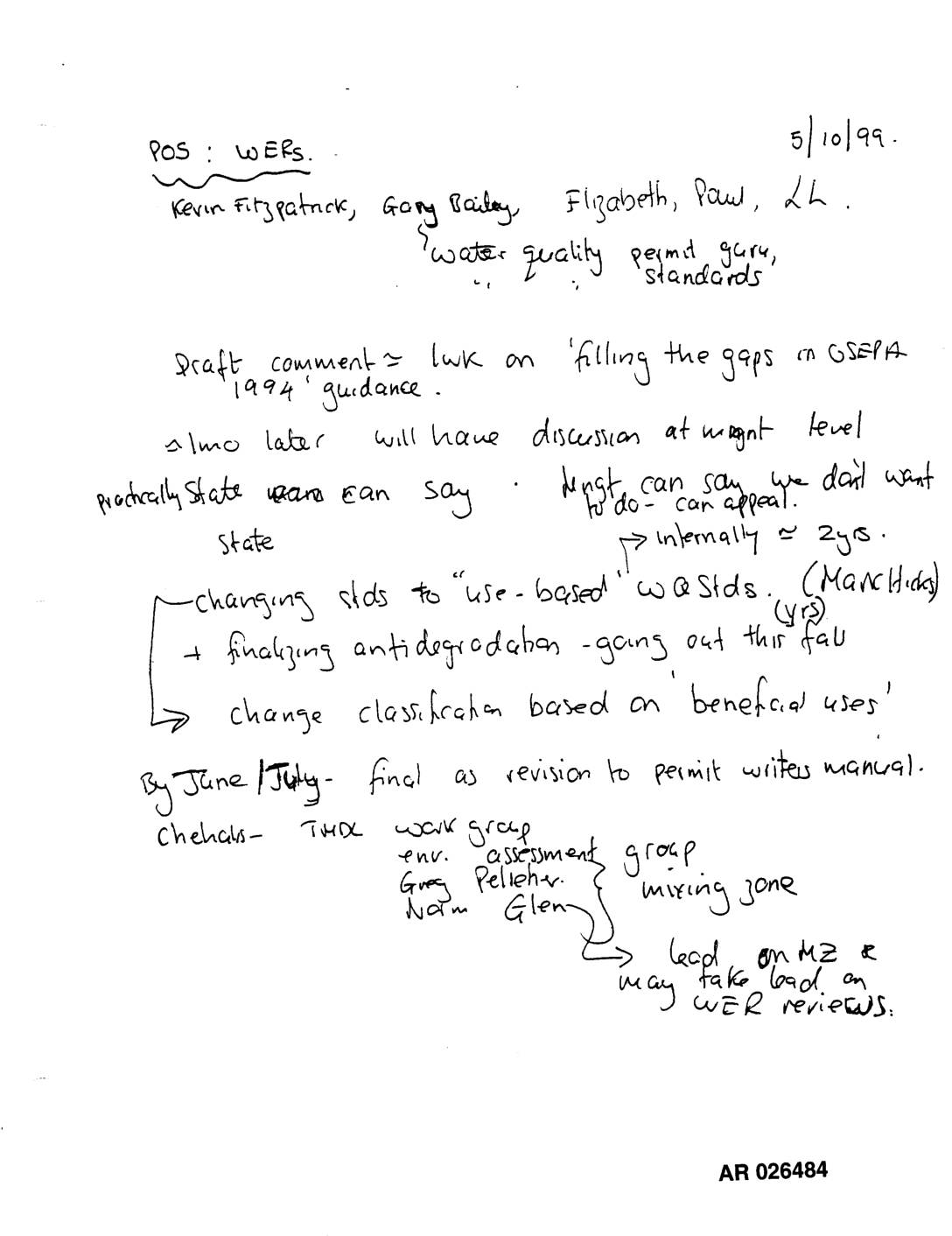
    EXH AR026484: Handwritten Meeting Notes Water Quality Permit Standards WER Guidance POS/WERS 5/10/99

    These handwritten meeting notes dated 5/10/99 document a discussion among water quality staff including Kevin Fitzpatrick and Gary Bailey regarding permit standards and guidance. Topics covered include updating water quality standards to 'use-based' classifications, finalizing antidegradation rules, and establishing sampling protocols such as requiring at least 5 days of sampling during critical low-flow conditions. The notes also address mixing zone limits, AKART conditions for permit outfalls, and revisions to the permit writer's manual expected by June or July.
    TagsACC, Ecology, Handwritten Notes, NPDES, PCHB, Pollution Control Hearings Board, Third Runway, Water Quality
  • 1999-05-01

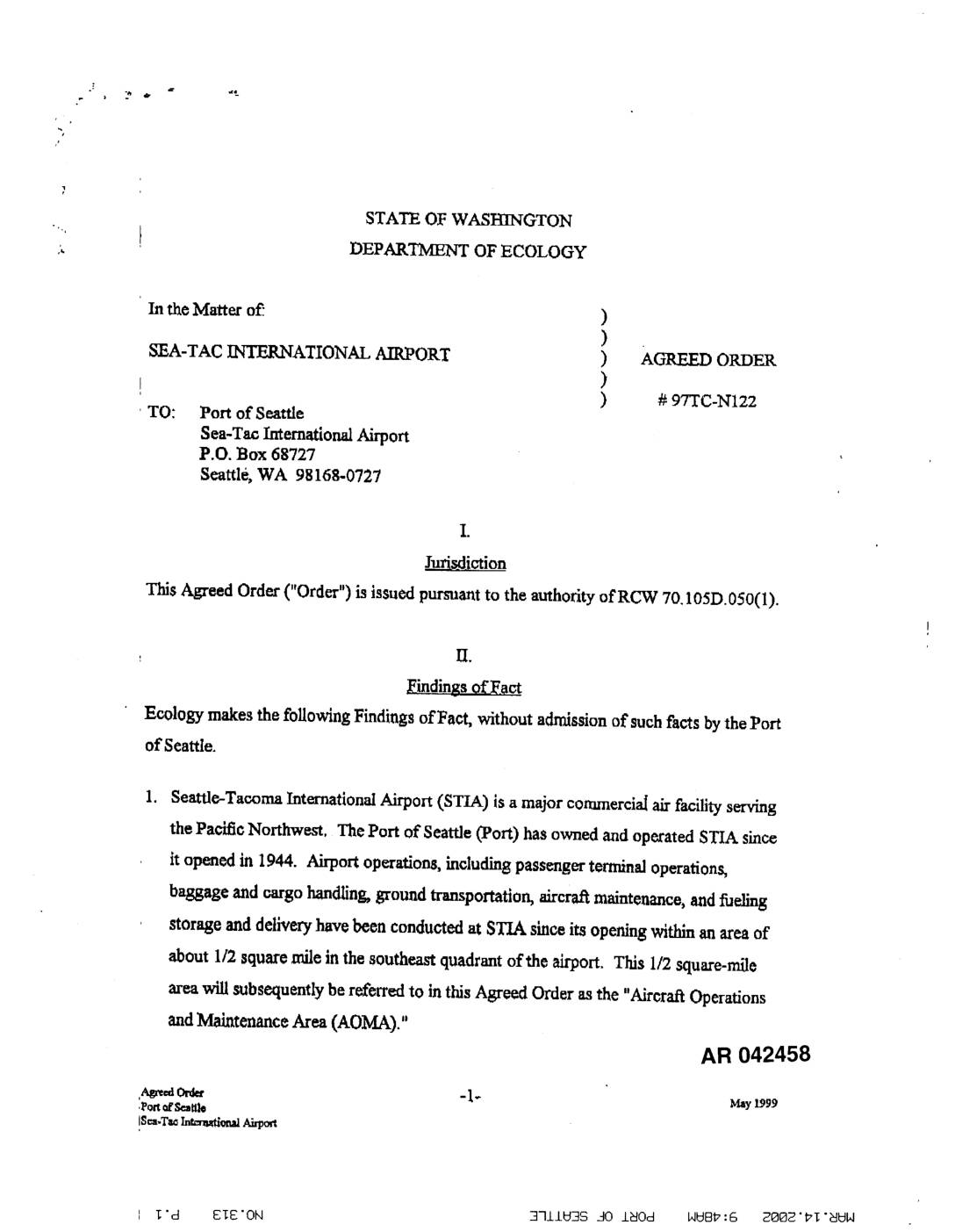
    EXH AR042458: Agreed Order #97TC-N122 — State of Washington Ecology vs. Port Of Seattle, Sea-Tac Airport

    Agreed Order #97TC-N122 issued by Washington State Department of Ecology under RCW 70.105D.050(1) directed to Port Of Seattle regarding hazardous substance contamination at Seattle-Tacoma International Airport (STIA). Documents thirteen contaminated sites within the Aircraft Operations and Maintenance Area (AOMA), a 1/2 square-mile area in the southeast quadrant of the airport, contaminated with jet fuel, gasoline,
    TagsACC, Ecology, MTCA, Pollution Control Hearings Board, Port Of Seattle, Sea-Tac Airport, Water Quality
  • 1999-05-01

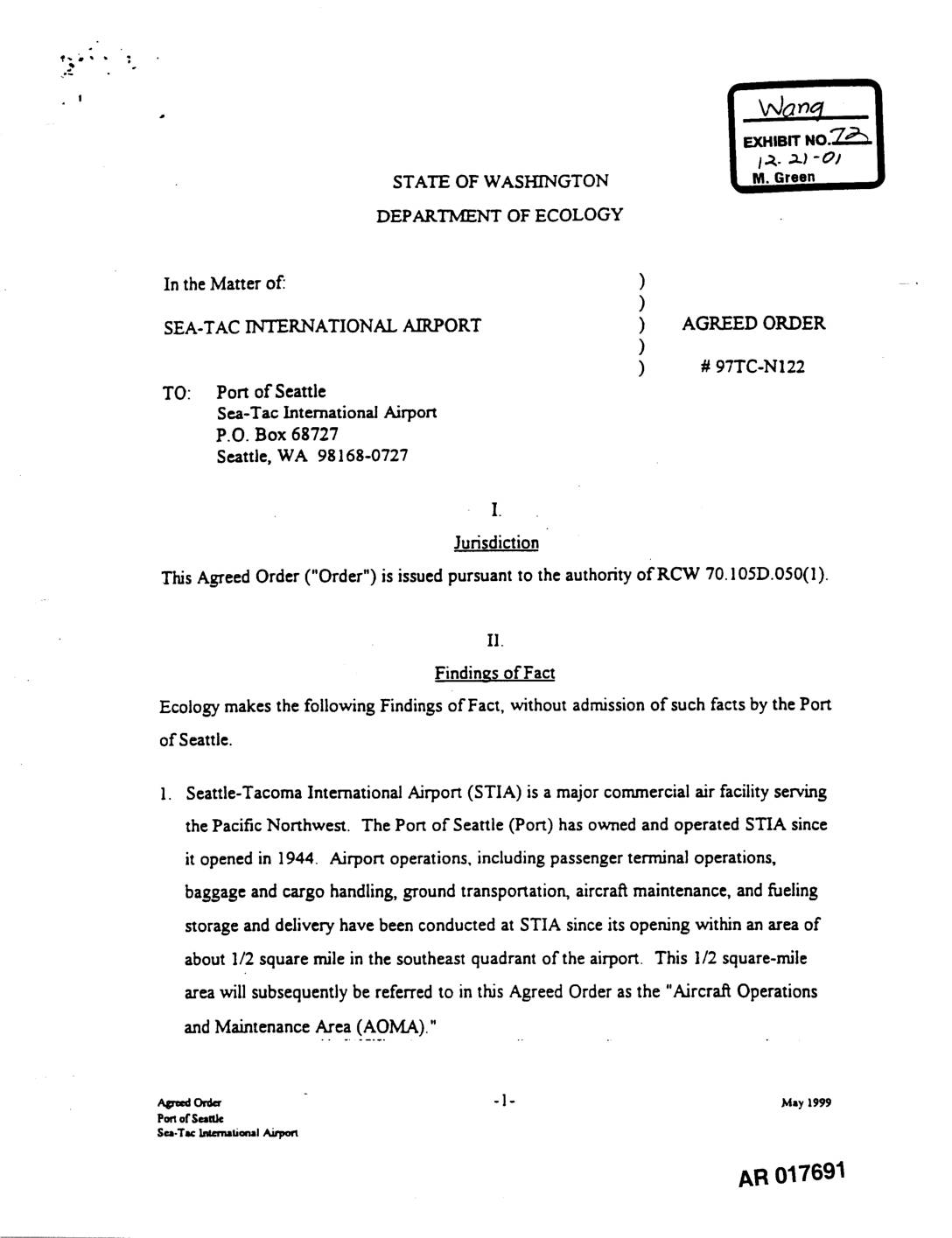
    EXH AR017691: Agreed Order #97TC-N122 — State of Washington Ecology vs. Port Of Seattle, Sea-Tac Airport

    Washington State Department of Ecology Agreed Order #97TC-N122 issued to Port Of Seattle for Seattle-Tacoma International Airport (STIA), pursuant to RCW 70.105D.050(1). Documents hazardous substance releases within the Aircraft Operations and Maintenance Area (AOMA), a half-square-mile southeast quadrant of STIA operational since 1944. Contaminants identified include jet fuel (most abundant by bulk volume), gasoline, industrial
    TagsACC, Ecology, MTCA, Pollution Control Hearings Board, Port Of Seattle, Sea-Tac Airport, Water Quality
  • 1999-04-30

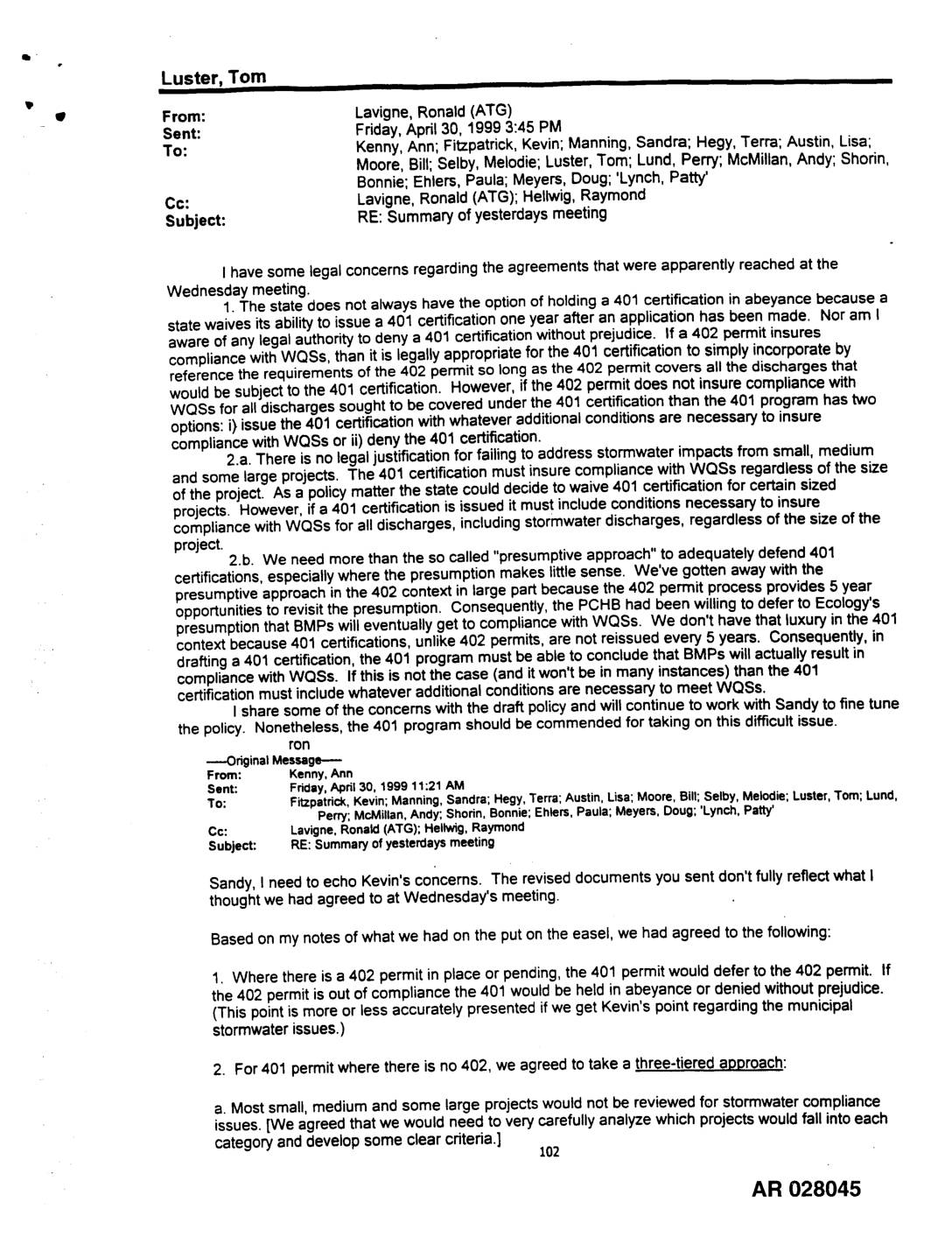
    EXH AR028045: Email Chain — Legal Concerns Regarding 401 Certification and Stormwater WQS Compliance Policy

    Email chain dated April 30, 1999 from Ronald Lavigne (ATG) and Ann Kenny to Washington State Department of Ecology staff including Sandra Manning, Kevin Fitzpatrick, and others, raising legal concerns about agreements reached at a Wednesday meeting regarding 401 certification and 402 permit policy. Lavigne raises issues including: the state’s one-year waiver deadline for 401
    TagsACC, Clean Water Act, Ecology, PCHB, Pollution Control Hearings Board, Stormwater, Water Quality

Posts pagination

Page 1 … Page 39 Page 40 Page 41 Page 42 Page 43 … Page 48
Sidebar On/Off

Upcoming Events

  • StART SEA Stakeholder Advisory Round Table
    Add to CalendarMWednesday Aug 26, 5:00pm - 7:00pm
    Zoom (Virtual Meeting)
    START meetingagenda 2026826 final 0 pdf

    Meeting Objectives Introduce the primary feedback themes identified by StART members regarding StART’s Operating Procedures and determine areas that may warrant future discussion. 5:00 PM – Welcome Meeting Management Welcome Lead: Andrés Mantilla, Facilitator, Uncommon Bridges; Wendy Reiter, Airport Managing Director, POS 5:15 PM – Dinner: All participants eat. 5:30 PM – StART Operating Procedures

    [...]
  • Commercial Aviation Work Group
    Add to CalendarMThursday Sep 3, 10:00am - 1:30pm
    Virtual Meeting (Zoom)
    Cawg agenda sep 3 26 virtual pdf

    Meeting Agenda 10:00 a.m. – 10:15 a.m. | Welcome – Evan Nordby, Chair a. Introductions and Agenda Reviewb. Status of appointments and non-voting member invitationsc. Other updates as necessary 10:15 a.m. – 11:00 a.m. | Is it practical and legal to operate the western Washington [Puget Sound] airports as a single airport system? – Consultant

    [...]

[See all...]


Help study childhood asthma. Get free HEPA filter!

read more...

Issues

Sea-Tac Airport is currently undergoing the largest and longest expansion in its history, collectively known as the Sustainable Airport Master Plan (SAMP). Some of it you can already hear, but you’re probably not aware of what it all means. Here’s what you need to know.
read more...

Read This!

As the source for federal transportation grants, the Puget Sound Regional Council was charged with developing a system to meet the growing need for commercial aviation. When the search for a second airport failed, they authorized the Port of Seattle to build the Third Runway, with a mandate to develop a noise abatement and mitigation program. In their effort to stop the Third Runway, the ACC argued over every detail of the Port's efforts--including property buyouts and sound insulation. The dispute was meant to be settled by a three member Expert Arbitration Panel. This is their final report. It finds 2-1, that the Port's program was insufficient in several respects. Despite that, funding for the Third Runway was approved by the PSRC, and the 'Port Package' program, proceeded largely unchanged. Expert Arbitration Panel's final decision finding that the Port of Seattle had not shown sufficient reduction in real on-the-ground noise impacts to satisfy noise reduction conditions required for approval of a third runway at Sea-Tac International Airport. The majority decision concluded the Port's noise abatement programs were insufficient despite being impressive in scope.
continue...

The Podcast!

Subscribe to the only podcast devoted to policies, politics, history, impacts for people living under the flight path everywhere. It’s definitely not just about noise!
  • Sea-Tac Noise.Info
  • Connect with STNI

    • Subscribe
    • Port Package Problem?
    • Donate
    • Podcast
    • Socials
      • Facebook
      • X (Twitter)
      • Bluesky
      • Instagram

    "Meeting our green goals" — , 2016

  • Learn

    • Frequently Asked Questions
    • Explainers
    • Youtube
    • Research Requests
    • Make a complaint
  • Goals

    Fulfill the promises of 1976:
    • Compensation
    • Reduced noise
    • Improved air quality
    • Environmental remediation
Login/Register
©2026•Data Privacy

Message

We use cookies to provide basic functionality. We also provide access to search engines in order to provide site analytics. We do not sell or share your data.
V V