Notes
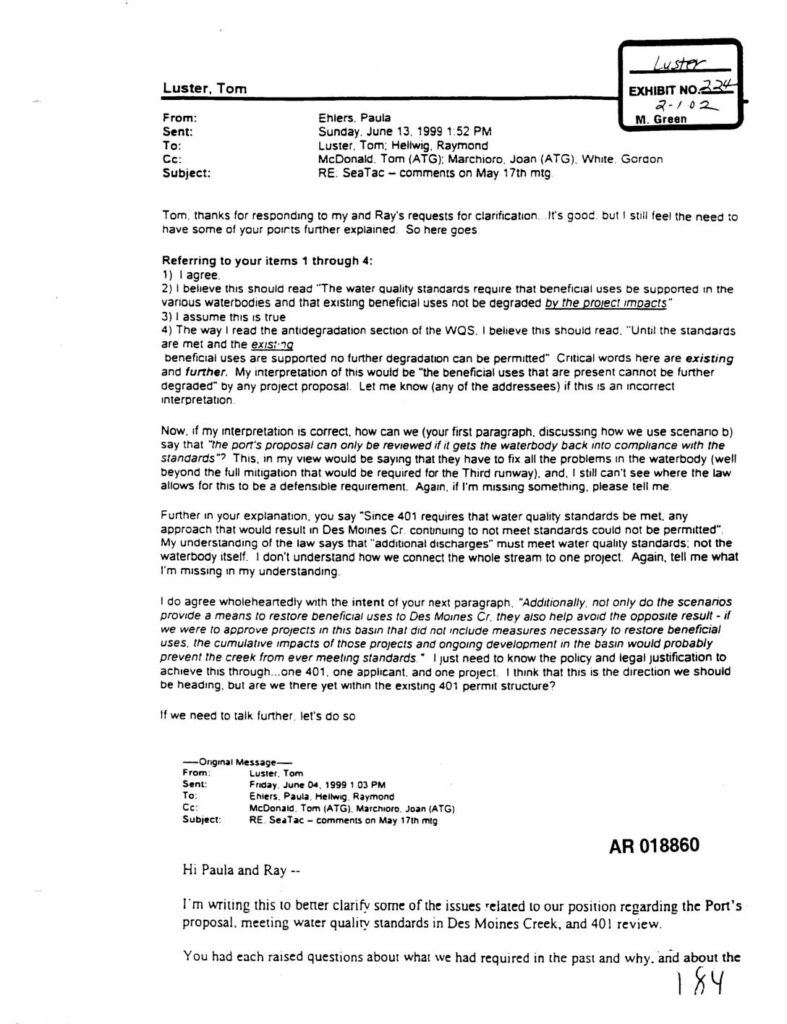
Exhibit 224 (AR 018860–018862) is a June 1999 email chain among Washington State Department of Ecology staff — Paula Ehlers, Tom Luster, and Raymond Hellwig — copied to Tom McDonald and Joan Marchioro (ATG) and Gordon White, concerning 401 water quality certification review of the Port Of Seattle’s Sea-Tac Airport third runway proposal and its impacts on Des Moines Creek. The exchange debates antidegradation requirements under Washington Water Quality Standards, whether 401 authority requires a project applicant to restore the entire waterbody to compliance before a permit can be issued, and two scenarios (a: deny permits until standards met; b: allow review if applicant’s mitigation restores beneficial uses). Key topics include Des Moines Creek Class AA beneficial uses, stormwater flows, base flows, water temperature, contaminants, TMDL, RDF (Retention/Detention Facility), flow augmentation, NPDES, and WAC/RCW antidegradation policy. Tom Luster argues both scenarios are defensible uses of Clean Water Act Section 401; Paula Ehlers questions the legal and policy basis for requiring one applicant to fix watershed-wide impairments.