TagWater Quality(475)
-
 1999-10-21
EXH AR042698: Sea-Tac Airport Dissolved Oxygen Deicing Study and Ecology Response Letter
Dissolved Oxygen Deicing Study prepared by Cosmopolitan Engineering Group for Port Of Seattle Sea-Tac International Airport (AR042698, August 1999), examining impacts of de-icing agents from airport stormwater runoff on Miller Creek and Des Moines Creek, including BOD5 discharges to NW Ponds and Lake Reba. Accompanied by Washington State Department of Ecology (NWRO) response letter dated -
 1999-10-20
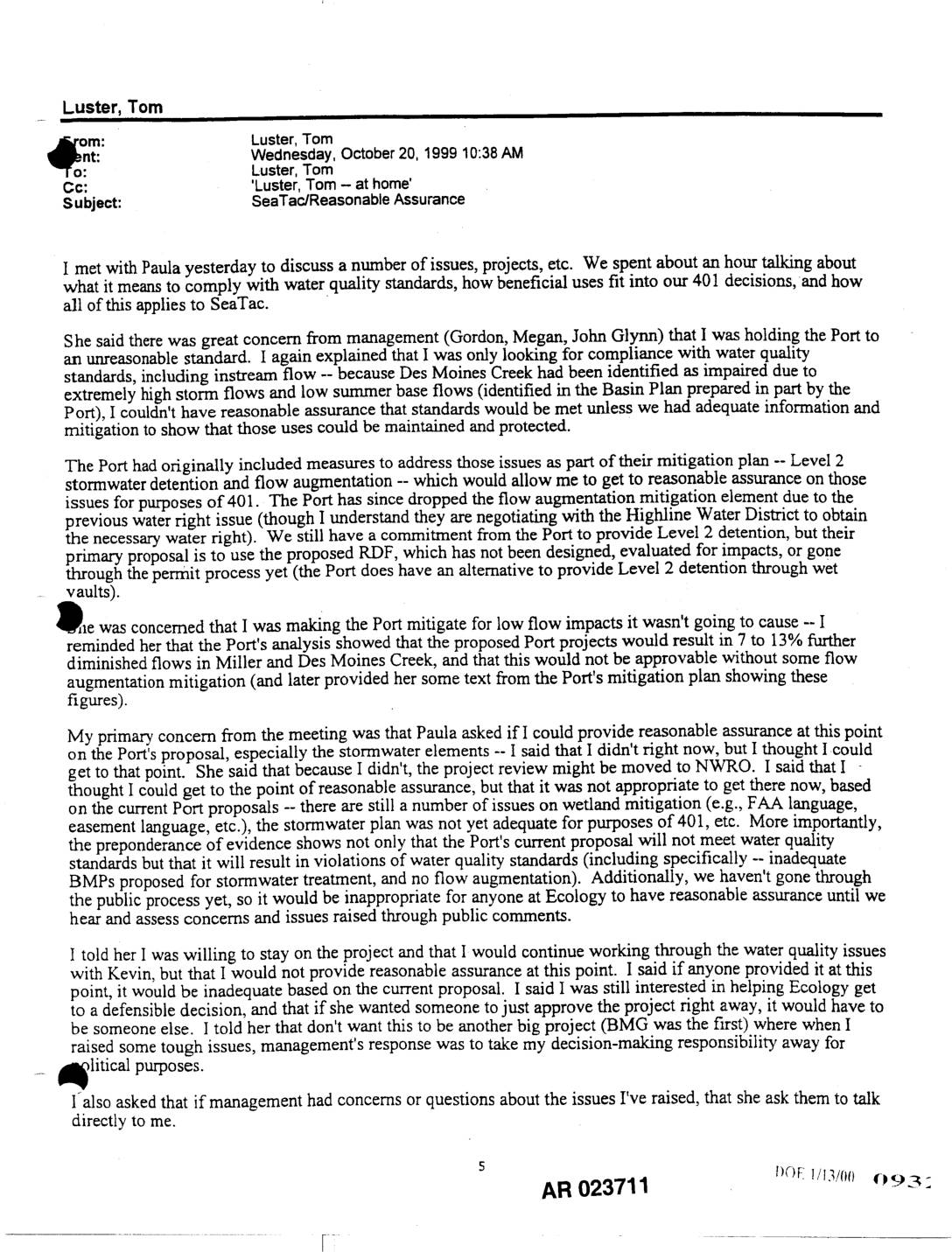
EXH AR023711: Internal Email — Tom Luster on Sea-Tac Third Runway 401 Certification and Reasonable Assurance
In this October 1999 internal memo, Washington State Department of Ecology staffer Tom Luster describes a meeting with his supervisor Paula regarding the agency's water quality review of Sea-Tac Airport expansion. Luster explains that he cannot yet provide 'reasonable assurance' that the Port of Seattle's proposal will meet water quality standards for Des Moines Creek, citing inadequate stormwater treatment plans and the Port's removal of flow augmentation measures from its mitigation plan. He expresses concern that management pressure to approve the project quickly could compromise the integrity of the regulatory review process. -
 1999-09-16
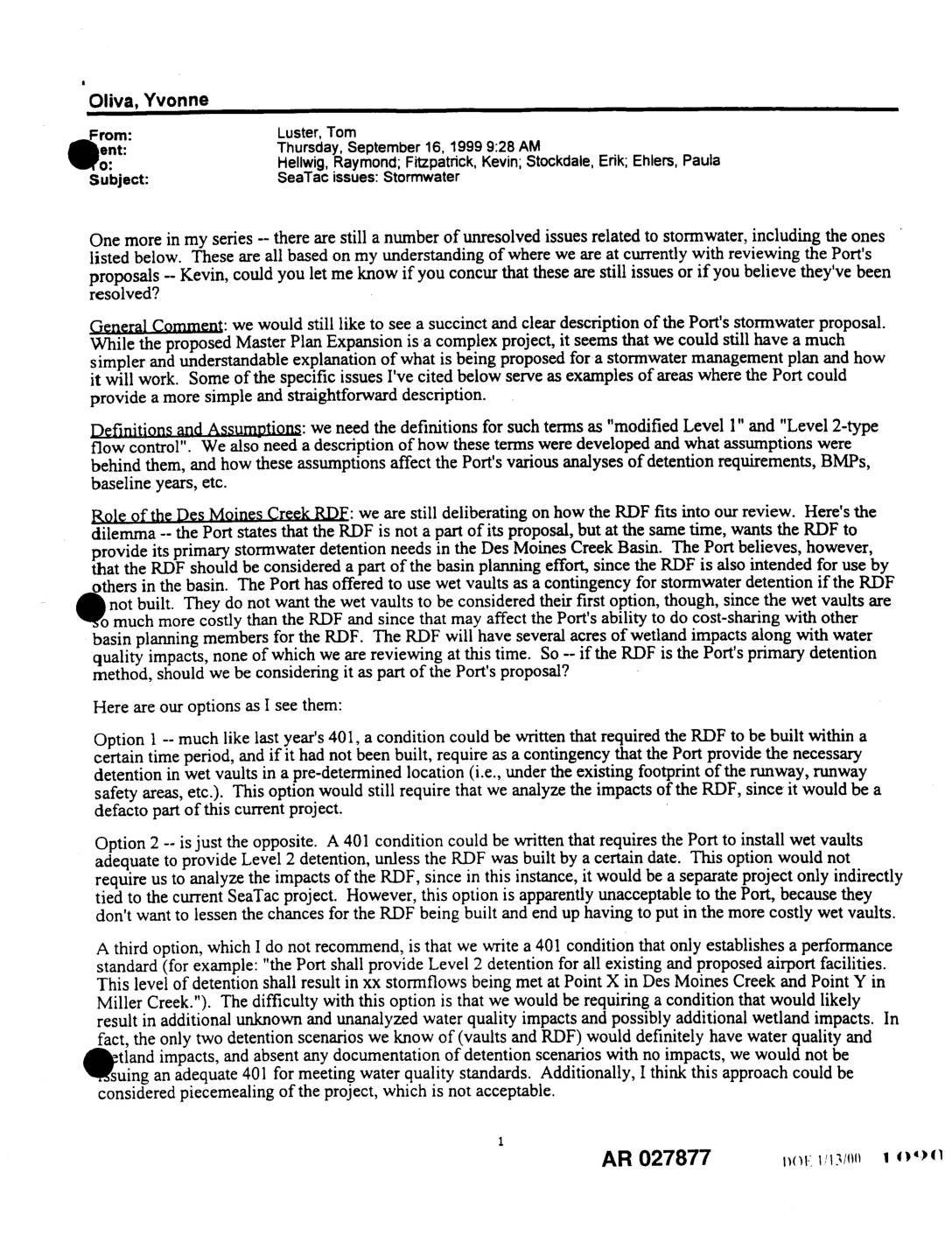
EXH AR027877: Internal Email on Unresolved Sea-Tac Stormwater Issues — 401/CZM Review, Des Moines Creek RDF, and Water Quality BMPs
Internal email from Tom Luster (Washington State Department of Ecology) to Raymond Hellwig, Kevin Fitzpatrick, Erik Stockdale, and Paula Ehlers dated September 16, 1999, outlining unresolved stormwater issues in the 401/CZM review of Port Of Seattle’s Sea-Tac Airport Master Plan Expansion. Topics include: definitions of ‘modified Level 1’ and ‘Level 2-type flow control’; role of -
 1999-09-16
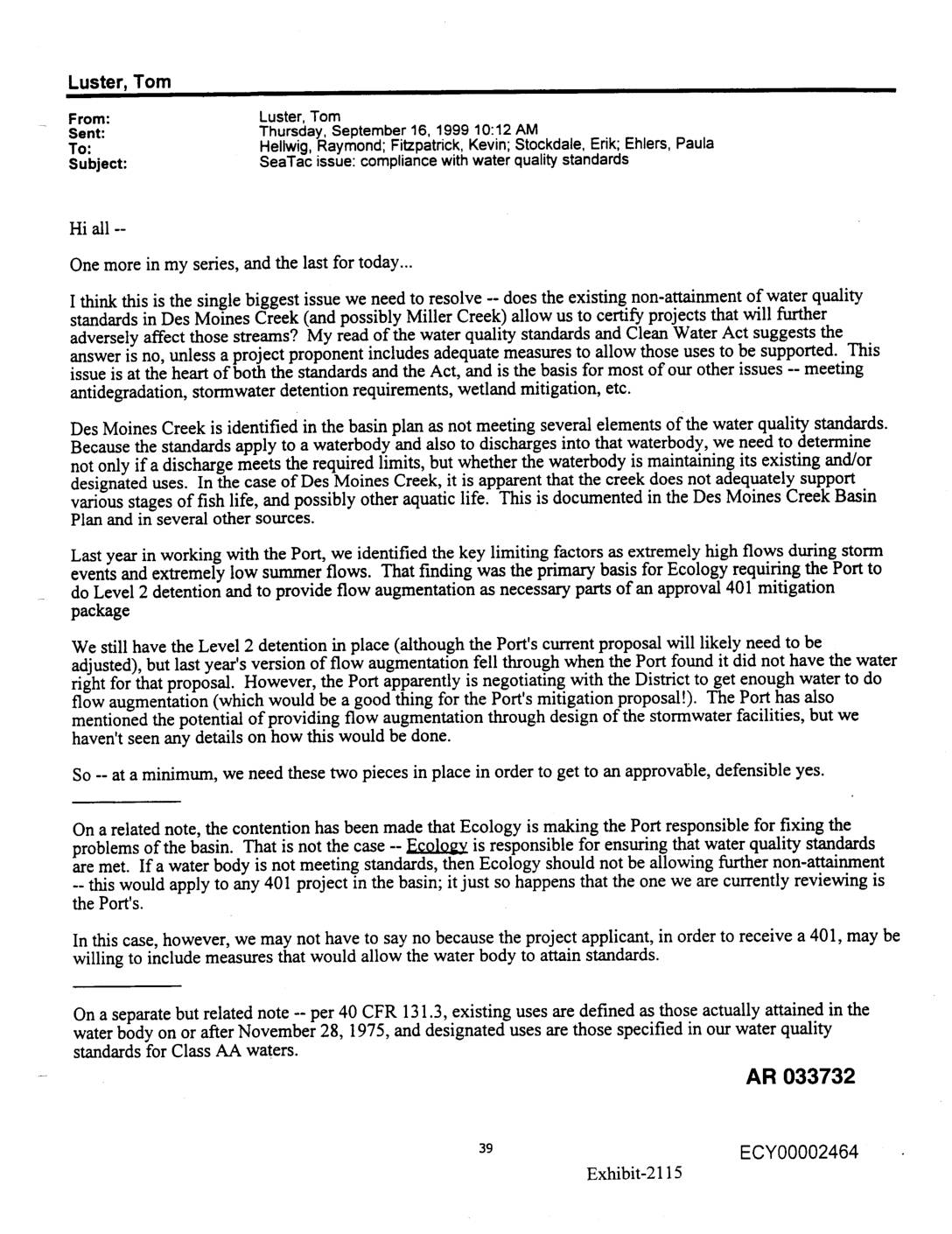
Exhibit 2115: Internal Email — Ecology on Sea-Tac Water Quality Standards Compliance, Des Moines Creek 401 Certification
Internal email from Tom Luster (Ecology) to Raymond Hellwig, Kevin Fitzpatrick, Erik Stockdale, and Paula Ehlers, dated September 16, 1999, regarding SeaTac Airport 401 certification and compliance with water quality standards under the Clean Water Act. Discusses non-attainment of water quality standards in Des Moines Creek and Miller Creek, antidegradation requirements, Level 2 detention requirements, -
 1999-09-16
EXH AR042985: Fax Transmittal and Map — Proposed Groundwater Level Monitoring Well Network, STIA Groundwater Study
Fax transmittal dated 9/16/99 from John Strunk of Associated Earth Sciences, Inc. (Bainbridge Island, WA) to Roger Nye at Ecology, transmitting a map showing proposed well locations for measuring groundwater levels at Seattle-Tacoma International Airport (STIA). The attached map titled ‘Proposed Groundwater Level Monitoring Well Network, STIA Groundwater Study’ (September 16th, 1999) shows on-site and -
 1999-09-07
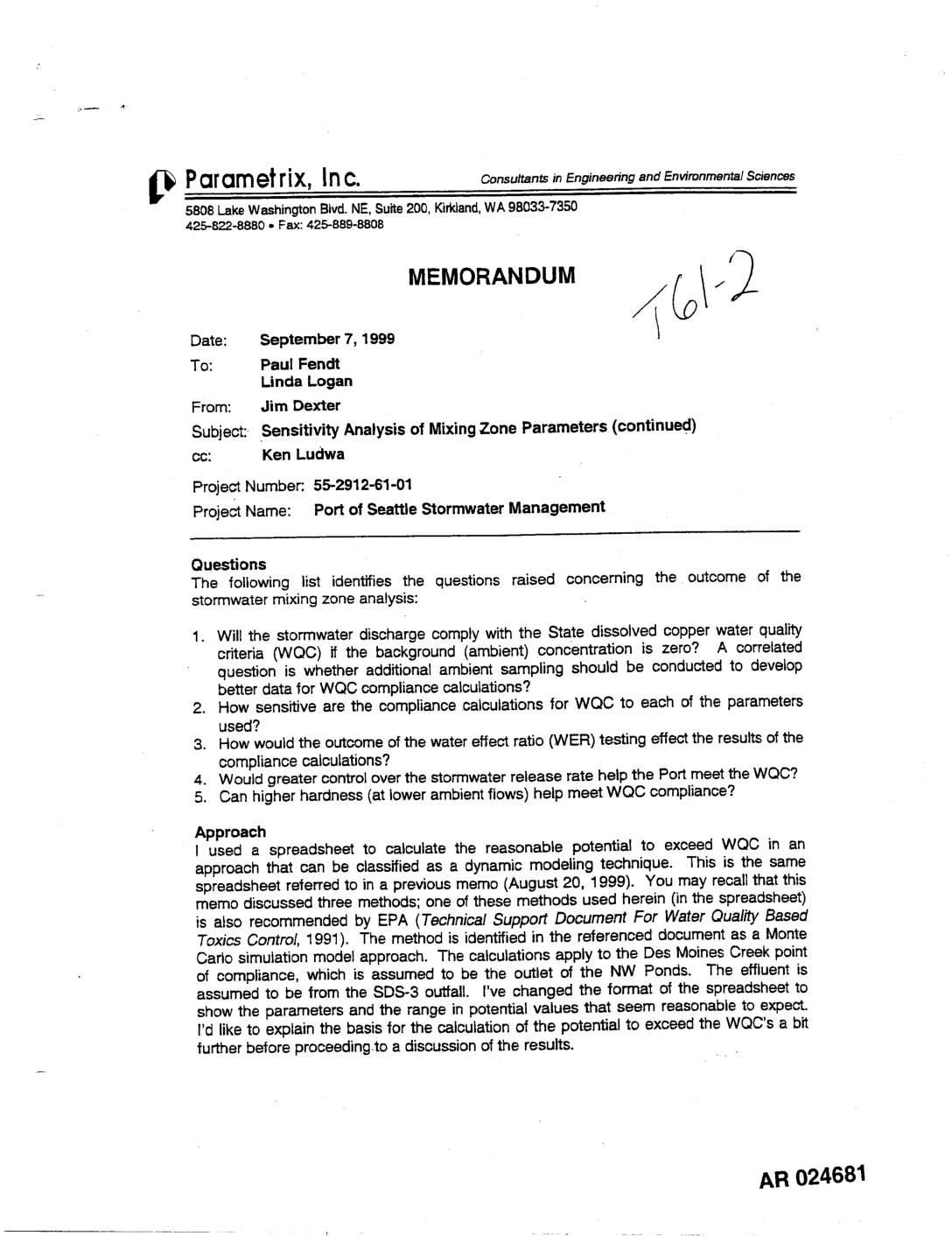
EXH AR024681: Sensitivity Analysis Mixing Zone Parameters (cont.) — Stormwater Mgmt
A 1999 technical memorandum from Parametrix, Inc. analyzes whether stormwater discharged near Des Moines Creek meets Washington State dissolved copper water quality criteria, using a Monte Carlo simulation model. The analysis finds that copper levels in the stormwater effluent consistently exceed water quality standards regardless of background ambient concentrations, with dilution factors generally less than 2. The study evaluates several potential remedies, including increased onsite detention, expanded mixing zones, and water effect ratio adjustments, finding that the Water Effect Ratio (WER) is the most influential factor in achieving compliance. -
 1999-09-01
EXH 428: Annual Stormwater Monitoring Report STIA Jul 1 1998–Jun 30 1999
This is the Annual Stormwater Monitoring Report for Seattle-Tacoma International Airport, covering the period from July 1, 1998 through June 30, 1999, prepared by the Port of Seattle. The report documents water quality sampling results from airport storm drainage systems, including measurements of petroleum hydrocarbons, metals, fecal coliforms, and the effects of aircraft and ground deicing activities on runoff. It includes data summaries, outfall inspections, and source tracing studies aimed at tracking and managing stormwater pollution from airport operations. -
 1999-09-01
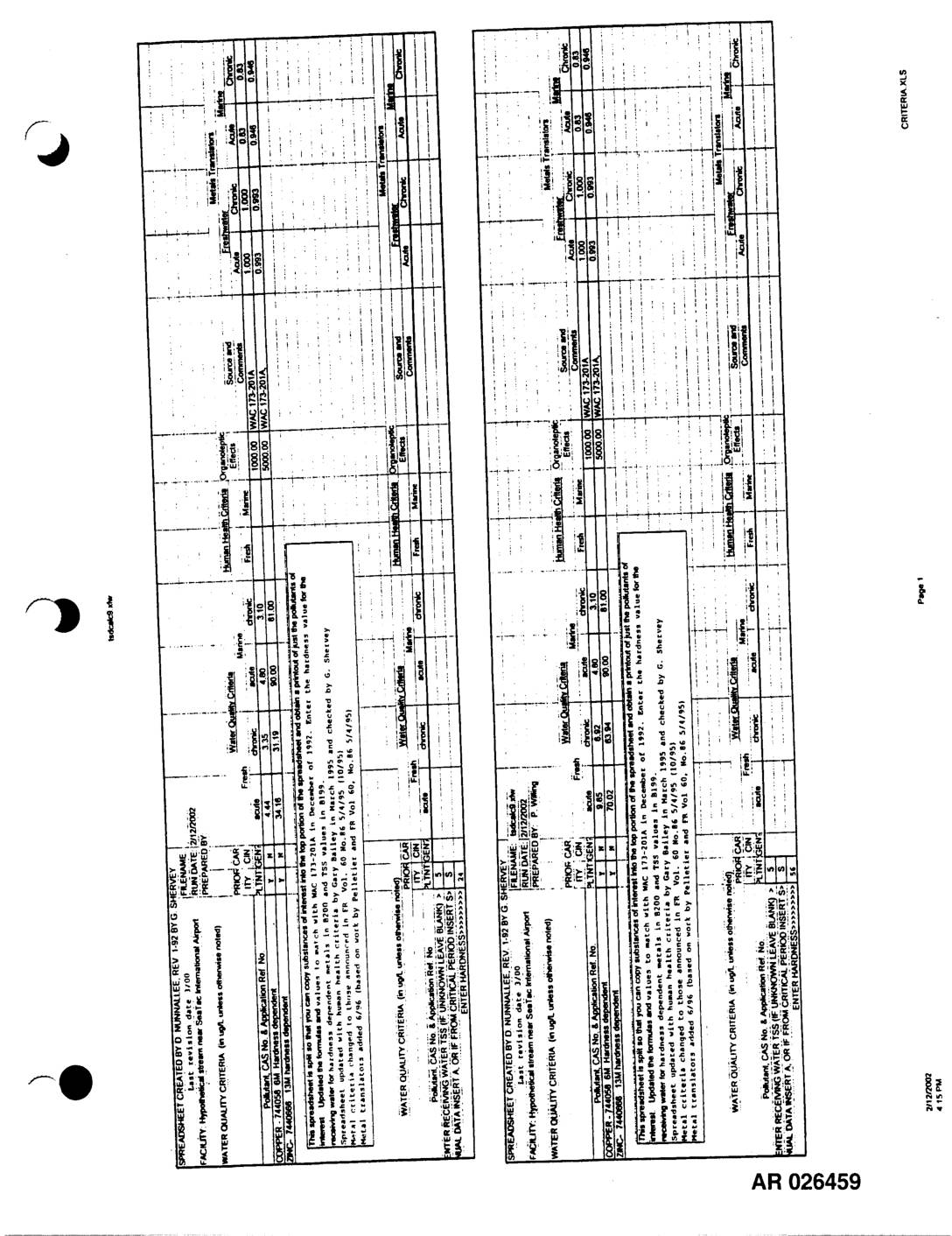
Exhibit 717: Annual Stormwater Monitoring Report for Seattle-Tacoma International Airport, July 1998–June 1999
Annual Stormwater Monitoring Report for Seattle-Tacoma International Airport (Sea-Tac Airport) covering July 1, 1998 through June 30, 1999, prepared by Port Of Seattle, September 1999 (AR 026459–AR 026461). Includes stormwater quality data tables for outfalls SDE4, SDS3, SDN1, and SDN4 with copper (CAS No. 7440-50-8) concentration measurements in micrograms per liter, hardness-dependent freshwater acute water -
 1999-09-01
EXH AR018047: Annual Stormwater Monitoring Report for Seattle-Tacoma International Airport, July 1, 1998 – June 30, 1999
Annual stormwater monitoring report (AR018047) prepared by Port Of Seattle for Seattle-Tacoma International Airport (STIA) covering the period July 1, 1998 through June 30, 1999. Documents NPDES stormwater sampling results across STIA storm drainage subbasins including grab and composite samples for total petroleum hydrocarbons (TPH), fecal coliforms, suspended solids (TSS), turbidity, biochemical oxygen demand (BOD5), -
 1999-08-23
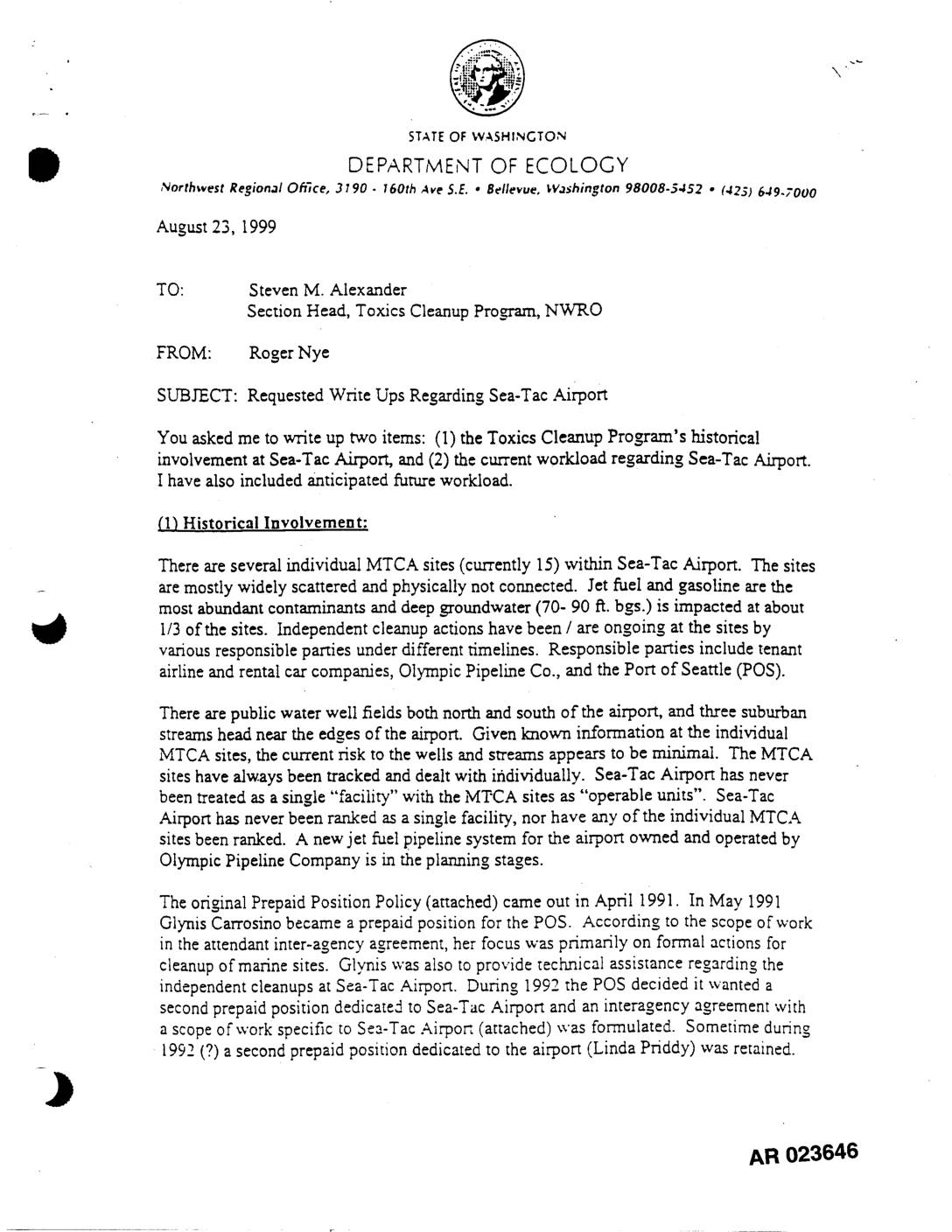
EXH AR023646: Ecology Internal Memo — Toxics Cleanup Program History & Workload at STIA
This 1999 internal memo from the Washington State Department of Ecology details the history of environmental cleanup oversight at Seattle-Tacoma International Airport, where 15 separate contaminated sites involving jet fuel and gasoline were managed individually under the state's Model Toxics Control Act. The memo describes a series of prepaid staff positions funded by the Port of Seattle to coordinate cleanup efforts with airline and pipeline companies, and the challenges in getting formal Agreed Orders signed. It concludes with an update that a key groundwater study Agreed Order was finally signed in May 1999 after receiving over 600 public comments in opposition.