Skip to content
  • STNI
  • Statistics
    • Ops and Passengers
      • King County International Airport (Boeing Field) Annual Operations
    • Financials
    • Aviation fuel uplift in the State of Washington 2018 – 2025
      • Aviation Fuel Tax Revenue in the State of Washington 1983-2025
      • Aviation Fuel Uplift at Sea-Tac Airport
    • Air Quality Monitoring
    • Flight Tracking
      • Flow and Flight Tracks
      • Five Year Comparison
      • Busiest Hours and Days
    • SEL Noise Reports & Graphs
      • About The Permanent Noise Monitors
      • Minutes of Quiet by Noise Monitor
      • Noise Events mapped
      • Noise Events (SEL)
    • Runways
    • Employees
    • Real Estate
      • Port Properties and Trees mapped
    • Parking
  • Events
  • Protest
    • Regular Events
    • Legislation 2026
    • Complain about a particular flight
    • Advocacy Organizations
    • Media Outlets
    • People
    • The Port of Seattle
      • Commission Meetings
      • Public Records Requests
      • StART
      • Highline Forum
    • Contact Your Electeds
  • Resources
    • FAQs
      • FAA Occurrences/Accidents/Indents
    • The SAMP
      • SAMP Public Comment Template
        • Two versions of Appendix K: NEPA/SEPA 2018 vs 2023
      • SAMP NTP: 31 projects by the numbers
      • SEPA Draft EIS (2026)
      • SAMP Record of Decision/FONSI (2025)
      • SAMP Draft EA (October 2024)
      • 2018 Scoping
    • Port Packages
      • Port Package Property Costs
      • Port Packages mapped
      • The Port Package Explainer
      • So you want a (first-time) Port Package? Start here
      • Port Package Looker Upper
      • How do I determine if I have a Port Package or Avigation Easement?
      • Progress on Port Package Update legislation
      • Having a Port Package Problem?
      • Port Package Site Visit Follow-Up
    • Document Library
    • Explainers
      • The Airport Law Cheat Sheet
      • The Grant Explainer
    • External Articles
    • History
      • Timeline
      • The Sea-Tac Communities Plan
        • Sea-Tac Communities Plan – Planning Maps
      • PSRC Third Runway Decision Process
    • Studies
    • Videos
  • Stories
  • Mission
  • Subscribe
  • Contact
Scroll down to content

Get InformedStay Informedx

I understand that you will never share my information with anyone, you will only use it to keep me updated on relevant events and that I may unsubscribe at any time.

STNI

STNISea-Tac Noise.Info

  • Solve for Sea-Tac. Solve for every airport.
  • Since 2016, working to obtain justice for everyone living under the flight path.
  • Less Noise. Cleaner Air. Better Public Health. Compensation.
  • Everything you think you know about the airport is wrong.

TagUltrafine Particles(75)

Advanced Search Options

  • Dates
  • Media
    • External Articles
    • Images
    • PDFs
    • Video
    • Audio
  • Order By
  • 2023-07-05

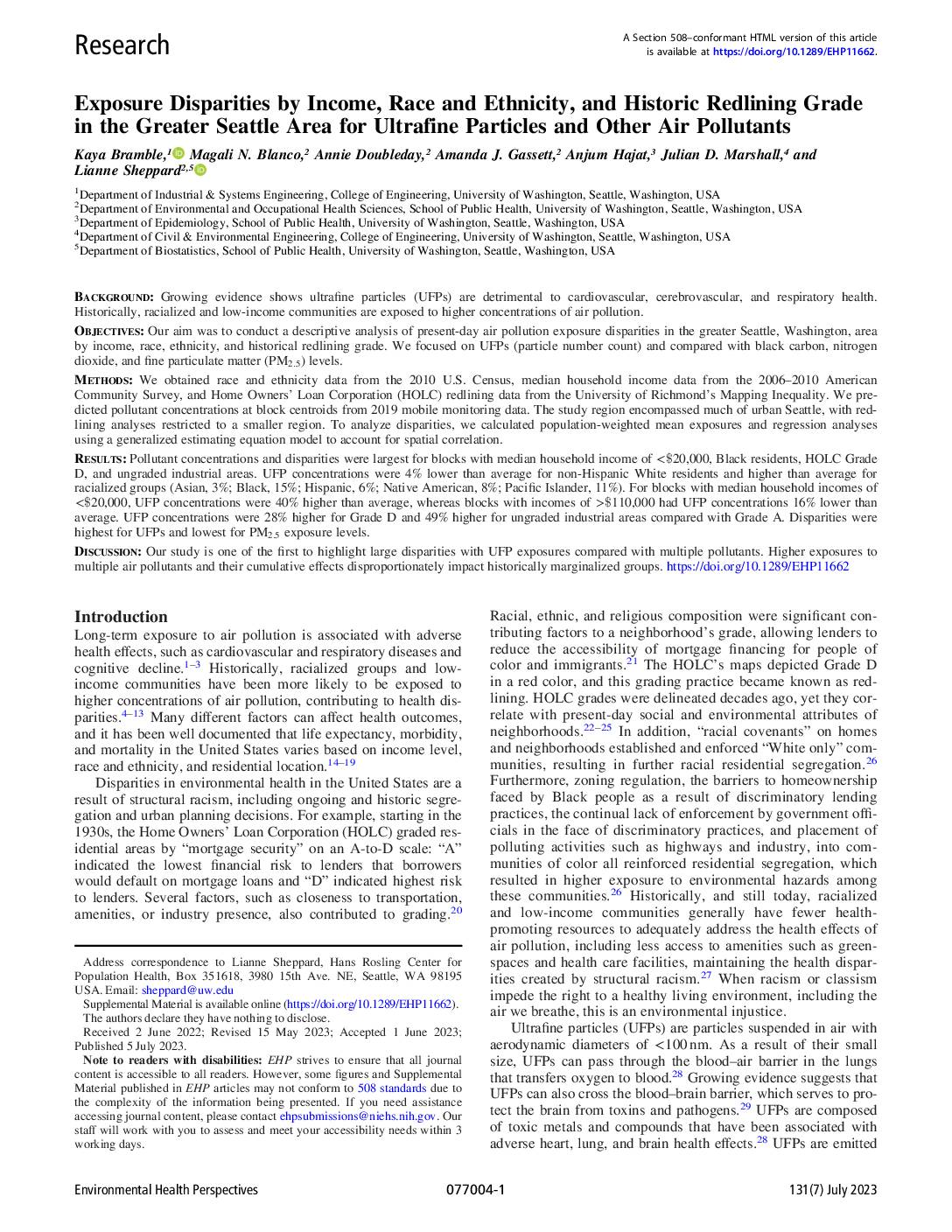
    Exposure disparities by income, race and ethnicity, and historic redlining grade in the greater Seattle area for ultrafine particles and other air pollutants

    A University of Washington study found that low-income and minority communities in the greater Seattle area are exposed to significantly higher levels of ultrafine particles (UFPs) and other air pollutants compared to wealthier, predominantly white neighborhoods. The research also revealed that neighborhoods historically designated as 'hazardous' under 1930s redlining practices continue to experience disproportionately poor air quality today. Disparities were most pronounced for UFPs, which are tiny particles linked to heart, lung, and brain health problems, and least pronounced for fine particulate matter (PM2.5).
    TagsAcademic Journals, Environmental Justice, UFP, Ultrafine ParticlesFolderHealth
  • 2023-06-07

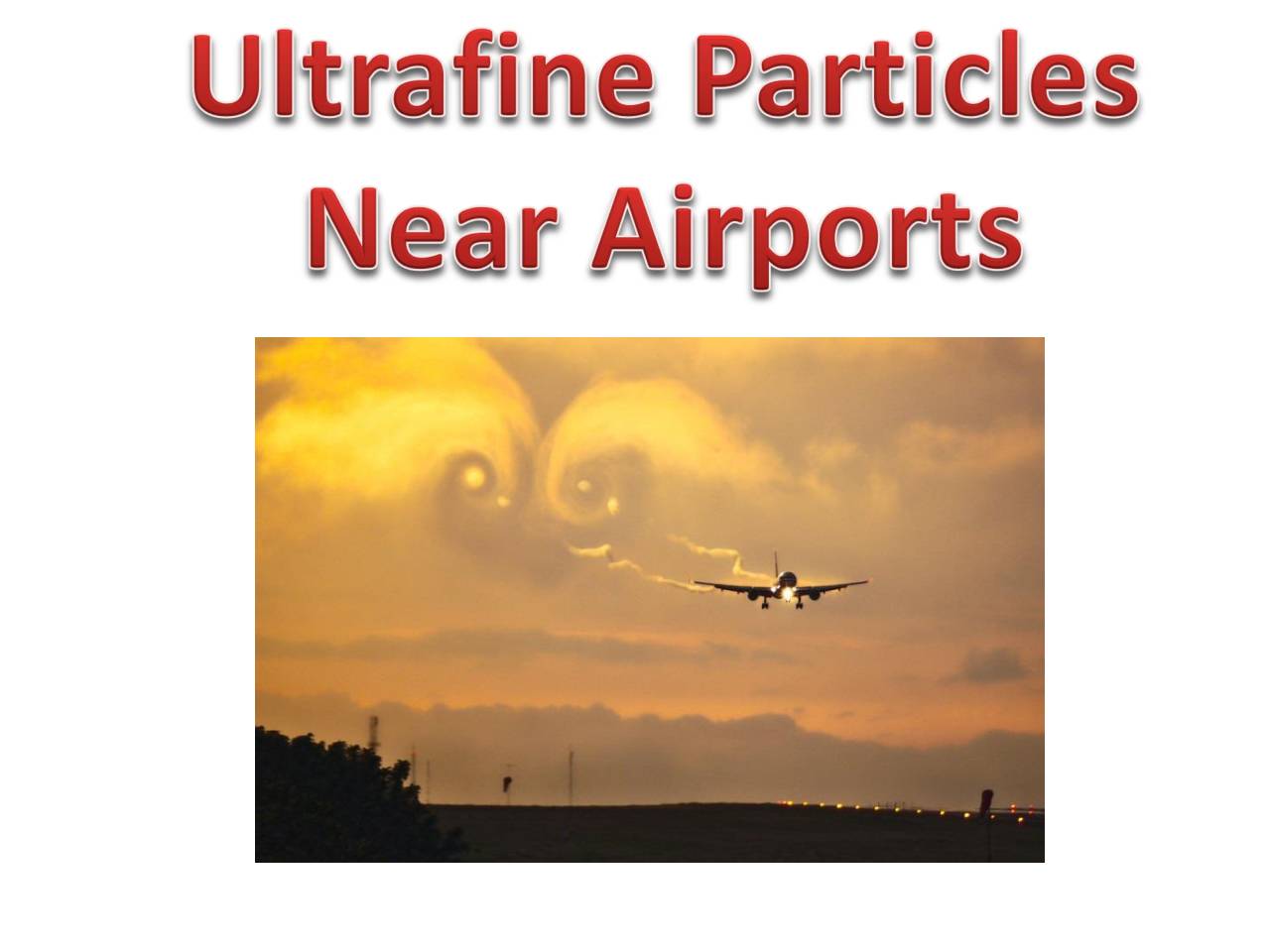
    Ultrafine particles near airports

    The University of Washington School of Public Health was directed by Washington State to study ultrafine particle air pollution near Sea-Tac Airport, the state's busiest international airport. The study assessed air quality within 10 miles of the airport along flight paths, distinguishing between aircraft and other pollution sources, and comparing affected areas with unaffected ones. Findings were shared with local governments and community members, with a final report due December 1, 2019.
    TagsAir Quality Monitors, Budget Proviso, Highline Forum, Sea-Tac Airport, Ultrafine Particles, University Of WashingtonFolderHighline Forum 2017
  • Study shows traffic-related air pollution in Irvine weakens brain function

    Anna Aldrich, University of California, Irvine The brains of wild type (WT) and Alzheimer’s (APP) mouse models were analyzed after exposure to purified air (Con) and ultrafine particulate matter (PM) for the presence of astrocyte cells. These were visualized by staining them green (left column), with potentially harmful and activated astrocytes appearing in red (middle
    CategoriesFrom The Web TagsIrvine, pollution, Toxicological Sciences, Ultrafine Particles, University of California
  • 2023-05-01

    Impact of airport-related pollution on health of near-by communities: LAX as an emerging case study

    A 2023 Tufts University study examined how living near major airports like LAX exposes millions of Americans to harmful levels of noise and air pollution. Research links this proximity to higher rates of hypertension, cardiovascular disease, poor learning outcomes in children, and emerging evidence of pre-term birth and brain cancer. With over 33 million people living within 10 miles of the 23 busiest U.S. airports, the findings carry significant public health implications for communities near facilities like Sea-Tac.
    TagsANES, Neelakshi Hudda, UFP, Ultrafine ParticlesFolderANES
  • 2023-03-29

    Community health & airport operations noise & air pollution: The King County Health Study

    The King County Health Study is a publicly funded research effort that examines how SeaTac Airport operations affect the health of surrounding communities through noise and air pollution. The study analyzes existing health data within one, five, and ten miles of the airport, reviews scientific literature on airport-related health effects, and incorporates findings from a University of Washington study on ultrafine particulate matter. It concludes with recommendations for addressing health impacts linked to airport operations.
    TagsKing County, King County Public Health, Ramboll, Sea-Tac Airport, Ultrafine ParticlesFolderHealth
  • 2023-02-10

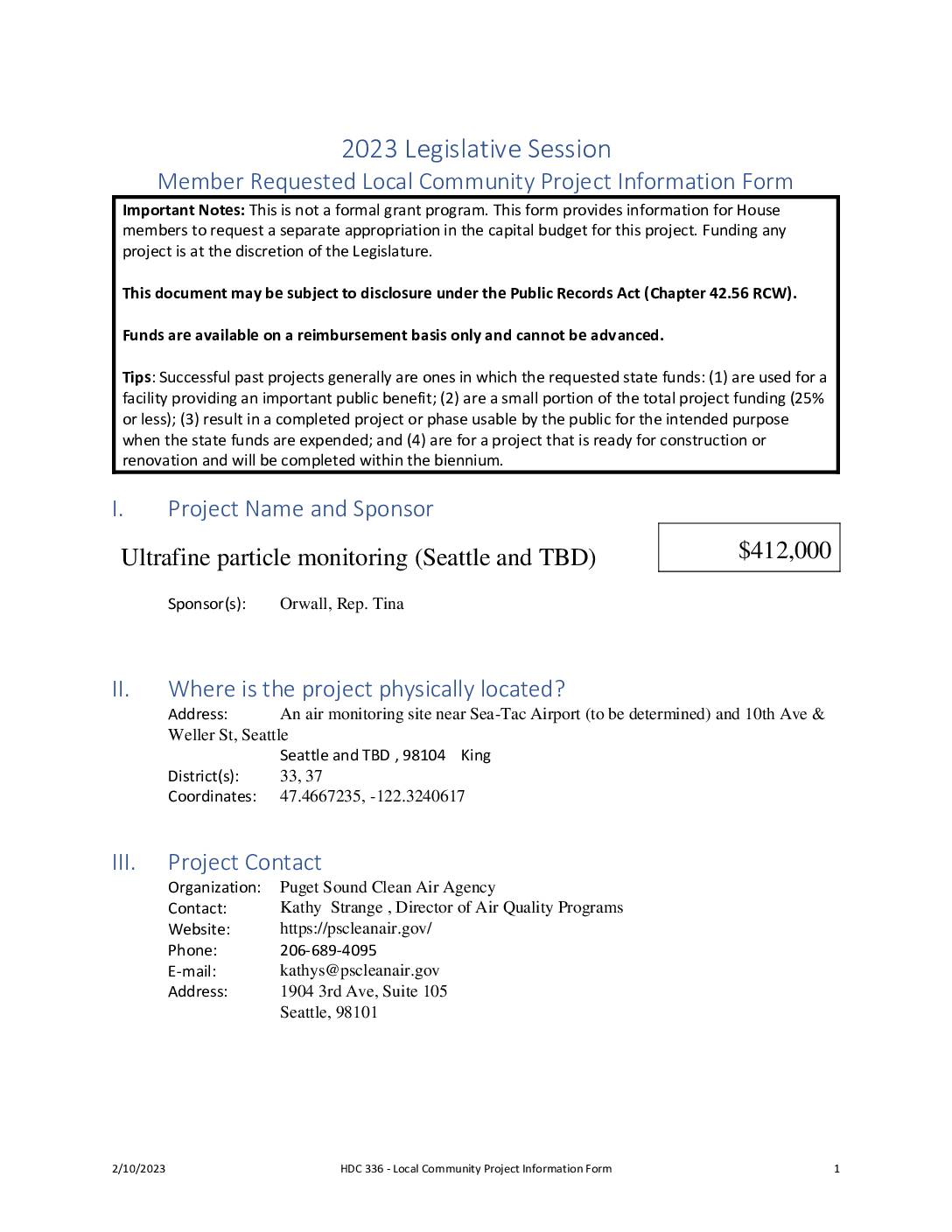
    Ultrafine particle monitoring (Seattle and TBD) – Member Requested Local Community Project Information Form

    A 2023 Washington State legislative funding request of $412,000 seeks to establish two ultrafine particle air quality monitors near Sea-Tac Airport and the I-5/I-90 interchange in Seattle, operated by the Puget Sound Clean Air Agency. The project aims to measure tiny airborne particles — particularly those produced by aircraft and vehicle traffic — that are not currently tracked routinely in Washington State. The University of Washington would analyze the collected data to identify pollution sources and establish health-impact baselines, with monitoring expected to begin in spring 2024.
    CategoriesLegislation TagsAir Quality Monitors, PSCAA, Tina Orwall, Ultrafine ParticlesFolderState
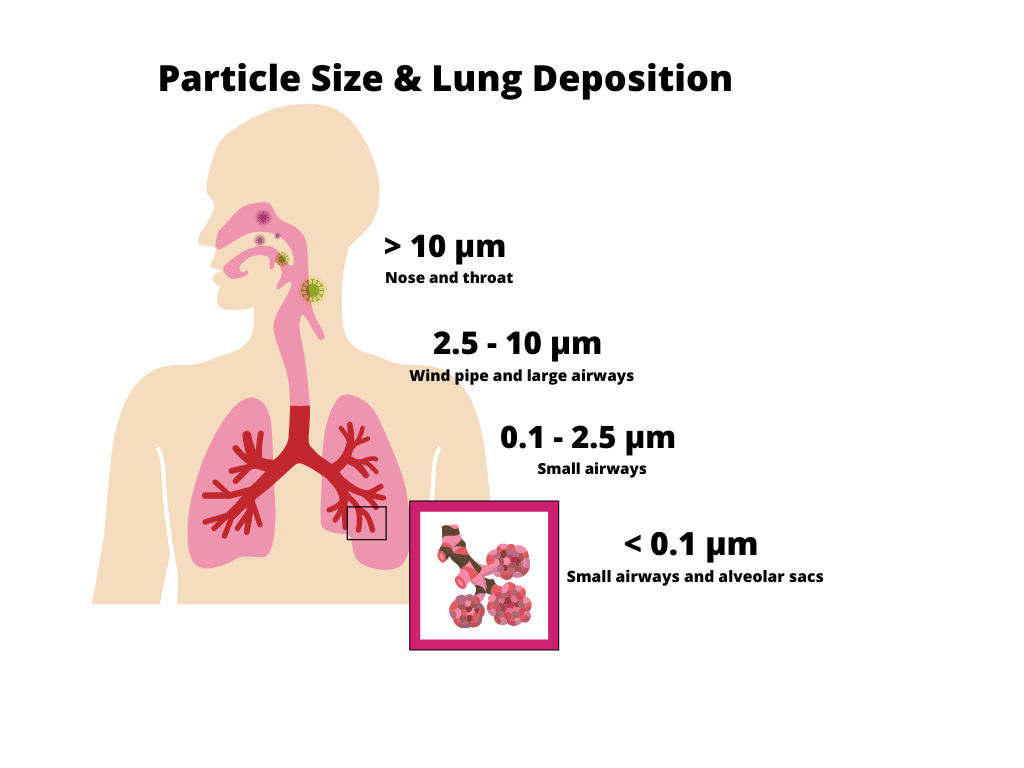
  • UWDEOHS-particle deposition

    An educational infographic titled 'Particle Size & Lung Deposition' illustrating how airborne particles of different sizes deposit in various regions of the respiratory tract: particles >10 μm in the nose and throat, 2.5–10 μm in the windpipe and large airways, 0.1–2.5 μm in small airways, and <0.1 μm in small airways and alveolar sacs. The diagram includes an anatomical illustration of the human respiratory system with a magnified inset of alveolar sacs.
    TagsAir Quality Monitors, DEOHS, Health, Ultrafine Particles, UWDEOHSFolderHealth
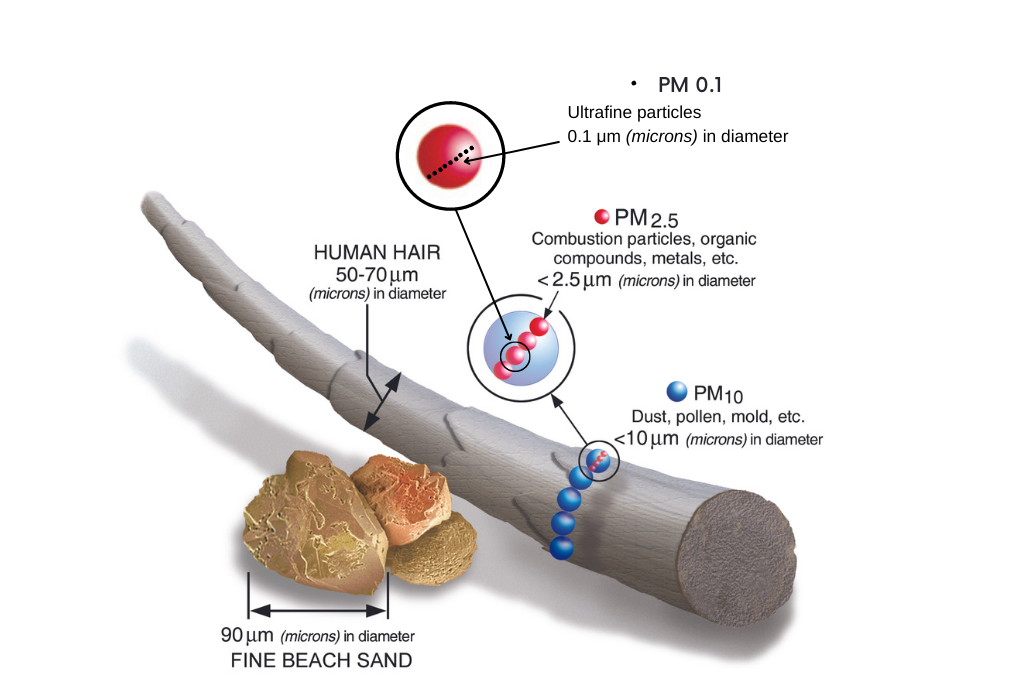
  • UWDEOHS-PM particle size

    An educational diagram comparing the sizes of airborne particulate matter categories: PM0.1 (ultrafine particles, 0.1 microns), PM2.5 (combustion particles, organic compounds, metals; <2.5 microns), and PM10 (dust, pollen, mold; <10 microns). These are shown relative to a human hair (50–70 microns in diameter) and fine beach sand (90 microns in diameter).
    TagsDEOHS, Health, PM25, Ultrafine Particles, UWDEOHSFolderHealth
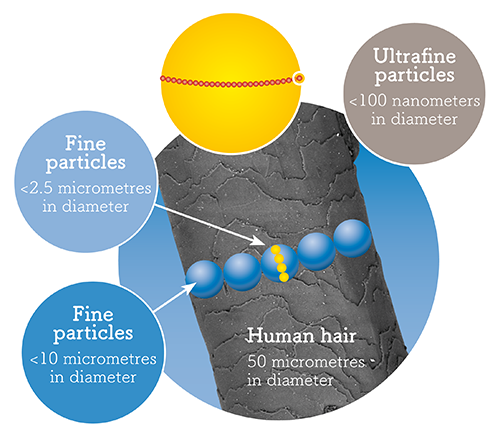
  • ultrafine particles

    Infographic comparing sizes of airborne particulate matter relative to a human hair (50 micrometres in diameter): ultrafine particles (<100 nanometers), fine particles (<2.5 micrometres), and coarse fine particles (<10 micrometres). The diagram uses scaled spheres to visually illustrate how these pollution particles relate in size to a strand of human hair.
    TagsAir Quality Monitors, Aviation Emissions, Health, Ultrafine ParticlesFolderHealth
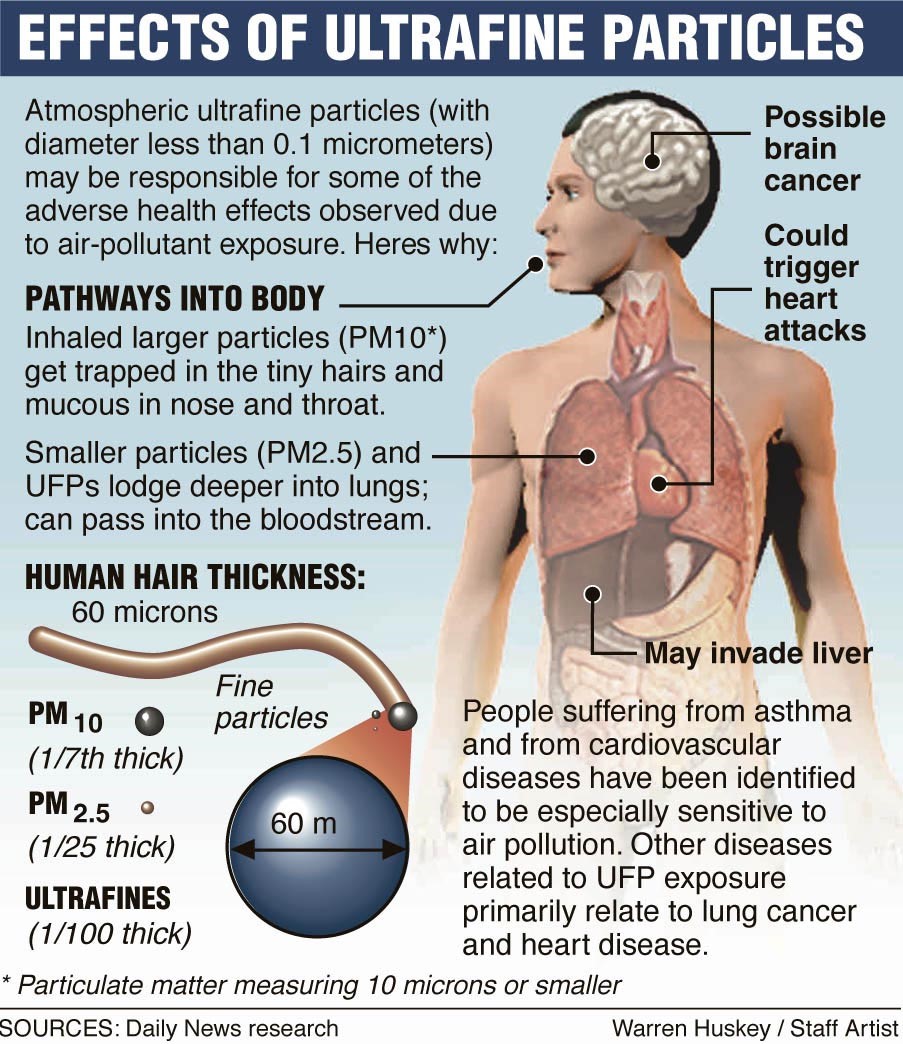
  • Effects of Ultrafine Particles

    Infographic from Daily News, illustrated by staff artist Warren Huskey, explaining how atmospheric ultrafine particles (diameter less than 0.1 micrometers) enter the human body and cause adverse health effects including possible brain cancer, heart attacks, and liver invasion. It details particle size comparisons (PM10, PM2.5, and ultrafines) relative to human hair thickness of 60 microns.
    TagsAviation Emissions, Health, PM25, UFP, Ultrafine ParticlesFolderHealth

Posts pagination

Page 1 Page 2 Page 3 Page 4 Page 5 … Page 8
Sidebar On/Off

Upcoming Events

  • Part 150 NCP Workshop — Burien
    Add to CalendarMSaturday Oct 17: 10:00am

    Attend a Port of Seattle open house on the Part 150 Study Noise Compatibility Program (NCP). The Part 150 program determines the noise boundary around the airport and opportunities for noise mitigation such as sound insulation.

    [...]
  • Part 150 NCP Workshop — SeaTac
    Add to CalendarMMonday Oct 19: 6:00pm

    Attend a Port of Seattle open house on the Part 150 Study Noise Compatibility Program (NCP). The Part 150 program determines the noise boundary around the airport and opportunities for noise mitigation such as sound insulation.

    [...]
  • Part 150 NCP Workshop — Des Moines
    Add to CalendarMTuesday Oct 20: 6:00pm

    Attend a Port of Seattle open house on the Part 150 Study Noise Compatibility Program (NCP). The Part 150 program determines the noise boundary around the airport and opportunities for noise mitigation such as sound insulation.

    [...]

[See all...]


Help study childhood asthma. Get free HEPA filter!

read more...

Issues

Sea-Tac Airport is currently undergoing the largest and longest expansion in its history, collectively known as the Sustainable Airport Master Plan (SAMP). Some of it you can already hear, but you’re probably not aware of what it all means. Here’s what you need to know.
read more...

Read This!

As the source for federal transportation grants, the Puget Sound Regional Council was charged with developing a system to meet the growing need for commercial aviation. When the search for a second airport failed, they authorized the Port of Seattle to build the Third Runway, with a mandate to develop a noise abatement and mitigation program. In their effort to stop the Third Runway, the ACC argued over every detail of the Port's efforts--including property buyouts and sound insulation. The dispute was meant to be settled by a three member Expert Arbitration Panel. This is their final report. It finds 2-1, that the Port's program was insufficient in several respects. Despite that, funding for the Third Runway was approved by the PSRC, and the 'Port Package' program, proceeded largely unchanged. Expert Arbitration Panel's final decision finding that the Port of Seattle had not shown sufficient reduction in real on-the-ground noise impacts to satisfy noise reduction conditions required for approval of a third runway at Sea-Tac International Airport. The majority decision concluded the Port's noise abatement programs were insufficient despite being impressive in scope.
continue...

  • Sea-Tac Noise.Info
  • Connect with STNI

    • Subscribe
    • Port Package Problem?
    • Donate
    • Podcast
    • Socials
      • Facebook
      • X (Twitter)
      • Bluesky
      • Instagram
  • Learn

    • Frequently Asked Questions
    • Explainers
    • Youtube
    • Research Requests
    • Complain about one flight
  • Goals

    Fulfill the promises of 1976:
    • Compensation
    • Reduced noise
    • Improved air quality
    • Environmental remediation
Login/Register
©2026•Data Privacy

Message

We use cookies to provide basic functionality. We also provide access to search engines in order to provide site analytics. We do not sell or share your data.
V V