Skip to content
  • STNI
  • Statistics
    • Ops and Passengers
      • King County International Airport (Boeing Field) Annual Operations
    • Financials
    • Aviation fuel uplift in the State of Washington 2018 – 2025
      • Aviation Fuel Tax Revenue in the State of Washington 1983-2025
      • Aviation Fuel Uplift at Sea-Tac Airport
    • Air Quality Monitoring
    • Flight Tracking
      • Flow and Flight Tracks
      • Five Year Comparison
      • Busiest Hours and Days
    • SEL Noise Reports & Graphs
      • About The Permanent Noise Monitors
      • Minutes of Quiet by Noise Monitor
      • Noise Events mapped
      • Noise Events (SEL)
    • Runways
    • Employees
    • Real Estate
      • Port Properties and Trees mapped
    • Parking
  • Events
  • Protest
    • Regular Events
    • Legislation 2026
    • Complain about a particular flight
    • Advocacy Organizations
    • Media Outlets
    • People
    • The Port of Seattle
      • Commission Meetings
      • Public Records Requests
      • StART
      • Highline Forum
    • Contact Your Electeds
  • Resources
    • FAQs
      • FAA Occurrences/Accidents/Indents
    • The SAMP
      • SAMP Public Comment Template
        • Two versions of Appendix K: NEPA/SEPA 2018 vs 2023
      • SAMP NTP: 31 projects by the numbers
      • SEPA Draft EIS (2026)
      • SAMP Record of Decision/FONSI (2025)
      • SAMP Draft EA (October 2024)
      • 2018 Scoping
    • Port Packages
      • Port Package Property Costs
      • Port Packages mapped
      • The Port Package Explainer
      • So you want a (first-time) Port Package? Start here
      • Port Package Looker Upper
      • How do I determine if I have a Port Package or Avigation Easement?
      • Progress on Port Package Update legislation
      • Having a Port Package Problem?
      • Port Package Site Visit Follow-Up
    • Document Library
    • Explainers
      • The Airport Law Cheat Sheet
      • The Grant Explainer
    • External Articles
    • History
      • Timeline
      • The Sea-Tac Communities Plan
        • Sea-Tac Communities Plan – Planning Maps
      • PSRC Third Runway Decision Process
    • Studies
    • Videos
  • Stories
  • Mission
  • Subscribe
  • Contact
Scroll down to content

Get InformedStay Informedx

I understand that you will never share my information with anyone, you will only use it to keep me updated on relevant events and that I may unsubscribe at any time.

STNI

STNISea-Tac Noise.Info

  • Solve for Sea-Tac. Solve for every airport.
  • Since 2016, working to obtain justice for everyone living under the flight path.
  • Less Noise. Cleaner Air. Better Public Health. Compensation.
  • Everything you think you know about the airport is wrong.

TagUltrafine Particles(75)

Advanced Search Options

  • Dates
  • Media
    • External Articles
    • Images
    • PDFs
    • Video
    • Audio
  • Order By
  • 2014-05-29

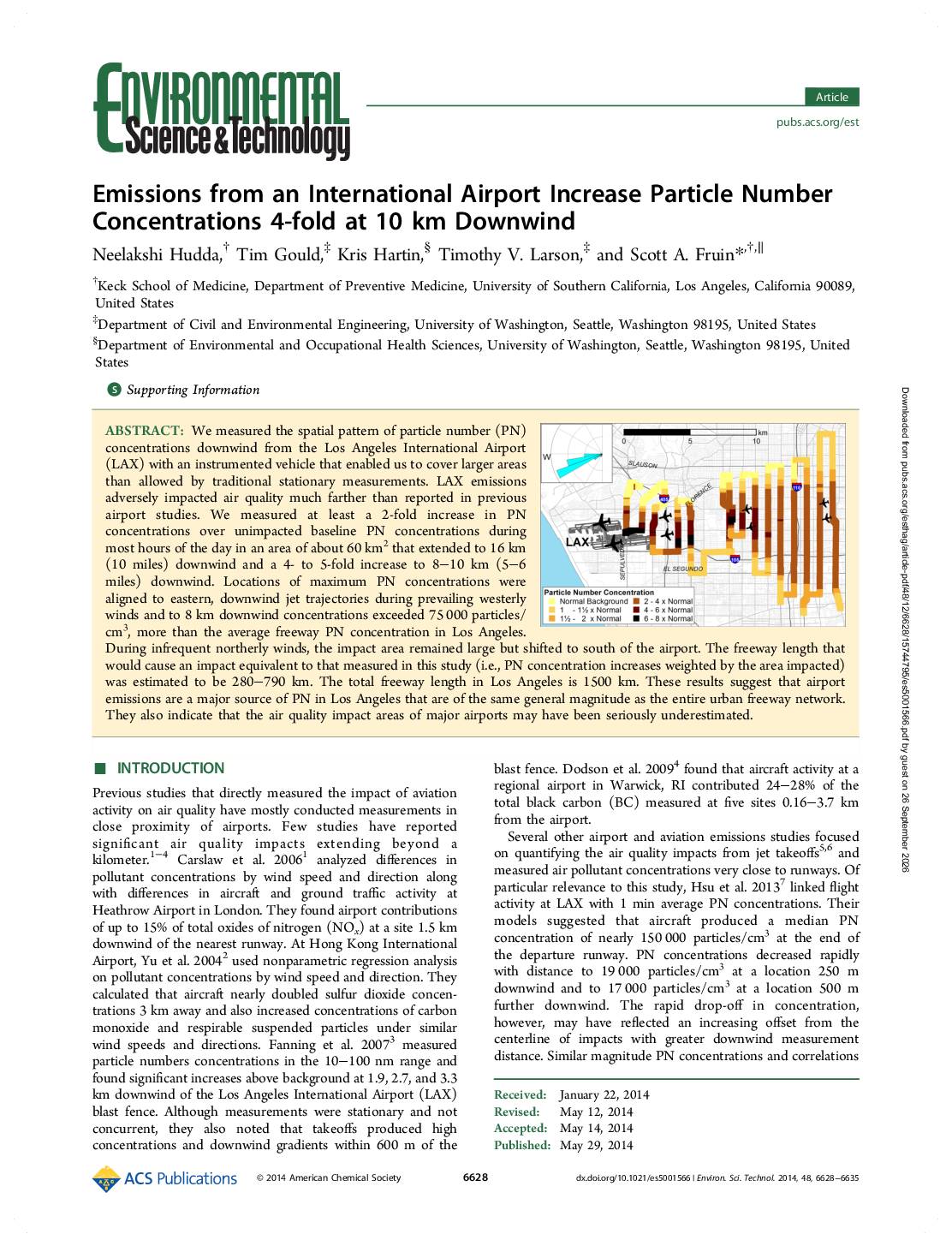
    Emissions from an International Airport Increase Particle Number Concentrations 4-fold at 10 km Downwind

    Peer-reviewed study published in Environmental Science & Technology (American Chemical Society, 2014) by Neelakshi Hudda, Tim Gould, Kris Hartin, Timothy V. Larson, and Scott A. Fruin measuring spatial patterns of particle number (PN) concentrations downwind of Los Angeles International Airport (LAX) using mobile monitoring platforms (MMP) from USC and University of Washington. Study found at
    TagsAcademic Journals, Aviation Emissions, Environmental Science & Technology, LAX, Neelakshi Hudda, Tim Gould, Timothy Larson, Ultrafine Particles, USC KeckFolderAir QualityStudy TopicsAir Quality, Ultrafine Particles
  • Unnamed
    2014-05-28

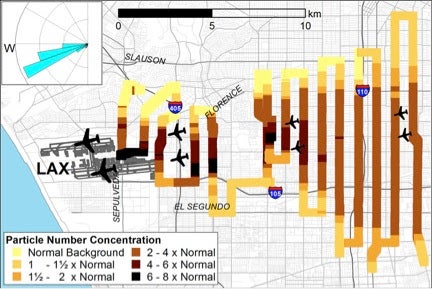
    Research by Keck School of Medicine of USC scientists raises new concerns about air pollution impacts at Los Angeles International Airport

    Uncategorized May 29, 2014 Contact: Leslie Ridgeway at (323) 442-2823 or lridgewa@usc.edu For a copy of the study, contact Leslie Ridgeway. Right: Graphic depicting ultrafine particle increase downwind of LAX relative to urban background air quality LOS ANGELES — For the first time, research conducted by scientists at the Keck School of Medicine of the
    CategoriesFrom The Web TagsLAX, Timothy Larson, Ultrafine Particles
  • 2013-08-24

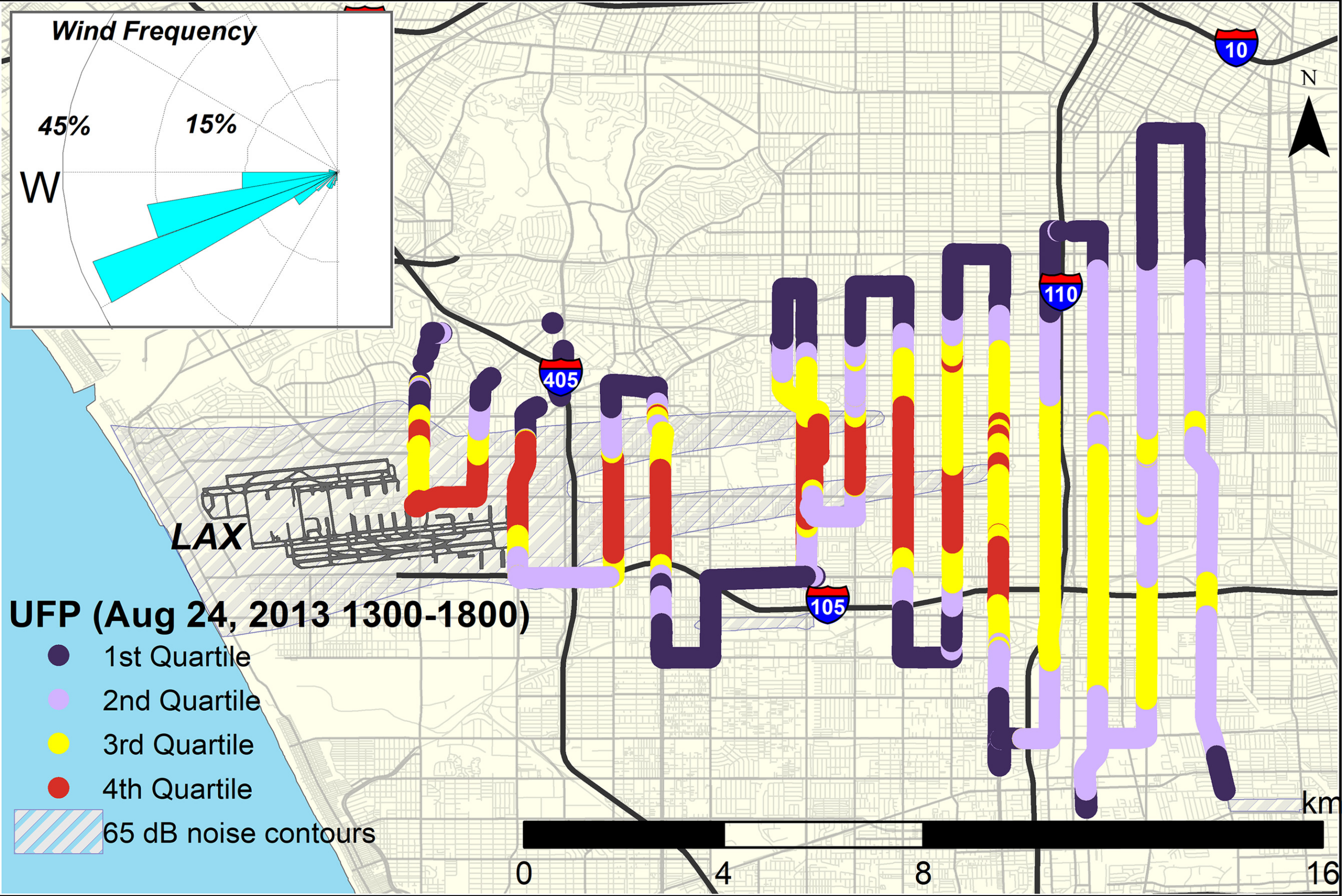
    LAX ultrafine particle (UFP) concentrations map, August 2013

    This map displays ultrafine particle (UFP) concentrations measured by quartile along driving routes near Los Angeles International Airport (LAX) on August 24, 2013, between 1300–1800 hours. The map includes a wind rose showing predominant westerly winds, 65 dB noise contours from LAX flight paths, and nearby freeways I-405, I-110, and I-105.
    TagsLAX, Map, UFP, Ultrafine Particles, UWDEOHSFolderUWDEOHS
  • 2012-02-18

    Scientists Find New Dangers in Tiny but Pervasive Particles in Air Pollution

    By Felicity Barringer Feb. 18, 2012 Fine atmospheric particles — smaller than one-thirtieth of the diameter of a human hair — were identified more than 20 years ago as the most lethal of the widely dispersed air pollutants in the United States. Linked to both heart and lung disease, they kill an estimated 50,000 Americans
    CategoriesFrom The Web TagsNew York Times, Ultrafine Particles
  • 2005-07-15

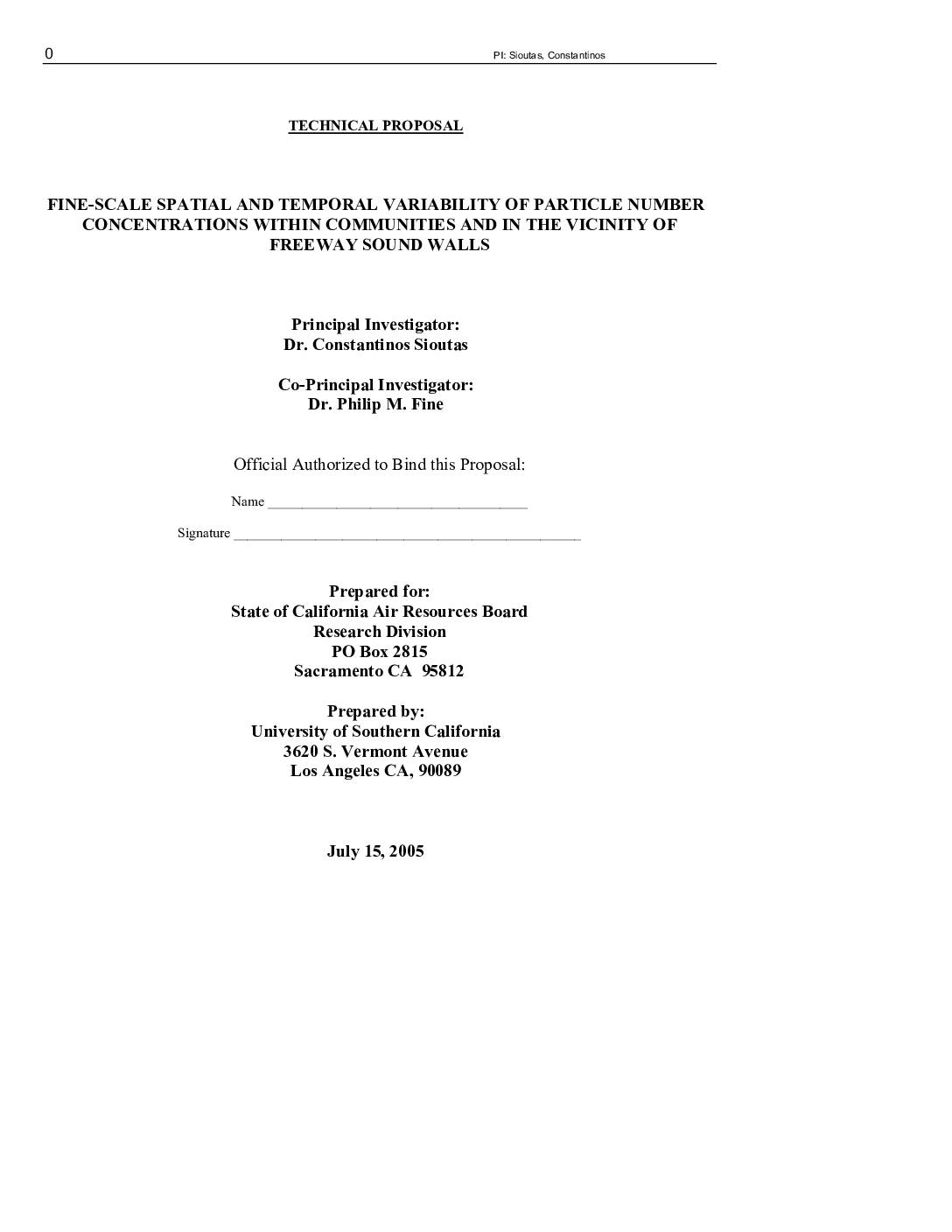
    Fine-scale spatial and temporal variability of particle number concentrations within communities and in the vicinity of freeway sound walls

    This 2005 technical proposal from the University of Southern California requests funding from the California Air Resources Board to study how ultrafine particle pollution varies at a fine scale within communities and near freeway sound walls. Researchers aim to determine whether single monitoring stations accurately represent residents' actual exposure to ultrafine particles, which are emitted primarily by vehicle traffic and are considered more toxic than the larger particles currently regulated by federal and state standards. The study focuses on spatial and temporal measurement of particle number concentrations rather than particle mass, as ultrafine particles may pose greater health risks despite making up only a small fraction of total airborne particulate matter.
    TagsCalifornia Air Resources Board, CARB, Ultrafine Particles, University of CaliforniaFolderHealth

Posts pagination

Page 1 … Page 6 Page 7 Page 8
Sidebar On/Off

Upcoming Events

  • Part 150 NCP Workshop — Burien
    Add to CalendarMSaturday Oct 17: 10:00am

    Attend a Port of Seattle open house on the Part 150 Study Noise Compatibility Program (NCP). The Part 150 program determines the noise boundary around the airport and opportunities for noise mitigation such as sound insulation.

    [...]
  • Part 150 NCP Workshop — SeaTac
    Add to CalendarMMonday Oct 19: 6:00pm

    Attend a Port of Seattle open house on the Part 150 Study Noise Compatibility Program (NCP). The Part 150 program determines the noise boundary around the airport and opportunities for noise mitigation such as sound insulation.

    [...]
  • Part 150 NCP Workshop — Des Moines
    Add to CalendarMTuesday Oct 20: 6:00pm

    Attend a Port of Seattle open house on the Part 150 Study Noise Compatibility Program (NCP). The Part 150 program determines the noise boundary around the airport and opportunities for noise mitigation such as sound insulation.

    [...]

[See all...]


Help study childhood asthma. Get free HEPA filter!

read more...

Issues

Sea-Tac Airport is currently undergoing the largest and longest expansion in its history, collectively known as the Sustainable Airport Master Plan (SAMP). Some of it you can already hear, but you’re probably not aware of what it all means. Here’s what you need to know.
read more...

Read This!

As the source for federal transportation grants, the Puget Sound Regional Council was charged with developing a system to meet the growing need for commercial aviation. When the search for a second airport failed, they authorized the Port of Seattle to build the Third Runway, with a mandate to develop a noise abatement and mitigation program. In their effort to stop the Third Runway, the ACC argued over every detail of the Port's efforts--including property buyouts and sound insulation. The dispute was meant to be settled by a three member Expert Arbitration Panel. This is their final report. It finds 2-1, that the Port's program was insufficient in several respects. Despite that, funding for the Third Runway was approved by the PSRC, and the 'Port Package' program, proceeded largely unchanged. Expert Arbitration Panel's final decision finding that the Port of Seattle had not shown sufficient reduction in real on-the-ground noise impacts to satisfy noise reduction conditions required for approval of a third runway at Sea-Tac International Airport. The majority decision concluded the Port's noise abatement programs were insufficient despite being impressive in scope.
continue...

  • Sea-Tac Noise.Info
  • Connect with STNI

    • Subscribe
    • Port Package Problem?
    • Donate
    • Podcast
    • Socials
      • Facebook
      • X (Twitter)
      • Bluesky
      • Instagram
  • Learn

    • Frequently Asked Questions
    • Explainers
    • Youtube
    • Research Requests
    • Complain about one flight
  • Goals

    Fulfill the promises of 1976:
    • Compensation
    • Reduced noise
    • Improved air quality
    • Environmental remediation
Login/Register
©2026•Data Privacy

Message

We use cookies to provide basic functionality. We also provide access to search engines in order to provide site analytics. We do not sell or share your data.
V V