Tagtransportation(56)
-
 2024-12-01
City of Sea-Tac Transportation Master Plan
The City of SeaTac's Transportation Master Plan, published in December 2024, replaces the city's previous transportation plan and outlines a comprehensive framework for managing and improving transportation infrastructure in SeaTac, Washington. Developed in collaboration with the Port of Seattle, DKS Associates, and other consultants, the plan addresses the city's transportation needs in the context of its unique position as home to Seattle-Tacoma International Airport. The document serves as a guiding policy resource for streets, transit, pedestrian and bicycle connectivity, and related transportation systems within the city. -
 2024-12-01
City of Sea-Tac Transportation Master Plan
The City of SeaTac's Transportation Master Plan, published in December 2024, replaces the city's previous transportation plan and outlines a comprehensive framework for managing and improving transportation infrastructure in SeaTac, Washington. Developed in collaboration with the Port of Seattle, DKS Associates, and other consultants, the plan addresses the city's transportation needs in the context of its unique position as home to Seattle-Tacoma International Airport. The document serves as a guiding policy resource for streets, transit, pedestrian and bicycle connectivity, and related transportation systems within the city. -
 2024-10-24
Overview of the 2025-2028 Regional Transportation Improvement Program
The 2025-2028 Regional Transportation Improvement Program (TIP), published by the Puget Sound Regional Council (PSRC) on October 24, 2024, outlines planned transportation projects and investments across the greater Puget Sound region for a four-year period. It covers project selection processes, funding plans, air quality requirements, and federal performance measures for roads, transit, ferries, and active transportation infrastructure. This document does not specifically address Sea-Tac Airport noise policy. -
 2024-09-05
Draft 2025-2028 regional transportation improvement program: Appendix A detailed project listings
This draft document from the Puget Sound Regional Council outlines the 2025-2028 Regional Transportation Improvement Program (TIP) for the greater Seattle-Tacoma region, listing federally, state, and locally funded transportation projects scheduled between 2025 and 2028. Projects are organized alphabetically by jurisdiction and include details on funding phases such as planning, design, construction, and equipment. The document was prepared as of September 5, 2024, with final updates expected by October 2024. -
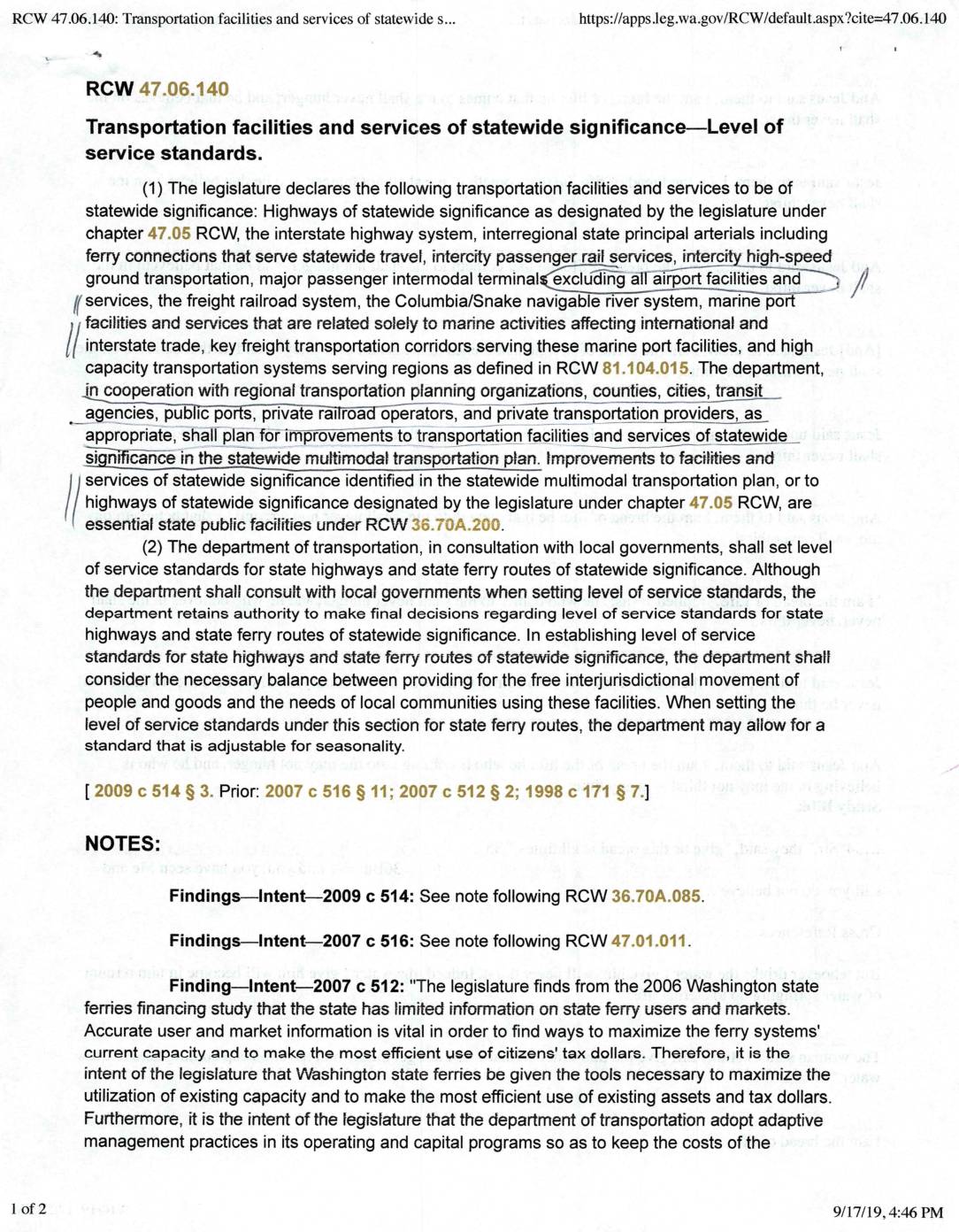 2024-05-13
RCW 47.06.140: Transportation facilities and services of statewide significance—Level of service standards
RCW 47.06.140 defines transportation facilities and services of statewide significance in Washington State, including highways, the interstate system, ferry routes, freight railroads, and high-capacity transit systems, while explicitly excluding airport facilities and services from this designation. The law requires the Washington State Department of Transportation to set level of service standards for state highways and ferry routes, in consultation with local governments, while retaining final decision-making authority. Improvements to these statewide facilities are classified as essential state public facilities under RCW 36.70A.200. -
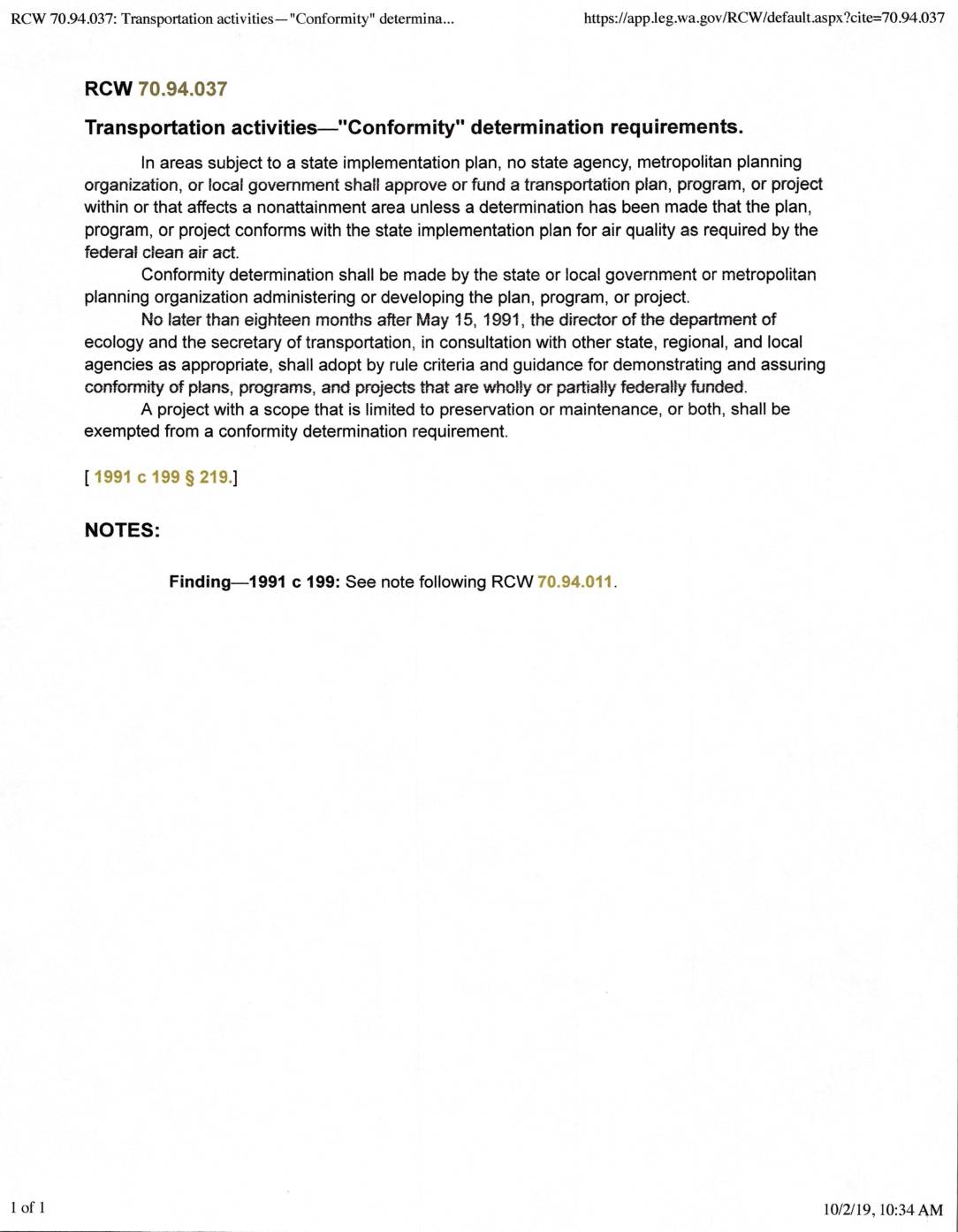 2024-05-13
RCW 70.94.037: Transportation activities—”Conformity” determination requirements
Washington State law RCW 70.94.037 requires that any transportation plan, program, or project in areas that don't meet federal air quality standards must be shown to conform with the state's air quality implementation plan before it can be approved or funded. The conformity determination must be made by the responsible state agency, local government, or metropolitan planning organization overseeing the project. Projects limited strictly to preservation or maintenance work are exempt from this requirement. -
 2023-12-05
The Conference Center at Sea-Tac Airport: directions and parking
This document provides directions to The Conference Center at Seattle-Tacoma International Airport, which is located on the mezzanine level above checkpoint #1. It includes instructions for arriving by car from multiple directions, by Link Light Rail, from a flight gate, by drop-off, and by hotel shuttle, all guiding visitors to the International ticketing counter area and up to the mezzanine level. Parking validation is available only in General Parking floors 3 and 5-8, and not all groups qualify for validation. -
 2023-10-01
2023-25 Biennium Climate Commitment Act Investments to Benefit Overburdened Communities and Tribes
Washington State's Climate Commitment Act invested over $2.1 billion in the 2023-25 budget cycle to reduce greenhouse gas emissions, with an estimated $924 million (43%) directed to overburdened communities and $155 million (7.3%) specifically benefiting Tribes. Key investments include rebates for energy-efficient home equipment, weatherization assistance for low-income households, transit grants, bike and pedestrian safety improvements, and air quality programs in heavily polluted communities. An additional $142 million was directed to salmon restoration projects important to Tribal culture and treaty rights. -
 2023-08-27
Trade, traffic on I-5 corridor raise vision to global level
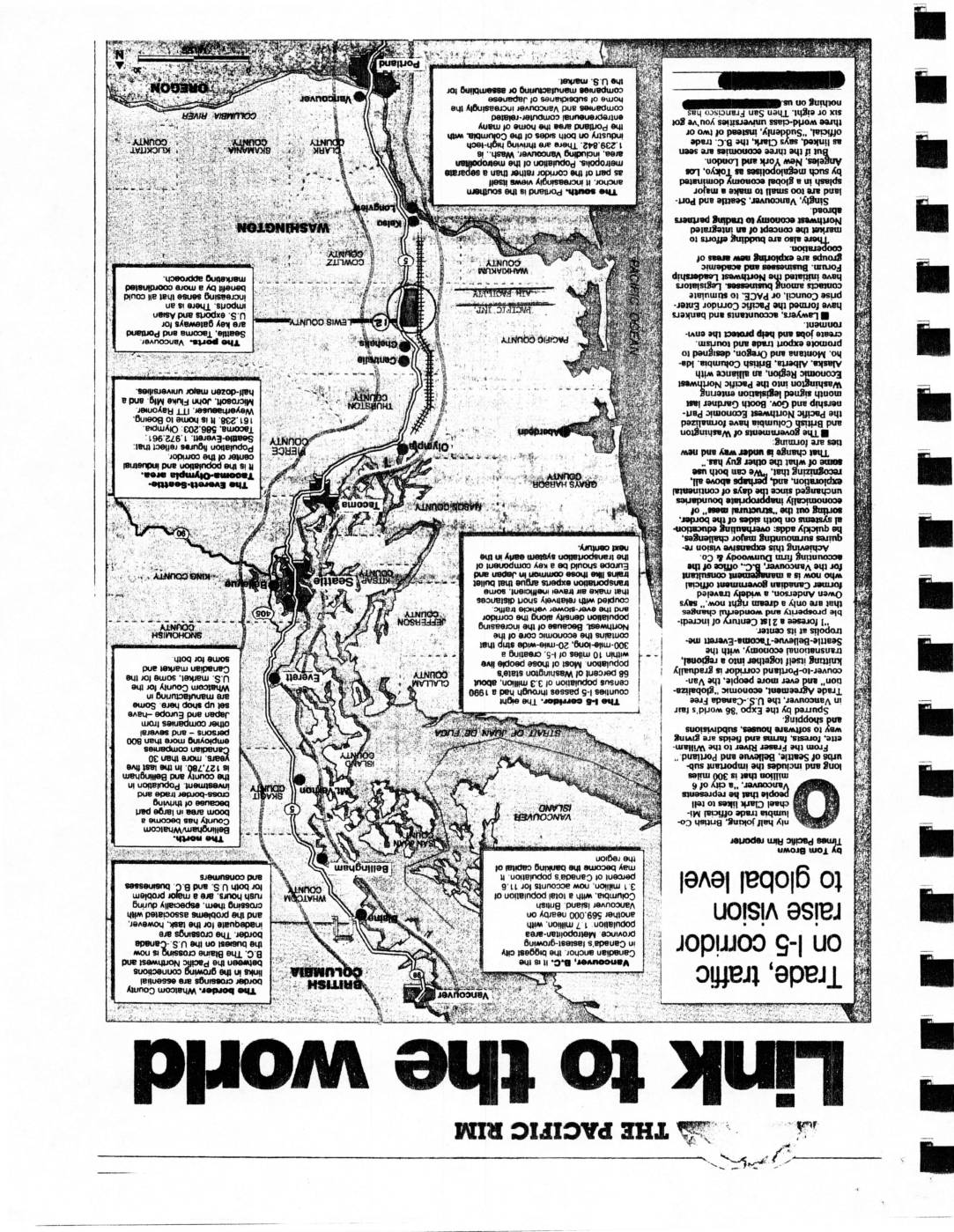
This article examines the growing trade and economic integration along the I-5 corridor connecting Portland, Seattle-Tacoma-Everett, and Vancouver, B.C., highlighting cross-border cooperation, Pacific Rim trade opportunities, and regional population and industrial growth in the late 20th century. It does not contain content related to Sea-Tac Airport noise policy. -
 2023-08-15
Congressional Letter Supporting Cascadia High-Speed Rail Federal-State Partnership Grant Application
Letter from Washington Democratic Delegation to SecDOT to fund Cascadia Bullet Train