Tagtransportation(56)
-
 2022-12-14
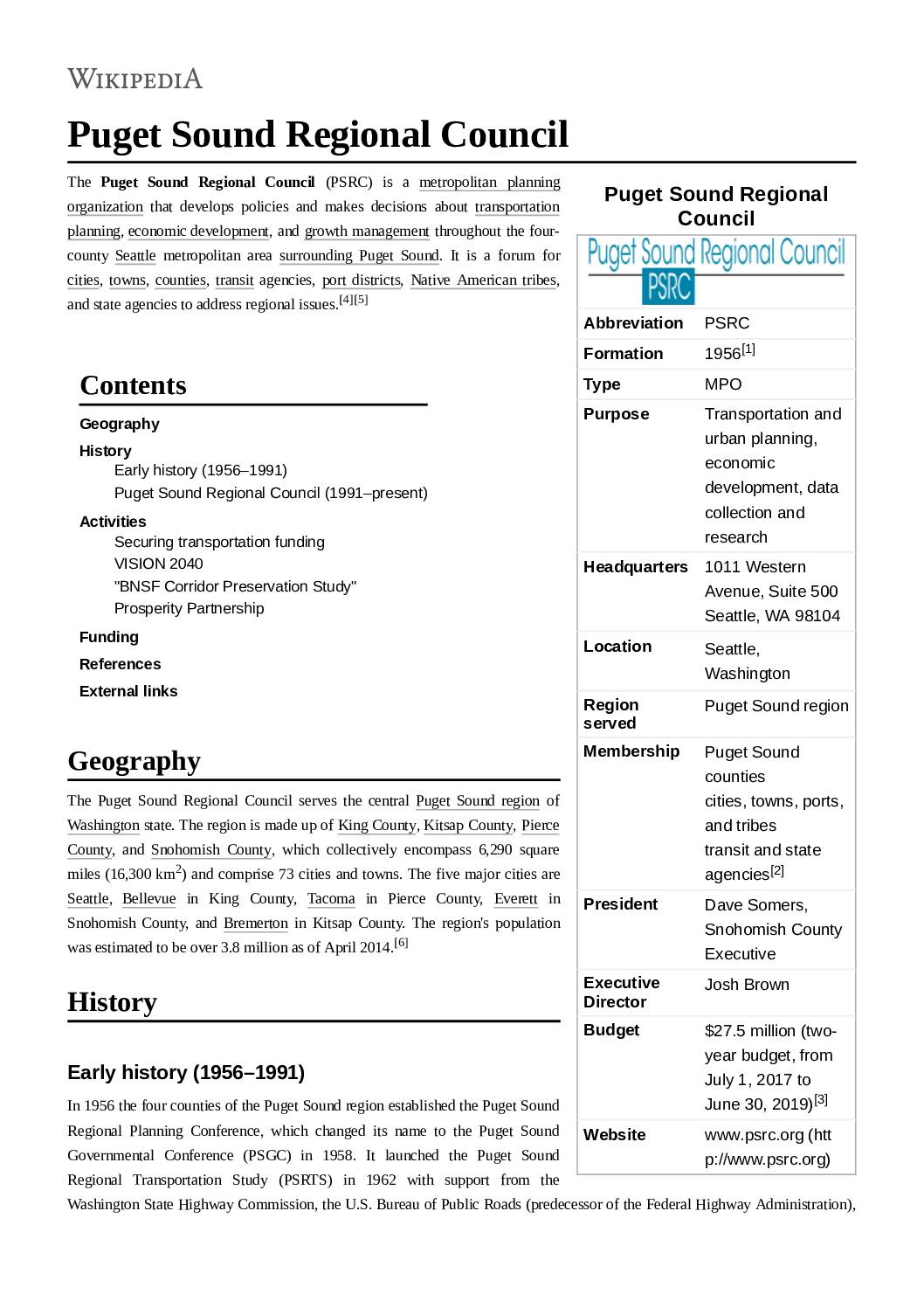
Puget Sound Regional Council
The Puget Sound Regional Council (PSRC) is a metropolitan planning organization founded in 1956 that oversees transportation planning, economic development, and growth management across King, Kitsap, Pierce, and Snohomish counties in the greater Seattle area. It serves as a collaborative forum for cities, counties, transit agencies, port districts, and tribal governments to address regional infrastructure and land-use issues. The PSRC maintains a regional Transportation Improvement Program and develops long-range strategies, such as VISION 2040, to guide the area's growth as its population approaches 5 million. -
 2022-09-01
Regional high occupancy vehicle system policies
This document outlines regional policies for High Occupancy Vehicle (HOV) lanes in the central Puget Sound region, covering rules for lane operation, enforcement, and public education. It establishes that HOV lanes should be reserved 24 hours a day, seven days a week for buses, carpools, and vanpools, and calls for increased fines for violations and better use of technology to improve compliance. The policies were developed by the Regional HOV Policy Advisory Committee in 1998-1999 and are intended to reduce traffic volumes, lower vehicle emissions, and improve overall transportation efficiency. -
 2022-09-01
Destination 2030 glossary of terms
This document is a glossary of transportation planning terms from the Puget Sound Regional Council's long-range transportation plan, Destination 2030. It defines key concepts such as accessibility, congestion management, transit services, and land use strategies used to guide regional transportation policy in the greater Seattle metropolitan area. While not focused specifically on airport noise policy, it does include definitions related to airport ground access and commercial aviation as part of its broader multi-modal transportation framework. -
 2022-09-01
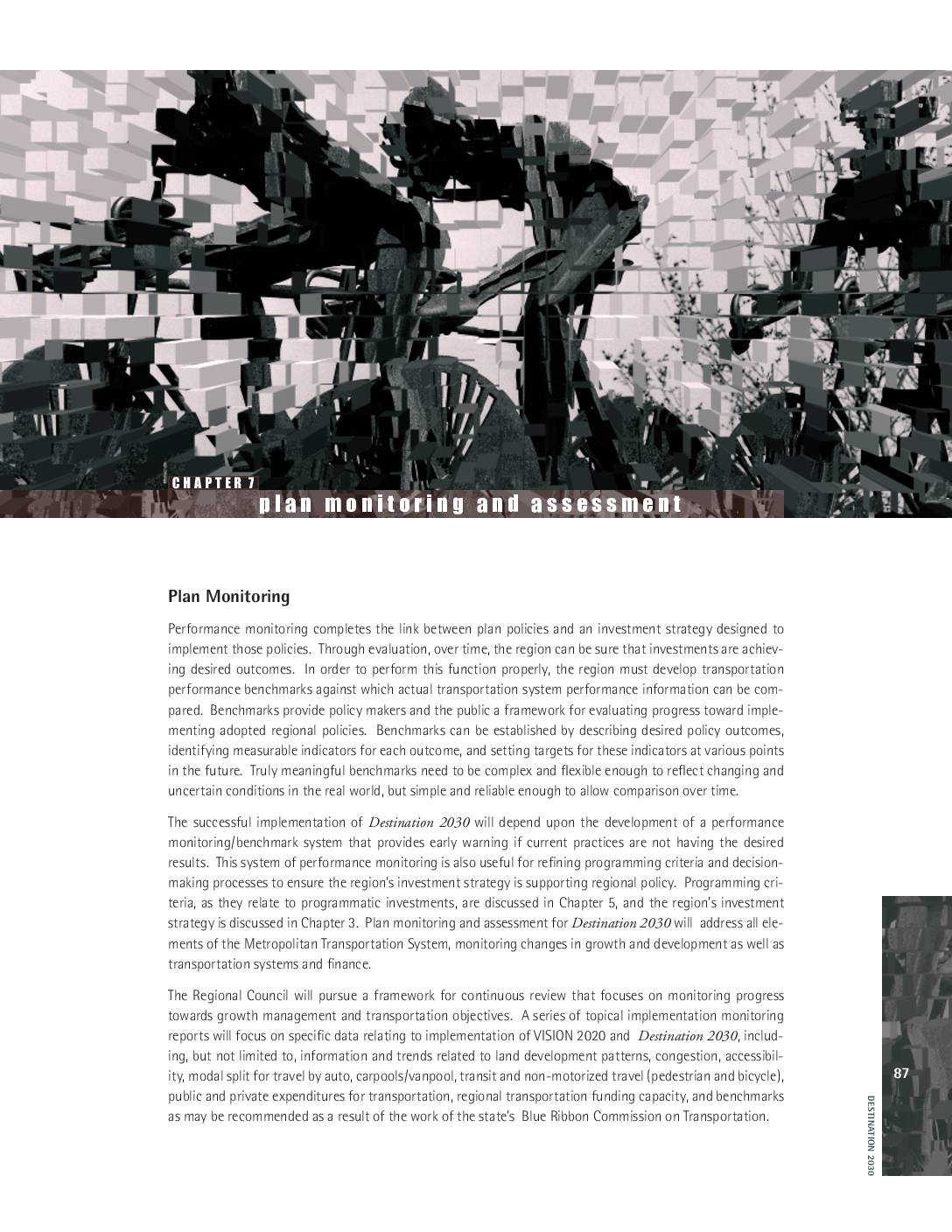
Destination 2030: Plan monitoring and assessment
Chapter 7 of the Destination 2030 regional transportation plan outlines how the Puget Sound Regional Council will monitor and assess progress toward its transportation goals through performance benchmarks, growth tracking, congestion management, and financial reporting. The plan establishes systems to measure land use patterns, travel behavior, and funding capacity across city streets, county roads, public transit, state highways, and ferries. Regular monitoring reports will help policymakers evaluate whether regional investments are achieving desired outcomes and allow for adjustments to planning and programming decisions over time. -
 2022-09-01
Destination 2030: Linking land use and transportation
Destination 2030 is a regional growth and transportation plan for the Seattle metropolitan area that focuses on linking land use decisions with transportation investments. It outlines strategies for directing housing and employment growth into compact urban centers where walking, biking, and transit use are more practical, while also providing physical design guidelines and development tools to support that vision. The plan emphasizes coordinating infrastructure spending with growth management goals to build more connected, pedestrian-friendly communities across the region. -
 2022-09-01
Destination 2030: Investment strategy
The Destination 2030 plan outlines a long-range transportation investment strategy for the central Puget Sound region, prioritizing maintenance and preservation of existing infrastructure while expanding multimodal travel options. Key investment principles include completing gaps in regional transportation systems, linking spending to measurable outcomes, and supporting compact urban development connected by efficient transit. -
 2022-09-01
Destination 2030: Metropolitan Transportation Plan background
Destination 2030 is the long-range Metropolitan Transportation Plan for the central Puget Sound region, developed by the Puget Sound Regional Council to address transportation needs over a 30-year horizon as the region's population is expected to grow by over 1.5 million people. The plan covers all modes of transportation—including transit, roads, ferries, rail, bicycle, and pedestrian facilities—and links land use planning with transportation investment strategies. It builds upon the 1995 Metropolitan Transportation Plan by providing improved guidance on funding, system management, and multimodal improvements across King, Kitsap, Pierce, and Snohomish counties. -
 2022-09-01
Destination 2030: Executive summary
Destination 2030 is a long-range regional transportation action plan for King, Pierce, Snohomish, and Kitsap counties in the central Puget Sound area of Washington state, designed to address growing traffic congestion as the region prepares for an additional 1.5 million residents and 800,000 new jobs. The plan outlines over 2,200 specific projects—including more than 2,000 miles of new and improved roadways, expanded transit services, and new walkways and bikeways—to improve mobility across the region by 2030. It also emphasizes coordinating land use and transportation planning to support sustainable growth while preserving environmental quality. -
 2022-05-01
PSRC annual report 2022
The Puget Sound Regional Council (PSRC) 2022 Annual Report highlights the organization's key regional planning achievements, including the adoption of the first-ever Regional Housing Strategy, an update to the Regional Transportation Plan, and $102 million in funding for the Northgate Extension of Link Light Rail. The report also notes the passage of the federal Bipartisan Infrastructure Law and Washington State's Move Ahead transportation package as significant funding milestones for transit, bridges, and roads in the central Puget Sound region. Note: this document does not contain information specifically related to Sea-Tac Airport noise policy. -
 2022-01-20
Fact sheet: Competitive infrastructure funding opportunities for local governments
This January 2022 White House fact sheet outlines 25 competitive infrastructure funding opportunities available to local governments under the Bipartisan Infrastructure Law, covering transportation, climate, energy, and environmental programs. It highlights grants for roads, ports, buses, electric vehicle charging, school buses, and community reconnection projects, with funding amounts ranging from $1 billion to $7.5 billion per program. Note: this document focuses on broad federal infrastructure funding and does not specifically address airport noise policy or Sea-Tac Airport.