Skip to content
  • STNI
  • Statistics
    • Ops and Passengers
      • King County International Airport (Boeing Field) Annual Operations
    • Financials
    • Aviation fuel uplift in the State of Washington 2018 – 2025
      • Aviation Fuel Tax Revenue in the State of Washington 1983-2025
      • Aviation Fuel Uplift at Sea-Tac Airport
    • Air Quality Monitoring
    • Flight Tracking
      • Flow and Flight Tracks
      • Five Year Comparison
      • Busiest Hours and Days
    • SEL Noise Reports & Graphs
      • About The Permanent Noise Monitors
      • Minutes of Quiet by Noise Monitor
      • Noise Events mapped
      • Noise Events (SEL)
    • Runways
    • Employees
    • Real Estate
      • Port Properties and Trees mapped
    • Parking
  • Events
  • Protest
    • Regular Events
    • Legislation 2026
    • Complain about a particular flight
    • Advocacy Organizations
    • Media Outlets
    • People
    • The Port of Seattle
      • Commission Meetings
      • Public Records Requests
      • StART
      • Highline Forum
    • Contact Your Electeds
  • Resources
    • FAQs
      • FAA Occurrences/Accidents/Indents
    • The SAMP
      • SAMP Public Comment Template
        • Two versions of Appendix K: NEPA/SEPA 2018 vs 2023
      • SAMP NTP: 31 projects by the numbers
      • SEPA Draft EIS (2026)
      • SAMP Record of Decision/FONSI (2025)
      • SAMP Draft EA (October 2024)
      • 2018 Scoping
    • Port Packages
      • Port Package Property Costs
      • Port Packages mapped
      • The Port Package Explainer
      • So you want a (first-time) Port Package? Start here
      • Port Package Looker Upper
      • How do I determine if I have a Port Package or Avigation Easement?
      • Progress on Port Package Update legislation
      • Having a Port Package Problem?
      • Port Package Site Visit Follow-Up
    • Document Library
    • Explainers
      • The Airport Law Cheat Sheet
      • The Grant Explainer
    • External Articles
    • History
      • Timeline
      • The Sea-Tac Communities Plan
        • Sea-Tac Communities Plan – Planning Maps
      • PSRC Third Runway Decision Process
    • Studies
    • Videos
  • Stories
  • Mission
  • Subscribe
  • Contact
Scroll down to content

Get InformedStay Informedx

I understand that you will never share my information with anyone, you will only use it to keep me updated on relevant events and that I may unsubscribe at any time.

STNI

STNISea-Tac Noise.Info

  • Solve for Sea-Tac. Solve for every airport.
  • Since 2016, working to obtain justice for everyone living under the flight path.
  • Less Noise. Cleaner Air. Better Public Health. Compensation.
  • Everything you think you know about the airport is wrong.

TagThird Runway(1067)

Advanced Search Options

  • Dates
  • Media
    • External Articles
    • Images
    • PDFs
    • Video
    • Audio
  • Order By
  • 2001-11-01

    Exhibit 449: Email Chain Re: Processed Materials and Fill Criteria Under 401 Permit — Port Of Seattle Third Runway

    This 2001 email chain discusses how fill materials used in the construction of Seattle-Tacoma Airport's Third Runway Embankment should meet environmental criteria under a 401 water quality permit. State regulators and Port of Seattle staff debated which materials — including topsoil, utility backfill, base course, and general embankment fill — required testing, supplier certification, or quality assurance plans to demonstrate compliance. Officials agreed that highly processed materials like topsoil could be covered by supplier certification, while bulk embankment fill would require a statistical sampling and QA/QC program.
    TagsACC, Ecology, Fill Dirt, Pollution Control Hearings Board, Port Of Seattle, Third Runway, Water QualityFolderBox 09
  • 2001-10-31

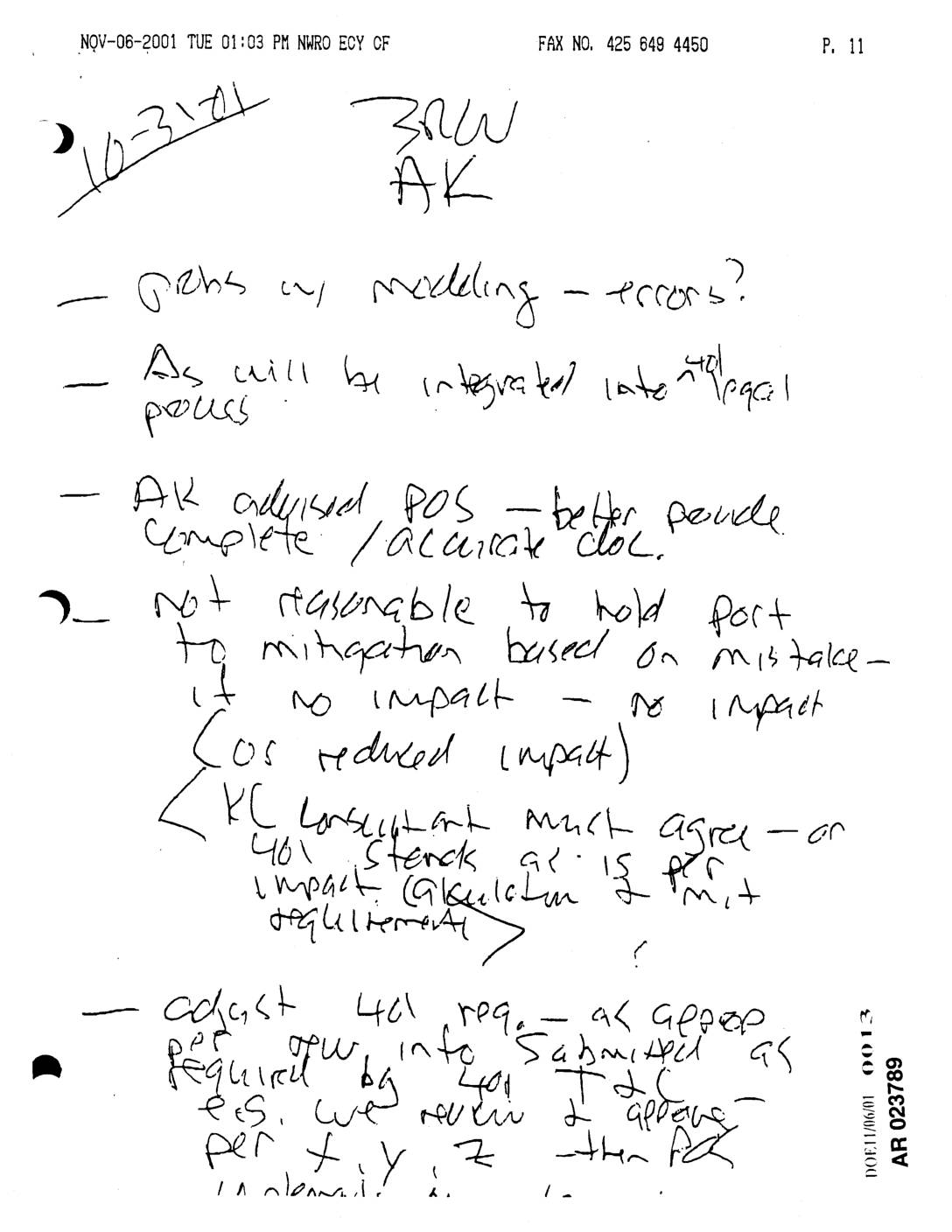
    EXH AR023790: Draft Low Flow Analysis Meeting Notes Oct 30 2001 Email Hellwig to Fitzsimmons

    A November 2001 email chain discusses a meeting held on October 30, 2001, regarding errors discovered in a low flow analysis related to environmental modeling near Seattle. Raymond Hellwig of NWRO confirms that revisions to the low flow analysis may be considered to correct previous modeling errors, but stresses that any revised submissions must include thorough documentation and clear rationale. The correspondence involves multiple agencies and contractors, including Floyd Snider McCarthy, Inc., the U.S. Army Corps of Engineers, and Port of Seattle representatives.
    TagsACC, Ecology, PCHB, Pollution Control Hearings Board, Third RunwayFolderBox 10
  • 2001-10-30

    EXH 307: Draft Meeting Notes – Low Flow Analysis, STIA Third Runway, Oct 30, 2001

    These draft meeting notes from October 30, 2001 document a technical review session in which Port of Seattle consultants disclosed and explained several errors found in the low streamflow modeling for the Sea-Tac Airport Third Runway project. The key errors included a 1/24th magnitude conversion factor mistake in embankment fill data input, incorrect input files used for embankment modeling, and an overlap in which approximately 8 acres of the Walker Creek embankment appeared to be counted in both the Hydrus embankment model and the HSPF stream model. The meeting outlined corrective steps to be taken by the Port's consulting team to fix these errors before finalizing the revised Low Streamflow Analysis required under 401 Permit conditions.
    TagsACC, Ecology, King County, Miller Creek, Pollution Control Hearings Board, Port Of Seattle, Third RunwayFolderBox 09
  • 2001-10-30

    EXH AR052151: Memorandum on Wetland Hydrology and the Third Runway Embankment Fill

    Memorandum dated October 30, 2001 from Michael Kenrick of Hart Crowser, Inc. to Jim Thomson of HNTB, CC Elizabeth Leavitt of Port Of Seattle, project number 4978-06. Addresses wetland hydrology impacts of Third Runway Embankment Fill construction at Sea-Tac Airport, covering depression wetlands, slope wetlands, and riparian wetlands. References Miller Creek and Walker Creek baseflow,
    TagsACC, Army Corp of Engineers, Elizabeth Leavitt, Environmental Impact Statement, Pollution Control Hearings Board, Port Of Seattle, Third RunwayFolderBox 22
  • 2001-10-30

    EXH AR022925: 401 Permit Post-Issuance Clarification STIA Third Runway — Final Meeting Notes, Low Flow Analysis

    Meeting notes from an October 30, 2001 technical session addressing errors discovered in the low streamflow modeling for Sea-Tac International Airport's Third Runway project. Consultants identified six modeling errors, including a conversion factor mistake that caused embankment flow contributions to be understated by a factor of 24, along with incorrect input files and improper groundwater routing. Representatives from the Port of Seattle, King County, the Department of Ecology, and the Army Corps of Engineers agreed on corrective revisions to be incorporated into a revised Low Streamflow Analysis and Summer Low Flow Impact Offset Facility Proposal required under the 401 Permit.
    TagsACC, Ecology, King County, PCHB, Pollution Control Hearings Board, Port Of Seattle, Third RunwayFolderBox 09
  • 2001-10-30

    EXH AR029210: 401 Permit Post-Issuance Clarification — Sea-Tac Airport Third Runway Low Flow Analysis Meeting Notes

    Final meeting notes from October 30, 2001 Low Flow Analysis meeting regarding Port Of Seattle’s revisions to the Low Streamflow Analysis and Summer Low Flow Impact Offset Facility Proposal per 401 Permit conditions for Sea-Tac Airport Third Runway. Attendees included Ann Kenny (Dept. of Ecology), Kelly Whiting and David Masters (King County), Lisa Scott (Corps
    TagsACC, Ecology, Miller Creek, Pollution Control Hearings Board, Port Of Seattle, Third Runway, Water QualityFolderBox 11
  • 2001-10-30

    EXH AR018326: Memorandum on Wetland Hydrology and the Third Runway Embankment Fill

    Memorandum dated October 30, 2001 from Michael Kenrick of Hart Crowser, Inc. to Jim Thomson of HNTB (project number 4978-06), CC Elizabeth Leavitt of Port Of Seattle, regarding wetland hydrology impacts of the Third Runway Embankment Fill at Sea-Tac Airport. Covers depression wetlands, slope wetlands, and riparian wetlands; references FEIS for the Master Plan Update
    TagsACC, Army Corp of Engineers, Environmental Impact Statement, Miller Creek, Pollution Control Hearings Board, Port Of Seattle, Third RunwayFolderBox 08
  • 2001-10-30

    EXH AR023792: Notes HSPF Modeling Miller, Walker & Des Moines Creeks — HSPF/Hydrus/Slice Linkages

    This technical memo from Hydrocomp, Inc. (authored by Norm Crawford) outlines recommendations for improving hydrological computer modeling of Miller, Walker, and Des Moines Creeks near Seattle-Tacoma International Airport's new runway construction. It describes how rainfall and runoff from the new impervious runway and taxiway surfaces and surrounding pervious grasslands are tracked through a linked series of models (HSPF, Hydrus, and Slice) to estimate groundwater movement and seepage through underlying soil layers. The document identifies several discrepancies in the existing model setup and recommends corrections to better account for water flow paths, drainage areas, and groundwater recharge in the fill areas created by airport expansion.
    TagsACC, Des Moines Creek, Miller Creek, PCHB, Pollution Control Hearings Board, Third RunwayFolderBox 10
  • 2001-10-26

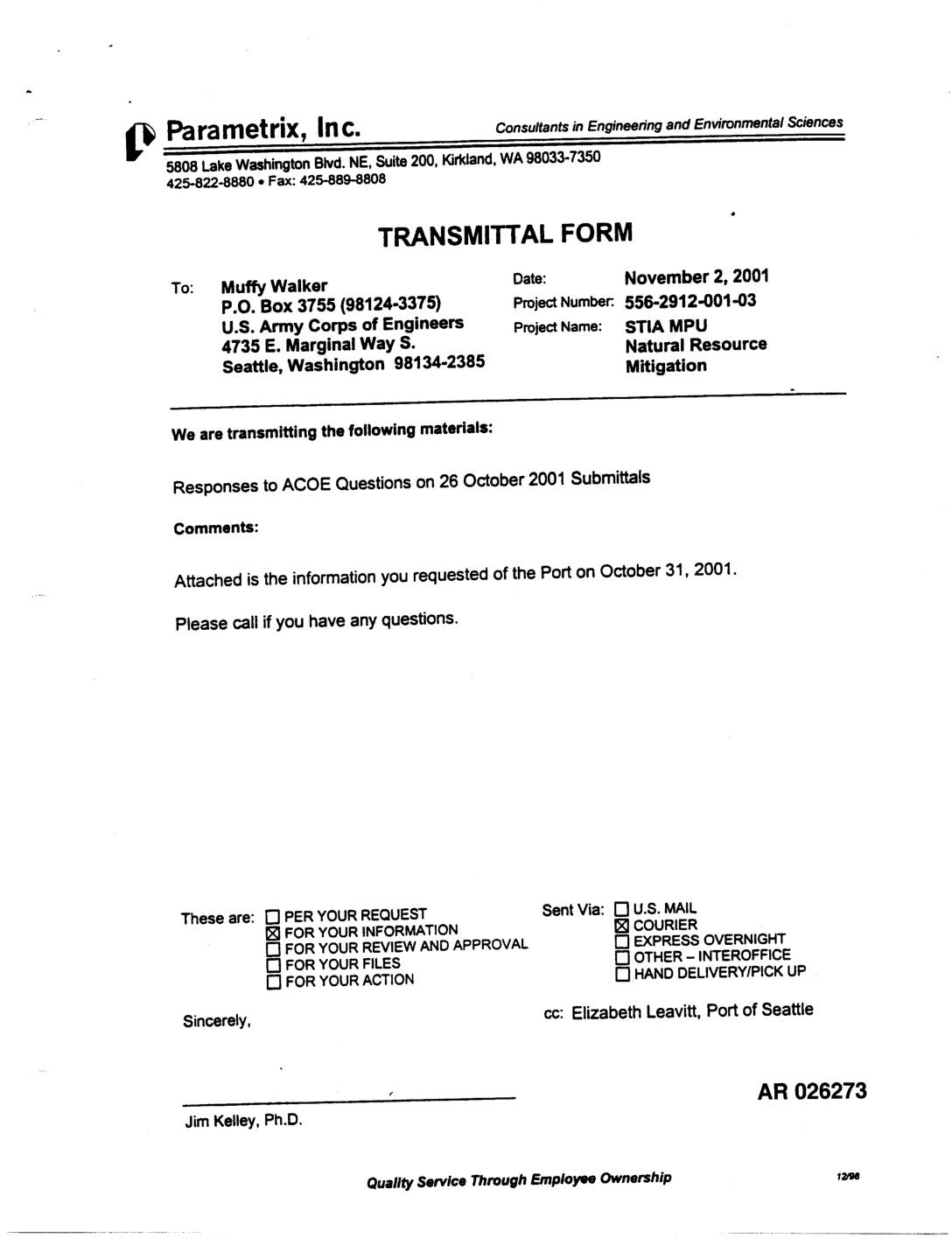
    EXH AR026216: Parametrix to US Army Corps Transmittal — STIA MPU Natural Resource Mitigation Responses

    A October 26, 2001 transmittal from Parametrix, Inc. to the U.S. Army Corps of Engineers (ACOE) provides responses to the ACOE's request for additional information regarding the Seattle-Tacoma International Airport (STIA) Master Plan Update (MPU) Natural Resource Mitigation project. The package includes maps and aerial photographs identifying wetland areas and acreages within Borrow Area 1, submitted on behalf of the Port of Seattle.
    TagsACC, Army Corp of Engineers, Elizabeth Leavitt, Pollution Control Hearings Board, Port Of Seattle, Sea-Tac Airport, Third RunwayFolderBox 10
  • 2001-10-24

    EXH AR026132: Letter to Ecology Requesting Extension Low Streamflow Analysis & Summer Low Flow Impact Offset Facility Proposal

    In this October 24, 2001 letter, the Port of Seattle notified the Washington Department of Ecology of a mathematical error discovered in hydrological modeling software used to assess the Seattle-Tacoma International Airport Master Plan's impacts on Miller and Walker Creeks. The error caused stream flow impacts to be overestimated at 1/24th of their actual value, meaning required mitigation facilities could be smaller than originally planned. As a result, the Port requested an extension of the Low Streamflow Analysis submittal deadline from November 5 to November 21, 2001.
    TagsACC, Ecology, Miller Creek, Pollution Control Hearings Board, Port Of Seattle, Sea-Tac Airport Master Plan, Third Runway, Water QualityFolderBox 10

Posts pagination

Page 1 … Page 39 Page 40 Page 41 Page 42 Page 43 … Page 107
Sidebar On/Off

Upcoming Events

  • Stay Grounded Event: Night trains, not night planes!
    Add to CalendarMSunday Sep 13: 12:00am
    Ntnnp social media3

    For the past two years, more than 220 initiatives from 15 countries have declared September 13th as the International day for the ban of night flights at airports. In parallel, activists across Europe have been gathering for pyjama parties for night trains – coordinated in 2024 and 2025 by Back on Track and Stay Grounded.

    [...]
  • Burien Airport Committee Meeting September 15, 2026
    Add to CalendarMTuesday Sep 15: 6:00pm
    400 SW 152nd St, Burien, WA 98166
    Burien airport committee 15 sep 2026 agenda pdf pdf

    a) Part 150 Noise Study (Emily Inlow-Hood) — 15 minutes
    b) SAMP Update and Next Steps (Brian Davis and Sarah Moore) — 15 minutes
    c) Legislative Updates — 10 minutes
       • SCA (Sarah Moore)
       • Work with Sen. Orwall (Brian Davis)
    d) StART Reorganization (Jeff Harbaugh and Karen Veloria) — 10 minutes

    [...]

[See all...]


Help study childhood asthma. Get free HEPA filter!

read more...

Issues

Sea-Tac Airport is currently undergoing the largest and longest expansion in its history, collectively known as the Sustainable Airport Master Plan (SAMP). Some of it you can already hear, but you’re probably not aware of what it all means. Here’s what you need to know.
read more...

Read This!

As the source for federal transportation grants, the Puget Sound Regional Council was charged with developing a system to meet the growing need for commercial aviation. When the search for a second airport failed, they authorized the Port of Seattle to build the Third Runway, with a mandate to develop a noise abatement and mitigation program. In their effort to stop the Third Runway, the ACC argued over every detail of the Port's efforts--including property buyouts and sound insulation. The dispute was meant to be settled by a three member Expert Arbitration Panel. This is their final report. It finds 2-1, that the Port's program was insufficient in several respects. Despite that, funding for the Third Runway was approved by the PSRC, and the 'Port Package' program, proceeded largely unchanged. Expert Arbitration Panel's final decision finding that the Port of Seattle had not shown sufficient reduction in real on-the-ground noise impacts to satisfy noise reduction conditions required for approval of a third runway at Sea-Tac International Airport. The majority decision concluded the Port's noise abatement programs were insufficient despite being impressive in scope.
continue...

The Podcast!

Subscribe to the only podcast devoted to policies, politics, history, impacts for people living under the flight path everywhere. It’s definitely not just about noise!
  • Sea-Tac Noise.Info
  • Connect with STNI

    • Subscribe
    • Port Package Problem?
    • Donate
    • Podcast
    • Socials
      • Facebook
      • X (Twitter)
      • Bluesky
      • Instagram

    "EXH 297: Low Streamflow Analysis Summer Low Flow Impact Offset Facility Proposal STIA Master Plan Update" — , 2001

  • Learn

    • Frequently Asked Questions
    • Explainers
    • Youtube
    • Research Requests
    • Make a complaint
  • Goals

    Fulfill the promises of 1976:
    • Compensation
    • Reduced noise
    • Improved air quality
    • Environmental remediation
Login/Register
©2026•Data Privacy

Message

We use cookies to provide basic functionality. We also provide access to search engines in order to provide site analytics. We do not sell or share your data.
V V