TagThird Runway(1084)
-
 2001-12-01
EXH 464: Low Streamflow Analysis Summer Low Flow Impact Offset Facility Proposal STIA Master Plan Update
This December 2001 technical report analyzes low streamflow conditions in Miller, Walker, and Des Moines Creeks near Seattle-Tacoma International Airport, assessing the hydrologic impacts of the proposed third runway embankment as part of the airport's Master Plan Update. The study found that the runway construction would reduce summer stream flows, requiring mitigation of 0.11 cfs in Walker Creek and 0.08 cfs in Des Moines Creek during the annual low-flow period (late July through October). To offset these impacts, the Port of Seattle proposed collecting and storing excess winter stormwater in underground vaults—approximately 18.5 acre-feet for Walker Creek and 13.5 acre-feet for Des Moines Creek—for controlled release during dry-season low-flow periods. -
 2001-11-30
PCHB Doc 5858: Declaration of Brett Fish Supporting CASE’s Motion to Intervene
Declaration by Brett Fish, President of Citizens Against Sea-Tac Expansion (CASE), filed in PCHB No. 01-160 (Airport Communities Coalition v. Washington State Department of Ecology and Port Of Seattle). Fish declares CASE’s interest in intervening in the ACC’s appeal of Ecology’s 401 Certification for the proposed third runway and master plan update at Sea-Tac Airport. -
 2001-11-28
EXH AR005864: Third Declaration of William A. Rozeboom Relating to ACC’s Motion for Stay
Third declaration of William A. Rozeboom, professional civil engineer with Northwest Hydraulic Consultants, filed before the Pollution Control Hearings Board (PCHB), Case No. 01-160, Airport Communities Coalition (ACC) v. State of Washington Department of Ecology and Port Of Seattle. Declaration concerns Section 401 Certification No. 1996-4-02325 and CZMA concurrency statement. Rozeboom identifies significant technical deficiencies -
 2001-11-27
EXH AR052548: Sea-Tac Third Runway Embankment Fill Modeling in Support of Low Streamflow Analysis
Report by Pacific Groundwater Group (project JE0105) prepared for Port Of Seattle, dated November 27, 2001, analyzing embankment fill modeling in support of low streamflow analysis for the Sea-Tac Third Runway. Uses HYDRUS-SLICE modeling to assess vertical infiltration through embankment fill materials (General Fill and Type 1 Fill), saturated flow beneath the fill, and effective -
 2001-11-26
EXH AR017588: Northwest Hydraulic Consultants Letter to U.S. Army Corps of Engineers Regarding Port Of Seattle Low Flow Mitigation, Third Runway
Letter dated November 26, 2001, from Northwest Hydraulic Consultants (on behalf of ACC, Airport Communities Coalition) to Colonel Ralph H. Graves, Ms. Muffy Walker, and Ms. Gail Terzi of U.S. Army Corps of Engineers, Seattle District, Corps Ref. No. 1996-4-02325. Identifies serious flaws in Port Of Seattle’s low flow mitigation analysis for Miller Creek, Walker -
 2001-11-26
EXH 300: Third Declaration Paul S. Fendt — ACC v. Ecology, PCHB No. 01-160
This legal declaration by stormwater engineer Paul S. Fendt, filed before Washington's Pollution Control Hearings Board, addresses the Port of Seattle's Master Plan Update and its potential impacts on local stream flows in Miller, Walker, and Des Moines Creeks near Sea-Tac Airport. Fendt explains the use of the HSPF hydrologic model and a 2-year, 7-day low flow standard to assess and mitigate summer streamflow impacts resulting from planned airport expansion projects. He concludes that revised analysis shows no significant changes to previously calculated low flow impacts. -
 2001-11-26
EXH AR005903: Port Of Seattle’s Response to ACC’s Motion to Supplement PCHB Case No. 01-160
Port Of Seattle’s response to Airport Communities Coalition (ACC) motion to supplement the record in PCHB Case No. 01-160, filed November 26, 2001. Port argues ACC’s hearsay emails and Keith Smith letter regarding revisions to the Low Streamflow Analysis do not warrant supplementing the record on the motion to stay. Document addresses HSPF groundwater model -
 2001-11-26
PCHB No. 01-160: Declaration of Roger A. Pearce, Port Of Seattle Attorney, Re Wetland and Groundwater Mitigation Documents
Declaration by Roger A. Pearce, attorney for Port Of Seattle, filed in Pollution Control Hearings Board (PCHB) Case No. 01-160, Airport Communities Coalition v. Department of Ecology and Port Of Seattle. Identifies four exhibits submitted to Washington Department of Ecology under amended §401 Certification on JARPA Application No. 1996-4-02325: Exhibit A (Wetland A17 Restoration Plan, -
 2001-11-26
PCHB Doc 01-160: Second Pre-Hearing Order — ACC v. Ecology and Port Of Seattle
Second Pre-Hearing Order issued by the Pollution Control Hearings Board (PCHB) in case PCHB No. 01-160, Airport Communities Coalition (ACC) v. State of Washington Department of Ecology and Port Of Seattle. Accepts 21 stipulated legal issues and adds issue 22 regarding Ecology’s reasonable assurance under §401 and applicable water quality laws concerning a stormwater detention -
 2001-11-26
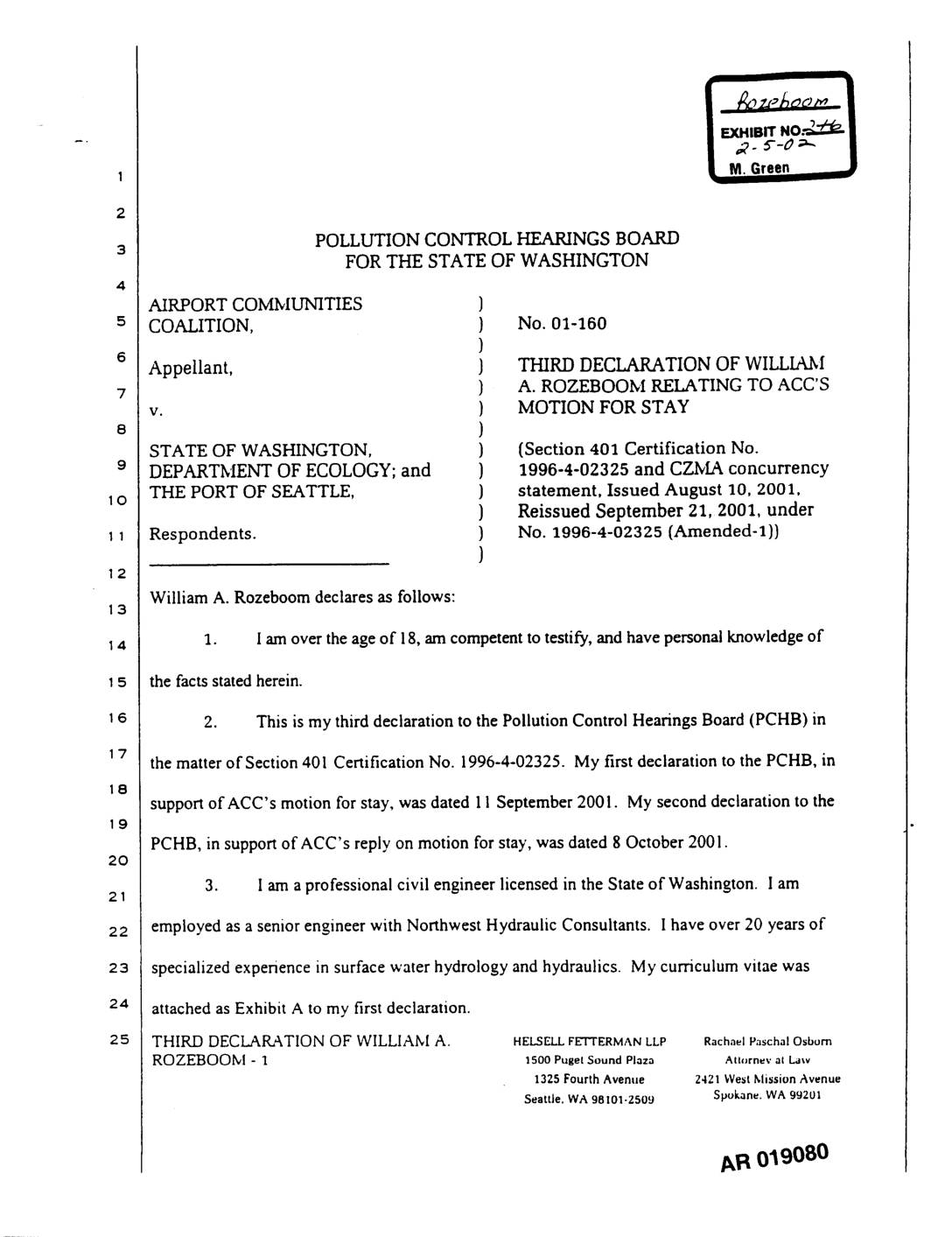
EXH 246: Third Declaration William A. Rozeboom ACC Motion for Stay PCHB No. 01-160
This 2001 legal declaration by civil engineer William Rozeboom, submitted to Washington's Pollution Control Hearings Board, challenges the Port of Seattle's stormwater and low-flow mitigation plans for the proposed third runway at Sea-Tac Airport. Rozeboom argues that the Port's analysis underestimates low-flow impacts on local streams and that the proposed underground storage vaults—equivalent in volume to more than seven Olympic-size swimming pools—are undersized. The declaration also disputes claims by Port engineer Paul Fendt that the water volumes involved are small and that mitigation can be easily adjusted.