Notes
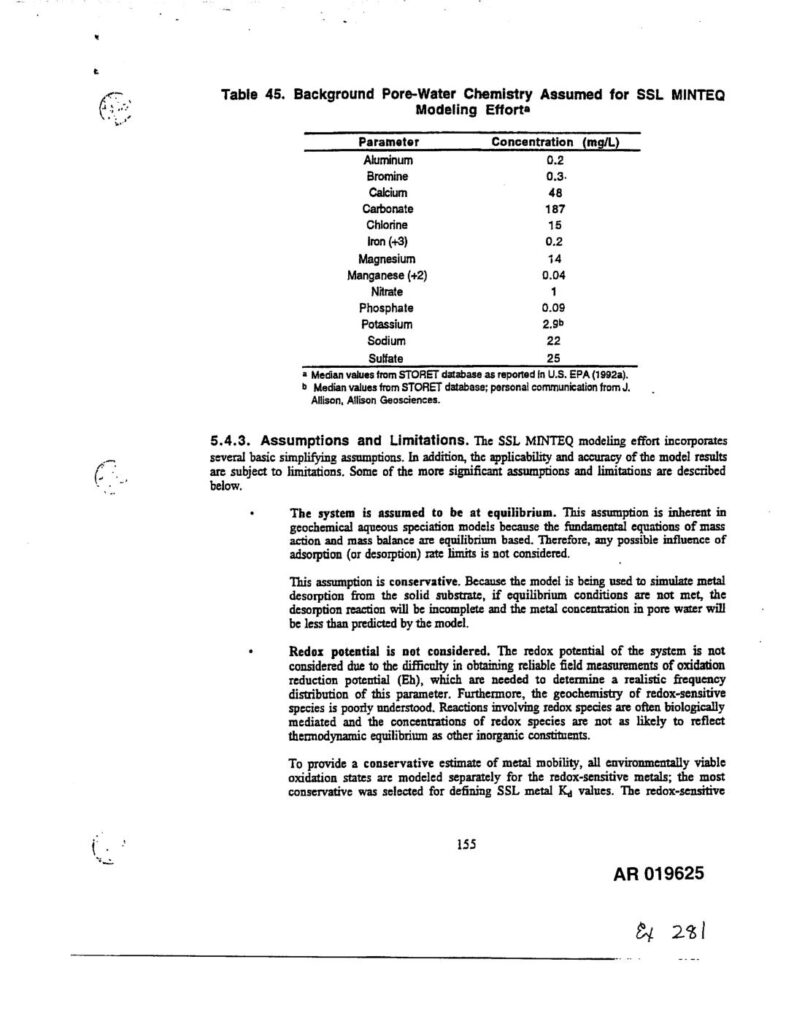
Administrative Record exhibit AR019625, filed in the PCHB Third Runway EIS proceeding. Documents the SSL (Soil Screening Level) MINTEQ geochemical aqueous speciation modeling effort, including Table 45 background pore-water chemistry (parameters: aluminum 0.2 mg/L, calcium 48 mg/L, carbonate 187 mg/L, iron +3 0.2 mg/L, manganese +2 0.04 mg/L, sulfate 25 mg/L, sodium 22 mg/L) drawn from the STORET database per U.S. EPA (1992a). Covers modeling assumptions (equilibrium, no redox potential, limited sorbent surfaces to FeOx and organic matter, no metal competition), limitations of the thermodynamic database, and pH-dependent Kd values for metals including arsenic (+3), chromium (+6), selenium, thallium, antimony, cyanide, and vanadium. Figure 11 plots MINTEQ-derived metal Kd (log L/kg) as a function of pH for chromium, beryllium, cadmium, nickel, zinc, mercury, silver, and barium at medium iron oxide content 0.31 wt% and organic matter 0.2 wt%. Arsenic (+3) Kd values range 25–31 L/kg for pH 4.9–8.0; compared to Battelle (1989) measured values 5.86–19.4 L/kg and Baes and Sharp (1983) range 1.0–8.3 L/kg. References RTI (1994) and SCDM.