TagThird Runway(1084)
-
 1996-06-20
Summary of the Regional Council’s decision process relating to amending the Metropolitan Transportation Plan to include a third runway at Sea-Tac International Airport with additional noise reduction measures
This 1996 Puget Sound Regional Council document summarizes the multi-year planning process that led to amending the regional transportation plan to include a third runway at Seattle-Tacoma International Airport. It traces decisions from the 1988 Regional Airport System Plan through the Flight Plan Project and environmental studies, explaining how planners concluded that no feasible alternative airport site existed and that measures like high-speed rail or congestion pricing could not substitute for added runway capacity. The plan also required implementation of additional noise reduction measures as a condition of approving the new runway. -
 1996-06-05
Air Quality Conformity Review for Sea-Tac Master Plan Update
A 1996 air quality review commissioned by the Airport Communities Coalition challenges the FAA's finding that Sea-Tac Airport's Master Plan Update would not worsen air pollution. Envirometrics, Inc. found that if the proposed third runway increased airport operations—by up to 33% annually and 50% during peak hours—carbon monoxide (CO) and nitrogen dioxide (NO₂) levels would exceed federal air quality standards at multiple locations near the airport. The report concludes that these increased emissions from greater aircraft and vehicle traffic would delay attainment of ambient air quality standards in the surrounding communities. -
 1996-05-28
Environmental Impact Statement Addendum To: The Flight Plan Project Final EIS (1992) and the Proposed Master Plan Update Development Actions at Seattle-Tacoma International Airport Final EIS (1996)
In May 1996, the Puget Sound Regional Council issued this Environmental Impact Statement Addendum to evaluate a proposal to add a third runway at Seattle-Tacoma International Airport (Sea-Tac) with specific noise reduction measures. The addendum was needed because a prior 1993 resolution authorizing the third runway had lapsed after the Port of Seattle failed to meet an independent noise-reduction review deadline by April 1, 1996. The Council considered new conditions and expert panel recommendations to reintroduce the third runway into the region's Metropolitan Transportation Plan while addressing community noise concerns. -
1996-05-28
Environmental Impact Statement Addendum To: The Flight Plan Project Final EIS (1992) and the Proposed Master Plan Update Development Actions at Seattle-Tacoma International Airport Final EIS (1996)
Puget Sound Regional Council EIS addendum dated May 28, 1996, serving as a SEPA addendum to the Flight Plan Project Final EIS (1992) and the Master Plan Update Development Actions at Seattle-Tacoma International Airport Final EIS (1996). The document concerns a proposed amendment to the Aviation Program and Appendix P – Resolution A-93-03 of the -
 1996-05-15
Barge in dirt for runway? Idea for filling ravine is built on conveyor, not trucks
In 1996, Lynnwood engineer Hank Hopkins proposed using barges and an electric conveyor belt system to transport the roughly 14 million cubic yards of fill dirt needed to build a third runway at Seattle-Tacoma International Airport, rather than relying on a constant stream of dump trucks. Hopkins argued his patented modular conveyor system would be faster, cheaper, quieter, and less disruptive to surrounding communities than the truck-based approach outlined in the environmental study. The city of Des Moines, which opposed the runway project, was seen as the primary obstacle to approving the conveyor plan, as the system would require city permits that trucking would not. -
 1996-03-27
Appendix E: Comments Concerning the Final Environmental Impact Statement — Sea-Tac Airport Master Plan Update
Appendix E contains public comments submitted in response to the Final Environmental Impact Statement (FEIS) for the Seattle-Tacoma International Airport Master Plan Update. Commenters include the Highline Water District, the Washington State Department of Ecology, the U.S. Public Health Service, and the Washington State Department of Natural Resources, raising concerns about groundwater contamination, the handling of aircraft de-icing glycols, storm water runoff, and surface mining permit requirements for borrow sites on Port of Seattle property. The agencies generally called for stronger mitigation measures and clearer answers to environmental questions before approving the proposed airport expansion. -
 1996-03-27
Expert panel says noise conditions not satisfied at Sea-Tac
In March 1996, an independent expert panel concluded by a 2-1 vote that the Port of Seattle had not done enough to reduce real-world noise impacts from Sea-Tac Airport to meet the conditions set by the Puget Sound Regional Council for approving a third runway. While the panel acknowledged the Port's extensive noise abatement programs, the majority found they fell short of the meaningful reductions required under Resolution A-93-03. The panel also determined that neither demand management improvements nor alternative transportation options, such as rail, would sufficiently reduce air travel demand to eliminate the need for the additional runway. -
 1996-03-27
PSRC Expert Arbitration Panel Final decision on noise issues
The Expert Arbitration Panel on Noise and Demand/System Management Issues issued its final decision on noise issues related to Resolution A-93-03, which set noise reduction conditions for PSRC authorization of a third runway at Sea-Tac International Airport. A majority of the Panel found that the Port of Seattle had not demonstrated a sufficient reduction in -
 1996-03-18
Testimony of Dr. Stephen Hockaday before the Subcommittee on Aviation of the House of Representatives Committee on Transportation and Infrastructure
In 1996 congressional testimony, Dr. Stephen Hockaday argued against building a costly third runway at Seattle-Tacoma International Airport, contending that the Port of Seattle greatly overstated the frequency of poor weather conditions that would require it. He presented evidence that true instrument flight conditions occur less than 8% of the year—not the 44% the Port claimed—and that existing navigation technologies like Localizer Directional Aid approaches could address capacity needs at far lower cost. Hockaday warned that spending half a billion dollars on a runway used only 15% of the time would divert resources from better long-term regional aviation solutions. -
 1996-03-18
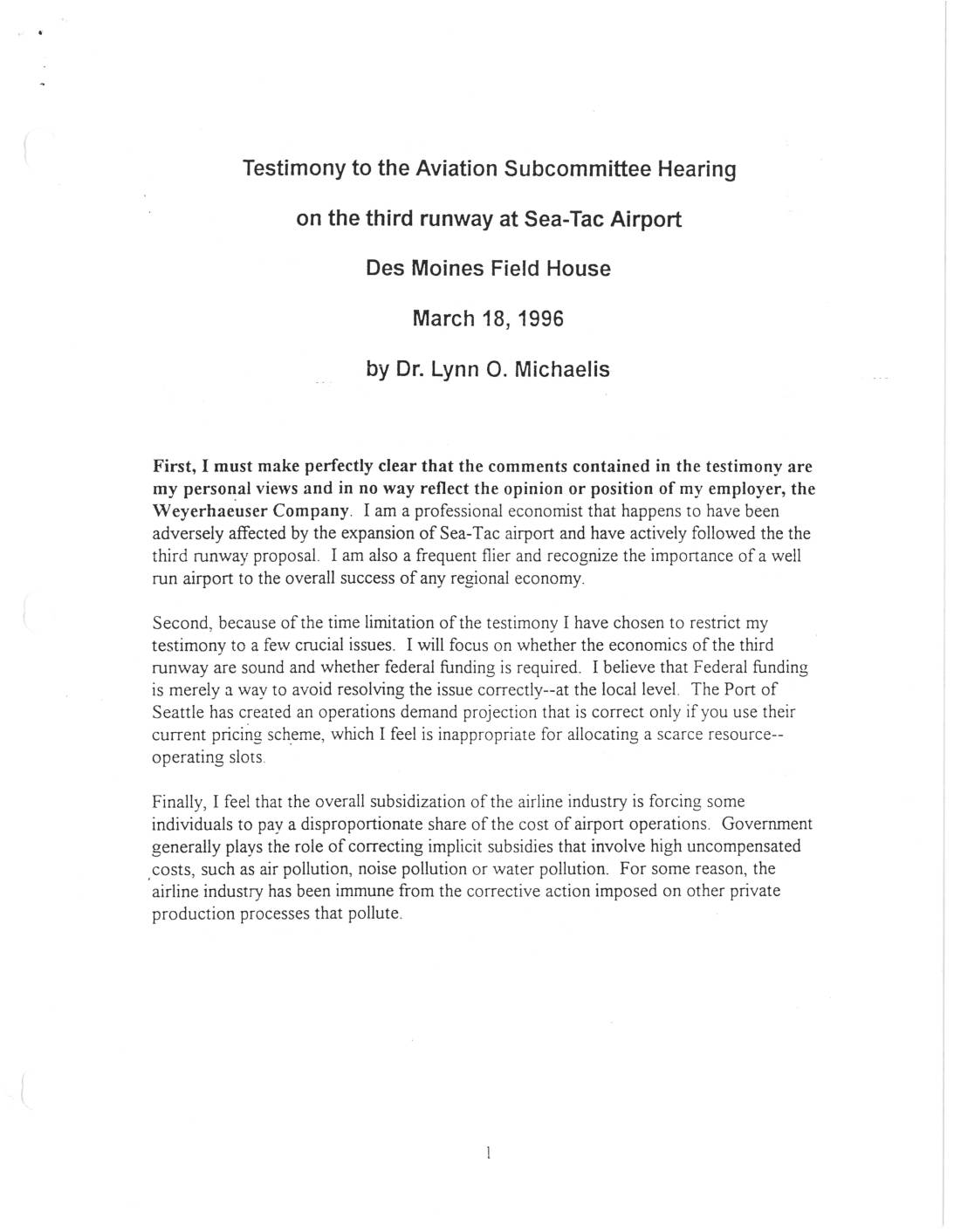
Testimony of Dr. Lynn O. Michaelis on the Third Runway at Sea-Tac Airport, Aviation Subcommittee Hearing, Des Moines Field House, March 18, 1996
In this 1996 testimony to the Aviation Subcommittee, economist Dr. Lynn O. Michaelis argues that the proposed third runway at Seattle-Tacoma International Airport is economically unjustified, citing flawed pricing schemes that fail to account for peak-hour demand and encourage inefficient small-plane operations. He contends that federal funding is being used to bypass local accountability, masking the project's poor return on investment — estimated at less than 1% on a $500 million expenditure. Michaelis also criticizes the airline industry's exemption from pollution-related cost corrections that apply to other industries, arguing that nearby residents bear a disproportionate share of the environmental costs.