TagThird Runway(1084)
-
 1996-10-01
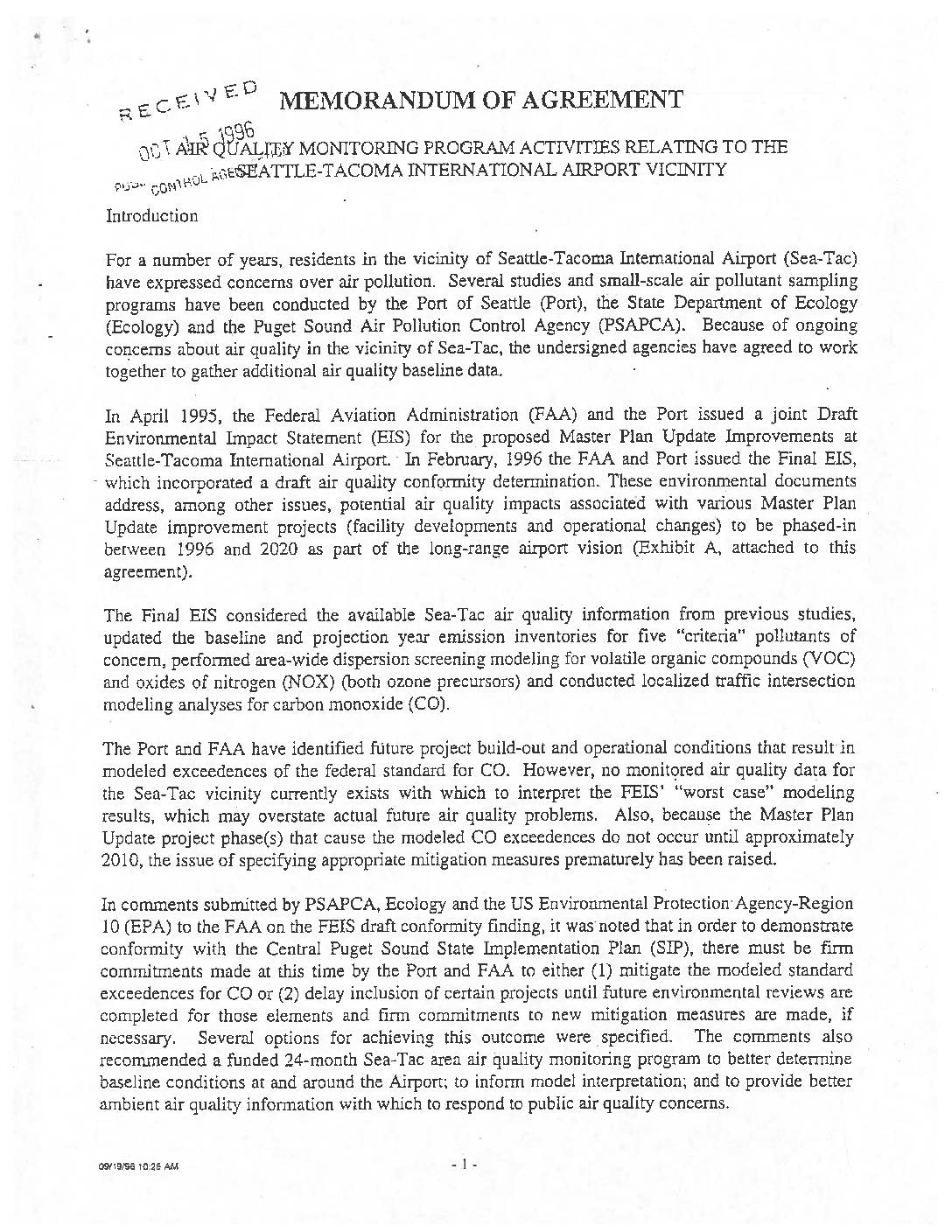
Memorandum of Agreement: Air Quality Monitoring Program Activities Relating to the Seattle-Tacoma International Airport Vicinity
This 1996 Memorandum of Agreement establishes a 24-month air quality monitoring program near Seattle-Tacoma International Airport, involving the Port of Seattle, FAA, EPA, Washington State Department of Ecology, and the Puget Sound Air Pollution Control Agency. The program, funded at $195,000, focuses on measuring carbon monoxide, nitrogen oxides, and aircraft fuel particle residue to establish baseline air quality data and evaluate potential pollution impacts from planned airport expansion projects. The Port agreed not to proceed with expansion elements projected to cause carbon monoxide standard violations until monitoring is complete and, if necessary, mitigation measures are identified. -
 1996-09-19
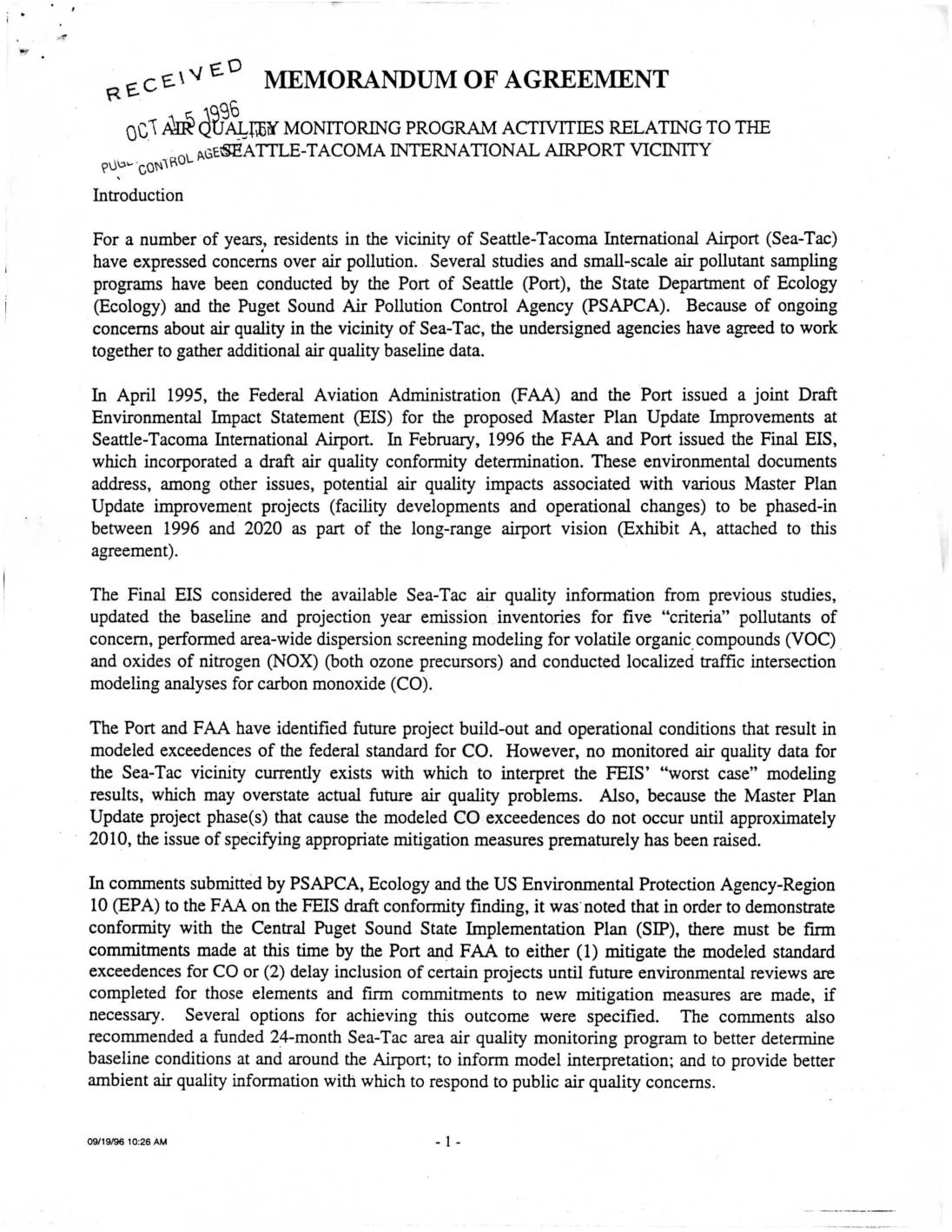
Memorandum of Agreement: Air Quality Monitoring Program Activities Relating to the Seattle-Tacoma International Airport Vicinity
A 1996 Memorandum of Agreement between the Port of Seattle, FAA, EPA, Washington State Department of Ecology, and the Puget Sound Air Pollution Control Agency established a 24-month air quality monitoring program near Seattle-Tacoma International Airport. The $195,000 program was designed to measure carbon monoxide, nitrogen oxides, and aircraft fuel particle residue in order to establish baseline pollution data and assess the accuracy of earlier 'worst case' air quality models from the airport's Final Environmental Impact Statement. The Port agreed not to proceed with Master Plan expansion projects projected to cause CO standard exceedances until monitoring was complete and, if necessary, appropriate mitigation measures were identified. -
 1996-08-23
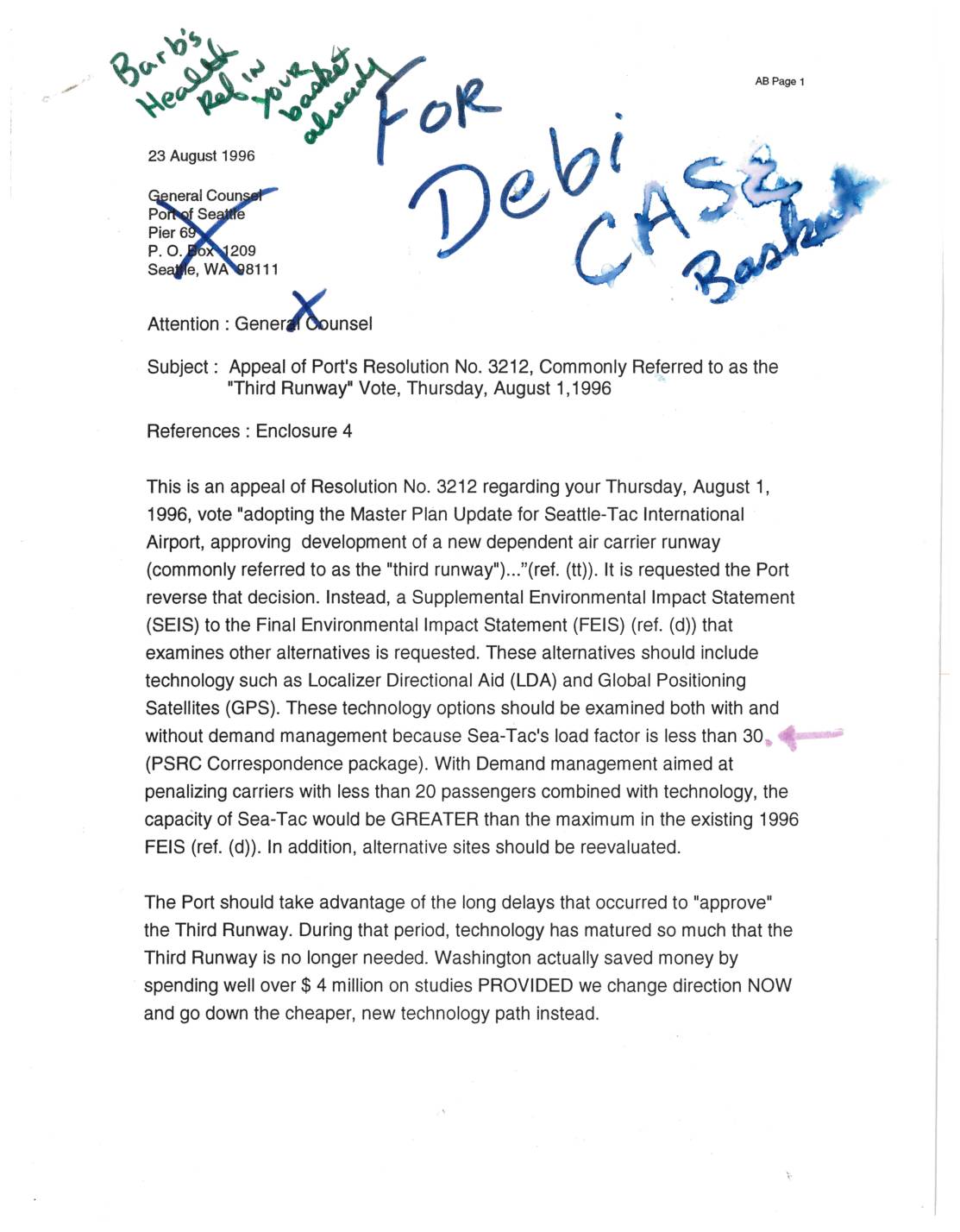
CASE & RCAA Appeal of Port Of Seattle Resolution No. 3212 (Third Runway Vote)
In August 1996, community groups CASE and RCAA formally appealed the Port of Seattle's Resolution No. 3212, which approved construction of a third runway at Seattle-Tacoma International Airport. The appeal argued that newer navigation technologies such as Localizer Directional Aid (LDA) and GPS, combined with demand management strategies, could provide equivalent airport capacity at far lower cost and with less environmental harm. The groups requested a Supplemental Environmental Impact Statement to evaluate these technology-based alternatives and reconsider the third runway decision. -
Down-To-Earth Job — Sea-Tac’s Third Runway To Get Its Fill Of Dirt
Jack Broom Seattle Times Staff Reporter Let’s say you’ve been looking for a better view, but you don’t want to leave the neighborhood. Instead, you bring in fill dirt to raise your property so you can see over all your neighbors. Somehow you get the dirt to form a nice column straight up from your -
 1996-08-15
Down-to-earth job: Sea-Tac’s third runway to get its fill of dirt
A 1996 Seattle Times article details the massive earth-moving challenge facing Sea-Tac Airport's planned third runway, which required importing approximately 14.25 million cubic yards of fill dirt at an estimated cost of $120 million to level a corridor of dips and valleys as deep as 145 feet. Port of Seattle planners were exploring multiple options for sourcing and transporting the dirt, including conveyor belts, barges, and rail spurs, while facing legal opposition from nearby cities who argued the project understated environmental and community harm. -
 1996-07-11
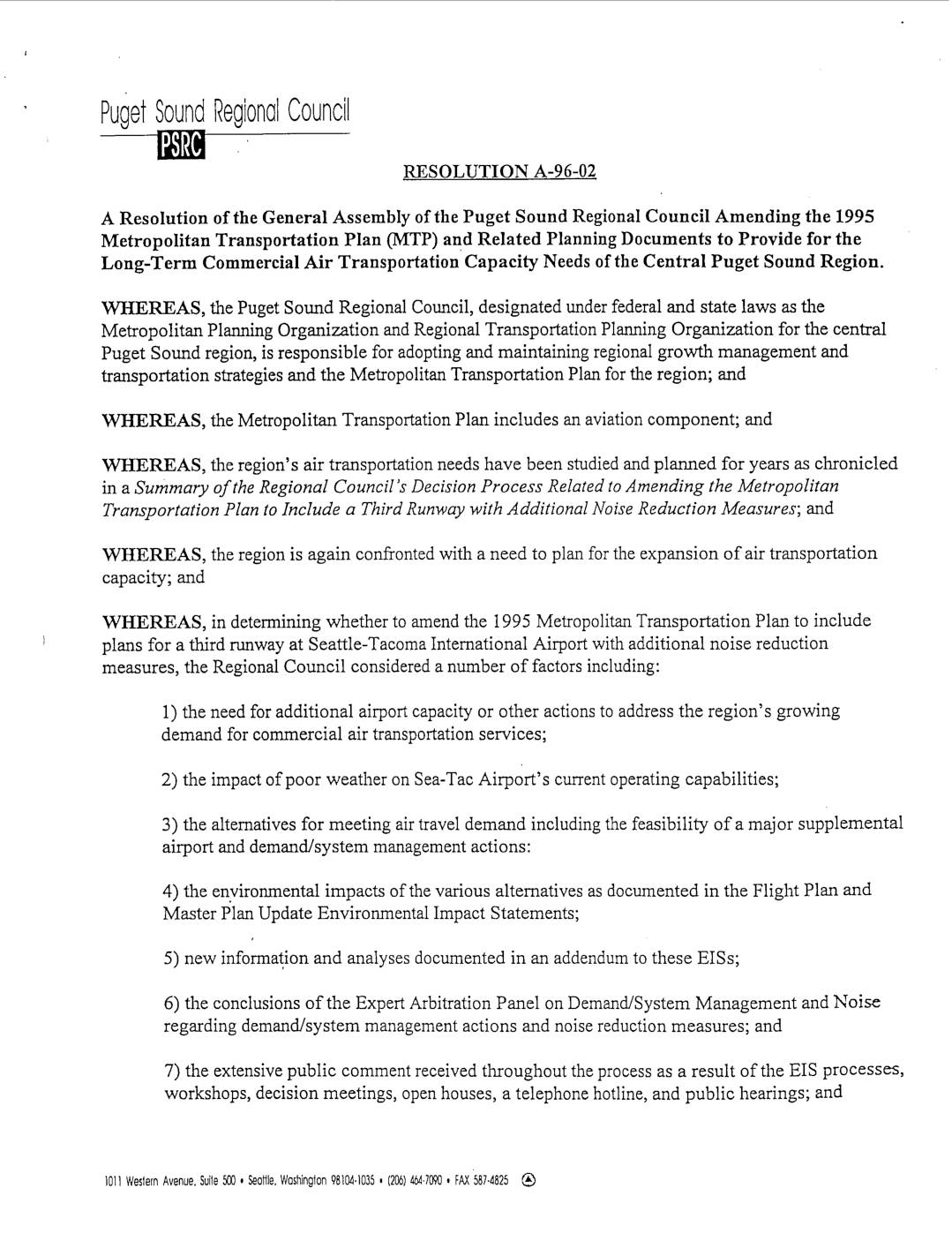
PSRC Resolution A-96-02: amending the 1995 MTP and related planning documents to provide for the long-term commercial air transportation capacity needs of the Central Puget Sound Region
In July 1996, the Puget Sound Regional Council adopted Resolution A-96-02, amending the region's Metropolitan Transportation Plan to include plans for a third runway at Seattle-Tacoma International Airport, paired with additional noise reduction measures. The decision followed years of study, including an Expert Panel finding that neither demand management strategies nor high-speed rail could eliminate the need for expanded capacity. Final approval of the runway remained contingent on environmental review by the Port of Seattle, Federal Aviation Administration permitting, and completion of required noise mitigation steps. -
 1996-07-11
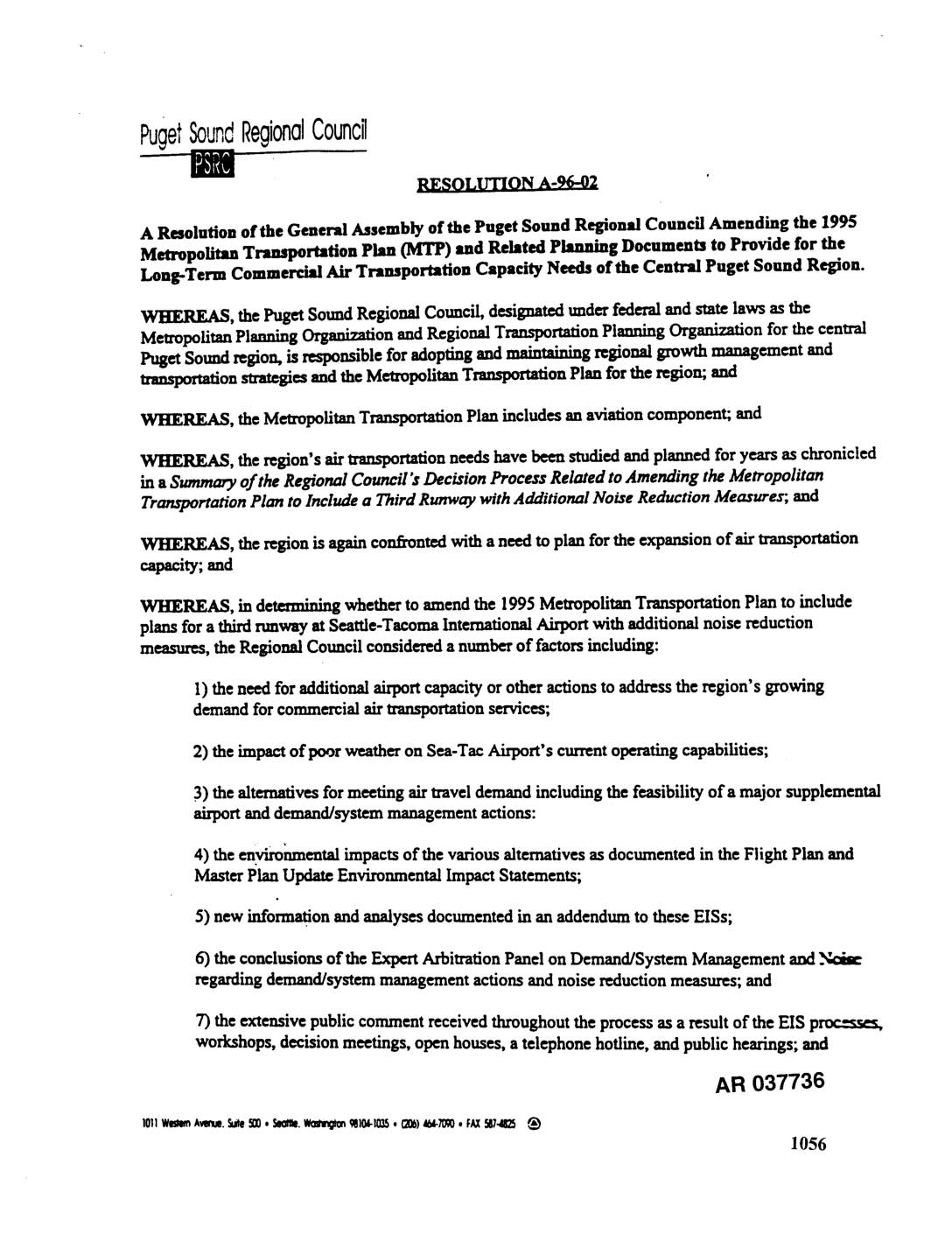
EXH AR037736: Puget Sound Regional Council Resolution A-96-02 Amending the 1995 Metropolitan Transportation Plan for Long-Term Commercial Air Transportation Capacity
Resolution A-96-02 adopted by the Puget Sound Regional Council (PSRC) General Assembly on July 11, 1996, amending the 1995 Metropolitan Transportation Plan (MTP) and Regional Transportation Plan (RTP) to include plans for a third runway at Seattle-Tacoma International Airport with additional noise reduction measures. References Resolution A-93-03, Expert Arbitration Panel on Demand/System Management and Noise, -
 1996-06-20
Summary of the Regional Council’s decision process relating to amending the Metropolitan Transportation Plan to include a third runway at Sea-Tac International Airport with additional noise reduction measures
This document summarizes the Puget Sound Regional Council’s planning process for amending the Metropolitan Transportation Plan to include a third runway at Sea-Tac International Airport. It covers the history of regional aviation planning from the 1988 Regional Airport System Plan through the Flight Plan Project, Sea-Tac Master Plan, and Expert Arbitration Panel findings on noise -
 1996-06-20
Summary of the Regional Council’s Decision Process Relating to Amending the Metropolitan Transportation Plan to Include a Third Runway at Sea-Tac International Airport with Additional Noise Reduction Measures
This 1996 Puget Sound Regional Council document summarizes the decision-making process behind adding a third runway at Seattle-Tacoma International Airport, tracing planning efforts from the late 1980s through 1996. It outlines how regional studies, including the Flight Plan Project and an Expert Panel evaluation, concluded that no feasible alternative airport sites existed and that options like high-speed rail or congestion pricing could not replace the need for the new runway. The amendment to the Metropolitan Transportation Plan was approved subject to conditions requiring noise reduction measures and demand management actions. -
1996-06-20
Summary of the Regional Council’s Decision Process Relating to Amending the Metropolitan Transportation Plan to Include a Third Runway at Sea-Tac International Airport with Additional Noise Reduction Measures
Title page of a Puget Sound Regional Council document dated June 20, 1996, summarizing the Regional Council's decision process relating to amending the Metropolitan Transportation Plan to include a third runway at Sea-Tac International Airport with additional noise reduction measures.