TagThird Runway(1084)
-
 1995-04-20
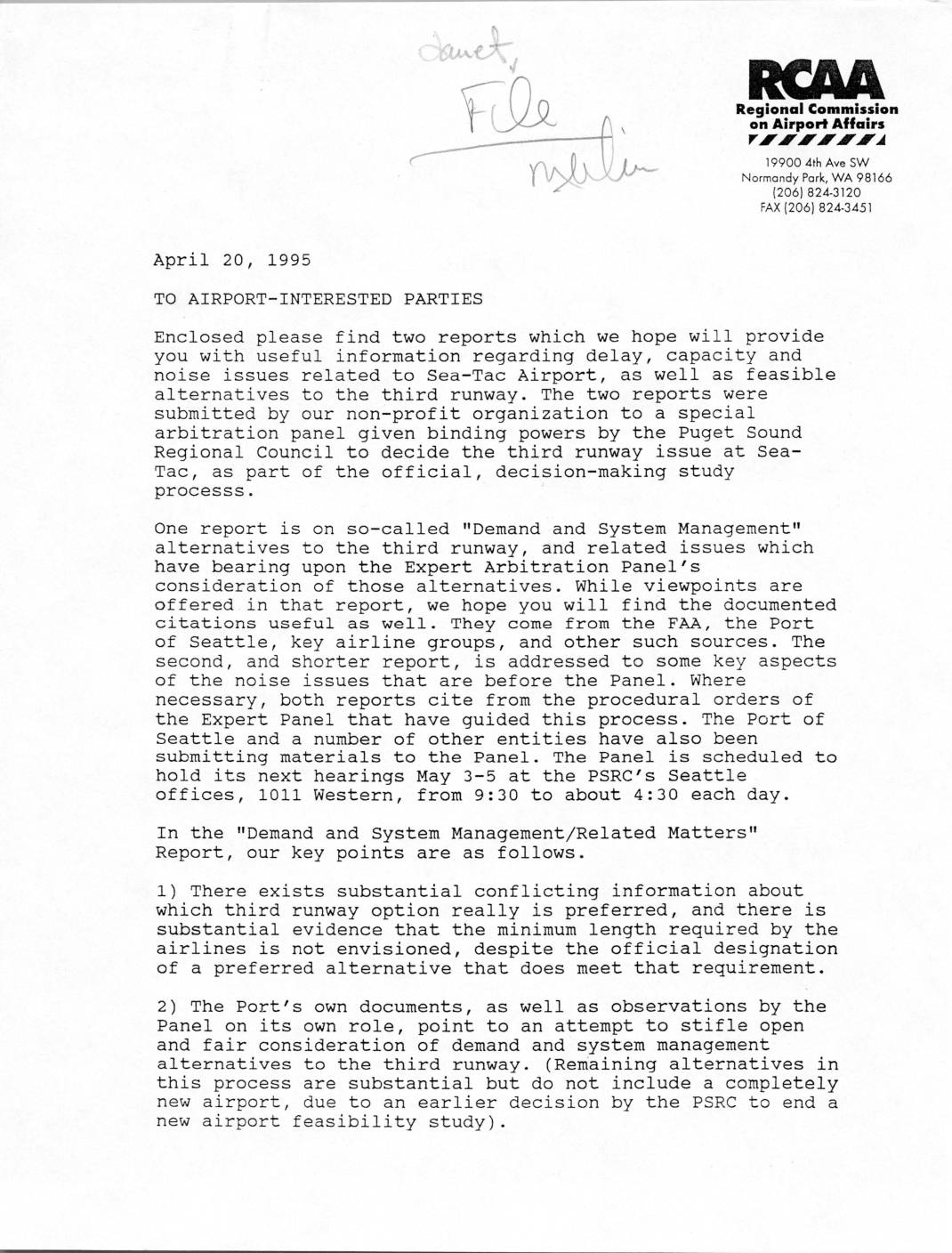
Letter to airport-interested parties regarding Sea-Tac third runway reports
A 1995 letter from the Regional Commission on Airport Affairs to airport-interested parties summarizes two reports submitted to an arbitration panel deciding the Sea-Tac Airport third runway issue. The reports argue that alternatives to the third runway—such as regional airport system use and peak-hour pricing—were not fairly considered, that flight delay figures cited to justify the runway were overstated, and that the project itself may never be buildable due to cost, financing, and construction obstacles. A separate shorter report addresses noise concerns related to the proposed runway. -
 1995-04-01
ACC Comments on the Proper Scope of the Environmental Impact Statement for a Proposed Development of Seattle-Tacoma International Airport
The Airport Communities Coalition, representing the cities of Burien, Des Moines, Normandy Park, and Tukwila, Washington, submitted formal scoping comments to the FAA and Port of Seattle regarding the proper scope of an Environmental Impact Statement for a proposed expansion of Seattle-Tacoma International Airport. The comments address key issues including the purpose and need for the project, the role of Puget Sound Regional Council planning, and the requirement for the FAA to independently fulfill its obligations under the National Environmental Policy Act. The document also calls for the EIS to account for connected and cumulative impacts, including planned land-side facility improvements and the Part 150 Noise Mitigation Program. -
1994-12-11
Sea-Tac’s Turbulent History
Dec 11, 1994 Stephen Clutter, Paul J. Lim The latest controversy at Sea-Tac, over a possible third runway, is one more chapter in a long, turbulent history of airport expansion. Planes started using the site in 1944 and in five decades, it has become the 16th-busiest airport in the nation. ———————————- If you’re upset about -
 1994-10-27
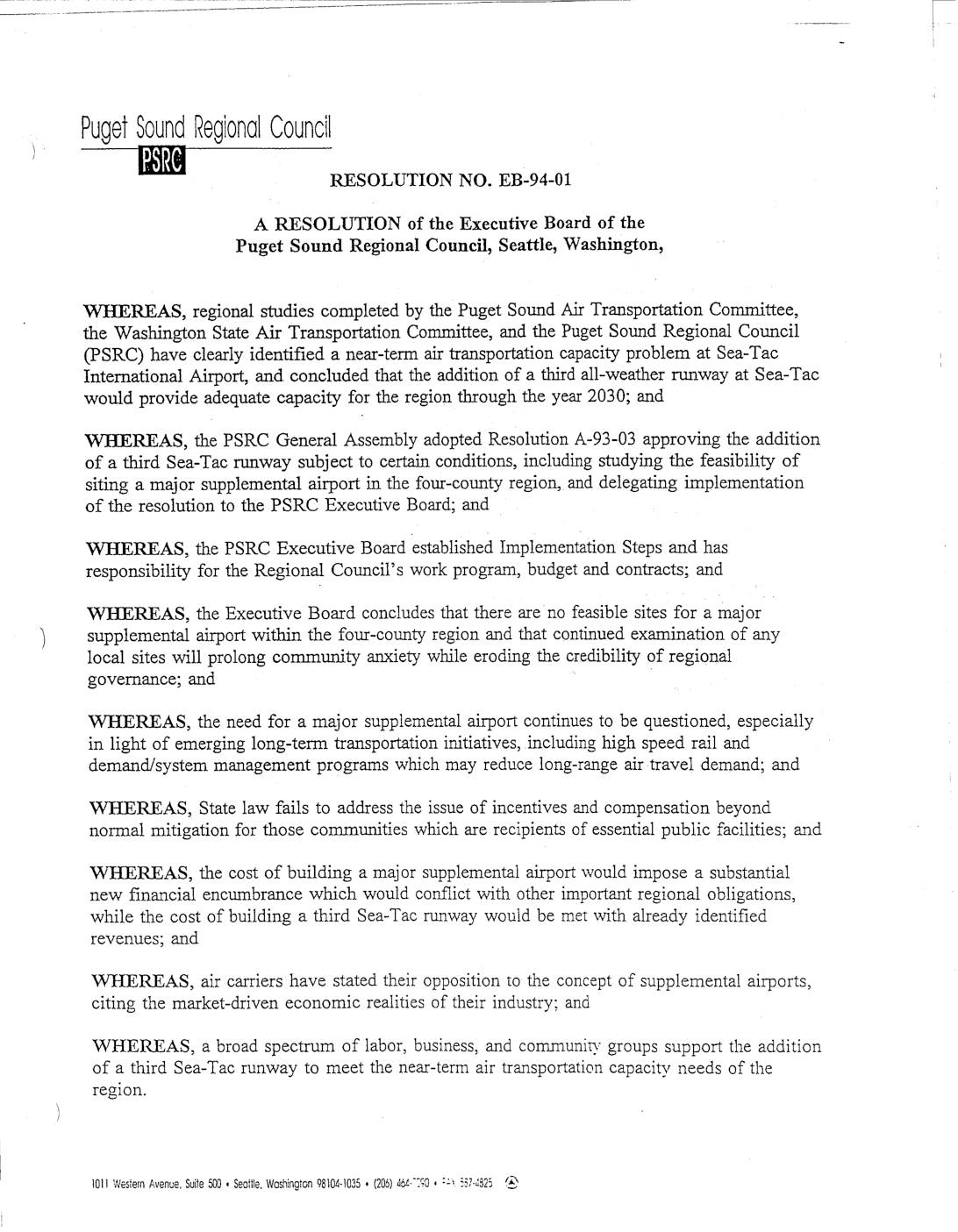
Resolution No. EB-94-01: A resolution of the Executive Board of the Puget Sound Regional Council, Seattle, Washington
★ 32In October 1994, the Puget Sound Regional Council's Executive Board formally approved moving forward with a third runway at Seattle-Tacoma International Airport, concluding that no feasible sites existed for a supplemental airport in the four-county region. The resolution affirmed that the third runway would meet regional air capacity needs through 2030, provided it satisfied noise and demand management conditions and passed environmental review. The Board also recommended that the State develop legislation to compensate communities impacted by essential public facilities and explore long-term transportation alternatives, including high-speed rail. -
 1994-10-27
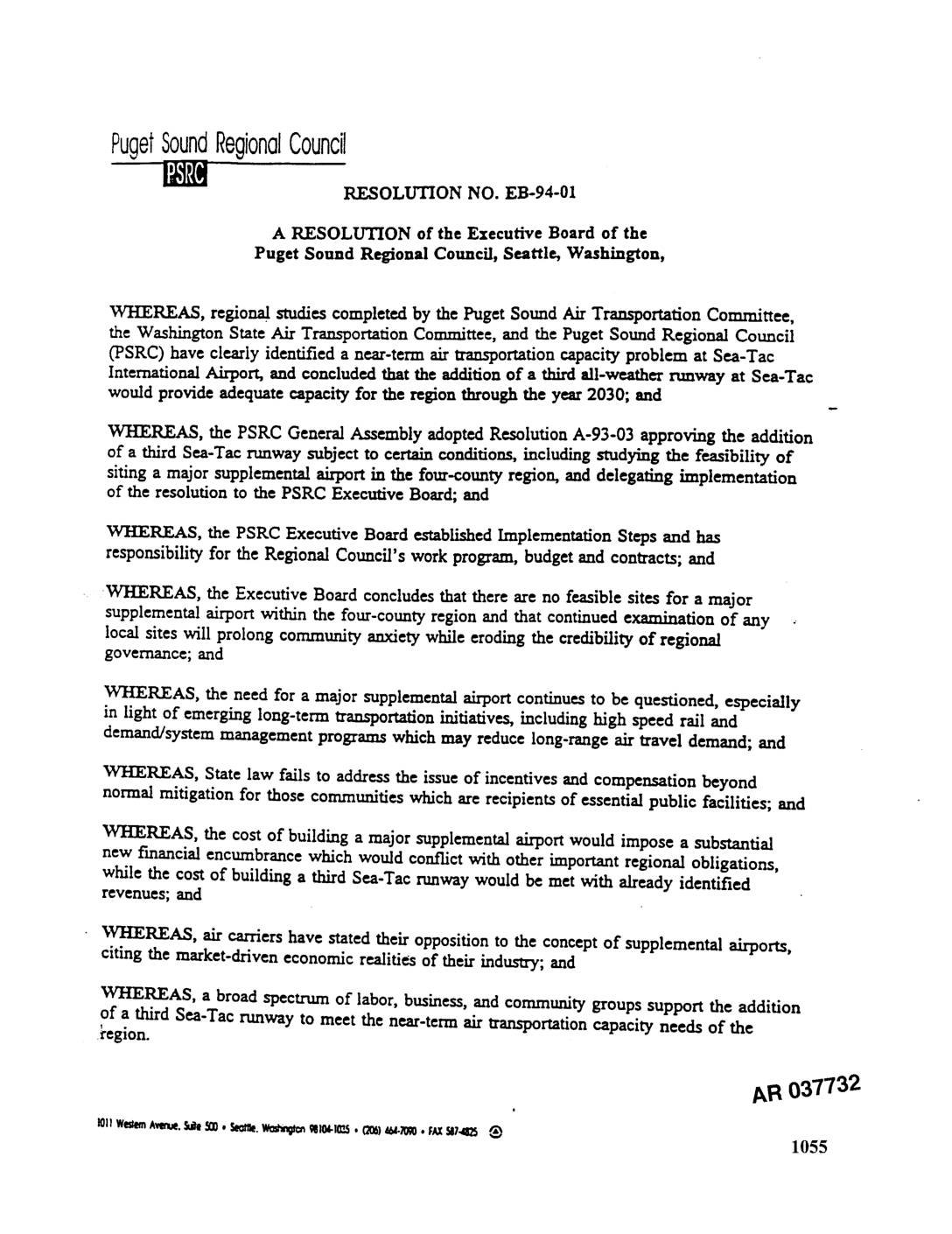
EXH AR037732: Puget Sound Regional Council Resolution No. EB-94-01 — Third Runway at Sea-Tac and Supplemental Airport Studies
Resolution EB-94-01 adopted October 27, 1994 by the Puget Sound Regional Council (PSRC) Executive Board, affirming the General Assembly’s Resolution A-93-03 approving a third all-weather runway at Sea-Tac International Airport. The Executive Board determined no feasible sites exist for a major supplemental airport in the four-county region and that further supplemental airport studies should not -
 1994-09-19
Technical Report No. 6: Airside Options Evaluation — Airport Master Plan Update for Seattle-Tacoma International Airport
This 1994 technical report, prepared by P&D Aviation for the Port of Seattle, evaluates airside development options for Seattle-Tacoma International Airport as part of a broader Airport Master Plan Update. It examines potential improvements to the existing airfield, analyzes options for adding a third runway, and assesses the operational, cost, and environmental implications of each scenario. The findings cover runway length requirements, projected airfield delays, estimated construction costs, and preliminary environmental screening results. -
 1994-04-01
Archive Record 1322: PSRC Administration Files, Sea-Tac Airport Correspondence and Implementation Resolution A-93-03 Records, 1992–1994
This archival record (Box 01290, Historical Box 1322) contains administrative files from 1992–1994 related to Sea-Tac Airport planning and noise policy, including litigation documents, Environmental Impact Statement (EIS) comments on a proposed third runway, capacity enhancement plans, and correspondence from citizens, city officials, and state agencies. It also includes records tied to Implementation Resolution A-93-03, covering communications with groups such as Apogee, Bricklin Gendler, and the Airport Communities Coalition. The files were prepared by Angie Daniels and are classified under the Department Subject Files record series. -
1994-04-01
Archive Record 1322: PSRC Administration Files, Sea-Tac Airport Correspondence and Implementation Resolution A-93-03 Records, 1992–1994
A search results screen showing '1 of 1' result with navigation controls. The toolbar includes options for New Search, Back, Opened (8), and Current Record Actions, consistent with a library or document database interface. -
 1993-12-22
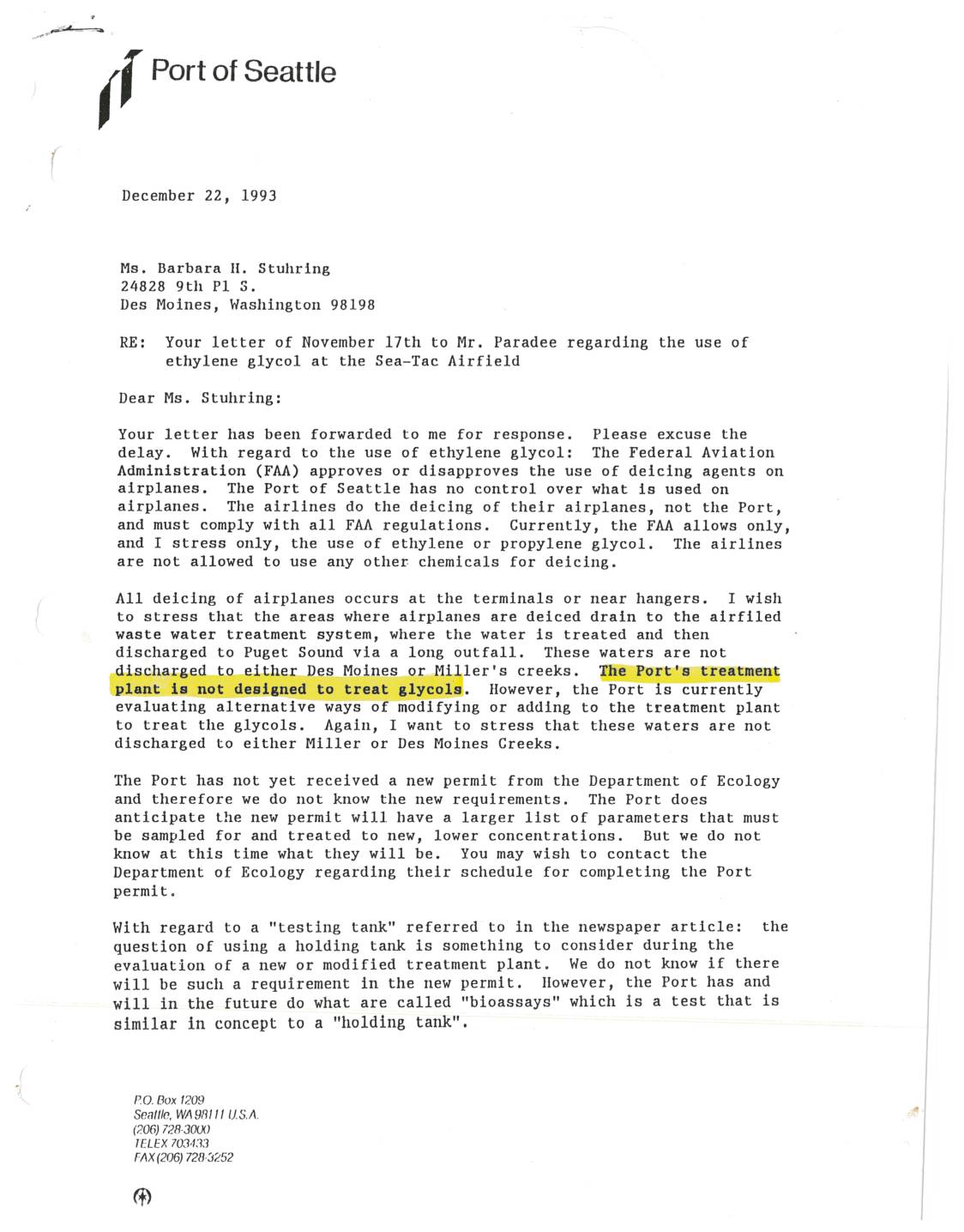
Port Of Seattle Letter to Barbara Stuhring: Ethylene Glycol Deicing at Sea-Tac Airport and Wastewater Treatment
A 1993 letter from the Port of Seattle to a Des Moines resident explains that airline deicing at Sea-Tac Airport uses only FAA-approved ethylene or propylene glycol, and that wastewater from deicing drains to the airport's treatment system before being discharged to Puget Sound — not to Miller or Des Moines Creeks. The Port acknowledged its treatment plant was not designed to handle glycols and was evaluating upgrades. A follow-up 1996 letter challenges a contradictory statement in the airport's Final Environmental Impact Statement, which claimed most deicing fluids were contained and treated by the Port's Industrial Wastewater System. -
 1993-04-29
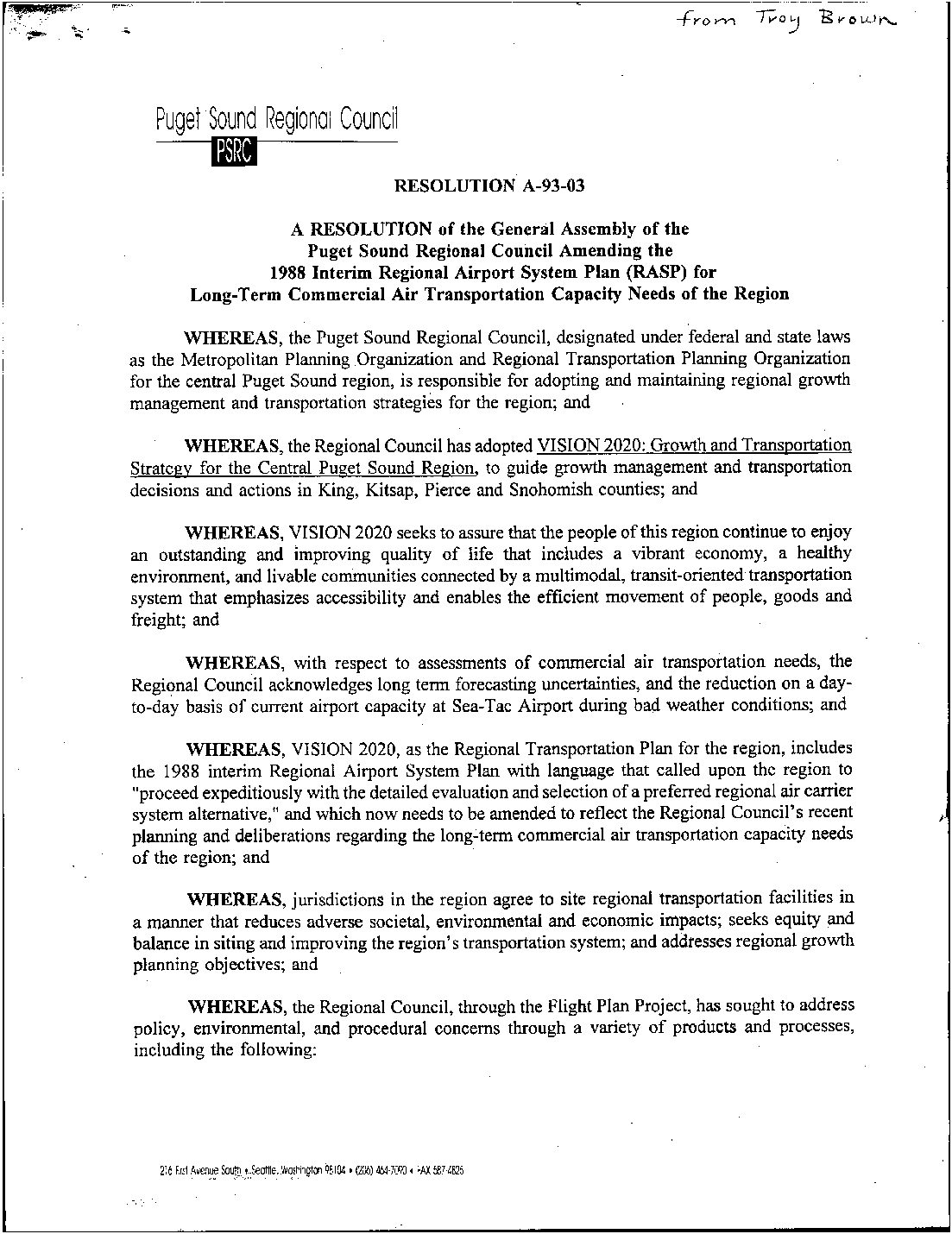
Resolution A-93-03: A resolution of the General Assembly of the Puget Sound Regional Council amending the 1988 Interim Regional Airport System Plan (RASP) for long-term commercial air transportation capacity needs of the region
In April 1993, the Puget Sound Regional Council adopted Resolution A-93-03, amending its 1988 Regional Airport System Plan to address long-term commercial air transportation needs in the central Puget Sound region. The resolution established a preferred strategy of pursuing both a major supplemental airport within the four-county area and a third runway at Sea-Tac Airport, with the third runway to be authorized by April 1, 1996 subject to conditions including noise reduction performance objectives and demand management efforts. The resolution also eliminated small supplemental airports such as Paine Field as a preferred alternative and called for site-specific environmental impact studies on the proposed Sea-Tac third runway.