TagSustainable Aviation Fuels(78)
-
 2022-01-01
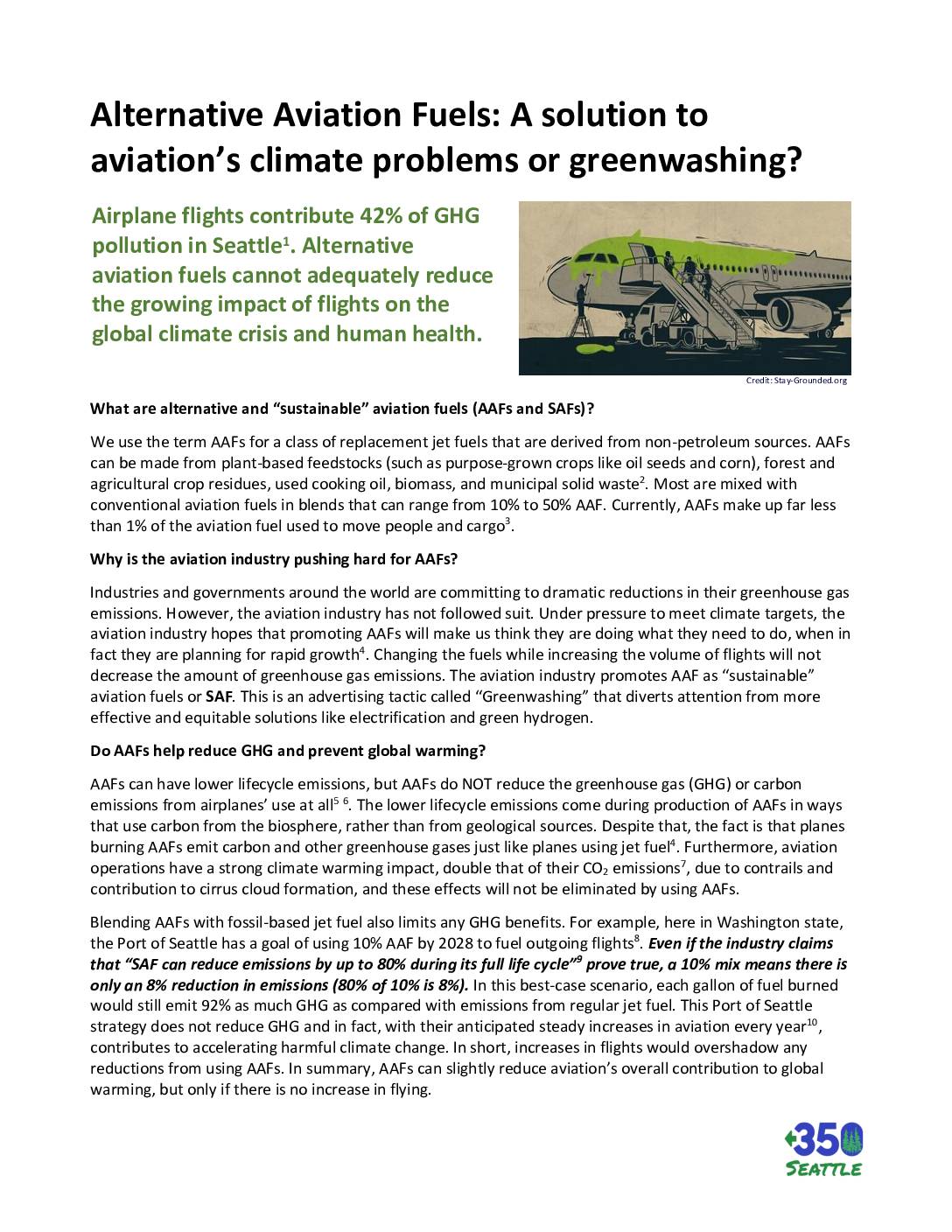
Alternative Aviation Fuels: A Solution To Aviation’s Climate Problems Or Greenwashing?
This document from 350 Seattle argues that alternative aviation fuels (AAFs), often marketed as 'sustainable aviation fuels' or SAFs, are largely a greenwashing tactic by the aviation industry and cannot meaningfully reduce greenhouse gas emissions, especially as flight volumes continue to grow. It highlights that planes burning AAFs still emit carbon just like conventional jet fuel, and that scaling up AAF production raises serious equity concerns, including health impacts on low-income communities and people of color living near Sea-Tac Airport and under flight paths. 350 Seattle instead calls for an emissions cap on aviation, a halt to airport expansion, and investment in true zero-emission solutions. -
Our Commitment to Fly Net Zero by 2050
Fly Net Zero is the commitment of airlines to achieve net zero carbon by 2050. At the 77th IATA Annual General Meeting in Boston, USA, on 4 October 2021, a resolution was passed by IATA member airlines committing them to achieving net-zero carbon emissions from their operations by 2050. This pledge brings air transport -
Biden Outlines a Plan for Cleaner Jet Fuel. But How Clean Would It Be?
Some biofuels may contribute to greenhouse gas emissions in ways that can significantly reduce, and sometimes offset, their advantages over fossil fuels, studies have shown. The deal between the Biden administration and the airline industry is meant to drive down flying’s environmental toll.Credit…Ted S. Warren/Associated Press By Hiroko Tabuchi At first glance, it’s a big step -
 2021-06-15
Burien Airport Committee agenda and draft minutes, June 15, 2021
The Burien Airport Committee held a virtual meeting on June 15, 2021, to review draft lists of future agenda topics, upcoming airport-related meetings, and airport legislation and mitigation funding, including discussion of Sustainable Aviation Fuel and its potential to reduce particulate pollution. The committee also received an update on the SEA Stakeholder Advisory Round Table (StART) activities and planned upcoming presentations on Burien's Draft Climate Action Plan and a session by the ASCENT aviation research lab from WSU. Public participation was conducted remotely via Zoom, email, or text due to pandemic restrictions on in-person meetings. -
 2021-05-18
Burien Airport Committee agenda, May 18, 2021
The Burien Airport Committee held a virtual meeting on May 18, 2021, to discuss issues related to Seattle-Tacoma International Airport, including proposals to invite Port Commission President Fred Felleman to a future meeting and presentations on sustainable aviation fuel and aviation's climate impacts. The committee also reviewed updates on the SEA Stakeholder Advisory Round Table (StART) and Burien's planned comments on the Port of Seattle's Sustainable Airport Master Plan (SAMP). Draft minutes from the April 20, 2021 meeting, which featured guests from Public Health Seattle-King County and the Port of Seattle, were also submitted for approval. -
Green air travel is still decades away. Here’s why
Airplane manufacturers are making big moves to decarbonize — but is it too little too late? Jennifer Van Evra “The airline sector doesn’t have a plan to date,” says Andrew Murphy, aviation director of Transport and Environment, “and it’s kind of scrambling to come up with one.” (Justin Sullivan/Getty Images) What On Earth27:01Up in the -
 2021-02-25
Recovering from COVID-19: The airline perspective
A February 2021 presentation by Airlines for America outlines how COVID-19 devastated the airline industry, with worldwide passenger traffic dropping 66% and U.S. carrier revenues falling 61.5% year-over-year. Despite these financial losses, airlines remained committed to environmental progress, including accelerating the retirement of older, less fuel-efficient aircraft in favor of newer, cleaner models. The presentation also highlights the role of Sustainable Aviation Fuel (SAF) and aviation's broader responsibility in achieving a sustainable future. -
How a 1940s treaty set airlines on a path to high emissions and low regulation
Before the pandemic, aviation was on course to be the UK’s most polluting sector and produce as much as 22% of global emissions by 2050. The industry is suffering from low demand due to coronavirus restrictions, but without meaningful policy changes, flight numbers and emissions are expected to return to pre-COVID-19 levels by 2024. When accounting for emissions, aviation is -
 2020-09-01
Sustainable Aviation Fuel: Review of Technical Pathways
This U.S. Department of Energy report, prepared by researchers from Pacific Northwest National Laboratory, the National Renewable Energy Laboratory, and the University of Dayton, reviews the technical pathways for producing Sustainable Aviation Fuel (SAF) — alternative fuels designed to reduce the environmental impact of commercial aviation. The report synthesizes findings from multiple expert workshops and evaluates various methods for converting renewable resources into jet fuel. It is intended to inform policymakers, fuel producers, and aviation stakeholders about viable routes toward cleaner air travel. -
 2020-02-25
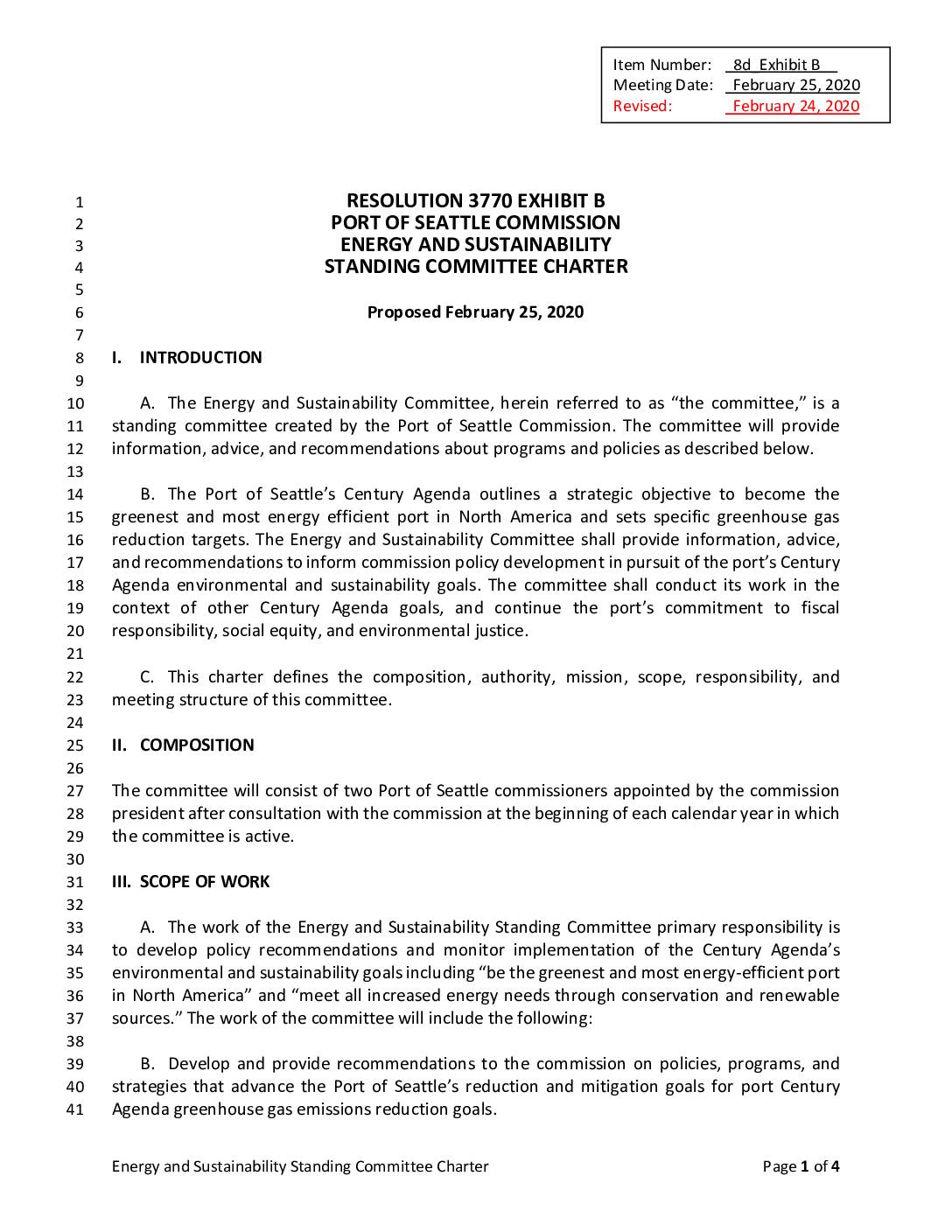
Port Of Seattle Commission Energy and Sustainability Standing Committee charter
The Port of Seattle Commission established the Energy and Sustainability Standing Committee to develop policy recommendations and monitor progress toward the port's environmental goals, including becoming the greenest and most energy-efficient port in North America and reducing carbon emissions 50% by 2030. The committee, composed of two appointed commissioners, oversees areas such as sustainable aviation fuels, shore power for cruise ships, and clean energy planning. While it can gather information and advise the full Commission, it does not have independent legal authority to act on the Commission's behalf.