TagSustainable Airport Master Plan(233)
-
 2024-02-08
Appendix J: Noise 2/2 Technical Report Modeling Protocol: AEDT Version 3e to 3f Update
This technical memorandum from Landrum & Brown (February 2024) explains that noise modeling for the Seattle-Tacoma Airport (SEA) Sustainable Airport Master Plan (SAMP) Environmental Review was updated from AEDT Version 3e to the newer AEDT Version 3f, released December 13, 2023. The upgrade allowed modelers to use actual aircraft data for the Boeing 737-7 and Cessna 408 SkyCourier rather than substitute aircraft, improving modeling accuracy. The document details the specific airframe, engine, and Aircraft Noise and Performance (ANP) data changes made between the two software versions. -
Sea-Tac Airport Got Very Close To Pre-Pandemic Passenger Peak in 2023
Seattle-Tacoma International Airport (SEA) nearly broke its passenger volume record in 2023. Just shy of the 2019 record by 941,979, SEA clocked 50,887,260 passengers in 2023. That was up 10.7% from 2022 when 45,964,321 passengers passed through the airport, as travel rebounds from pandemic lows. SEA has seen tremendous growth over the past decade. In -
 2024-02-01
Appendix M: Water Resources — Wetland and Stream Delineation Technical Report, Seattle-Tacoma International Airport SAMP Near Term Projects
This technical report, prepared by Parametrix for the Port of Seattle in February 2024, documents the wetlands and streams found within and around Seattle-Tacoma International Airport as part of the Sustainable Airport Master Plan (SAMP) Near Term Projects. It covers the delineation of aquatic critical areas, assessments of potential project impacts on wetlands and waterways, proposed mitigation measures, and the permitting approach needed to address those impacts. The report also includes analysis of impervious surface changes and Federal Flood Risk Management Standard (FFRMS) compliance worksheets. -
 2024-02-01
Seattle-Tacoma International Airport SAMP Near Term Projects: Wetlands and Streams Report
This technical report, prepared by Parametrix for the Port of Seattle in February 2024, documents the wetlands and streams found at Seattle-Tacoma International Airport as part of the Sustainable Airport Master Plan (SAMP) Near Term Projects. It covers the delineation of wetland and stream boundaries, assesses potential impacts to these aquatic areas from planned airport improvements, and outlines mitigation measures and permitting approaches to address those impacts. -
 2024-02-01
Seattle-Tacoma International Airport SAMP Near Term Projects: Wetlands and Streams Report — Appendix A Background Information
This February 2024 technical report from the Port of Seattle documents the wetlands and streams located at and around Seattle-Tacoma International Airport as part of the Sustainable Airport Master Plan (SAMP). It includes mapped locations of wetlands surveyed across multiple years (2006, 2014, and 2017) along with stream corridors such as Miller Creek, Des Moines Creek, and Walker Creek. Field hydrology monitoring data from 2020 is also provided, recording groundwater depth and soil saturation measurements to assess wetland conditions across the airport property. -
 2024-02-01
Appendix M: SAMP Near Term Projects: Water Resources Wetlands and Streams Report
This technical report, prepared by Parametrix for the Port of Seattle in February 2024, documents the wetlands and streams found at Seattle-Tacoma International Airport as part of the Sustainable Airport Master Plan (SAMP) Near Term Projects. It covers the delineation of wetland and stream boundaries, assessments of potential impacts to these aquatic areas from planned airport projects, and proposed mitigation measures and permitting strategies to address those impacts. -
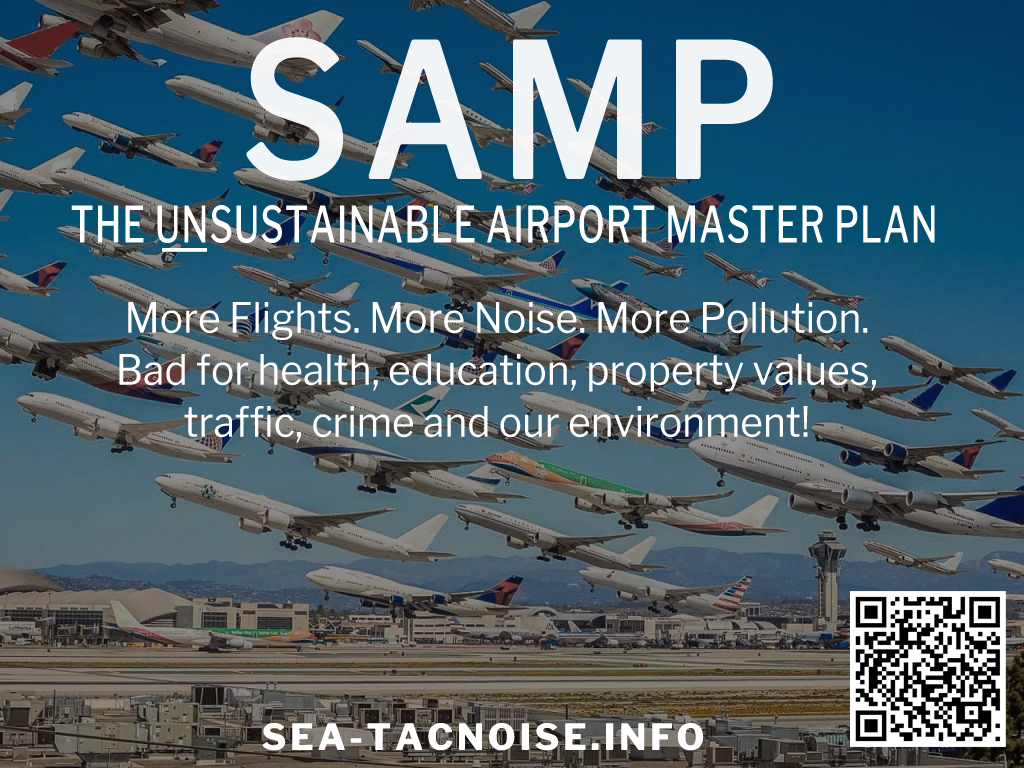
The UnSustainable Airport Master Plan
Sea-Tac Airport is currently undergoing the largest and longest expansion in its history, collectively known as the Sustainable Airport Master Plan (SAMP). Some of it you can already <em>hear</em>, but you’re probably not aware of what it all means. Here’s what you need to know. -
 2024-01-01
Appendix H: Land Use Technical Report — Sustainable Airport Master Plan Near-Term Projects
This January 2024 Land Use Technical Report, prepared by Landrum & Brown for the Port of Seattle, examines how near-term construction projects at Seattle-Tacoma International Airport align with local and regional land use plans. It reviews existing and planned land uses in surrounding cities—including SeaTac, Des Moines, Burien, and Tukwila—and evaluates the potential land use impacts of proposed action alternatives. The report draws on key planning documents such as a 2018 Interlocal Agreement and the Puget Sound Regional Council's Vision 2050 to assess consistency with community goals. -
 2024-01-01
Appendix F: Hazardous Materials, Solid Waste, and Pollution Prevention Technical Report: Sustainable Airport Master Plan Near-Term Projects
This technical report, prepared by Landrum & Brown for the Port of Seattle in January 2024, assesses hazardous materials, solid waste, and pollution prevention concerns related to near-term construction projects under the Sustainable Airport Master Plan at Seattle-Tacoma International Airport. It includes investigations of contaminated fuel farm sites, environmental baseline studies, and regulated building materials surveys (such as asbestos and lead) for several airport facilities slated for redevelopment. The report compiles findings and regulatory correspondence from Washington State Department of Ecology to guide safe handling and cleanup of hazardous materials during planned airport improvements. -
 2024-01-01
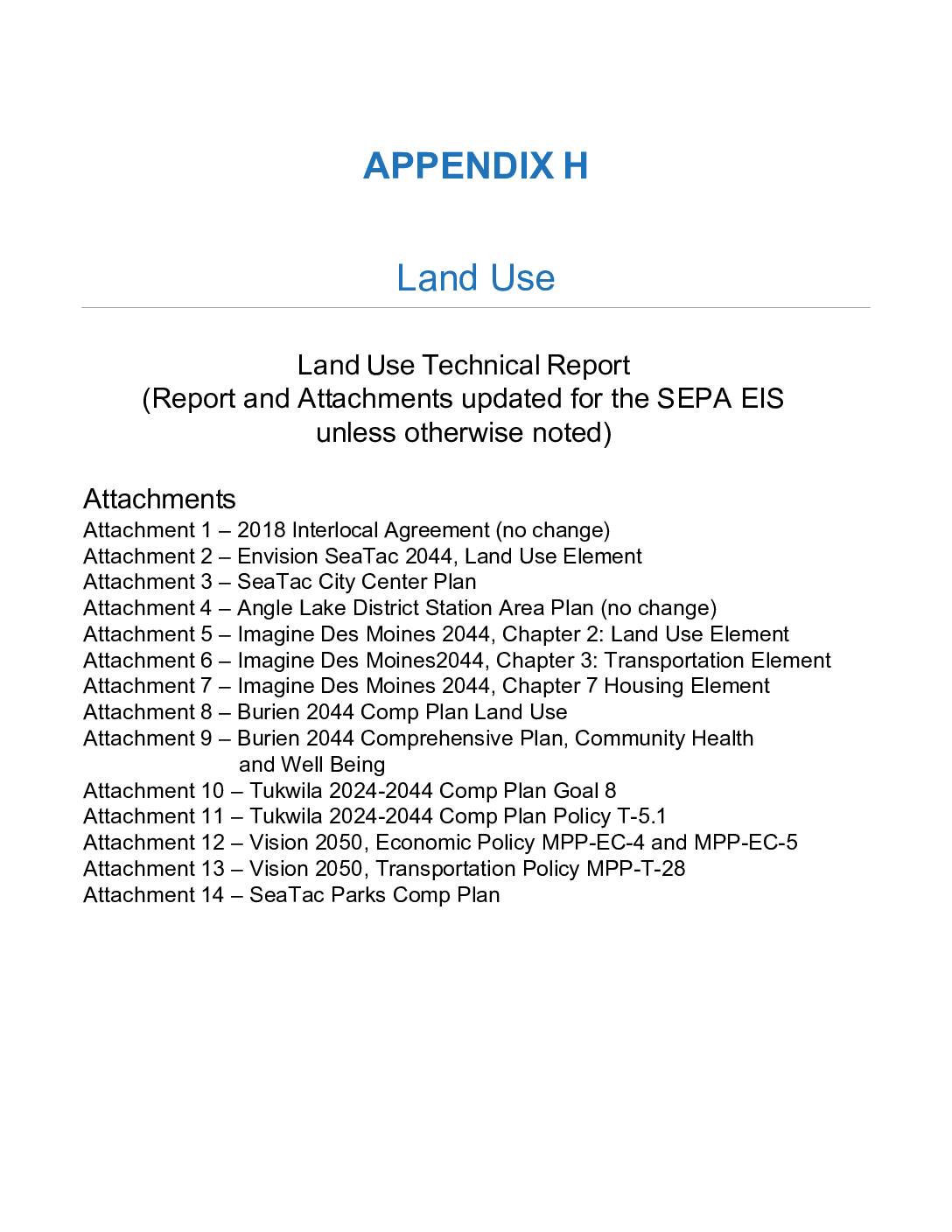
Appendix H: Land Use Technical Report
This Land Use Technical Report, prepared for the Port of Seattle's Sustainable Airport Master Plan Near-Term Projects, examines how proposed improvements at Seattle-Tacoma International Airport align with land use plans and regulations in surrounding communities including SeaTac, Des Moines, Burien, and Tukwila. It reviews existing and planned land uses, relevant local and regional planning documents, and assesses potential land use impacts under three alternatives: No Action, Proposed Action, and a Hybrid Terminal Option. The report was originally prepared in January 2024 by Landrum & Brown and later updated in April 2026 by Parametrix for the SEPA Environmental Impact Statement.