TagSea-Tac Airport(1855)
-
 2023-11-01
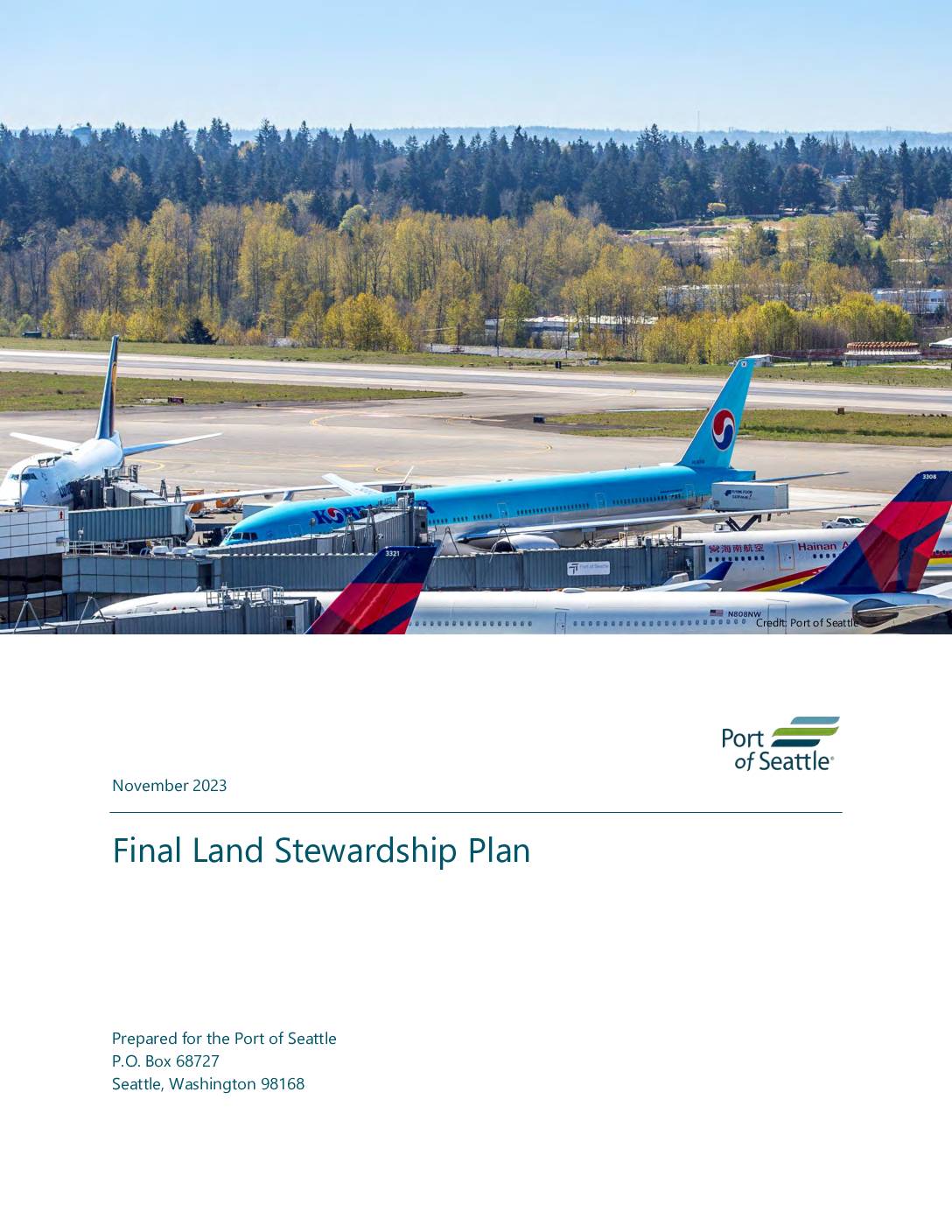
Final Land Stewardship Plan
The Port of Seattle's Final Land Stewardship Plan (November 2023) outlines a framework for managing and improving the natural lands surrounding Seattle-Tacoma International Airport (SEA), covering ecological inventory, land use assessment, and stewardship recommendations across defined management units. The plan establishes priorities for habitat preservation, tree canopy protection, and community equity considerations in relation to airport operations. It was developed collaboratively by Port of Seattle staff across aviation, seaport, and real estate divisions, along with environmental consulting firm Anchor QEA, LLC. -
Port outlines priorities for Sea-Tac Airport in proposed spending plan
By Marissa Nall – Reporter, Puget Sound Business Journal Oct 31, 2023 The Port of Seattle plans to commit another $1.1 billion to its massive, rolling capital projects agenda at Seattle-Tacoma International Airport under its newly proposed budget for next year. Introduced late last week, the budget sets the stage for $5.3 billion in capital -
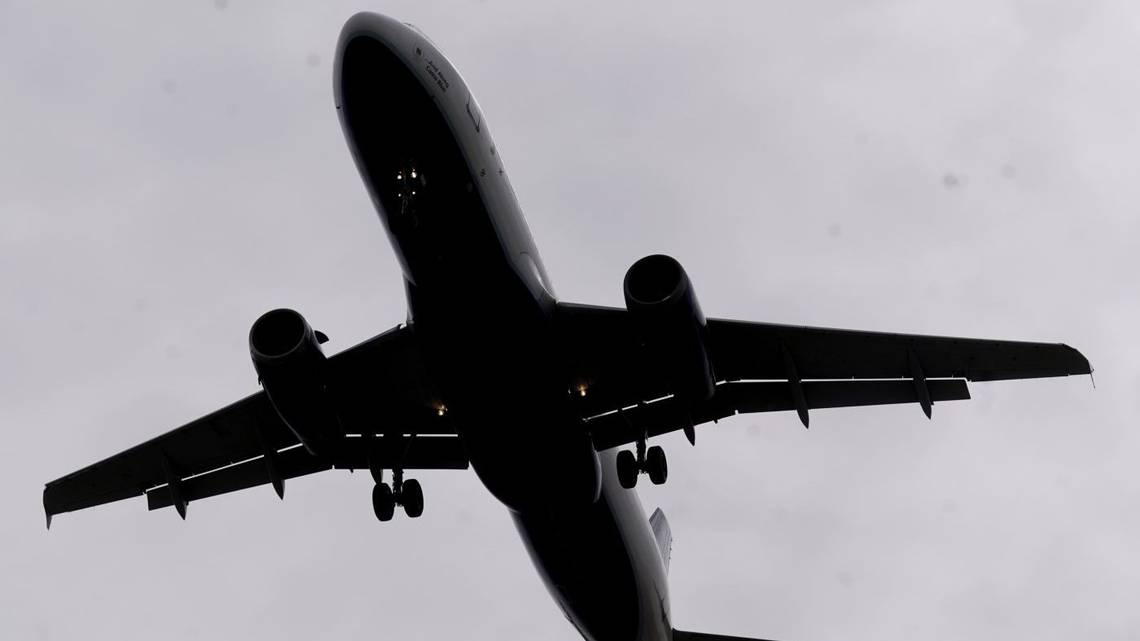
Airbus A320-Family Aircraft on Approach, Photographed From Below
A twin-engine narrow-body commercial aircraft, consistent with an Airbus A320-family type, photographed from directly below against an overcast sky. Landing gear is extended, suggesting the aircraft is on approach; winglets and engine nacelles are visible in silhouette with no airline livery discernible. -
 2023-10-10
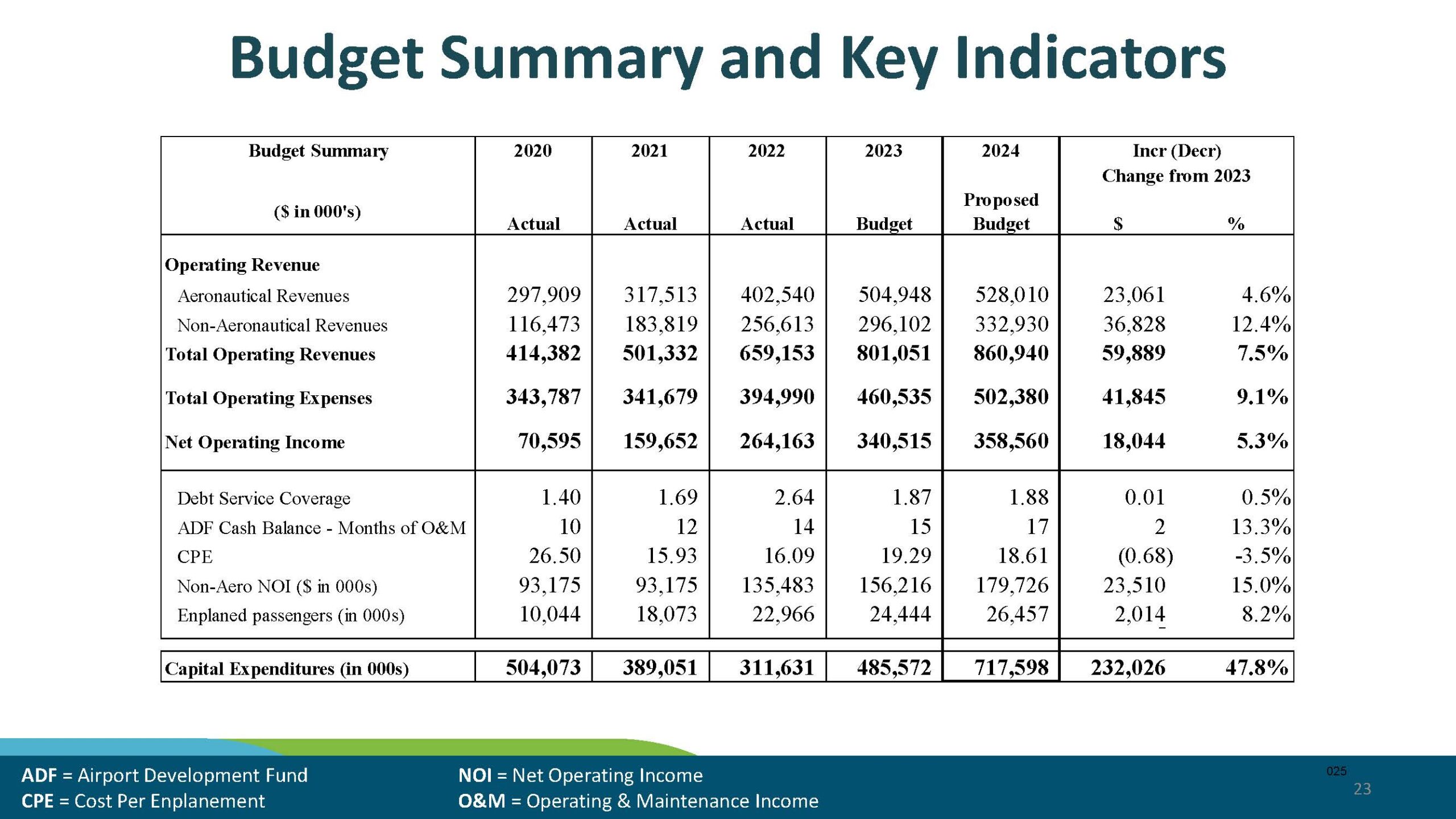
Sea-Tac Airport Financial Budget Summary 2020–2024 Proposed
A financial budget summary table presenting operating revenues, operating expenses, net operating income, and capital expenditures from 2020 actuals through a 2024 proposed budget. Key indicators include debt service coverage, ADF cash balance, cost per enplanement (CPE), non-aeronautical NOI, and enplaned passengers, with the 2024 proposed budget showing total operating revenues of $860,940 thousand and capital expenditures of $717,598 thousand. -
 2023-10-10
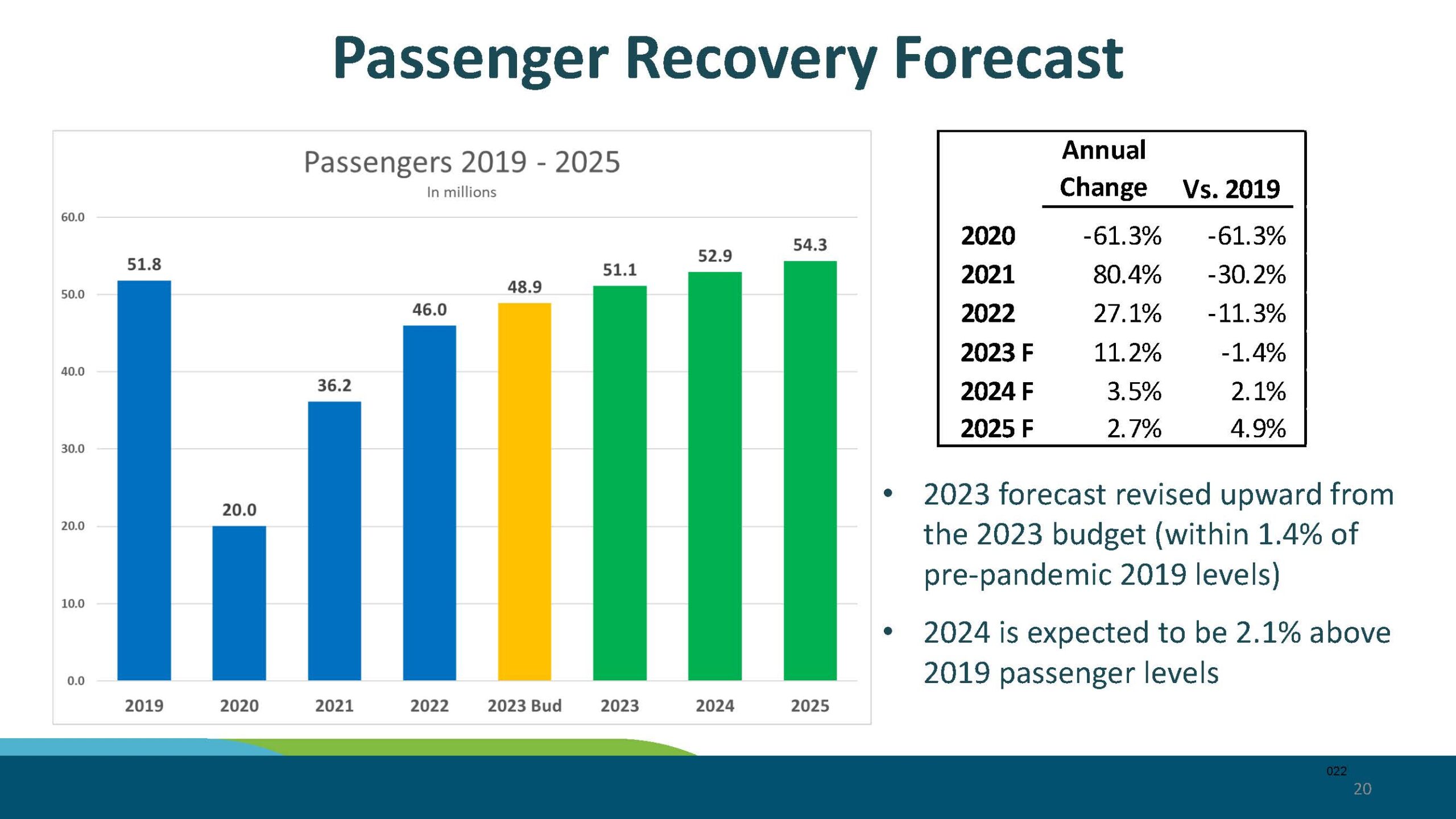
Sea-Tac Airport Passenger Volume Data and Forecast 2019–2025
A slide from a Sea-Tac Airport presentation showing passenger volume data from 2019 to 2025 (in millions), including actual figures and forecasts. The chart shows a COVID-19-related drop to 20.0 million passengers in 2020 (-61.3% vs. 2019) with projected recovery to 54.3 million by 2025, exceeding pre-pandemic 2019 levels of 51.8 million by 4.9%. -
 2023-10-10
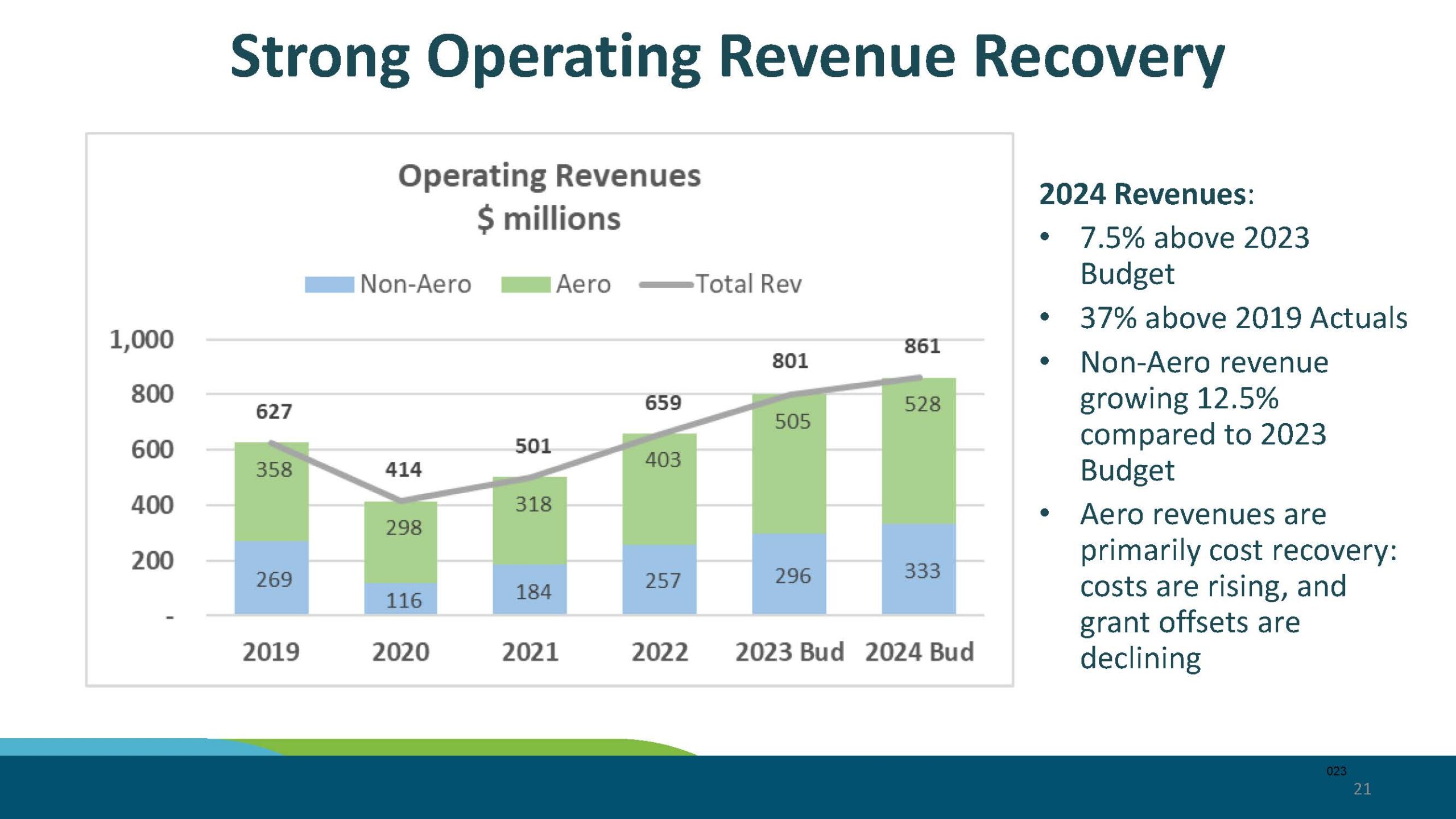
Sea-Tac Airport Operating Revenue Recovery: 2019–2024 Budget Presentation Slide
A presentation slide titled 'Strong Operating Revenue Recovery' showing Sea-Tac Airport operating revenues in $ millions from 2019 actuals through 2024 budget, broken down by Aero and Non-Aero categories. The 2024 budget projects total revenues of $861 million, 7.5% above the 2023 budget and 37% above 2019 actuals, with Non-Aero revenue growing 12.5% compared to the 2023 budget. -
 2023-10-10
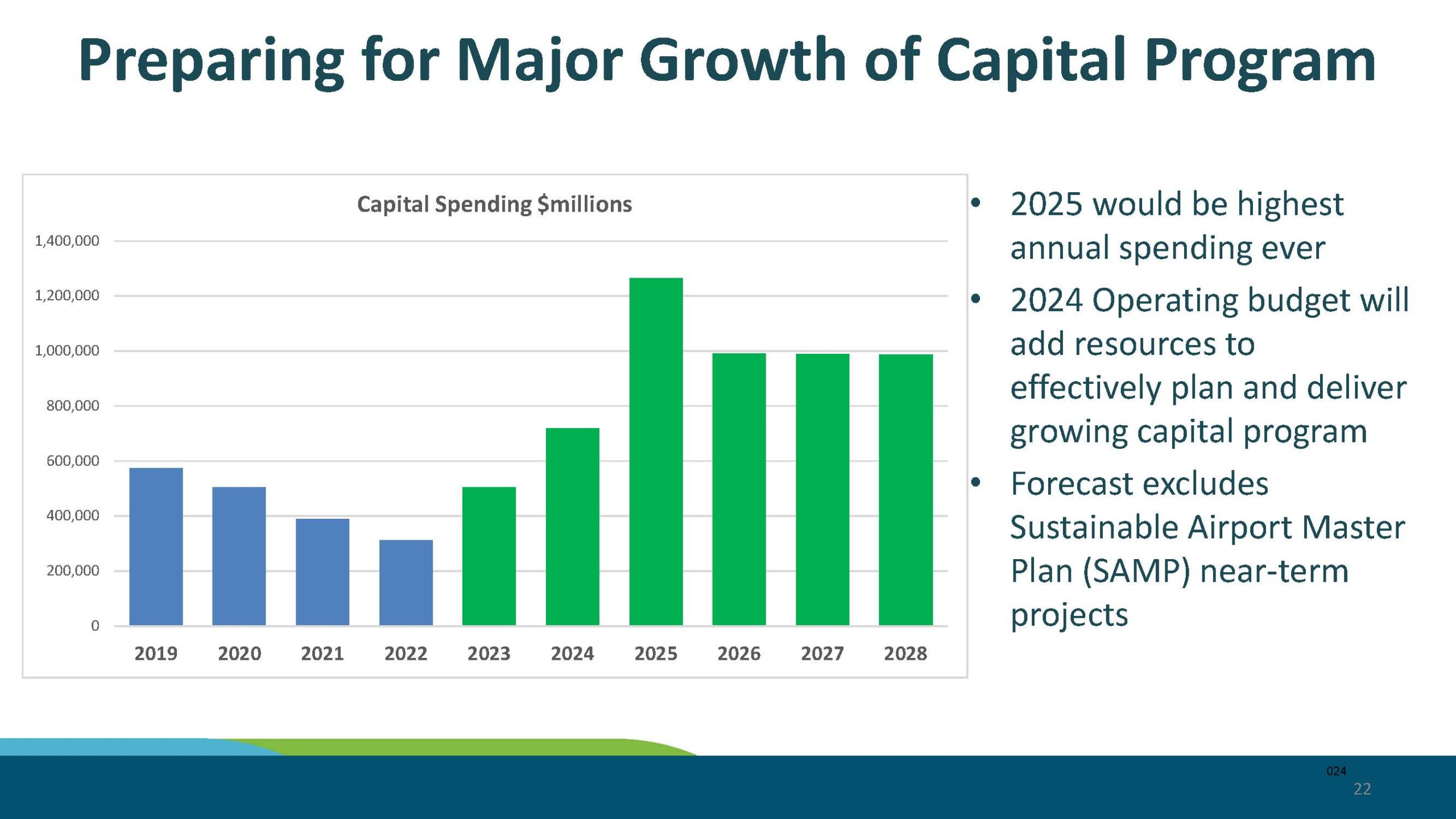
Sea-Tac Airport Capital Program Growth Forecast 2019–2028 Presentation Slide
A presentation slide titled 'Preparing for Major Growth of Capital Program' shows a bar chart of capital spending in millions of dollars from 2019 through 2028, with 2025 projected as the highest annual spending year at approximately $1.26 billion. Key notes indicate the 2024 operating budget will add resources to deliver the growing capital program, and the forecast excludes Sustainable Airport Master Plan (SAMP) near-term projects. -
 2023-10-02
Fred Felleman speaking at podium
Fred Felleman speaking at a podium, October 2023, identified from the original filename; background signage partially reads Electric Commission/Coalition (not fully legible). -
 2023-09-28
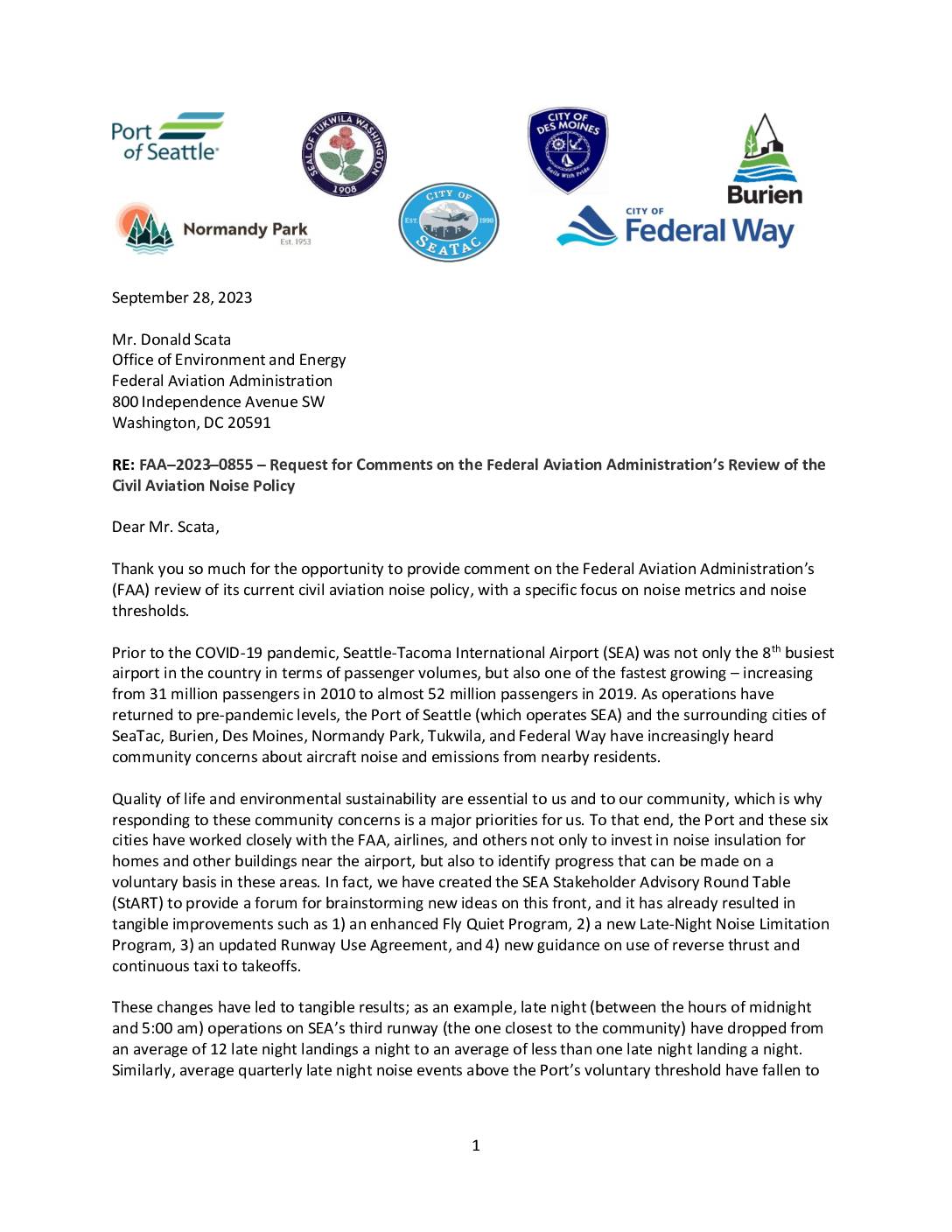
Comment letter on FAA review of civil aviation noise policy (FAA–2023–0855)
The Port of Seattle and six neighboring cities (SeaTac, Burien, Des Moines, Normandy Park, Tukwila, and Federal Way) submitted comments to the FAA in September 2023, urging updates to federal aviation noise policy in response to growing community concerns around Seattle-Tacoma International Airport. The letter highlights collaborative efforts already underway, including a Fly Quiet Program and Late-Night Noise Limitation Program, which have significantly reduced overnight flight activity on the runway closest to residential areas. The signatories call on the FAA to modernize its noise metrics, lower noise thresholds, and take a broader approach to reducing aircraft noise and emissions rather than simply measuring and disclosing them. -
 2023-09-26
SAMP Near Term Projects EA: Scoping Comments Received (Attachment 4a-c)
This document compiles public and agency scoping comments received during the environmental review process for Seattle-Tacoma International Airport's SAMP (Sustainable Airport Master Plan) Near Term Projects. Comments are organized into 22 topical categories, covering issues such as noise, air quality, transportation, water resources, and human health, and are labeled to indicate whether they directly relate to the SAMP Near Term Projects or address broader airport concerns. Each comment is coded for easy reference, allowing readers to track specific concerns raised by the public and agencies throughout the scoping process.