TagSea-Tac Airport(1855)
-
 2025-10-10
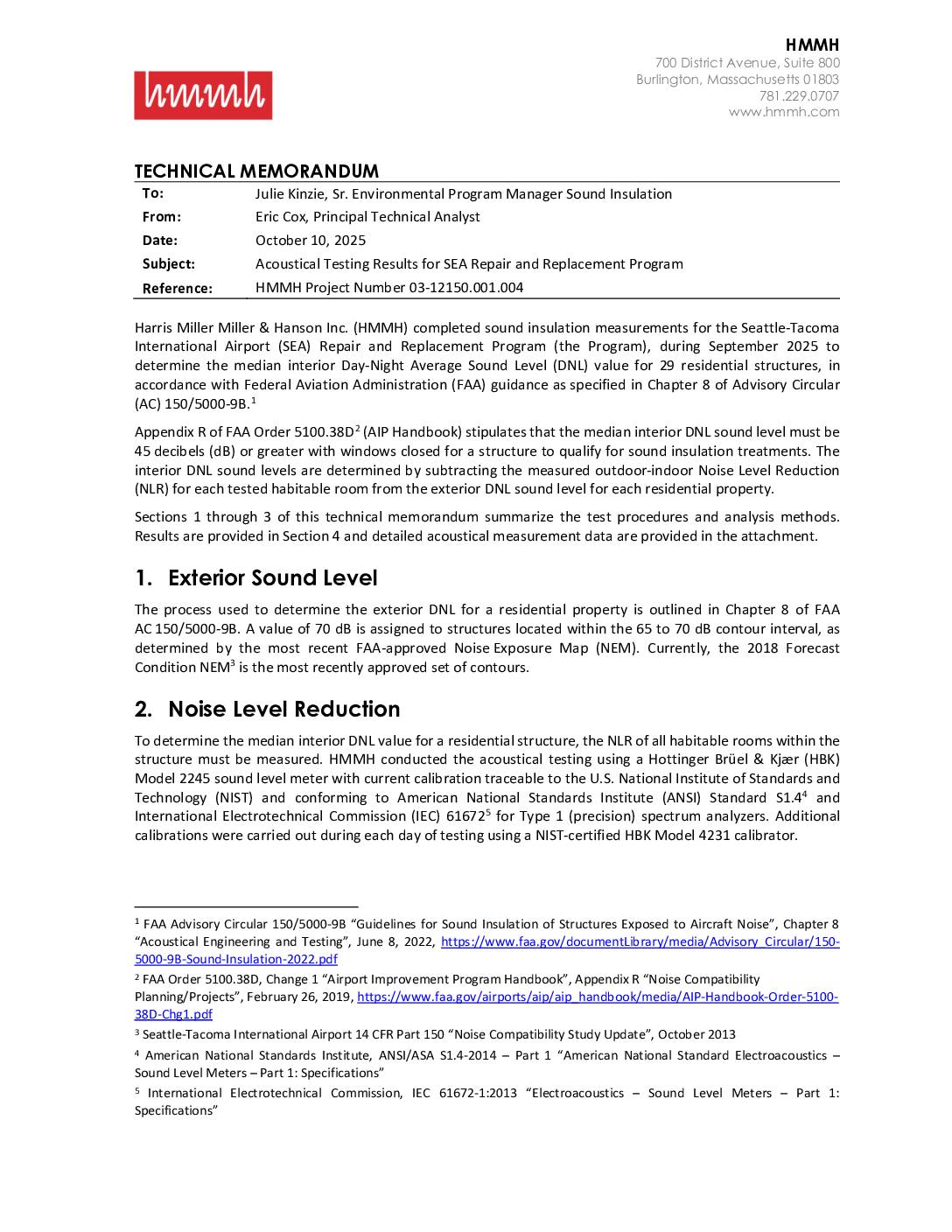
Acoustical Testing Results for SIRRPP — October 2025
In September 2025, acoustical engineers tested 29 homes near Seattle-Tacoma International Airport to measure how much aircraft noise penetrates indoors. The study found that none of the homes exceeded the 45-decibel interior noise threshold required to qualify for federally funded soundproofing treatments, though 10 homes had at least one room above that level. The findings are part of SEA's Repair and Replacement Program, which evaluates whether previously soundproofed homes need updated windows and doors. -
 2025-10-01
NEM_Wkshp_Boards_8
A presentation introducing the Part 150 Study process for Seattle-Tacoma International Airport. The document explains the federal regulatory framework for preparing Noise Exposure Maps and Noise Compatibility Programs, outlines the phases of the study process, and provides historical context of previous Part 150 studies conducted at SEA from 1985 to 2014. -
 2025-09-26
Appendix O: Agency & Public Engagement (with responses)
Appendix O of the FAA NEPA Draft Environmental Assessment (EA) for the Sustainable Airport Master Plan (SAMP) at Sea-Tac Airport. Documents agency and public engagement activities during the EA process, including coordination under NEPA (42 U.S.C. 4321 et seq.), FAA Orders 1050.1F and 5050.4B, and CEQ regulations (40 CFR parts 1500-1508). Notes regulatory changes including -
 2025-09-23
Port Of Seattle regular commission meeting agenda, September 23, 2025
The Port of Seattle held a Regular Commission Meeting on September 23, 2025, covering routine business including approval of meeting minutes, claims totaling approximately $141 million, and personnel matters. A key action item was authorization for the Executive Director to renew a Bonneville Power Administration contract to supply electrical power to Seattle-Tacoma International Airport from 2028 through 2044, estimated at $150 million. The meeting also included a briefing on the 2026 preliminary budget rollup for Port-wide central services. -
American Airlines Passengers at Gate A29
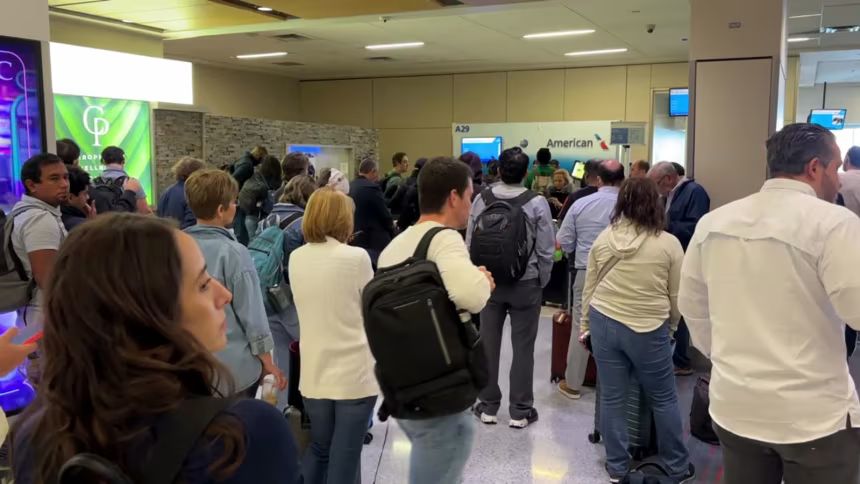
A large crowd of passengers with luggage waits at American Airlines Gate A29. The gate signage and American Airlines logo are clearly visible in the background. -
Airport vs. FAA Parking Revenue Comparison Table, 2012–2013
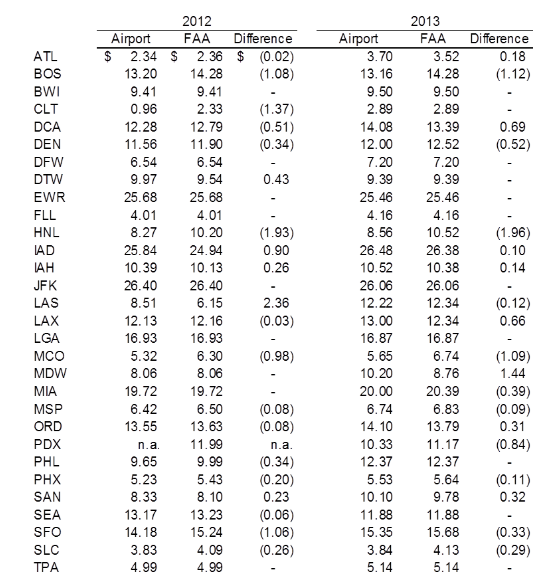
A data table comparing Airport-reported and FAA-reported figures (likely parking or landing fees in dollars) for approximately 30 major U.S. airports in 2012 and 2013, including SEA (Seattle-Tacoma), with differences noted. SEA shows figures of $13.17 (Airport) and $13.23 (FAA) in 2012 with a -$0.06 difference, and $11.88 for both in 2013 with no difference. -
 2025-09-12
Acoustical Testing Results for SIRRPP — September 2025
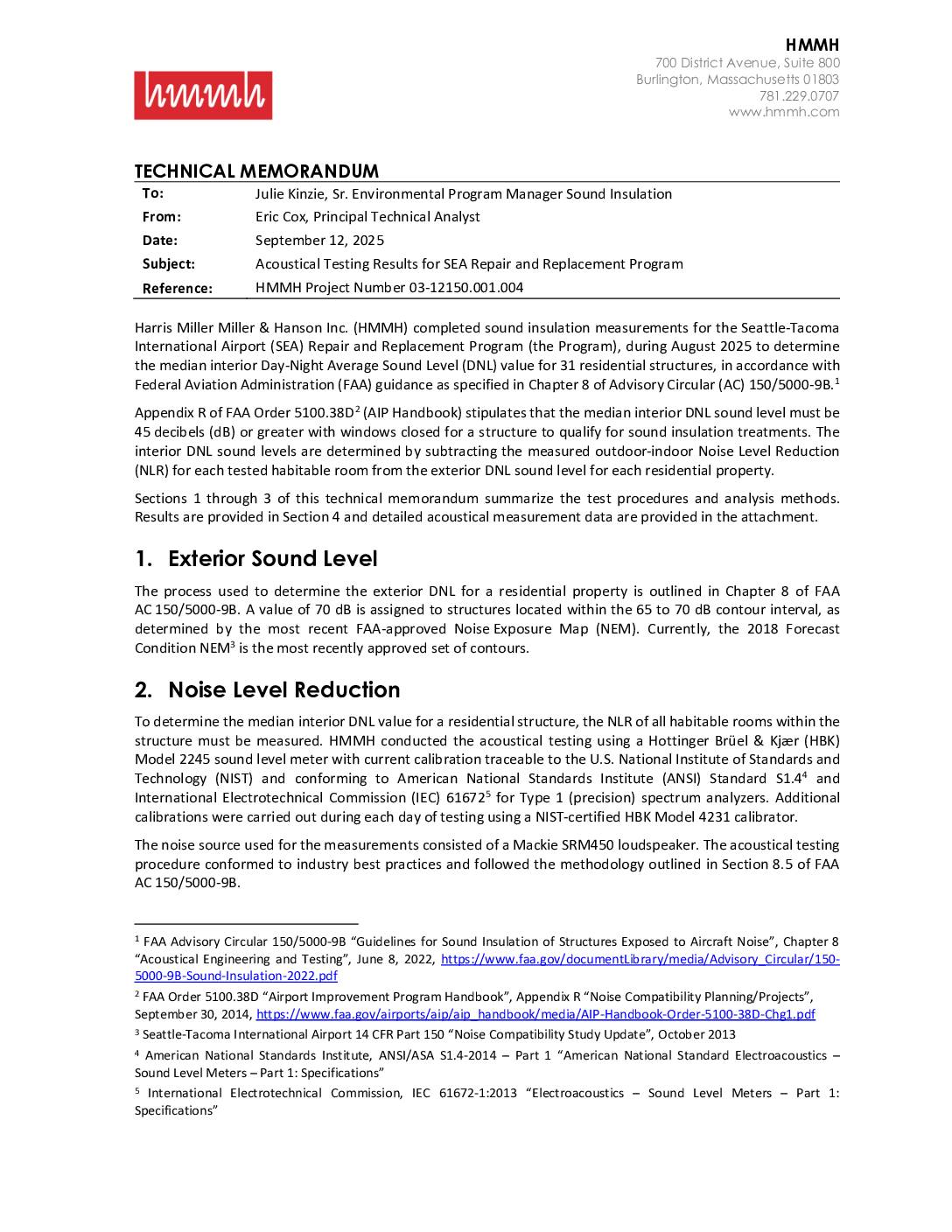
In August 2025, acoustical engineering firm HMMH measured indoor noise levels at 31 homes near Seattle-Tacoma International Airport to assess eligibility for the airport's Sound Insulation Repair and Replacement Program. Testing found that only one of the 31 homes met the FAA's minimum threshold of 45 decibels interior Day-Night Average Sound Level required to qualify for full sound insulation treatment, while seven additional homes had at least one room exceeding that level. The study used FAA-approved methods, including a Boeing 737-800 aircraft noise spectrum, to calculate how much airport noise penetrates each habitable room with windows closed. -
 2025-09-01
Sustainable Airport Master Plan Environmental Assessment: Chapter 3 – Affected Environment
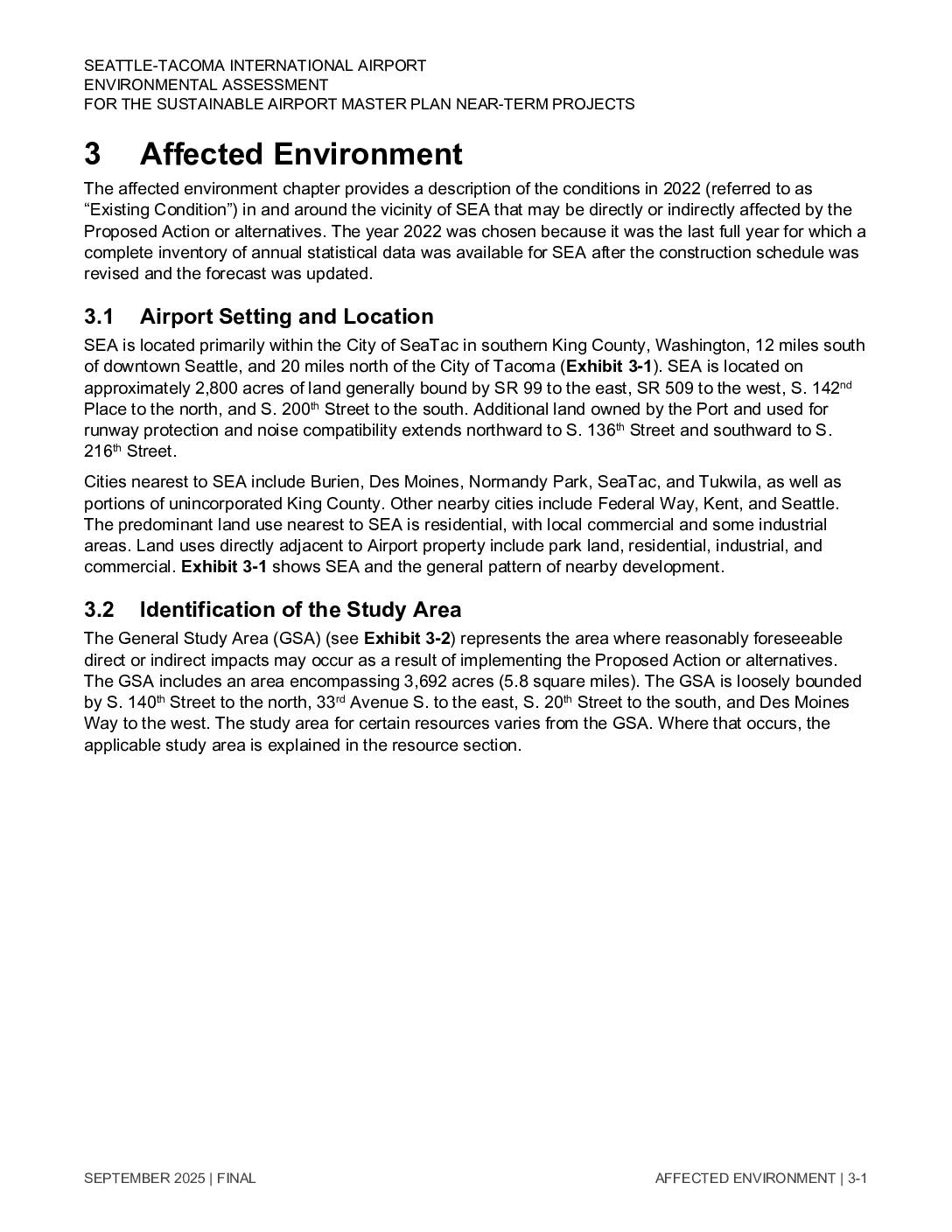
This section of the Seattle-Tacoma International Airport (SEA) Environmental Assessment describes the airport's physical setting and surrounding communities as they existed in 2022, serving as the baseline for evaluating potential impacts from near-term expansion projects. SEA occupies approximately 2,800 acres in the City of SeaTac, bordered by state routes and residential neighborhoods in cities including Burien, Des Moines, and Tukwila. The assessment defines a General Study Area of 3,692 acres where direct or indirect impacts from proposed actions may reasonably be expected to occur. -
 2025-09-01
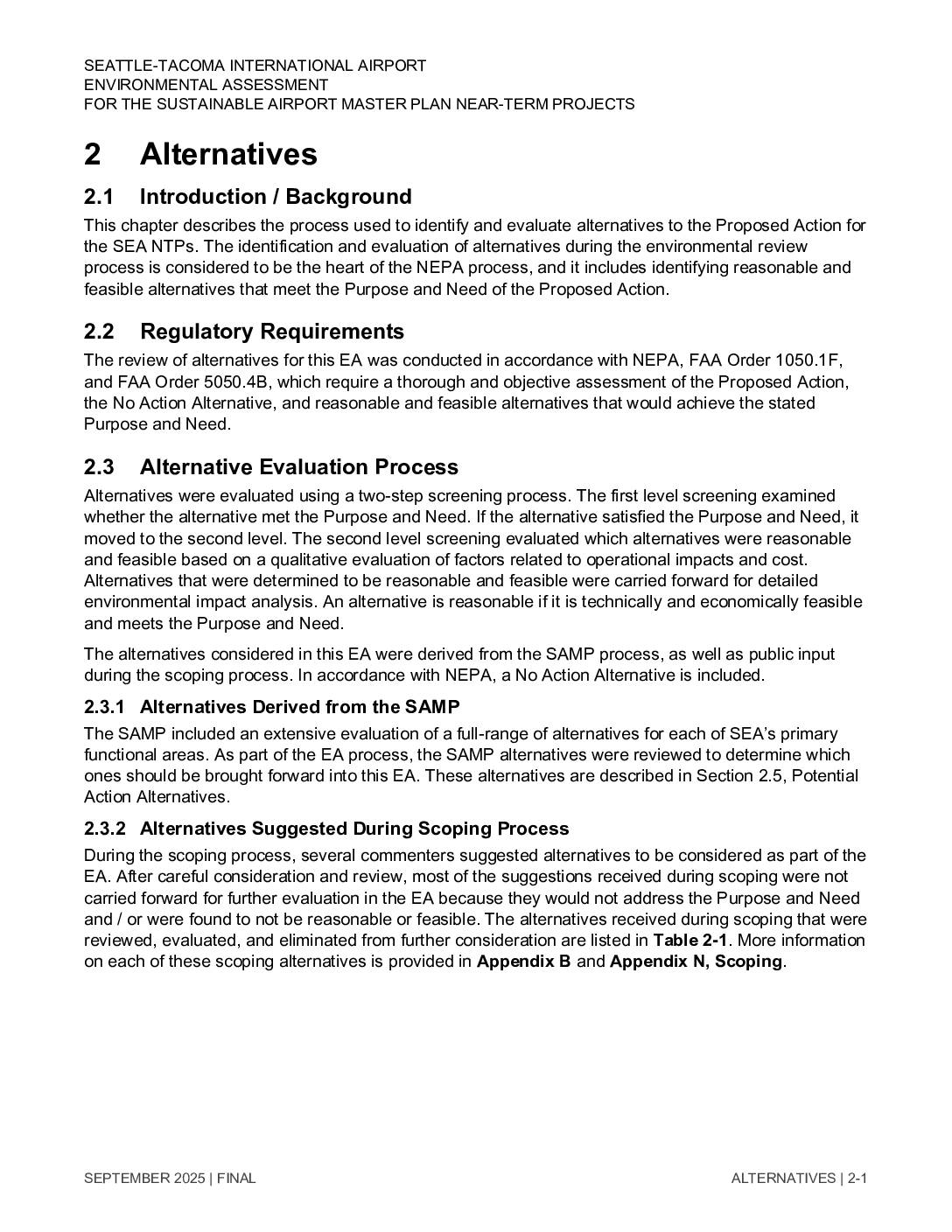
Seattle-Tacoma International Airport Environmental Assessment for the Sustainable Airport Master Plan Near-Term Projects: Chapter 2 — Alternatives
This section of the Seattle-Tacoma International Airport Environmental Assessment describes how planners evaluated different alternatives to the airport's near-term expansion projects, using a two-step screening process to determine whether each option met the project's stated goals and was practical to implement. Public suggestions submitted during the scoping process—such as building a new airport, using high-speed rail, limiting growth, or relying on other existing airports—were largely rejected because they could not meet current and future passenger demand at SEA. A No Action Alternative is also included, representing a future scenario in which none of the proposed new construction takes place. -
 2025-09-01
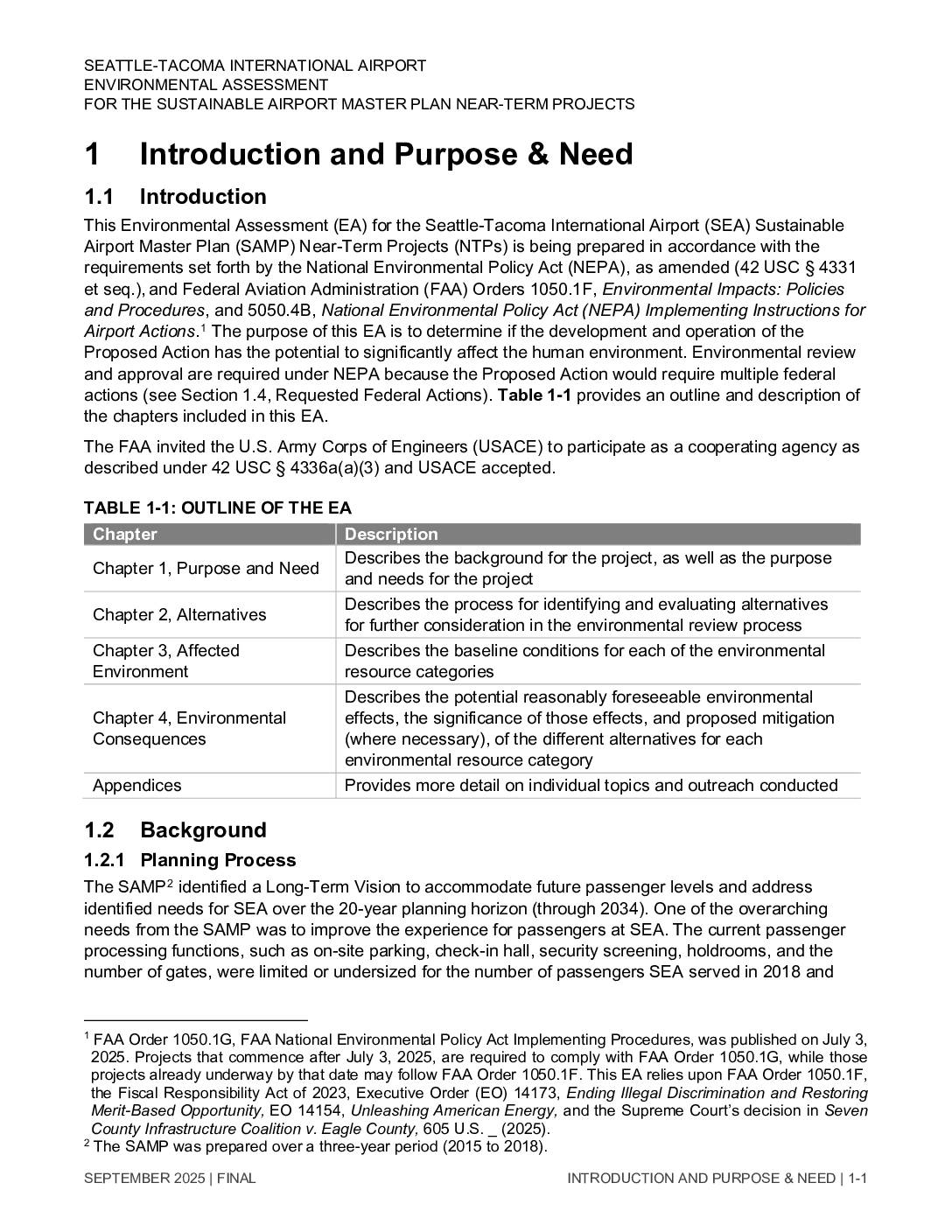
Seattle-Tacoma International Airport Environmental Assessment for the Sustainable Airport Master Plan Near-Term Projects: Chapter 1, Introduction and Purpose & Need
The Port of Seattle is conducting an Environmental Assessment (EA) under federal law for 31 near-term improvement projects at Seattle-Tacoma International Airport (SEA), covering airfield upgrades, taxiway extensions, and passenger facility improvements. The projects, collectively known as the Sustainable Airport Master Plan Near-Term Projects, are intended to reduce congestion, improve safety, and enhance the passenger experience, with construction potentially beginning in late 2025 and completion targeted for 2032. The federal review will determine whether the projects could significantly impact the surrounding human environment, including potential noise and other effects on neighboring communities.