TagSea-Tac Airport(1835)
-
 2013-10-23
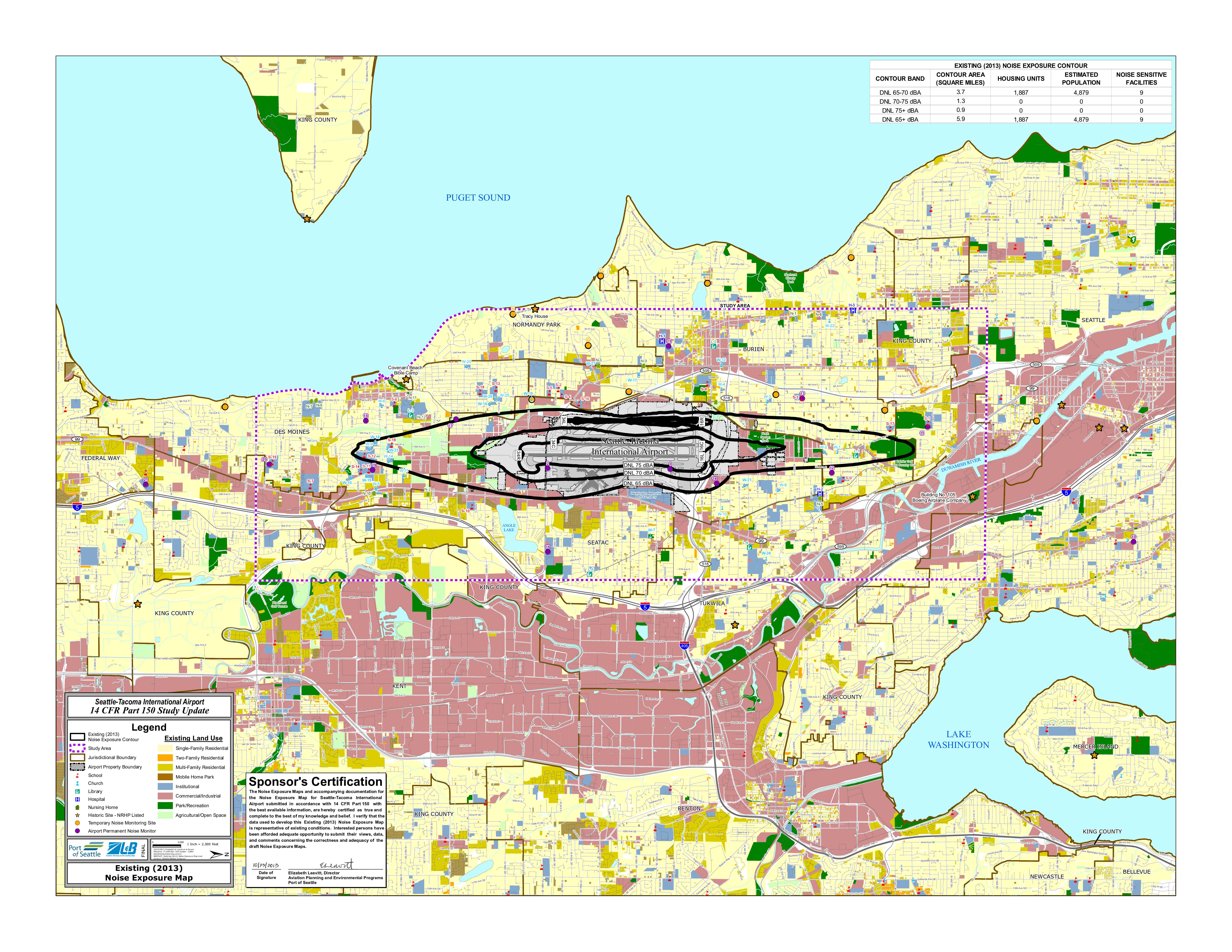
Existing (2013) Noise Exposure Map: Seattle-Tacoma International Airport 14 CFR Part 150 Study Update
This is the Existing (2013) Noise Exposure Map for Seattle-Tacoma International Airport, prepared as part of a 14 CFR Part 150 Study Update by Landrum & Brown for the Port of Seattle. The map shows aircraft noise contours around Sea-Tac, indicating that the DNL 65 dBA or greater noise zone covers approximately 5.9 square miles and affects an estimated 1,887 housing units and 4,879 residents, along with 9 noise-sensitive facilities such as schools and churches. The map was certified by Port of Seattle Aviation Planning Director Elizabeth Leavitt as accurately representing existing noise conditions based on the best available data. -
 2013-10-01
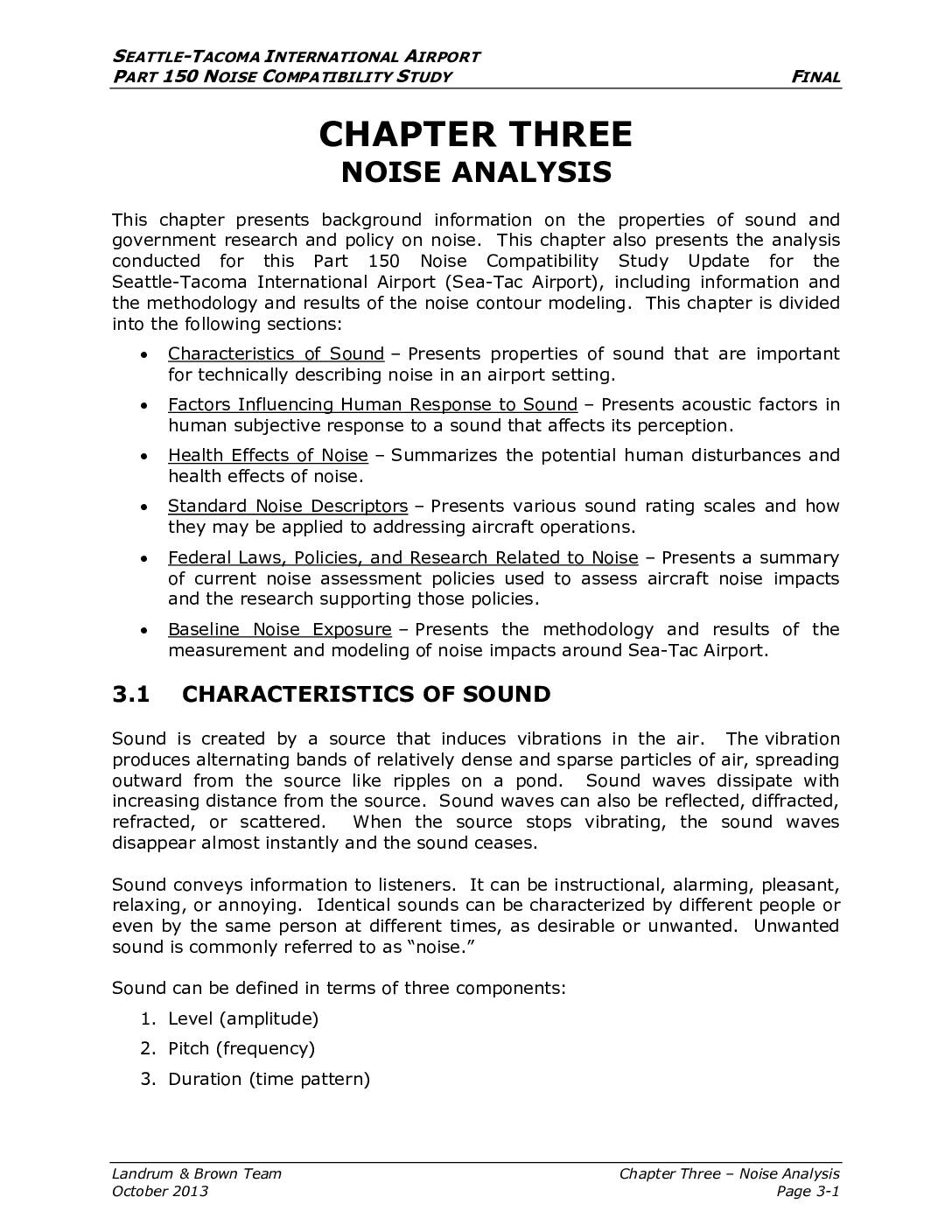
Seattle-Tacoma International Airport Part 150 noise compatibility study final: Chapter three – noise analysis
This chapter from Sea-Tac Airport's 2013 Part 150 Noise Compatibility Study explains how aircraft noise is measured and analyzed around Seattle-Tacoma International Airport. It covers the basic properties of sound—including loudness, pitch, and duration—and explains why noise is measured on the logarithmic decibel (dB) scale rather than a standard linear scale. The chapter also outlines how noise contour modeling was conducted to assess the real-world impact of aircraft operations on surrounding communities. -
 2013-10-01
Seattle-Tacoma International Airport 14 CFR Part 150 Noise Compatibility Study Update
This October 2013 final report, prepared by Landrum & Brown for the Port of Seattle, updates the noise exposure maps and noise compatibility program for Seattle-Tacoma International Airport under federal regulations (14 CFR Part 150). It assesses the impact of aircraft noise on surrounding communities and outlines strategies to reduce noise-related conflicts between the airport and neighboring land uses. The study serves as a key planning document guiding Port of Seattle noise mitigation policies at Sea-Tac Airport. -
 2013-10-01
2013 Part 150 Noise Compatibility Study Update — Volume One Cover Page
Cover page of the Final Part 150 Noise Compatibility Study Update for Seattle-Tacoma International Airport, published October 2013 by the Port of Seattle. The document cover includes the Port of Seattle logo, three photographs of airport operations, and a background image of the airport terminal with Mount Rainier visible in the distance. -
 2013-10-01
Seattle-Tacoma International Airport Part 150 Noise Compatibility Study Update: Public Involvement Plan
This document outlines the Public Involvement Program developed in March 2010 for Seattle-Tacoma International Airport's Part 150 Noise Compatibility Study Update, which was finalized in October 2013. The program details eight key elements of community engagement, including Technical Review Committee meetings, public information workshops, community meetings, newsletters, and a public hearing, all designed to gather input on airport noise compatibility. Additional details on these elements, along with meeting minutes, presentation materials, and public comments, are documented in the study's Chapter Seven and subsequent appendices. -
 2013-10-01
Seattle-Tacoma International Airport Part 150 noise compatibility study final: Chapter two – forecast
This chapter from the Seattle-Tacoma International Airport Part 150 Noise Compatibility Study presents aviation activity forecasts developed to support noise exposure planning through 2018 and beyond. It covers historical passenger enplanement trends showing growth from 8.2 million in 1990 to 15.6 million in 2009, as well as domestic and international air service patterns dominated by Alaska Airlines. The forecasts, approved by the FAA in August 2010, were used to project aircraft fleet mix and noise exposure contours for future planning purposes. -
 2013-10-01
Future (2021) noise exposure map/noise compatibility program – Seattle-Tacoma International Airport Part 150 noise compatibility study update
This document outlines the Future (2021) Noise Exposure Map and Noise Compatibility Program for Seattle-Tacoma International Airport, projecting noise levels for a typical day in 2021 assuming all recommended noise abatement measures are in place. Using the FAA's Integrated Noise Model, it forecasts 419,597 annual aircraft operations — a 15.4% increase over 2016 baseline levels — and maps noise contours at 65, 70, and 75 decibel DNL thresholds. The report details the fleet mix and runway usage data used in the modeling, with Boeing 737-800s representing the largest share of daily operations. -
 2013-09-24
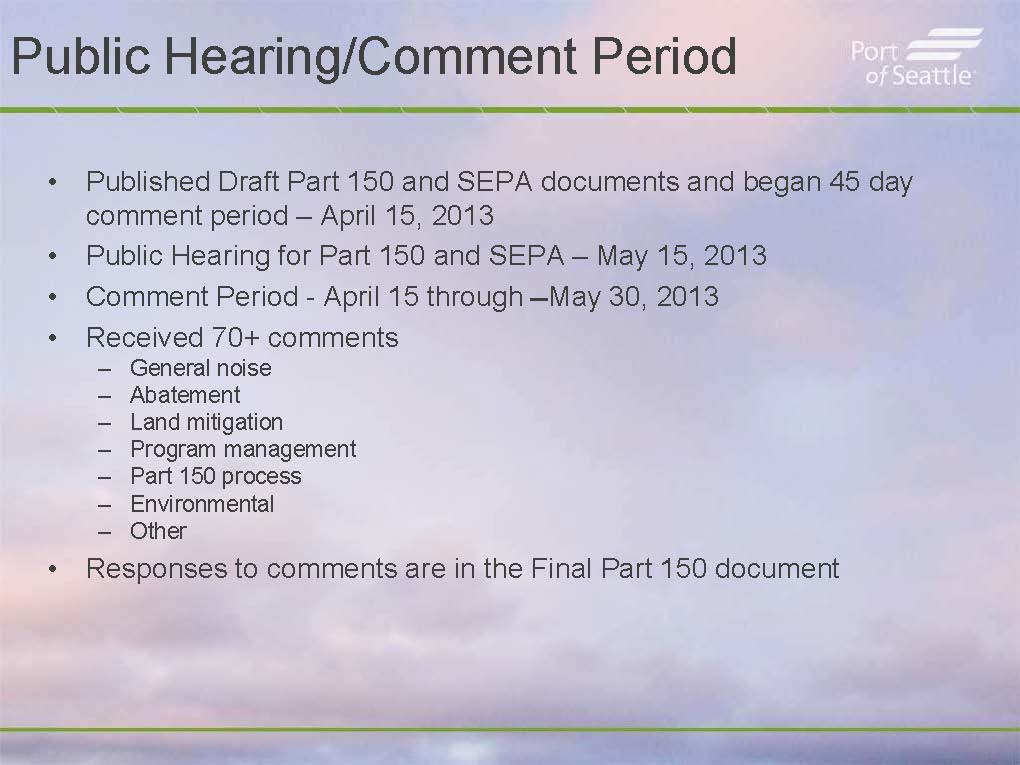
Part 150 Public Comment Process Summary — Commission Presentation, September 24, 2013 (Slide 13)
A Port of Seattle presentation slide summarizing the Part 150 and SEPA public comment process: Draft documents were published and a 45-day comment period began April 15, 2013; a public hearing was held May 15, 2013; the comment period ran April 15 through May 30, 2013; over 70 comments were received covering general noise, abatement, land mitigation, program management, Part 150 process, environmental issues, and other topics. Responses to all comments are contained in the Final Part 150 document. -
 2013-09-24
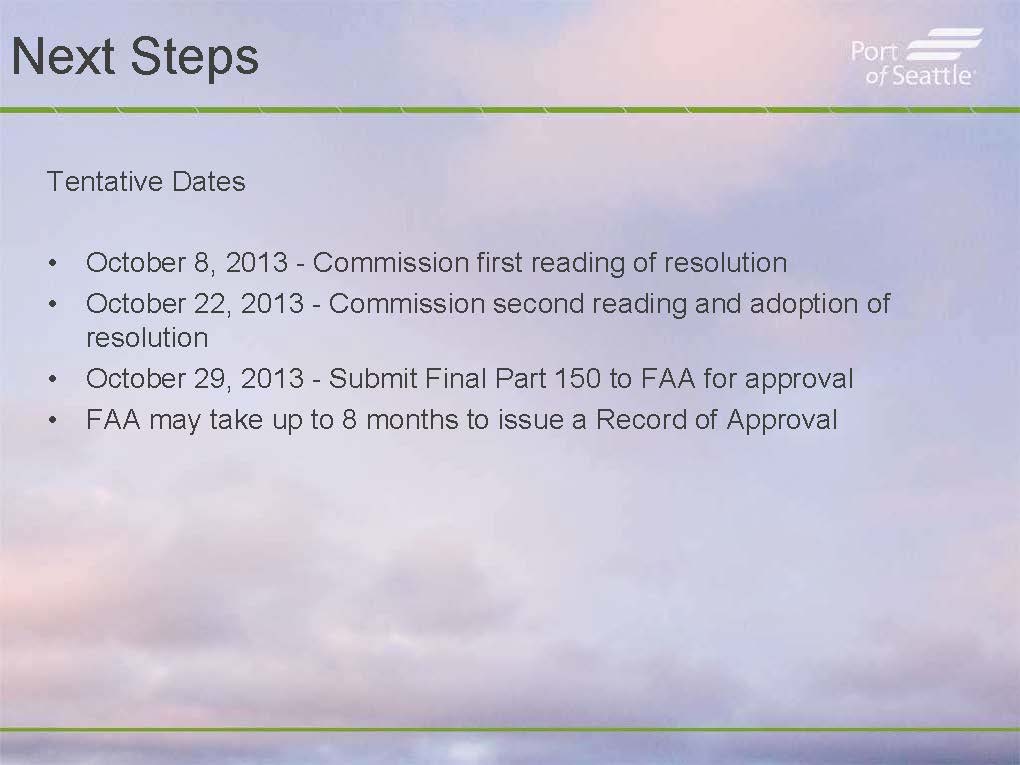
Part 150 Noise Study — Tentative Schedule and FAA Submission Timeline (Slide 14, September 24, 2013)
A Port of Seattle presentation slide outlining tentative dates for the Part 150 noise study process, including Commission first reading on October 8, 2013, second reading and adoption on October 22, 2013, submission of the Final Part 150 to the FAA on October 29, 2013, and a note that the FAA may take up to 8 months to issue a Record of Approval. -
 2013-09-24
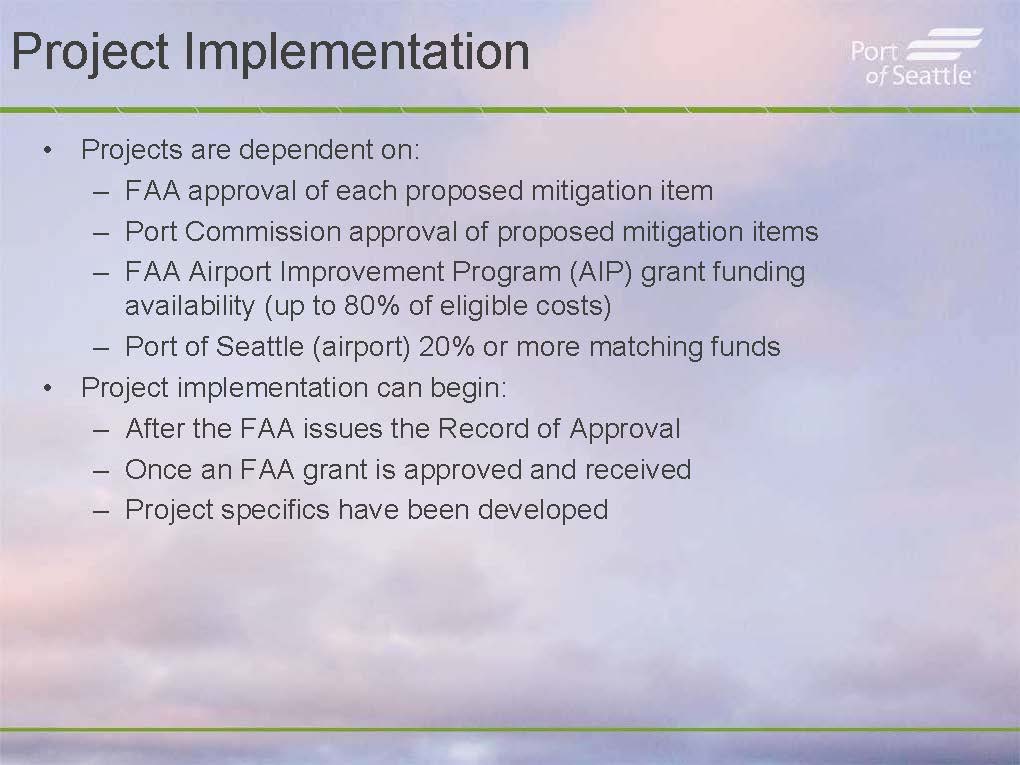
Port Of Seattle Part 150 Study — Project Implementation Conditions (Page 15, September 24, 2013 Commission Presentation)
A Port of Seattle presentation slide titled 'Project Implementation' outlines conditions for noise mitigation projects at Sea-Tac Airport, including required FAA approval of mitigation items, Port Commission approval, FAA Airport Improvement Program (AIP) grant funding covering up to 80% of eligible costs, and a Port of Seattle 20% match. Project implementation may begin after the FAA issues a Record of Approval, an FAA grant is approved and received, and project specifics are developed.