TagSAMP(650)
Articles tagged with the Sustainable Airport Master Plan.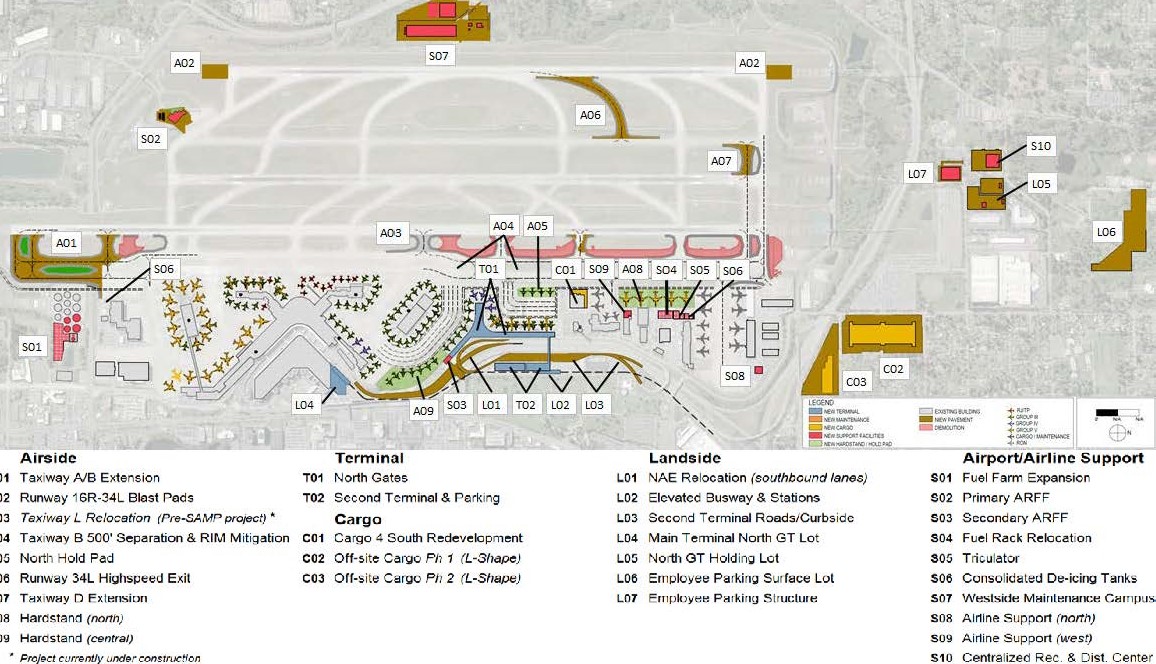
-
2026-05-27
Port of Seattle Commission May 26, 2026
Introduction of SAMP-NTP 2026 05 26 Regular Meeting Packet At almost four hours, the May 26 Port Commission meeting had several lengthy presentations. The longest was not the one of interest to airport communities: the first public briefing on the Sustainable Airport Master Plan Near-Term Projects SEPA Draft EIS. The practical outcomes: no required mitigations -
 2026-05-26
Port of Seattle Commission Regular Meeting May 26, 2026 (SAMP/SEPA intro)
Item 11b is the SAMP/SEPA EIS introduction and presentation -
 2026-05-26
Sustainable Airport Master Plan near-term projects: State Environmental Policy Act draft environmental impact statement and next steps
The Port of Seattle presented a draft Environmental Impact Statement under Washington State's environmental review law (SEPA) for a set of near-term construction projects at Seattle-Tacoma International Airport. The projects, part of the Sustainable Airport Master Plan, include expansions and improvements such as new gates, taxiway extensions, a second terminal, cargo facilities, and roadway upgrades. The presentation outlined the environmental review process and next steps, including public outreach and engagement. -
 2026-05-26
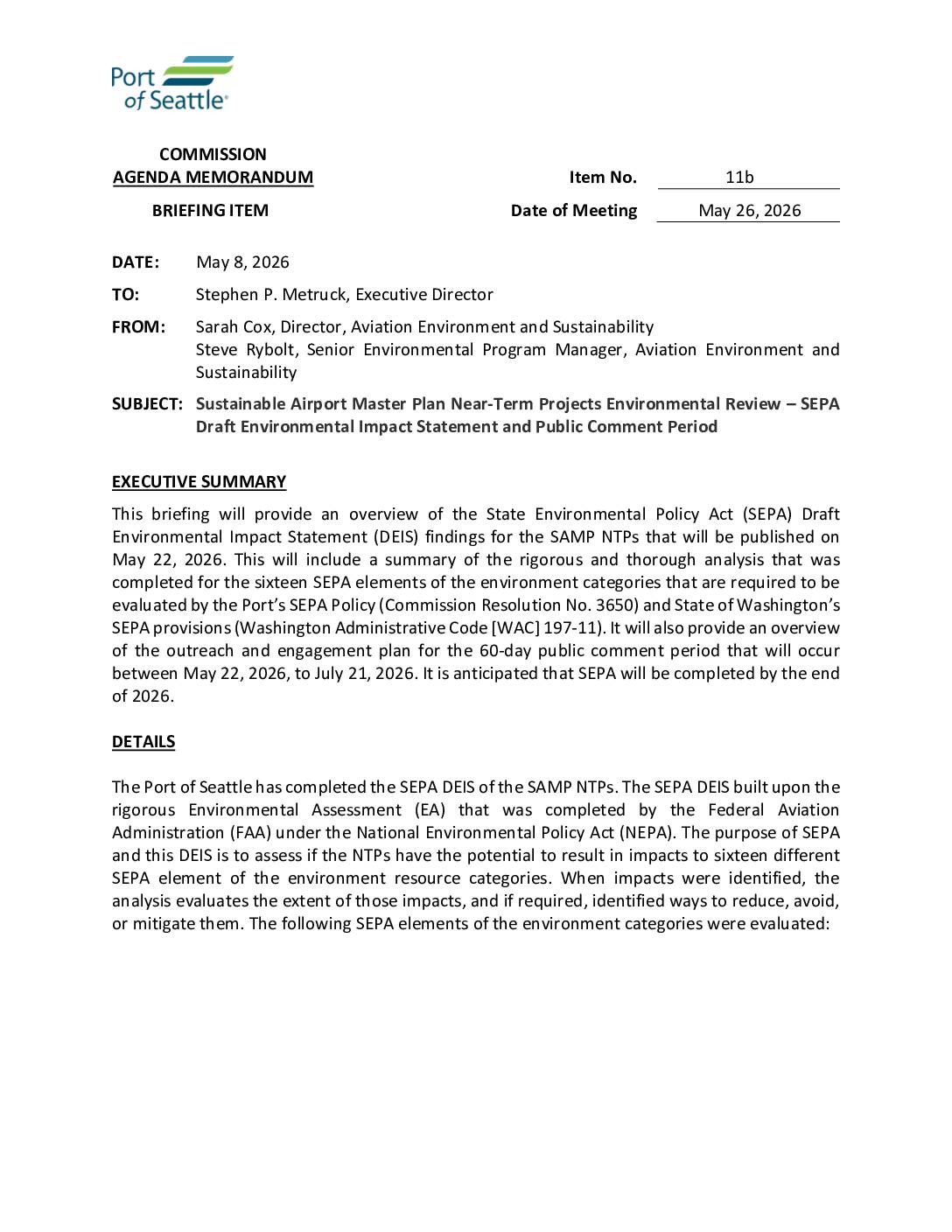
SAMP Near-Term Projects Environmental Review: SEPA Draft Environmental Impact Statement and Public Comment Period
The Port of Seattle released a Draft Environmental Impact Statement (DEIS) under the State Environmental Policy Act (SEPA) for near-term construction and expansion projects at Seattle-Tacoma International Airport, finding that surface transportation would face significant impacts while noise and air quality impacts would remain within legal health standards. A 60-day public comment period runs from May 22 to July 21, 2026, with in-person meetings in SeaTac, Burien, Des Moines, and Federal Way, plus virtual options and multilingual outreach. A Final Environmental Impact Statement is expected by the end of 2026. -
 2026-05-26
Sustainable Airport Master Plan Near-Term Projects: SEPA Draft Environmental Impact Statement and Next Steps
The Port of Seattle presented a Sustainable Airport Master Plan (SAMP) Near-Term Projects update to commissioners on May 26, 2026, covering both federal (NEPA) and state (SEPA) environmental review processes for planned expansions at Seattle-Tacoma International Airport. The projects include new terminals, taxiway extensions, cargo facilities, a fuel farm expansion, and other infrastructure improvements spread across the airport campus. The presentation outlined the completion of a Final Environmental Assessment and FAA Finding of No Significant Impact, as well as the next steps for a Draft SEPA Environmental Impact Statement and community outreach. -
 2026-05-26
Sustainable airport master plan near-term projects state environmental policy act draft environmental impact statement and next steps
Presentation about the Port of Seattle’s Sustainable Airport Master Plan Near-Term Projects, covering the completed NEPA process and the required SEPA Draft Environmental Impact Statement. The document outlines various airport infrastructure projects including runway improvements, terminal facilities, maintenance facilities, and cargo operations planned for Sea-Tac Airport. -
 2026-05-22
Appendix O: Agency & Public Engagement
Appendix O is a placeholder section titled 'Agency & Public Engagement,' reserved for public comment and public engagement information that will be included in the final SEPA (State Environmental Policy Act) Environmental Impact Statement. No content has been populated in this draft version. The completed section will document how agencies and the public were involved in the environmental review process. -
 2026-05-22
Appendix I: Natural Resources & Energy Supply — Bonneville Power Administration 2024–2028 Strategic Plan
The Bonneville Power Administration's 2024–2028 Strategic Plan outlines the agency's goals for delivering reliable, affordable electricity and high-voltage transmission across the Pacific Northwest. The plan focuses on workforce investment, updating power products and rate structures, expanding transmission infrastructure, and addressing growing risks such as drought conditions, extreme heat, and cybersecurity threats. Note: This document concerns regional energy supply policy and is not directly related to Sea-Tac Airport noise policy. -
 2026-05-22
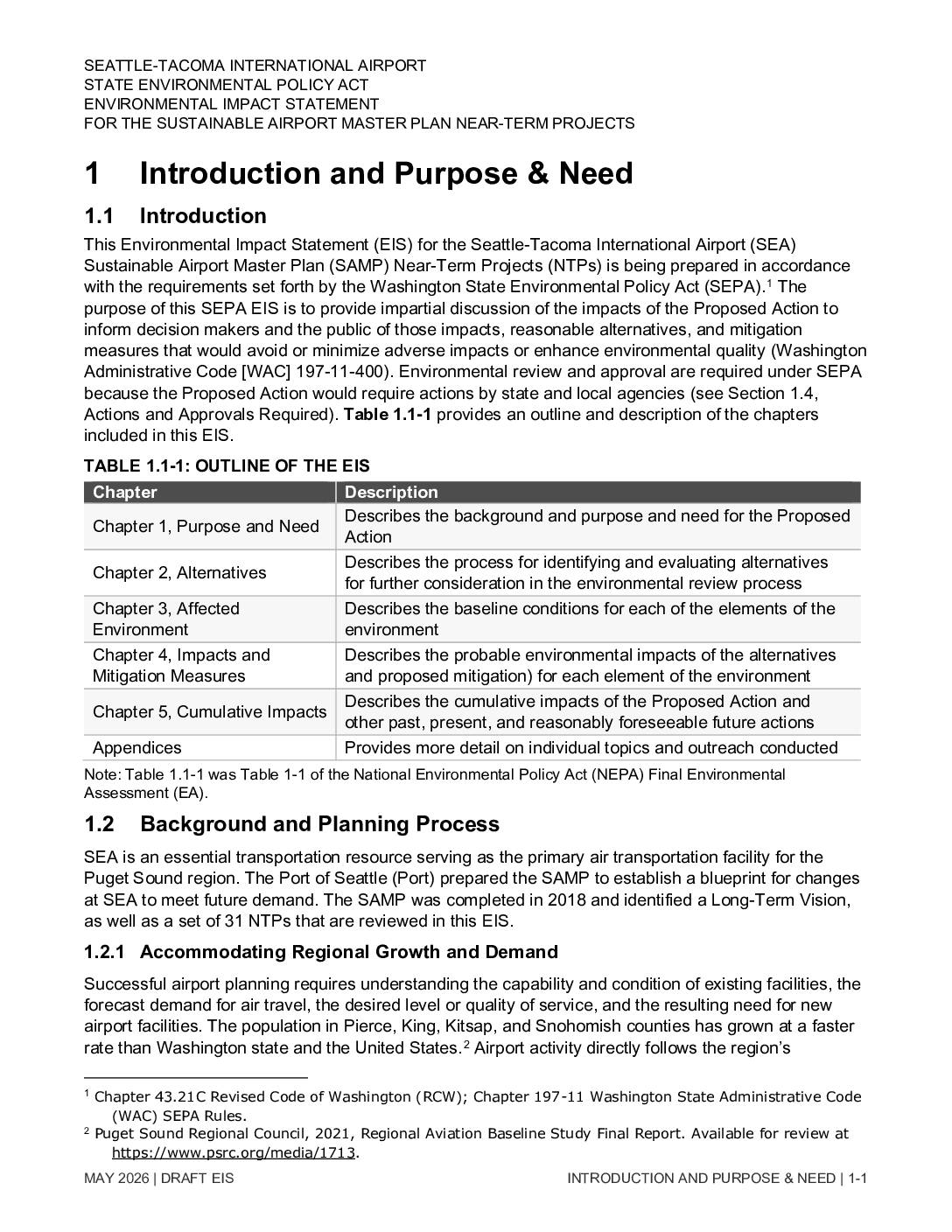
SAMP Near-Term Projects Draft EIS: Chapter 1, Introduction and Purpose & Need
The Port of Seattle is preparing an Environmental Impact Statement (EIS) under Washington State's Environmental Policy Act (SEPA) for 31 near-term construction and improvement projects at Seattle-Tacoma International Airport (SEA). These projects, drawn from the airport's 2018 Sustainable Airport Master Plan, aim to improve passenger facilities, safety, efficiency, and airport access ahead of a projected 2032 completion date. The review follows a completed federal environmental assessment and addresses the region's growing air travel demand while evaluating potential environmental impacts and mitigation measures. -
 2026-05-19
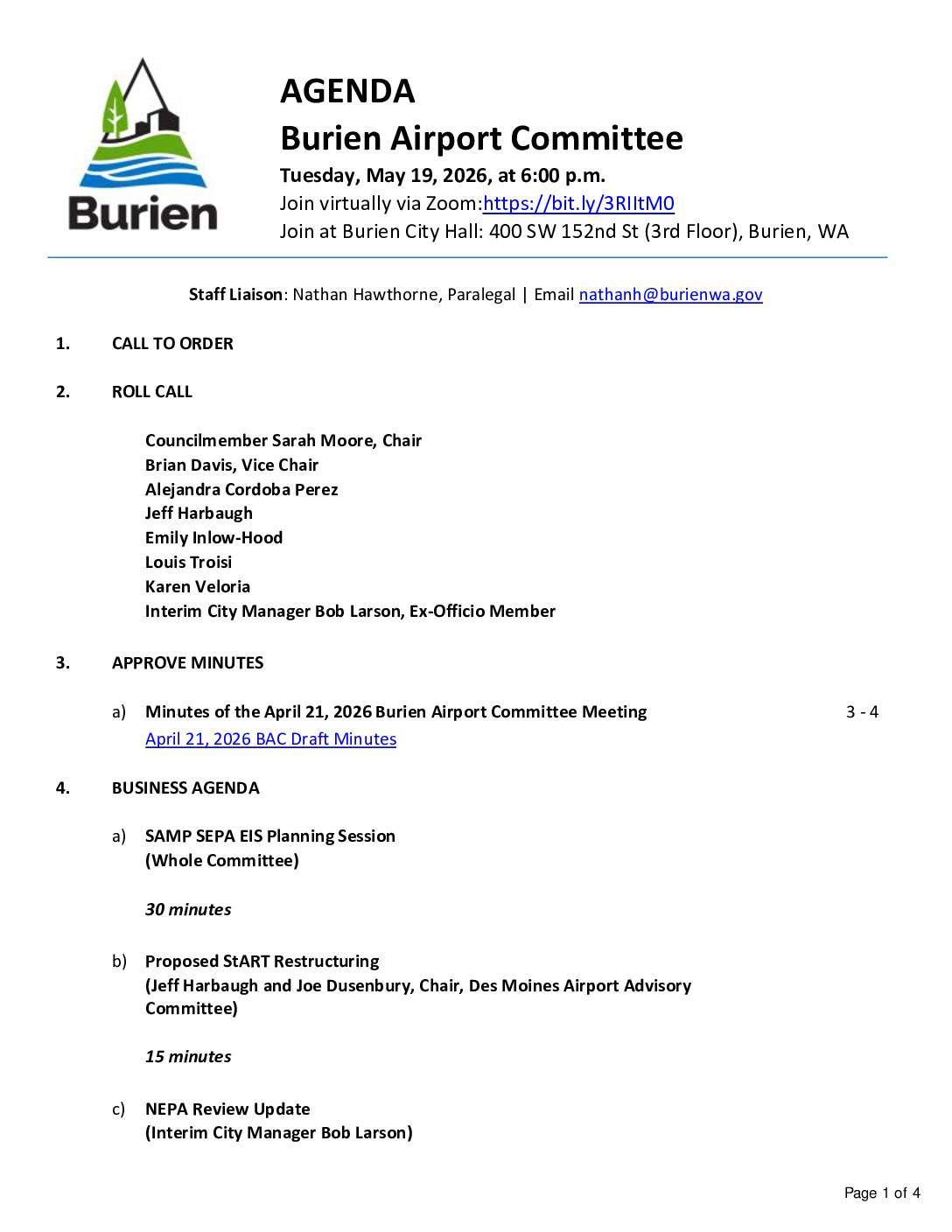
Burien airport committee agenda and minutes
The Burien Airport Committee is scheduled to meet on May 19, 2026, to discuss key aviation policy topics including a SAMP Environmental Impact Statement planning session, a proposed restructuring of the StART regional airport advisory group, and a NEPA review update. Draft minutes from the April 21, 2026 meeting show the committee also addressed the Port of Seattle's response to Burien's request for revisions to the Sound Insulation Program, with the committee expressing continued disagreement over the Port's criteria for qualifying homes for noise-reduction packages. Members of the public can participate in person at Burien City Hall, via Zoom, or by submitting written comments by email before 4:45 p.m. on the day of the meeting.