I understand that you will never share my information with anyone, you will only use it to keep me updated on relevant events and that I may unsubscribe at any time.
Port of Seattle Commission Regular Meeting May 26, 2026 (SAMP/SEPA intro)
Article Summary:
TL;DR: Added categories. Still no significant impacts.
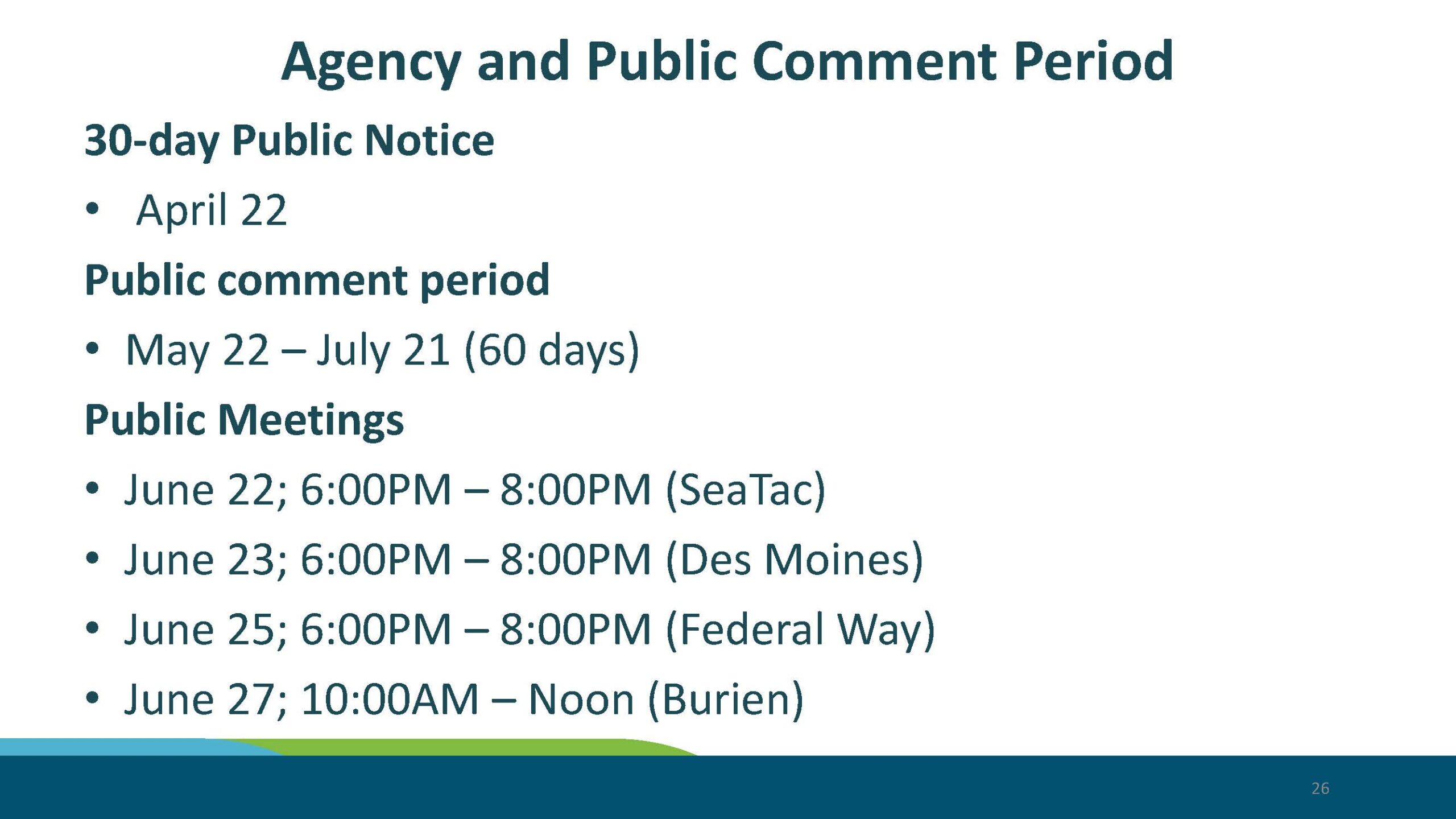
The introduction to SAMP/SEPA. There will be a 60 day comment period, with four public meetings on June 22 (SeaTac: 6pm-8pm), 23 (Des Moines: 6pm-8pm), 25 (Federal Way: 6pm-8pm, and 27 (Burien: 10am-2pm), plus two virtual public meetings.
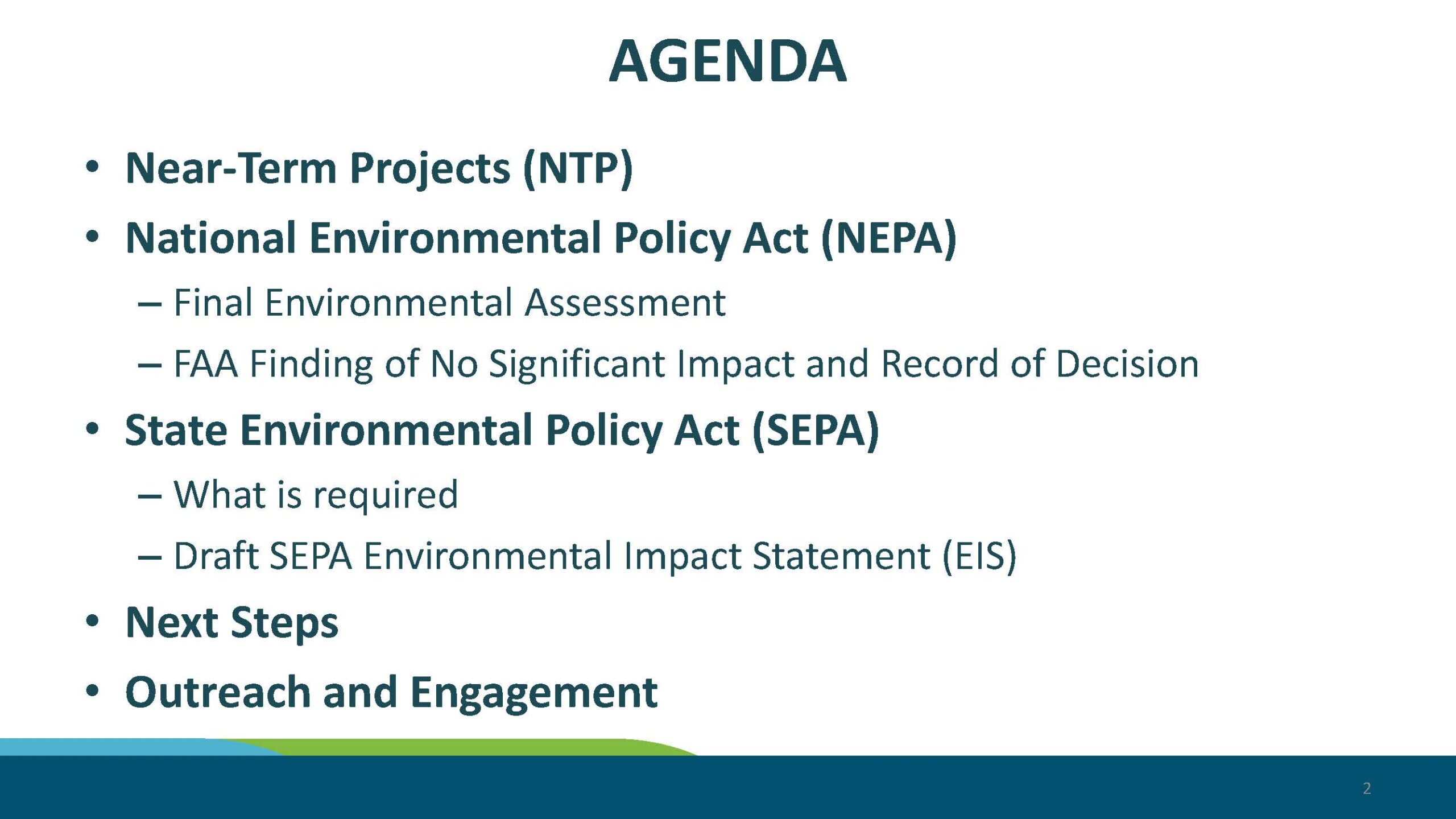
Agenda slide from a Sea-Tac Airport presentation covering Near-Term Projects (NTP), National Environmental Policy Act (NEPA) topics including a Final Environmental Assessment and FAA Finding of No Significant Impact and Record of Decision, State Environmental Policy Act (SEPA) topics including requirements and a Draft SEPA Environmental Impact Statement (EIS), Next Steps, and Outreach and Engagement. This appears to be slide 2 of the presentation.
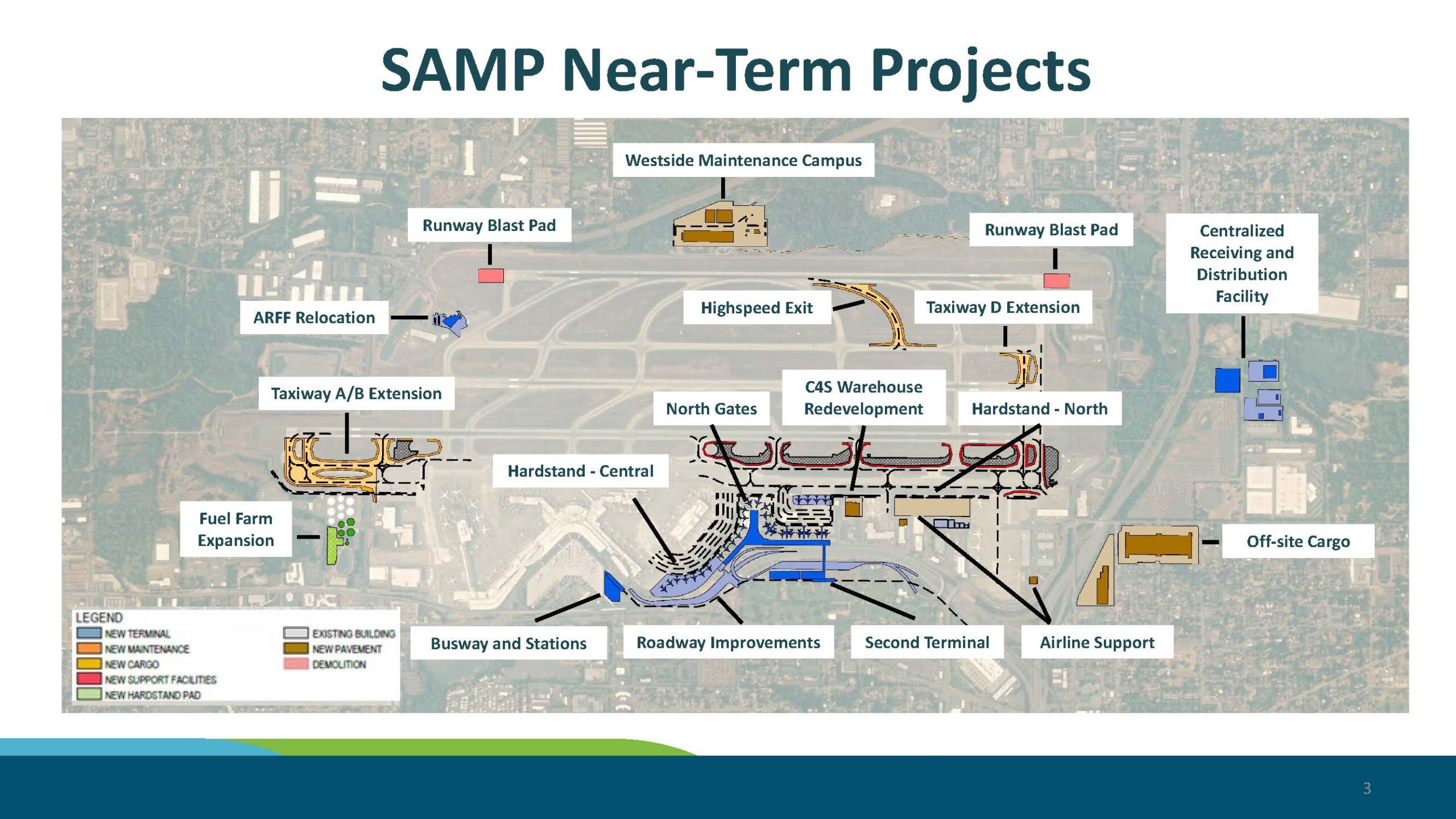
A slide titled 'SAMP Near-Term Projects' presents an aerial map of Seattle-Tacoma International Airport annotated with planned near-term capital improvements. Labeled projects include a Second Terminal, North Gates, Busway and Stations, Roadway Improvements, Taxiway A/B and D Extensions, Hardstand areas (Central and North), Fuel Farm Expansion, ARFF Relocation, Runway Blast Pads, Westside Maintenance Campus, C4S Warehouse Redevelopment, Off-site Cargo, Airline Support, Highspeed Exit, and a Centralized Receiving and Distribution Facility.
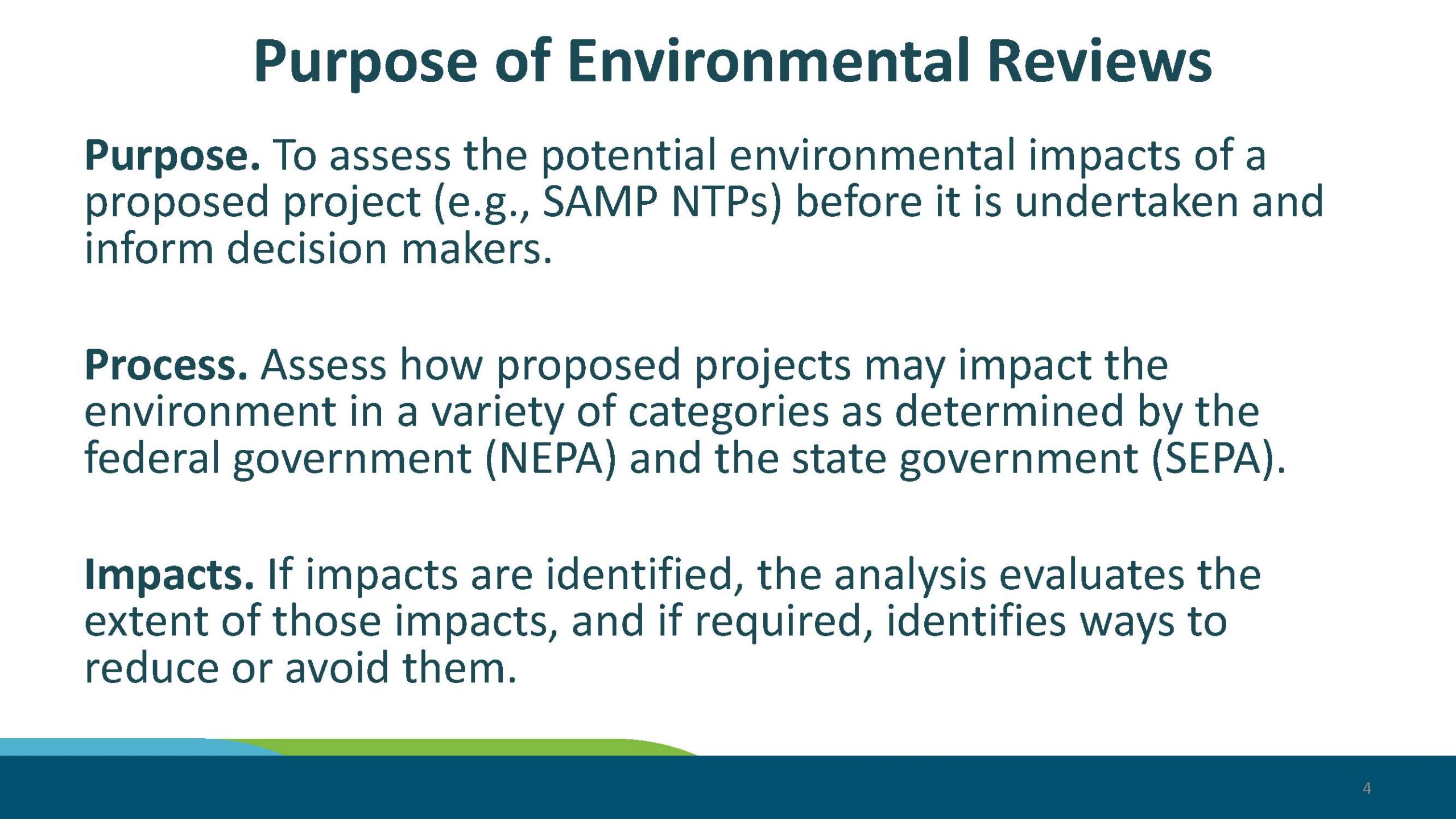
A presentation slide titled 'Purpose of Environmental Reviews' explains that environmental reviews assess potential impacts of proposed projects such as SAMP NTPs (Near-Term Projects) before they are undertaken, following federal NEPA and state SEPA requirements. The slide outlines three components: Purpose, Process, and Impacts, including identification of mitigation measures if impacts are found.
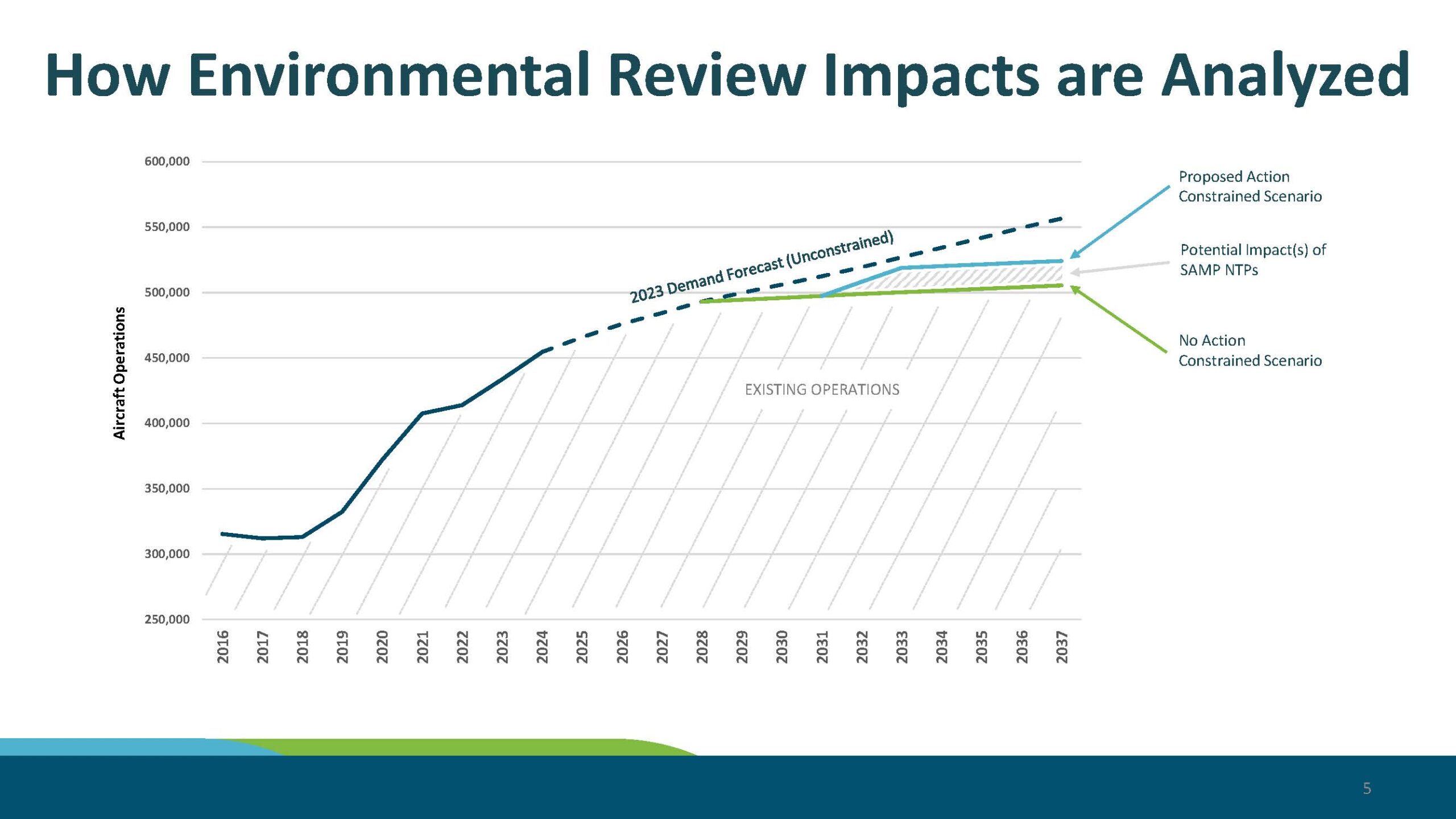
Slide 5 from a Seattle-Tacoma International Airport presentation titled 'How Environmental Review Impacts are Analyzed,' showing projected aircraft operations from 2016 to 2037. The chart compares the 2023 Demand Forecast (Unconstrained) against three constrained scenarios: Proposed Action, No Action, and Potential Impacts of SAMP NTPs (Notice to Proceed), with operations ranging from approximately 315,000 in 2016 to a projected 525,000–555,000 by 2037.
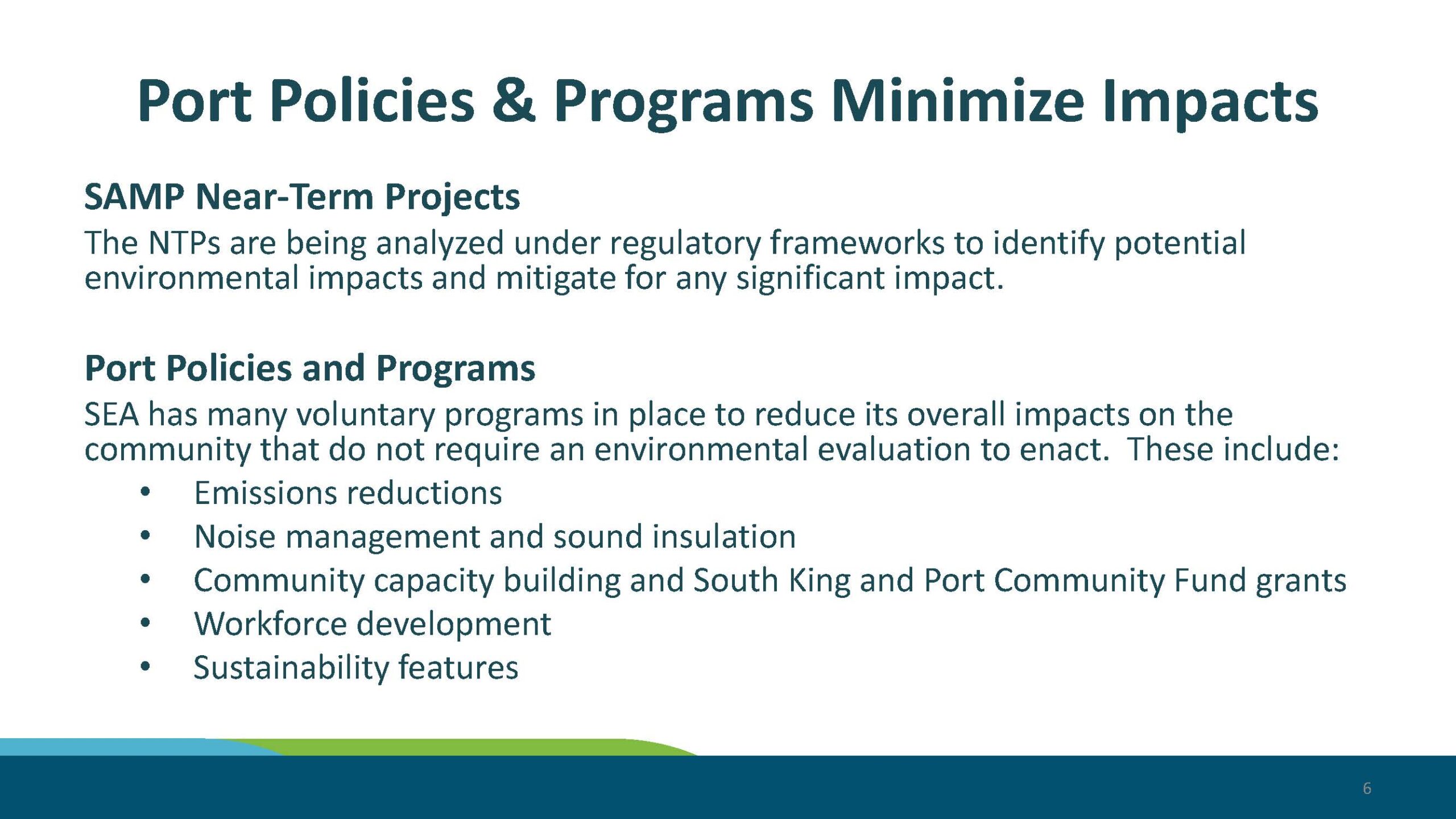
Slide 6 from a Port of Seattle Seattle-Tacoma International Airport (SEA) Sub-Area Master Plan (SAMP) presentation, explaining that Near-Term Projects are analyzed under regulatory frameworks to mitigate environmental impacts, and listing voluntary Port policies and programs—including emissions reductions, noise management and sound insulation, community capacity building and South King and Port Community Fund grants, workforce development, and sustainability features—that reduce community impacts without requiring a formal environmental evaluation.
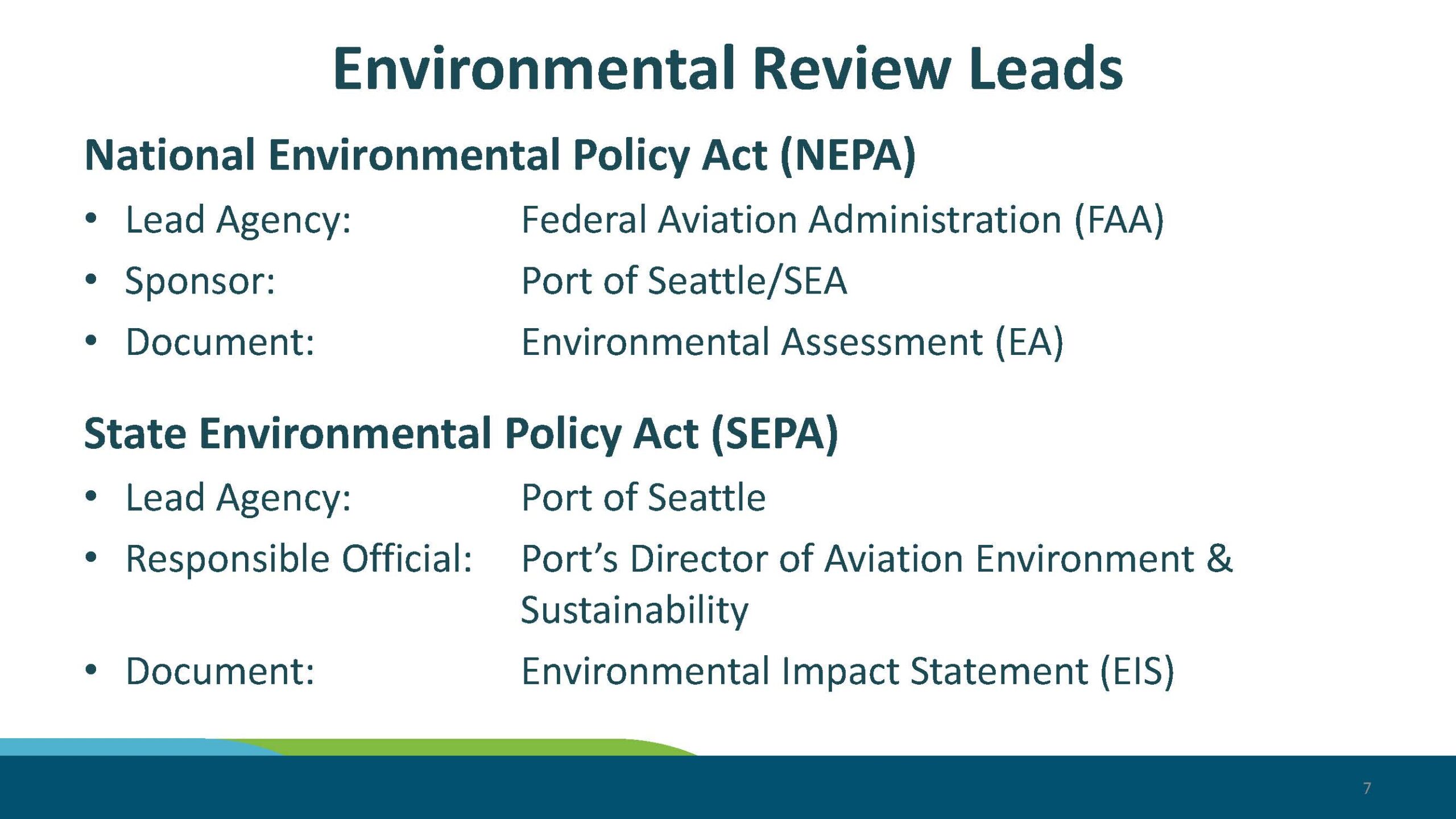
Slide 7 from a Sea-Tac Airport presentation outlining the lead agencies for environmental review: under NEPA, the FAA serves as lead agency with the Port of Seattle/SEA as sponsor, producing an Environmental Assessment (EA); under SEPA, the Port of Seattle is the lead agency with its Director of Aviation Environment & Sustainability as responsible official, producing an Environmental Impact Statement (EIS).
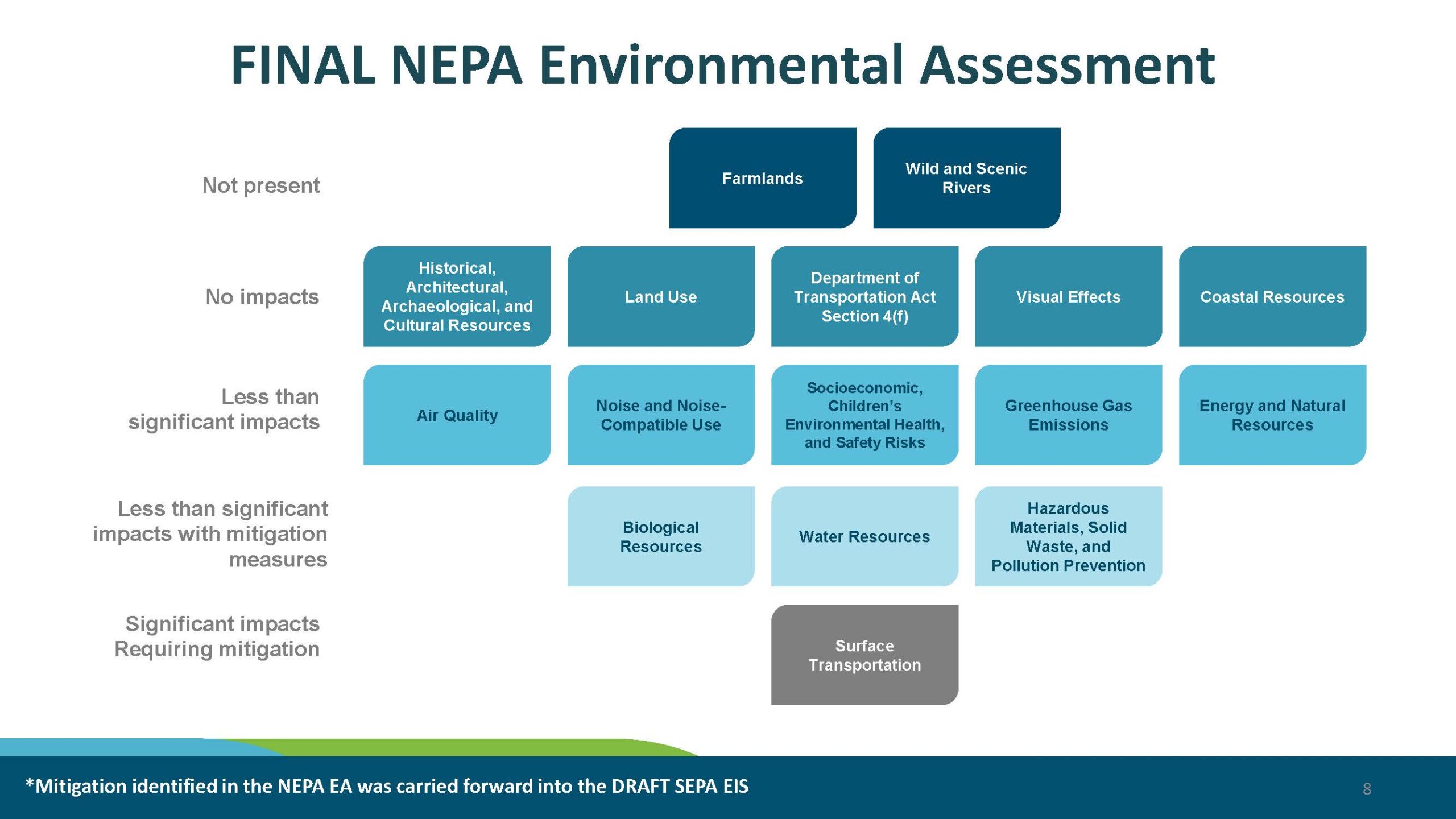
This slide summarizes the findings of a Final NEPA Environmental Assessment, categorizing resource areas by impact level ranging from 'Not present' (Farmlands, Wild and Scenic Rivers) to 'Significant impacts requiring mitigation' (Surface Transportation). A footer note states that mitigation identified in the NEPA EA was carried forward into the Draft SEPA EIS, indicating this is part of a joint NEPA/SEPA review process likely related to Sea-Tac Airport or a similar major transportation project.
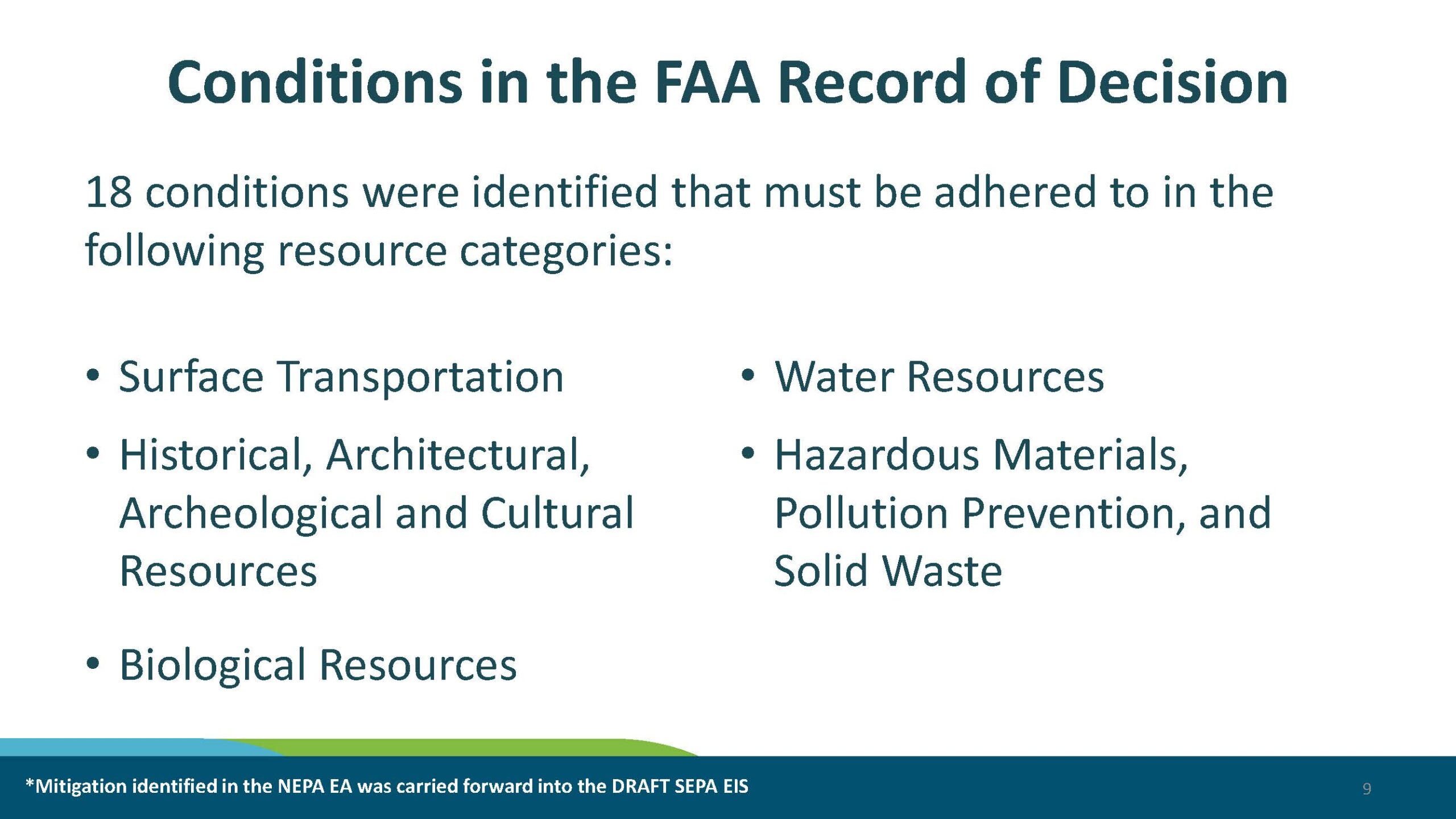
This slide describes 18 conditions identified in the FAA Record of Decision that must be adhered to, covering five resource categories: Surface Transportation, Historical/Architectural/Archeological and Cultural Resources, Biological Resources, Water Resources, and Hazardous Materials/Pollution Prevention/Solid Waste. A footer note states that mitigation identified in the NEPA EA was carried forward into the Draft SEPA EIS.
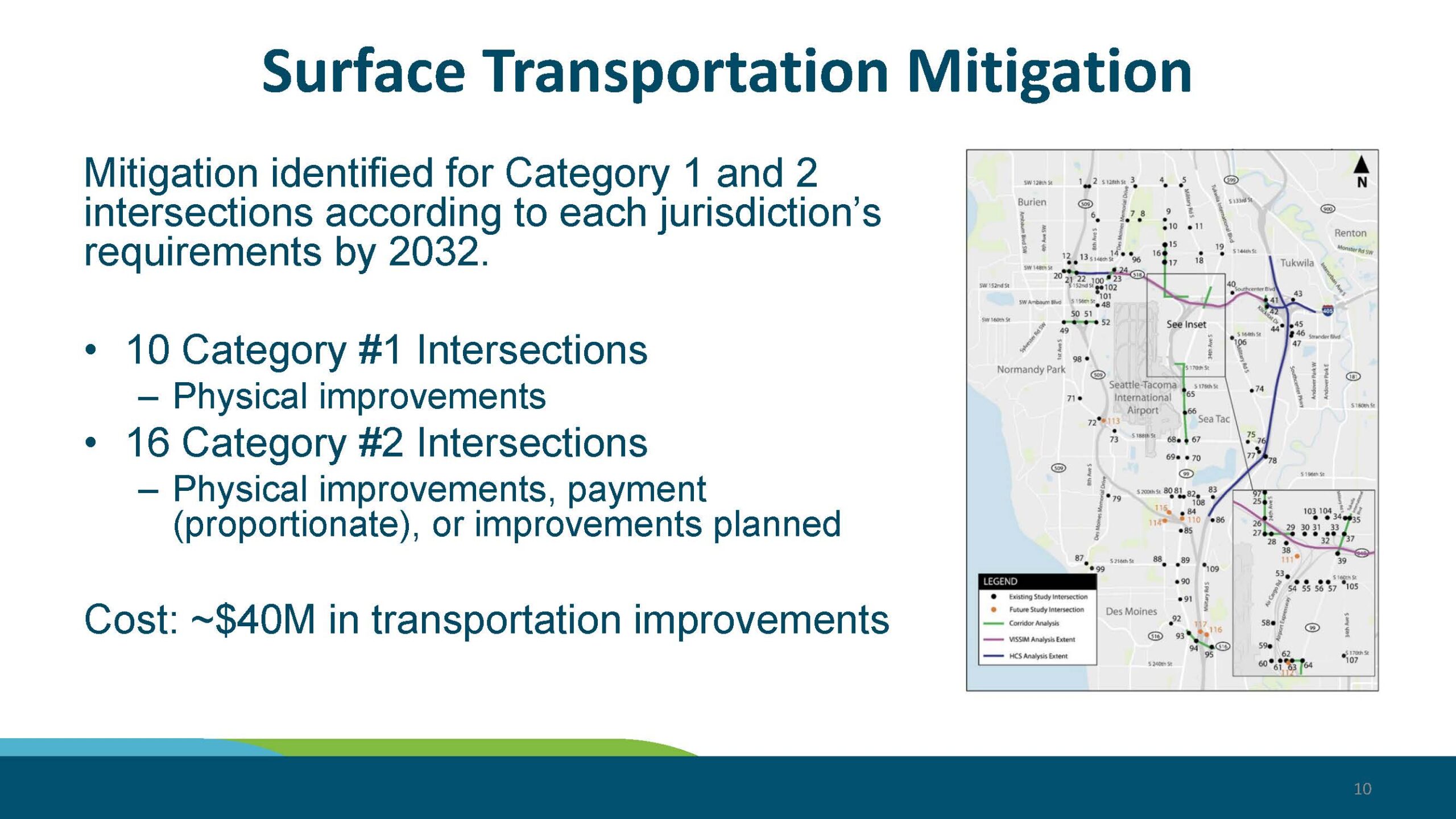
A presentation slide titled 'Surface Transportation Mitigation' describes mitigation measures identified for Category 1 and 2 intersections near Seattle-Tacoma International Airport by 2032, covering 10 Category #1 intersections requiring physical improvements and 16 Category #2 intersections, at an estimated cost of approximately $40 million. The slide includes a map showing study intersections across the Sea-Tac area including Burien, Normandy Park, Sea-Tac, Des Moines, Tukwila, and Renton jurisdictions.
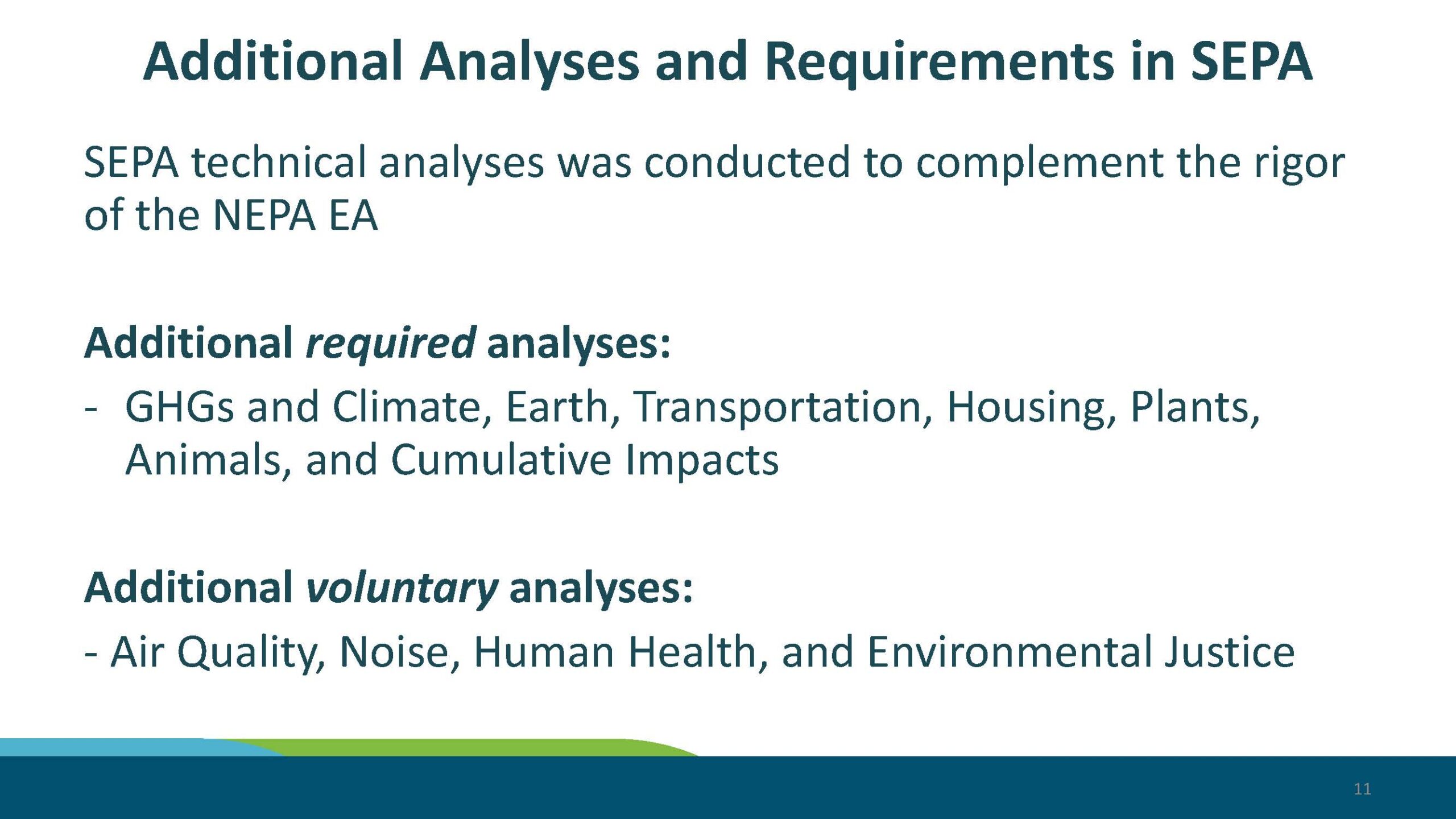
This presentation slide (page 11) outlines additional analyses conducted under the State Environmental Policy Act (SEPA) to complement a NEPA Environmental Assessment (EA). It lists required analyses including GHGs and Climate, Earth, Transportation, Housing, Plants, Animals, and Cumulative Impacts, as well as voluntary analyses covering Air Quality, Noise, Human Health, and Environmental Justice.
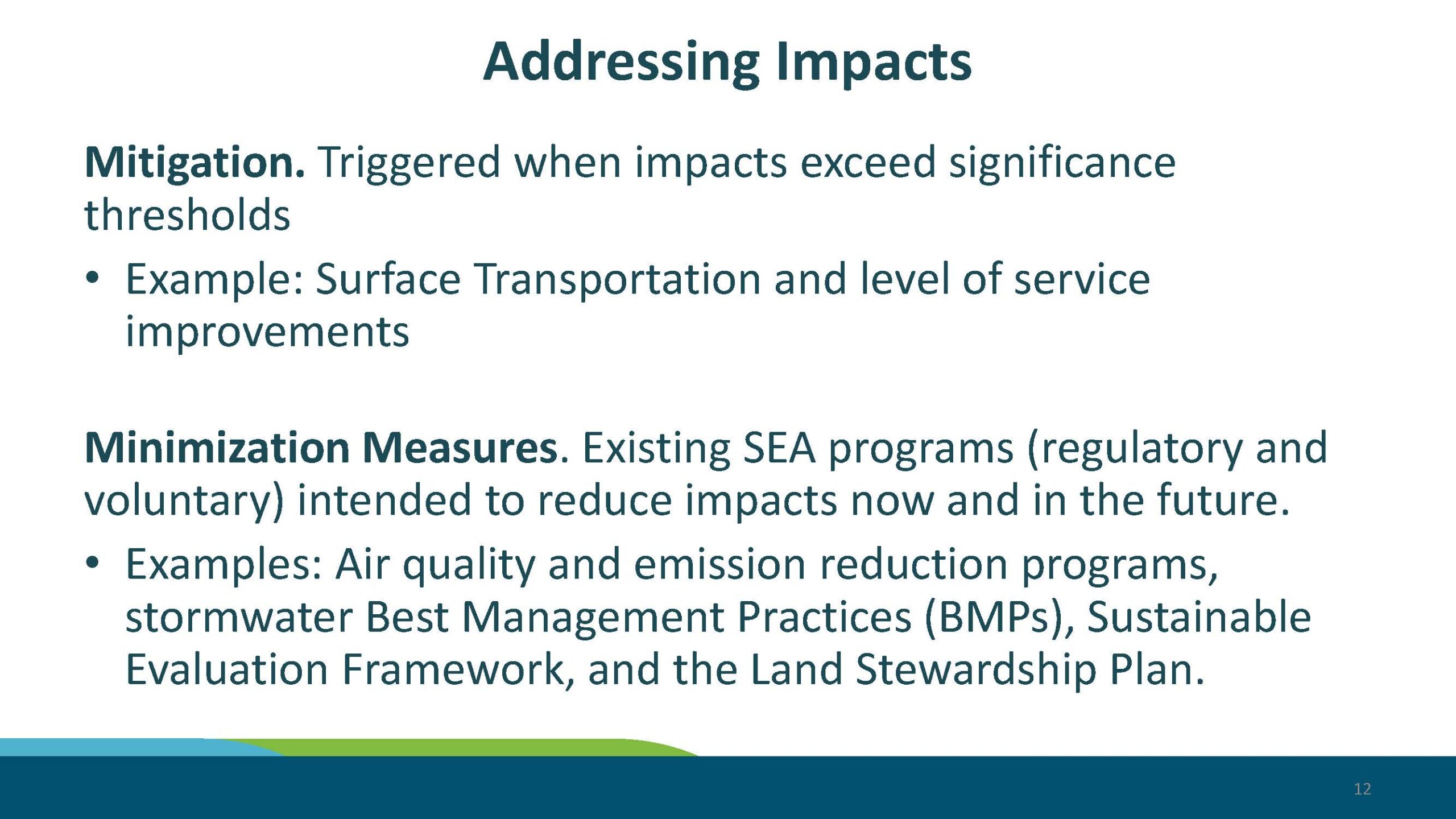
A presentation slide titled 'Addressing Impacts' distinguishes between Mitigation (triggered when impacts exceed significance thresholds, e.g., surface transportation and level of service improvements) and Minimization Measures (existing SEA programs, regulatory and voluntary, including air quality and emission reduction programs, stormwater BMPs, Sustainable Evaluation Framework, and the Land Stewardship Plan). The 'SEA' abbreviation and subject matter suggest this is from a Seattle-Tacoma International Airport environmental or planning presentation, slide 12.
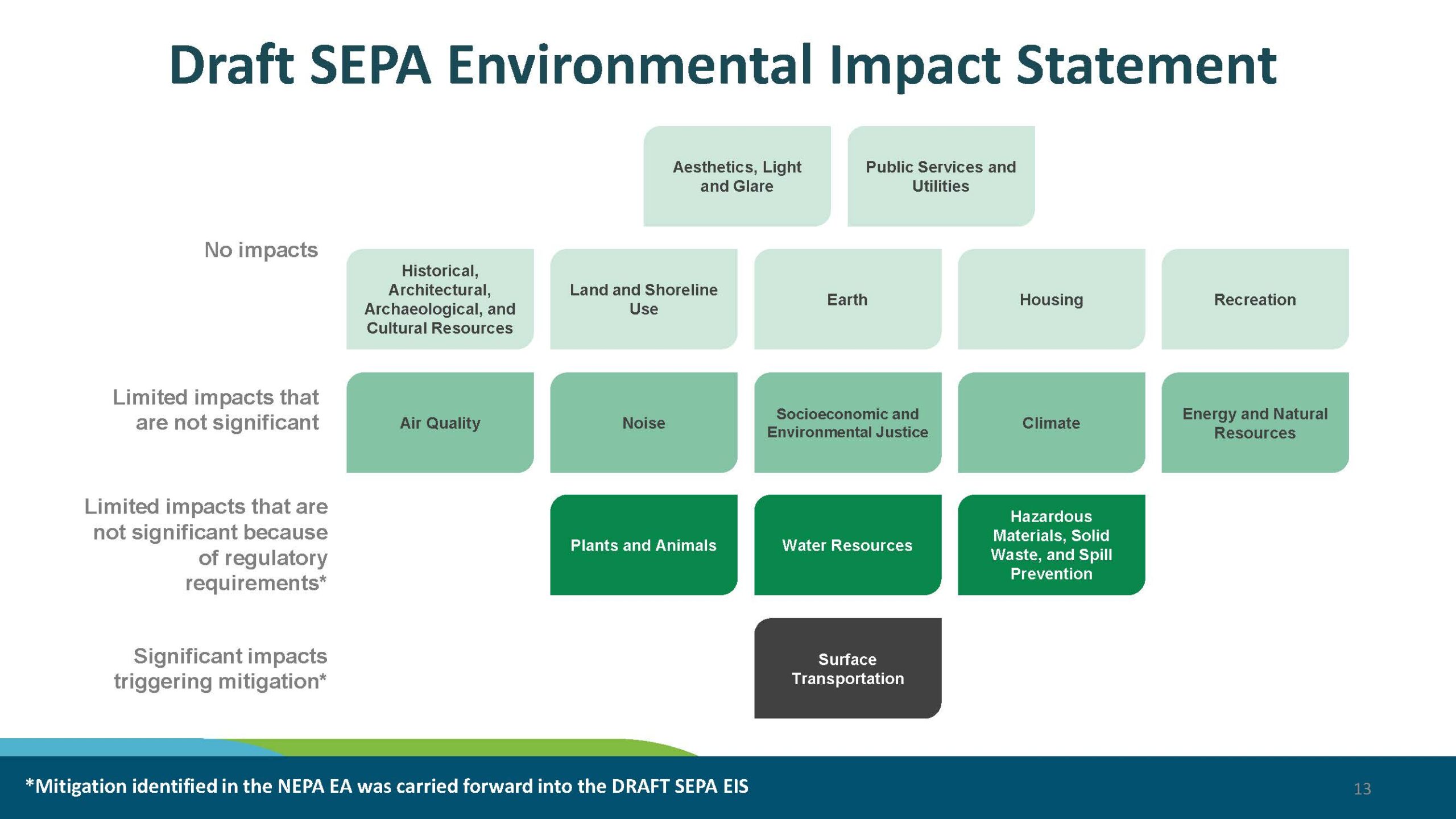
A presentation slide titled 'Draft SEPA Environmental Impact Statement' categorizes environmental impact areas into four tiers: no impacts (e.g., Historical/Cultural Resources, Earth, Housing, Recreation); limited impacts that are not significant (e.g., Air Quality, Noise, Climate); limited impacts not significant due to regulatory requirements (Plants and Animals, Water Resources, Hazardous Materials/Solid Waste/Spill Prevention); and significant impacts triggering mitigation (Surface Transportation). A footer note states that mitigation identified in the NEPA EA was carried forward into the Draft SEPA EIS.
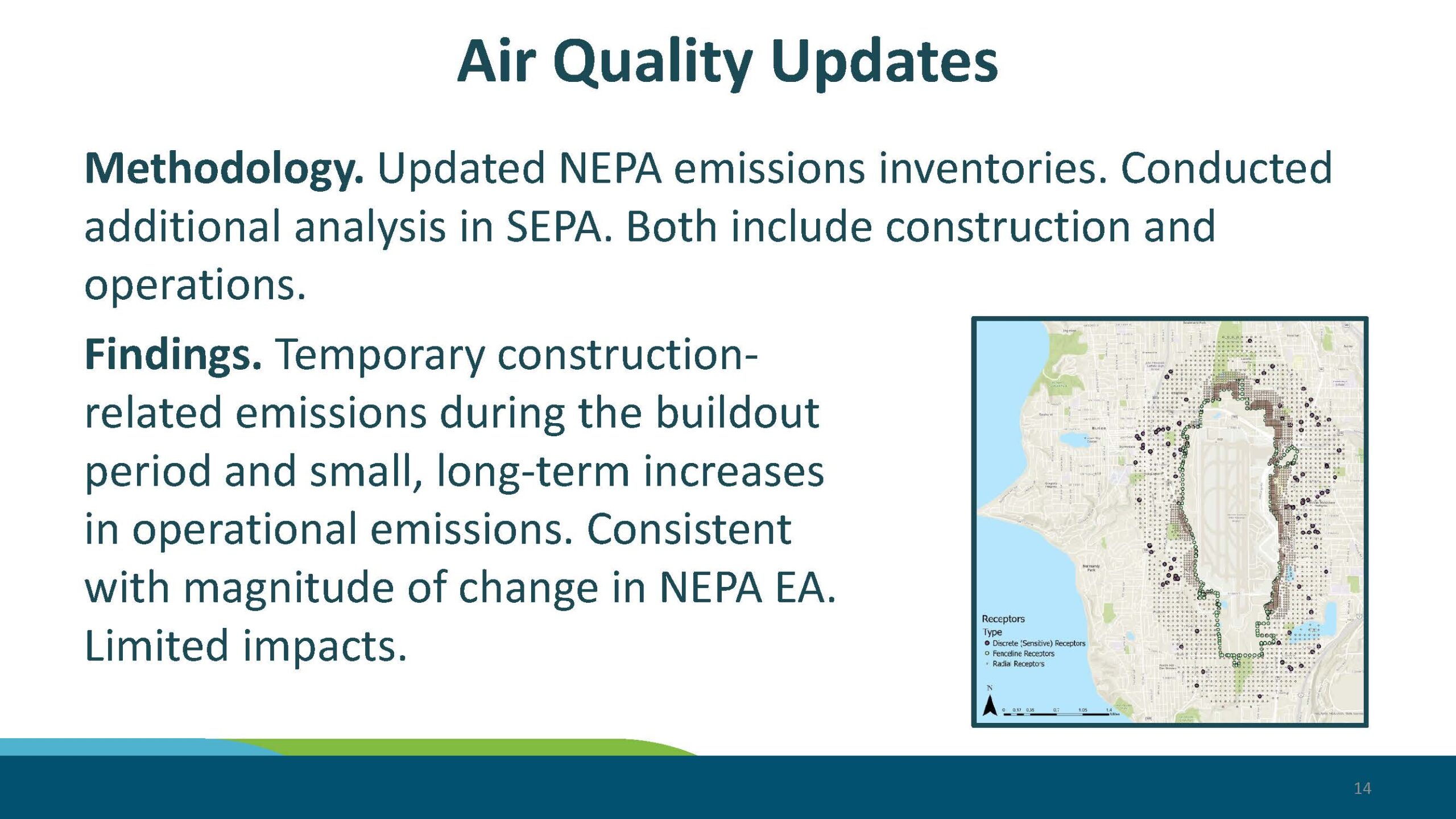
Presentation slide titled 'Air Quality Updates' describing methodology and findings for NEPA emissions inventories and SEPA analysis covering construction and operations phases. Findings note temporary construction-related emissions during the buildout period and small long-term increases in operational emissions, characterized as limited impacts consistent with the NEPA EA; accompanied by a map showing Discrete (Sensitive), Fenceline, and Radial Receptors along what appears to be a corridor in the Seattle/Sea-Tac area.
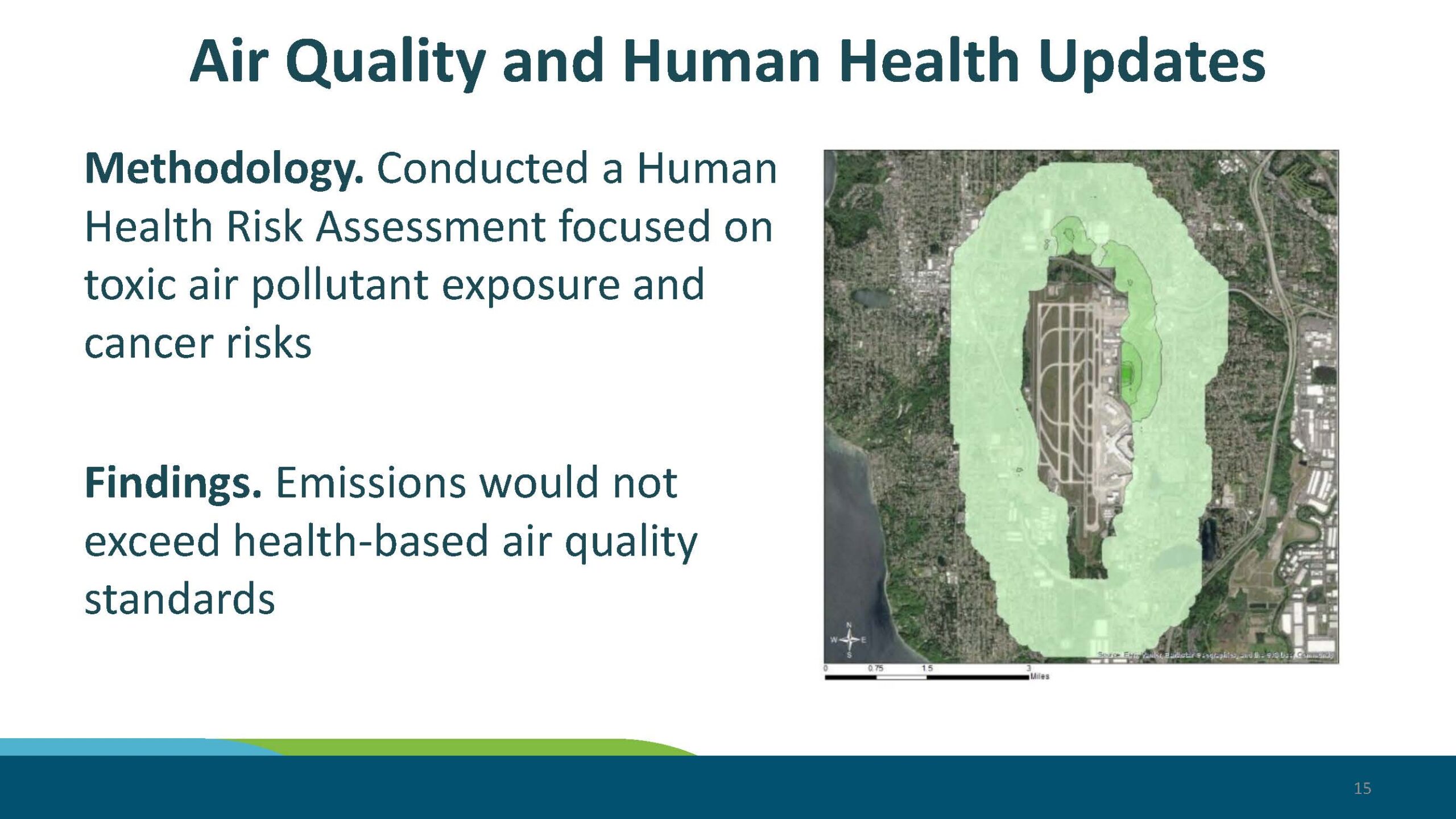
Slide 15 from a Sea-Tac Airport environmental review presentation summarizes a Human Health Risk Assessment focused on toxic air pollutant exposure and cancer risks. The findings state that emissions would not exceed health-based air quality standards, accompanied by an aerial map showing modeled pollutant dispersion contours overlaid on Seattle-Tacoma International Airport and surrounding communities.
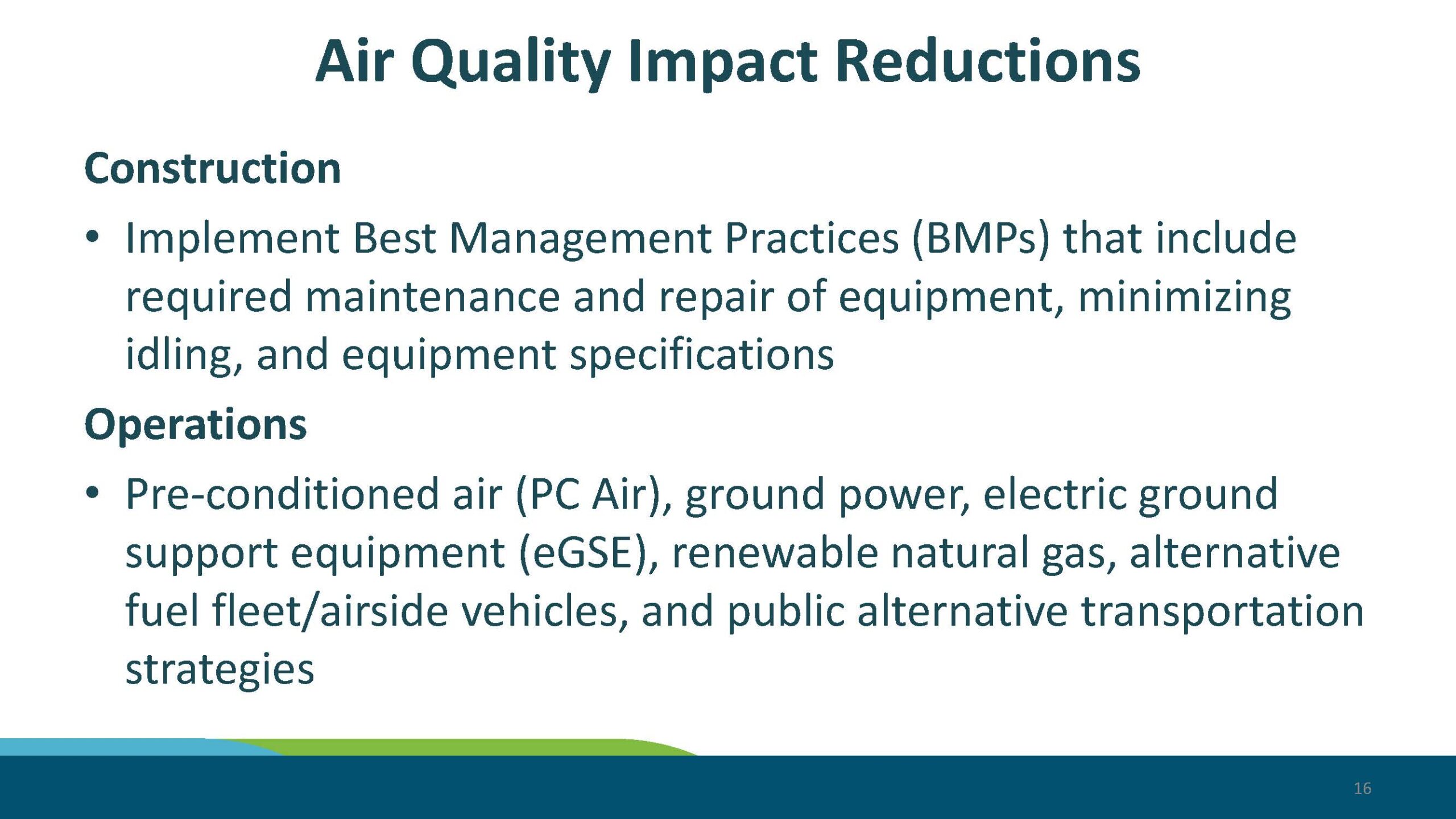
A presentation slide titled 'Air Quality Impact Reductions' outlining mitigation strategies for construction (implementing Best Management Practices including equipment maintenance, minimizing idling, and equipment specifications) and operations (pre-conditioned air, electric ground support equipment, renewable natural gas, alternative fuel vehicles, and public alternative transportation strategies). The slide is numbered 16, suggesting it is part of a larger environmental impact or planning presentation, potentially related to airport development.
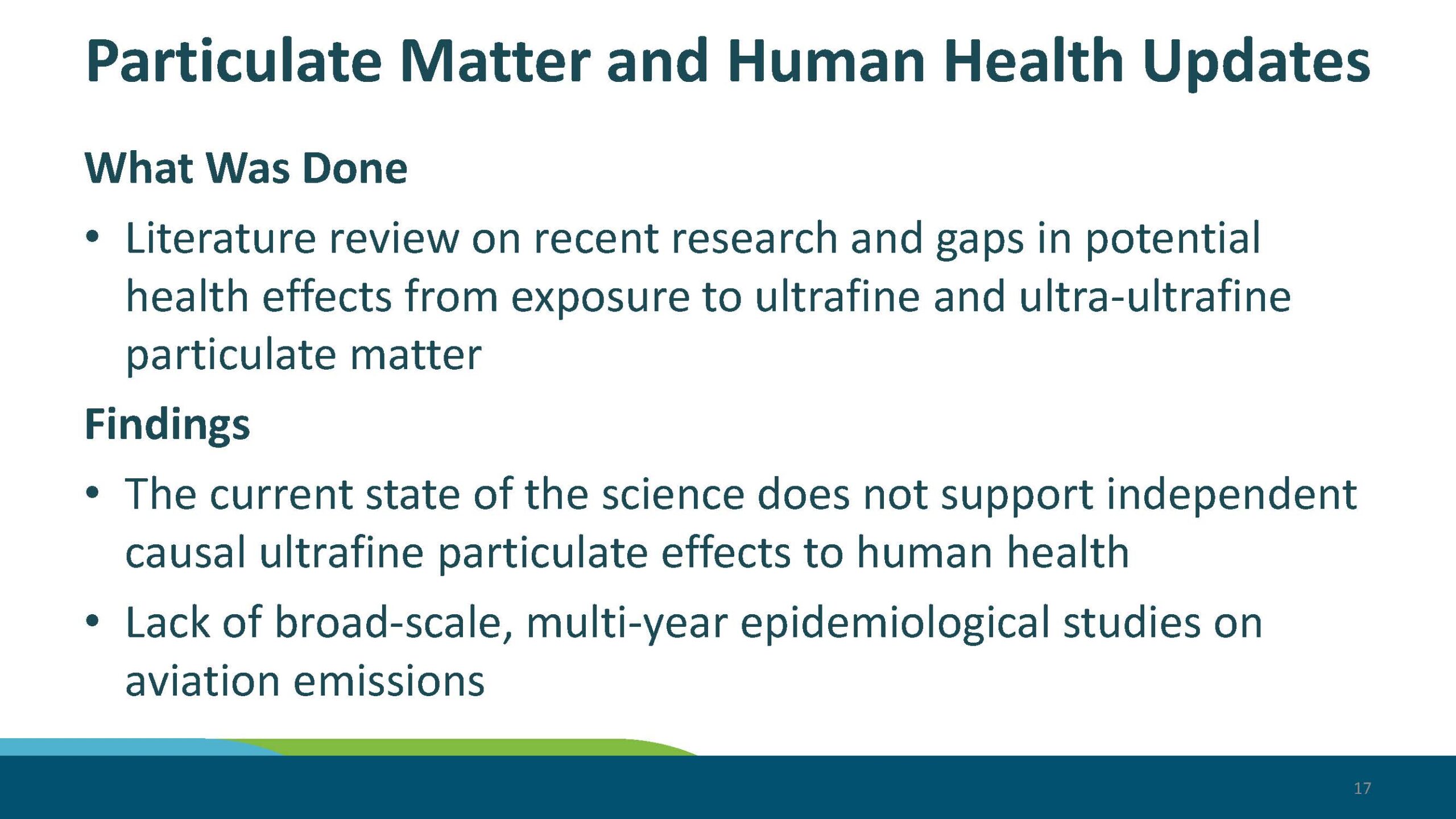
A presentation slide summarizing a literature review on health effects from ultrafine and ultra-ultrafine particulate matter. Findings state that current science does not support independent causal ultrafine particulate effects on human health, and notes a lack of broad-scale, multi-year epidemiological studies on aviation emissions.
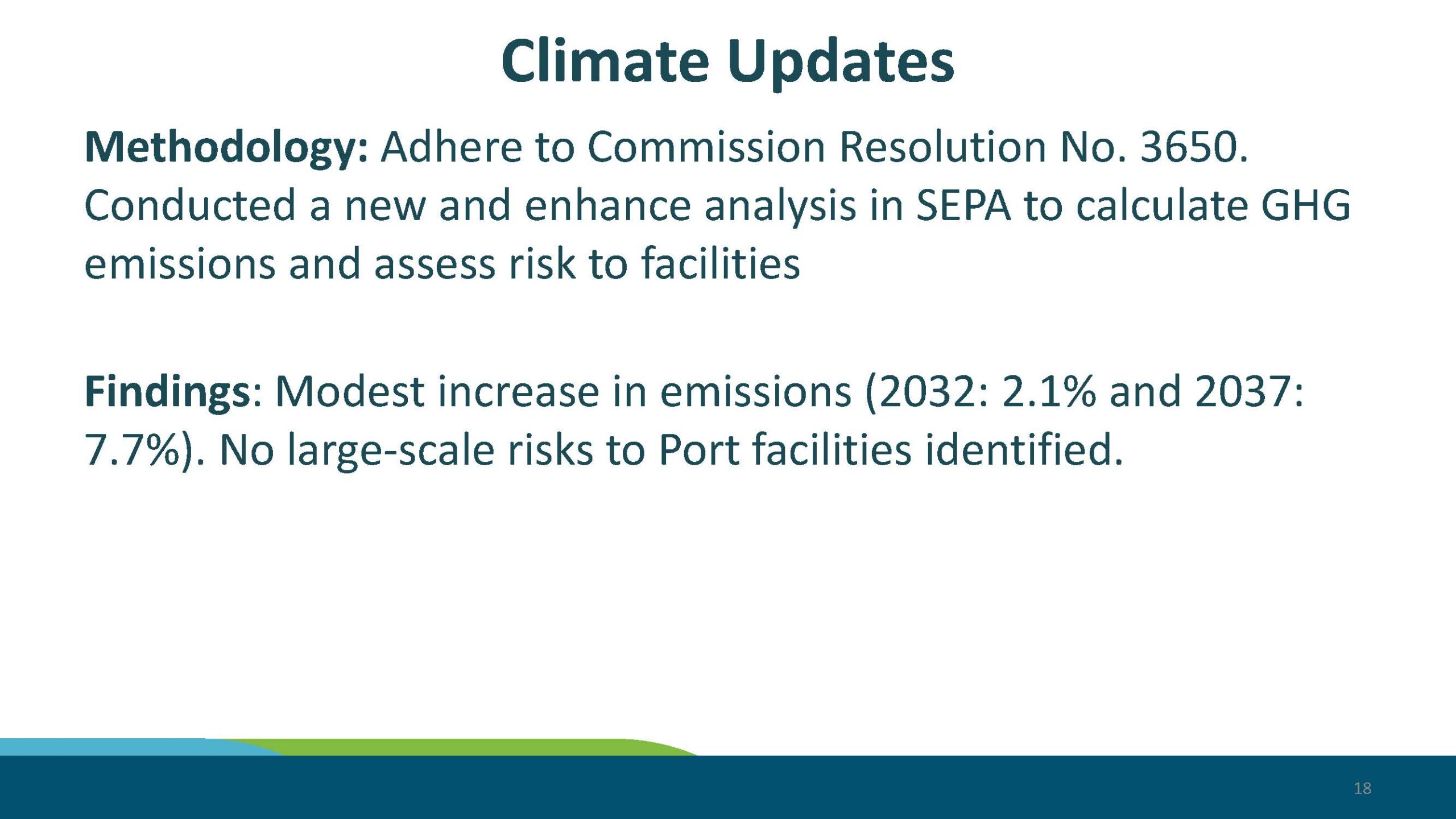
A presentation slide titled 'Climate Updates' describes methodology adhering to Commission Resolution No. 3650, with a new SEPA analysis calculating GHG emissions and assessing facility risk. Findings show a modest emissions increase (2.1% by 2032, 7.7% by 2037) and no large-scale risks to Port facilities identified.
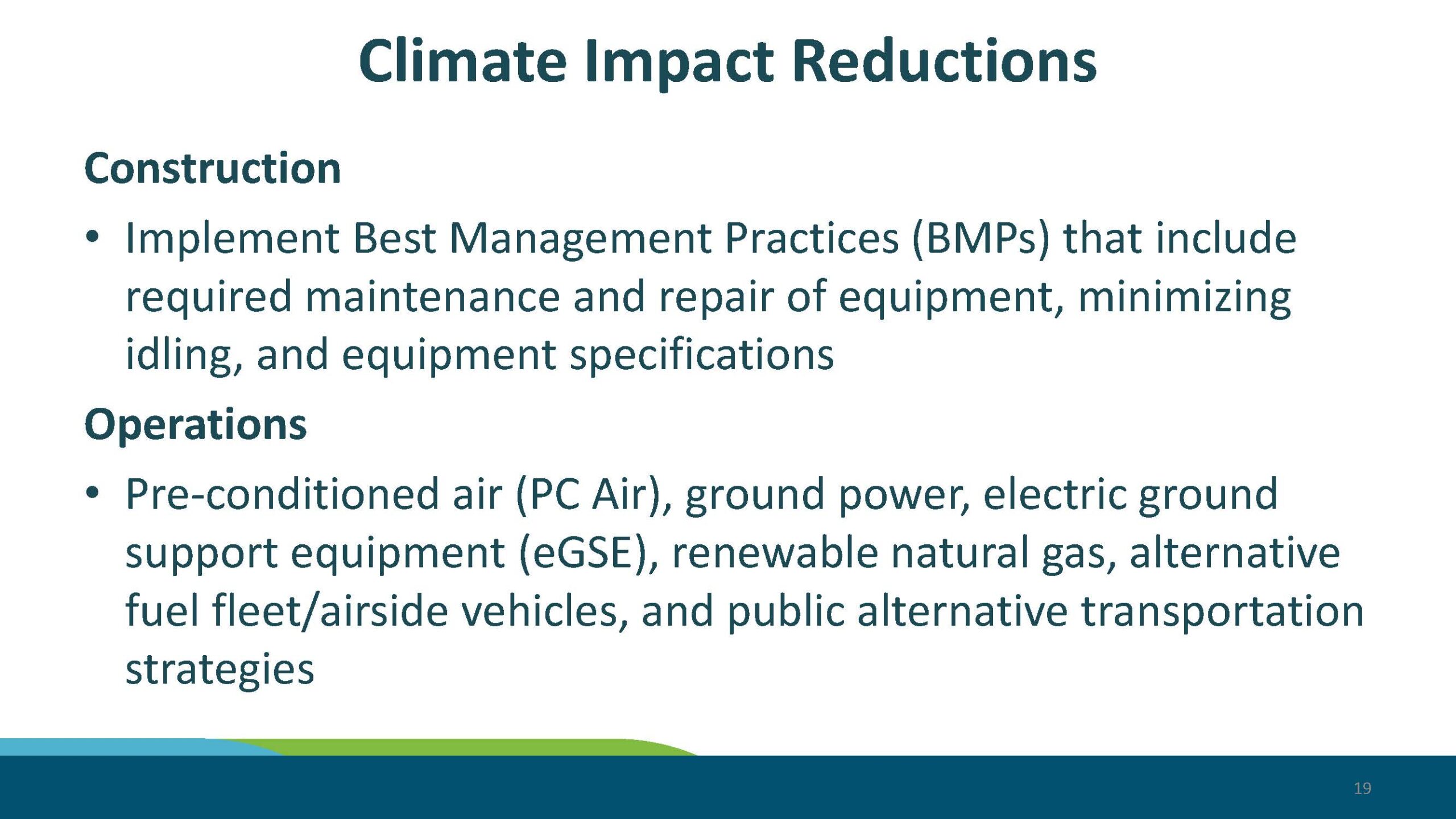
A presentation slide titled 'Climate Impact Reductions' outlining two categories of greenhouse gas mitigation measures: Construction (implementing Best Management Practices including equipment maintenance, minimizing idling, and equipment specifications) and Operations (pre-conditioned air, ground power, electric ground support equipment, renewable natural gas, alternative fuel vehicles, and public alternative transportation strategies). No specific organization logo or date is visible, though the slide numbering (19) and subject matter are consistent with an airport environmental or EIS presentation context.
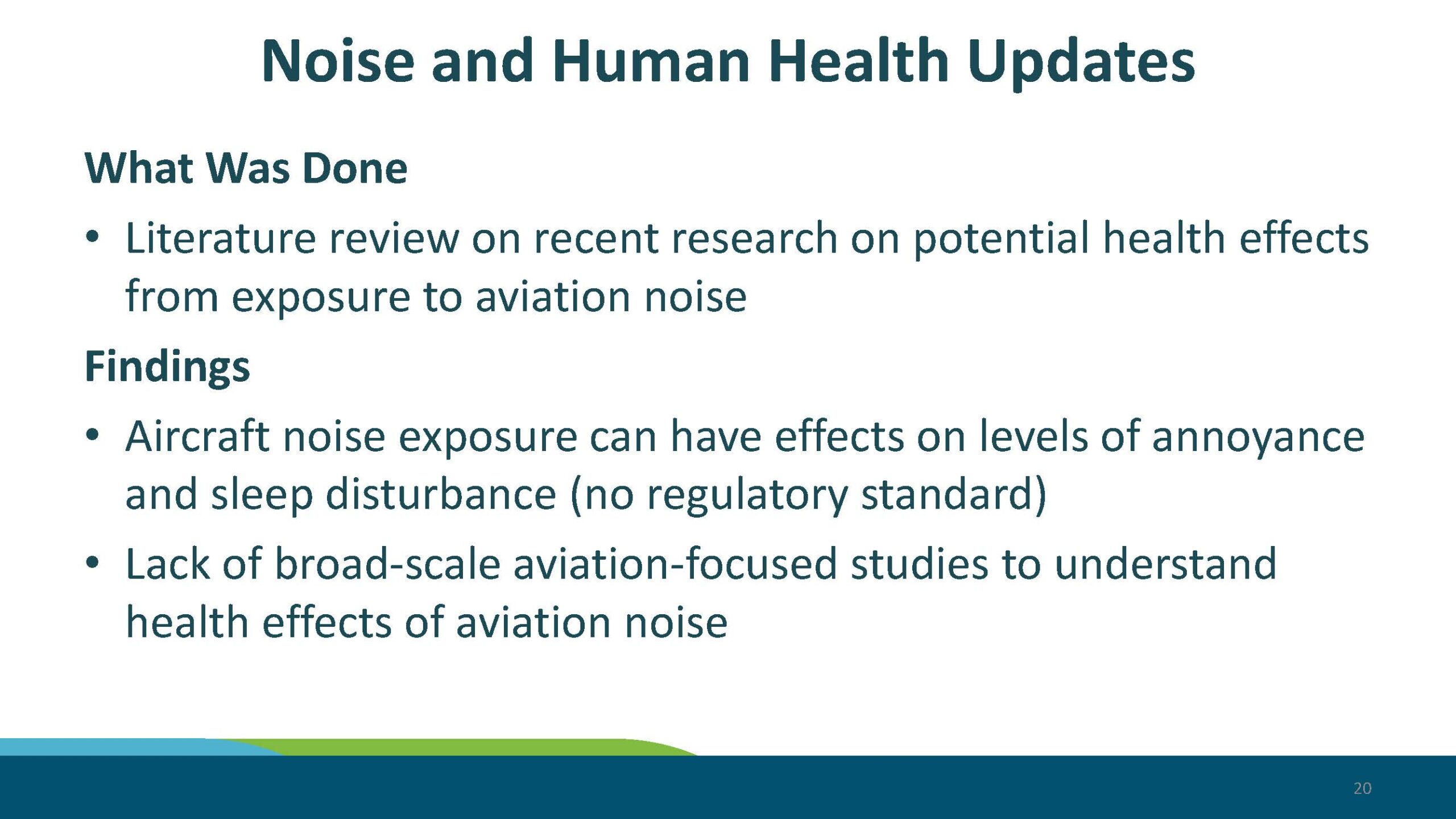
Slide 20 from a Sea-Tac Airport presentation summarizing a literature review on aviation noise and human health. Key findings note that aircraft noise exposure can affect annoyance and sleep disturbance (with no regulatory standard) and that broad-scale aviation-focused health studies are lacking.
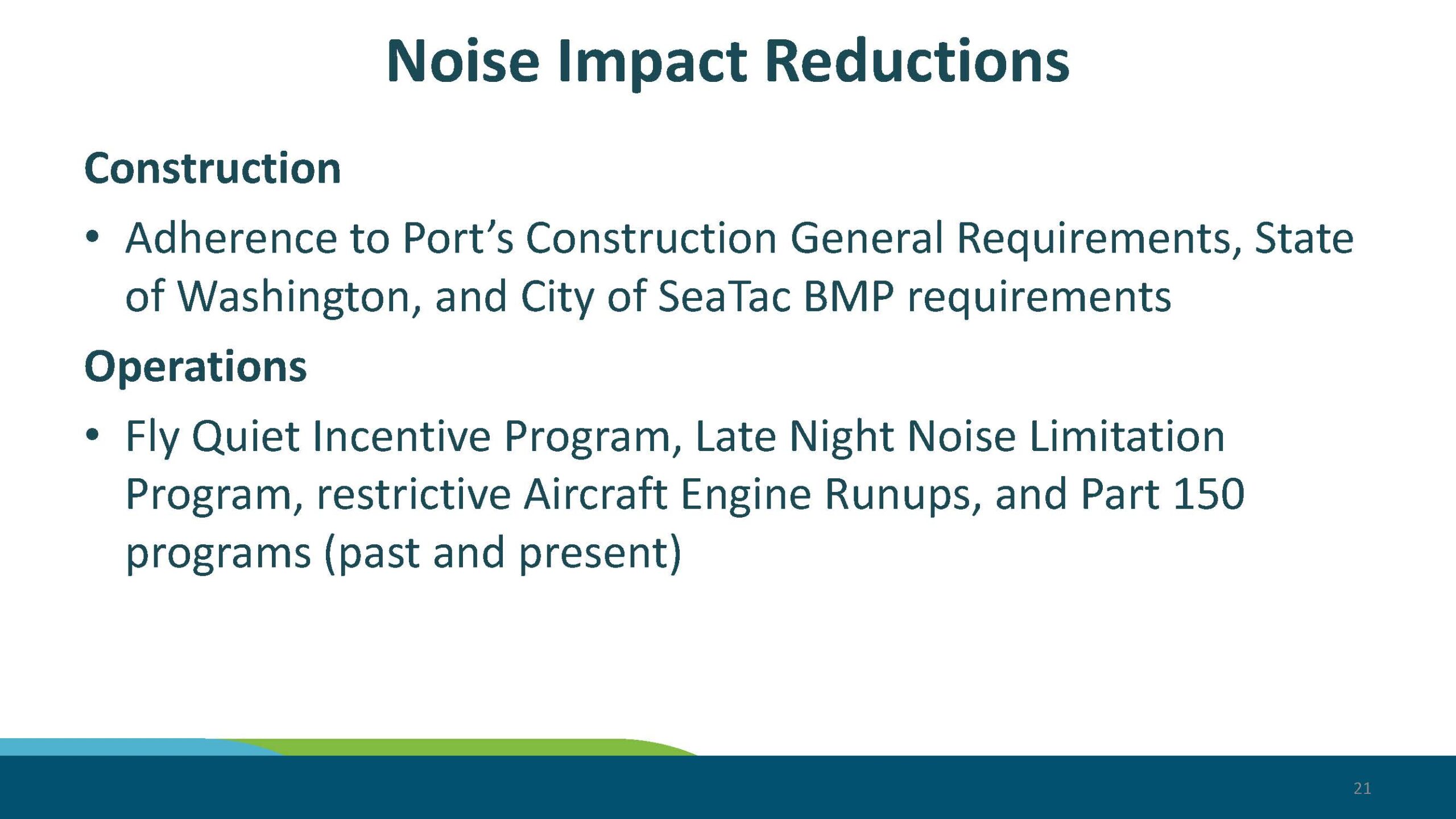
Slide 21 from a Sea-Tac Airport presentation outlines noise impact reduction measures, covering Construction (adherence to Port's Construction General Requirements, State of Washington, and City of SeaTac BMP requirements) and Operations (Fly Quiet Incentive Program, Late Night Noise Limitation Program, restrictive Aircraft Engine Runups, and Part 150 programs past and present).
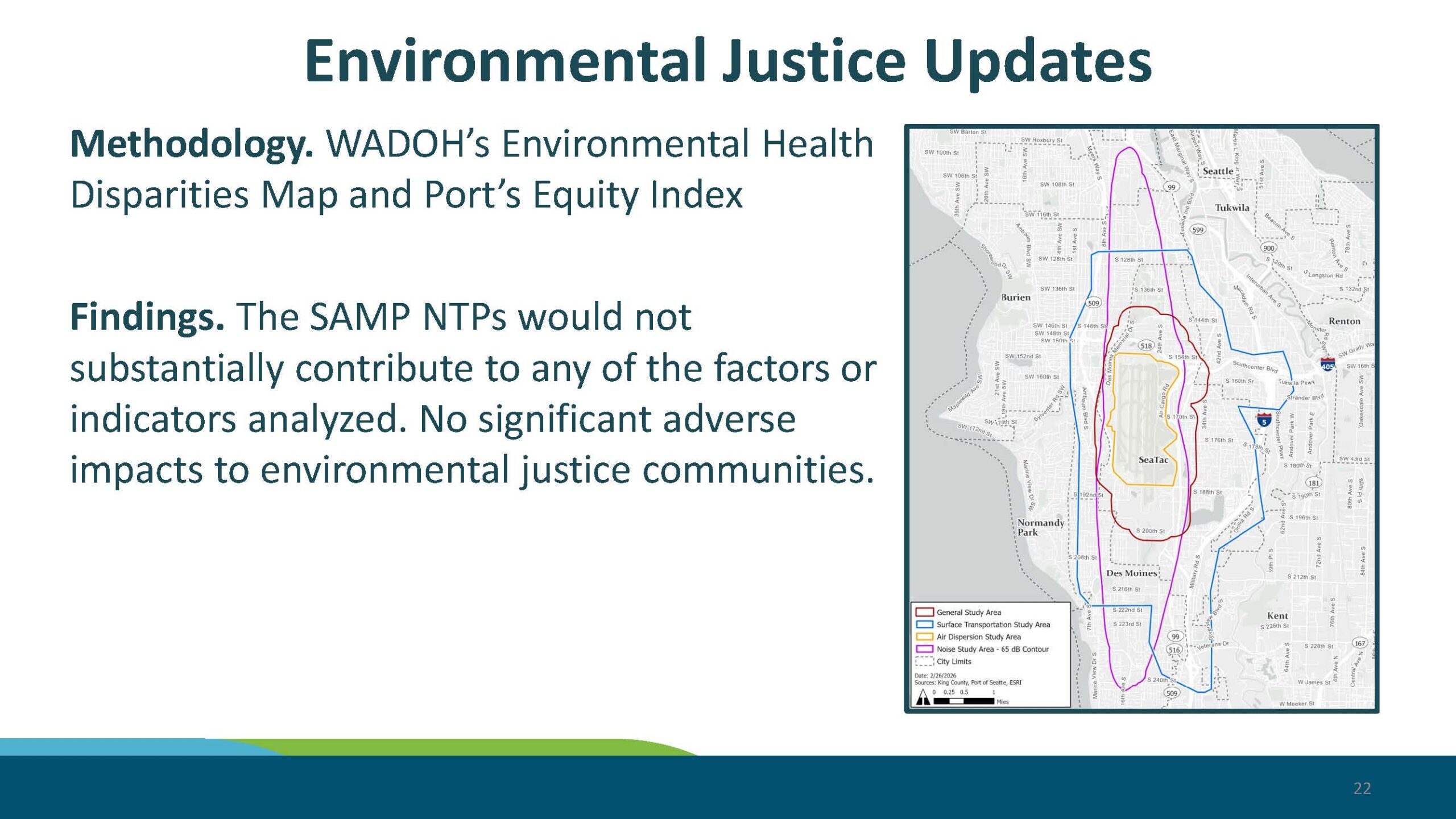
Slide 22 from a Port of Seattle presentation on the Sea-Tac Airport Master Plan (SAMP) Near-Term Projects (NTPs), summarizing Environmental Justice findings using WADOH's Environmental Health Disparities Map and the Port's Equity Index. The findings conclude that the SAMP NTPs would not substantially contribute to any analyzed factors and pose no significant adverse impacts to environmental justice communities, accompanied by a study area map covering SeaTac, Burien, Des Moines, Normandy Park, and surrounding cities.
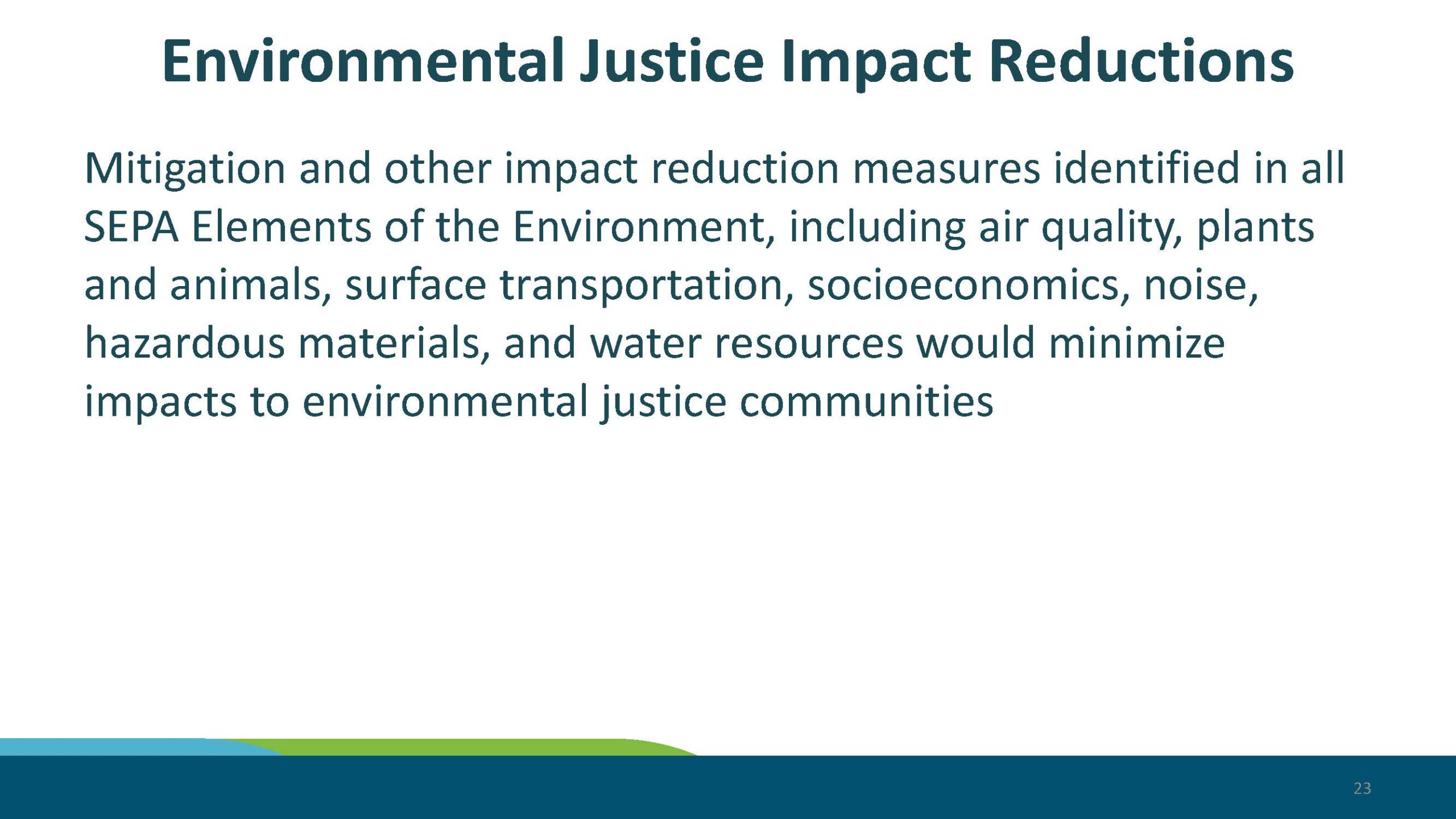
Presentation slide titled 'Environmental Justice Impact Reductions' stating that mitigation and impact reduction measures identified across all SEPA Elements of the Environment—including air quality, plants and animals, surface transportation, socioeconomics, noise, hazardous materials, and water resources—would minimize impacts to environmental justice communities. Slide is numbered 23 and uses a teal/green color scheme consistent with a Sea-Tac Airport or related agency environmental review presentation.
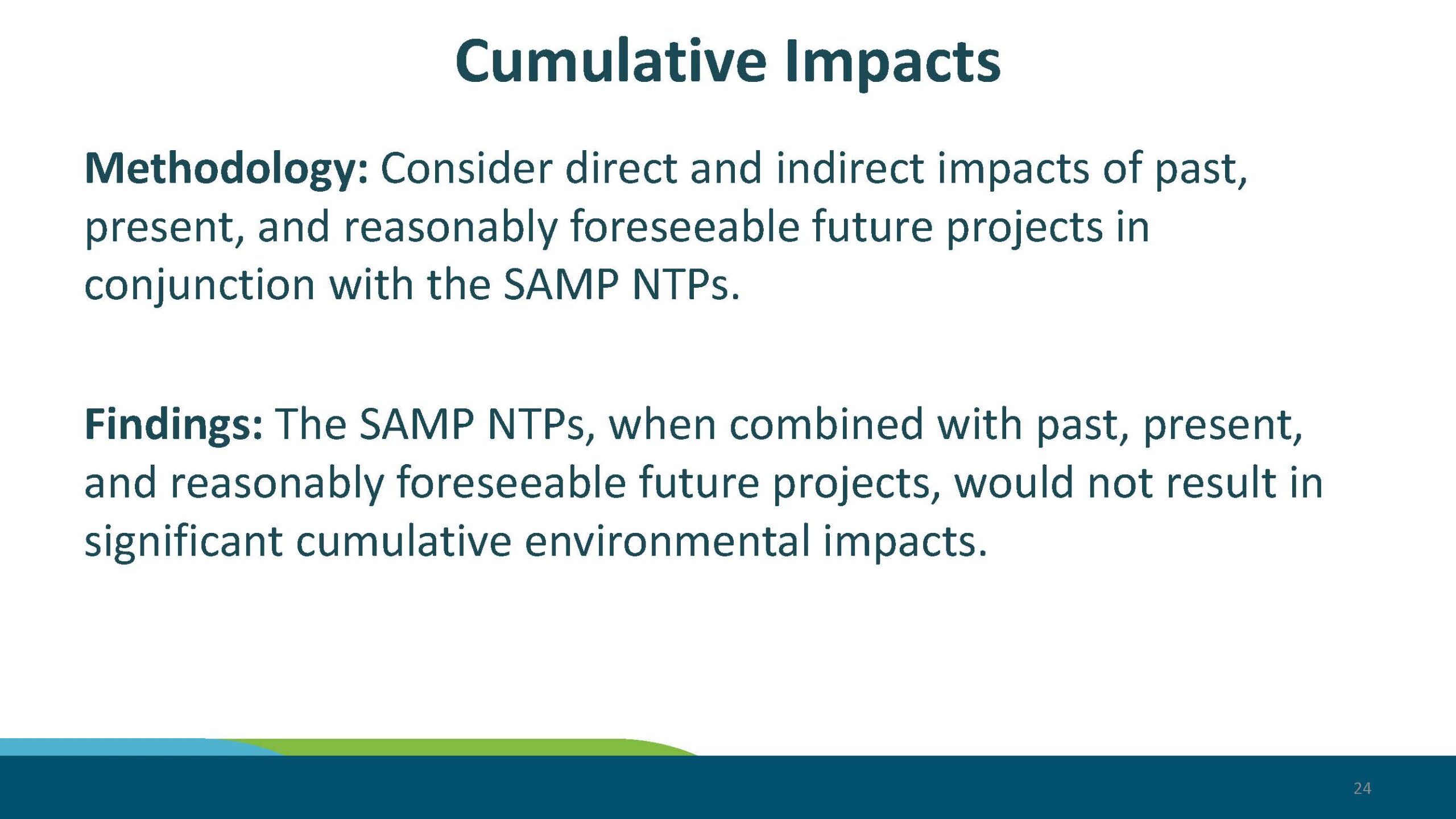
Slide 24 from a Sea-Tac Airport environmental review presentation covering the Sustainable Airport Master Plan (SAMP) Near-Term Projects (NTPs). It states the methodology for cumulative impact analysis and finds that the SAMP NTPs, combined with past, present, and reasonably foreseeable future projects, would not result in significant cumulative environmental impacts.
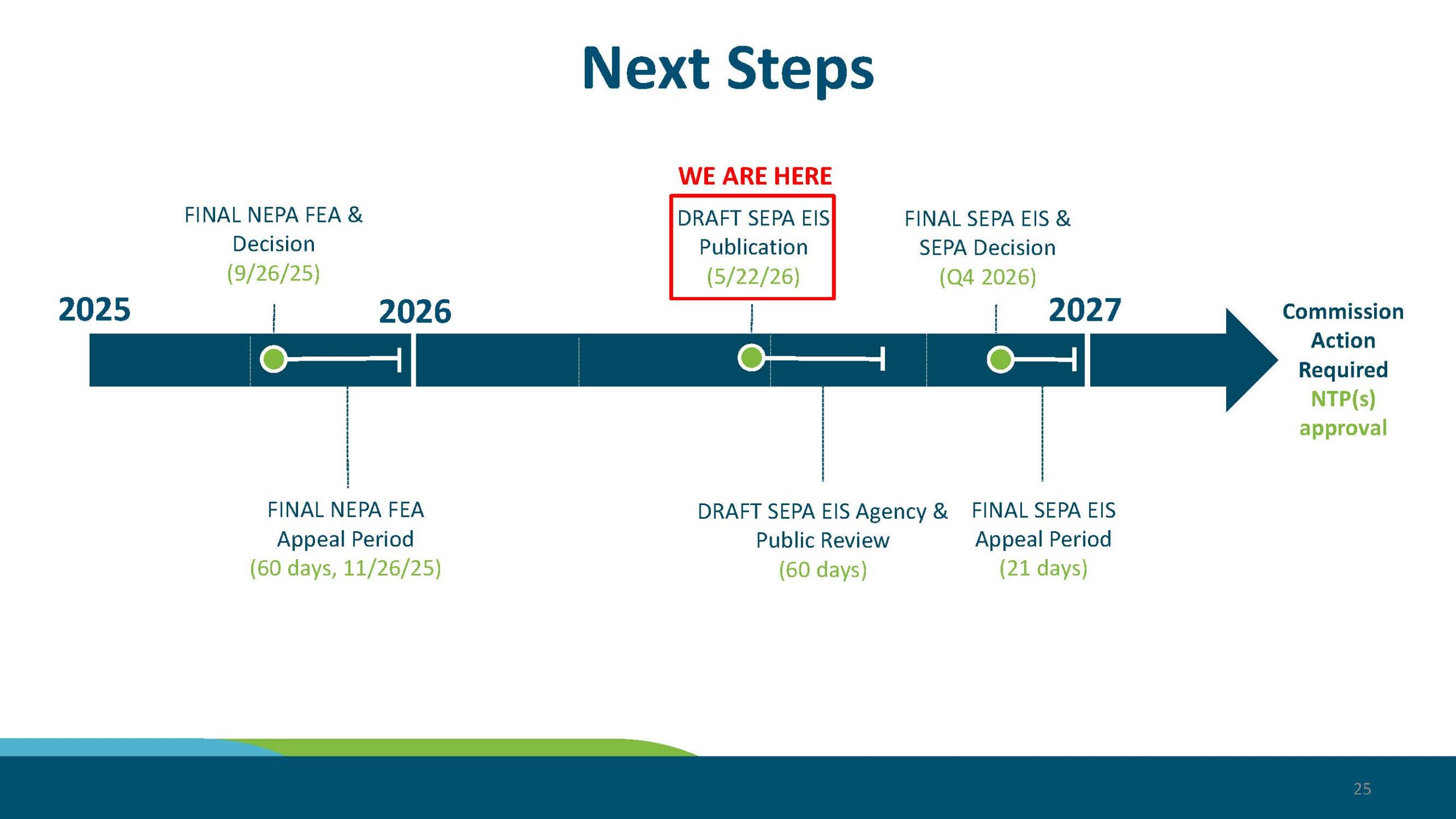
This project timeline slide shows the environmental review schedule for what appears to be a Sea-Tac Airport noise or development project, marking the current position at the Draft SEPA EIS Publication date of 5/22/26. Key milestones include the Final NEPA FEA & Decision (9/26/25), a 60-day public review period, Final SEPA EIS & Decision in Q4 2026, and a 21-day appeal period, culminating in Commission Action Required for NTP(s) approval in 2027.
Slide 26 from a Sea-Tac Airport noise-policy presentation detailing the public engagement timeline: a 30-day public notice issued April 22, a 60-day public comment period from May 22 through July 21, and four public meetings held June 22 (SeaTac), June 23 (Des Moines), June 25 (Federal Way), and June 27 (Burien).
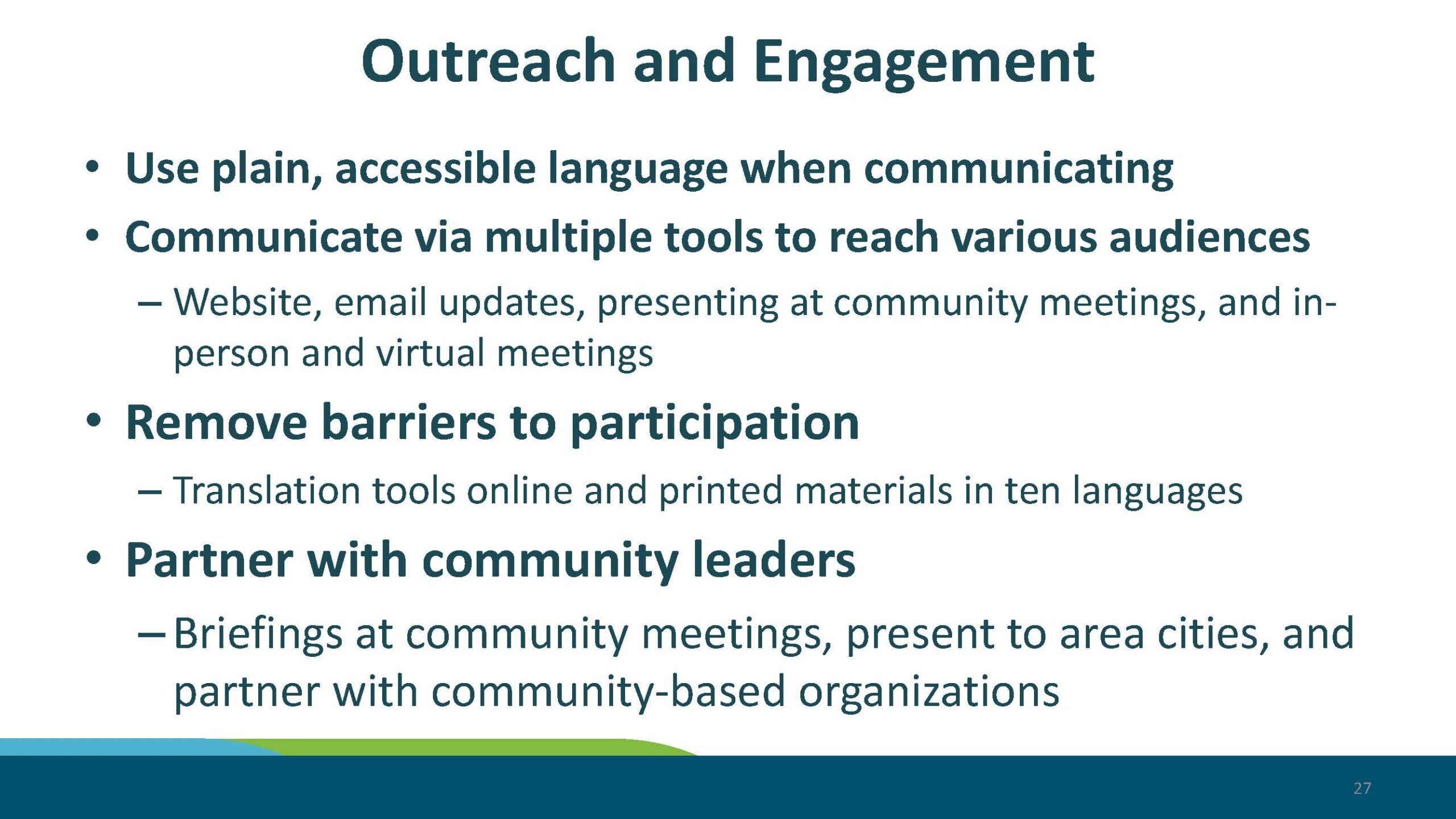
A presentation slide titled 'Outreach and Engagement' outlining communication strategies including use of plain language, multiple communication tools (website, email, community meetings), removing participation barriers via translation tools in ten languages, and partnering with community leaders and community-based organizations. No specific organization logo or date is visible, though the content and style are consistent with a public agency engagement plan.
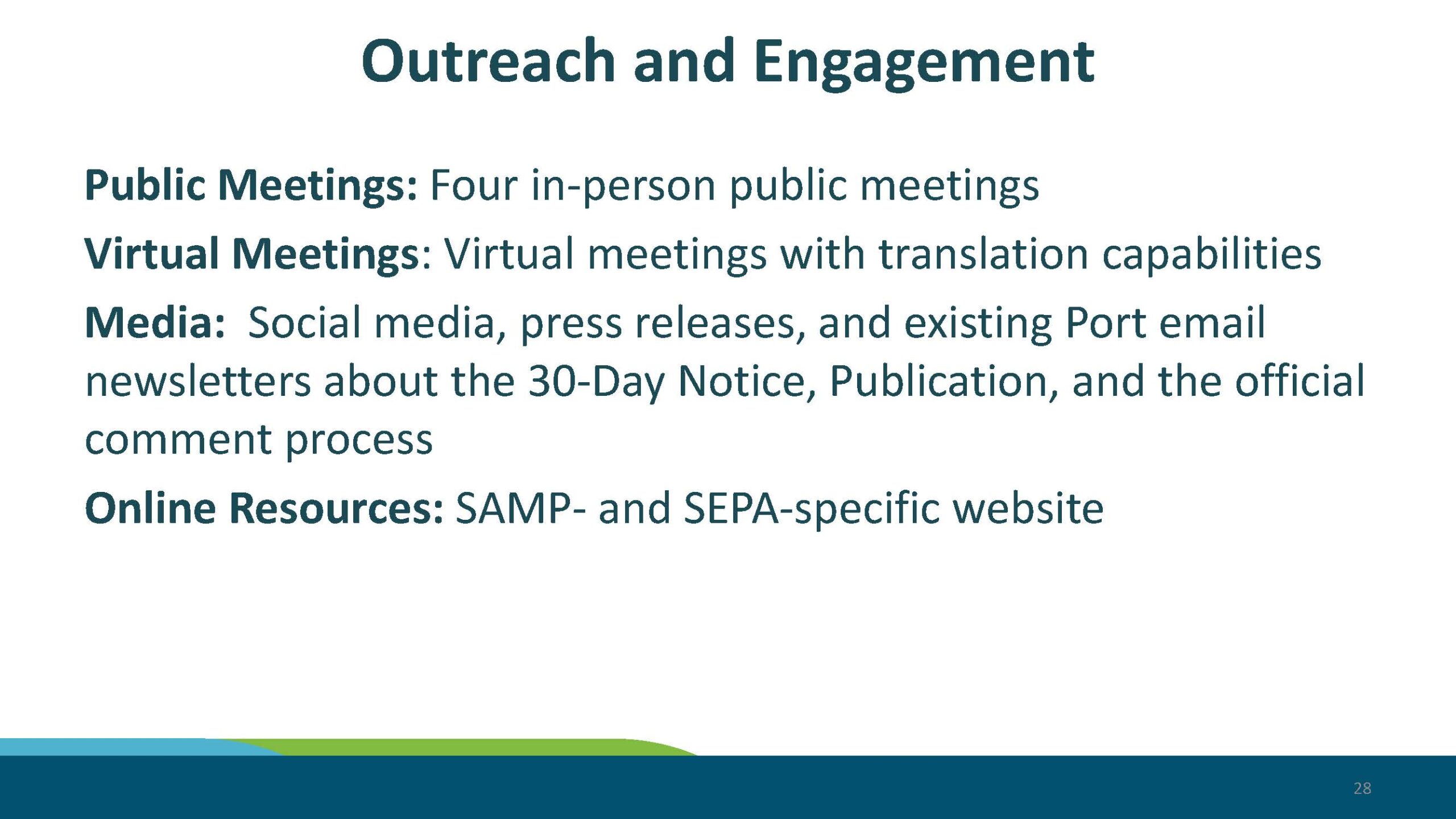
Slide 28 from a Port of Seattle presentation outlines the public outreach and engagement strategy for the Sea-Tac Airport SAMP (Sustainable Airport Master Plan) and SEPA process, including four in-person public meetings, virtual meetings with translation capabilities, media outreach via social media and press releases, and a dedicated SAMP/SEPA website.
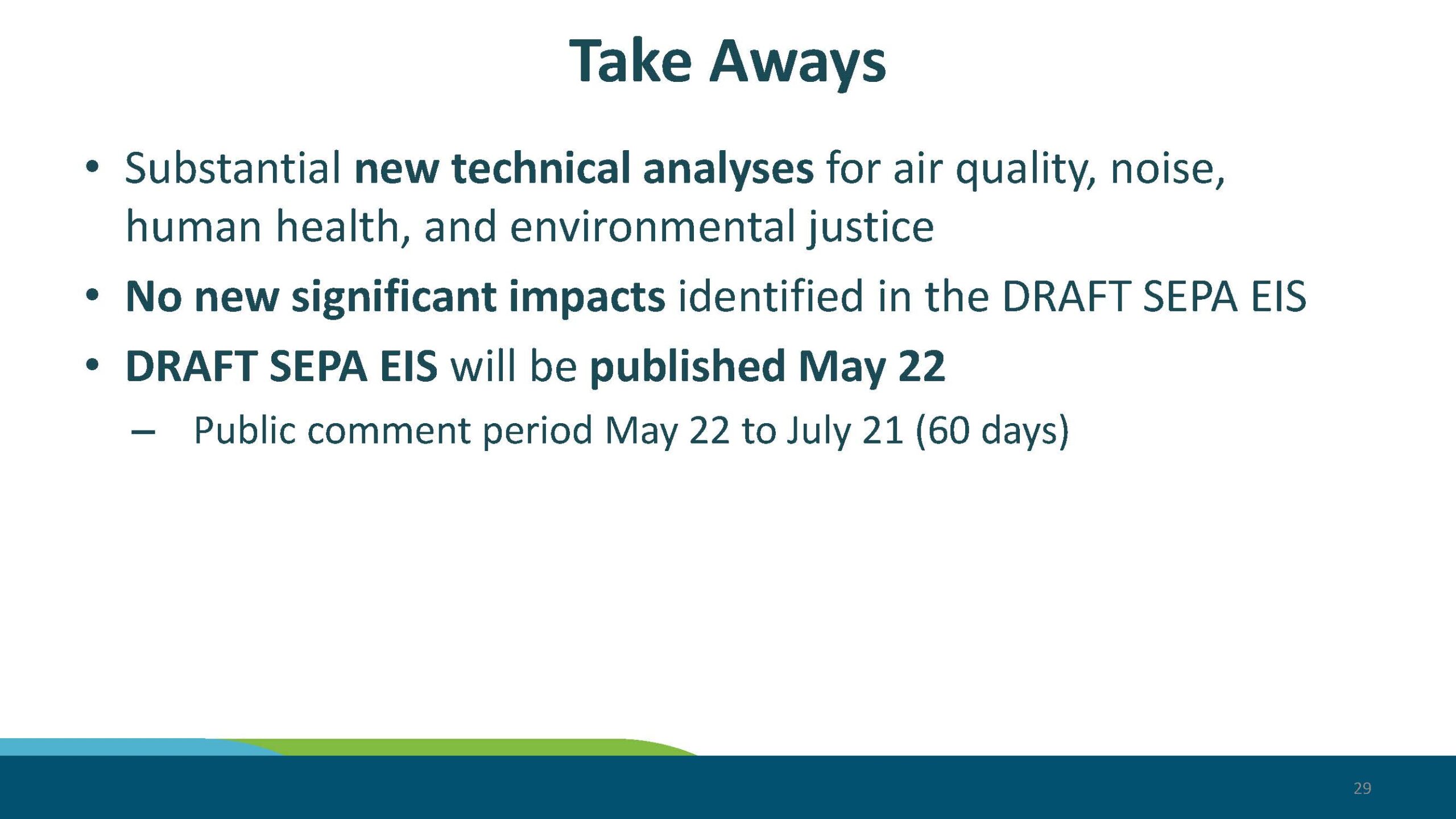
Slide 29 summarizes key takeaways from a Draft SEPA Environmental Impact Statement (EIS) presentation, noting substantial new technical analyses for air quality, noise, human health, and environmental justice, with no new significant impacts identified. The Draft SEPA EIS was scheduled for publication on May 22, with a 60-day public comment period running May 22 to July 21.
This is slide 30 of a Port of Seattle presentation, displaying a 'Questions?' prompt on a teal background with the Port of Seattle logo in the lower right corner. The slide appears to be the closing Q&A slide from a Port of Seattle briefing, likely related to Sea-Tac Airport noise policy given the archival context.
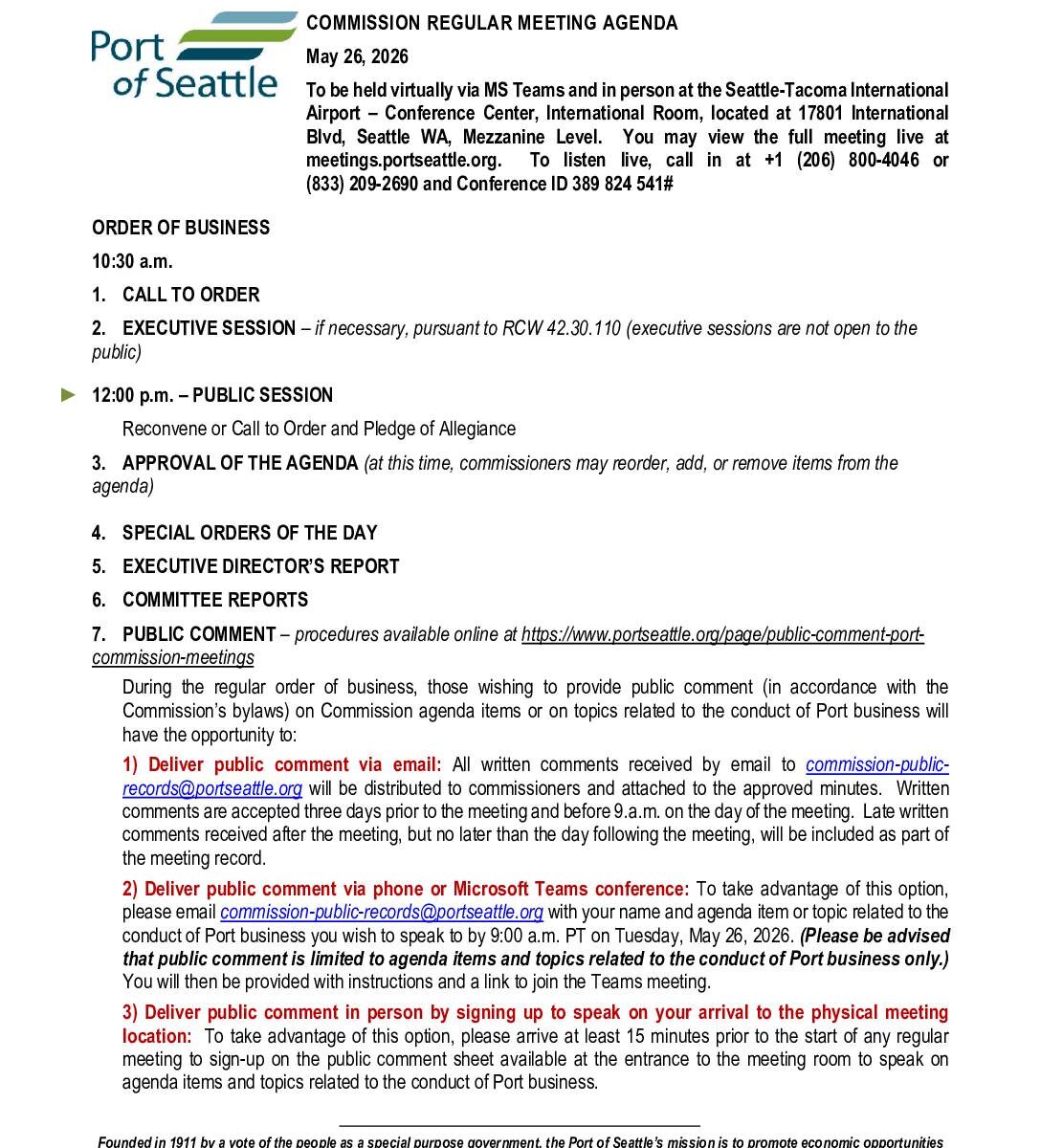
12:00 p.m. – Public Session
Reconvene or Call to Order and Pledge of Allegiance
3. Approval of the Agenda
4. Special Orders of the Day
5. Executive Director’s Report
6. Committee Reports
7. Public Comment
8. Consent Agenda
8a. Approval of Special Meeting Minutes of April 2, 2026 and May 7, 2026; and Regular Meeting Minutes of April 28, 2026
8b. Approval of Claims and Obligations for April 1-30, 2026 (Total Payments: $122,098,077.41)
8c. Monthly Notification of Prior Executive Director Delegation Actions April 2026 (For Information Only)
8d. Authorization for Executive Director to Execute Amendment to Interlocal Agreement with Highline Public Schools for Maritime High School ($100,000)
8e. Authorization for Executive Director to Execute Contract with WorldWide Technology for Cisco Software Licensing (Not-to-Exceed $3,500,000)
8f. Authorization for Executive Director to Complete Pre-Construction Activities for S Concourse Evolution Program Through 2027 (Total Project Authorization: $300,000,000)
10. New Business
10a. Authorization for Executive Director to Execute Amendments and Assignments with Norwegian Cruise Line Holdings for Pier 66 Shore Power Project
10b. Authorization for Executive Director to Approve 30% Design Development for Emergency Power Scope of Main Terminal Improvement Program ($7,000,000)
11. Presentations and Staff Reports
11a. SEA Childcare Center Feasibility Study Initial Briefing
11b. Sustainable Airport Master Plan Near-Term Projects Environmental Review – SEPA Draft Environmental Impact Statement and Public Comment Period Briefing
11c. 2025 Diversity in Contracting Annual Report
12. Questions on Referral to Committee and Closing Comments
We use cookies to provide basic functionality. We also provide access to search engines in order to provide site analytics. We do not sell or share your data.