I understand that you will never share my information with anyone, you will only use it to keep me updated on relevant events and that I may unsubscribe at any time.
At almost four hours, the May 26 Port Commission meeting had several lengthy presentations. The longest was not the one of interest to airport communities: the first public briefing on the Sustainable Airport Master Plan Near-Term Projects SEPA Draft EIS.
The practical outcomes: no required mitigations in any of the reviewed categories beyond some traffic signals. Identical to last December’s NEPA EA.
Agenda slide from a Sea-Tac Airport presentation covering Near-Term Projects (NTP), National Environmental Policy Act (NEPA) topics including a Final Environmental Assessment and FAA Finding of No Significant Impact and Record of Decision, State Environmental Policy Act (SEPA) topics including requirements and a Draft SEPA Environmental Impact Statement (EIS), Next Steps, and Outreach and Engagement. This appears to be slide 2 of the presentation.
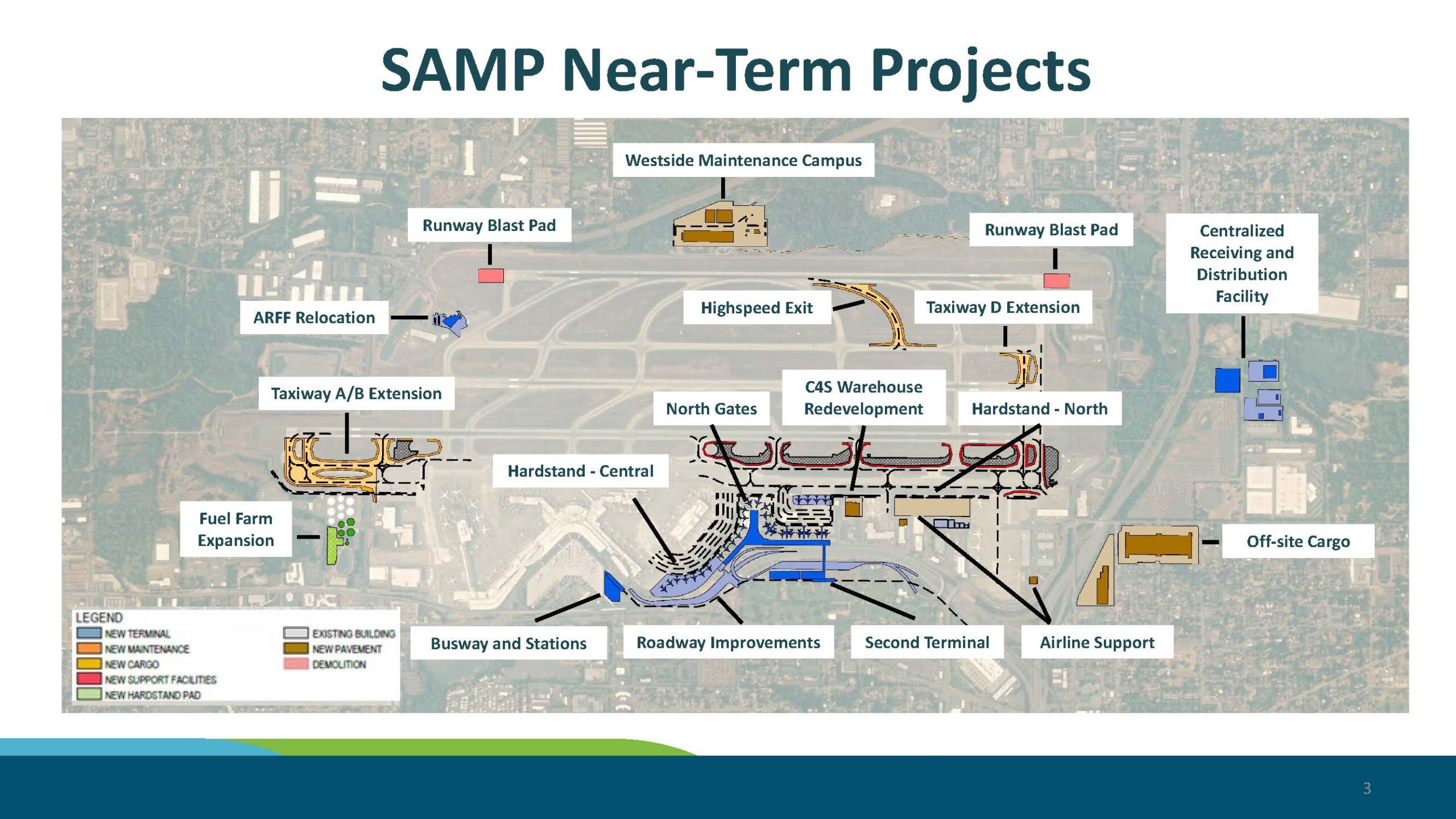
A slide titled 'SAMP Near-Term Projects' presents an aerial map of Seattle-Tacoma International Airport annotated with planned near-term capital improvements. Labeled projects include a Second Terminal, North Gates, Busway and Stations, Roadway Improvements, Taxiway A/B and D Extensions, Hardstand areas (Central and North), Fuel Farm Expansion, ARFF Relocation, Runway Blast Pads, Westside Maintenance Campus, C4S Warehouse Redevelopment, Off-site Cargo, Airline Support, Highspeed Exit, and a Centralized Receiving and Distribution Facility.
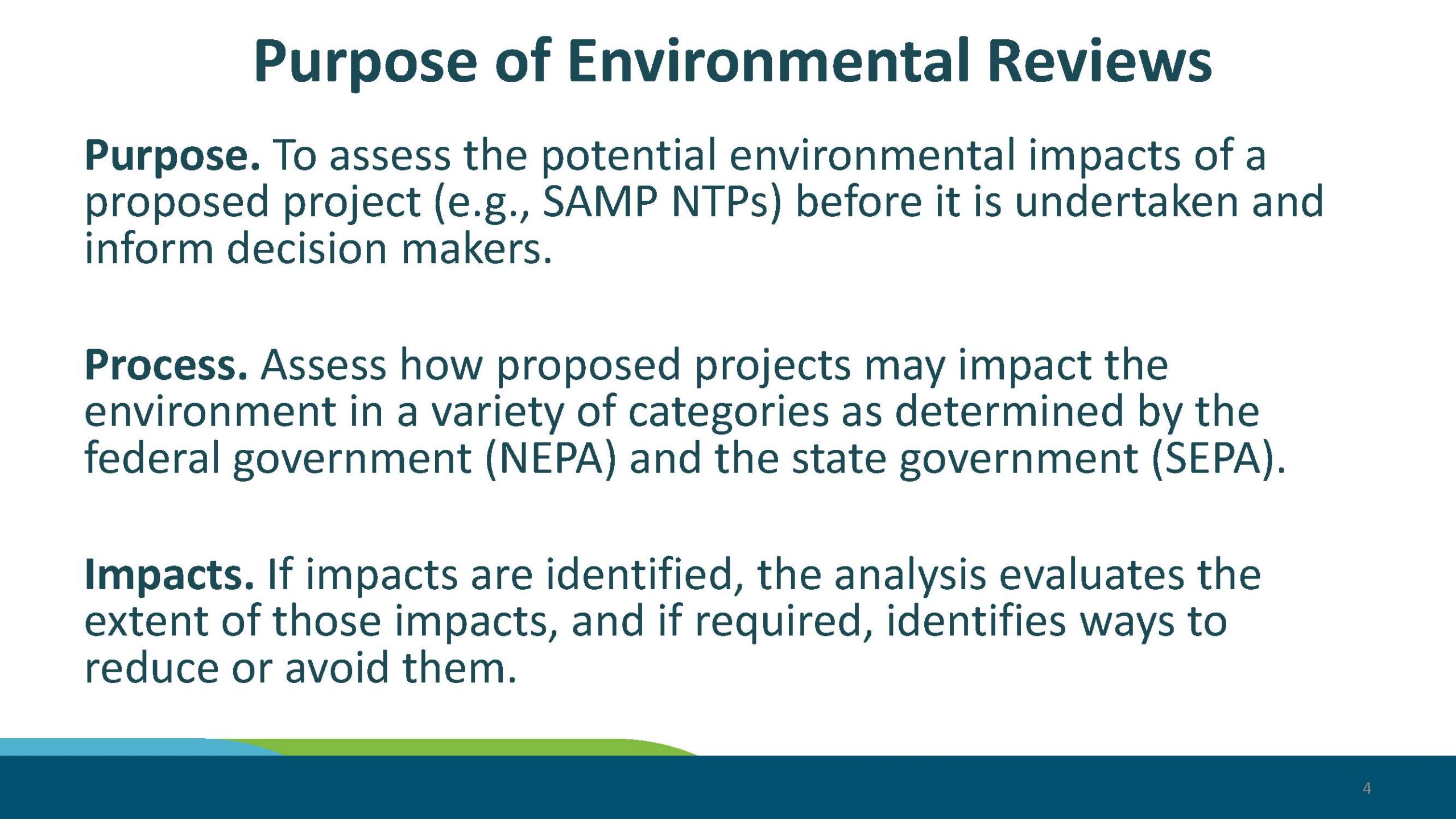
A presentation slide titled 'Purpose of Environmental Reviews' explains that environmental reviews assess potential impacts of proposed projects such as SAMP NTPs (Near-Term Projects) before they are undertaken, following federal NEPA and state SEPA requirements. The slide outlines three components: Purpose, Process, and Impacts, including identification of mitigation measures if impacts are found.
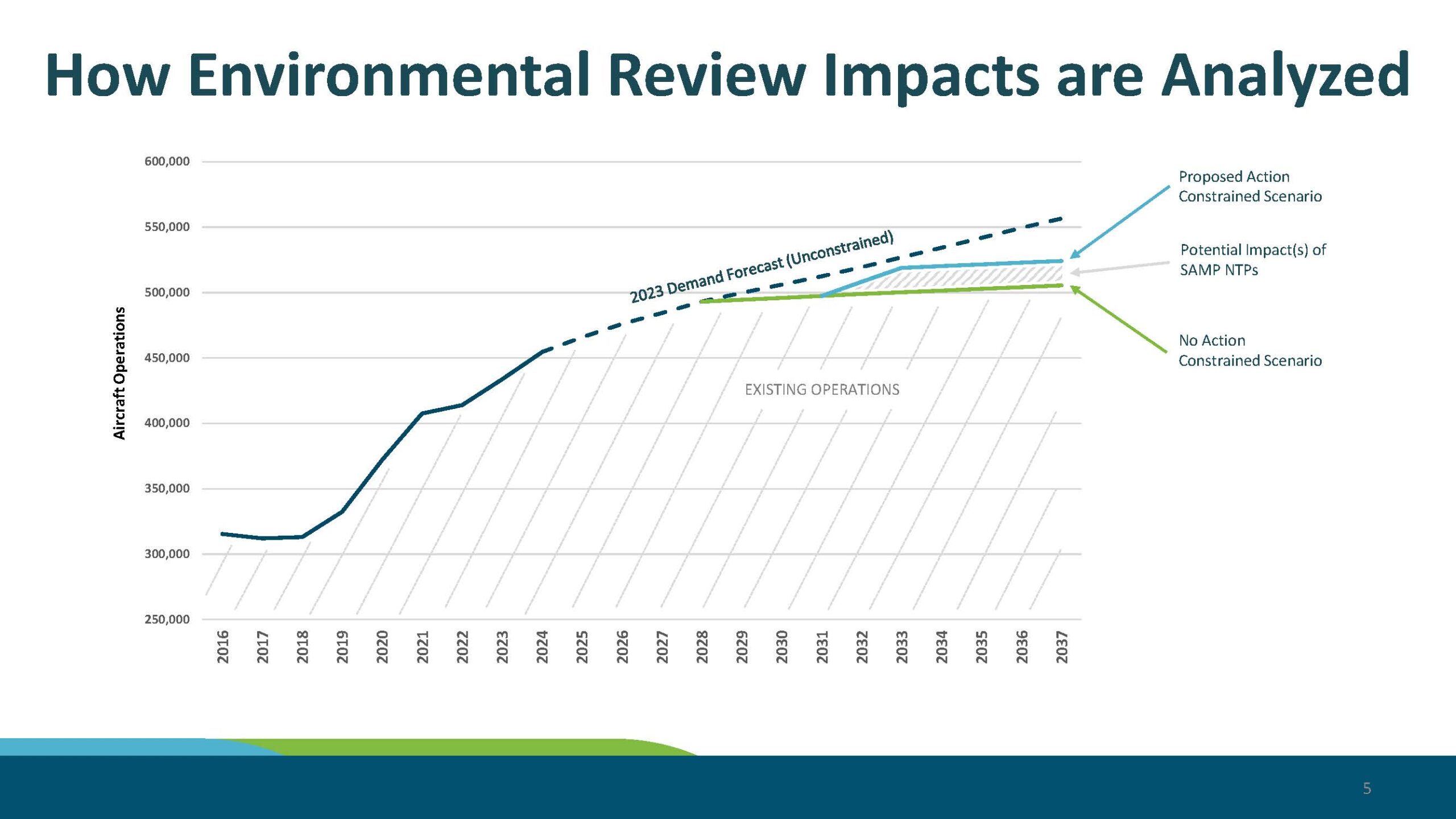
Slide 5 from a Seattle-Tacoma International Airport presentation titled 'How Environmental Review Impacts are Analyzed,' showing projected aircraft operations from 2016 to 2037. The chart compares the 2023 Demand Forecast (Unconstrained) against three constrained scenarios: Proposed Action, No Action, and Potential Impacts of SAMP NTPs (Notice to Proceed), with operations ranging from approximately 315,000 in 2016 to a projected 525,000–555,000 by 2037.
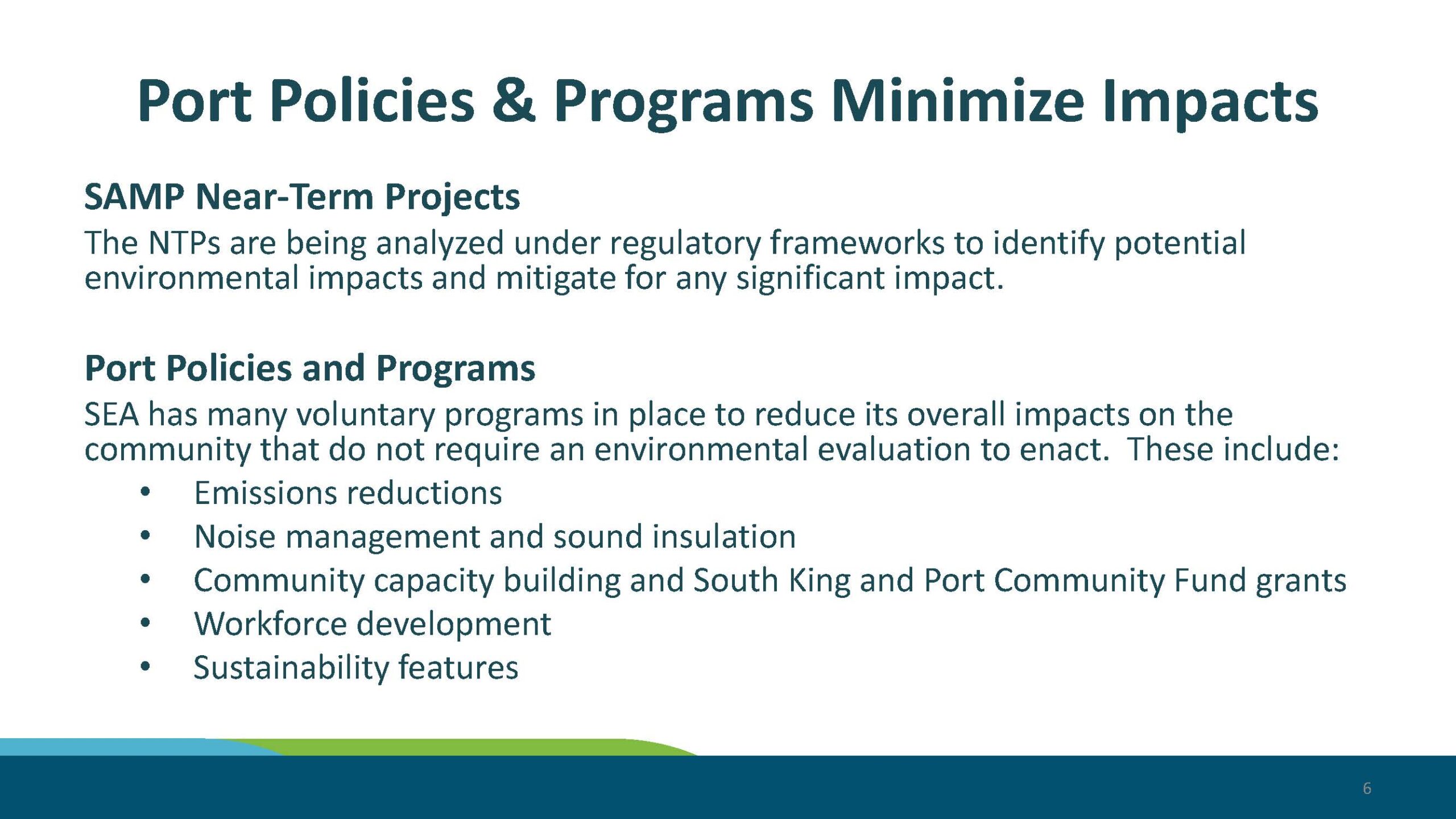
Slide 6 from a Port of Seattle Seattle-Tacoma International Airport (SEA) Sub-Area Master Plan (SAMP) presentation, explaining that Near-Term Projects are analyzed under regulatory frameworks to mitigate environmental impacts, and listing voluntary Port policies and programs—including emissions reductions, noise management and sound insulation, community capacity building and South King and Port Community Fund grants, workforce development, and sustainability features—that reduce community impacts without requiring a formal environmental evaluation.
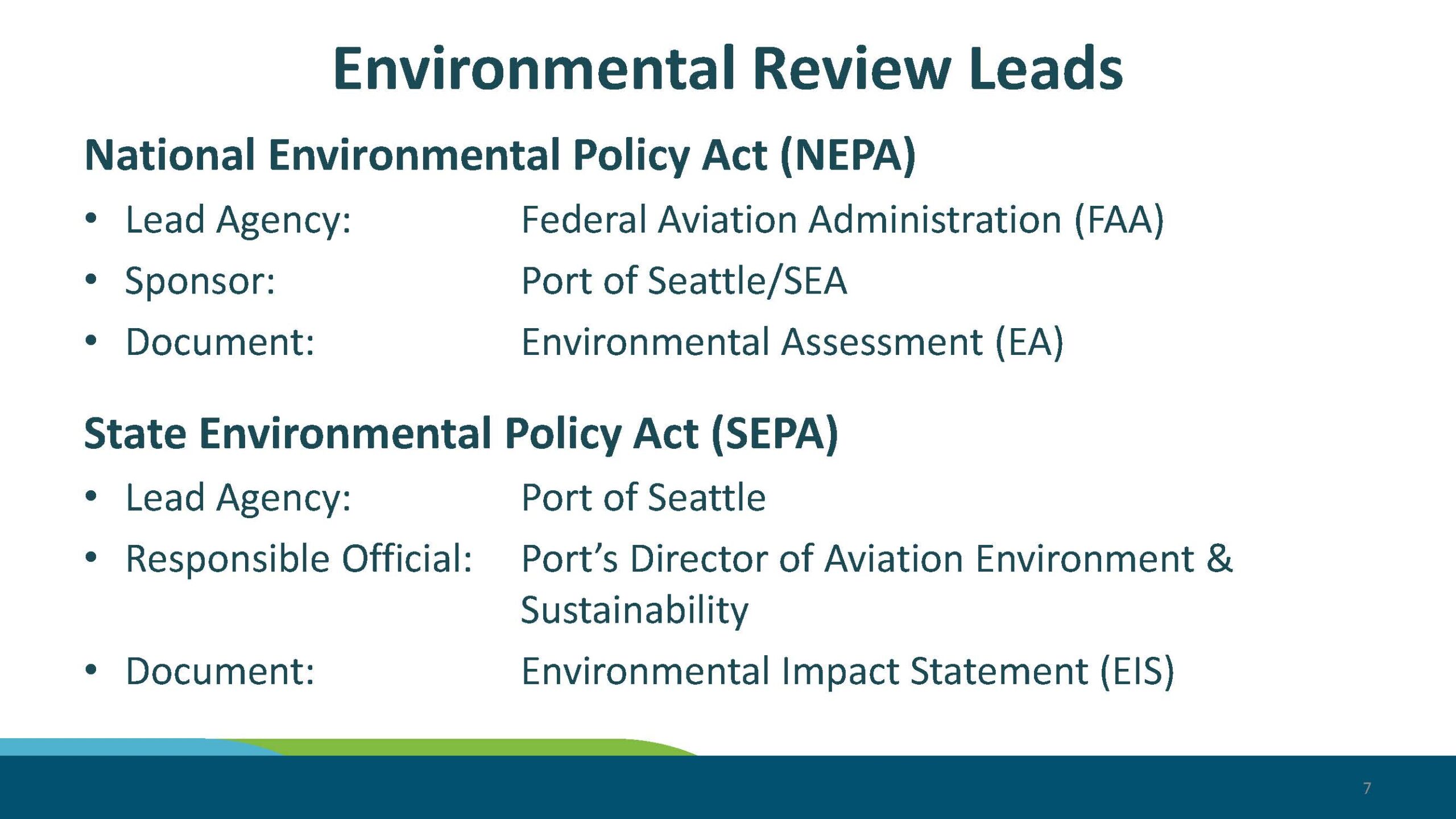
Slide 7 from a Sea-Tac Airport presentation outlining the lead agencies for environmental review: under NEPA, the FAA serves as lead agency with the Port of Seattle/SEA as sponsor, producing an Environmental Assessment (EA); under SEPA, the Port of Seattle is the lead agency with its Director of Aviation Environment & Sustainability as responsible official, producing an Environmental Impact Statement (EIS).
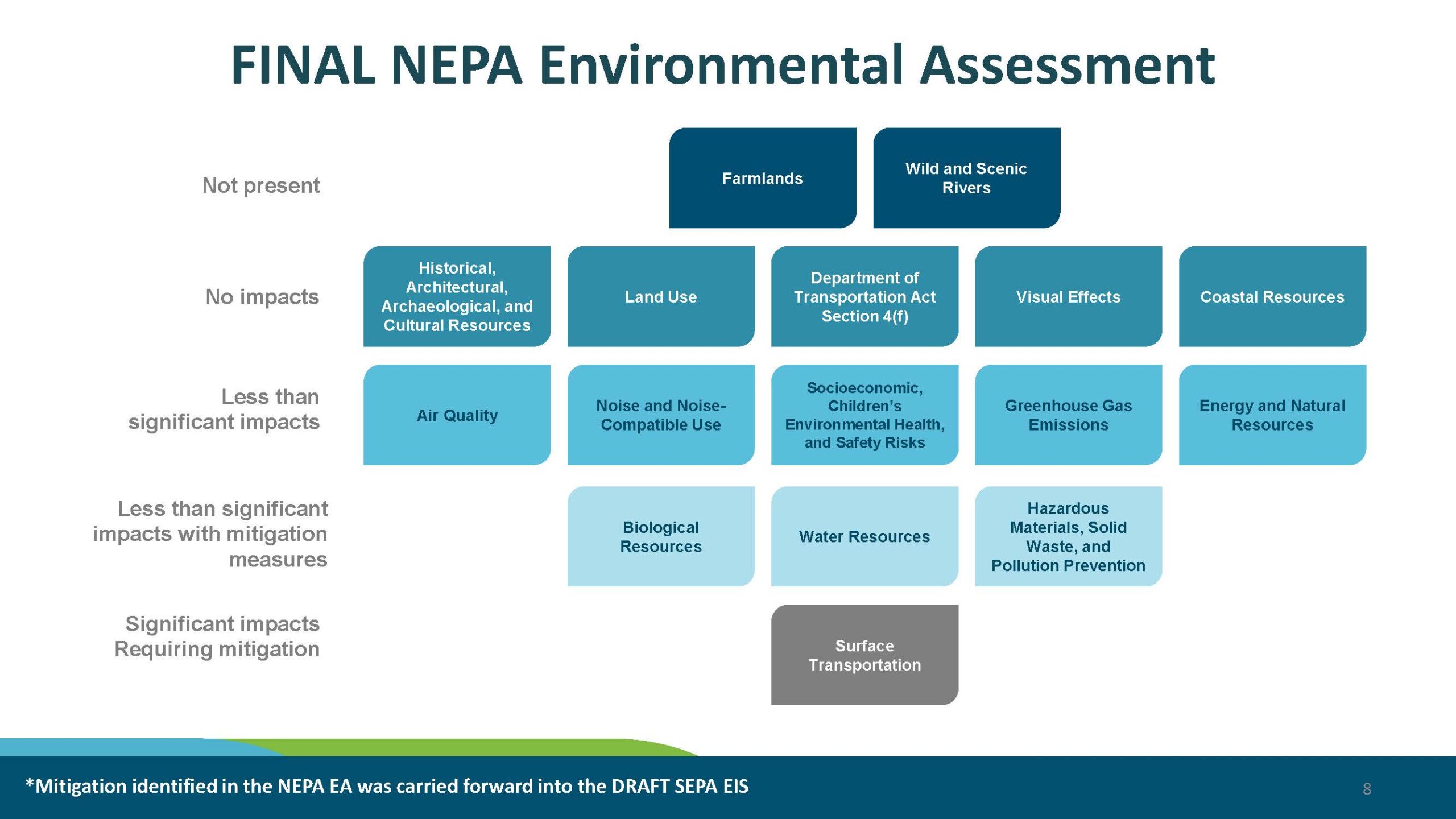
This slide summarizes the findings of a Final NEPA Environmental Assessment, categorizing resource areas by impact level ranging from 'Not present' (Farmlands, Wild and Scenic Rivers) to 'Significant impacts requiring mitigation' (Surface Transportation). A footer note states that mitigation identified in the NEPA EA was carried forward into the Draft SEPA EIS, indicating this is part of a joint NEPA/SEPA review process likely related to Sea-Tac Airport or a similar major transportation project.
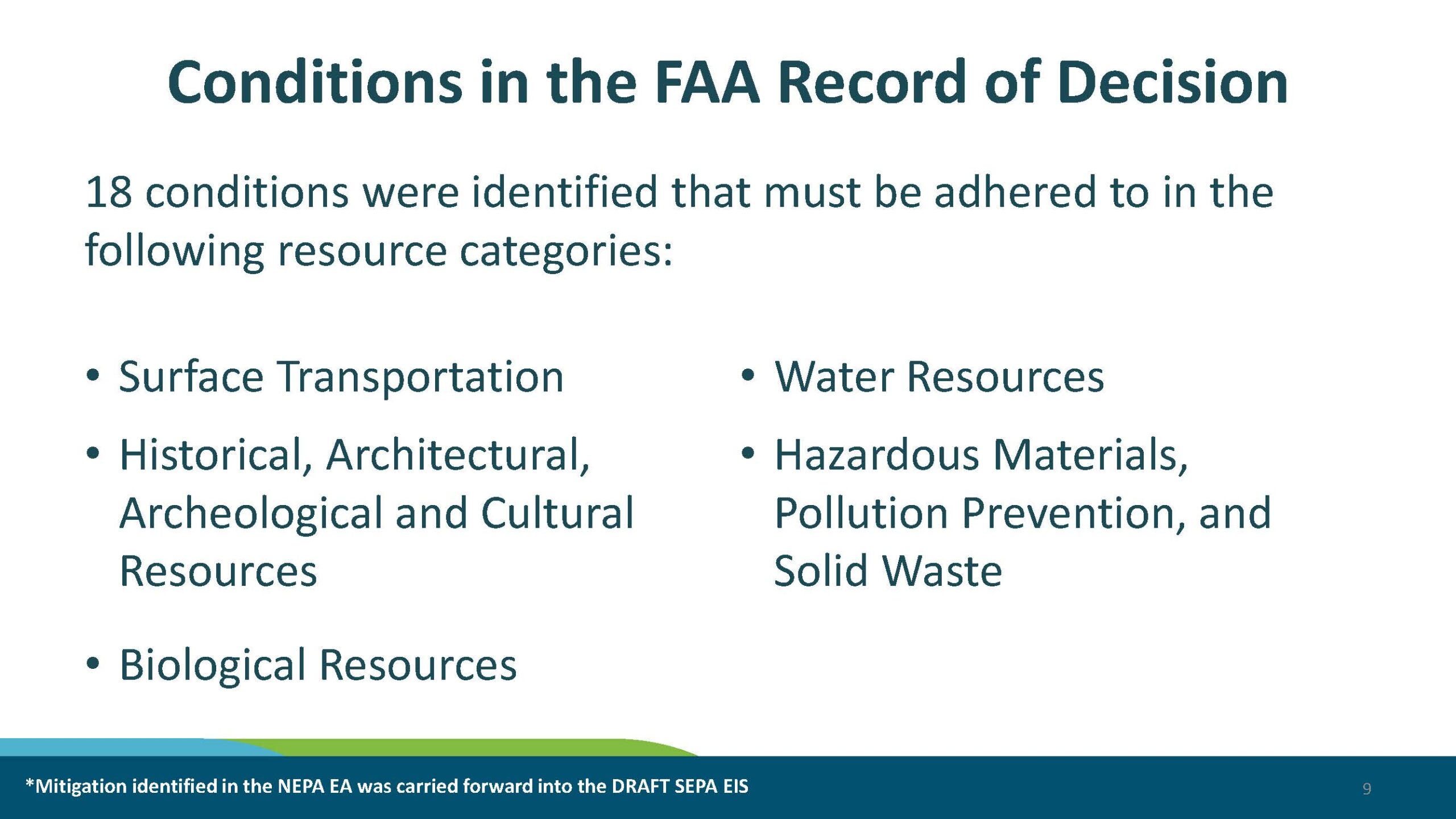
This slide describes 18 conditions identified in the FAA Record of Decision that must be adhered to, covering five resource categories: Surface Transportation, Historical/Architectural/Archeological and Cultural Resources, Biological Resources, Water Resources, and Hazardous Materials/Pollution Prevention/Solid Waste. A footer note states that mitigation identified in the NEPA EA was carried forward into the Draft SEPA EIS.
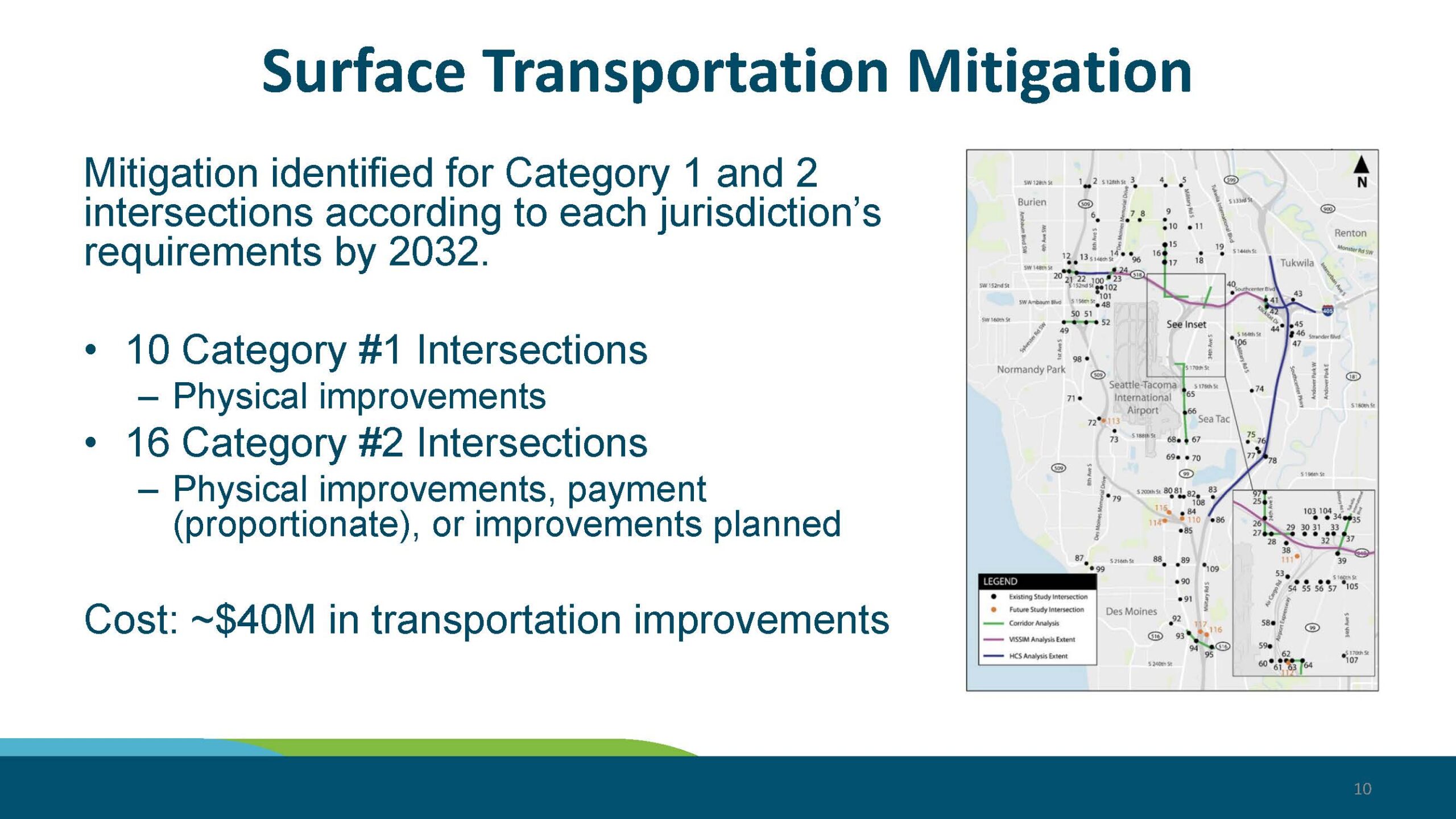
A presentation slide titled 'Surface Transportation Mitigation' describes mitigation measures identified for Category 1 and 2 intersections near Seattle-Tacoma International Airport by 2032, covering 10 Category #1 intersections requiring physical improvements and 16 Category #2 intersections, at an estimated cost of approximately $40 million. The slide includes a map showing study intersections across the Sea-Tac area including Burien, Normandy Park, Sea-Tac, Des Moines, Tukwila, and Renton jurisdictions.
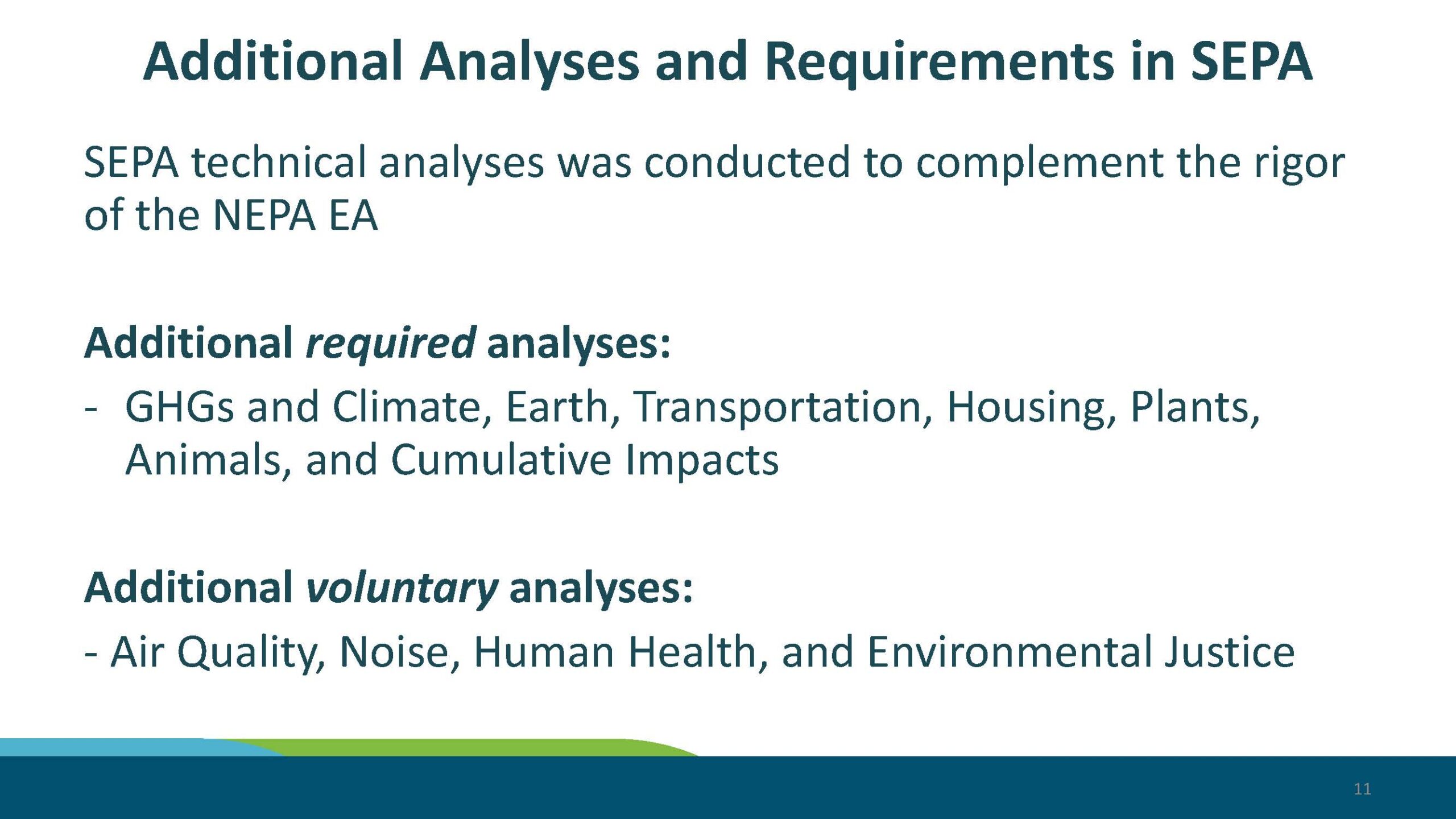
This presentation slide (page 11) outlines additional analyses conducted under the State Environmental Policy Act (SEPA) to complement a NEPA Environmental Assessment (EA). It lists required analyses including GHGs and Climate, Earth, Transportation, Housing, Plants, Animals, and Cumulative Impacts, as well as voluntary analyses covering Air Quality, Noise, Human Health, and Environmental Justice.
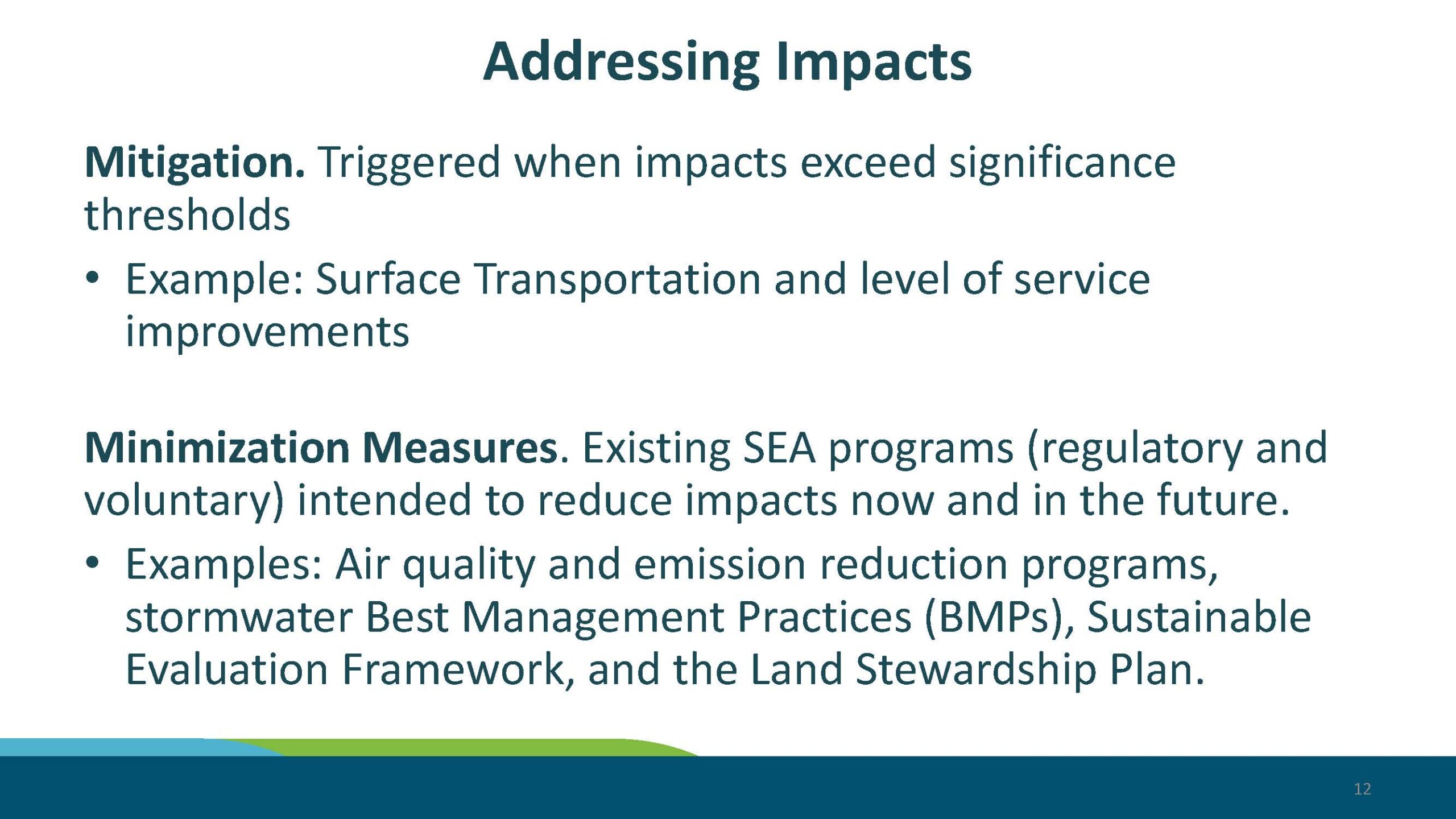
A presentation slide titled 'Addressing Impacts' distinguishes between Mitigation (triggered when impacts exceed significance thresholds, e.g., surface transportation and level of service improvements) and Minimization Measures (existing SEA programs, regulatory and voluntary, including air quality and emission reduction programs, stormwater BMPs, Sustainable Evaluation Framework, and the Land Stewardship Plan). The 'SEA' abbreviation and subject matter suggest this is from a Seattle-Tacoma International Airport environmental or planning presentation, slide 12.
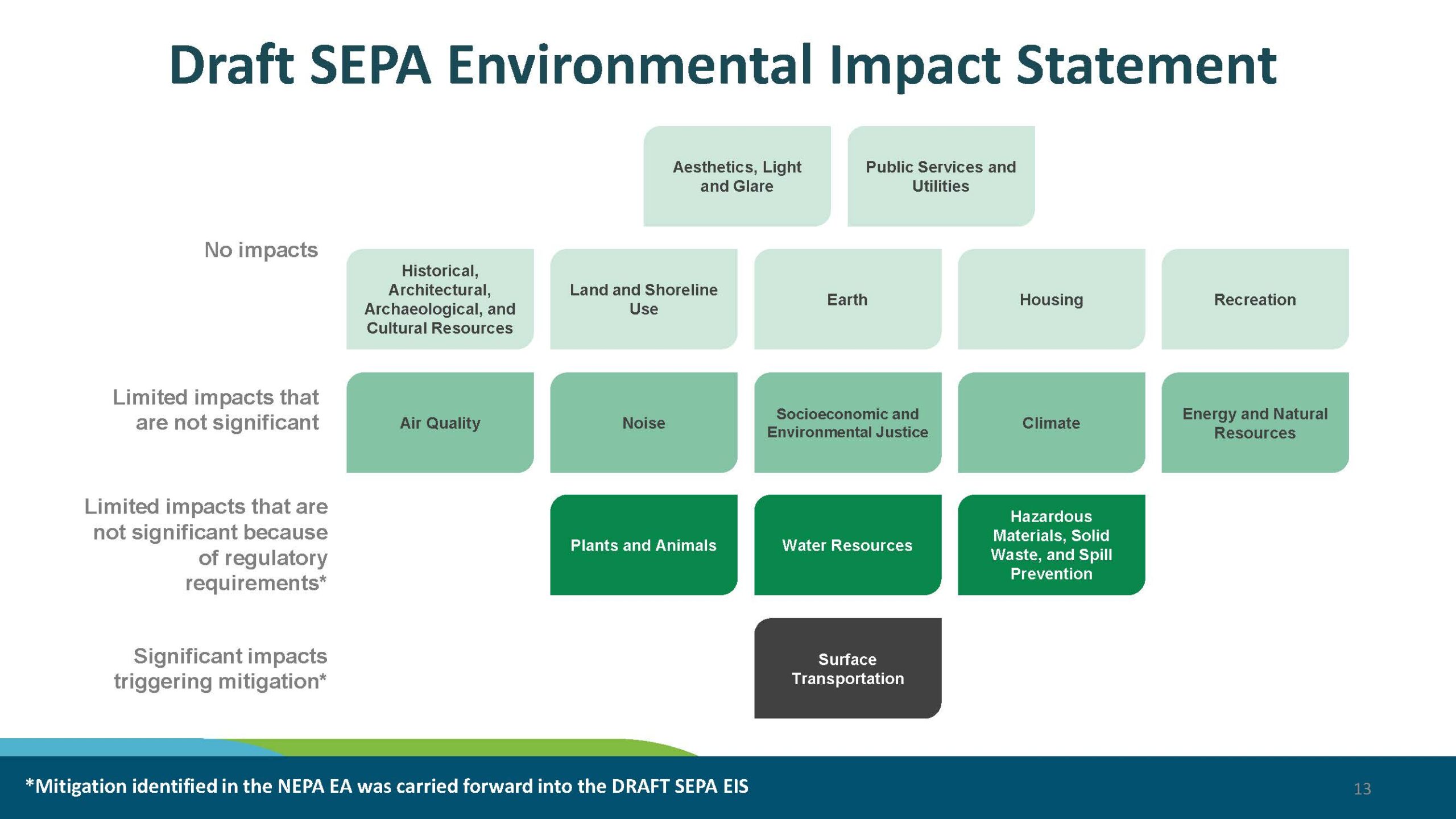
A presentation slide titled 'Draft SEPA Environmental Impact Statement' categorizes environmental impact areas into four tiers: no impacts (e.g., Historical/Cultural Resources, Earth, Housing, Recreation); limited impacts that are not significant (e.g., Air Quality, Noise, Climate); limited impacts not significant due to regulatory requirements (Plants and Animals, Water Resources, Hazardous Materials/Solid Waste/Spill Prevention); and significant impacts triggering mitigation (Surface Transportation). A footer note states that mitigation identified in the NEPA EA was carried forward into the Draft SEPA EIS.
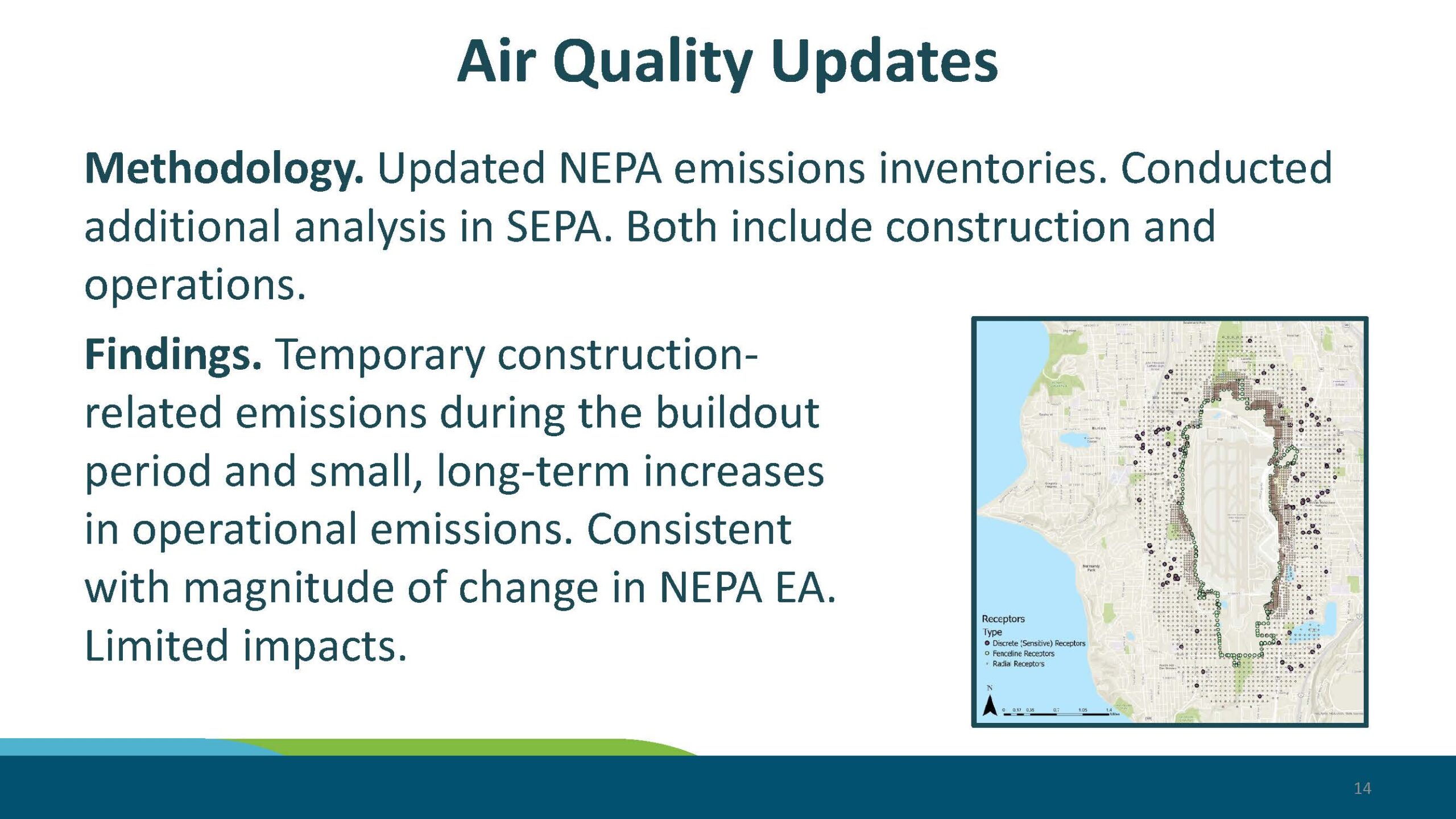
Presentation slide titled 'Air Quality Updates' describing methodology and findings for NEPA emissions inventories and SEPA analysis covering construction and operations phases. Findings note temporary construction-related emissions during the buildout period and small long-term increases in operational emissions, characterized as limited impacts consistent with the NEPA EA; accompanied by a map showing Discrete (Sensitive), Fenceline, and Radial Receptors along what appears to be a corridor in the Seattle/Sea-Tac area.
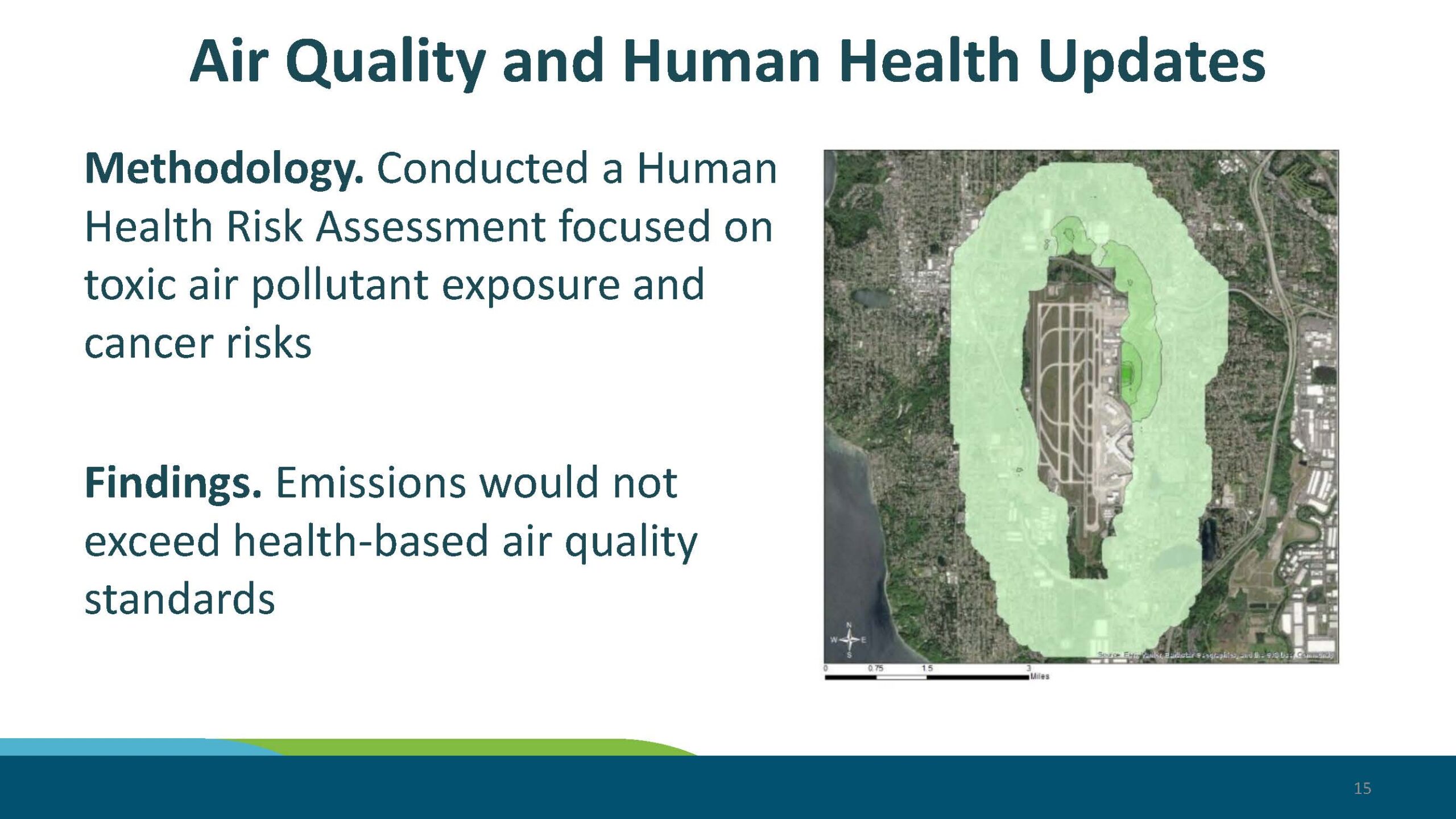
Slide 15 from a Sea-Tac Airport environmental review presentation summarizes a Human Health Risk Assessment focused on toxic air pollutant exposure and cancer risks. The findings state that emissions would not exceed health-based air quality standards, accompanied by an aerial map showing modeled pollutant dispersion contours overlaid on Seattle-Tacoma International Airport and surrounding communities.
A presentation slide titled 'Air Quality Impact Reductions' outlining mitigation strategies for construction (implementing Best Management Practices including equipment maintenance, minimizing idling, and equipment specifications) and operations (pre-conditioned air, electric ground support equipment, renewable natural gas, alternative fuel vehicles, and public alternative transportation strategies). The slide is numbered 16, suggesting it is part of a larger environmental impact or planning presentation, potentially related to airport development.
A presentation slide summarizing a literature review on health effects from ultrafine and ultra-ultrafine particulate matter. Findings state that current science does not support independent causal ultrafine particulate effects on human health, and notes a lack of broad-scale, multi-year epidemiological studies on aviation emissions.
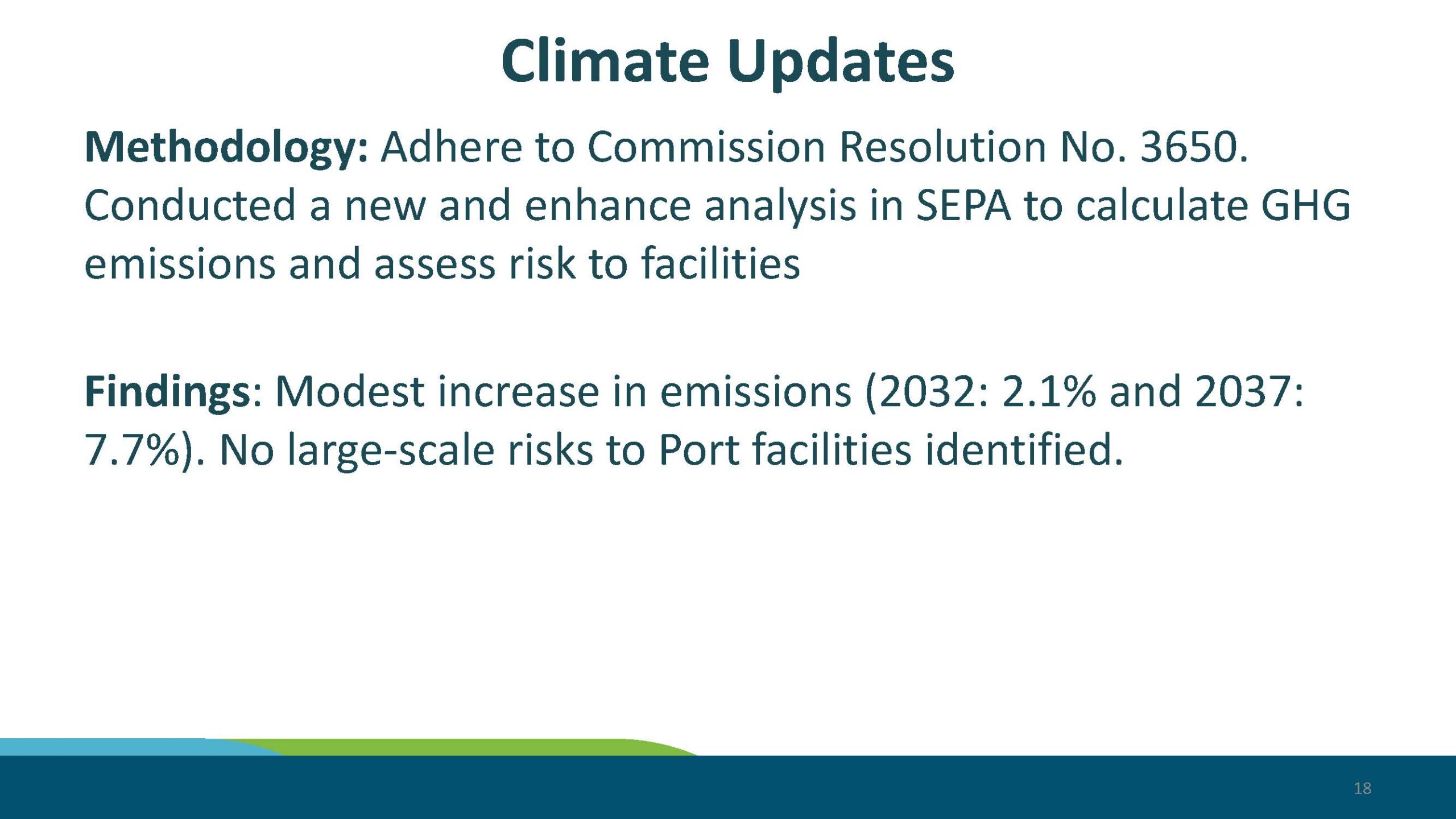
A presentation slide titled 'Climate Updates' describes methodology adhering to Commission Resolution No. 3650, with a new SEPA analysis calculating GHG emissions and assessing facility risk. Findings show a modest emissions increase (2.1% by 2032, 7.7% by 2037) and no large-scale risks to Port facilities identified.
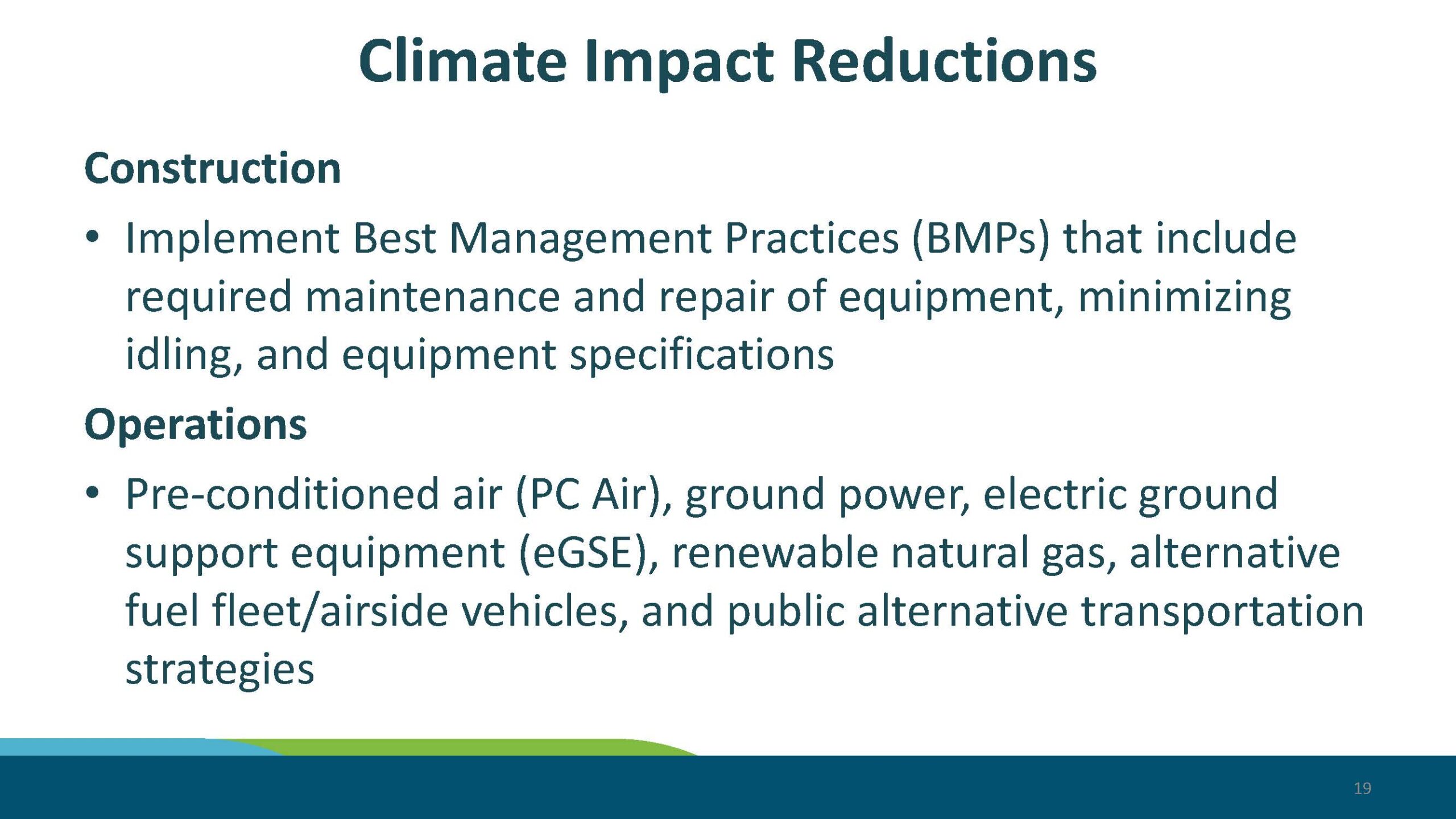
A presentation slide titled 'Climate Impact Reductions' outlining two categories of greenhouse gas mitigation measures: Construction (implementing Best Management Practices including equipment maintenance, minimizing idling, and equipment specifications) and Operations (pre-conditioned air, ground power, electric ground support equipment, renewable natural gas, alternative fuel vehicles, and public alternative transportation strategies). No specific organization logo or date is visible, though the slide numbering (19) and subject matter are consistent with an airport environmental or EIS presentation context.
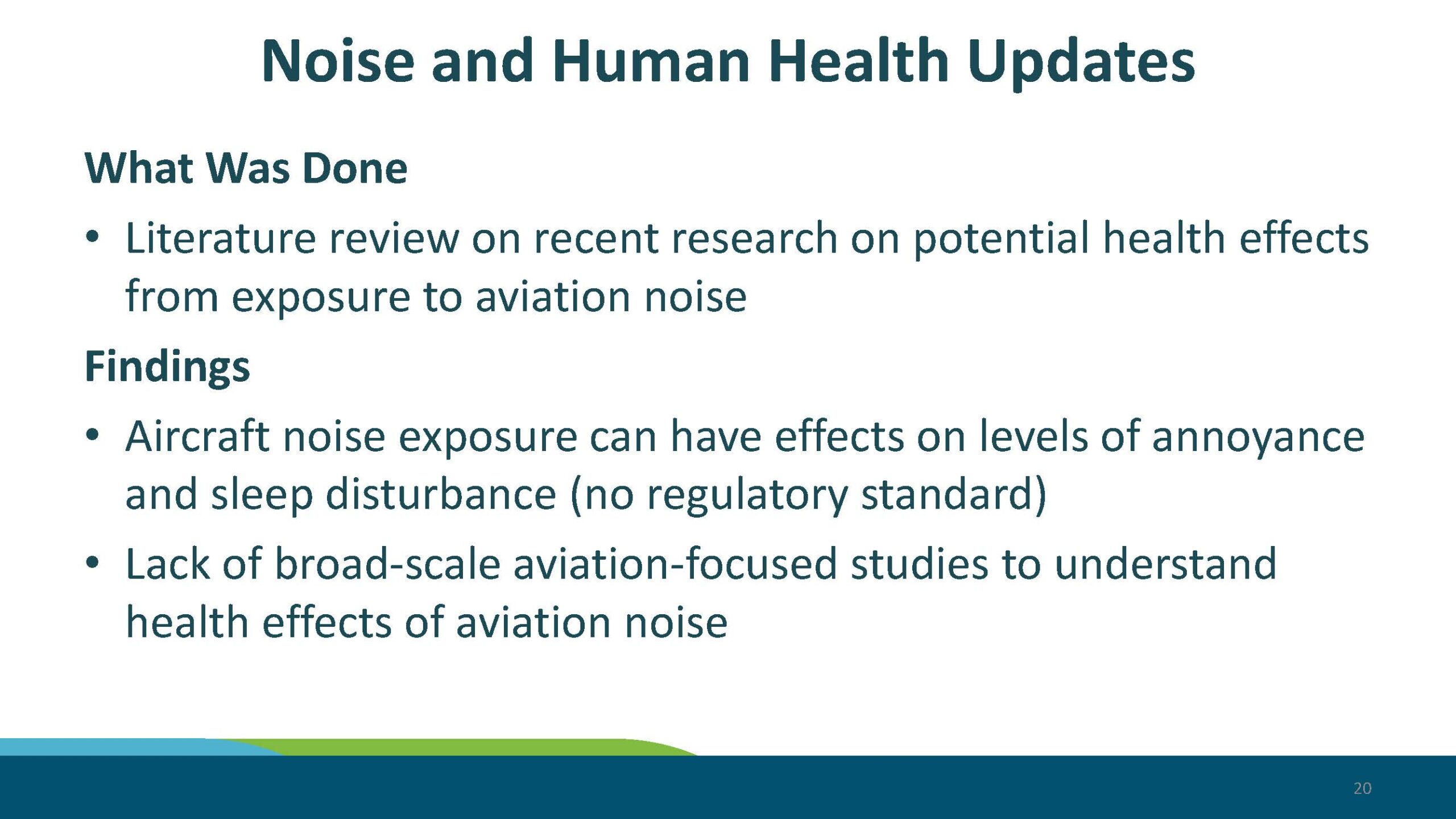
Slide 20 from a Sea-Tac Airport presentation summarizing a literature review on aviation noise and human health. Key findings note that aircraft noise exposure can affect annoyance and sleep disturbance (with no regulatory standard) and that broad-scale aviation-focused health studies are lacking.
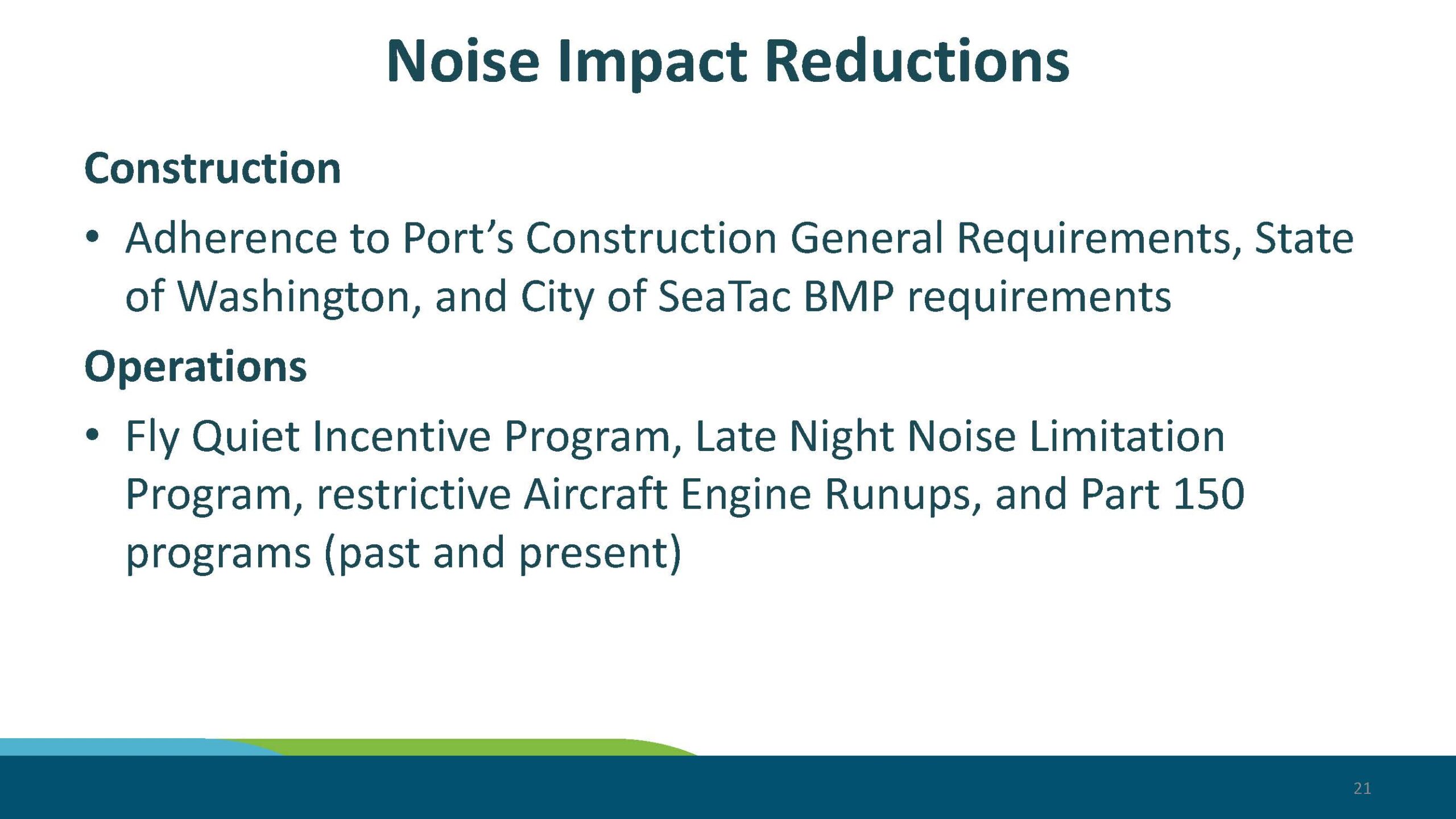
Slide 21 from a Sea-Tac Airport presentation outlines noise impact reduction measures, covering Construction (adherence to Port's Construction General Requirements, State of Washington, and City of SeaTac BMP requirements) and Operations (Fly Quiet Incentive Program, Late Night Noise Limitation Program, restrictive Aircraft Engine Runups, and Part 150 programs past and present).
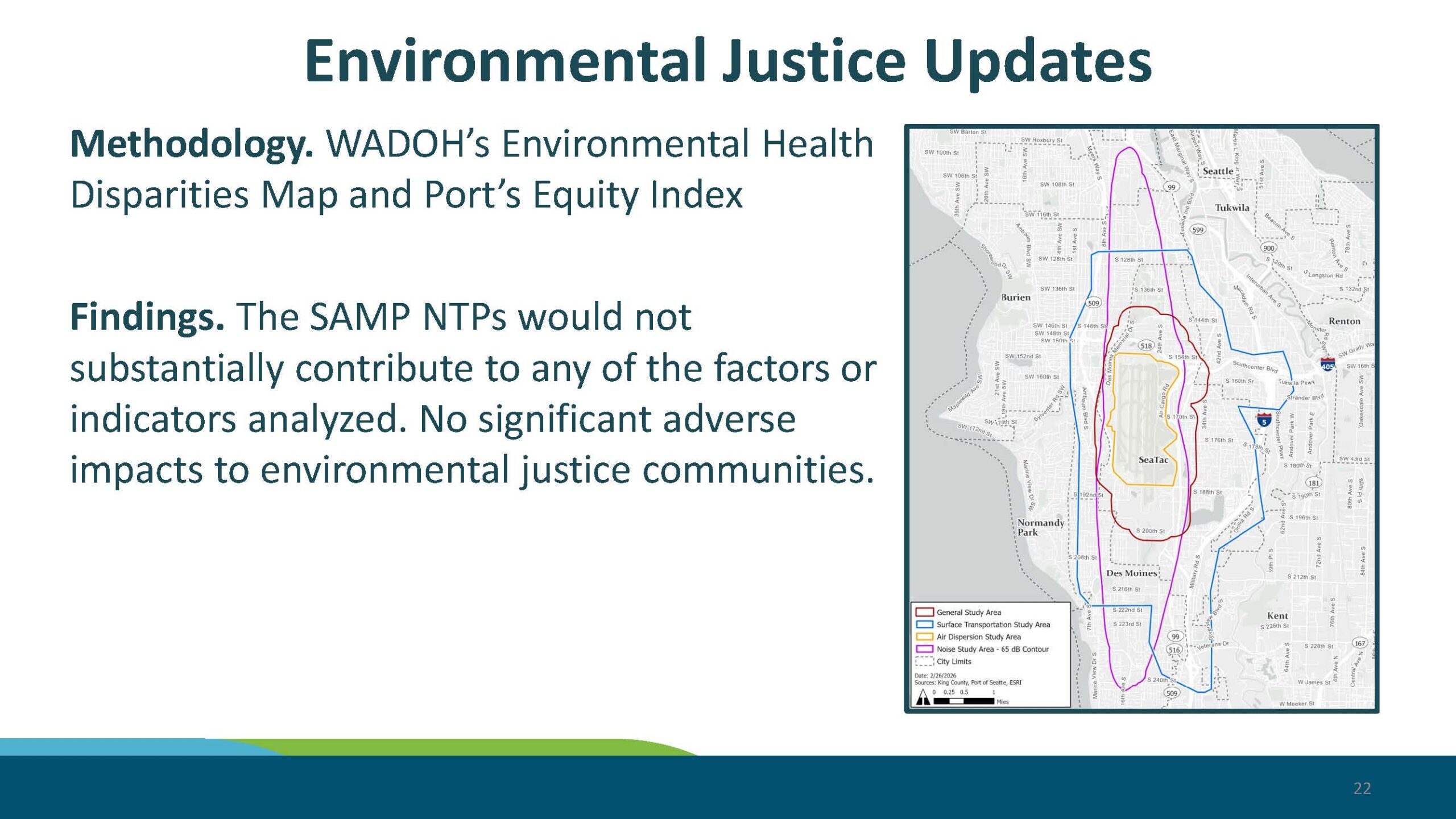
Slide 22 from a Port of Seattle presentation on the Sea-Tac Airport Master Plan (SAMP) Near-Term Projects (NTPs), summarizing Environmental Justice findings using WADOH's Environmental Health Disparities Map and the Port's Equity Index. The findings conclude that the SAMP NTPs would not substantially contribute to any analyzed factors and pose no significant adverse impacts to environmental justice communities, accompanied by a study area map covering SeaTac, Burien, Des Moines, Normandy Park, and surrounding cities.
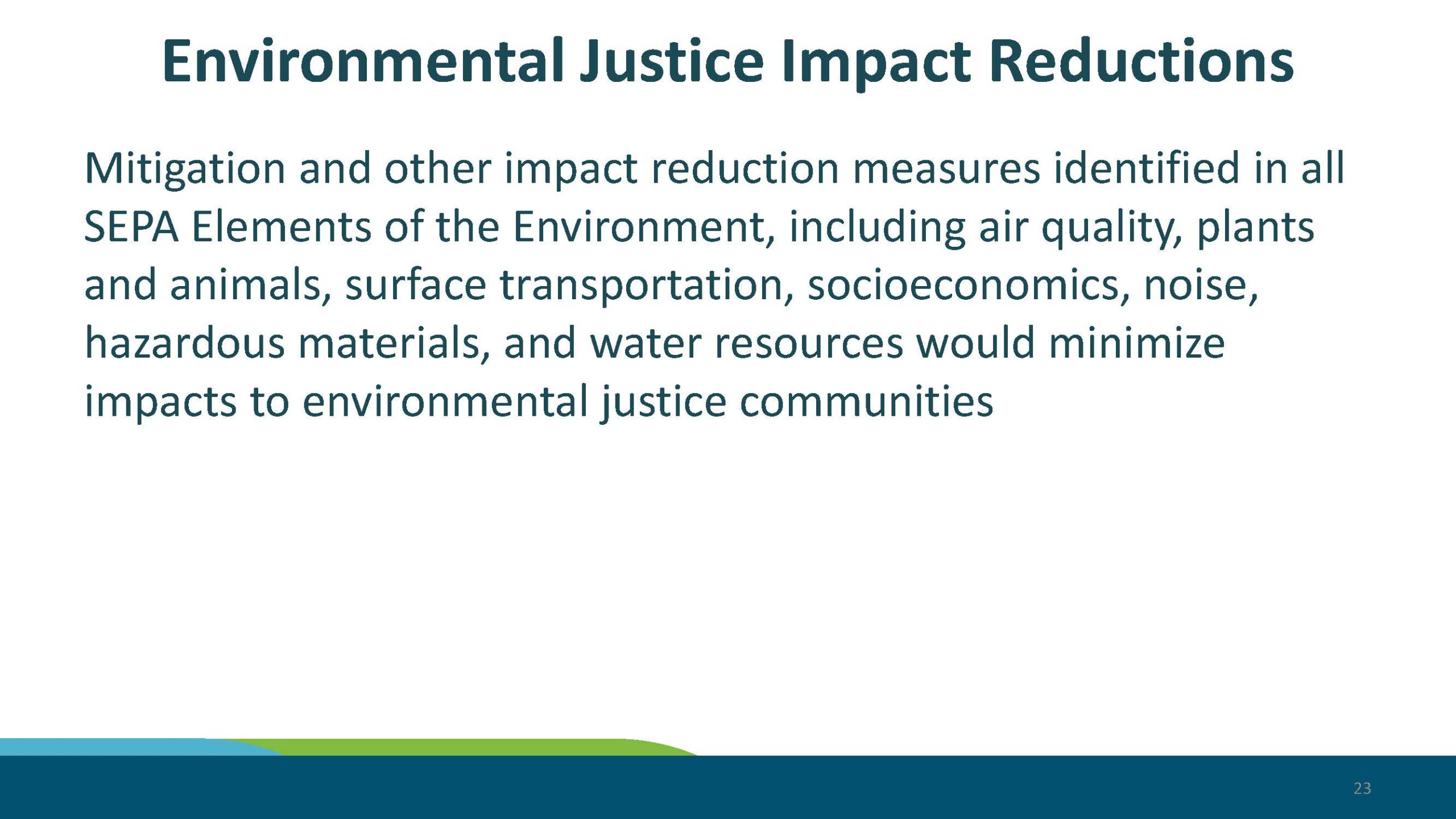
Presentation slide titled 'Environmental Justice Impact Reductions' stating that mitigation and impact reduction measures identified across all SEPA Elements of the Environment—including air quality, plants and animals, surface transportation, socioeconomics, noise, hazardous materials, and water resources—would minimize impacts to environmental justice communities. Slide is numbered 23 and uses a teal/green color scheme consistent with a Sea-Tac Airport or related agency environmental review presentation.
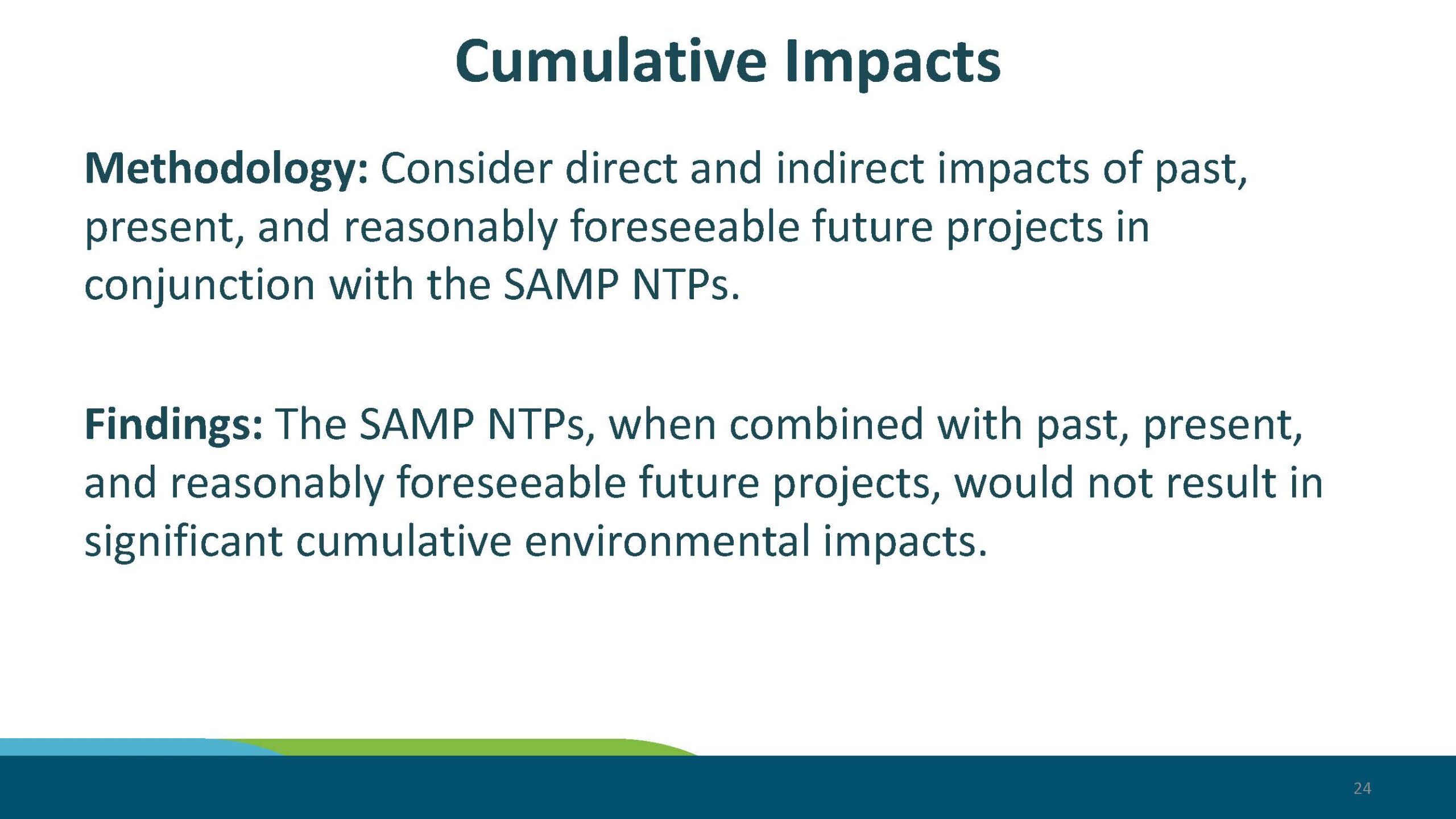
Slide 24 from a Sea-Tac Airport environmental review presentation covering the Sustainable Airport Master Plan (SAMP) Near-Term Projects (NTPs). It states the methodology for cumulative impact analysis and finds that the SAMP NTPs, combined with past, present, and reasonably foreseeable future projects, would not result in significant cumulative environmental impacts.
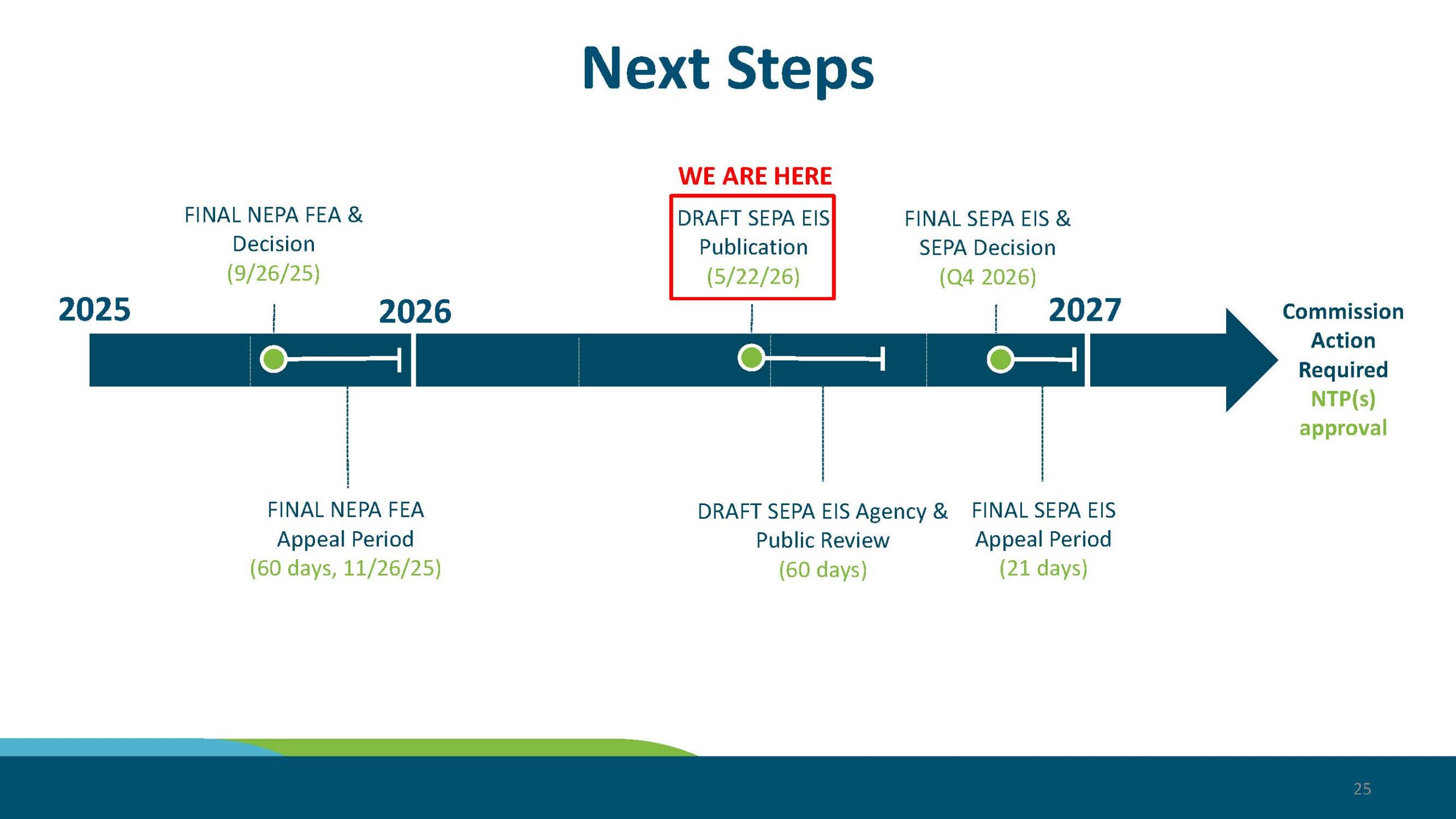
This project timeline slide shows the environmental review schedule for what appears to be a Sea-Tac Airport noise or development project, marking the current position at the Draft SEPA EIS Publication date of 5/22/26. Key milestones include the Final NEPA FEA & Decision (9/26/25), a 60-day public review period, Final SEPA EIS & Decision in Q4 2026, and a 21-day appeal period, culminating in Commission Action Required for NTP(s) approval in 2027.
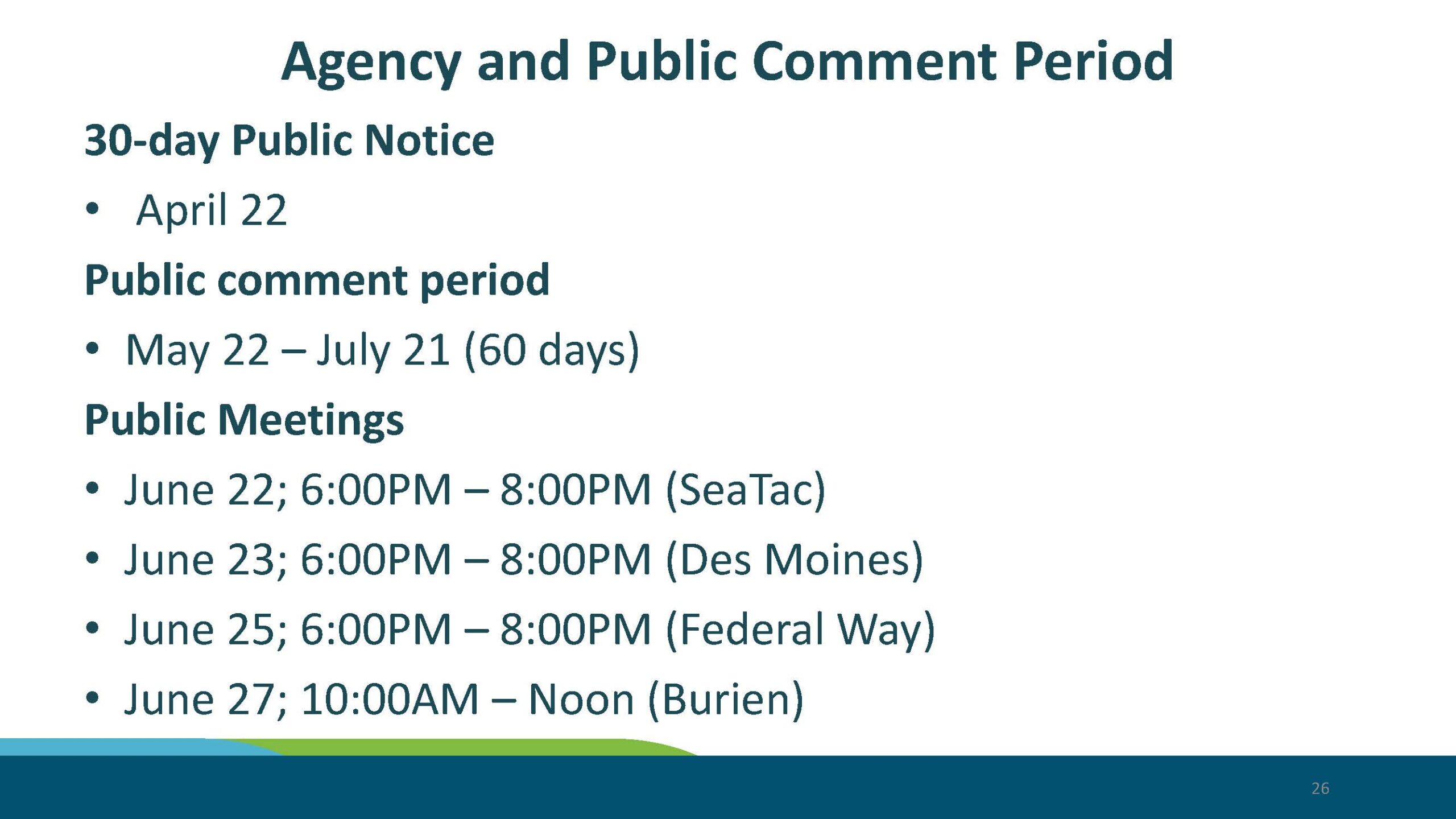
Slide 26 from a Sea-Tac Airport noise-policy presentation detailing the public engagement timeline: a 30-day public notice issued April 22, a 60-day public comment period from May 22 through July 21, and four public meetings held June 22 (SeaTac), June 23 (Des Moines), June 25 (Federal Way), and June 27 (Burien).
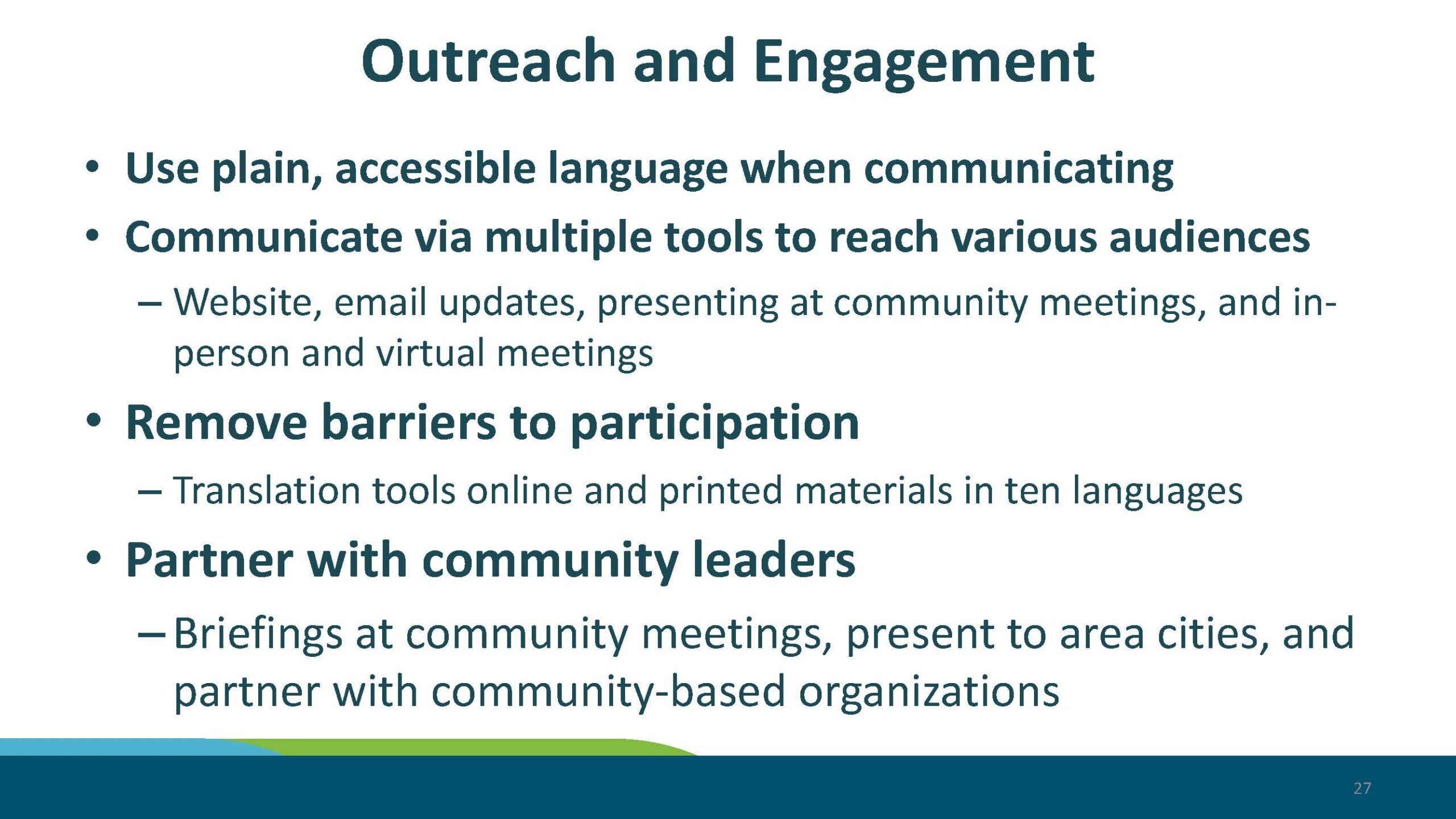
A presentation slide titled 'Outreach and Engagement' outlining communication strategies including use of plain language, multiple communication tools (website, email, community meetings), removing participation barriers via translation tools in ten languages, and partnering with community leaders and community-based organizations. No specific organization logo or date is visible, though the content and style are consistent with a public agency engagement plan.
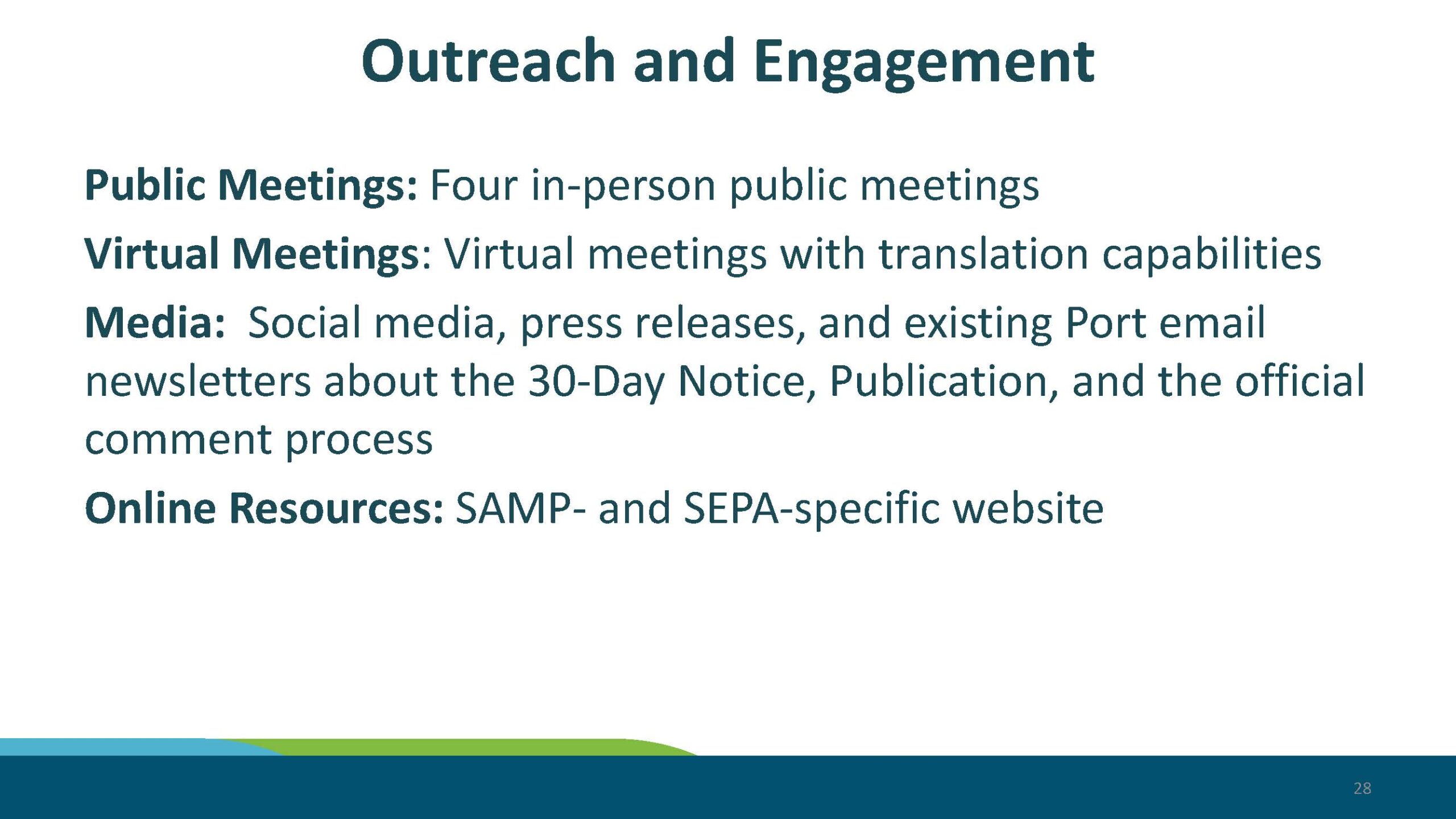
Slide 28 from a Port of Seattle presentation outlines the public outreach and engagement strategy for the Sea-Tac Airport SAMP (Sustainable Airport Master Plan) and SEPA process, including four in-person public meetings, virtual meetings with translation capabilities, media outreach via social media and press releases, and a dedicated SAMP/SEPA website.
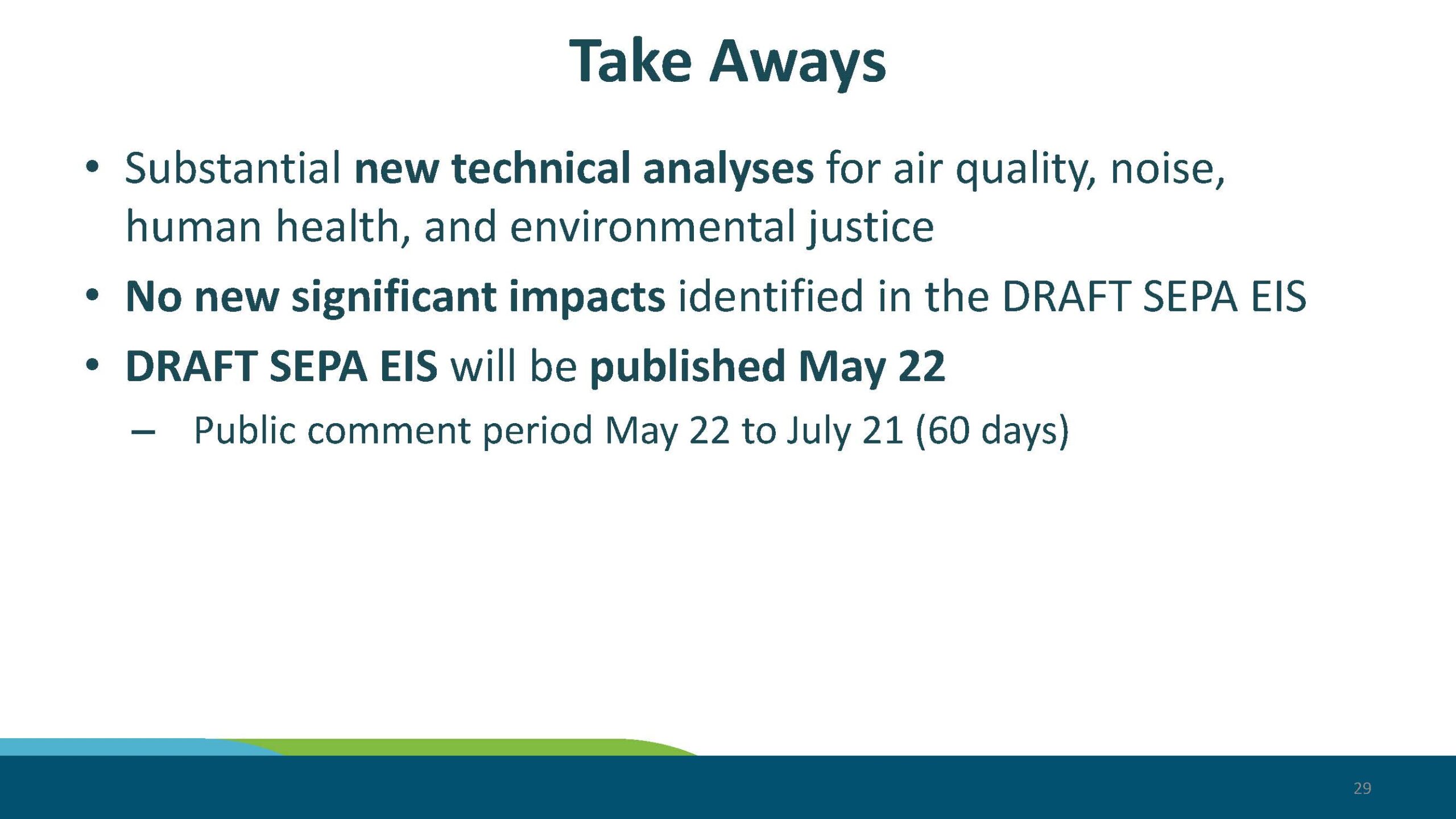
Slide 29 summarizes key takeaways from a Draft SEPA Environmental Impact Statement (EIS) presentation, noting substantial new technical analyses for air quality, noise, human health, and environmental justice, with no new significant impacts identified. The Draft SEPA EIS was scheduled for publication on May 22, with a 60-day public comment period running May 22 to July 21.
This is slide 30 of a Port of Seattle presentation, displaying a 'Questions?' prompt on a teal background with the Port of Seattle logo in the lower right corner. The slide appears to be the closing Q&A slide from a Port of Seattle briefing, likely related to Sea-Tac Airport noise policy given the archival context.
The comment period debate
Public comment was limited to one minute. At least ten people commented on the SAMP. Several in favor, most against. Those concerned included council members from Burien and SeaTac. These all focused on the same two requests: extend the public comment period from 60 to 90 days. Provide more translations.
Port staff responded by saying they had already doubled the comment period from 30 to 60. They also made a point of saying how hard they had worked to make the document readable and less technical. We agree. And we find that problematic.
They also told the Commission that they would provide special outreach to Port South King County grant recipients, which we find an interesting choice to say the least.
Too short
Although public understanding is important, we do not believe that the primary purpose of an EIS should be to educate the public. A core function should be to provide enough technical detail that qualified reviewers can identify flaws and suggest improvements. If it lacks that detail, it cannot perform its essential purpose—no matter how many languages the summaries are is translated into, and no matter how long the comment window.
The premise of the SAMP is to speed permitting. As with the NEPA EA, for almost all construction projects, the document makes the assumption that, because they are well-established project types, they do not require more detailed reporting.
The EIS documents were released at noon the previous Friday. STNI immediately noticed flaws we reported to staff. Port staff did not correct the problem until Tuesday morning, but since there were no other complaints, we were willing to chalk that up as an oversight. However, at the end of the presentation, staff gave the wrong URL for the SAMP web site. Our concern is a lack of care on both sides: the public who will not engage meaningfully, and staff who sense this.
The correct web site for public comment is: sea-samp.com
Self-permitting, 31 projects
Today’s presenters the Port’s technical lead. He prepared the document (along with long-time consultants Landrum &Brown). He will process public comments. He will then create a finished document, including those comments and the Port’s official responses, to the SEPA Official in charge of signing off on the project. That official is his boss, Sarah Cox, Director of Aviation Environmental Planning.
Under its 2016 agreement with the City of SeaTac, the Port approves its own construction permits–including the SAMP-NTP. The structural problem is obvious.
Assuming Ms. Cox approves that final version, a 21 day appeal period opens.
Several Commissioners said that even after that SAMP EIS is approved, nothing actually moves forward until they vote, likely in early 2027. However, they also commented that there was nothing preventing them from breaking the package apart to approve individual projects. That is unlikely.
First, the projects are holistic. To understand why, the origin of the SAMP began in 2010 as two planning tracks: a Terminal Realignment Program and a Airline Realignment Program. After the Third Runway, airport planners began discussing how to make more room for their primary tenant–Alaska Air. They quickly realized that they could use that process to dramatically increase capacity on existing property — but only by moving almost every piece around to more efficient spaces. That is the SAMP. A slow-motion redesign of almost every structural piece of the airport. While it keeps running.
If the Commission had wished to make changes, it likely would have spoken up by now–as it did with North SeaTac Park.
Second, under state law, once a developer complies with all applicable requirements, the permitting authority cannot arbitrarily withhold approval. Doing so is discriminatory and exposes the agency to legal action.
The developer, the permitting authority, and the electeds acting on behalf of the public interest are all the same entity. Ironically, Port counsel may be telling the Commission not to engage to avoid any appearance of conflict.
Where the Commissioners’ hearts are
Two other presentations were at least as long as the SAMP briefing, and they say a lot about where the Commission’s energy actually goes.
The first was a feasibility study for an on-airport childcare center for airport employees. Other airports have funded similar centers in part with FAA dollars. They noted that other airports are using FAA grants for funding. As we’ve said many times, FAA grant use is not a fixed set of rules, it is a negotiation. Airports propose, the FAA reviews, and approval at one airport sets precedent for others. Expanding what grants can fund requires elected officials willing to push. The Port is willing to push on childcare—because that is where their hearts are.
The second was the 2025 Diversity in Contracting Annual Report. WMBE contracting has been a Commission priority. It has been expensive, not always successful, but this year appears to be heading in the right direction. Commissioners acknowledged that disparities are not resolving themselves organically and that sustained effort is required.
The pattern
Projects like these are often proposed and championed by one particular Commissioners and we salute them. But the core institutional interest is keeping flights going, because flights pay for everything else, including childcare and contracting equity.
Several Commissioners observed that meaningful airport community work can always happen outside the SAMP process. That is true. But that statement was undercut by other comments expressing ongoing satisfaction with current efforts on surrounding-community impacts.
During their re-election campaigns, three commissioners said they had heard from the public that much more needed to be done. This document was supposed to send a clear signal that SEPA would be different from NEPA.
Which is it? If the Commission now states that it is already doing a great job, and the SEPA document requires nothing more legally, we wonder what more they could have in mind.
Still, we know what the Commission can do when it finds projects its members believe in. Unfortunately, even with the SAMP, so far airport communities have not been among them. Perhaps if we could learn to ask for things more meaningful than more readable documents — and more time to read them.
We use cookies to provide basic functionality. We also provide access to search engines in order to provide site analytics. We do not sell or share your data.