TagSAMP(650)
Articles tagged with the Sustainable Airport Master Plan.
-
SAMP Draft EA: How to provide a great public comment
1How to provide effective public comment by December 13, 2024 Because new ways for you to participate will likely become available, this article may be subject to updates. Introduction This is the second of a two-part article concerning the Sustainable Airport Master Plan Draft Environmental Assessment (SAMP Draft EA). If you’re looking for the short -
2024-10-22
Port Commission Meeting features SAMP EA and Tax Levy
Four hours, 700 pages Meeting Agenda It is difficult to get a man to understand something, when his salary depends on his not understanding it. Sustainable Airport Master Plan Draft EA Presentation (Item #11a SAMP EA Presentation) Sarah Potter: Landrum & Brown, Steve Rybold and Sarah Cox: Port of Seattle Today’s Commission meeting was -
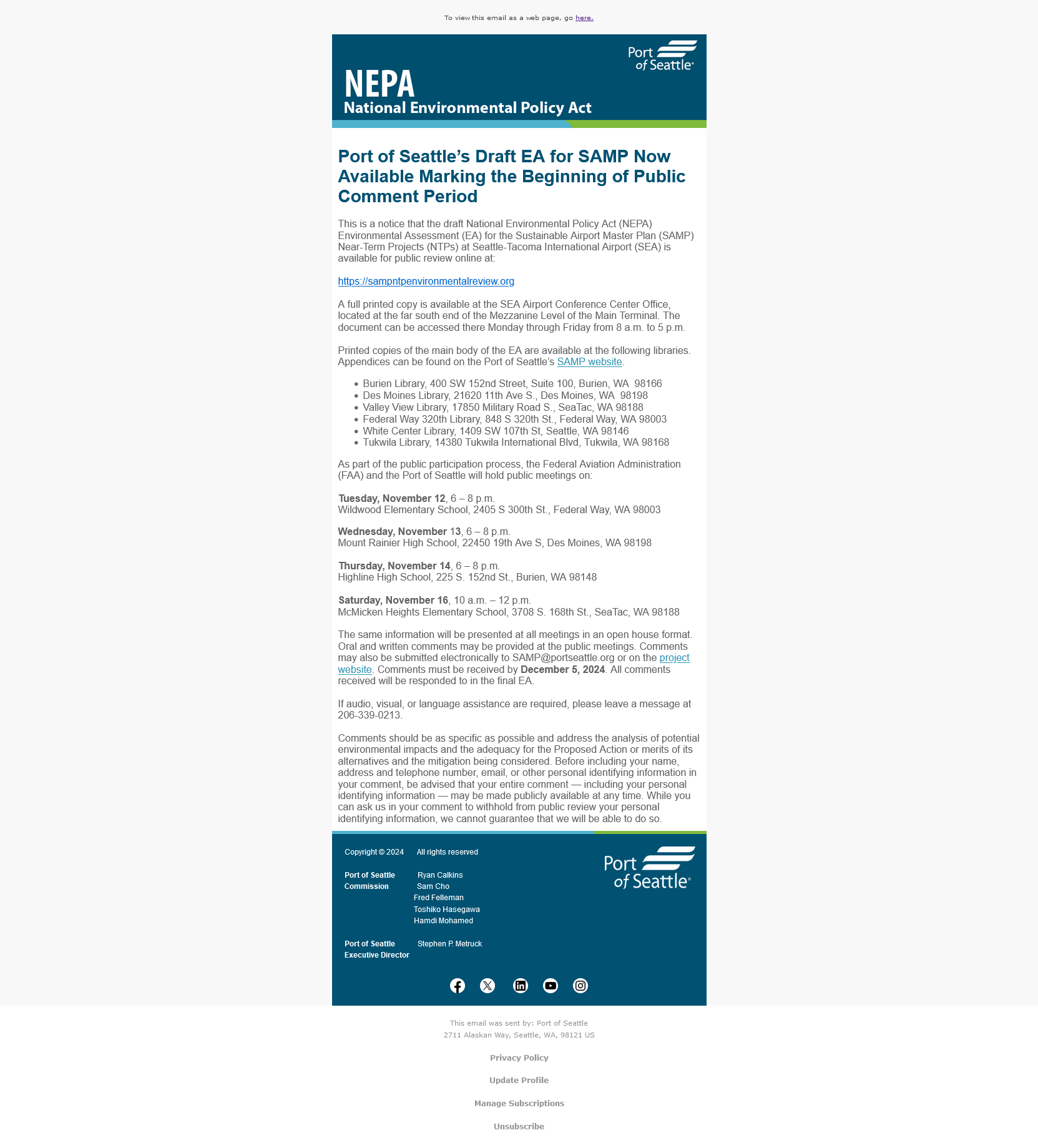
Port of Seattle NEPA Draft EA for SAMP Public Comment Notice
Official email notice from the Port of Seattle announcing the draft National Environmental Policy Act (NEPA) Environmental Assessment for the Sustainable Airport Master Plan (SAMP) Near-Term Projects at Seattle-Tacoma International Airport is available for public review. Public comment period closes December 5, 2024, with four public meetings scheduled November 12–16, 2024 at locations in Federal Way, Des Moines, Burien, and SeaTac. -
 2024-10-21
Appendix I: Natural Resources & Energy Supply — Bonneville Power Administration Strategic Plan Progress Update 2018–2023
The Bonneville Power Administration's 2018–2023 Strategic Plan Progress Update outlines the agency's efforts to strengthen financial health, modernize infrastructure, and better serve power and transmission customers across the Pacific Northwest. Nearly three years into implementation, BPA reaffirmed its original four strategic goals and added a fifth focused on workplace culture and valuing its workforce. The plan reflects BPA's broader mission to remain commercially competitive while fulfilling its public responsibilities to the region. -
 2024-10-21
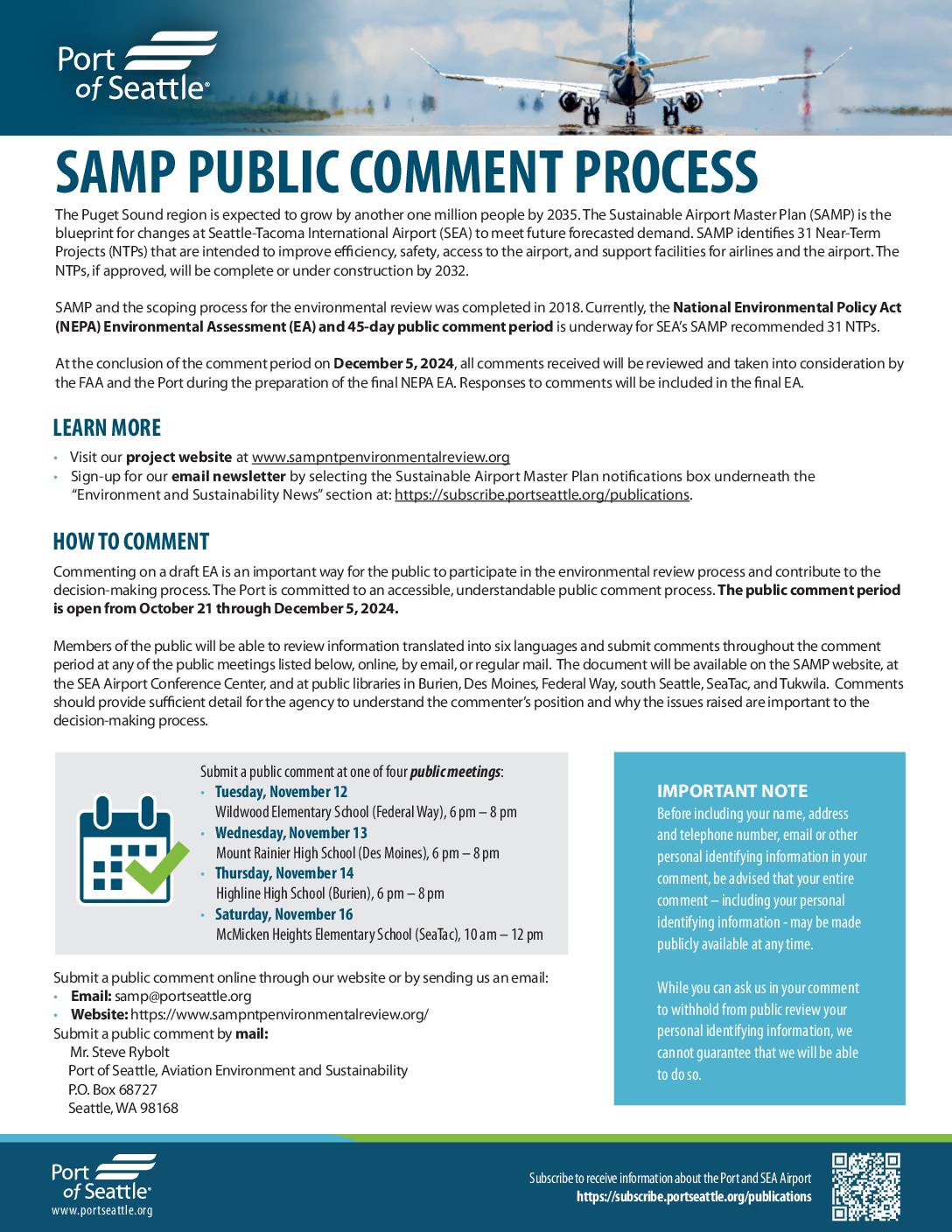
SAMP Public Comment Process: Factsheet
The Port of Seattle is seeking public comments on a proposed environmental review of 31 Near-Term Projects at Seattle-Tacoma International Airport (SEA), designed to improve efficiency, safety, and access as the Puget Sound region prepares for one million additional residents by 2035. The public comment period runs from October 21 through December 5, 2024, with four in-person meetings scheduled across Federal Way, Des Moines, Burien, and SeaTac. Comments can be submitted online, by email at samp@portseattle.org, by mail, or in person, and will be considered by the FAA and Port of Seattle in finalizing the National Environmental Policy Act (NEPA) Environmental Assessment. -

Enplaned Passengers Forecast 2018 SAMP Financial briefing
A presentation slide showing enplaned passenger data and projections for Seattle-Tacoma International Airport from 2012 to 2027, measured in thousands. The slide notes 41% growth from 2012–2017 and a projected 20% growth from 2017–2027, with forecasts based on the Strategic Airport Master Plan (SAMP). -
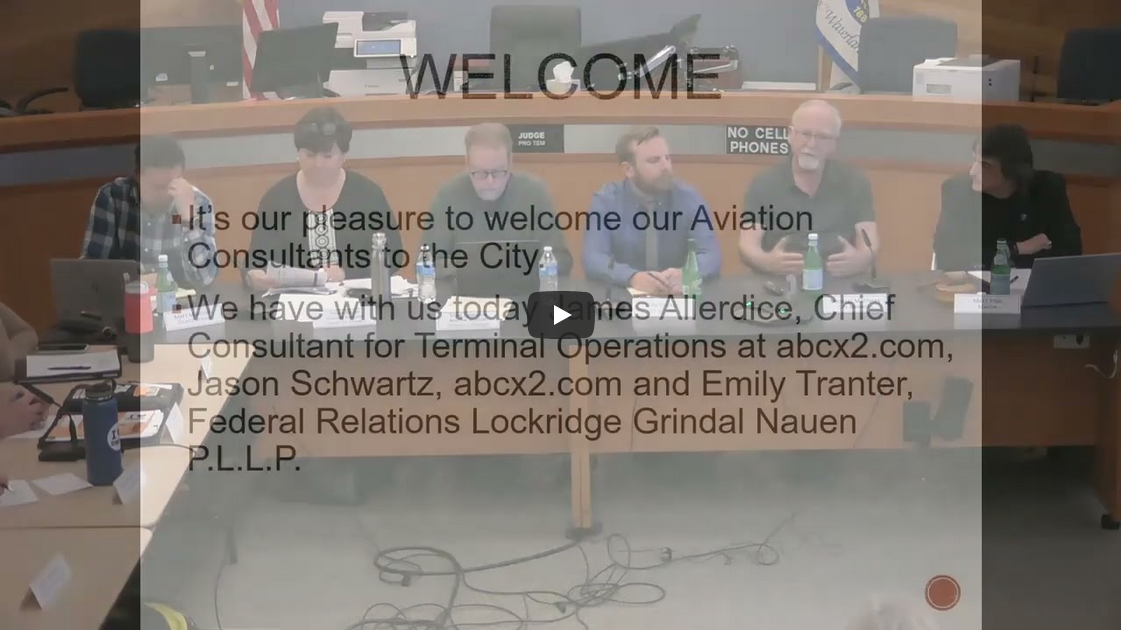
City Council Meeting: Aviation Consultants Welcome Presentation
A city council or municipal meeting slide welcomes aviation consultants including James Allerdice (Chief Consultant for Terminal Operations, abcx2.com), Jason Schwartz (abcx2.com), and Emily Tranter (Federal Relations, Lockridge Grindal Nauen P.L.L.P.). The meeting appears to involve airport-related consultation, likely pertaining to terminal operations planning. -
The SAMP Four City Consultant ILA 2018
Burien, Des Moines, Normandy Park, SeaTac environmental response Although the Sustainable Airport Master Plan (SAMP) was announced in 2012, it only moved towards public environmental review in 2017. We covered where we’re at now in the SAMP Public Comment Explainer To help them navigate the process, in 2018 four cities (Burien, Des Moines, Normandy Park, -
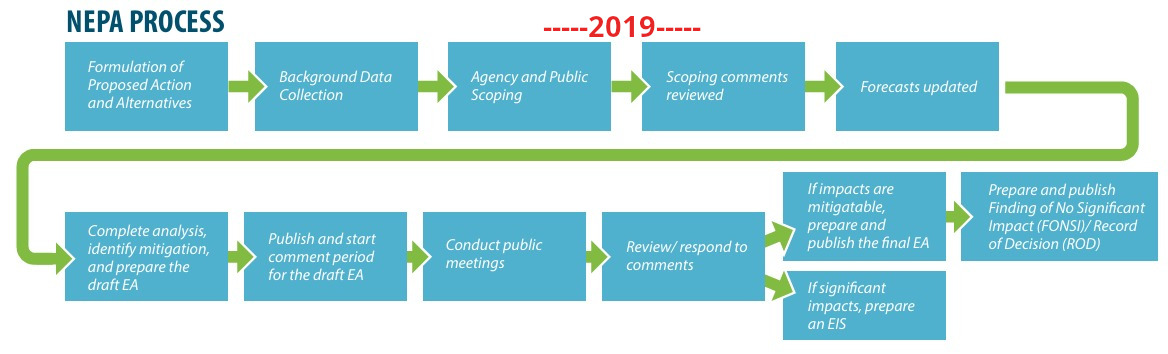
NEPA flow-chart Screenshot_30-9-2024_205456_www.airportprojects.net
This diagram illustrates the National Environmental Policy Act (NEPA) process as applied to an environmental assessment, with a 2019 milestone marker indicating the stage reached that year. The flowchart spans from initial formulation of proposed actions and alternatives through public scoping, draft EA preparation, public comment periods, and concludes with either a Finding of No Significant Impact (FONSI)/Record of Decision (ROD) or preparation of an Environmental Impact Statement (EIS) if significant impacts are found. -
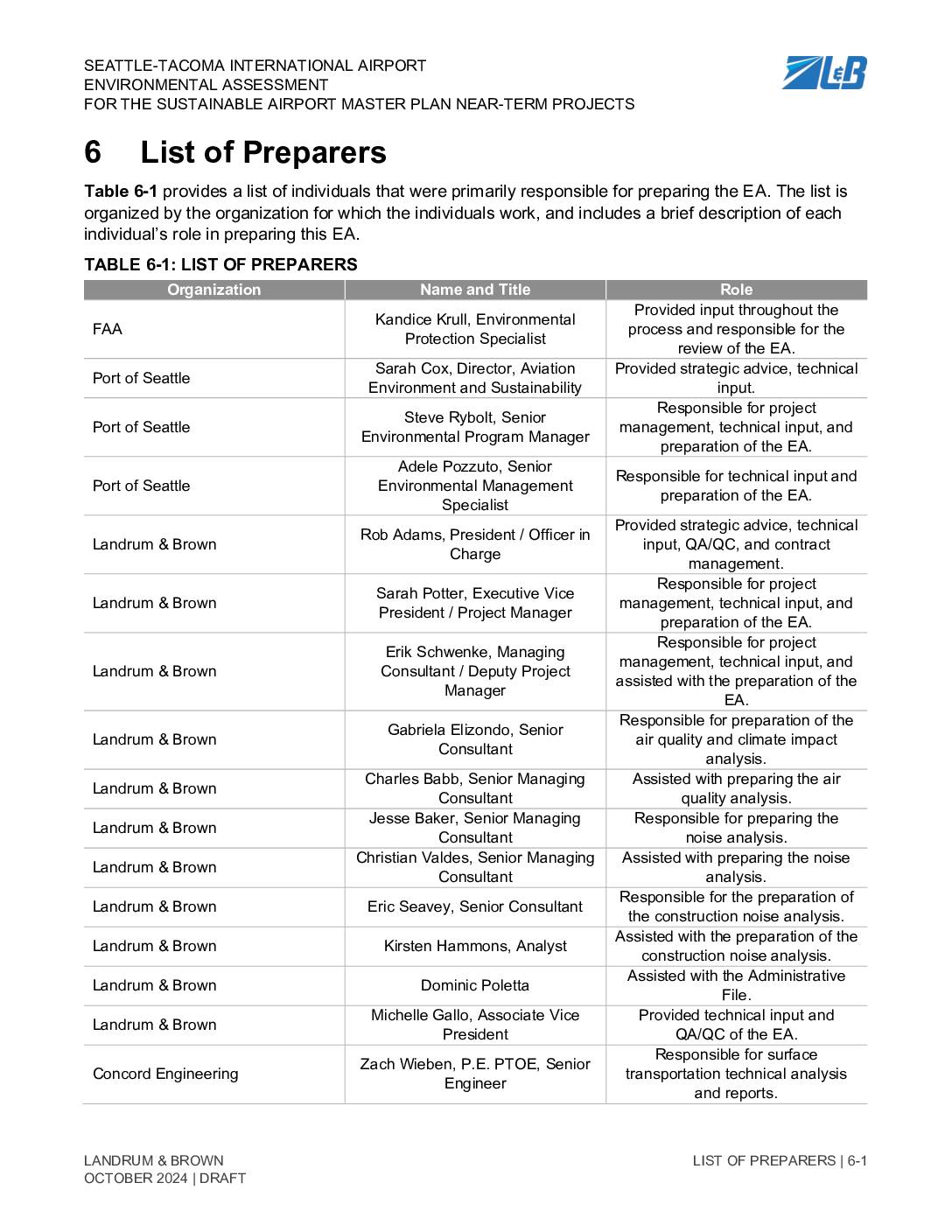 2024-10-01
Seattle-Tacoma International Airport Environmental Assessment for the Sustainable Airport Master Plan Near-Term Projects: Chapter 6 — List of Preparers
This section of the Seattle-Tacoma International Airport Environmental Assessment lists the individuals and organizations responsible for preparing the document, including staff from the FAA, Port of Seattle, and several consulting firms. The team covered a wide range of technical areas, with specialists handling noise analysis, air quality, surface transportation, wetlands, cultural resources, and public engagement. The assessment was produced in October 2024 as a draft under the airport's Sustainable Airport Master Plan for near-term projects.