I understand that you will never share my information with anyone, you will only use it to keep me updated on relevant events and that I may unsubscribe at any time.
Since 2016, working to obtain justice for everyone living under the flight path.
Less Noise. Cleaner Air. Better Public Health. Compensation.
Everything you think you know about the airport is wrong.
Last Updated: January 23rd, 2025
SAMP Draft EA: How to provide a great public comment
Outline
1How to provide effective public comment by December 13, 2024
Because new ways for you to participate will likely become available, this article may be subject to updates.
Introduction
This is the second of a two-part article concerning the Sustainable Airport Master Plan Draft Environmental Assessment (SAMP Draft EA). If you’re looking for the short version? This is the short version.
Part 1 provided background on what the SAMP is, how we got here, what the environmental review looks like, and expected outcomes for this comment period. But in one paragraph:
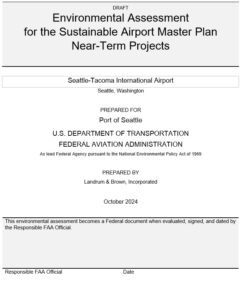
The SAMP is the next major expansion plan for Sea-Tac Airport. We call it The Fourth Runway because it will increase flights by at least a third–as much as building a runway– but without building a runway. Instead, it is 31 projects on current airport property, so you’re probably unaware that it’s already been going on for six years. The Draft EA is a document which describes those projects and their expected impacts to the community. The FAA is conducting a 2NEPA environmental review of that document, which they must approve, before the SAMP can continue forward. As part of their decision, they are holding a public comment period on the Draft EA from October 21st through December 5, 2024.
This article provides specific instructions on how to comment on the Draft EA and what happens afterwards.
Draft EA Documents
The SAMP Draft Environmental Assessment (Draft EA) documents are here. These describe the 31 projects, and the thirteen categories being considered for approval or mitigation (eg. noise, air quality, water quality, cumulative impacts, etc.) There are five main Chapters, about 275 pages, which provide an overview. There are also fifteen Appendices (over 4,000 pages). But most of that is Scoping Comments made by people just like you during an earlier comment period. Don’t be intimidated. No one expects you to read all it. Think of it like a dictionary where you’ll want to look up a few things. We’ll show you how below.
Here are some overview slides, courtesy of the Port of Seattle, which you should look at.
Title slide for a Port of Seattle commission presentation dated October 22, 2024, agenda Item No. 11a supp, covering Sustainable Airport Master Plan Near-Term Projects at Seattle-Tacoma International Airport.
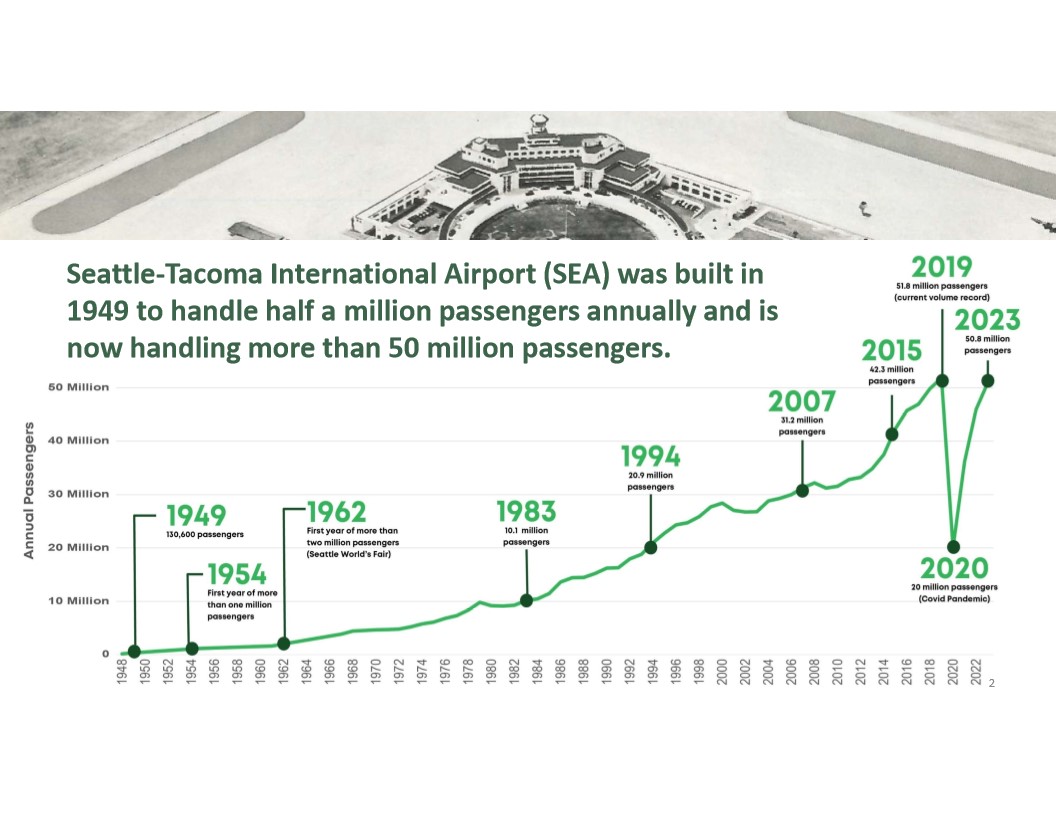
An infographic chronicling annual passenger volume at Seattle-Tacoma International Airport (SEA) from its 1949 opening (130,600 passengers) through 2023 (50.8 million passengers), highlighting milestones such as the 1962 Seattle World’s Fair surge, the 2019 record of 51.8 million passengers, and the COVID-19 pandemic drop to 20 million in 2020. A historic aerial photograph of the original terminal building appears at the top.
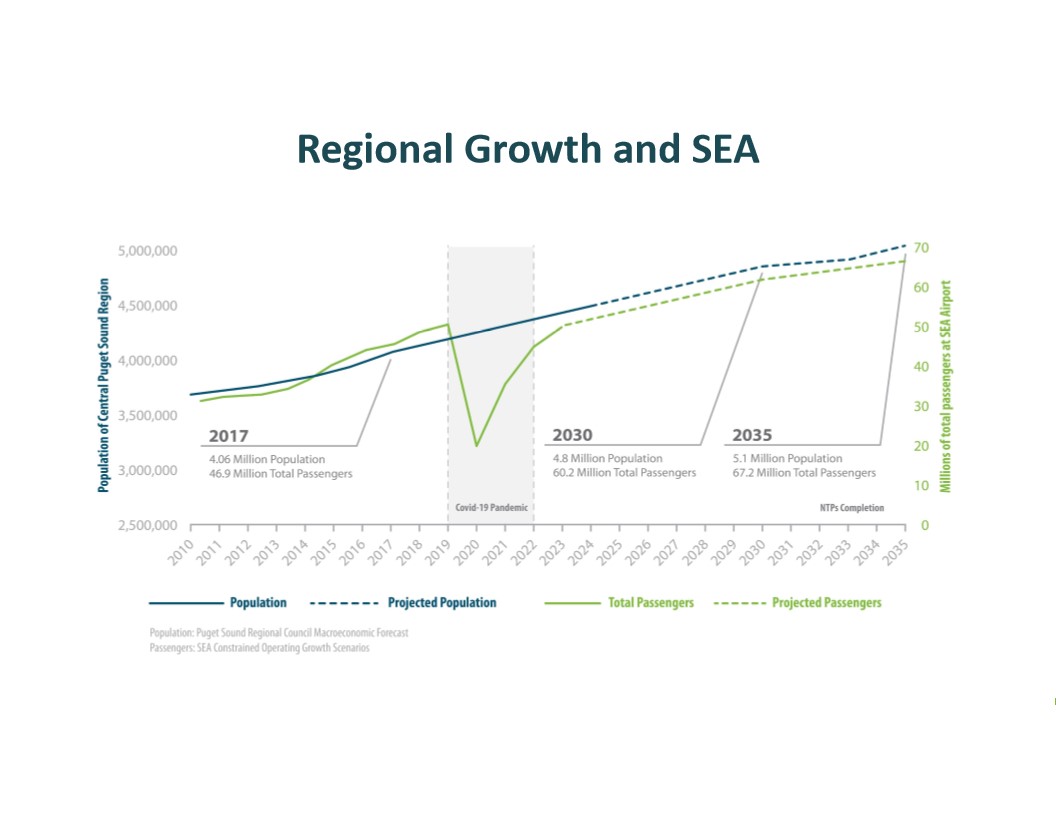
This chart from a Sea-Tac Airport (SEA) planning document shows the correlation between Central Puget Sound regional population growth and total passenger volumes from 2010 through 2035, including the COVID-19 pandemic dip. Key data points include 46.9 million passengers and 4.06 million population in 2017, with projections of 60.2 million passengers and 4.8 million population by 2030, and 67.2 million passengers and 5.1 million population by 2035 following NTPs Completion.
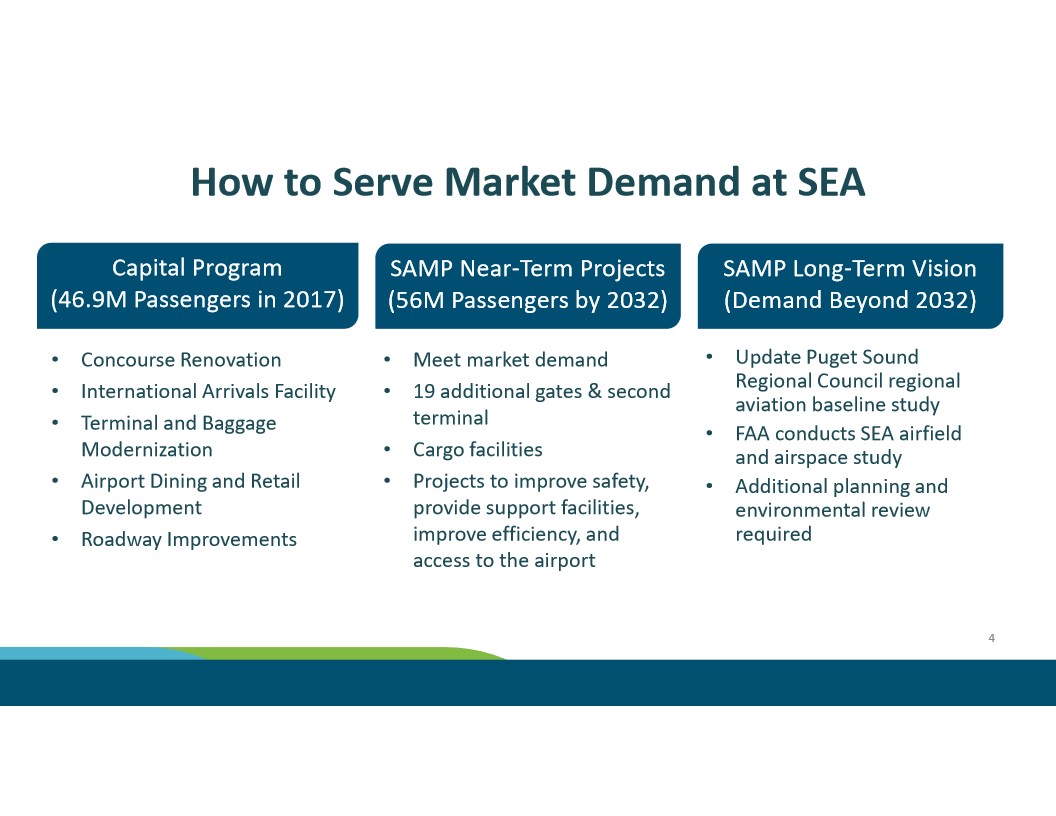
A presentation slide titled ‘How to Serve Market Demand at SEA’ outlining Seattle-Tacoma International Airport’s three-phase capacity strategy: the Capital Program serving 46.9M passengers in 2017, SAMP Near-Term Projects targeting 56M passengers by 2032 (including 19 additional gates and a second terminal), and a SAMP Long-Term Vision for demand beyond 2032 involving FAA airfield studies and environmental review.
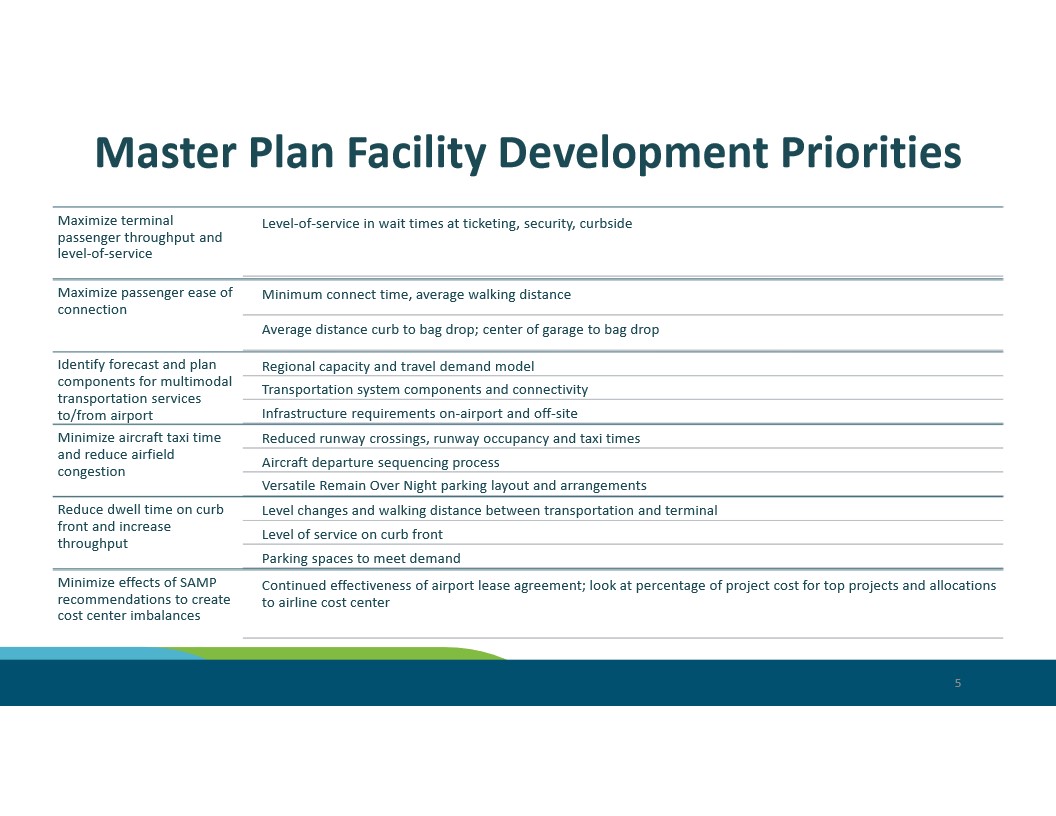
A presentation slide titled ‘Master Plan Facility Development Priorities’ outlining airport planning objectives including maximizing terminal passenger throughput, ease of connection, multimodal transportation, minimizing aircraft taxi time, reducing curb front dwell time, and minimizing cost center imbalances from SAMP recommendations. No specific airport name, date, or organization logo is visible in the image.
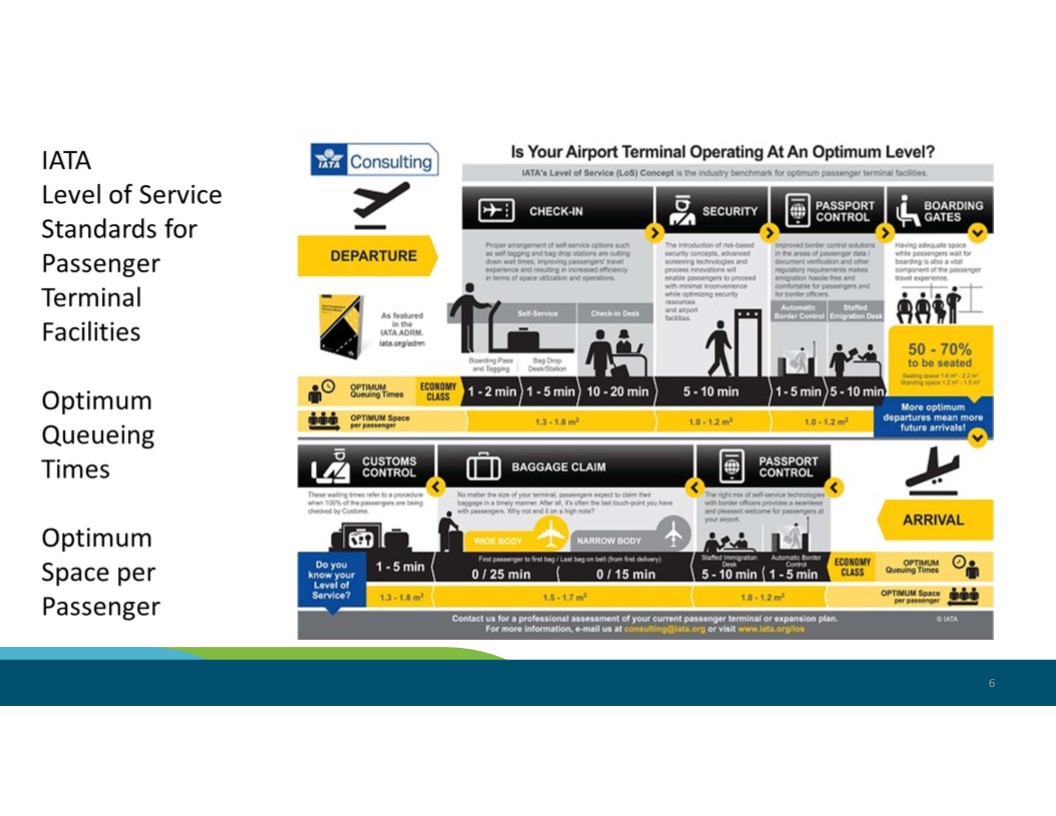
An IATA Consulting infographic titled ‘Is Your Airport Terminal Operating At An Optimum Level?’ outlining the IATA Level of Service (LoS) concept for passenger terminal facilities, including optimum queueing times and space-per-passenger standards for departure and arrival processes such as check-in, security, passport control, baggage claim, and customs. The slide references IATA’s Airport Development Reference Manual (ADRM) at iata.org/adrm.
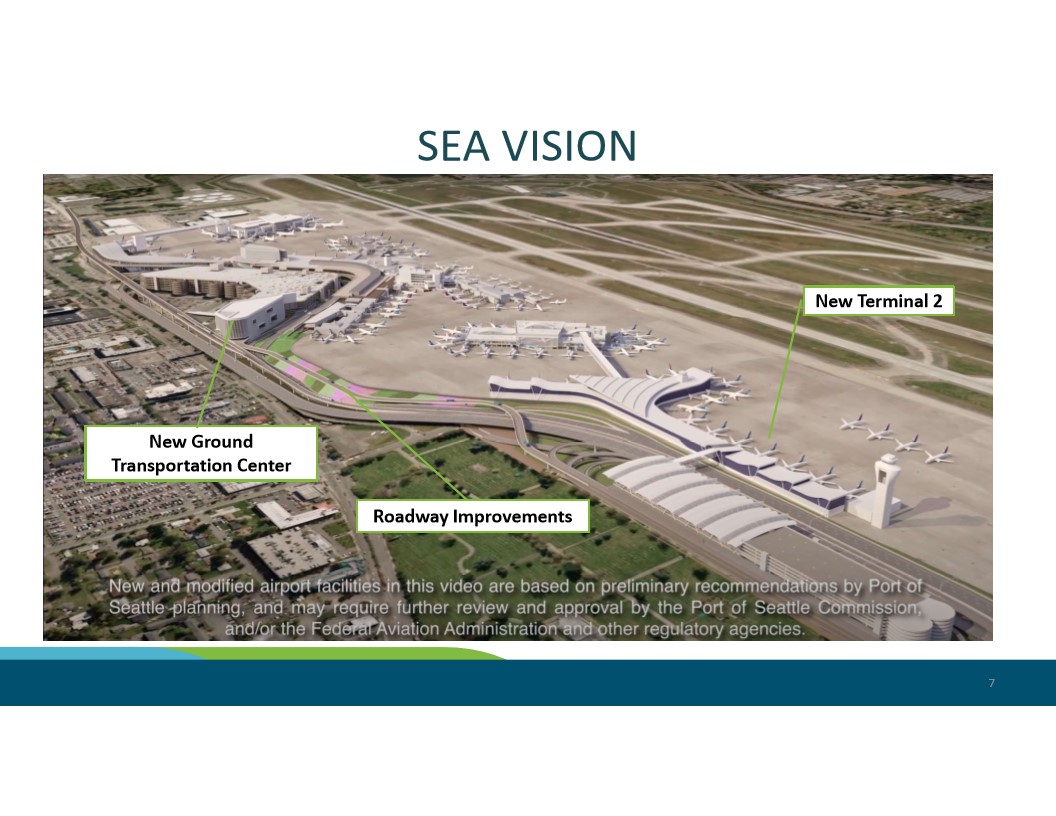
A Port of Seattle presentation slide titled ‘SEA VISION’ (slide 7) showing an aerial rendering of proposed future development at Seattle-Tacoma International Airport, including a New Terminal 2, a New Ground Transportation Center, and Roadway Improvements. A disclaimer notes that the facilities are based on preliminary recommendations by Port of Seattle planning and may require further review by the Port of Seattle Commission, the FAA, and other regulatory agencies.
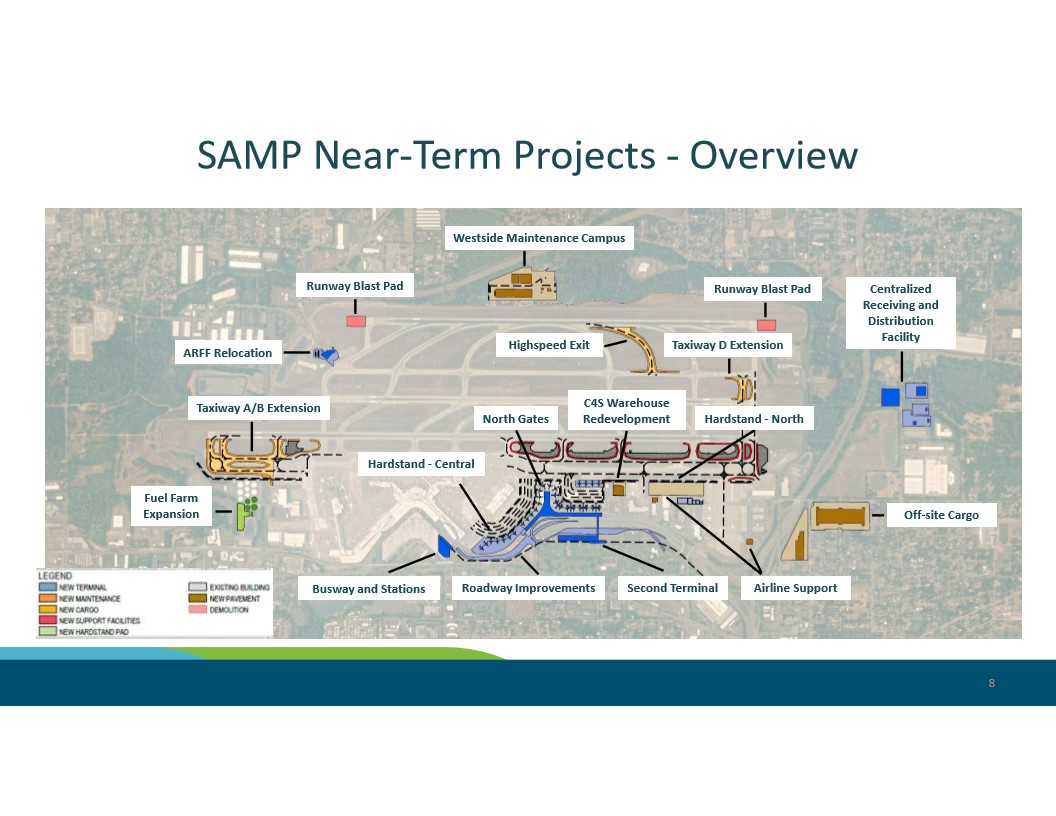
Slide 8 from a Seattle-Tacoma International Airport Strategic Airport Master Plan (SAMP) presentation, showing an aerial map of near-term capital projects including a Second Terminal, North Gates, Taxiway A/B and D extensions, Runway Blast Pads, Busway and Stations, Roadway Improvements, Fuel Farm Expansion, ARFF Relocation, Westside Maintenance Campus, and Off-site Cargo facilities. The legend distinguishes new terminal, maintenance, cargo, support facilities, hardstand pad, existing buildings, new pavement, and demolition areas.
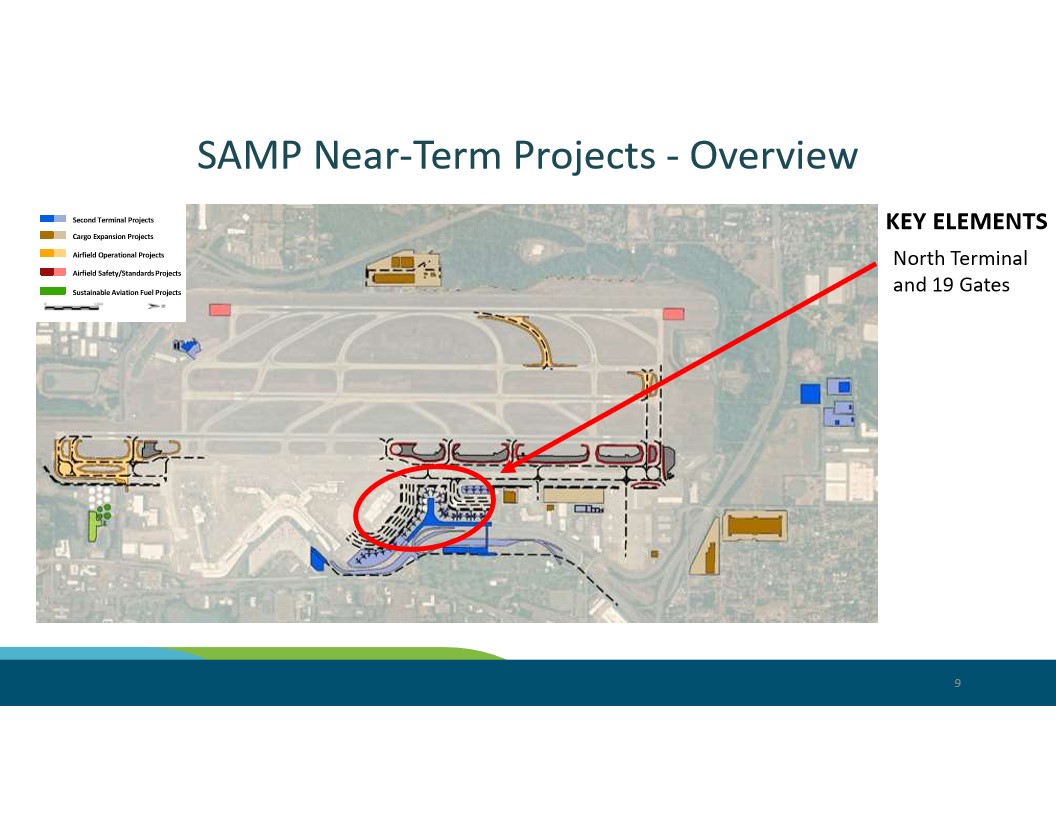
Slide 9 from a Seattle-Tacoma International Airport Strategic Airport Master Plan (SAMP) presentation, showing an aerial map of near-term capital projects color-coded by category (Second Terminal, Cargo Expansion, Airfield Operational, Airfield Safety/Standards, and Sustainable Aviation Fuel projects). A red arrow and circle highlight the key element of a new North Terminal with 19 gates.
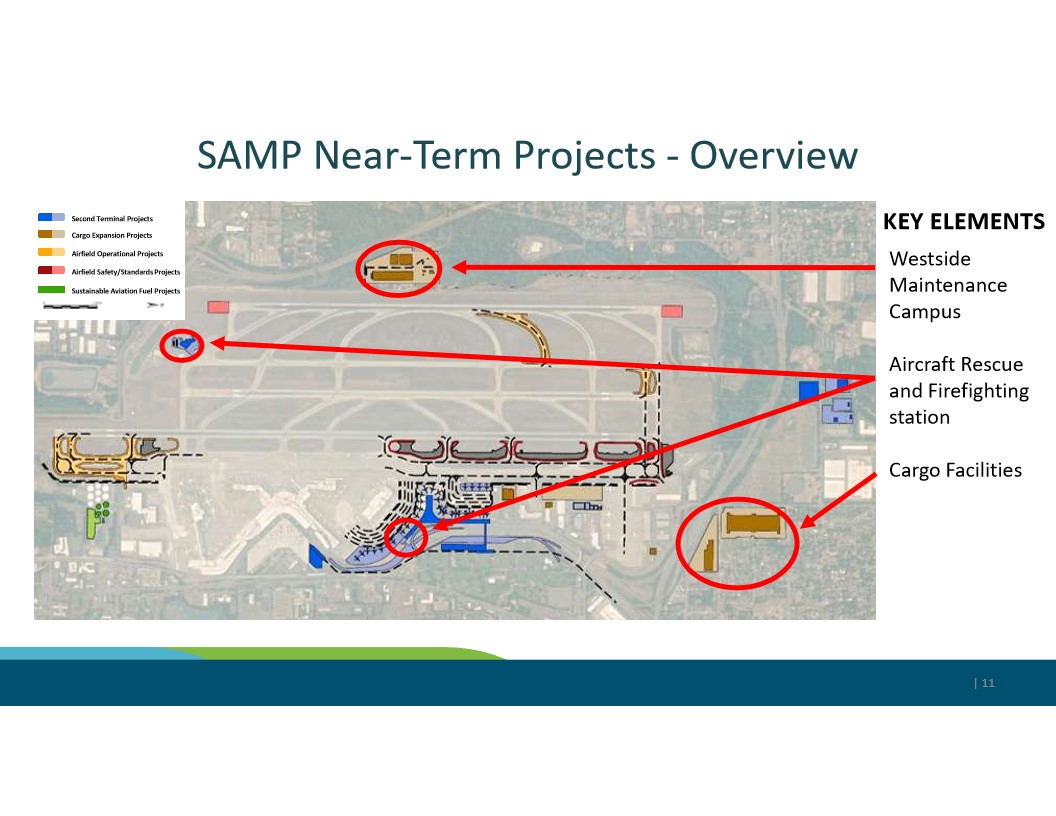
Slide 11 from a Seattle-Tacoma International Airport Strategic Airport Master Plan (SAMP) presentation, showing an aerial map of near-term capital projects. Key elements identified include a Westside Maintenance Campus, Aircraft Rescue and Firefighting Station, and Cargo Facilities, with color-coded categories for Second Terminal, Cargo Expansion, Airfield Operational, Airfield Safety/Standards, and Sustainable Aviation Fuel projects.
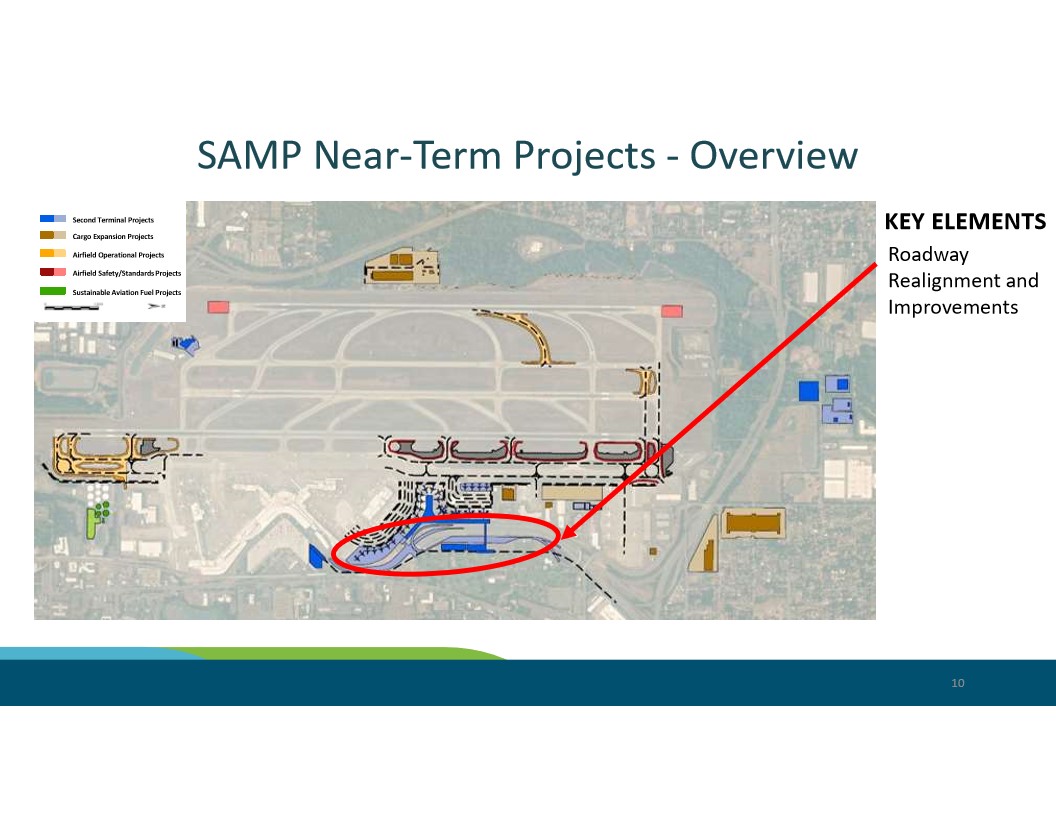
Presentation slide 10 titled ‘SAMP Near-Term Projects – Overview’ showing an aerial map of Seattle-Tacoma International Airport with color-coded project categories including Second Terminal Projects, Cargo Expansion Projects, Airfield Operational Projects, Airfield Safety/Standards Projects, and Sustainable Aviation Fuel Projects. A red arrow and circle highlight the terminal area, with ‘Roadway Realignment and Improvements’ identified as a key element.
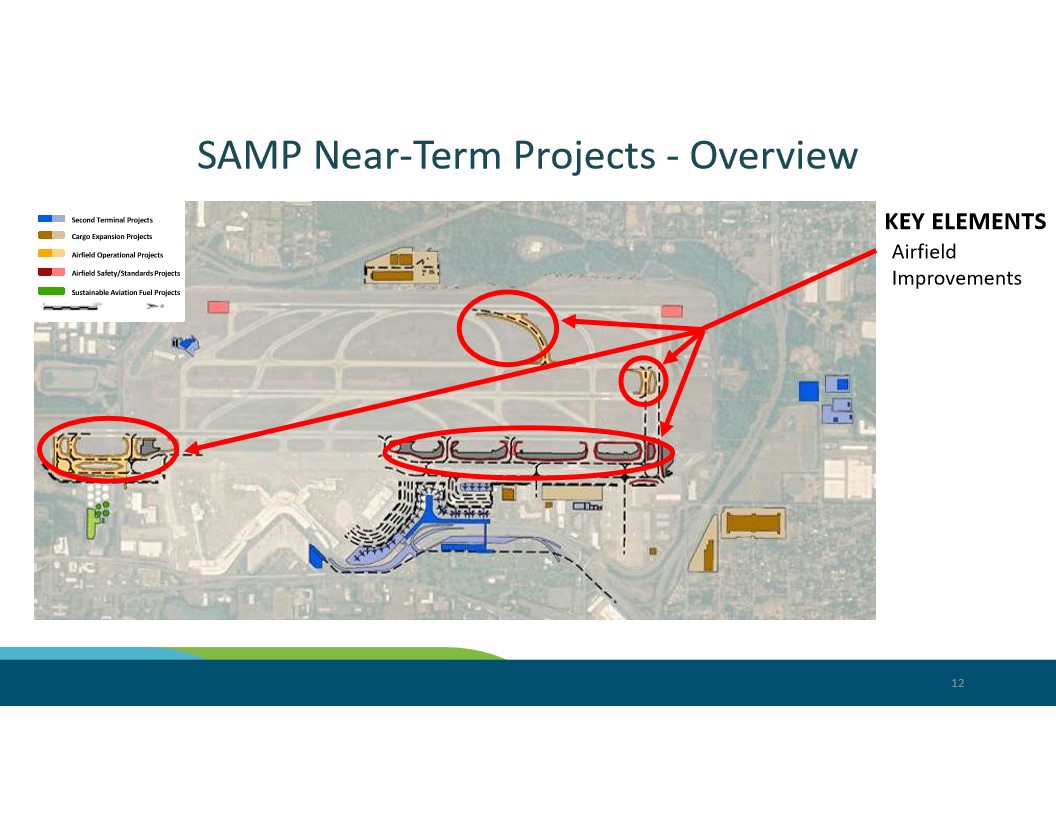
Slide 12 from a Seattle-Tacoma International Airport Strategic Airport Master Plan (SAMP) presentation, showing an aerial map with near-term capital projects highlighted by category including Second Terminal Projects, Cargo Expansion Projects, Airfield Operational Projects, Airfield Safety/Standards Projects, and Sustainable Aviation Fuel Projects. Key elements called out with red circles and arrows include Airfield Improvements located on the airfield and terminal areas.
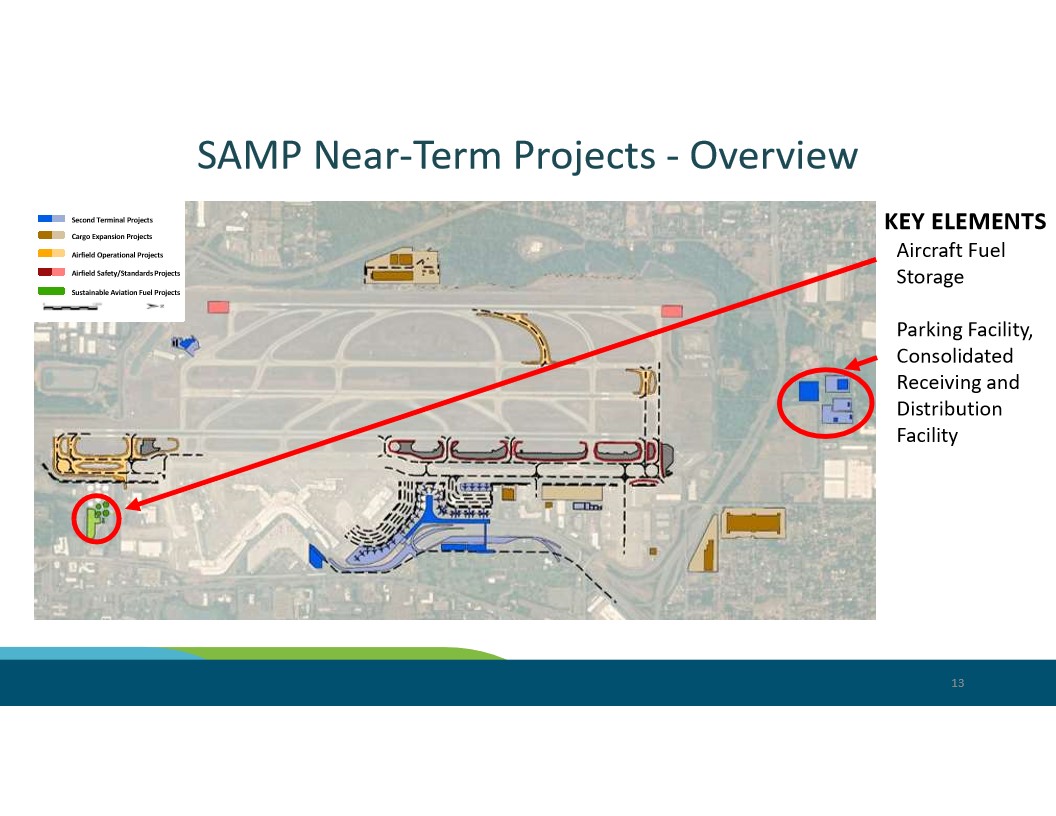
Presentation slide 13 titled ‘SAMP Near-Term Projects – Overview’ showing an aerial map of Seattle-Tacoma International Airport with color-coded project categories including Second Terminal Projects, Cargo Expansion Projects, Airfield Operational Projects, Airfield Safety/Standards Projects, and Sustainable Aviation Fuel Projects. Key elements highlighted include Aircraft Fuel Storage and a Parking Facility/Consolidated Receiving and Distribution Facility, indicated by red arrows and circles on the map.
Slide 14 from a Port of Seattle presentation titled ‘SAMP Near-Term Projects Environmental Review,’ covering Draft NEPA Environmental Assessment Findings and Next Steps. The Port of Seattle logo is visible, indicating this is an official Port document related to the Seattle-Tacoma International Airport Master Plan (SAMP) environmental review process.
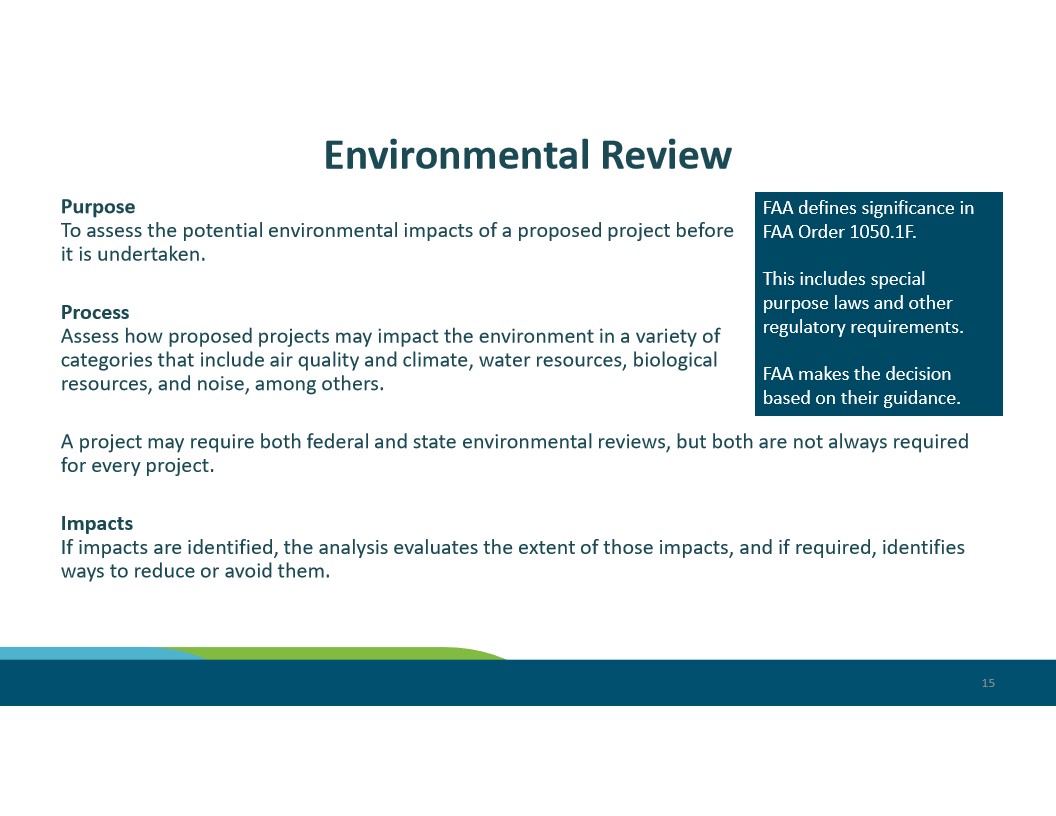
Slide 15 from a presentation explaining the FAA environmental review process, referencing FAA Order 1050.1F as the governing document for defining significance. It outlines the purpose, process (covering air quality, water resources, biological resources, and noise), and impact mitigation requirements for proposed airport projects.
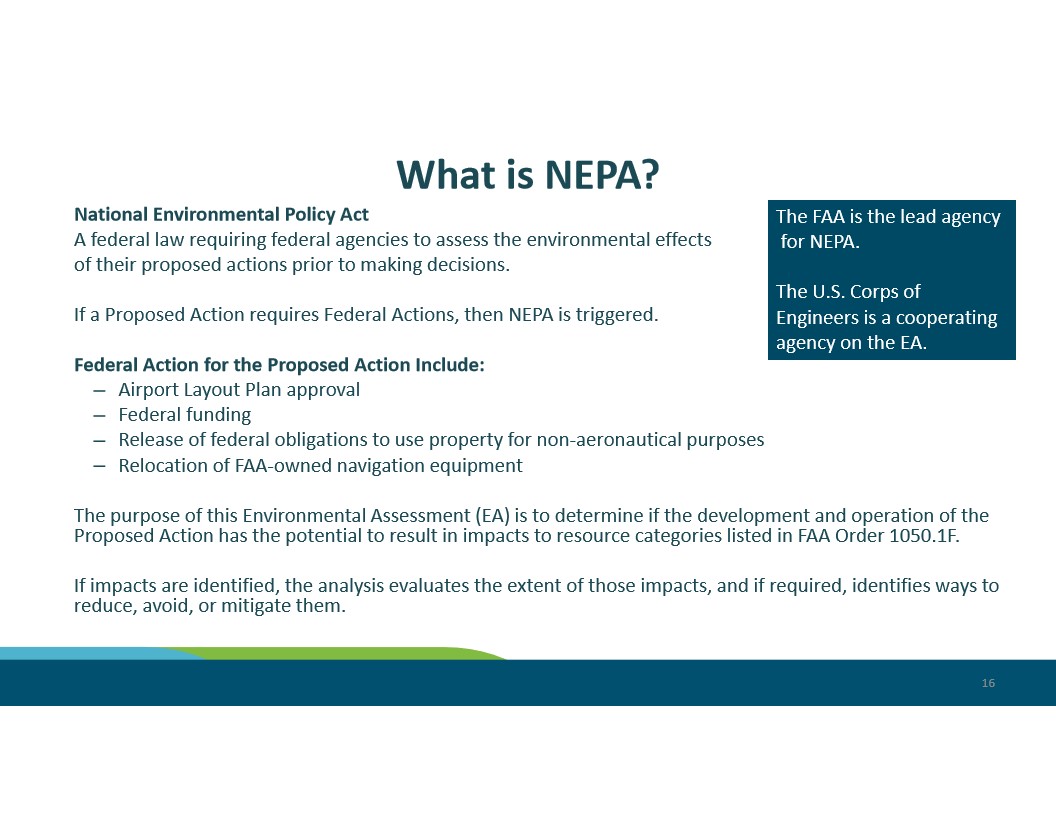
Slide 16 from an FAA-led Environmental Assessment (EA) presentation explaining the National Environmental Policy Act (NEPA), noting the FAA as lead agency and the U.S. Army Corps of Engineers as cooperating agency. It outlines federal actions triggering NEPA review—including Airport Layout Plan approval, federal funding, and relocation of FAA-owned navigation equipment—and references FAA Order 1050.1F as the governing framework for resource impact categories.
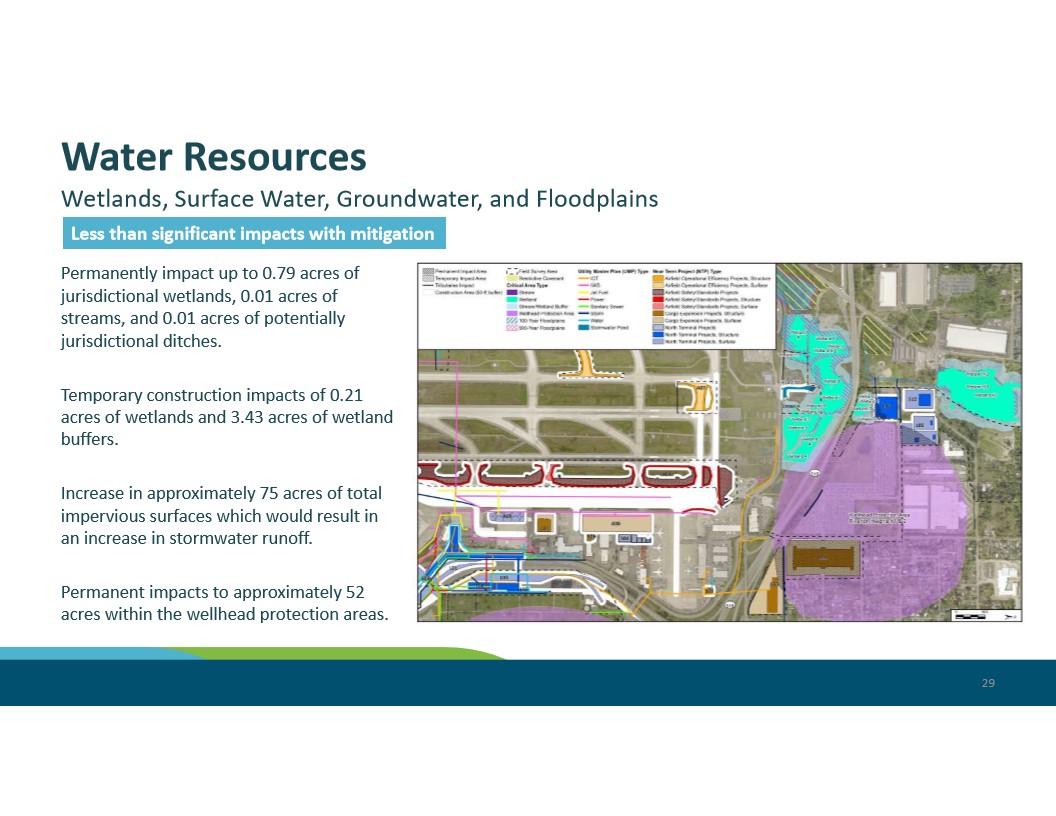
Slide 29 from what appears to be a Sea-Tac Airport Environmental Impact Statement presentation, summarizing water resource impacts including permanent impacts to 0.79 acres of jurisdictional wetlands, temporary construction impacts of 0.21 acres of wetlands and 3.43 acres of wetland buffers, an increase of approximately 75 acres of impervious surfaces, and permanent impacts to approximately 52 acres within wellhead protection areas. The overall finding is ‘Less than significant impacts with mitigation.’
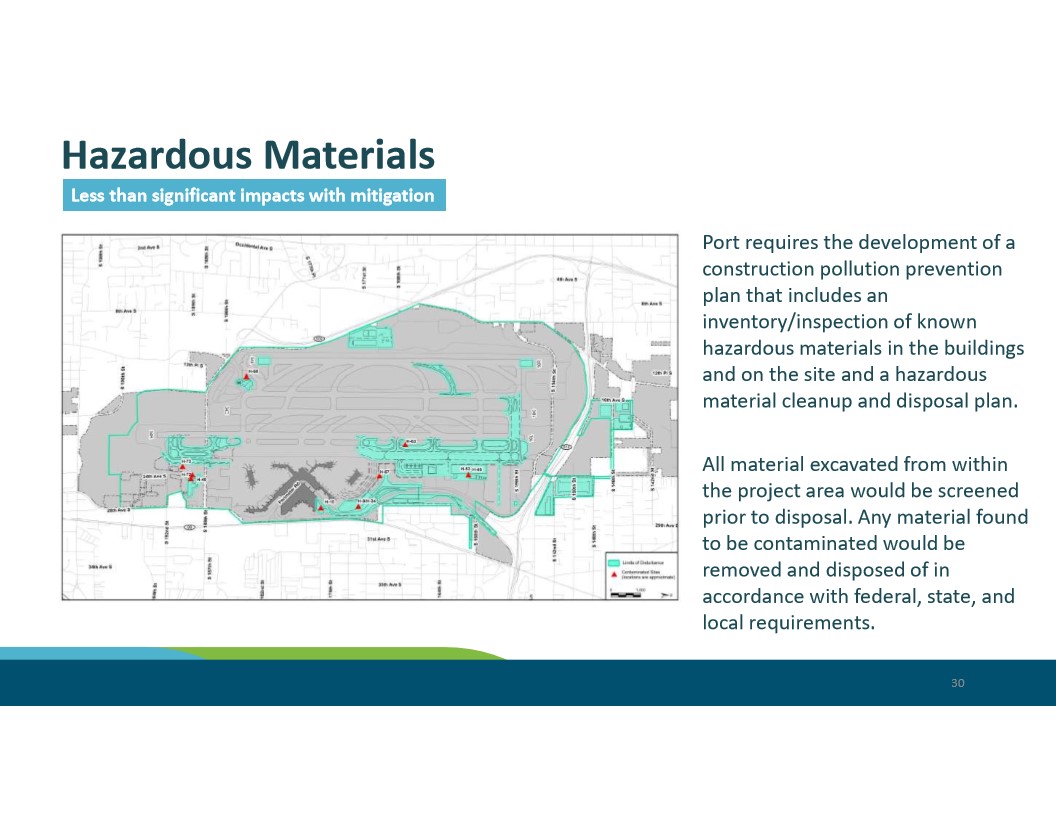
Presentation slide titled ‘Hazardous Materials’ classified as ‘Less than significant impacts with mitigation,’ describing Port requirements for a construction pollution prevention plan including inventory/inspection of known hazardous materials and a cleanup/disposal plan for the Sea-Tac Airport project area. A map shows the limits of disturbance and contaminated site locations (marked as approximate) within and around the airport footprint.
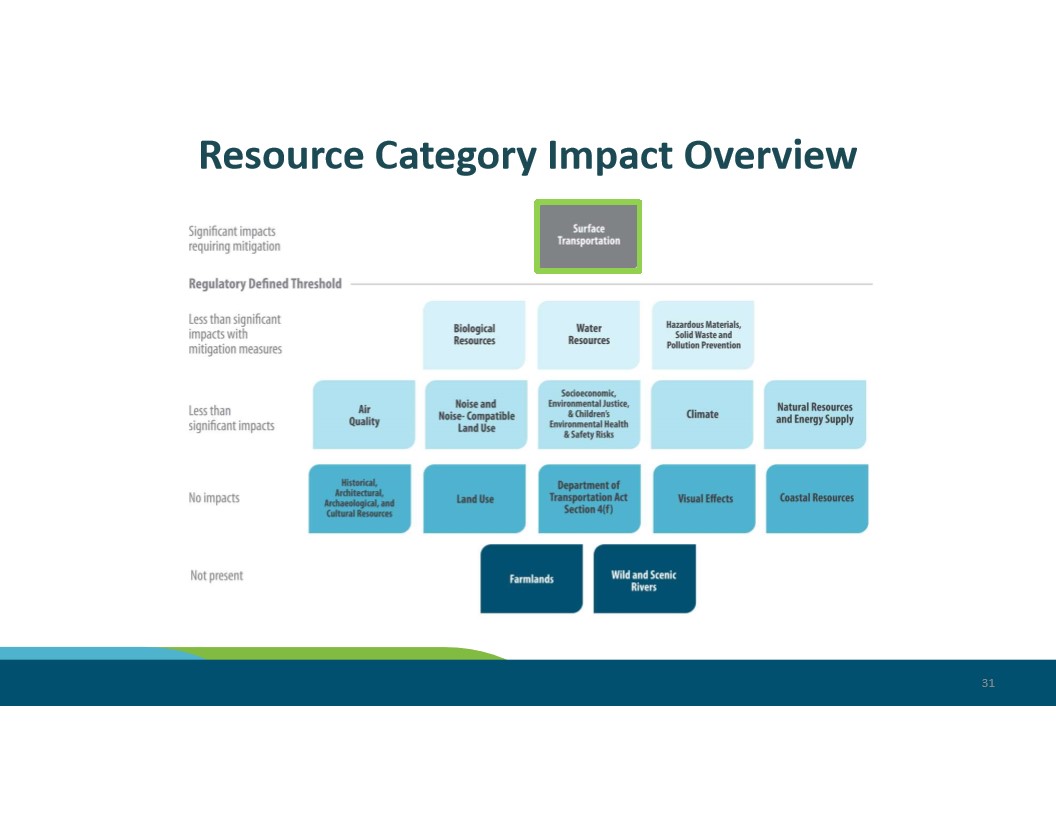
A presentation slide titled ‘Resource Category Impact Overview’ displaying a tiered matrix of environmental and transportation resource categories organized by impact level, ranging from ‘Significant impacts requiring mitigation’ (Surface Transportation) down through ‘Less than significant,’ ‘No impacts,’ and ‘Not present’ (Farmlands, Wild and Scenic Rivers). The slide appears to be from an environmental impact assessment or NEPA-related planning document, numbered page 31.
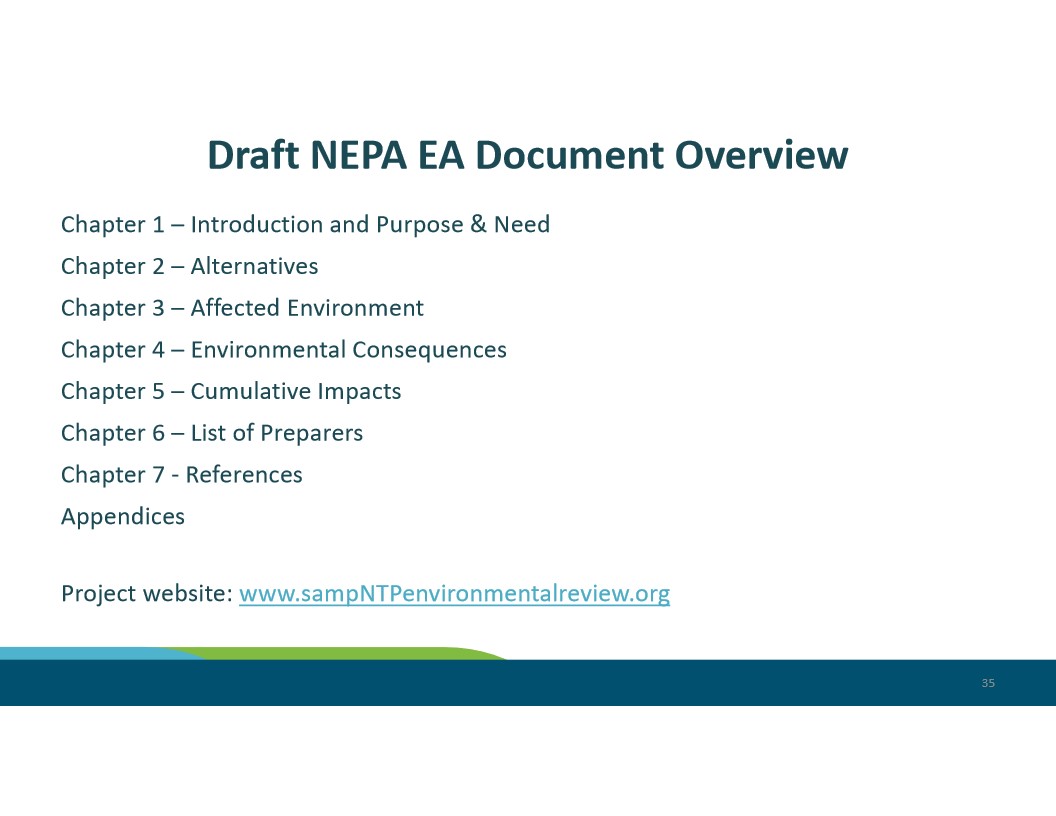
Slide 35 presents the chapter structure of the Draft NEPA Environmental Assessment (EA) document for the SAMP-NTP project, covering Introduction/Purpose & Need, Alternatives, Affected Environment, Environmental Consequences, Cumulative Impacts, List of Preparers, References, and Appendices. The project website is listed as www.sampNTPenvironmentalreview.org, indicating this is associated with Sea-Tac Airport’s Sustainable Airport Master Plan – Near-Term Projects environmental review process.
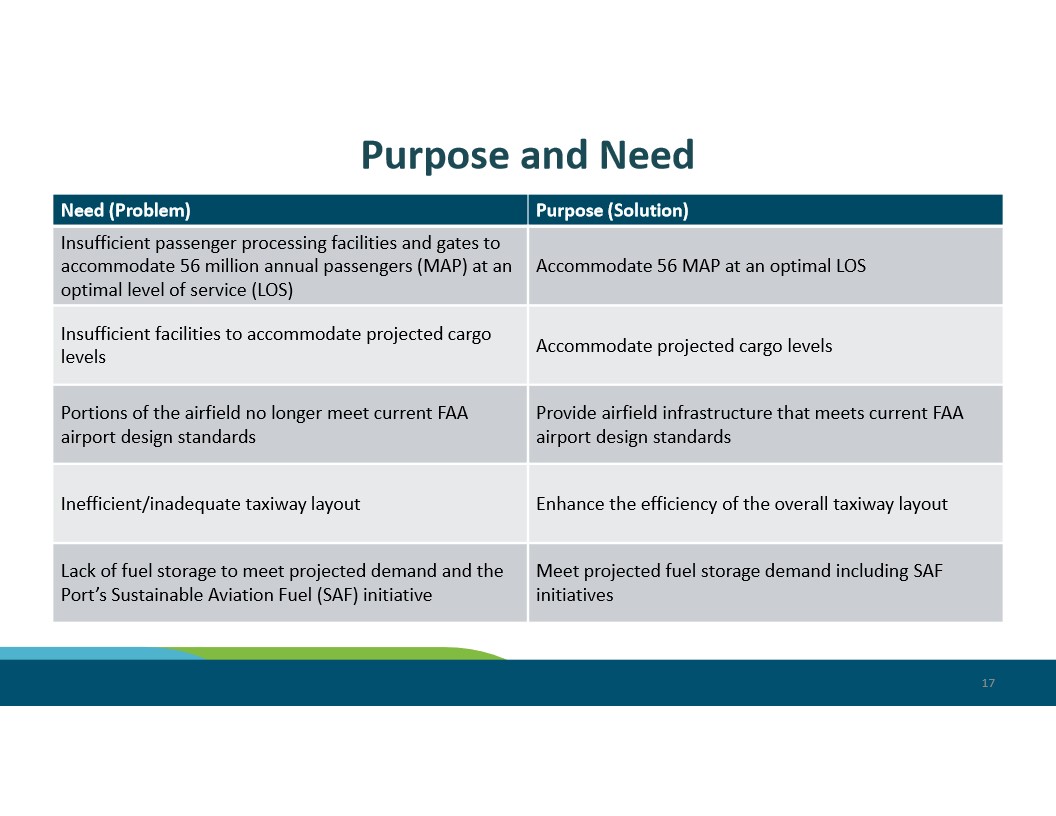
Slide 17 from a Sea-Tac Airport planning presentation outlines five needs and corresponding purposes, including accommodating 56 million annual passengers at an optimal level of service, meeting projected cargo levels, bringing airfield infrastructure into compliance with current FAA airport design standards, improving taxiway layout efficiency, and addressing fuel storage needs including the Port’s Sustainable Aviation Fuel (SAF) initiative.
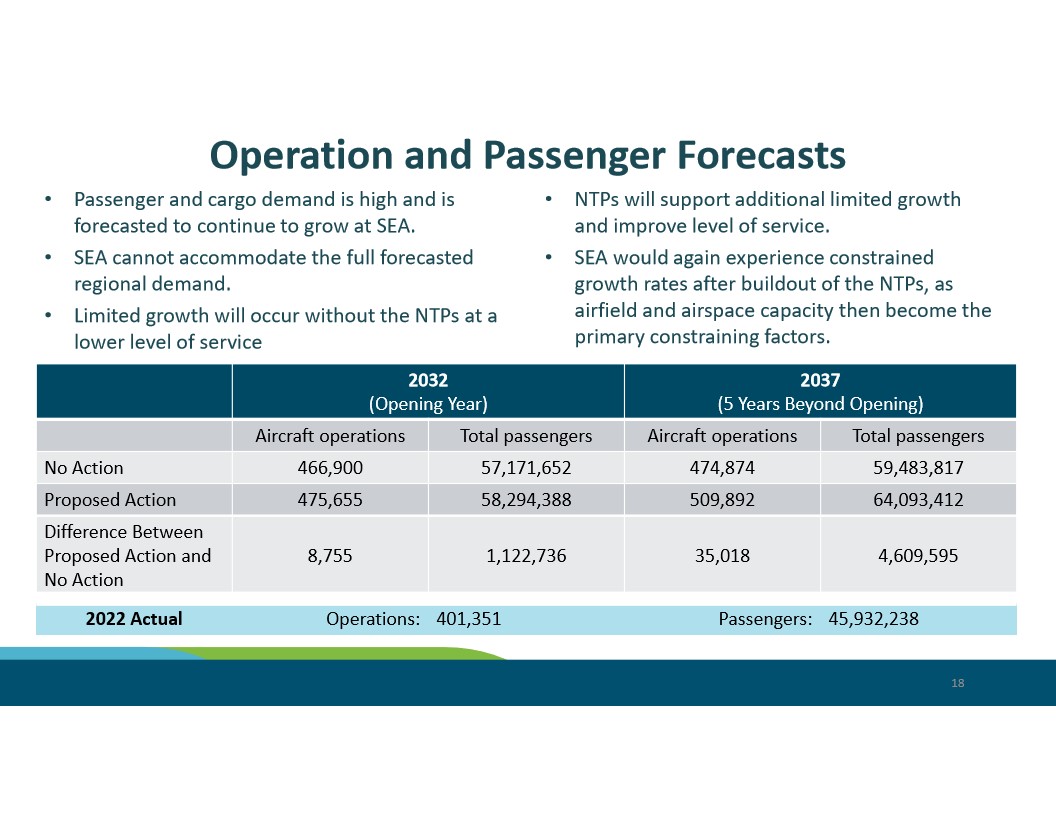
Slide 18 from a Sea-Tac Airport planning presentation showing operation and passenger forecast data for 2032 (opening year) and 2037 (5 years beyond opening) under ‘No Action’ and ‘Proposed Action’ (NTP – New Terminal/Concourse Program) scenarios. The 2022 actual baseline shows 401,351 operations and 45,932,238 passengers, with the Proposed Action projecting 509,892 operations and 64,093,412 total passengers by 2037.
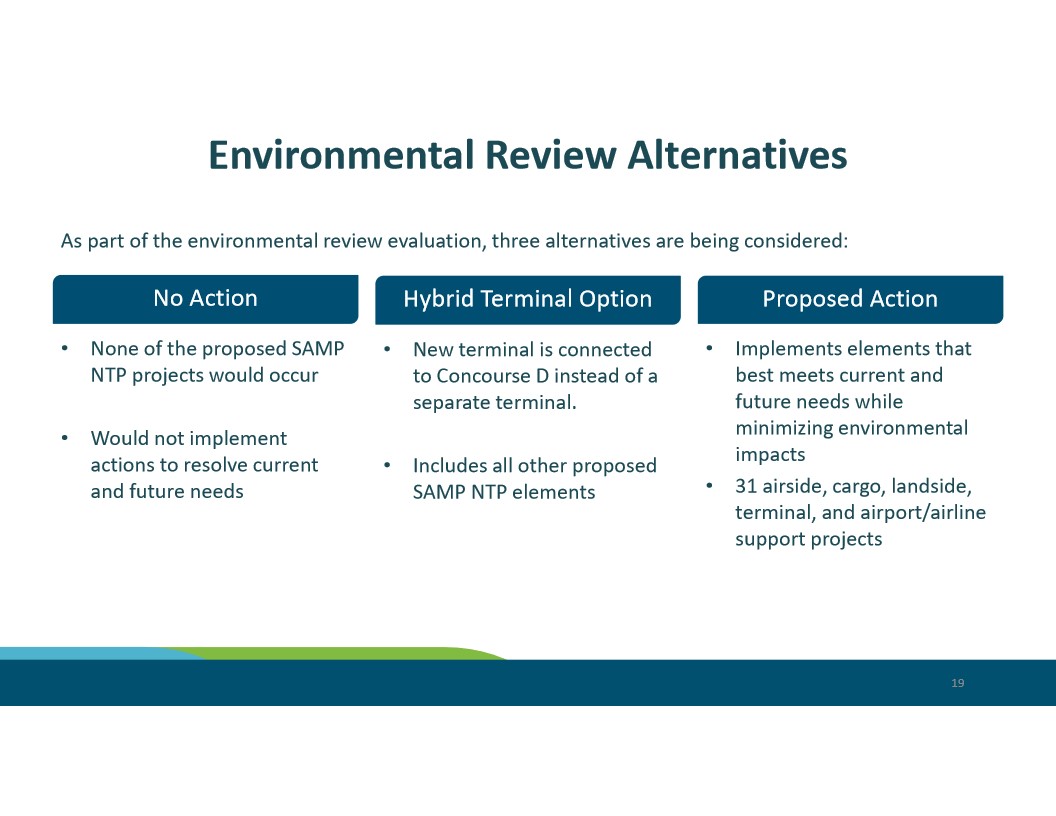
Slide 19 from a Sea-Tac Airport presentation outlines three alternatives under the Sustainable Airport Master Plan (SAMP) Near-Term Projects (NTP) environmental review evaluation: No Action (no SAMP NTP projects occur), Hybrid Terminal Option (new terminal connected to Concourse D), and Proposed Action (31 airside, cargo, landside, terminal, and airport/airline support projects minimizing environmental impacts).
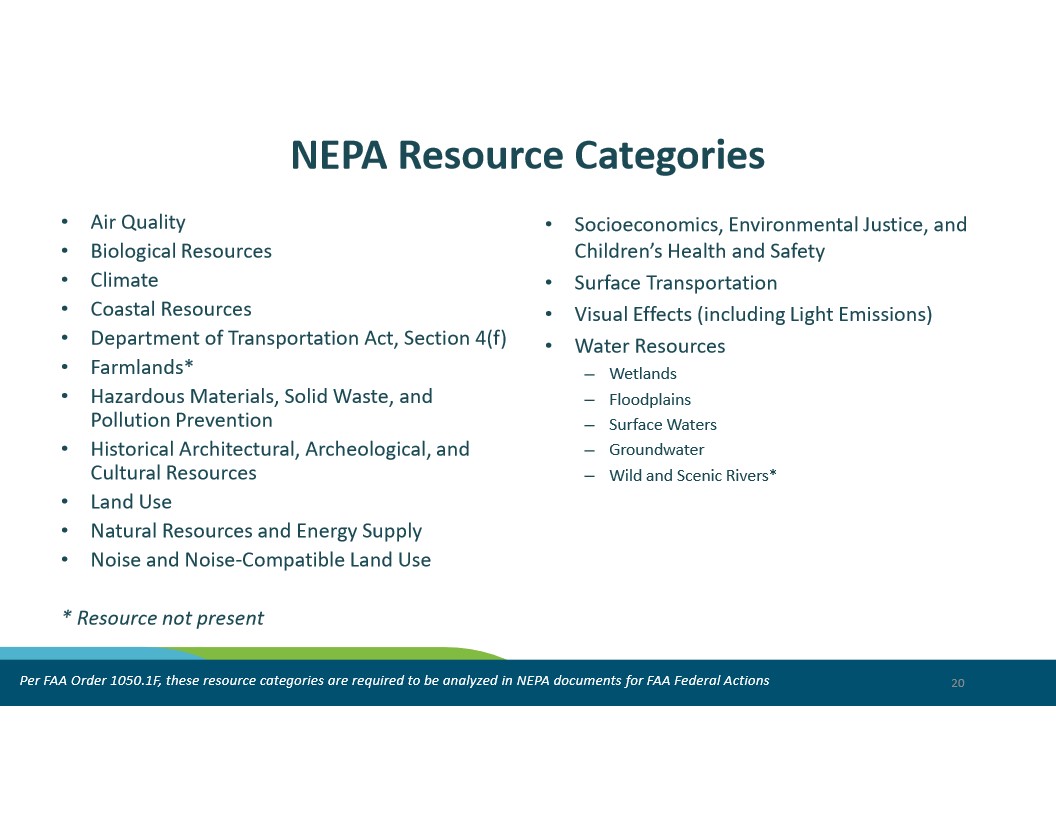
This slide lists the NEPA resource categories required to be analyzed in environmental documents for FAA Federal Actions per FAA Order 1050.1F. Categories include Air Quality, Biological Resources, Climate, Coastal Resources, Noise and Noise-Compatible Land Use, Water Resources (with subcategories), and others; items marked with an asterisk (Farmlands, Wild and Scenic Rivers) are noted as resources not present.
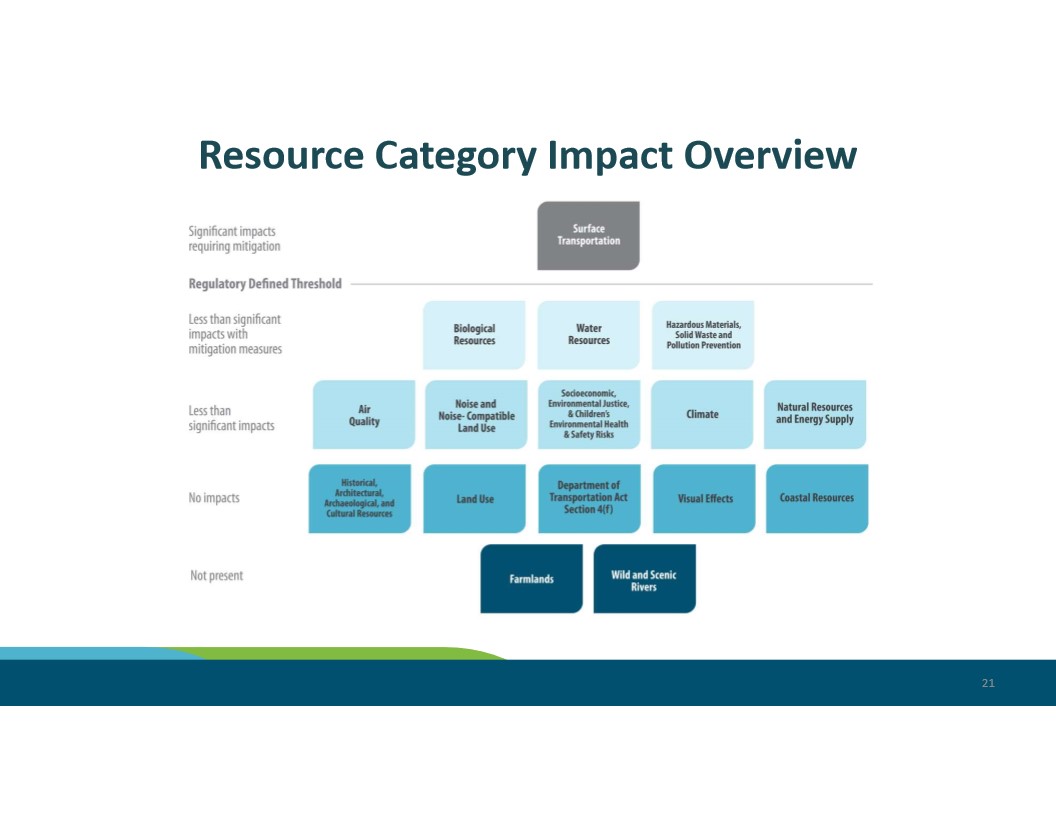
A presentation slide titled ‘Resource Category Impact Overview’ showing a tiered matrix of environmental resource categories ranked by impact level, from ‘Significant impacts requiring mitigation’ (Surface Transportation) down through ‘Less than significant impacts with mitigation measures,’ ‘Less than significant impacts,’ ‘No impacts,’ and ‘Not present’ (Farmlands, Wild and Scenic Rivers). The slide appears to be from an environmental impact or NEPA-related assessment document, page 21.
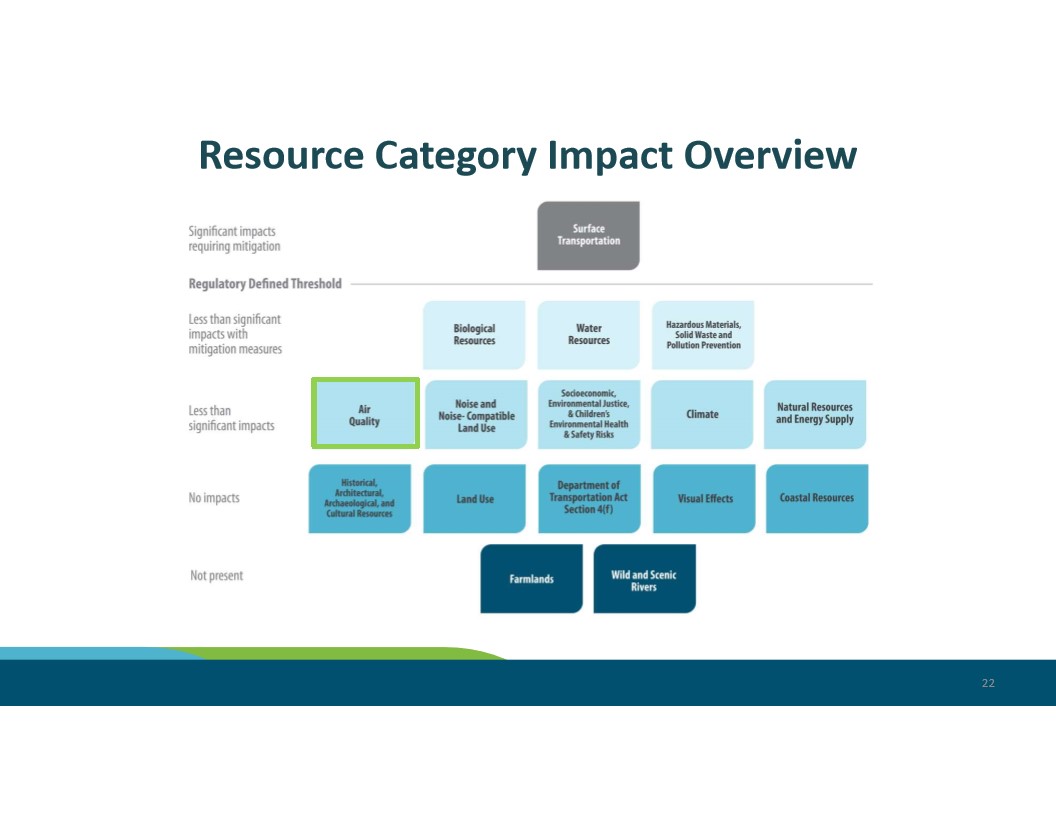
A presentation slide titled ‘Resource Category Impact Overview’ categorizes environmental resource impacts into five tiers: significant impacts requiring mitigation (Surface Transportation), less than significant with mitigation (Biological Resources, Water Resources, Hazardous Materials), less than significant (Air Quality, Noise, Climate, etc.), no impacts (Land Use, Visual Effects, Coastal Resources, etc.), and not present (Farmlands, Wild and Scenic Rivers). No organization logo or project name is visible on this slide.
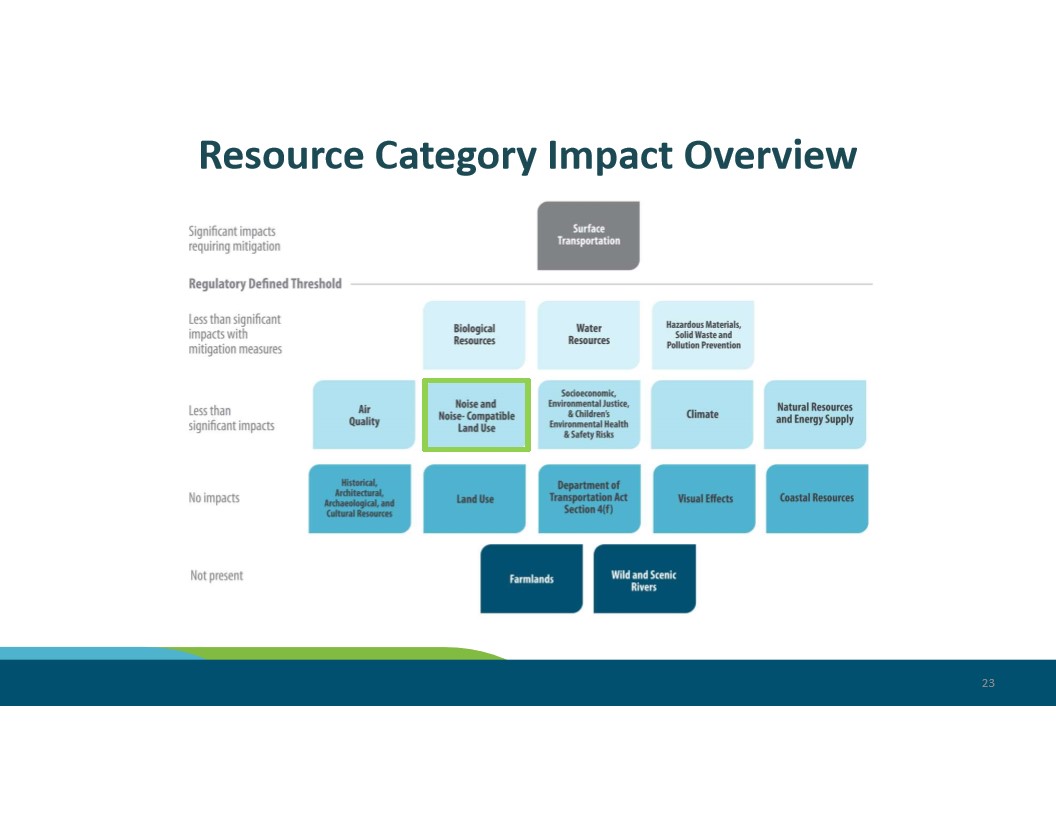
A presentation slide titled ‘Resource Category Impact Overview’ displaying a tiered impact matrix categorizing environmental resource areas from ‘Significant impacts requiring mitigation’ (Surface Transportation) down through ‘Less than significant,’ ‘No impacts,’ and ‘Not present’ (Farmlands, Wild and Scenic Rivers). Categories include Biological Resources, Water Resources, Noise and Noise-Compatible Land Use, Climate, Visual Effects, and Coastal Resources, among others.
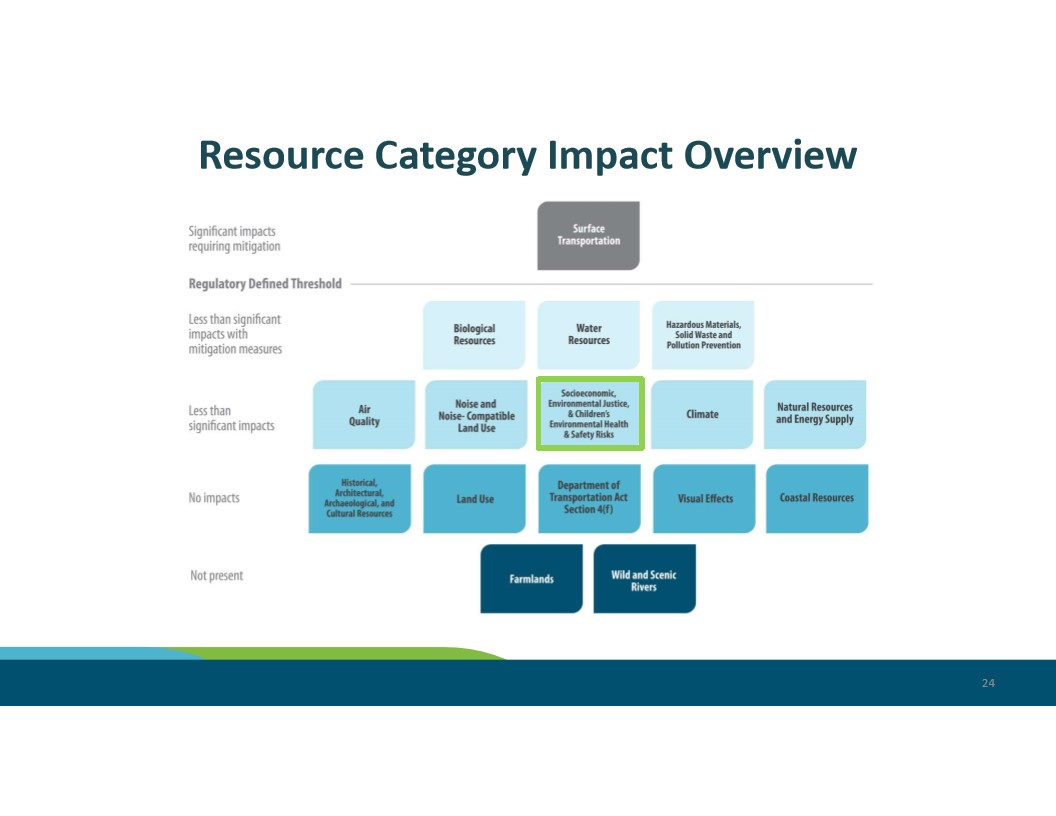
A presentation slide titled ‘Resource Category Impact Overview’ displaying a tiered impact matrix categorizing environmental resource areas by level of significance, ranging from ‘Significant impacts requiring mitigation’ (Surface Transportation) down to ‘Not present’ (Farmlands; Wild and Scenic Rivers). Categories include Biological Resources, Water Resources, Air Quality, Climate, Land Use, Visual Effects, and Socioeconomic/Environmental Justice among others, with the latter highlighted in a green border under ‘Less than significant impacts.’
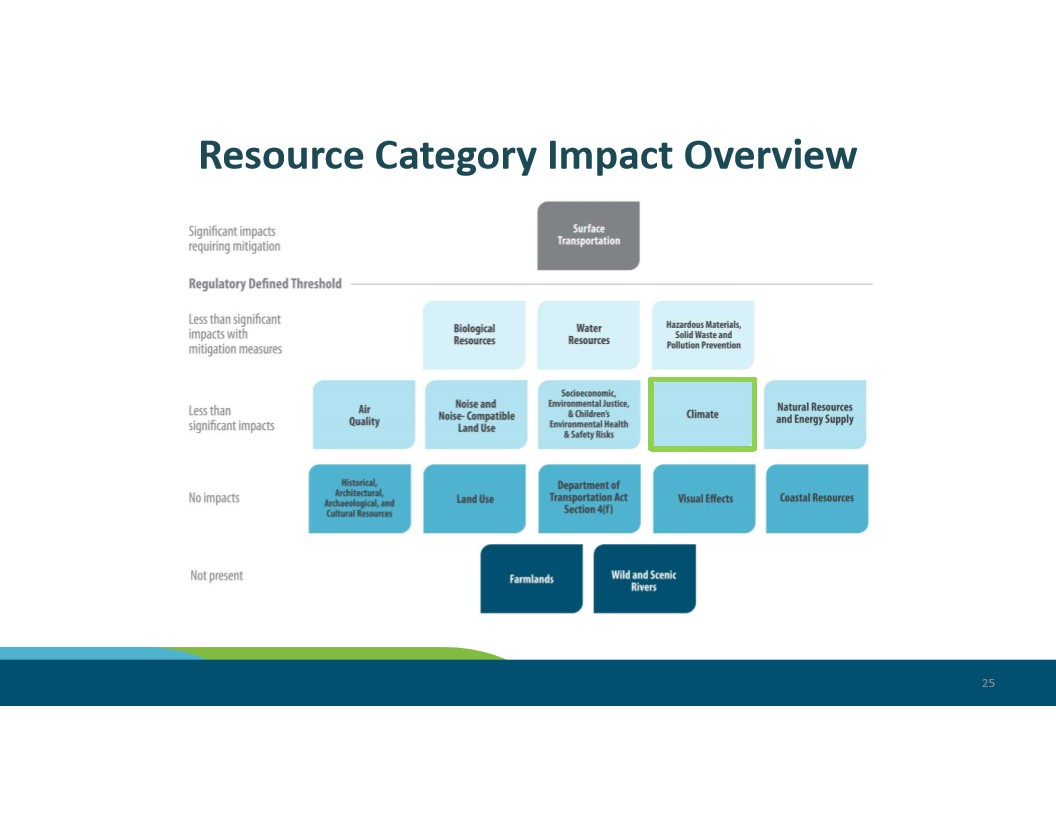
A presentation slide titled ‘Resource Category Impact Overview’ organizing environmental resource categories into impact tiers ranging from ‘Significant impacts requiring mitigation’ (Surface Transportation) down through ‘Less than significant impacts,’ ‘No impacts,’ and ‘Not present.’ Climate is highlighted with a green border under ‘Less than significant impacts,’ and Farmlands and Wild and Scenic Rivers are marked as ‘Not present.’
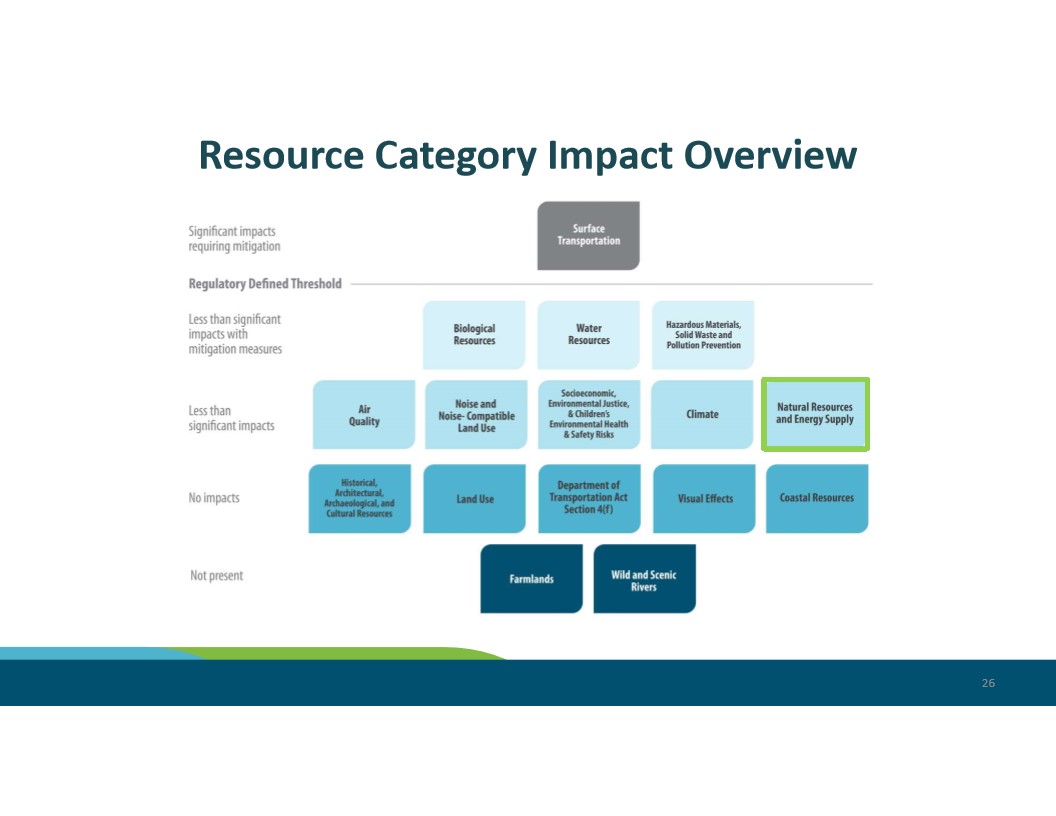
A presentation slide titled ‘Resource Category Impact Overview’ displaying a matrix of environmental resource categories organized by impact level, ranging from ‘Significant impacts requiring mitigation’ (Surface Transportation) down through ‘Less than significant,’ ‘No impacts,’ and ‘Not present’ categories including Biological Resources, Water Resources, Air Quality, Climate, Natural Resources and Energy Supply, and others. The slide is numbered 26 and uses a color-coded layout typical of an environmental impact assessment document.
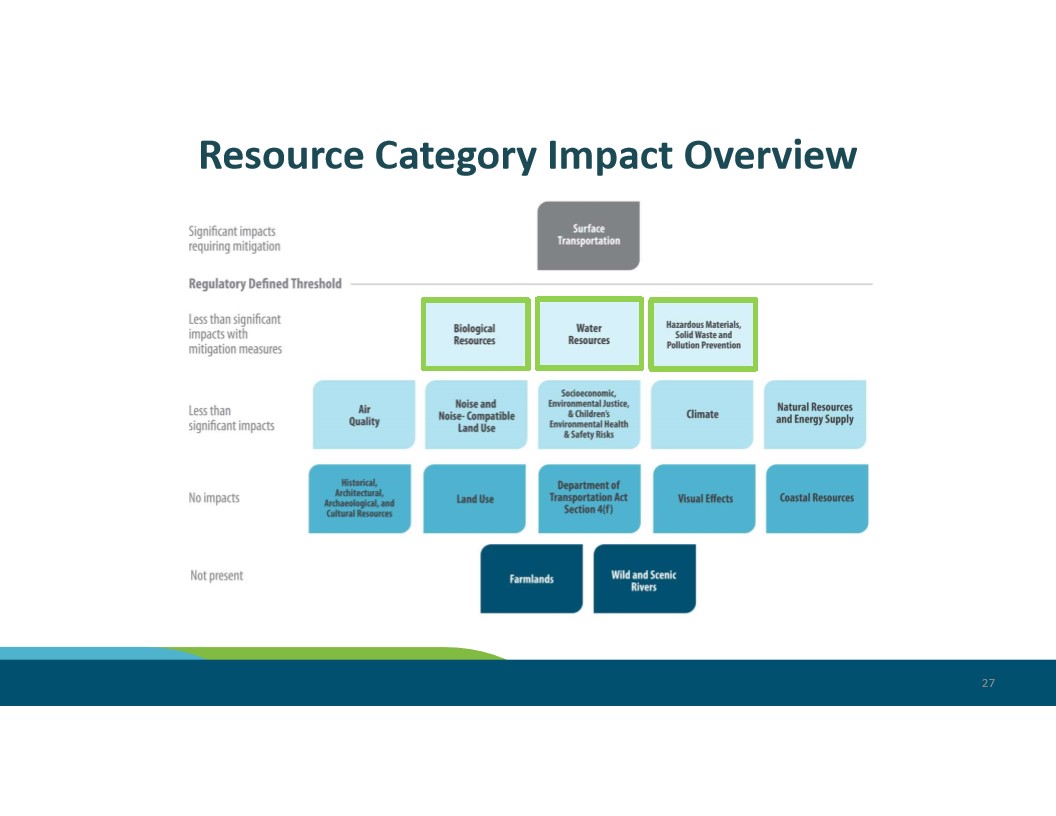
A presentation slide titled ‘Resource Category Impact Overview’ displaying a tiered impact classification chart. Categories range from ‘Significant impacts requiring mitigation’ (Surface Transportation) down through ‘Less than significant impacts with mitigation measures’ (Biological Resources, Water Resources, Hazardous Materials/Solid Waste/Pollution Prevention), ‘Less than significant impacts,’ ‘No impacts,’ and ‘Not present’ (Farmlands, Wild and Scenic Rivers).
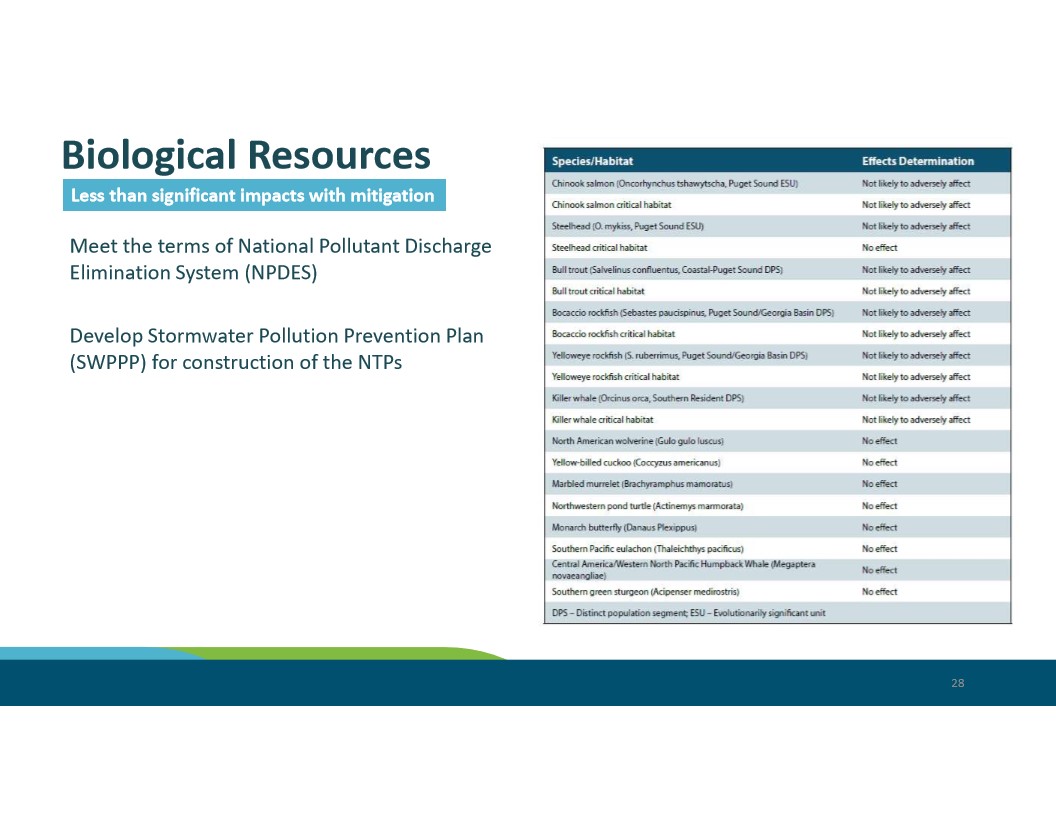
A presentation slide titled ‘Biological Resources’ states impacts are ‘Less than significant with mitigation’ and lists mitigation measures including NPDES compliance and a Stormwater Pollution Prevention Plan (SWPPP) for construction of NTPs. A table on the right lists species and habitats such as Chinook salmon, Steelhead, Bull trout, Killer whale, and Monarch butterfly with effects determinations of ‘Not likely to adversely affect’ or ‘No effect.’
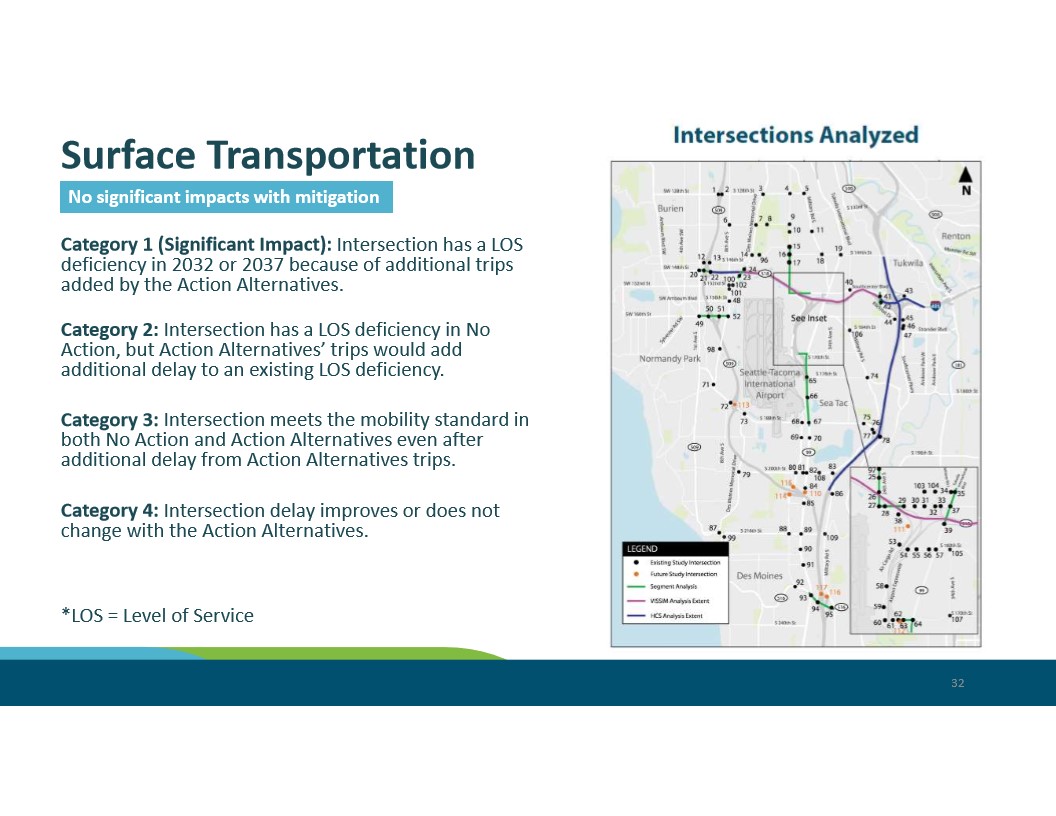
A presentation slide titled ‘Surface Transportation’ states ‘No significant impacts with mitigation’ and defines four categories of Level of Service (LOS) intersection impact for 2032 and 2037 Action Alternatives. The accompanying map shows numbered study intersections analyzed in the vicinity of Seattle-Tacoma International Airport, Des Moines, Burien, Tukwila, and Sea-Tac, with VISSIM and HCS analysis extents marked.
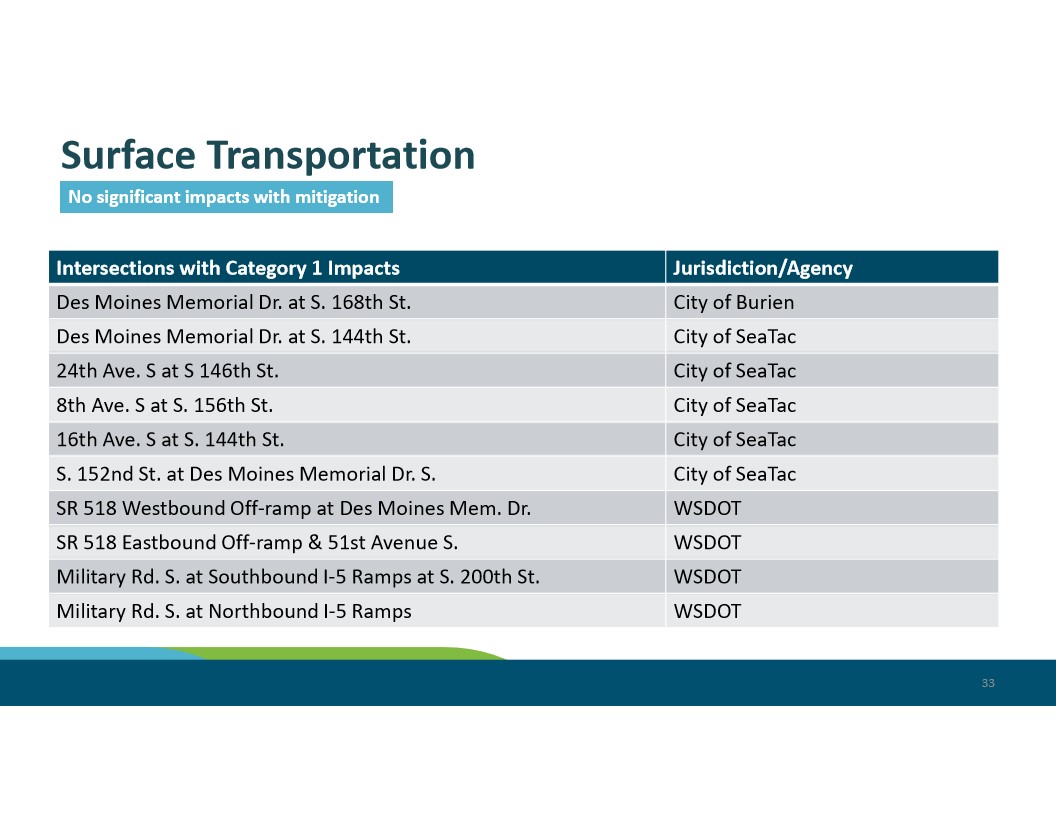
A presentation slide titled ‘Surface Transportation’ noting ‘No significant impacts with mitigation,’ listing ten intersections with Category 1 impacts and their jurisdictions, including the City of Burien, City of SeaTac, and WSDOT. Affected intersections include locations on Des Moines Memorial Drive, SR 518 ramps, and Military Road S. at I-5 ramps.
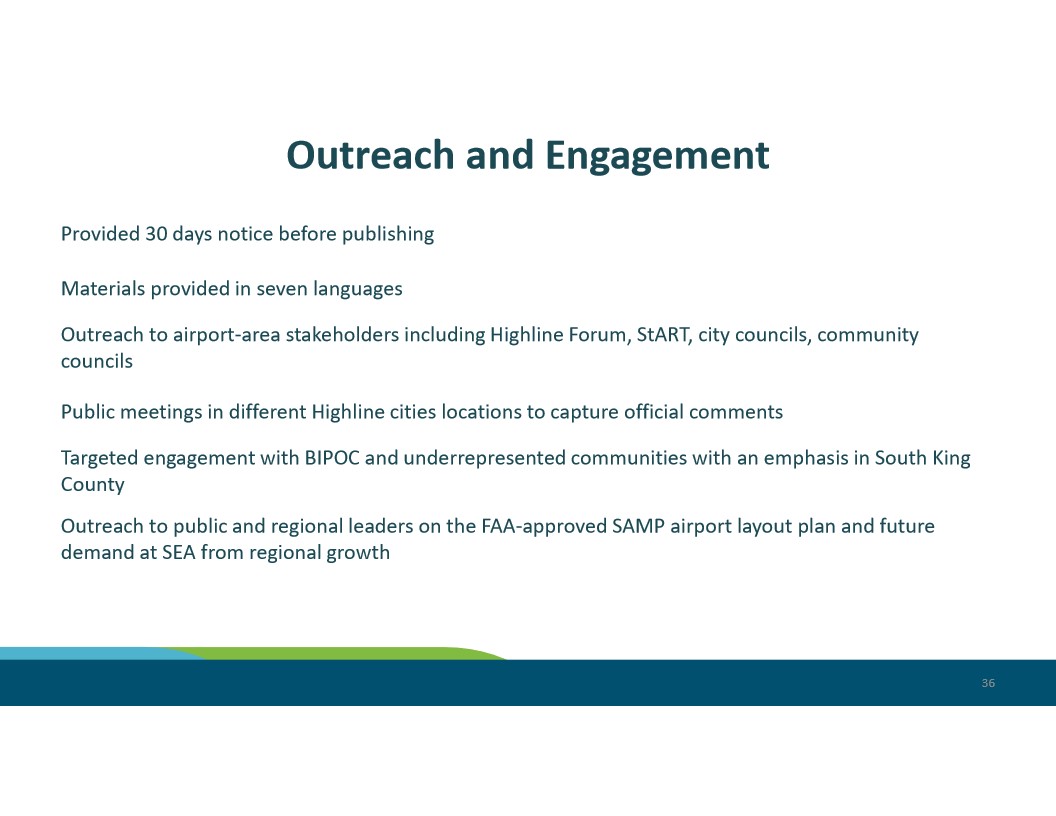
Slide 36 from a Sea-Tac Airport (SEA) presentation summarizing public outreach and engagement efforts related to the FAA-approved SAMP (Sustainable Airport Master Plan) airport layout plan. Activities included 30-day advance notice, materials in seven languages, stakeholder outreach to the Highline Forum and StART, public meetings in Highline cities, targeted engagement with BIPOC and underrepresented communities in South King County, and outreach to regional leaders on future airport demand.
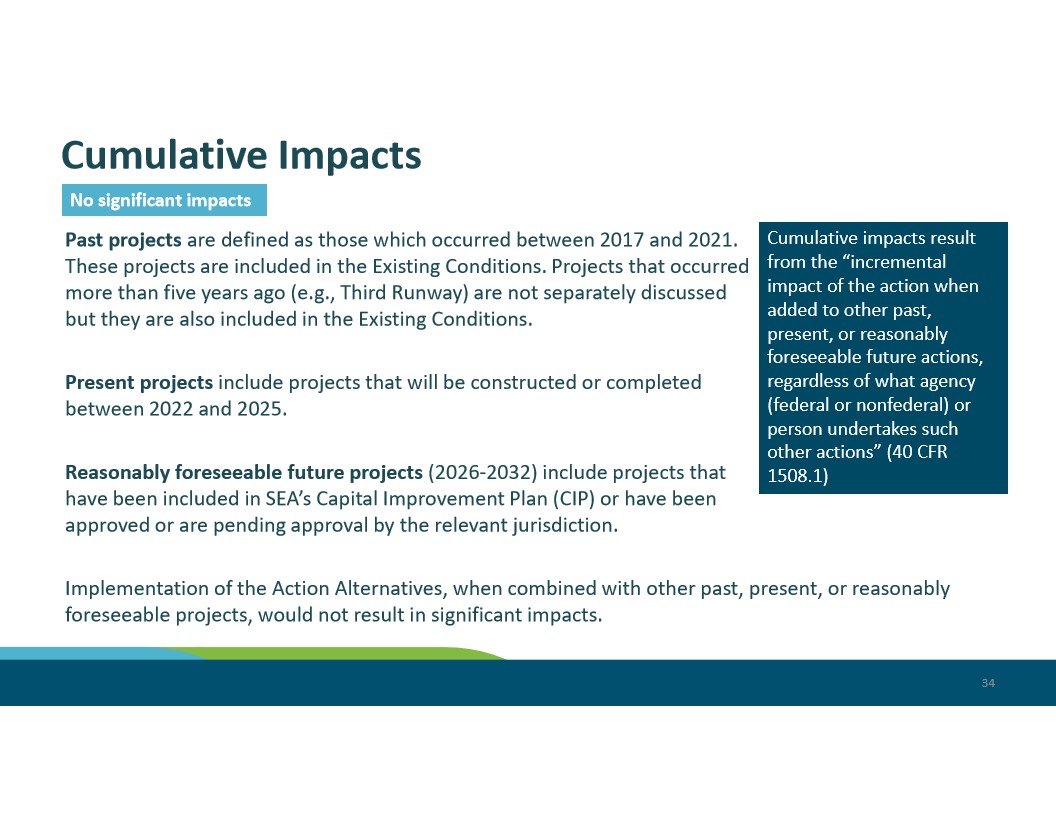
Slide 34 from a Seattle-Tacoma International Airport (SEA) environmental review presentation defines past (2017–2021), present (2022–2025), and reasonably foreseeable future (2026–2032) projects for cumulative impact analysis under 40 CFR 1508.1. It concludes that implementation of the Action Alternatives, combined with other past, present, or foreseeable projects, would not result in significant cumulative impacts.
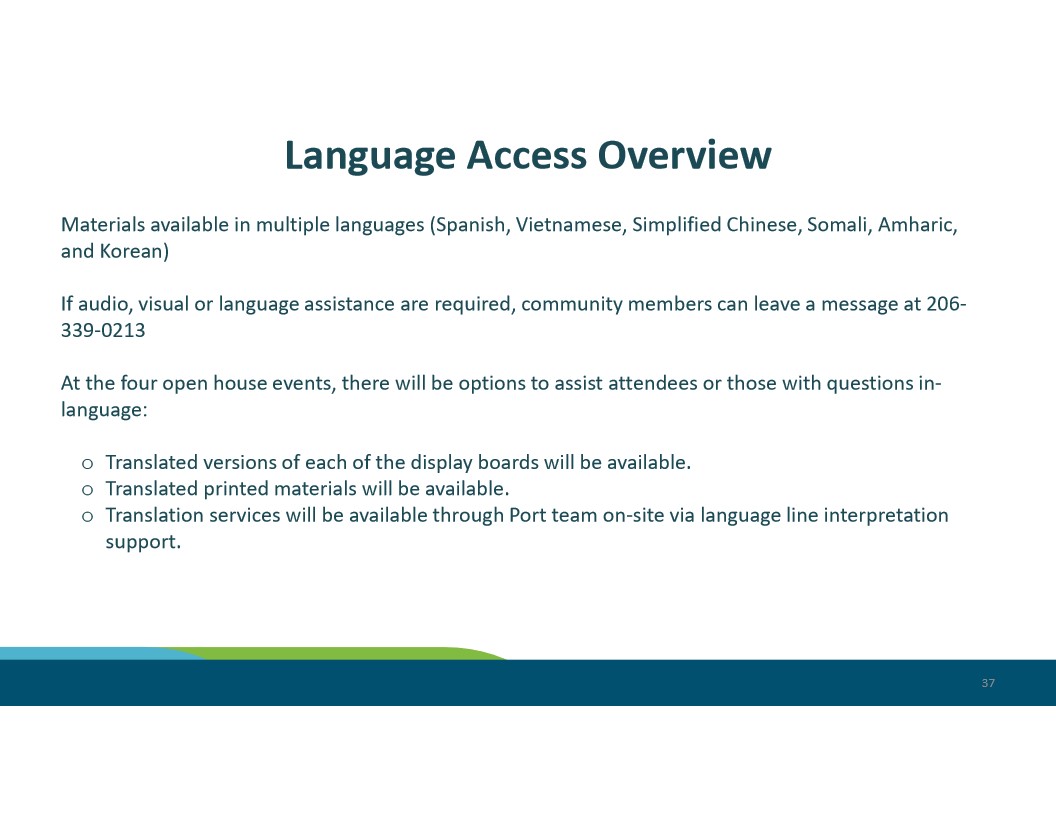
Slide 37 from a Port of Seattle presentation outlines language access provisions for Sea-Tac Airport community open house events, noting materials available in Spanish, Vietnamese, Simplified Chinese, Somali, Amharic, and Korean. Community members requiring audio, visual, or language assistance could call 206-339-0213, and on-site language line interpretation support was offered at four open house events.
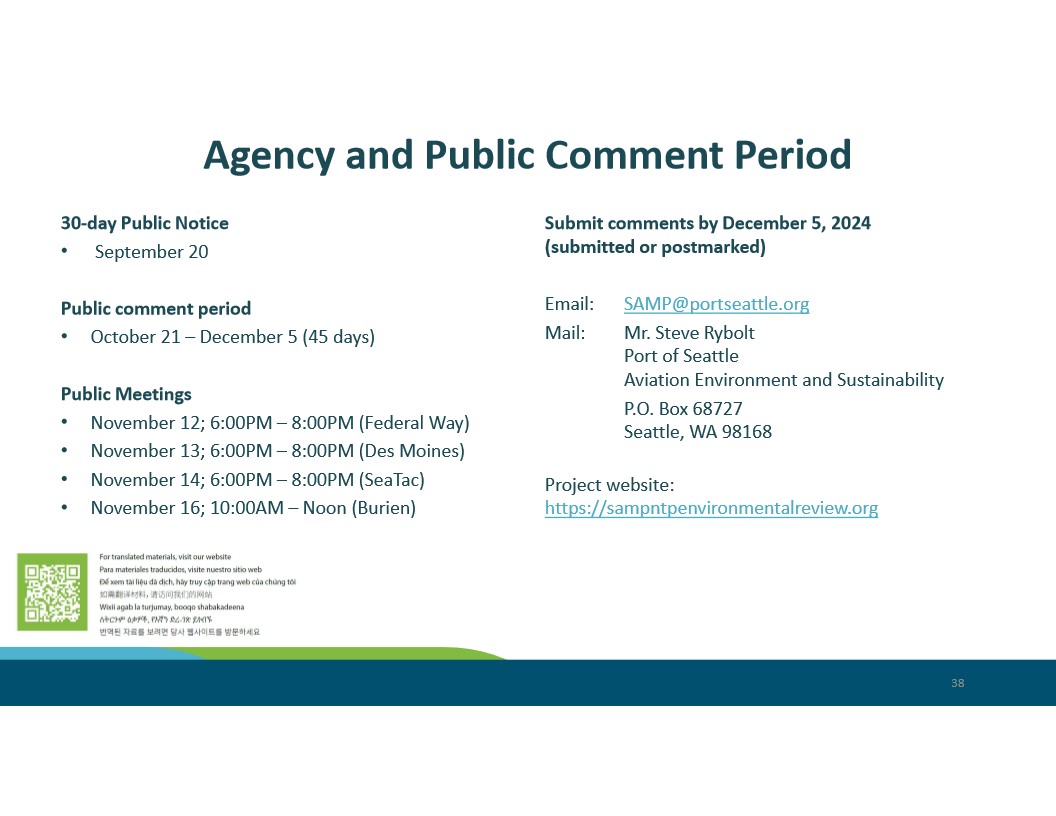
Slide 38 from a Port of Seattle presentation announcing the 30-day public notice (September 20) and 45-day public comment period (October 21 – December 5, 2024) for the Seattle-Tacoma International Airport Sustainable Airport Master Plan (SAMP) environmental review. Public meetings are listed for Federal Way, Des Moines, SeaTac, and Burien in November 2024, with comments directed to Mr. Steve Rybolt at SAMP@portseattle.org or via the project website sampntpenvironmentalreview.org.
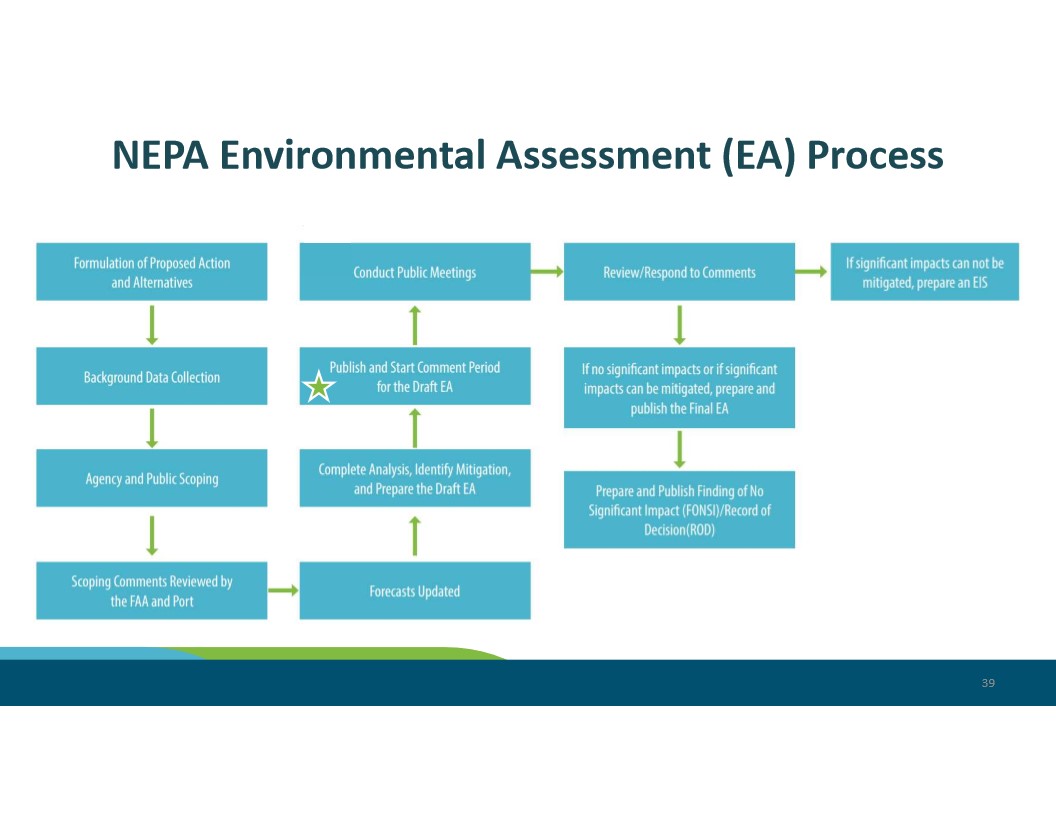
This slide (page 39) depicts the step-by-step NEPA Environmental Assessment process, beginning with Formulation of Proposed Action and Alternatives and proceeding through Background Data Collection, Agency and Public Scoping, Forecasts Updated, Draft EA preparation, public comment period, and culminating in either a Finding of No Significant Impact (FONSI)/Record of Decision (ROD) or, if significant impacts cannot be mitigated, preparation of an Environmental Impact Statement (EIS). A star icon marks the current status at the ‘Publish and Start Comment Period for the Draft EA’ step.
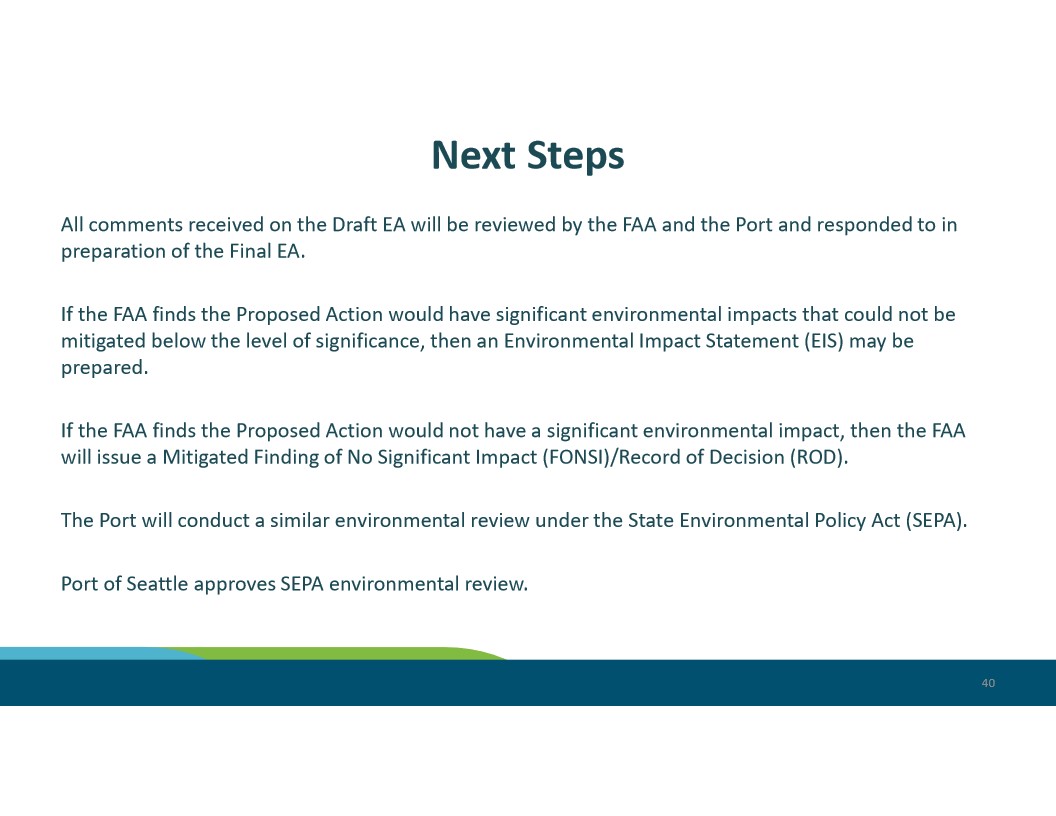
This presentation slide outlines the next steps in the FAA and Port of Seattle environmental review process for a proposed action at Sea-Tac Airport. Steps include FAA review of Draft EA comments, potential preparation of an Environmental Impact Statement (EIS) or issuance of a Mitigated FONSI/ROD, and Port of Seattle SEPA environmental review approval.
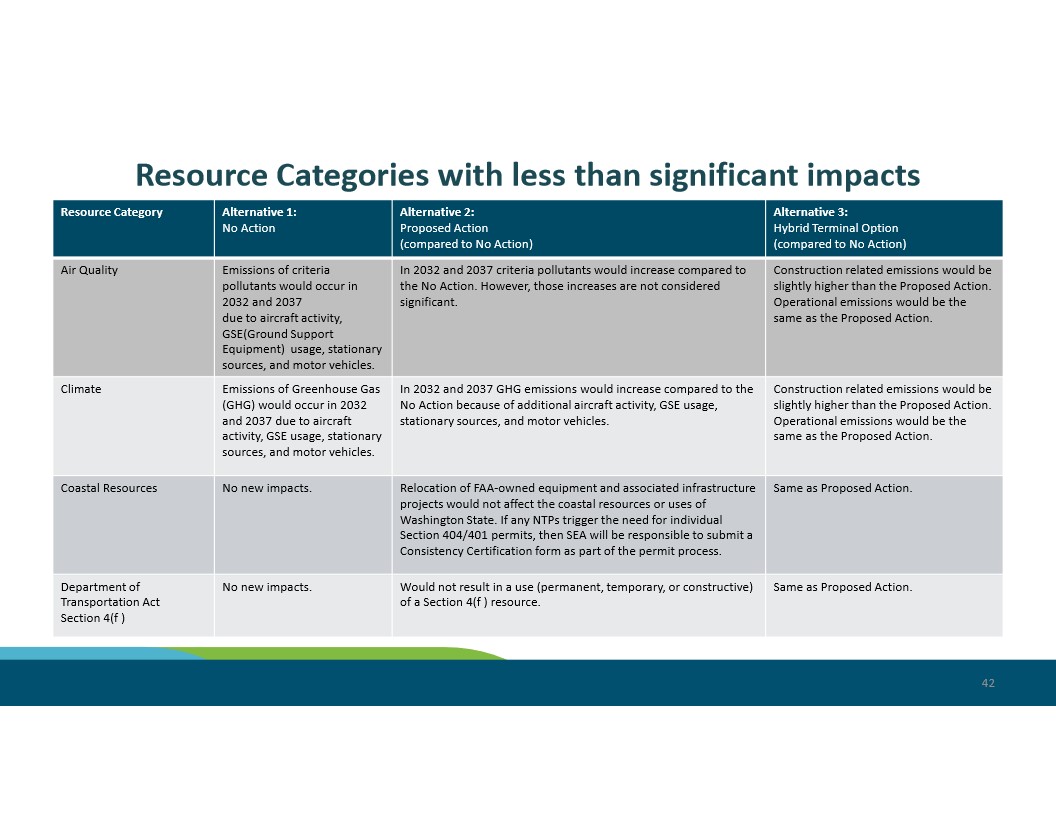
Slide 42 from a Sea-Tac Airport environmental review presentation comparing impacts across three alternatives (No Action, Proposed Action, and Hybrid Terminal Option) for resource categories including Air Quality, Climate, Coastal Resources, and Department of Transportation Act Section 4(f). The slide indicates that criteria pollutant and GHG emissions would increase under Alternatives 2 and 3 compared to No Action but are not considered significant, and that Coastal Resources and Section 4(f) resources would not be adversely affected.
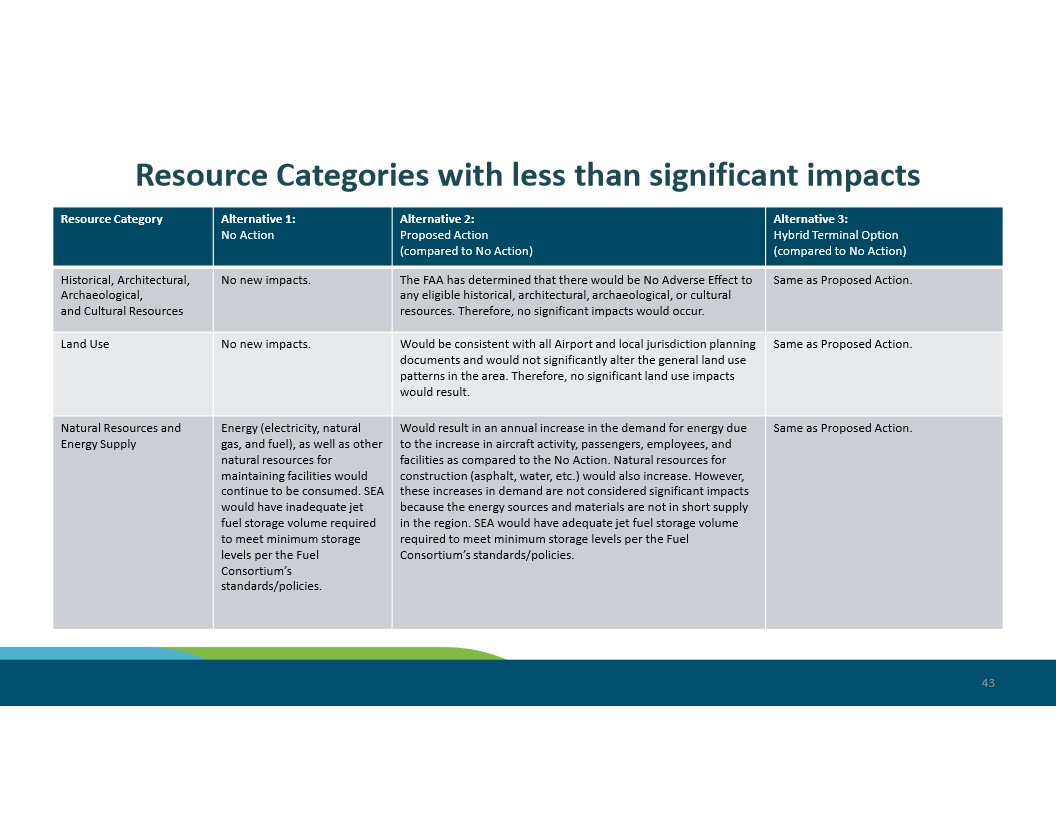
Slide 43 from a Seattle-Tacoma International Airport (SEA) environmental impact document compares three alternatives — No Action, Proposed Action, and Hybrid Terminal Option — across resource categories including Historical/Archaeological/Cultural Resources, Land Use, and Natural Resources and Energy Supply. The FAA determined no adverse effects to historical or cultural resources under the Proposed Action, and noted that SEA would have adequate jet fuel storage under Alternatives 2 and 3 but inadequate storage under the No Action alternative.
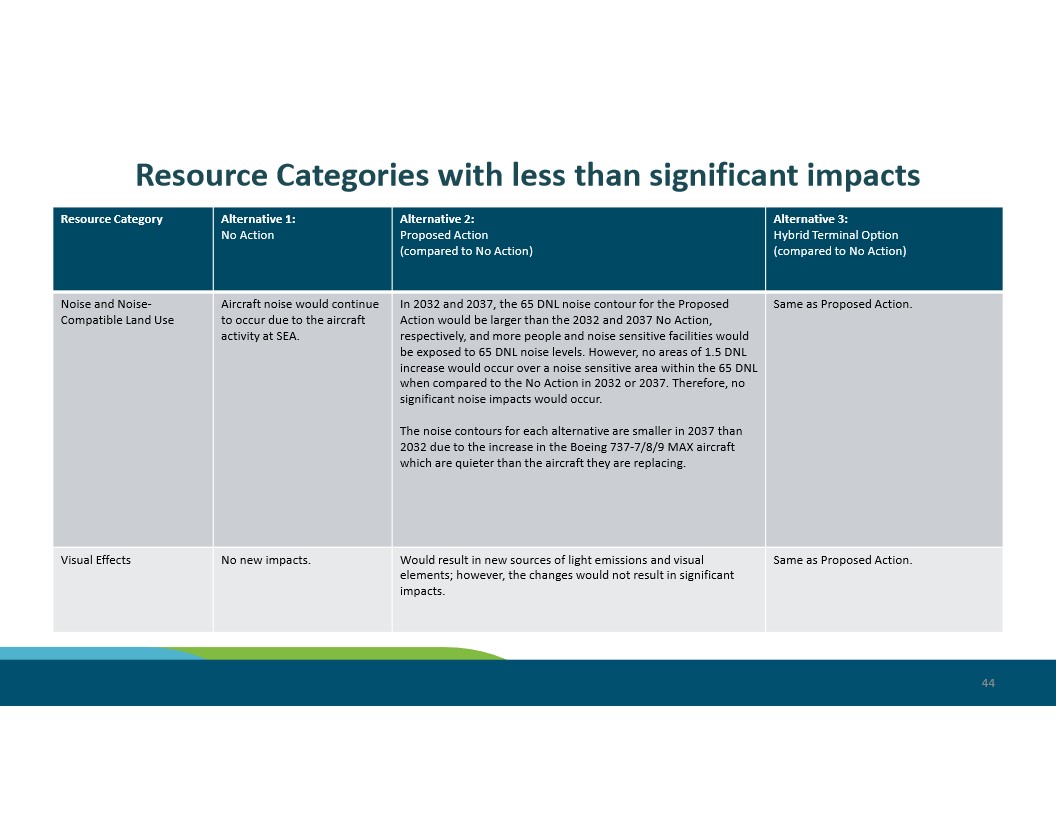
Slide 44 from a Sea-Tac Airport (SEA) Environmental Impact Statement presentation comparing noise and visual effects impacts across three alternatives: No Action, Proposed Action, and Hybrid Terminal Option. Key findings indicate that while the 65 DNL noise contour would be larger under the Proposed Action in 2032 and 2037, no significant noise impacts would occur, and noise contours shrink by 2037 due to quieter Boeing 737 MAX aircraft.
Open Houses
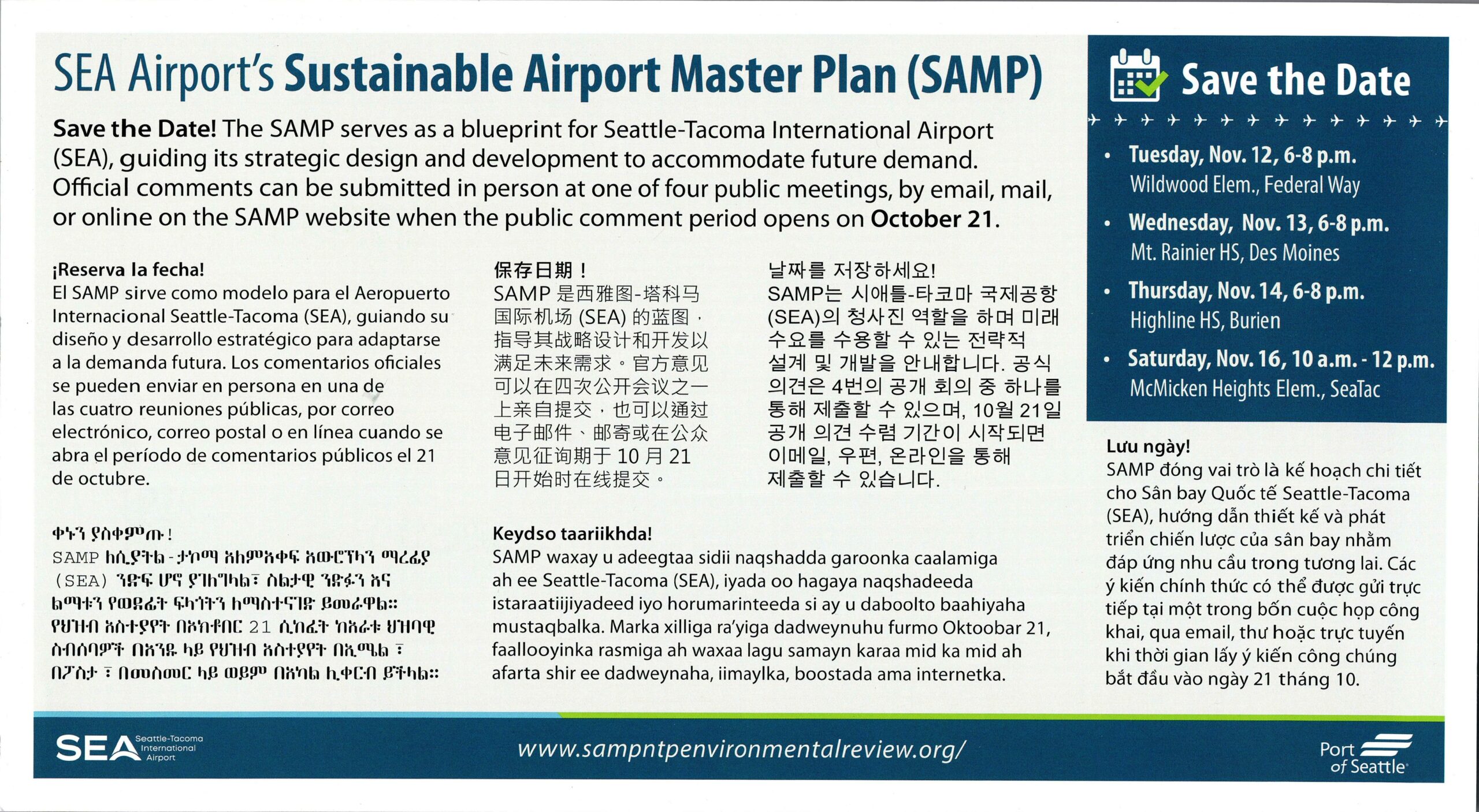
In the coming days, watch for a postcard in the mail telling you about four Port-sponsored open-houses with Port staff to answer your questions. If you attend the open houses there will be a reporter to take your comments in-person. Or, you can provide comments on-line (see below.)
Port of Seattle Town Halls:
November 12 (Tuesday) — 6 to 8 p.m. — Wildwood Elementary School (Federal Way)
November 13 (Wednesday) — 6 to 8 p.m. — Mount Rainier High School (Des Moines)
November 14 (Thursday) — 6 to 8 p.m. — Highline High School (Burien)
November 16 (Saturday) — 10 a.m. to 12 p.m. — McMicken Heights Elementary School (SeaTac)
The FAA will also conduct a webinar on the airspace around Sea-Tac Airport. This information is not specific to the SAMP, but understanding how air traffic is managed will be useful in commenting on the SAMP
November 20 (Wednesday) FAA Airspace Webinar register
Comment
In addition to the open houses, you have three other ways to provide official comments:
US Mail:
Mr. Steve Ryboldt
Port of Seattle
Aviation Environment and Sustainability
PO Box 68727
Seattle, WA 98168
A quick note: Comments to Port of Seattle Commissioners or staff or any other electeds or to the FAA in general will not be considered in this process.
What makes a good comment?
What makes a bad comment?
For many reasons (including raw frustration and feeling intimidated by the issue) you may feel a strong urge to write comments such as “It’s not fair!” or “Stop the noise!” or “Save the environment!” We understand. We agree. However, we advise you not do that. Remember: this is essentially a legal process. You don’t have to be an expert (in fact, most of the best comments avoid jargon), but it follows those same kinds of rules and you should follow them for your comments to be effective. Try to be specific. If you need help, please ask us. That’s what we’re here for!
The quality of your comment really matters. We mentioned that there are thirteen ‘official’ categories in the SAMP Draft EA. Each one has its own Appendix. Realistically, some don’t really apply to us, some could be broken out into multiple categories, while others are pretty technical. What we think matters most is this: the only proposed mitigation is for surface transportation (in green). Read again: the only aspect of the plan the Port thinks will need addressing are some traffic intersections.
Appendix A: Forecast and Airport Operational Assumptions Appendix B: Purpose & Need and Alternatives Supporting Information Appendix C: Air Quality and Climate Appendix D: Biological Resources
Appendix E: Coastal Resources Appendix F: Hazardous Materials and Solid Waste
Appendix G: Historic Resources Appendix H: Land Use Appendix I: Natural Resources & Energy Supply Appendix J: Noise and Noise-Compatible Land Use Appendix K: Socioeconomics, Environmental Justice, and Children’s Health Appendix L: Surface Transportation Appendix M: Water Resources
The SAMP Draft EA proposes no mitigation for any of the categories in red. That is why all our comments must be as effective as possible.
Suggestion: Pick one area that is most meaningful to you, read that section, which will only be 15 pages or so, and write a comment on that.
Still don’t know what to say? As we said in Part I, there was also the 2018 Scoping Process where many people, including professionals, already provided very good comments that are as important today as they were then.
Suggestion: Open the 2018 Comments and skim through them to find comments on your area of interest.
You can also comment on the process itself, which has been so unfair to the community that it calls the entire plan into question. For example, one of the best 2018 comments was (oddly enough) from Alaska Airlines where they asked the Port to stop and conduct a complete EIS. Why? Because even then they recognized that without that deeper study, the communities would undoubtedly appeal any ruling–thus causing even more delay.
Suggestion: Look here for some quick comment ideas on the entire SAMP process.
What happens after the comment period?
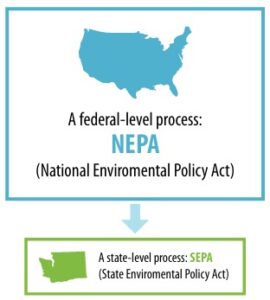
(NEPA Decision 2025)
On December 5, an FAA official will take everyone’s comments and then evaluate them according to the NEPA process. That decision is expected by September 2025. At that time, their official will decide
FONSI Finding of No Significance. The entire plan, as proposed by the Port of Seattle, can proceed, so long as the 1mitigations in the plan are done.
ROD Record of Decision, indicating that all the projects can proceed, but with an additional set of defined mitigations.
EIS Environmental Impact Statement. All projects will be put on hold until a much more thorough study of those projects can be done.
From our point of view, a successful comment period would be for the FAA to call for a full Environmental Impact Statement.
(SEPA Decision 2026)
After that decision, the state review will begin. There are three similar outcomes, but SEPA has its own rules. Who decides on that? The Port of Seattle. Their decision is expected in Q2 of 2026.
Coda
We don’t want to get ahead of ourselves. Although the SEPA review is separate, that outcome will be influenced by the FAA/NEPA decision process. We only mention it to emphasize how important this current comment period is. Your comments now will influence both the Federal and State decisions to come!
1The only mitigation indicated in the SAMP are traffic improvements at eight intersections around the airport. Not. Kidding. Nothing concerning air quality, noise, water, or cumulative community impacts.
2National Environmental Policy Act
3State of Washington Environmental Policy Act
4The original deadline was extended from December 5 to December 13, 2024
2 Replies to “SAMP Draft EA: How to provide a great public comment”
The Northwest needs another airport. Unchecked growth and greatly increased flight noise is ruining our health and enjoyment of our homes. My husband and I cannot sleep at night as planes (especially cargo) fly all night long. We live in a densely populated central Seattle neighborhood, and night flights between 11 pm and 6 am should be illegal. Moreover, planes fly overhead every minute all day long. We’ve had enough!
The public deserves nothing less than a full and complete EIS, nothing short of that. You spent 12 years developing SAMp and you give us the public 2 weeks for comment. That the public fairly and respectfully and they will return the privilege.
We use cookies to provide basic functionality. We also provide access to search engines in order to provide site analytics. We do not sell or share your data.
 This is the second of a two-part article concerning the Sustainable Airport Master Plan Draft Environmental Assessment (SAMP Draft EA). If you’re looking for the short version? This is the short version.
 In the coming days, watch for a postcard in the mail telling you about four Port-sponsored open-houses with Port staff to answer your questions. If you attend the open houses there will be a reporter to take your comments in-person. Or, you can provide comments on-line (see below.)
 The FAA will also conduct a webinar on the airspace around Sea-Tac Airport. This information is not specific to the SAMP, but understanding how air traffic is managed will be useful in commenting on the SAMP
 (NEPA Decision 2025)
The Northwest needs another airport. Unchecked growth and greatly increased flight noise is ruining our health and enjoyment of our homes. My husband and I cannot sleep at night as planes (especially cargo) fly all night long. We live in a densely populated central Seattle neighborhood, and night flights between 11 pm and 6 am should be illegal. Moreover, planes fly overhead every minute all day long. We’ve had enough!
The public deserves nothing less than a full and complete EIS, nothing short of that. You spent 12 years developing SAMp and you give us the public 2 weeks for comment. That the public fairly and respectfully and they will return the privilege.
/Users/billcorbin/Desktop/Submitted SAMP protest.pdf