TagRCAA(206)
-
2022-09-08
Fly Quiet Awards 2022
Credit: Port of Seattle For the past several years, Airport Director Lance Lyttle has been promoting a Fly Quiet Awards program at the StART meetings. This is a voluntary program to track airlines by noise. Who are the main violators. Who is improving. Who is not. Flying Quiet First Quarter 2022 Scoring List From the -
 2022-08-24
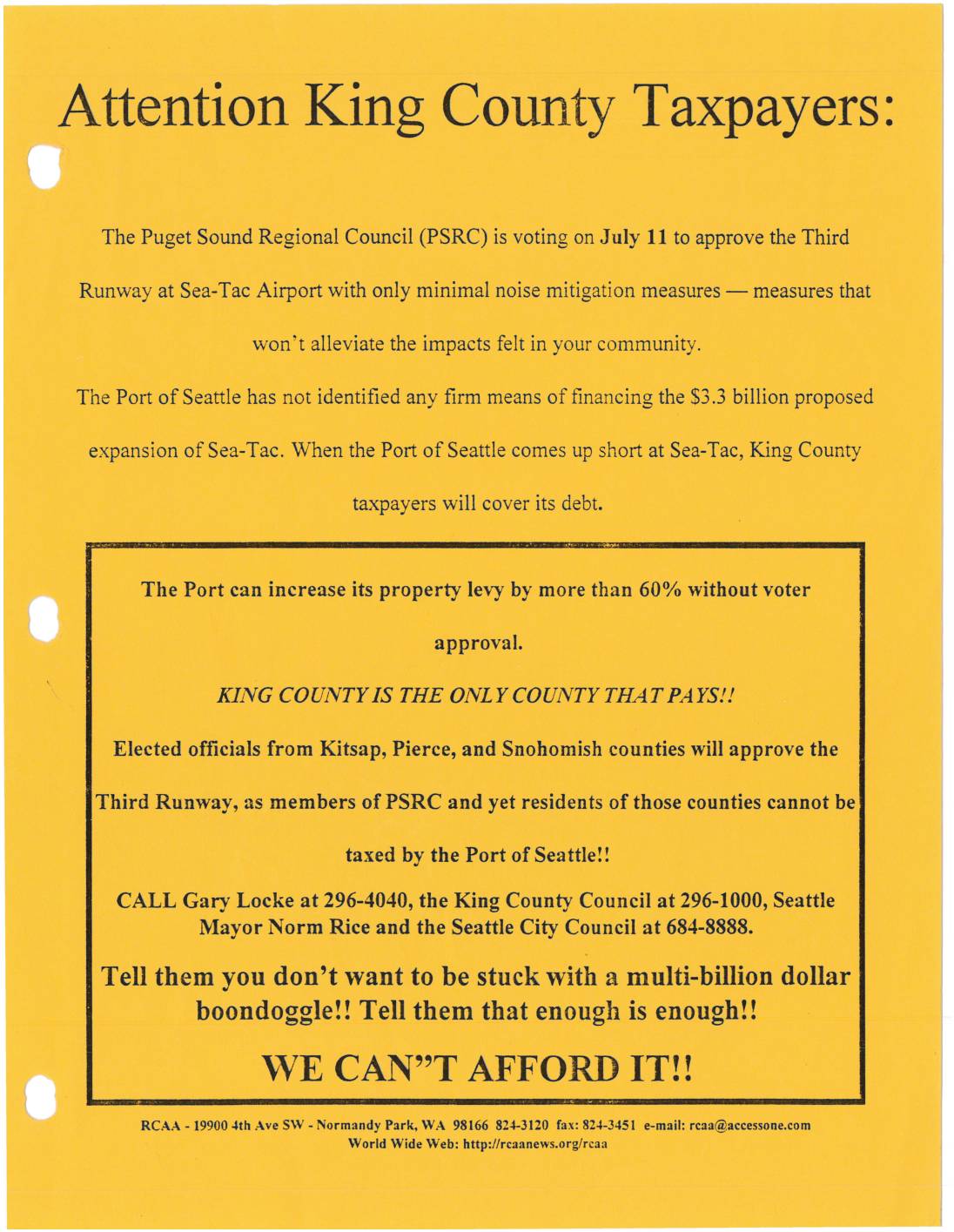
Attention King County taxpayers: Third Runway at Sea-Tac Airport
A community advocacy flyer from RCAA (Residential Communities Against Airport expansion) urges King County taxpayers to oppose the planned Third Runway at Sea-Tac Airport, warning that the Port of Seattle's $3.3 billion expansion lacks firm financing and could result in significant tax increases for King County residents. The flyer highlights that the Port can raise property levies by over 60% without voter approval, and that elected officials from neighboring counties — whose residents face no such tax burden — will have a vote in approving the project through the Puget Sound Regional Council. Residents are urged to contact local officials including King County Executive Gary Locke, Seattle Mayor Norm Rice, and their respective councils to oppose the expansion. -
 2021-01-07
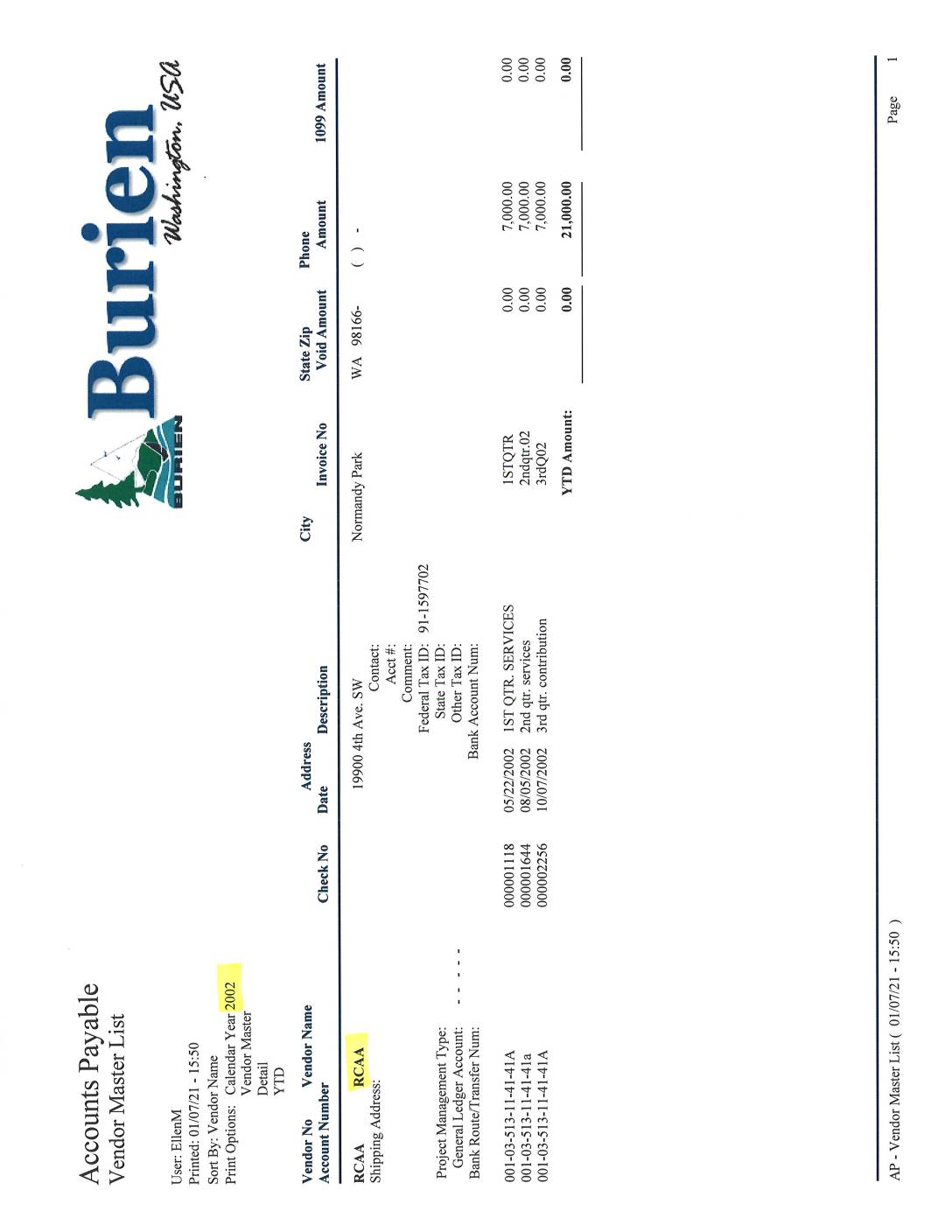
Accounts payable vendor master list
This document is an Accounts Payable Vendor Master List from the City of Burien, Washington, recording payments made to RCAA (located at 19900 4th Ave. SW, Normandy Park, WA 98166) across calendar years 2002, 2003, and 2004. The records show quarterly service payments of $7,000 per quarter, with annual totals of $21,000 (2002), $28,000 (2003), and $17,000 (2004, partial year through 2nd quarter). These payments, charged to account 001-03-513-11-41-41A, appear to reflect contracted community services funded through the City of Burien, likely related to Sea-Tac Airport noise mitigation or related municipal programs. -
Regional Commission on Airport Affairs (RCAA)
The Regional Commission on Airport Affairs is a citizens’ group in the greater Seattle, Washington, metropolitan area. Our primary focus is to Protect our communities from the impacts of expansion at Sea-Tac Airport We pledge our best efforts to compel the Airport to obey the environmental rules that are supposed to govern the construction of -
 2010-02-20
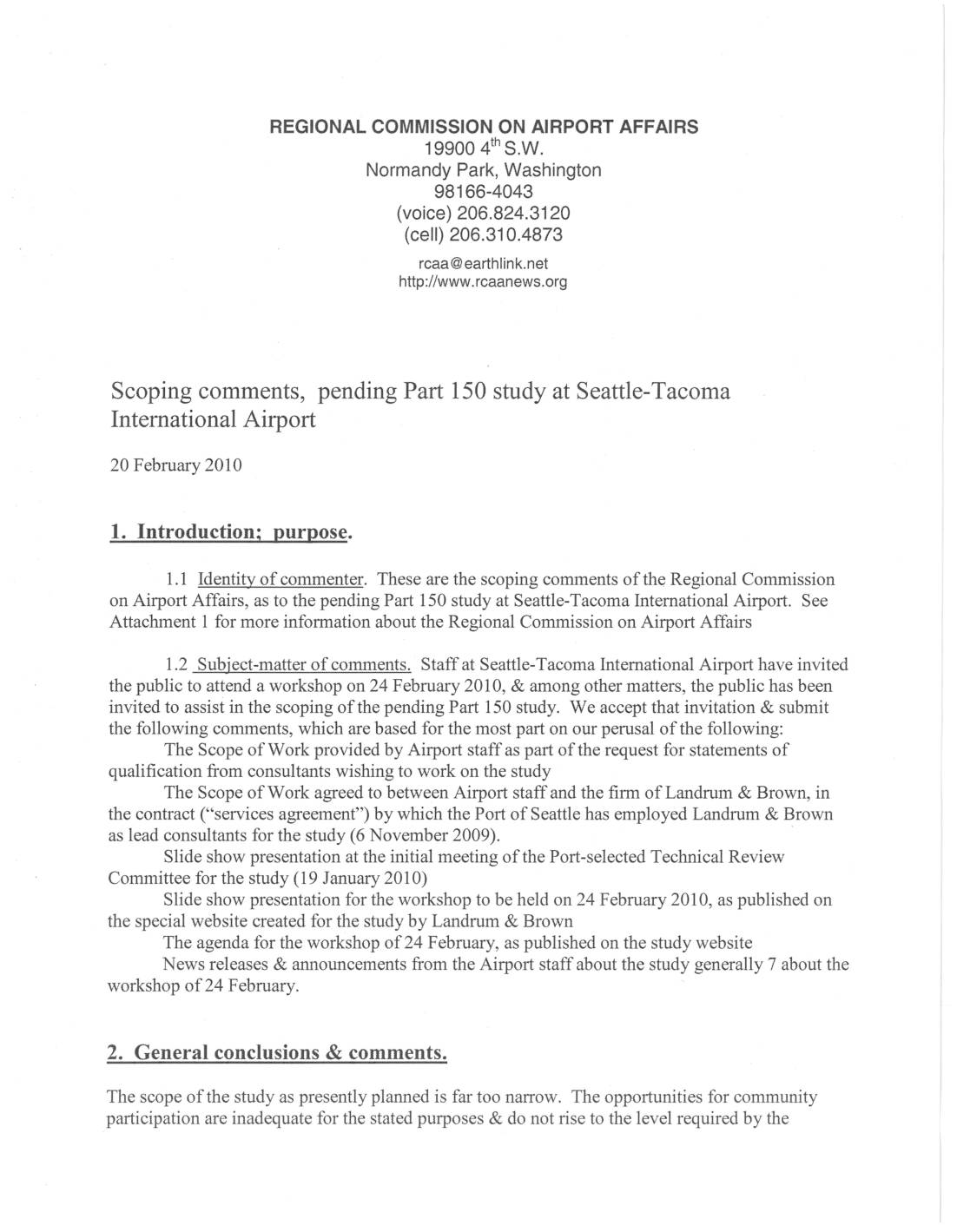
Scoping Comments, Pending Part 150 Study at Seattle-Tacoma International Airport
The Regional Commission on Airport Affairs submitted formal scoping comments in February 2010 criticizing the planned Part 150 noise study at Seattle-Tacoma International Airport as too narrow in scope and insufficient in public participation opportunities. The comments call for improvements in study documentation standards, including proper indexing, clear citations, author transparency, and plain-English presentation of data. The commission also urges that public comment periods be at least 60 days and not scheduled around major holidays. -
CASE/RCAA Community Forum 2009
Videos from CASE and RCAA September 29, 2009 community meeting moderated by former Des Moines City Councilmember Susan White, with opening comments from 33rd Rep. Tina Orwall, 33rd Senator Karen Keiser, King County Councilmember Dave Upthegrove and former 33rd Rep. Julia Patterson. Panel includes FAA Northwest Mountain Region Director Dave Soumi, Port of Seattle Noise -
 2006-02-14
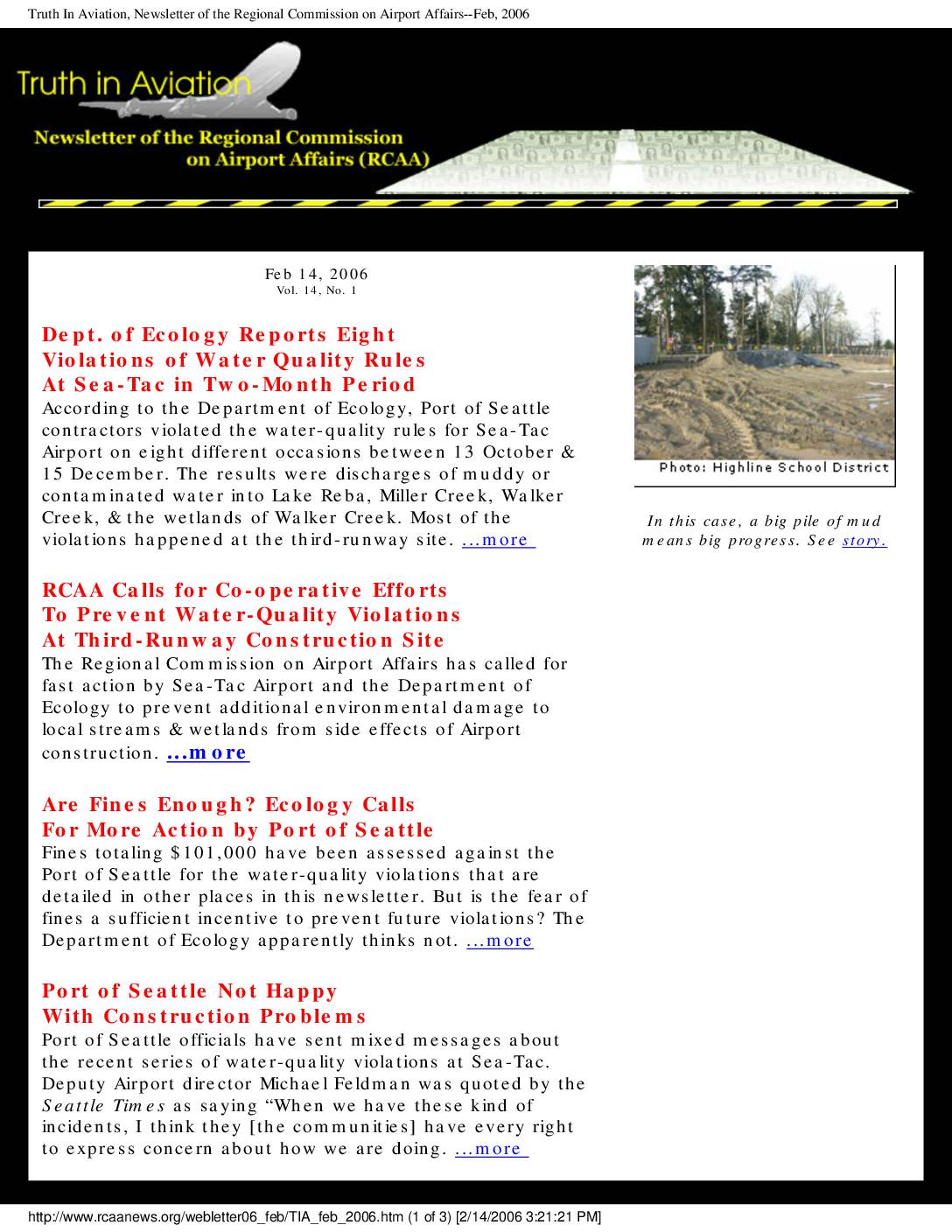
Truth in Aviation, newsletter of the Regional Commission on Airport Affairs, February 2006
Between October and December 2005, Port of Seattle contractors committed eight water-quality violations at Sea-Tac Airport's third-runway construction site, discharging muddy and contaminated water into local waterways including Lake Reba, Miller Creek, and Walker Creek. The violations resulted in $101,000 in fines levied by the Washington Department of Ecology, which also questioned whether fines alone were sufficient to prevent future incidents. The Regional Commission on Airport Affairs (RCAA) called for cooperative action between Sea-Tac Airport and the Department of Ecology to prevent further environmental damage to local streams and wetlands. -
2006-01-12
State rebukes Port of Seattle for 3rd-runway water pollution – Runoff from construction Millions of gallons flow into nearby streams
By Warren Cornwall January 12, 2006 Publication: Seattle Times, The (WA) Page: A1 Word Count: 865 For years, the Port of Seattle has promised that construction of a massive third runway at Seattle-Tacoma International Airport wouldn’t hurt surrounding streams and would actually be a boon to the environment. But since October, a string of oversights, accidents and intentional -
 2005-10-21
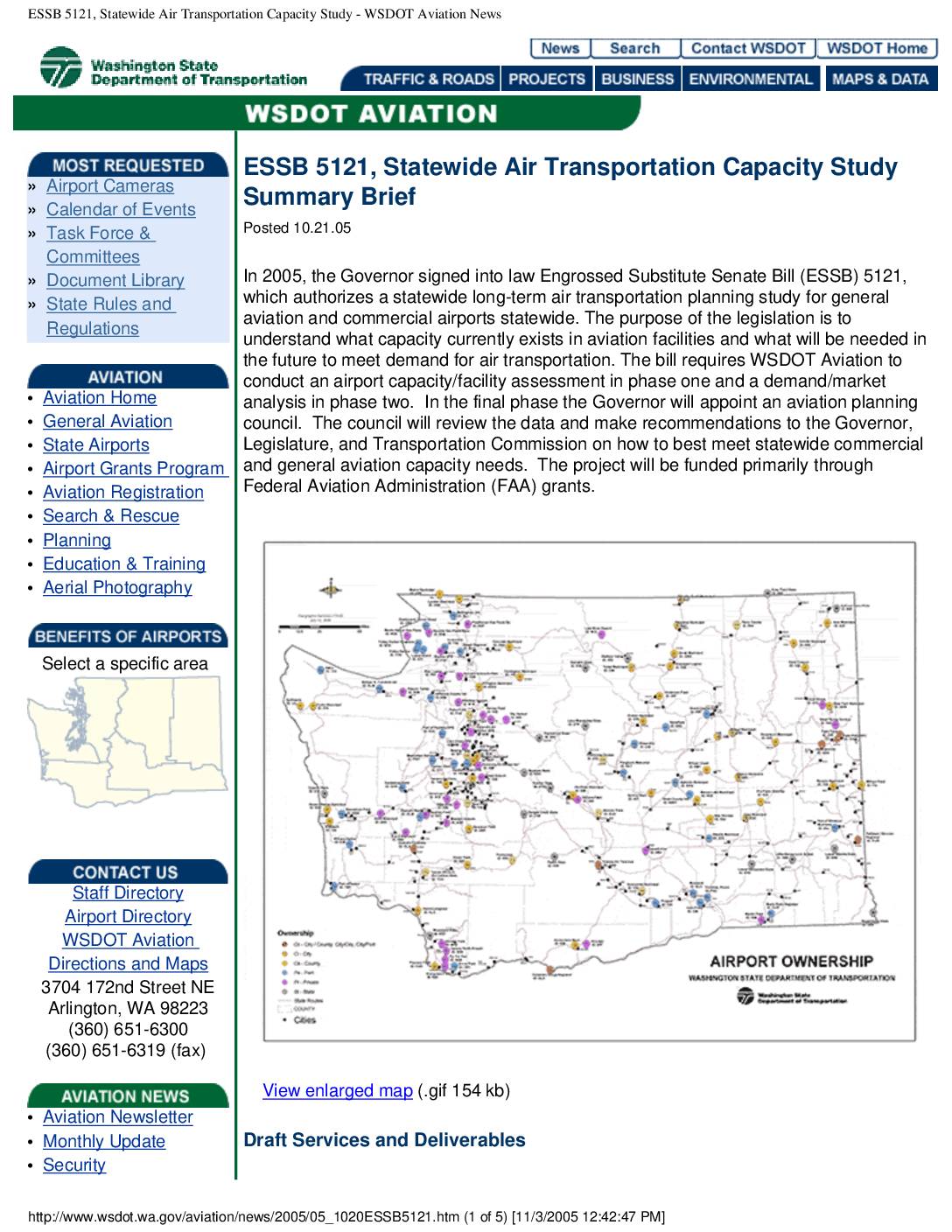
ESSB 5121, Statewide air transportation capacity study summary brief
In 2005, Washington State passed ESSB 5121, directing the Washington State Department of Transportation (WSDOT) to conduct a multi-phase statewide air transportation capacity study covering both commercial and general aviation airports. The study required an assessment of existing airport facilities and capacity (Phase 1, due July 2006), followed by a 25-year demand and market forecast analysis with focused attention on the Puget Sound region (Phase 2, due July 2007). A 10-member Governor-appointed aviation planning council would then review the findings and make recommendations on how to meet the state's long-term aviation capacity needs, including identifying sites for future airport facilities. -
 2005-10-20
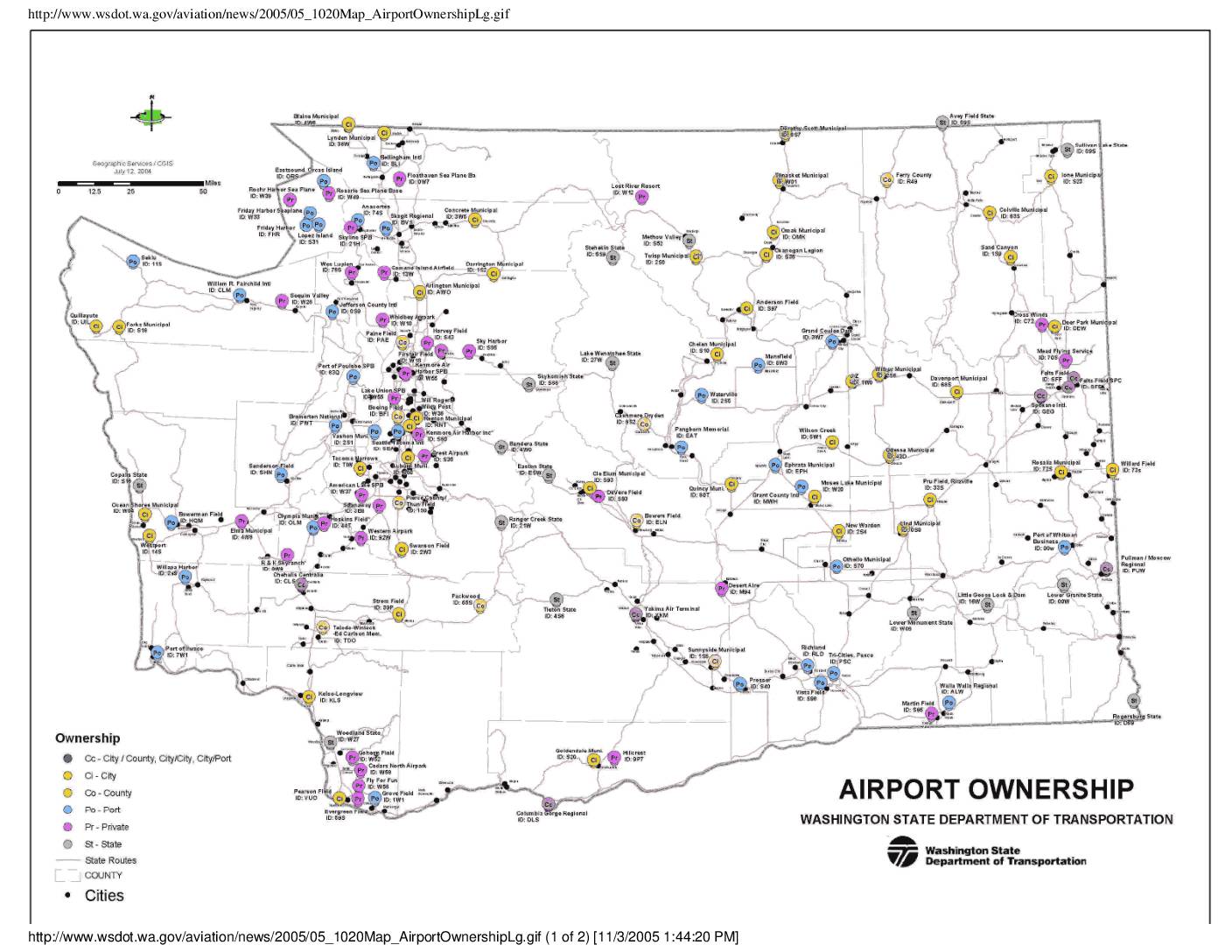
Airport ownership map, Washington State
This 2005 map from the Washington State Department of Transportation's Aviation Division shows the locations and ownership types of airports across Washington State. Airports are categorized by ownership as City/County, City, County, Port, Private, or State. While centered on statewide aviation infrastructure, the map provides context for understanding the public and private entities responsible for airport operations in the region, including major facilities near the Seattle-Tacoma area.