TagPuget Sound Clean Air Agency(9)
-
 2024-02-05 14:59
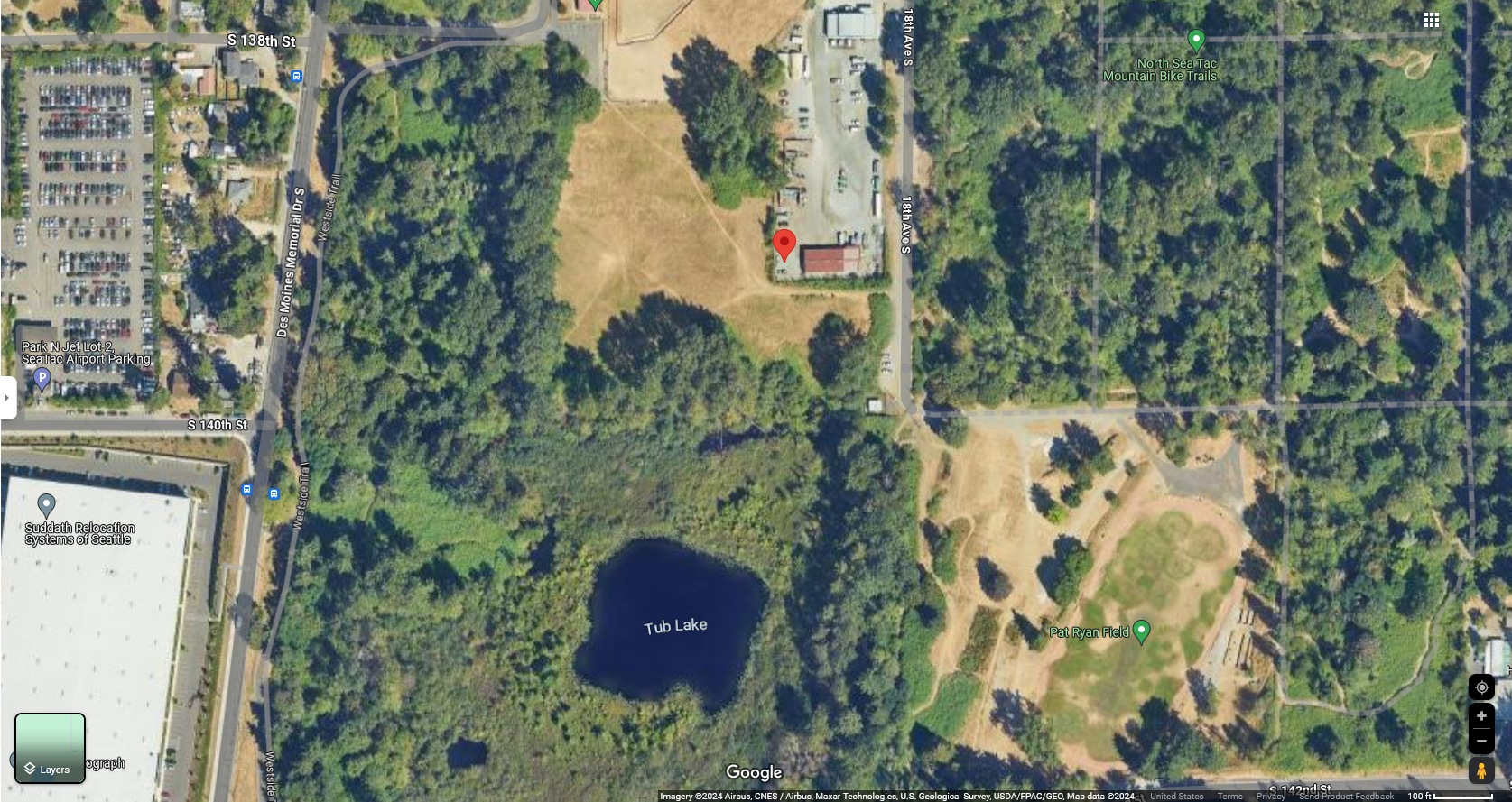
PSCAA Air Quality Monitor Site Sunset Park 2024-02-05
Sunset Park King County DNRP service yard. TSI Scanning Mobility Particle Sizer, which will collect routine ultrafine particle counts in many size bins. Also hourly black carbon and total fine particle concentrations at this site. Google Maps -
 2023-05-03 14:12
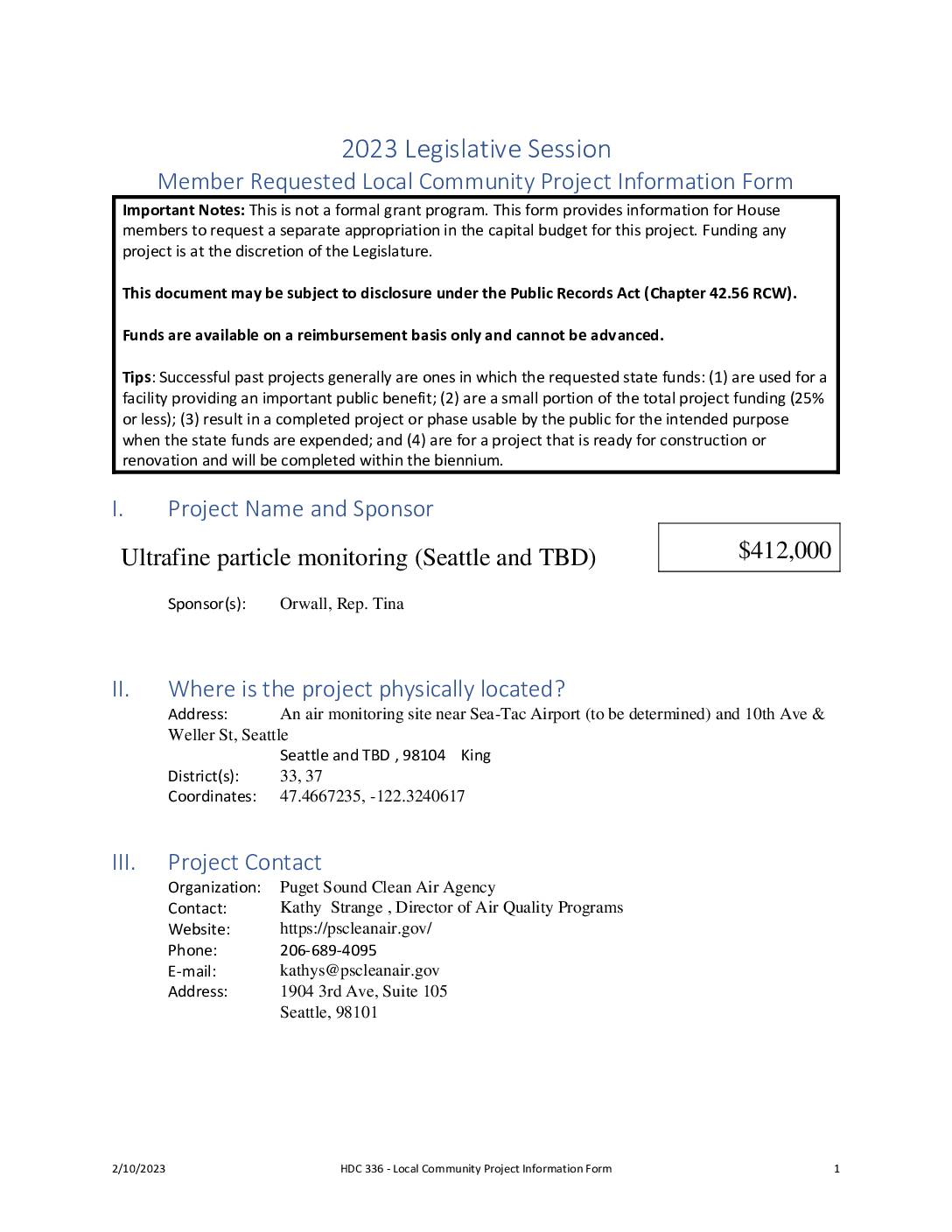
Ultrafine particle monitoring (Seattle/Chinatown and Sea-Tac Airport) HDC2 11 12 42
2/10/2023 HDC 336 - Local Community Project Information Form 1 2023 Legislative Session Member Requested Local Community Project Information Form Important Notes: This is not a formal grant program. This form provides information for House members to request a separate appropriation in the capital budget for this project. Funding any project is at the discretion of the Legislature. This document may be subject to disclosure under the Public Records Act (Chapter 42.56 RCW). Funds are available on a reimbursement basis only and cannot be advanced. Tips: Successful past projects generally are ones in which the requested state funds: (1) are used for a facility providing an important public benefit; (2) are a small portion of the total project funding (25% or less); (3) result in a completed project or phase usable by the public for the intended purpose when the state funds are expended; and (4) are for a project that is ready for construction or renovation and will be completed within the biennium. I. Project Name and Sponsor Ultrafine particle monitoring (Seattle and TBD) $412,000 Sponsor(s): Orwall, Rep. Tina II. Where is the project physically located? Address: An air monitoring site near Sea-Tac Airport (to be determined) and 10th Ave & Weller St, Seattle Seattle and TBD , 98104 King District(s): 33, 37 Coordinates: 47.4667235, -122.3240617 III. Project Contact Organization: Puget Sound Clean Air Agency Contact: Kathy Strange , Director of Air Quality Programs Website: https://pscleanair.gov/ Phone: 206-689-4095 E-mail: kathys@pscleanair.gov Address: 1904 3rd Ave, Suite 105 Seattle, 98101 -
 2022-08-13 22:48
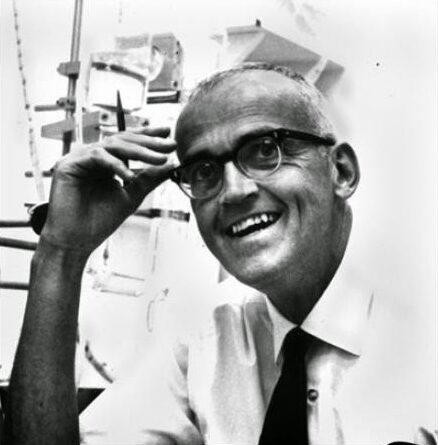
*Where’s my Clair Patterson?
There is this form of air pollution, which you probably have not heard of, called ultrafine particulates (UFPs). Though they are invisible, they seem to have some particularly nasty effects on human health. UFPs have not been well-studied, they are unregulated, and yet they are prevalent in commercial jet engine emissions. But this is not -
2021-01-17 21:25
The Sea-Tac Airport Annual Air Quality Monitoring Proposal (STAAQM)
This post describes a proposal we have put forward to Washington State legislators Senator Karen Keiser (33rd) and Representative Jesse Johnson (30th). In one sentence, we want an annual report of all key aviation-related emissions for every neighborhood affected by the operations from Sea-Tac Airport. We refer to this proposal as Sea-Tac Airport Annual Air -
2020-10-12 20:33
A letter to Tina Orwall: Air Quality Monitor Proposal
Hi Rep. Orwall, Thank you for your time on the phone today. BACKGROUND As I said, I have a lot of experience as a consultant with the environmental monitoring and mitigation process of conventional businesses (ie. where NEPA is governed by EPA.) It has always been annoying to me that the airport (being governed by -
2018-08-06 14:01
Puget Sound Clean Air Advisory Council
Our Advisory Council provides guidance and input on agency programs and regulations. The Advisory Council is made up of representatives of large and small businesses, suburban cities, area sources, education, transportation, health, tribal nations, fire chiefs, environmental justice, local ports, the environmental community, and the Public-at-Large. Meetings Agendas & Minutes Advisory Council Members Advisory council -
 2003-10-01 00:00
Puget Sound Air Toxics Evaluation Final Report, October 2003
For more information about this report, call Leslie Keill at (206) 689-4022 -
 2000-03-01 00:00
Addressing Community Health Concerns Around Sea-Tac Airport 2000
Addressing Community Health Concerns Around SeaTac Airport Response to the question, “Is it possible to monitor jet engine exhaust emissions or to model their path using data on prevailing winds and takeoff patterns?” March 2000 Prepared by Washington State Department of Health Washington State Department of Ecology Puget Sound Clean Air Agency In consultation with Public Health – Seattle & King County SeaTac Airport Area Community Representatives United States Environmental Protection Agency University of Washington Washington State University For more information contact Juliet VanEenwyk Washington State Department of Health (360) 236-4250 juliet.vaneenwyk@doh.wa.gov Naydene Maykut Puget Sound Clean Air Agency (206) 689-4062 nmaykut@pscleanair.org John Williamson Washington State Department of Ecology (425) 649-7118 jwil461@ecy.wa.gov Additional copies of this report are available at: http://www.doh.wa.gov/EHSPHL/Epidemiology/NICE/default.htm CONTENTS Abbreviations.................................................................................................................................................. ii Executive Summary ........................................................................................................................................ 1 Preface ............................................................................................................................................................ 5 Background..................................................................................................................................................... 5 Conclusions Based On Previous Air Quality Studies...................................................................................... 6 Rationale For Further Study............................................................................................................................ 7 Health Issues............................................................................................................................................ 7 Environmental Justice.............................................................................................................................. 8 Recommendations........................................................................................................................................... 9 Goals of an Air Quality Study.................................................................................................................. 9 General Recommendations For an Air Quality Study.............................................................................. 9 Methods ........................................................................................................................................................ 10 Manual Methods .................................................................................................................................... 10 Automated Methods............................................................................................................................... 11 Quality Assurance Procedures ............................................................................................................... 11 Data Analysis And Interpretation.................................................................................................................. 12 Initial Data Analysis .............................................................................................................................. 12 Additional Data Analysis ....................................................................................................................... 14 Timeframe..................................................................................................................................................... 16 Estimated Costs as of March 2000................................................................................................................ 17 References..................................................................................................................................................... 18 Attachment 1: Committee Members ............................................................................................................. 19 Attachment 2: Summary of Recent Studies................................................................................................... 21 Attachment 3: Draft List of Recommended Pollutants For Air Monitoring.................................................. 25 Attachment 4: Compendium Method TO-11A.............................................................................................. 27 Attachment 5: Compendium Method TO-13A.............................................................................................. 29 Attachment 6: Compendium Method… -
 1996-10-01 00:00
Memorandum Of Agreement Air Quality Monitoring 1996