TagPCHB(607)
-
 1999-03-16
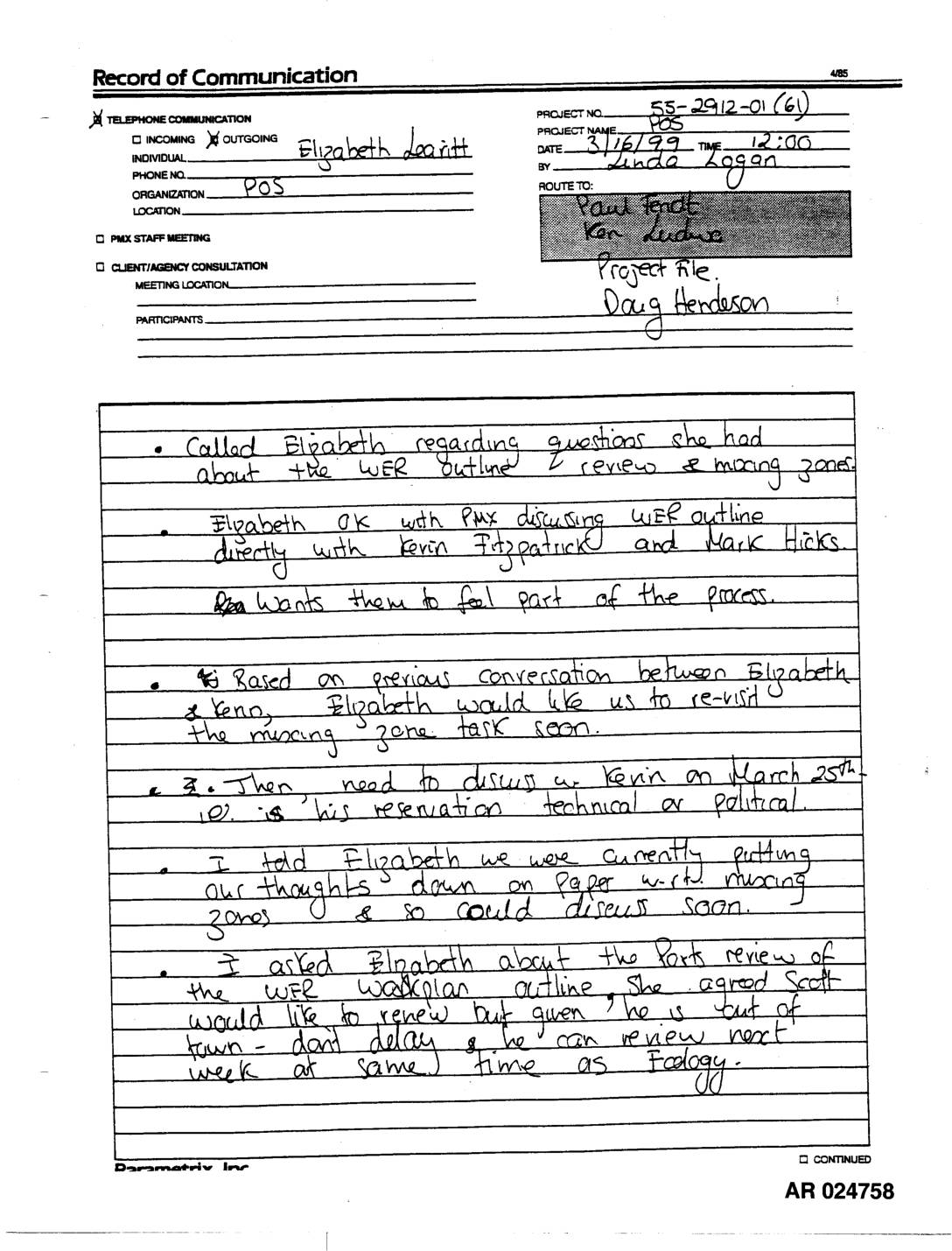
EXH AR024758: Record of Communication — WER Outline, Mixing Zones, Port Review
A March 16, 1999 outgoing phone call was made to Elizabeth Leavitt of POS regarding her questions about the WER (Work Element Review) outline, review process, and mixing zones. Elizabeth was advised she could discuss the WER outline directly with Kevin Fitzpatrick and Mark Hicks, and that the team was preparing written thoughts on mixing zones for further discussion. The call also addressed scheduling a Port review of the WER workplan outline, with a suggestion to coordinate the review alongside a Fooogy (likely Ecology) meeting the following week. -
 1999-03-11
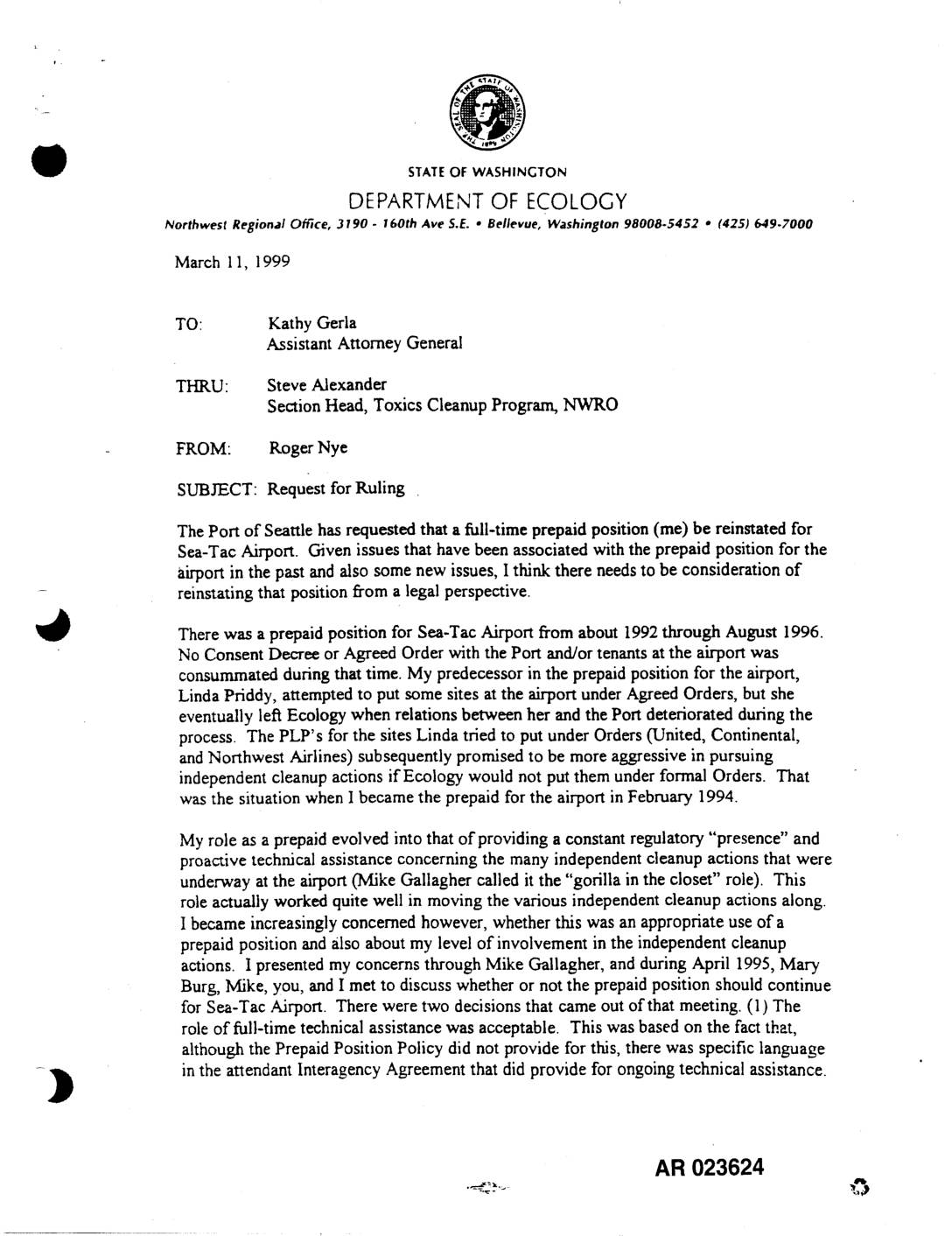
EXH AR023624: Roger Nye to Kathy Gerla — Ruling Request, Reinstatement Prepaid Position STIA
A 1999 memo from Washington State Department of Ecology staff member Roger Nye to Assistant Attorney General Kathy Gerla raises legal questions about reinstating a full-time 'prepaid' regulatory position at Sea-Tac Airport, funded by the Port of Seattle. The memo outlines the history of the position from 1992–1996, noting it was cancelled due to the lack of a signed Agreed Order, and describes public concerns that the arrangement gave the Port undue influence over Ecology. Key issues flagged include whether the prepaid role can legally extend beyond the scope of an Agreed Order, whether a new Interagency Agreement is needed, and whether reinstatement would require a public comment period likely to draw strong opposition. -
 1999-02-23
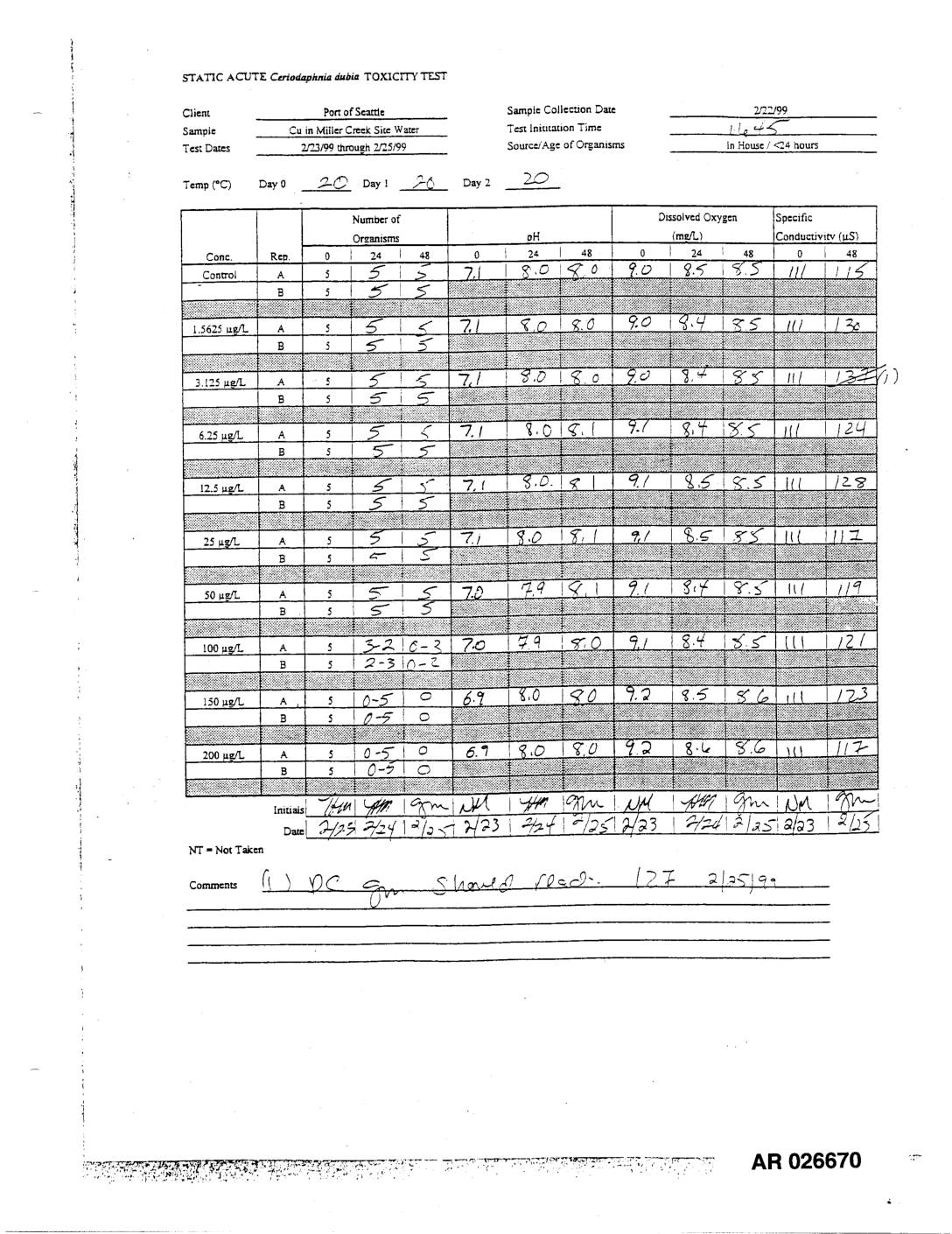
EXH AR026670: Static Acute Ceriodaphnia dubia Toxicity Test — Cu, Miller Creek Site Water, Feb 1999
This document presents results from a 48-hour acute toxicity test conducted in February 1999 for the Port of Seattle, exposing water fleas (Ceriodaphnia dubia) to copper-contaminated water collected from Miller Creek. The test found that all organisms survived at concentrations up to 50 micrograms per liter, while complete mortality occurred at concentrations of 100 micrograms per liter and above. Water quality parameters including pH, dissolved oxygen, and specific conductivity were monitored throughout the test period. -
 1999-01-14
EXH AR024885: Water Quality Datalog 55-2912-01(61) Miller DS Field Measurements & Flow Weighting Calc, Jan 14 1999
These are field records from a water quality sampling event conducted on January 14, 1999, at the Miller DS site near McD NC, documenting storm water measurements taken from a culvert. Samplers recorded water levels, flow rates, pH, temperature, and dissolved oxygen at 12 intervals throughout the morning. A flow-weighting calculation worksheet was used to determine subsample volumes, with a total storm flow of 122,400 units recorded from a 4x4.3 pipe. -
 1999-01-05
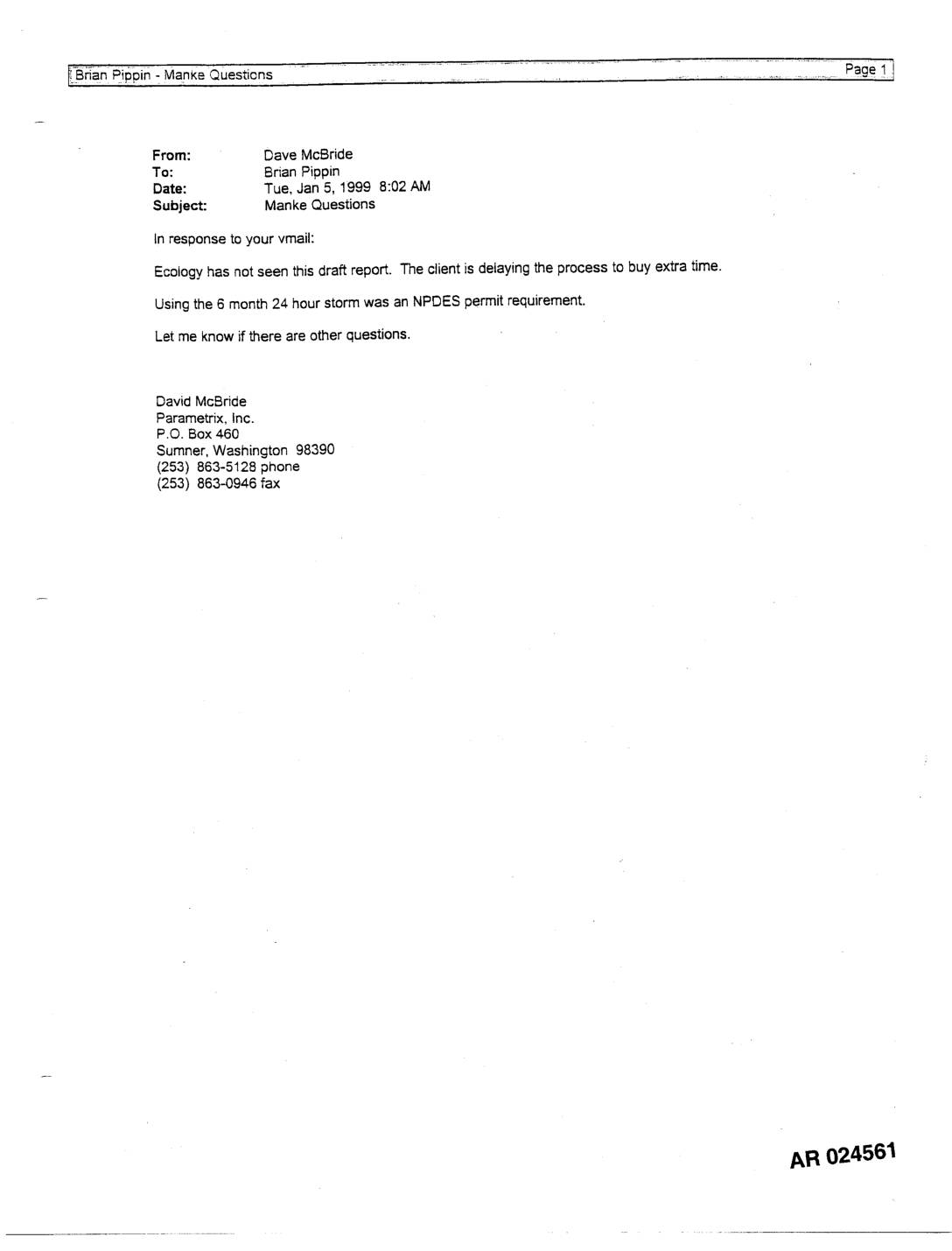
EXH AR024561: Email McBride to Pippin – Manke Questions
In this January 1999 email, Dave McBride of Parametrix, Inc. responds to questions from Brian Pippin about the Manke project, clarifying that the Washington State Department of Ecology had not yet reviewed the draft report and that the client was intentionally delaying the process to gain more time. He also notes that the use of a 6-month, 24-hour storm standard was a requirement of the NPDES permit. -
 1998-12-08
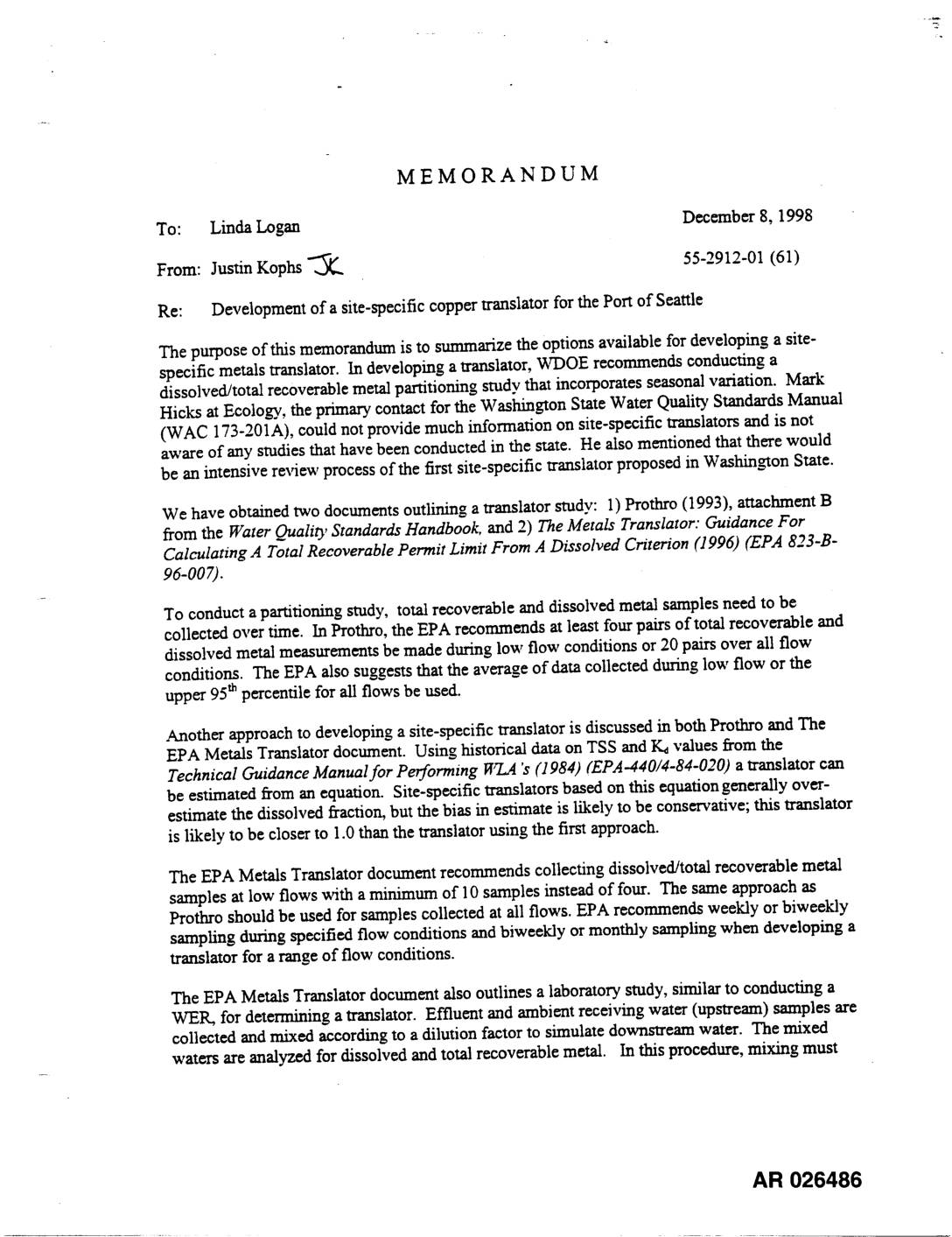
EXH AR026486: Memo – Site-Specific Copper Translator Development
This December 1998 internal memorandum from Justin Kophs to Linda Logan outlines options for developing a site-specific copper translator for the Port of Seattle, summarizing EPA guidance on dissolved and total recoverable metal sampling studies. It describes recommended approaches including field partitioning studies, historical data equations, and laboratory mixing tests to measure how copper partitions between dissolved and total recoverable forms in receiving water. The memo notes that while a site-specific translator improves compliance measurement accuracy, it cannot be used to influence permit limits in the same way as a Water Effect Ratio (WER). -
 1998-11-25
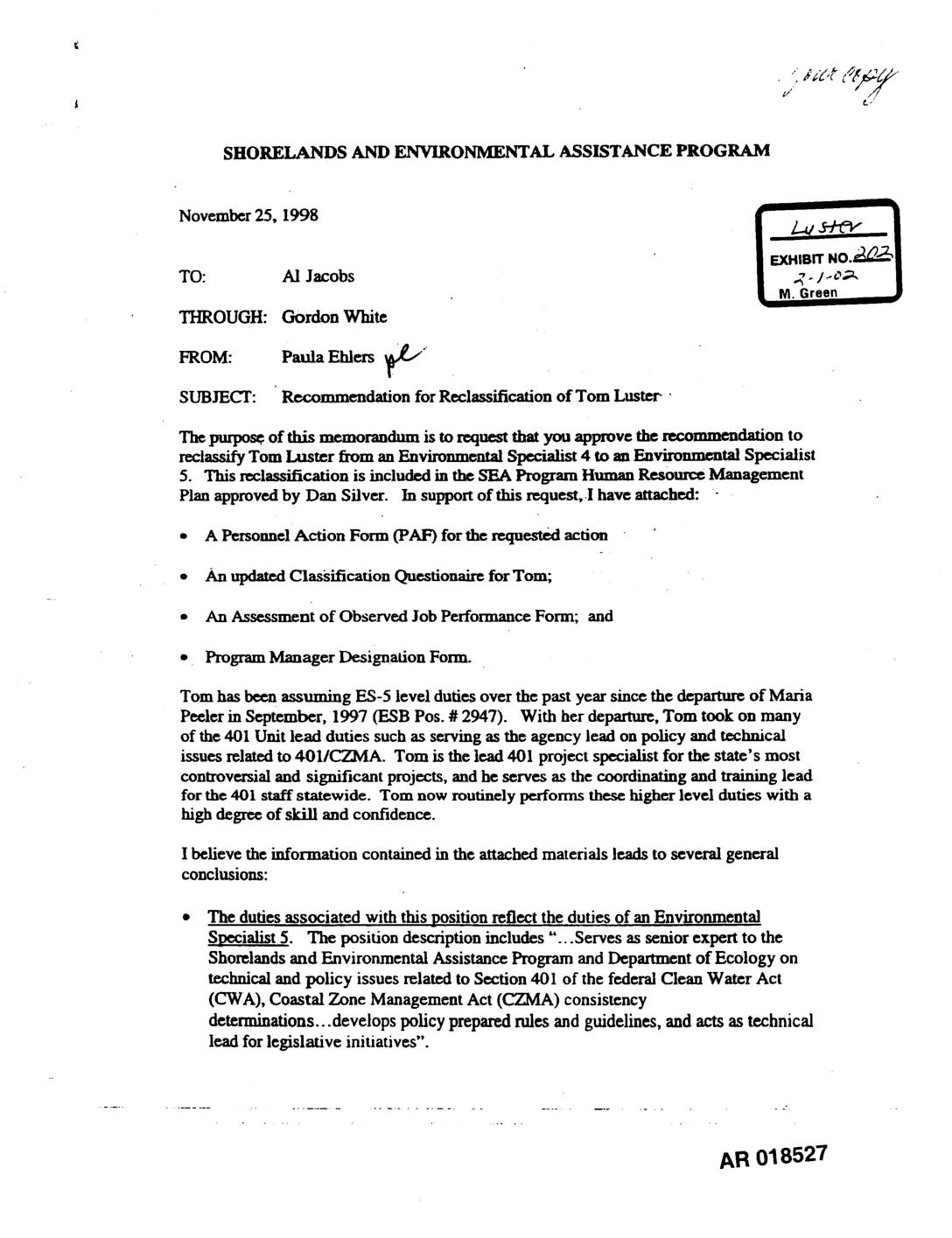
Exhibit 202: Recommendation for Reclassification of Tom Luster — Shorelands and Environmental Assistance Program
A 1998 internal memorandum from Washington State's Shorelands and Environmental Assistance Program recommends reclassifying employee Tom Luster from Environmental Specialist 4 to Environmental Specialist 5, citing his assumption of higher-level duties following a colleague's departure in 1997. Luster's qualifications, including a Master's degree in Geography and over 10 years of experience, along with the cost-neutral budget impact, are presented as justification for the upgrade. -
 1998-11-01
EXH 427: Annual Stormwater Monitoring Report STIA Jun 1 1997–Jun 30 1998
This November 1998 report presents the Annual Stormwater Monitoring Report for Seattle-Tacoma International Airport, covering the period from June 1, 1997 through June 30, 1998, prepared by the Port of Seattle. It documents stormwater sampling results from various airport subbasins, including measurements of pollutants such as metals, oils, grease, fecal coliforms, and deicing chemicals. The report also evaluates the performance of Best Management Practices (BMPs) implemented across the airport to manage and reduce stormwater contamination. -
 1998-10-27
EXH AR024767: Water Quality Talking Points — Copper, Third Runway 401 Certification
A 1998 fax from Parametrix, Inc. to the Port of Seattle discusses water quality concerns related to copper in stormwater runoff at Seattle-Tacoma International Airport. The document outlines that while standard Best Management Practices (BMPs) can remove most metals from stormwater, copper remains a persistent challenge due to its widespread presence from sources like automobile brakes and rooftops. It raises questions about compliance requirements, the cost of installing sand or compost filters (potentially up to $100 million), and how the Port and Washington State Department of Ecology can reach a workable agreement on stormwater discharge standards. -
 1998-09-28
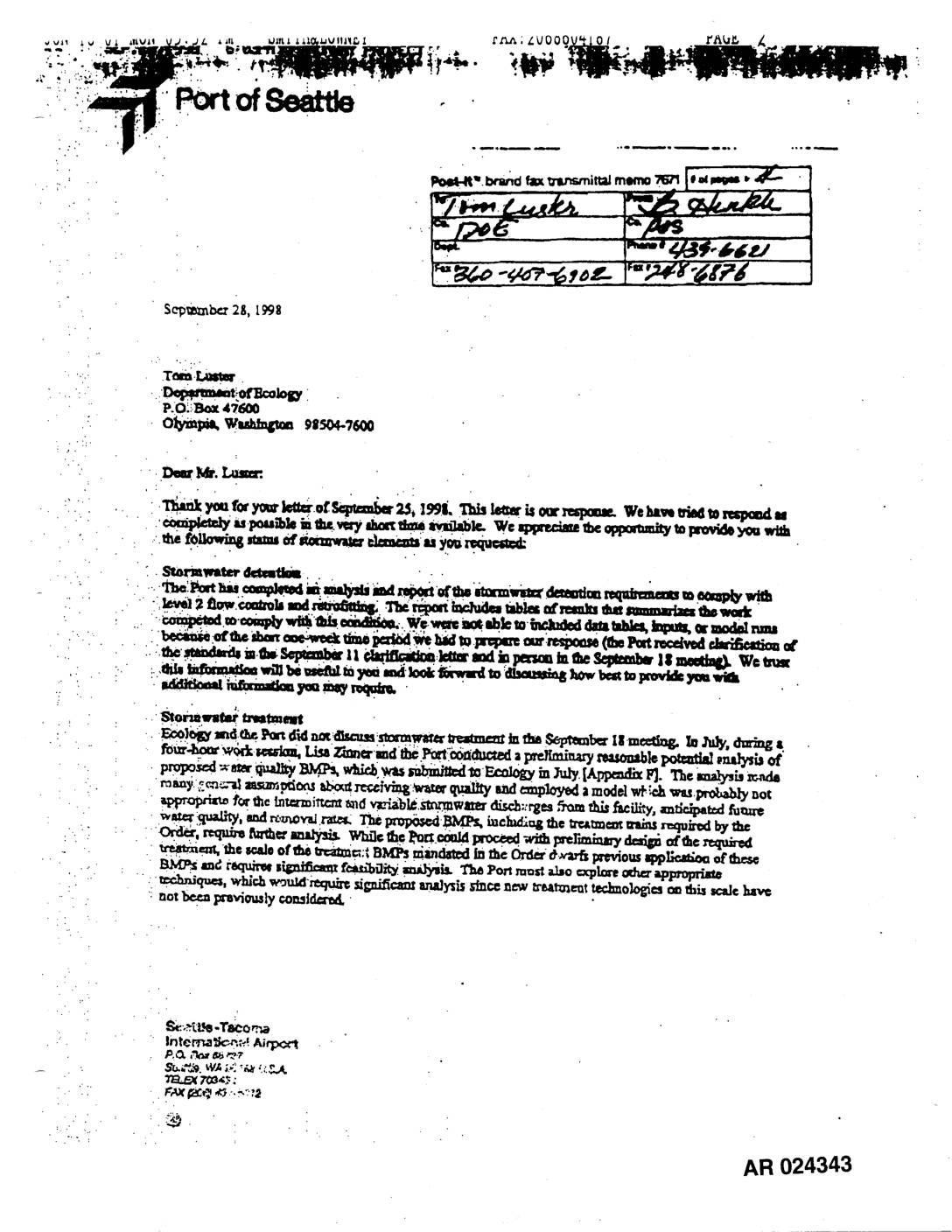
EXH AR024343: Letter to Ecology — Stormwater Detention, Treatment, Copper, First Flush, Wetland Delineation, Water Rights
In a September 28, 1998 letter from the Port of Seattle to the Washington Department of Ecology, the Port provides a status update on stormwater management efforts at Seattle-Tacoma International Airport, covering detention, treatment, copper loading, and first flush analysis. The letter outlines proposed delivery dates for required reports and explains the complexity of treating stormwater runoff, including challenges related to mandatory FAA-regulated de-icing and anti-icing chemicals used on runways. It also addresses the status of ongoing wetland delineations and water rights reviews connected to the airport's planned third runway construction.