TagPCHB(607)
-
 1995-12-14
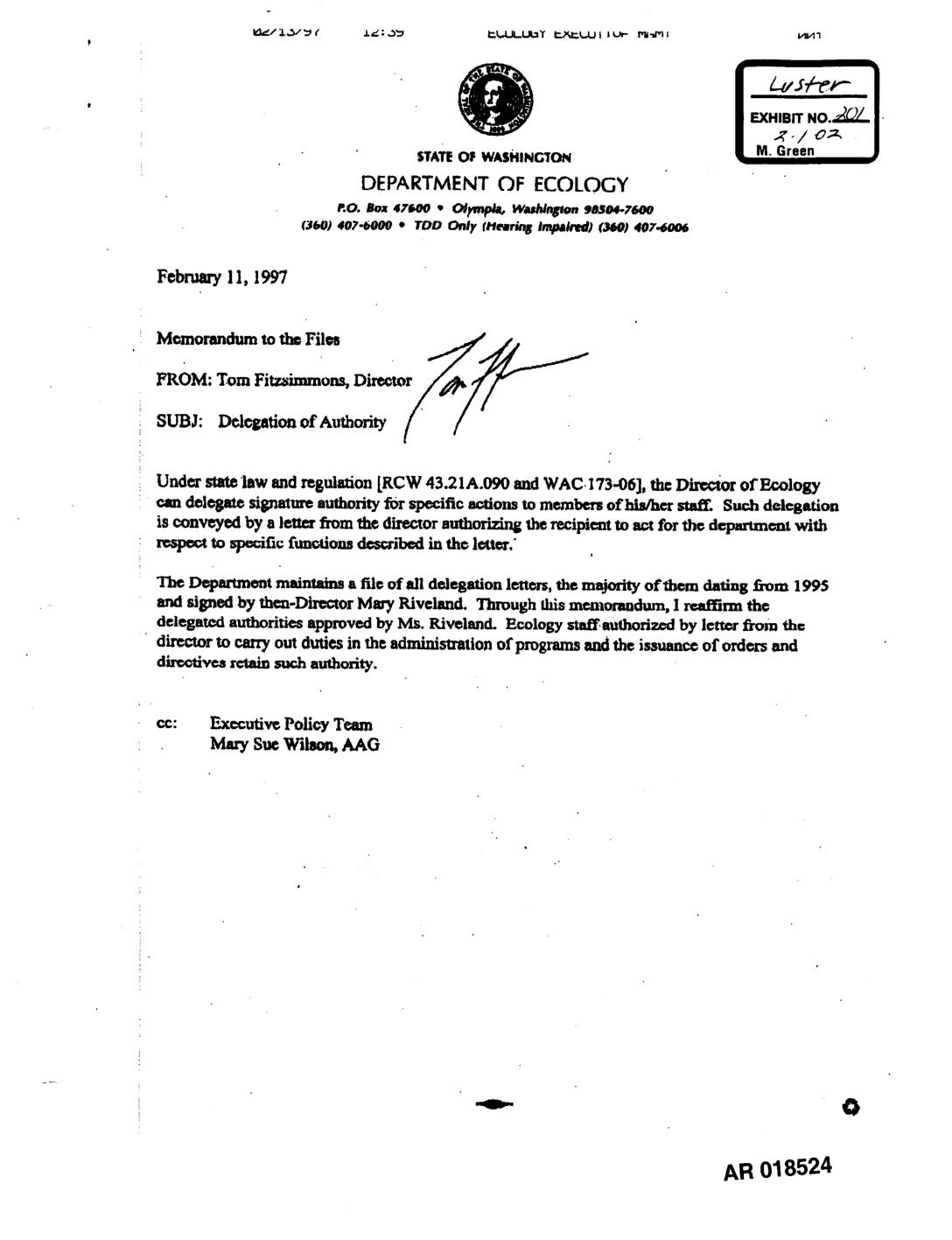
Exhibit 201: Ecology Delegation of Authority — Tom Luster, Section 401 Certifications and CZM Consistency Determinations
These three pages from the Washington State Department of Ecology document the delegation of signature authority to staff member Tom Luster, allowing him to issue routine Section 401 water quality certifications, Coastal Zone Management consistency determinations, and related administrative orders. Originally signed by Director Mary Riveland in December 1995, the authority was reaffirmed by Director Tom Fitzsimmons in February 1997. The delegation includes a succession of authority chain to ensure continuity if Luster is absent or leaves his position. -
 1995-12-01
EXH AR024562: Analysis of Regulatory Issues — NPDES Permit Program Municipal & Industrial Stormwater Discharges
A 1995 Washington Department of Ecology staff discussion paper analyzes regulatory challenges in applying the NPDES permit program to municipal and industrial stormwater discharges, focusing on how to ensure such discharges comply with Clean Water Act water quality standards. The paper explores questions around defining 'Waters of the State,' determining compliance monitoring points, and identifying which permitted dischargers require water-quality-based effluent limitations. Note that this paper does not represent official Ecology policy and was intended to stimulate internal discussion and policy decisions. -
 1995-11-01
EXH AR023140: Guidance Remediation Petroleum Contaminated Soils
This 1995 Washington State Department of Ecology document provides guidance for cleaning up soils contaminated by petroleum products. It outlines remediation standards and procedures under the state's Toxics Cleanup Program, applicable across all regions of Washington State. Note: This document addresses soil contamination cleanup and does not contain content specifically related to Sea-Tac Airport noise policy. -
 1992-01-01
EXH 326: Aroclor 1254 Physical Chemical Environmental Properties CRCnetBASE CRC Press
This document contains detailed chemical and environmental property data for Aroclor 1254, a polychlorinated biphenyl (PCB) mixture, including its molecular weight, water solubility, vapor pressure, and environmental fate characteristics. It covers sorption coefficients, half-lives in various environmental compartments (water, soil, sediment, biota), and bioconcentration factors in fish and other organisms. The data is compiled from numerous scientific studies published between the 1970s and late 1980s. -
 1991-05-01
EXH AR019107: Field Assessment Mitigation Replacement Ratios Puget Sound
This 1991 report by Sheldon and Associates, prepared for the Washington Department of Ecology, assesses wetland mitigation replacement ratios in the Puget Sound region. It evaluates compensation sites where wetlands were restored or created to offset permitted wetland losses, examining how well those sites functioned as replacements. The report provides findings, conclusions, and recommendations on compensation plan design, monitoring, and appropriate replacement ratios for regulatory guidance. -
 1983-01-01
EXH 327: VS2D Computer Program Input Data Formats Table 3 Cards B-14–C-3
This document describes input data formats for the VS2D computer program, developed by the U.S. Geological Survey, which simulates fluid flow in variably saturated porous media. It details technical parameters for evaporation and evapotranspiration modeling, including variables for potential evaporation rates, rooting depth, root activity, and atmospheric pressure. The document also outlines time-step control settings used to manage the numerical simulation of subsurface water movement. -
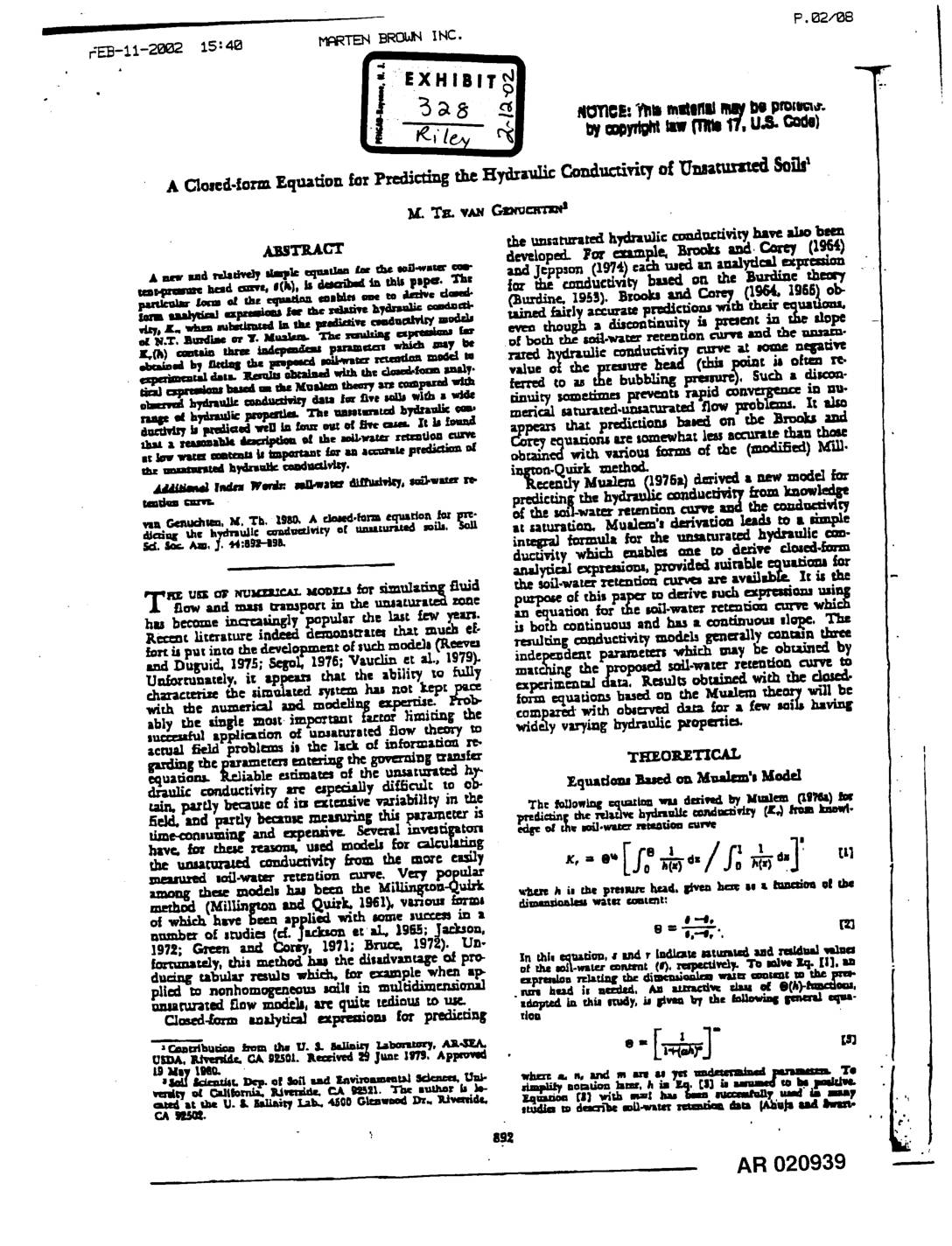 1980-01-01
EXH AR020939: Closed-Form Equation Predicting Hydraulic Conductivity Unsaturated Soils
This 1980 soil science paper by M.Th. van Genuchten presents a closed-form mathematical equation for predicting how well water moves through unsaturated (partially dry) soils. The equation relates soil-water retention to hydraulic conductivity using a small set of measurable parameters, offering a simpler and more computationally reliable alternative to earlier methods. The model was validated against observed data for several soils with widely varying properties.