Notes
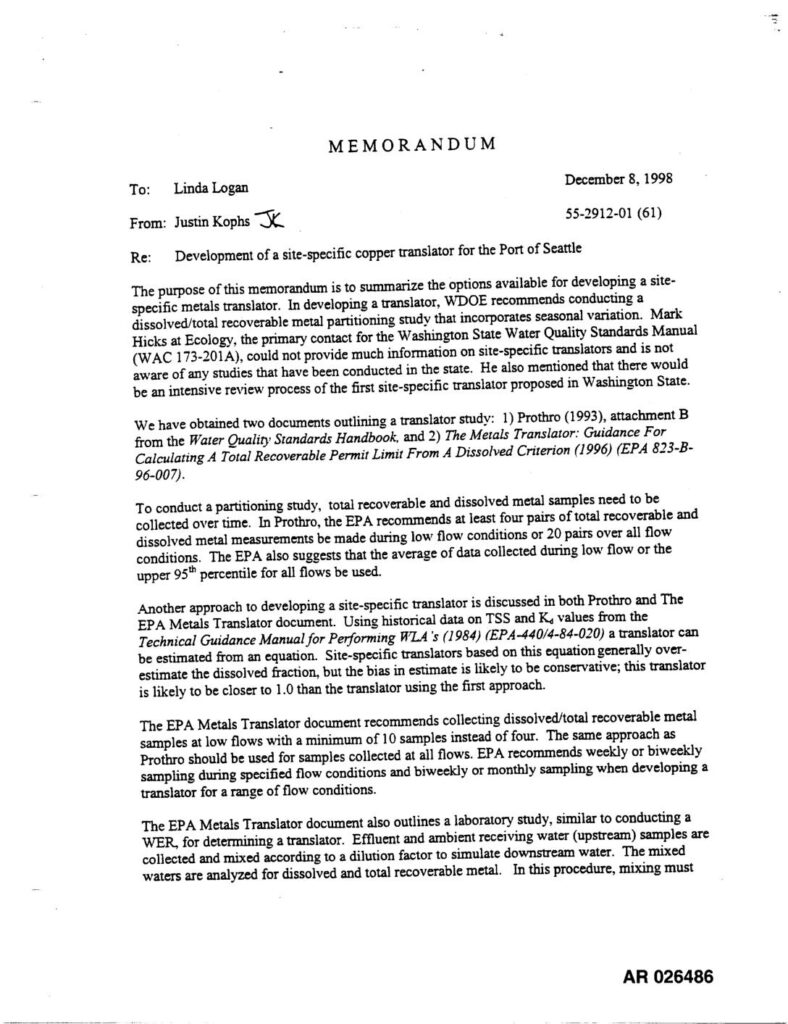
Memorandum dated December 8, 1998 from Justin Kophs to Linda Logan (cc: Doug Henderson) summarizing options for developing a site-specific copper metals translator for the Port Of Seattle. Discusses WDOE recommendations for dissolved/total recoverable metal partitioning studies incorporating seasonal variation, referencing WAC 173-201A, Prothro (1993), and EPA Metals Translator guidance document (EPA 823-B-96-007). Covers three approaches: field partitioning study (minimum 4–10 pairs of dissolved/total recoverable samples at low flow), equation-based estimation using historical TSS and Kd values from Technical Guidance Manual for Performing WLAs (EPA-440/4-84-020), and laboratory WER-style mixing study using effluent and ambient upstream receiving water. Notes that site-specific translator applies to receiving water data and cannot influence permit limits like a WER. AR 026486–026487.