TagPCHB(607)
-
 1998-09-14
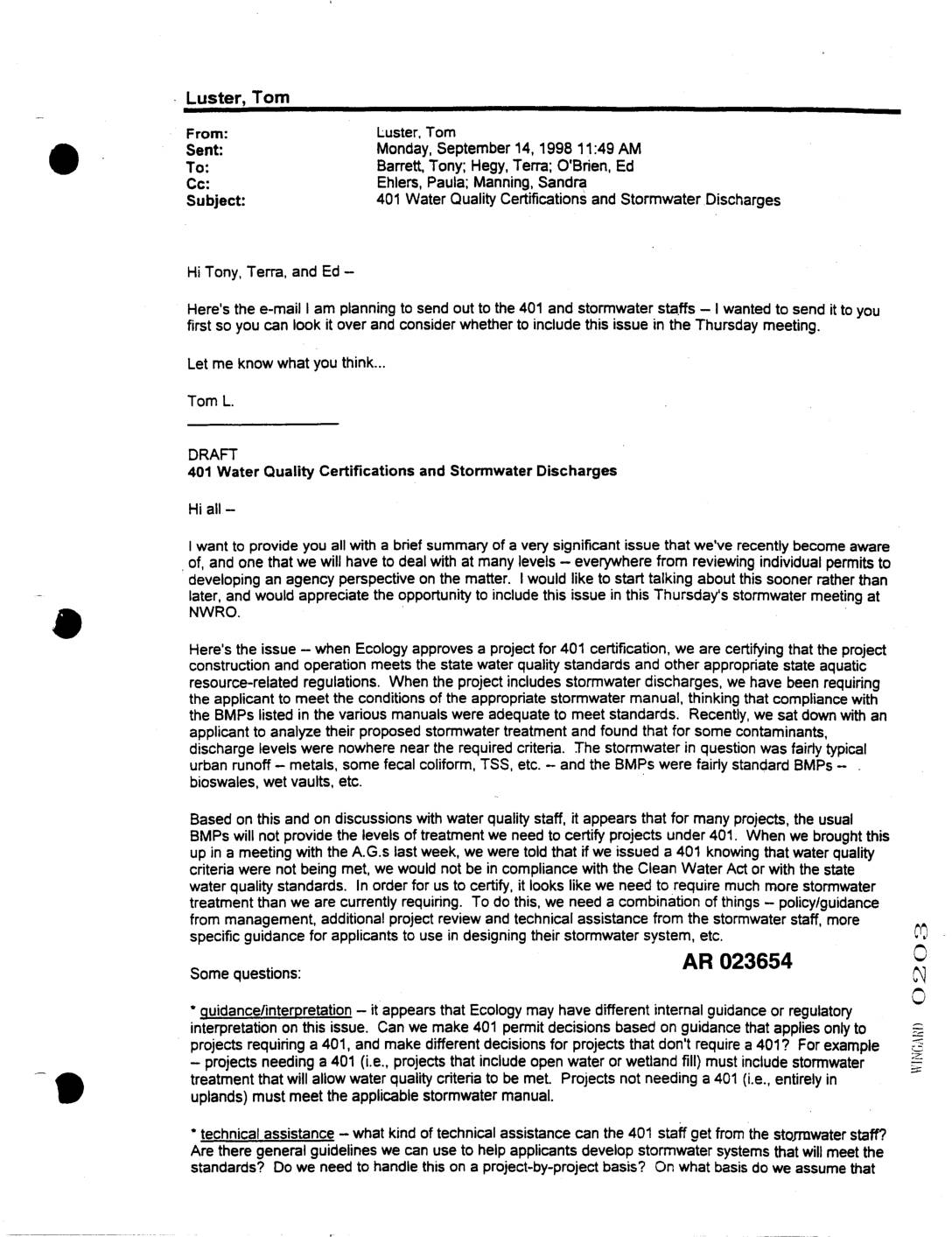
EXH AR023654: Draft Internal Email — 401 Water Quality Certs & Stormwater Discharges
A 1998 internal email from Washington State Department of Ecology staff raises concerns that standard stormwater Best Management Practices (BMPs) may not provide sufficient water quality treatment to meet state and federal Clean Water Act standards for projects requiring 401 Water Quality Certification. The author warns that issuing 401 certifications while knowingly allowing water quality criteria to go unmet would be legally indefensible, and calls for updated policy guidance, better technical assistance, and clearer requirements for applicants. The email proposes that projects involving waters of the state be held to stricter stormwater treatment standards than upland projects not requiring a 401 certification. -
 1998-09-11
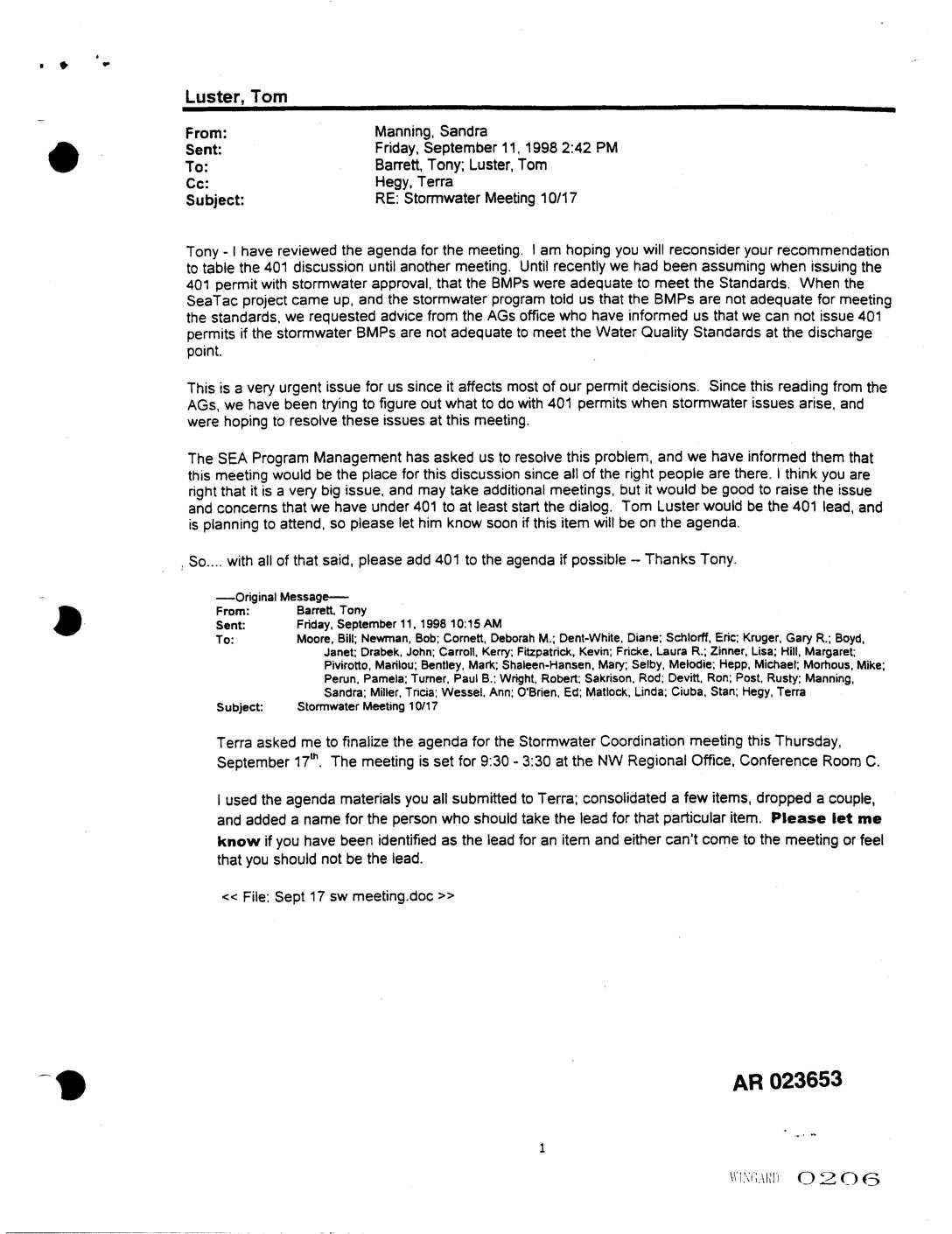
EXH AR023653: Email – Stormwater Meeting 10/17, 401 Permit & Water Quality Standards
A 1998 internal email exchange between Washington State environmental officials discusses an urgent regulatory problem that arose during the SeaTac Airport project: stormwater Best Management Practices (BMPs) were found to be inadequate to meet Water Quality Standards, meaning 401 water quality permits could not legally be issued. The Attorney General's office confirmed that 401 permits cannot be granted when stormwater BMPs fail to meet standards at the discharge point, affecting most permit decisions at the time. Officials urged that the issue be added to the agenda of a September 17, 1998 Stormwater Coordination meeting to begin resolving how to handle 401 permits when stormwater concerns arise. -
 1998-08-13
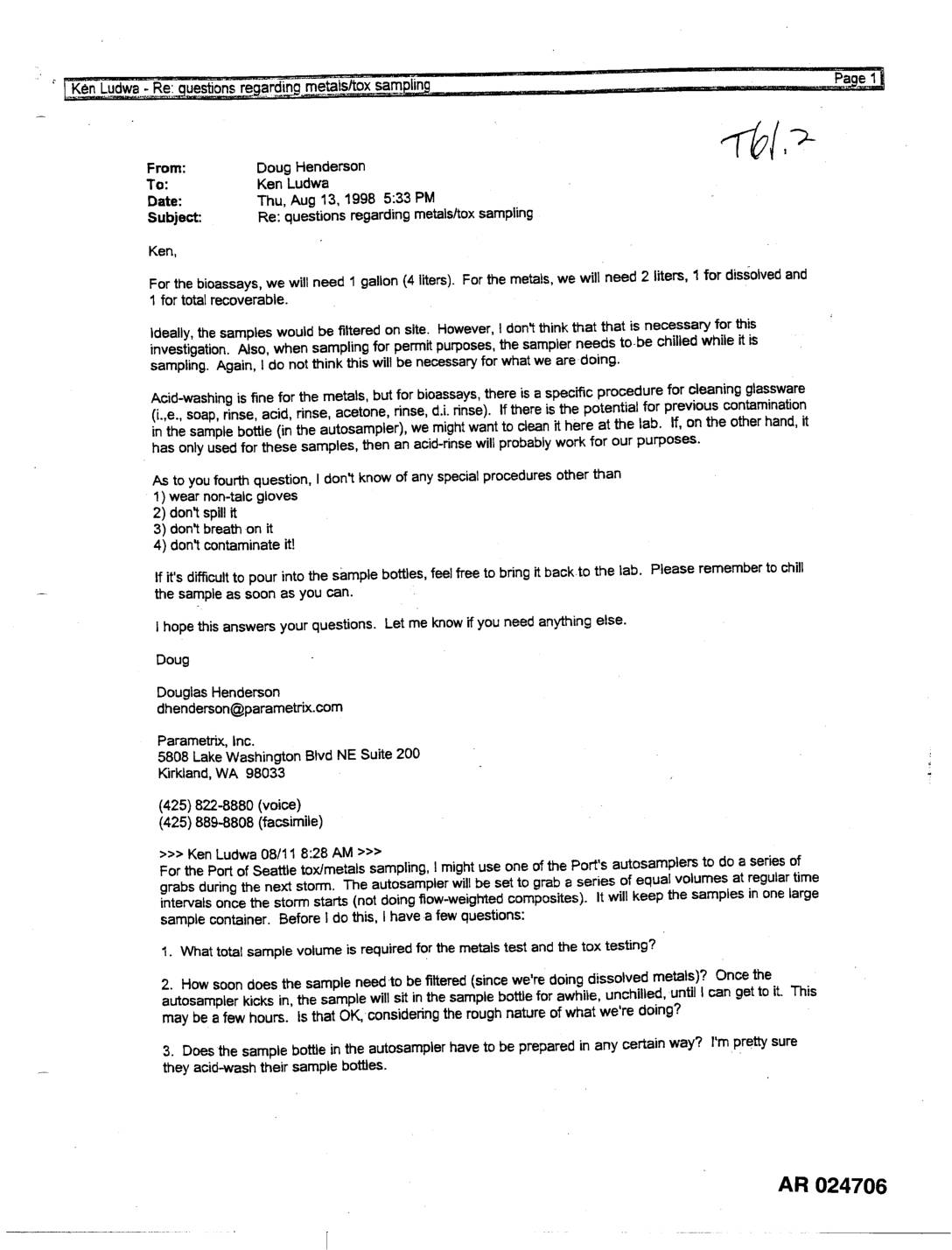
EXH AR024706: Email Correspondence Metals/Tox Sampling Procedures Storm Water Study
This August 1998 email exchange between Ken Ludwa and Doug Henderson of Parametrix, Inc. discusses technical procedures for collecting stormwater samples at the Port of Seattle for metals and toxicity testing. Ludwa asks about required sample volumes, filtration timing, bottle preparation, and transfer procedures when using an autosampler during a storm event. Henderson advises that bioassays require 1 gallon and metals testing requires 2 liters, and provides guidance on sample chilling, glassware cleaning, and handling precautions. -
 1998-07-01
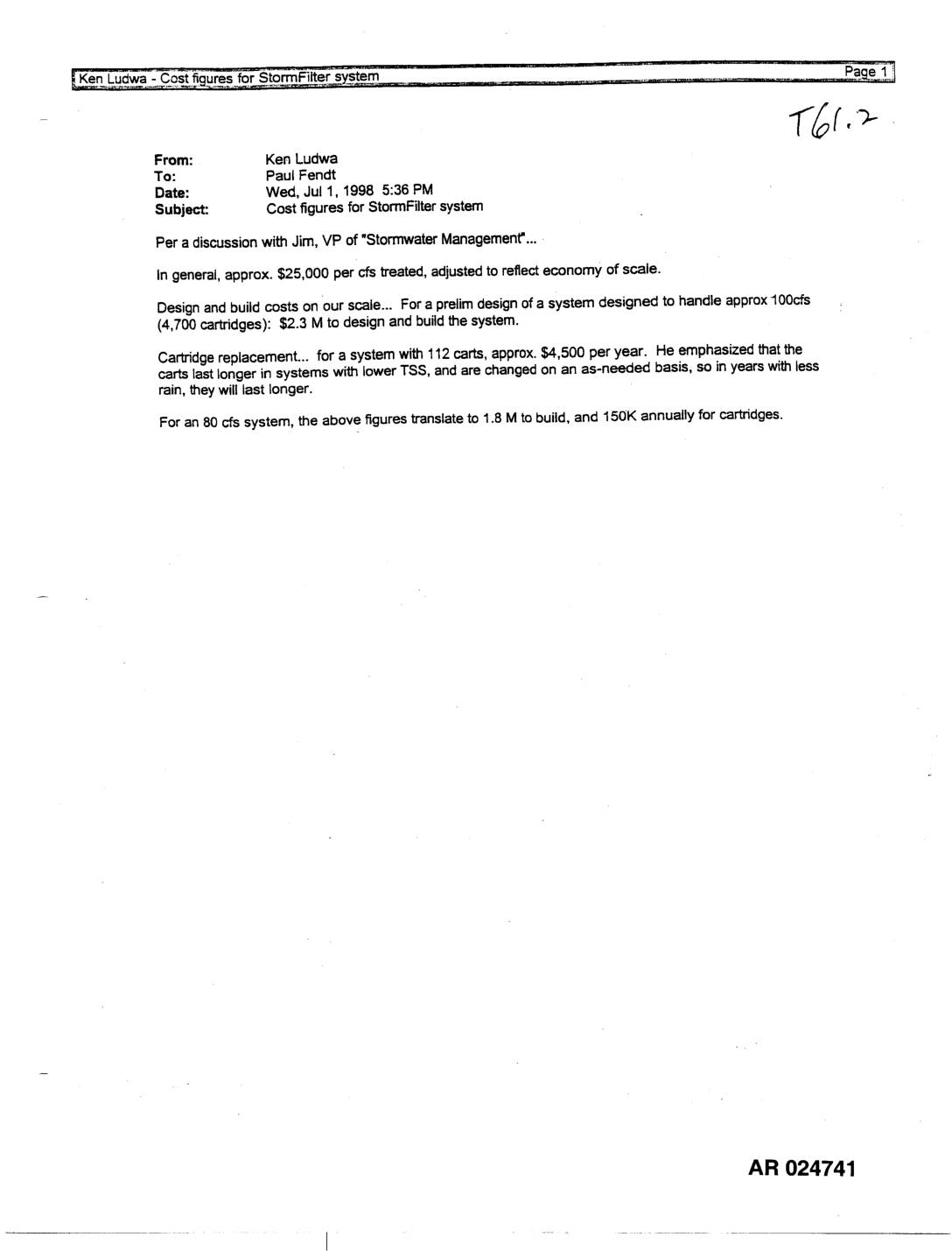
EXH AR024741: Cost Figures StormFilter System — Email Ludwa to Fendt
A July 1, 1998 internal email from Ken Ludwa to Paul Fendt outlines preliminary cost estimates for a StormFilter stormwater treatment system, based on a discussion with a VP of Stormwater Management. A 100 cfs system handling approximately 4,700 cartridges would cost roughly $2.3 million to design and build, while an 80 cfs system would cost approximately $1.8 million to build with $150,000 annually for cartridge replacement. Cartridge costs vary depending on total suspended solids (TSS) levels and rainfall, as cartridges are replaced on an as-needed basis. -
 1998-06-30
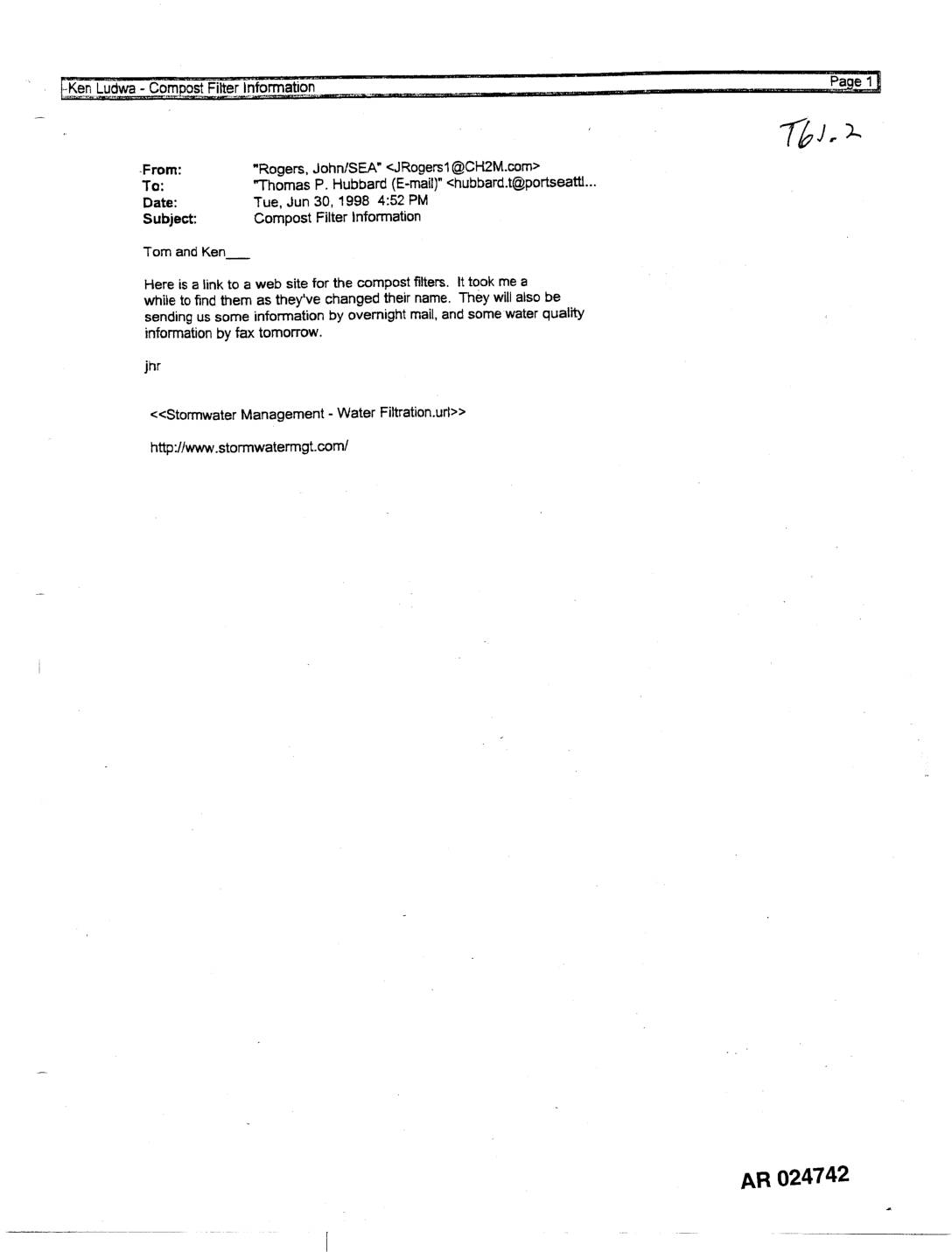
EXH AR024742: Email — Compost Filter Info for Stormwater Management
A June 30, 1998 email from John Rogers of CH2M to Thomas Hubbard and Ken Ludwa provides a website link (www.stormwatermgt.com) for a compost filter vendor, noting the company had recently changed its name. Rogers mentions that the vendor would be sending additional product information by overnight mail and water quality data by fax the following day. The correspondence relates to stormwater management and water filtration research being conducted in connection with Port of Seattle operations. -
 1998-06-30
EXH AR024744: Email Ludwa to Kelley with BMP Removal Efficiency Data (Bmps.xls)
A June 1998 internal email from Ken Ludwa to Jim Kelley includes spreadsheet data comparing removal efficiency percentages for various pollutants—including solids, phosphorus, nitrogen, BOD, iron, lead, zinc, copper, bacteria, and total petroleum hydrocarbons—across multiple published studies from the 1980s and 1990s. The tables compile findings from sources such as Marselek et al. (1996), Metro (1992), and the UW Short Course, and conclude with recommended removal efficiency values for each pollutant category. This document appears to relate to Best Management Practices (BMPs) for stormwater treatment, likely in the context of environmental review for airport-related runoff management. -
 1998-04-06
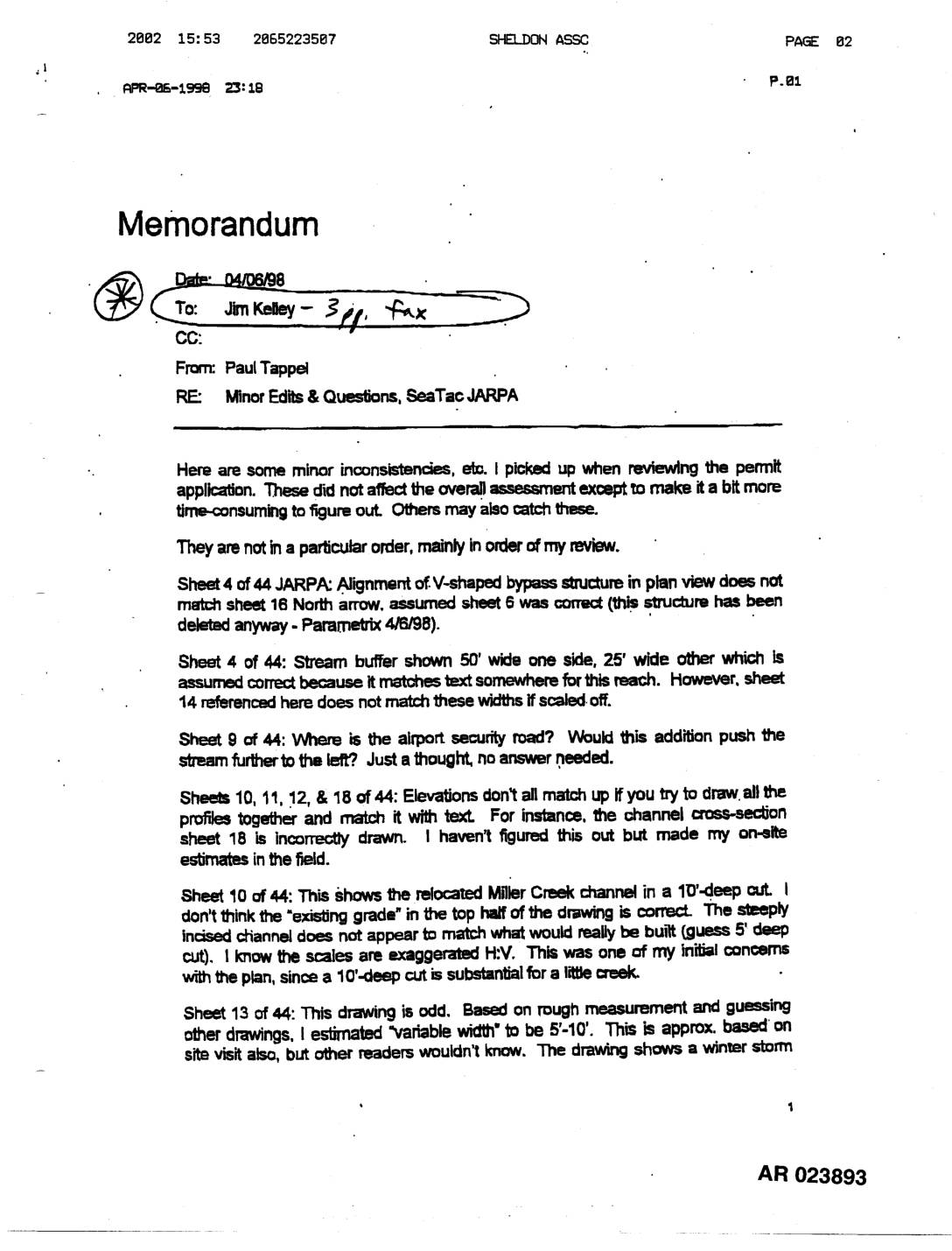
EXH AR023893: Memo Tappel to Kelley — Minor Edits & Questions, STIA JARPA
A April 6, 1998 internal memorandum from Paul Tappel to Jim Kelley identifies minor technical inconsistencies and questions in the Sea-Tac Airport JARPA permit application, focusing on discrepancies in engineering drawings, stream buffer widths, channel elevation profiles, and hydraulic calculations for a proposed Miller Creek relocation. Tappel raises concerns that the plan overstates the environmental benefits of the reconstructed creek channel and contains contradictory goals regarding wildlife habitat and airport bird-strike safety. He notes these issues are not critical to the overall assessment but could cause confusion as the design moves forward. -
 1998-01-22
EXH AR025788: Geotechnical Design Recommendations Phase 1 Embankment Construction Third Runway STIA
This January 1998 geotechnical engineering report by AGI Technologies provides design recommendations for Phase 1 embankment construction related to the Third Runway Project at Seattle-Tacoma International Airport. The report covers site conditions including subsurface soil layers and groundwater, as well as design concepts addressing embankment stability, settlement, and drainage. It was prepared for HNTB Corporation as part of the engineering groundwork for the airport's runway expansion. -
 1997-09-12
EXH AR023208: Sediment Characterization Hamm Creek Restoration Project Duwamish Turning Basin
This 1997 report by Science Applications International Corporation characterizes sediment quality in the Duwamish Turning Basin near Seattle, Washington, as part of the Hamm Creek Restoration Project. It presents results from chemical testing, biological bioassays, and sediment sampling to evaluate contaminant levels and compare them against sediment management standards. The study was prepared for the U.S. Army Corps of Engineers, Seattle District. -
 1997-08-31
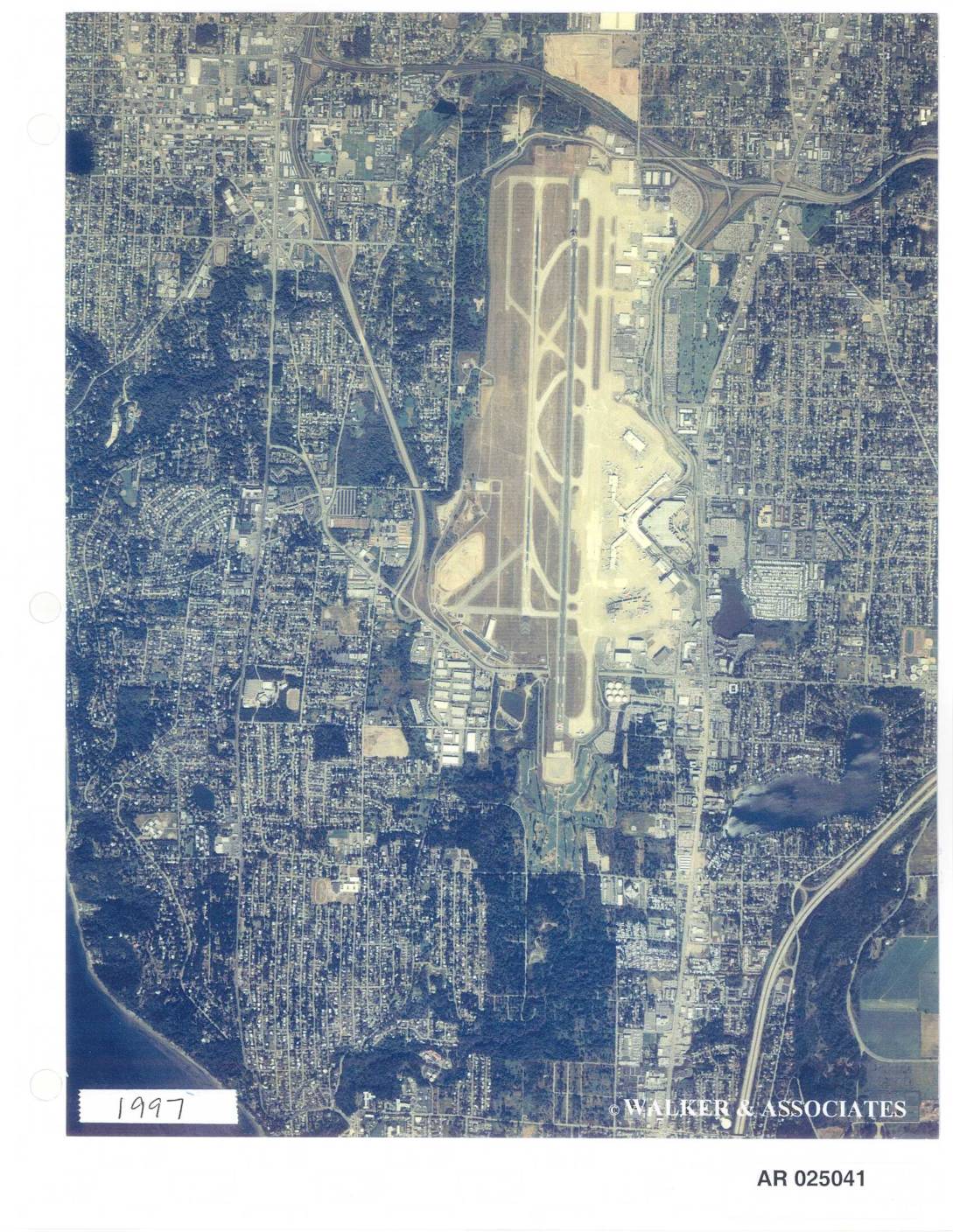
EXH AR025041: Aerial Photographs STIA 1997–1998 — Walker & Associates
This document contains aerial photographs of Seattle-Tacoma International Airport (Sea-Tac) taken in 1997 and 1998 by Walker & Associates, a photogrammetric and GIS services firm based in Seattle, WA. The images show the airport's runways, taxiways, terminal area, and surrounding residential and commercial neighborhoods from above. Accompanying metadata indicates the 1997 photograph was taken on August 31, 1997, at an approximate print scale of 1 inch equals 2,300 feet, under negative number 1197 SeaTac PP-2.