Skip to content
  • STNI
  • Statistics
    • Ops and Passengers
      • King County International Airport (Boeing Field) Annual Operations
    • Financials
    • Aviation fuel uplift in the State of Washington 2018 – 2025
      • Aviation Fuel Uplift at Sea-Tac Airport
    • Air Quality Monitoring
    • Flight Tracking
      • Flow and Flight Tracks
      • Five Year Comparison
      • Busiest Hours and Days
    • SEL Noise Reports & Graphs
      • About The Permanent Noise Monitors
      • Minutes of Quiet by Noise Monitor
      • Noise Events mapped
      • Noise Events (SEL)
    • Runways
    • Employees
    • Real Estate
      • Port Properties and Trees mapped
    • Parking
  • Events
  • Protest
    • Regular Events
    • Legislation 2026
    • Complain about a particular flight
    • Advocacy Organizations
    • Media Outlets
    • People
    • The Port of Seattle
      • Commission Meetings
      • Public Records Requests
      • StART
      • Highline Forum
    • Contact Your Electeds
  • Resources
    • FAQs
      • FAA Occurrences/Accidents/Indents
    • The unSustainable Airport Master Plan
      • SAMP Public Comment Template
        • Two versions of Appendix K: NEPA/SEPA 2018 vs 2023
      • SAMP NTP: 31 projects by the numbers
      • SEPA Draft EIS (2026)
      • SAMP Record of Decision/FONSI (2025)
      • SAMP Draft EA (October 2024)
      • 2018 Scoping
    • Port Packages
      • Port Package Property Costs
      • Port Packages mapped
      • The Port Package Explainer
      • So you want a (first-time) Port Package? Start here
      • Port Package Looker Upper
      • How do I determine if I have a Port Package or Avigation Easement?
      • Progress on Port Package Update legislation
      • Having a Port Package Problem?
      • Port Package Site Visit Follow-Up
    • Document Library
    • Explainers
      • The Airport Law Cheat Sheet
      • The Grant Explainer
    • External Articles
    • History
      • Timeline
      • The Sea-Tac Communities Plan
        • Sea-Tac Communities Plan – Planning Maps
      • PSRC Third Runway Decision Process
    • Studies
    • Videos
  • Stories
  • Mission
  • Subscribe
  • Contact
Scroll down to content

Get InformedStay Informedx

I understand that you will never share my information with anyone, you will only use it to keep me updated on relevant events and that I may unsubscribe at any time.

STNI

STNISea-Tac Noise.Info

  • Solve for Sea-Tac. Solve for every airport.
  • Since 2016, working to obtain justice for everyone living under the flight path.
  • Less Noise. Cleaner Air. Better Public Health. Compensation.
  • Everything you think you know about the airport is wrong.

TagPCHB(607)

Advanced Search Options

  • Dates
  • Media
    • External Articles
    • Images
    • PDFs
    • Video
    • Audio
  • Order By
  • 1999-10-28

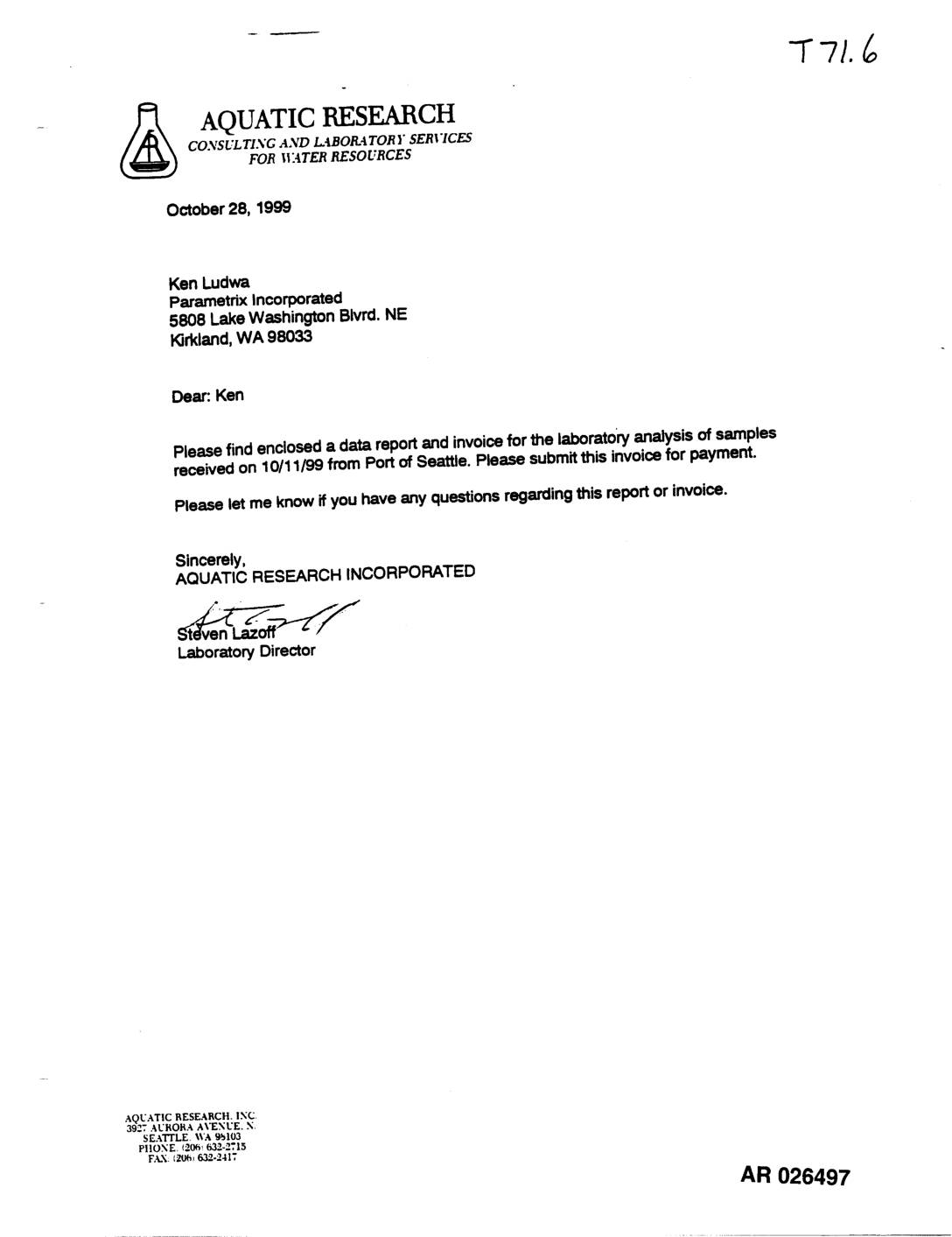
    EXH AR026497: Aquatic Research Inc Lab Analysis — Water Samples (PAR025-18)

    A October 1999 laboratory analysis report from Aquatic Research Incorporated details water sample testing conducted for Parametrix/Port of Seattle. One water sample collected on October 8-11, 1999 was tested for total suspended solids, petroleum hydrocarbons (diesel and motor oil), and total metals including cadmium, copper, lead, and zinc. Results showed low levels of contaminants, with zinc detected at 0.102 mg/l and copper at 0.0070 mg/l, while diesel and motor oil levels fell below detection limits.
    TagsACC, Environment, letter, PCHB, Pollution Control Hearings Board, Port Of Seattle, Third Runway, Water Quality
  • 1999-10-20

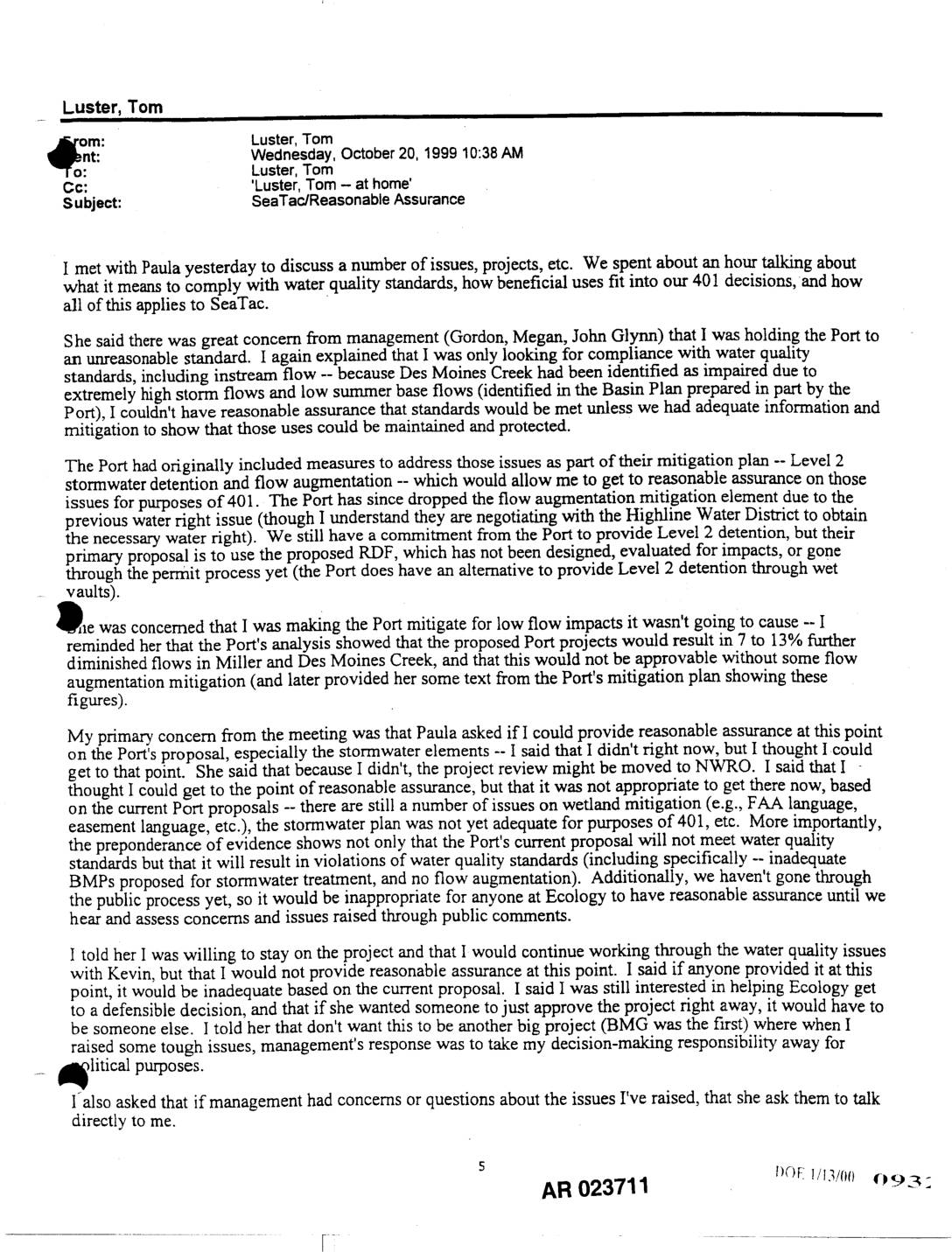
    EXH AR023711: Internal Email — Tom Luster on Sea-Tac Third Runway 401 Certification and Reasonable Assurance

    In this October 1999 internal memo, Washington State Department of Ecology staffer Tom Luster describes a meeting with his supervisor Paula regarding the agency's water quality review of Sea-Tac Airport expansion. Luster explains that he cannot yet provide 'reasonable assurance' that the Port of Seattle's proposal will meet water quality standards for Des Moines Creek, citing inadequate stormwater treatment plans and the Port's removal of flow augmentation measures from its mitigation plan. He expresses concern that management pressure to approve the project quickly could compromise the integrity of the regulatory review process.
    TagsACC, Des Moines Creek, Ecology, PCHB, Pollution Control Hearings Board, Third Runway, Water Quality
  • 1999-09-20

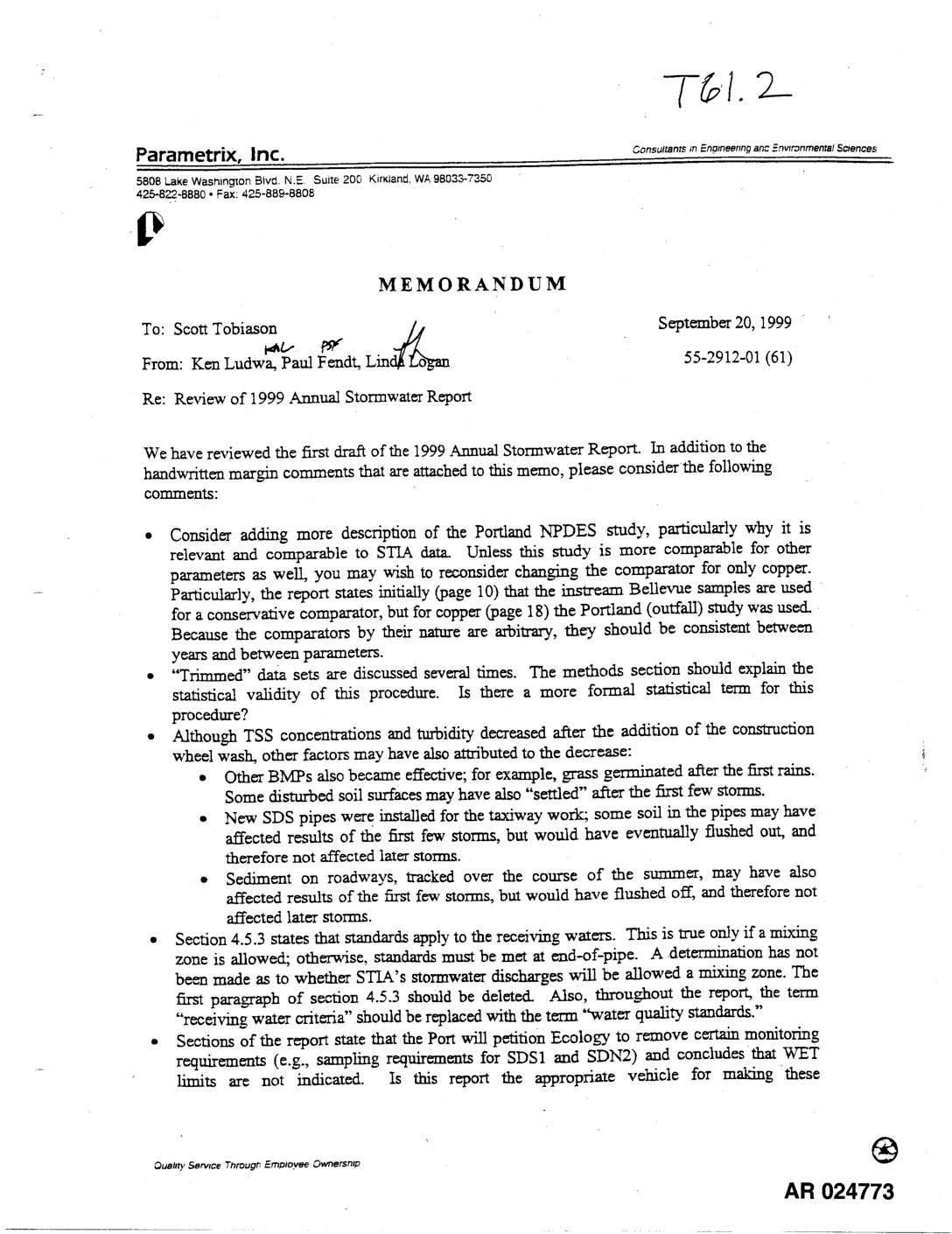
    EXH AR024773: Parametrix Memo — Review of 1999 Annual Stormwater RP, STIA

    A September 20, 1999 internal memorandum from Parametrix, Inc. consultants to Scott Tobiason provides technical review comments on the first draft of the 1999 Annual Stormwater Report for Seattle-Tacoma International Airport (STIA). The memo raises concerns about consistency in water quality comparators, statistical methods for 'trimmed' data sets, and the attribution of reduced sediment levels to construction wheel wash versus other factors. It also flags regulatory issues regarding mixing zones, water quality standards language, and potential NPDES permit compliance implications of identifying pollution sources in the annual report.
    TagsACC, NPDES, PCHB, Pollution Control Hearings Board, Port Of Seattle, Stormwater, Third Runway
  • 1999-09-07

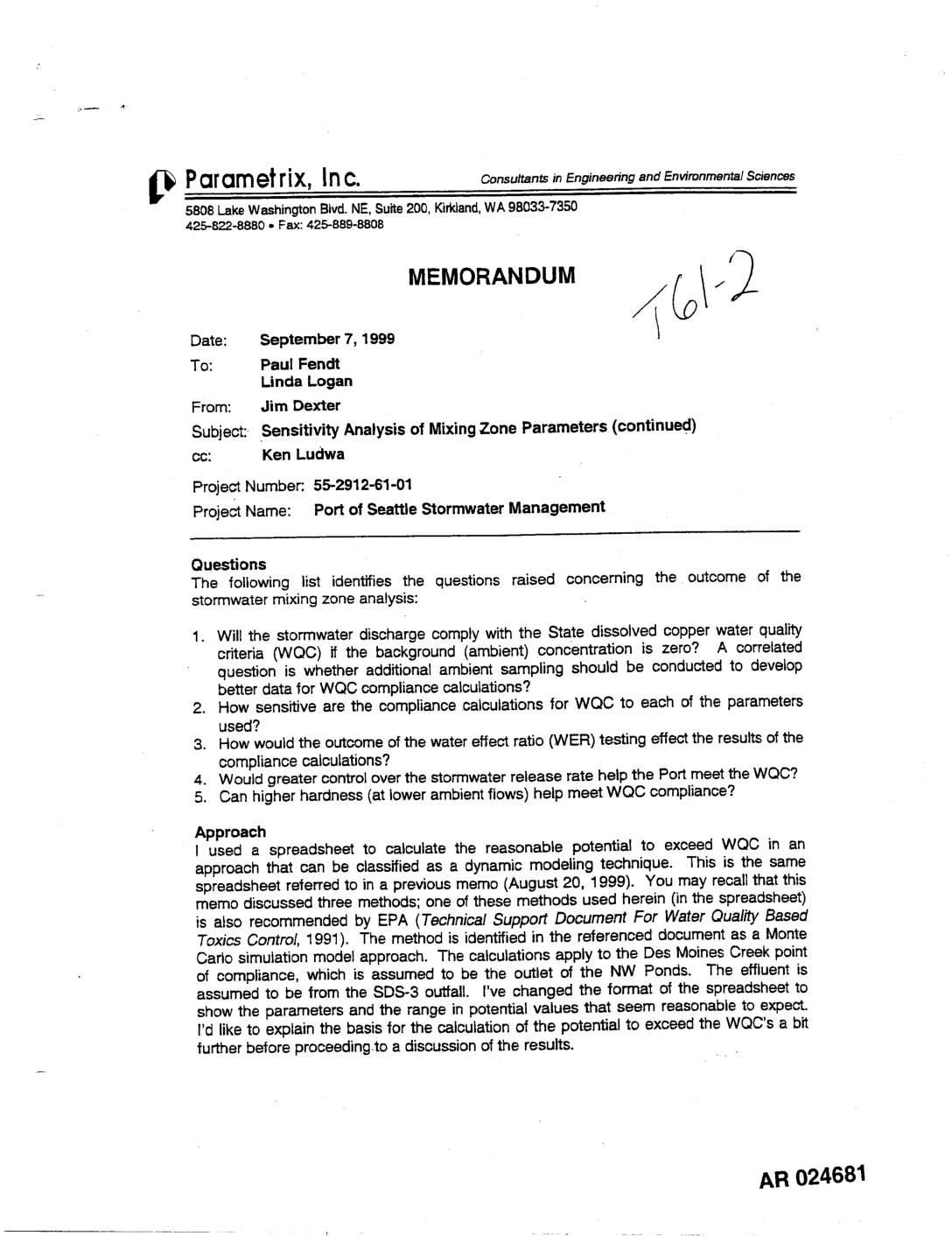
    EXH AR024681: Sensitivity Analysis Mixing Zone Parameters (cont.) — Stormwater Mgmt

    A 1999 technical memorandum from Parametrix, Inc. analyzes whether stormwater discharged near Des Moines Creek meets Washington State dissolved copper water quality criteria, using a Monte Carlo simulation model. The analysis finds that copper levels in the stormwater effluent consistently exceed water quality standards regardless of background ambient concentrations, with dilution factors generally less than 2. The study evaluates several potential remedies, including increased onsite detention, expanded mixing zones, and water effect ratio adjustments, finding that the Water Effect Ratio (WER) is the most influential factor in achieving compliance.
    TagsACC, Des Moines Creek, PCHB, Pollution Control Hearings Board, Port Of Seattle, Stormwater, Water Quality
  • 1999-08-20

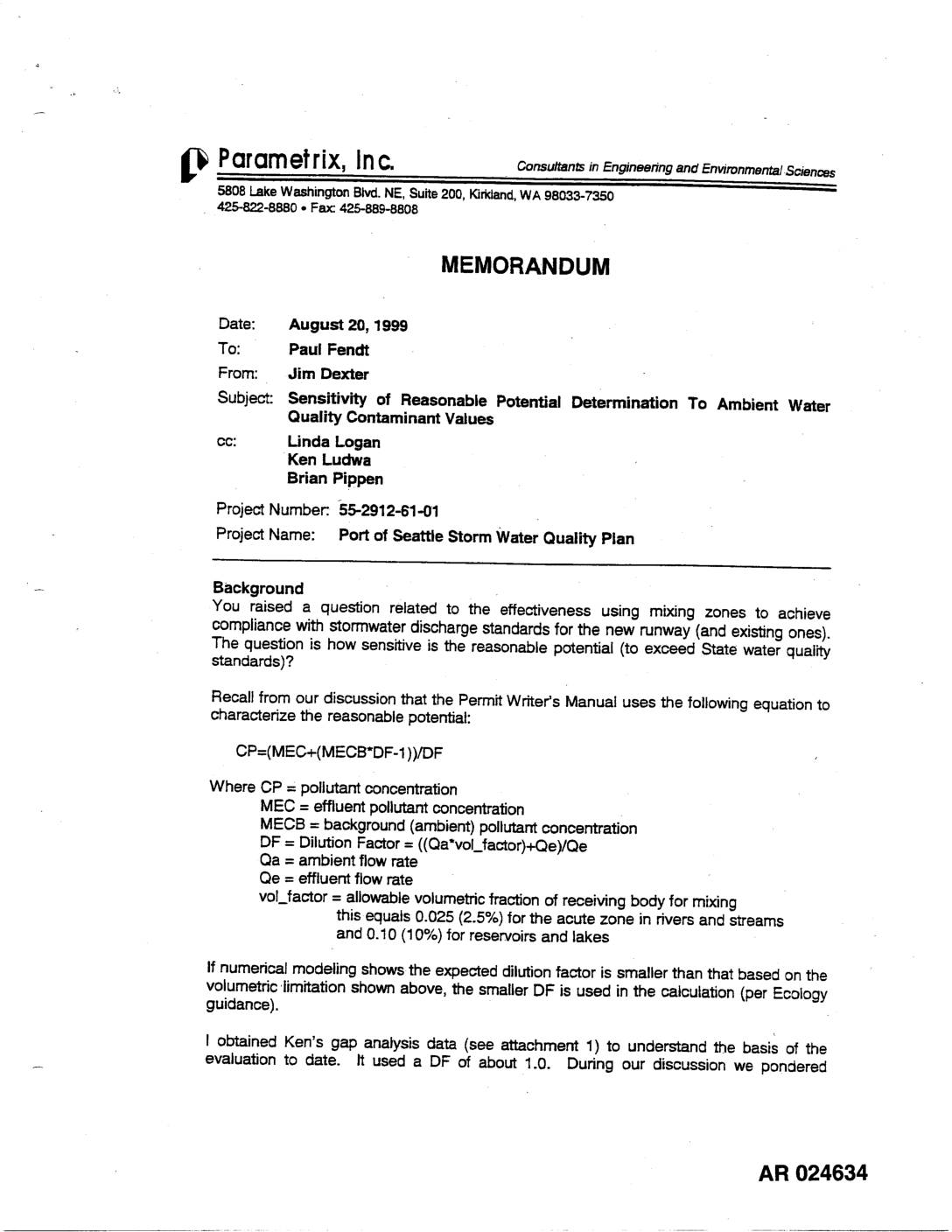
    EXH AR024634: Memo — Sensitivity of Reasonable Potential Determination to Ambient Water Quality Contaminant Values

    A 1999 technical memorandum from Parametrix, Inc. to the Port of Seattle analyzes the sensitivity of stormwater discharge compliance determinations for Sea-Tac Airport's runways, focusing on dissolved copper concentrations in Des Moines Creek. The memo evaluates whether mixing zones and dilution factors could offset elevated copper levels in stormwater runoff, finding that ambient copper concentrations already exceeded water quality criteria in 37–65% of samples. The analysis concludes that dilution factors based on streamflow alone are unlikely to be significantly greater than 1.0, though accounting for the Northwest Ponds' reservoir volume raises the estimated dilution factor to approximately 1.7.
    TagsACC, PCHB, Pollution Control Hearings Board, Port Of Seattle, Stormwater, Third Runway, Water Quality
  • 1999-08-09

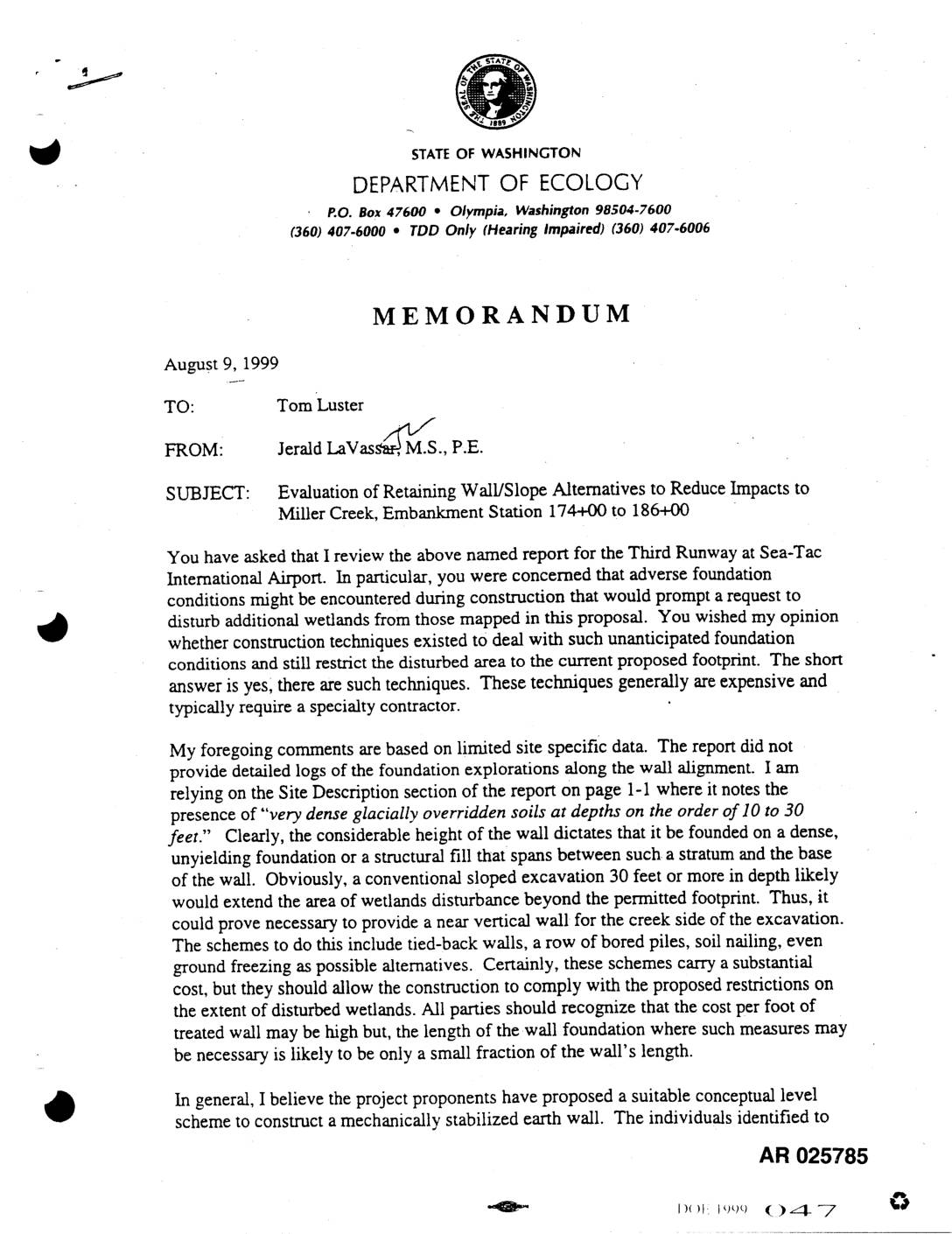
    EXH AR025785: Ecology Memo — Retaining Wall/Slope Alternatives, Miller Creek, Sta 174+00–186+00

    A 1999 memo from the Washington State Department of Ecology evaluates construction techniques for a retaining wall near Miller Creek at Sea-Tac International Airport's Third Runway project. The memo concludes that specialized methods such as tied-back walls, bored piles, soil nailing, or ground freezing can address difficult underground soil conditions while keeping construction within the approved wetlands disturbance footprint, though at significant cost. The author also recommends installing monitoring devices in the wall and backfill to confirm the structure performs as designed throughout its service life.
    TagsACC, Ecology, Mechanically Stabilized Earth, Miller Creek, PCHB, Pollution Control Hearings Board, Third Runway
  • 1999-07-01

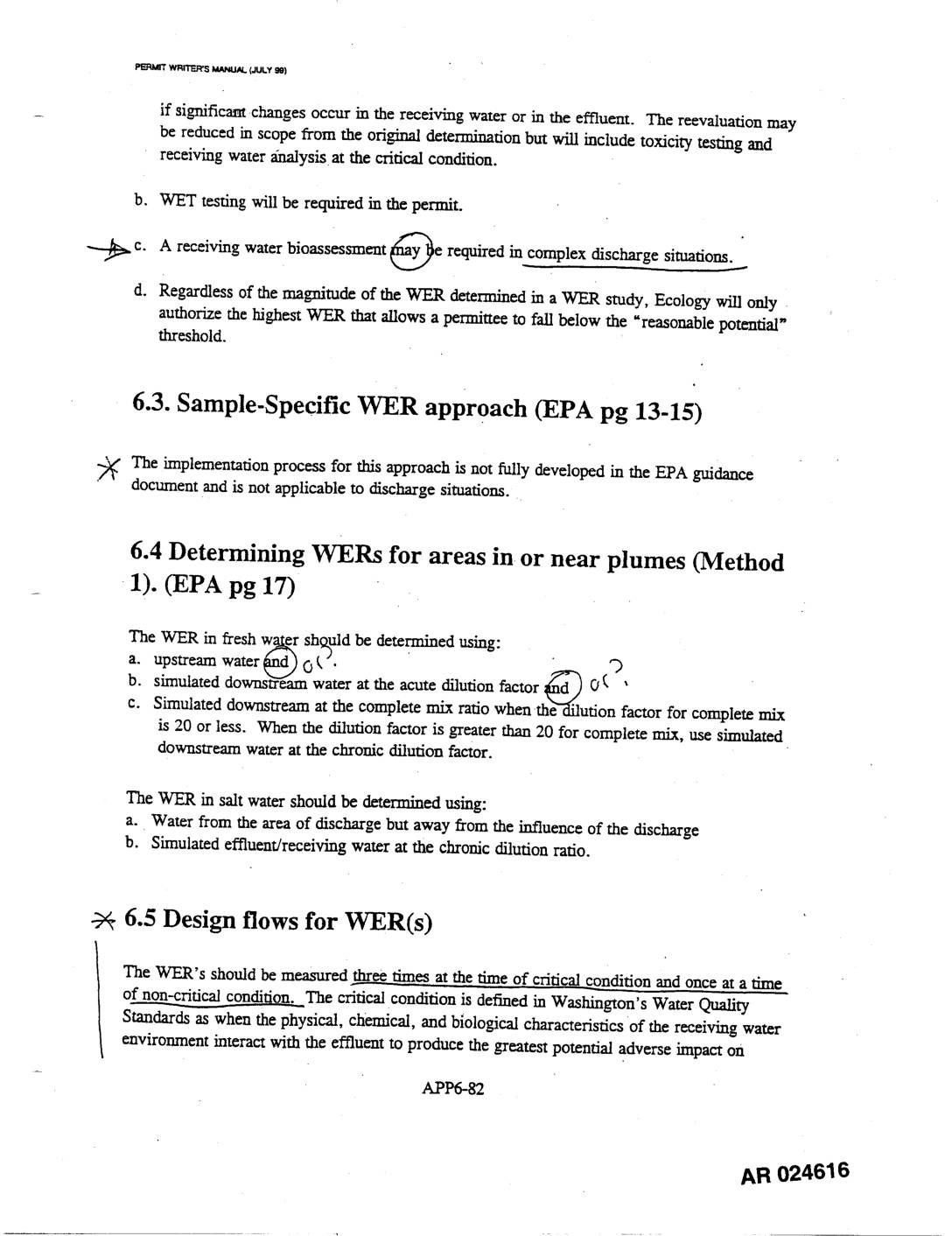
    EXH AR024616: Permit Writer’s Manual (July 1999) WER Methodology Sections 6.3–6.7

    This document is a section of Washington State's Permit Writer's Manual covering Water Effect Ratio (WER) methodology for water quality permitting. It outlines procedures for determining how receiving water conditions affect the toxicity of discharged effluents, including required toxicity testing species, sampling schedules at critical and non-critical flow conditions, and guidelines for freshwater and saltwater discharge situations. The document is unrelated to Sea-Tac Airport noise policy.
    TagsACC, Ecology, NPDES, PCHB, Pollution Control Hearings Board, Stormwater, Water Quality
  • 1999-06-13

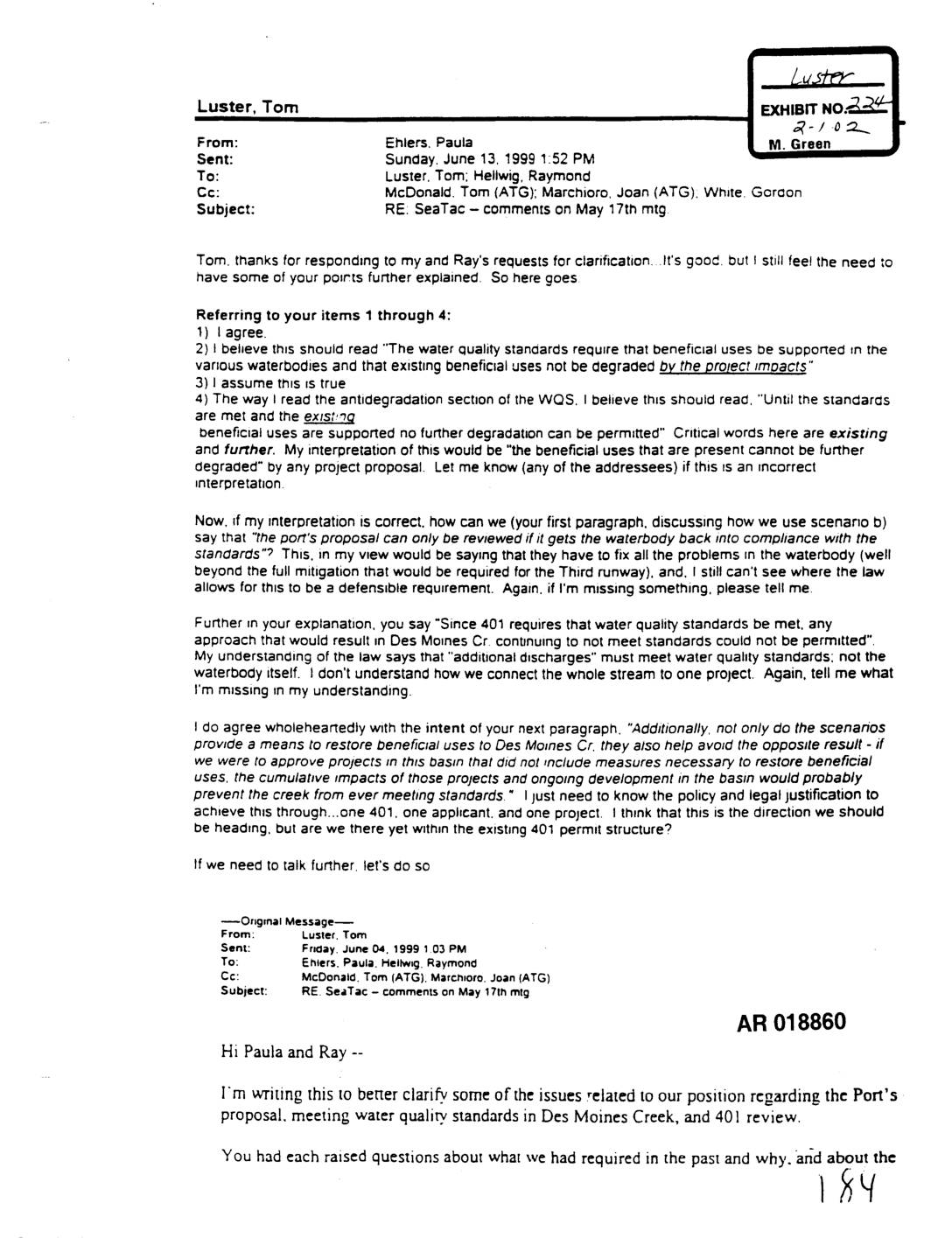
    Exhibit 224: Email Chain RE: Sea-Tac – Comments on May 17th Meeting, Water Quality Standards and 401 Certification for Des Moines Creek

    This 1999 email exchange between Washington State Department of Ecology staff debates the legal basis for requiring the Port of Seattle to restore water quality in Des Moines Creek as a condition of receiving a Section 401 water quality certification for the Sea-Tac Airport third runway project. The central question is whether Ecology can require a single applicant to fix broader watershed problems that pre-exist their project, or whether mitigation can only address the applicant's direct project impacts. Staff ultimately conclude that under antidegradation requirements, no further degradation of the creek can be permitted until existing beneficial uses are restored, meaning the Port's mitigation plan must include measures such as flow augmentation and stormwater controls to bring the creek into compliance with water quality standards.
    TagsACC, Des Moines Creek, Ecology, PCHB, Pollution Control Hearings Board, Third Runway, Water Quality
  • 1999-06-09

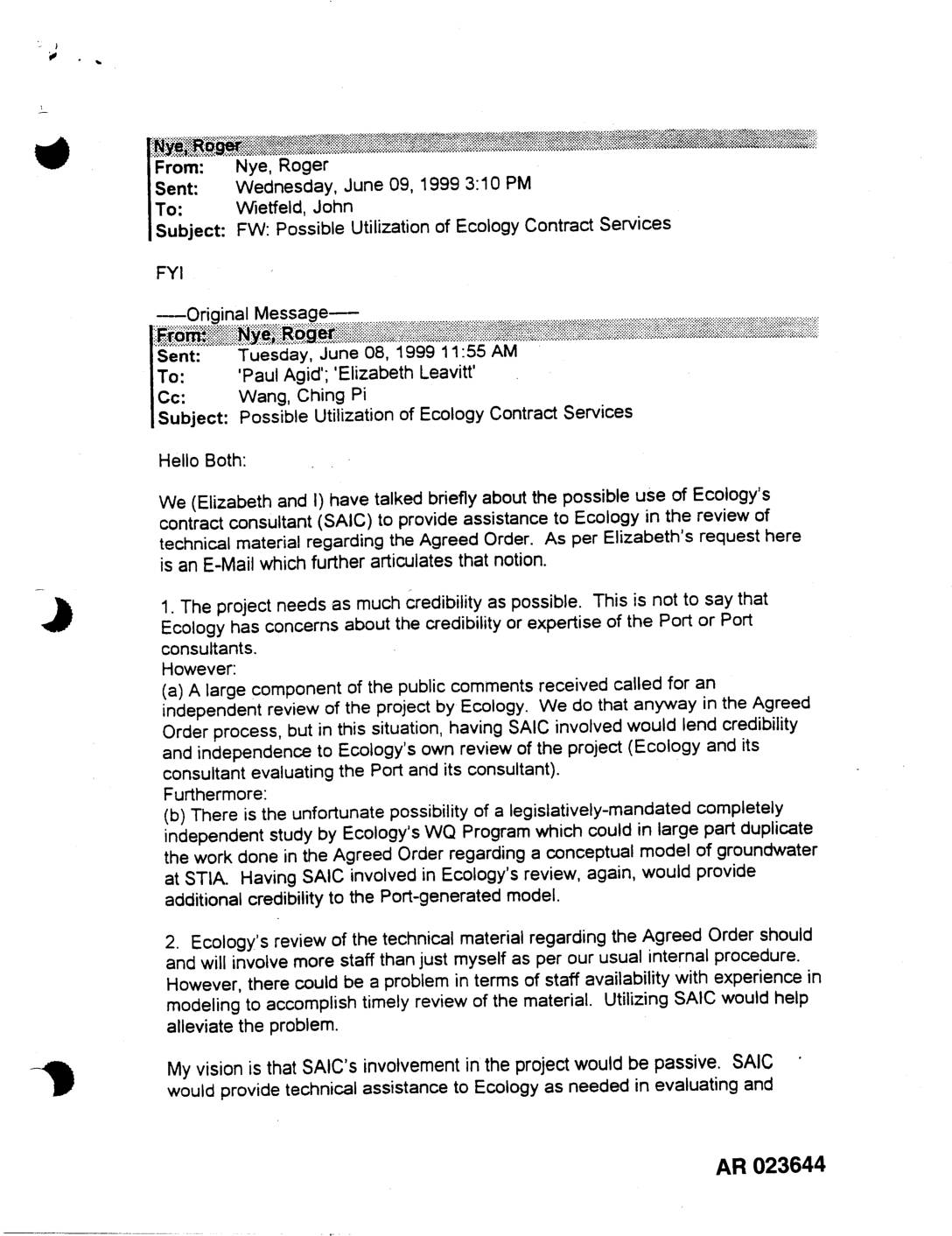
    EXH AR023644: Email Chain – Possible Utilization Ecology Contract Services (SAIC) Agreed Order Review STIA

    In a June 1999 email chain, Washington State Department of Ecology staff member Roger Nye proposed bringing in an outside consulting firm (SAIC) to help review technical groundwater studies related to an environmental cleanup agreement (Agreed Order) at Seattle-Tacoma International Airport (STIA). The goal was to add credibility and independence to Ecology's review process, particularly in response to public demands for an independent assessment. Nye also requested that the Port of Seattle agree to cover SAIC's costs as part of the overall project expenses under state cleanup regulations (MTCA).
    TagsACC, Ecology, MTCA, PCHB, Pollution Control Hearings Board, Port Of Seattle, Third Runway
  • 1999-06-01

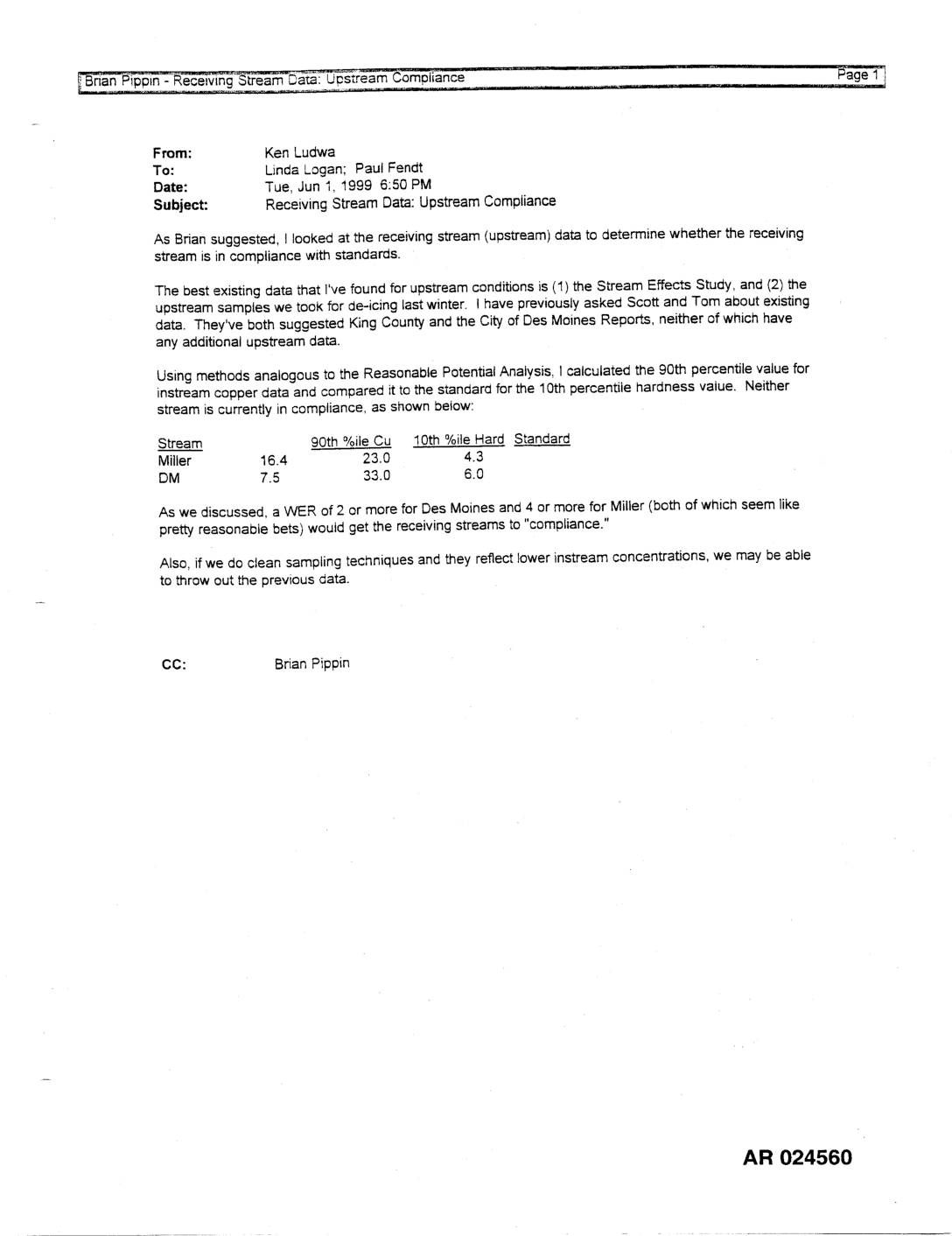
    EXH AR024560: Internal Email — Upstream Compliance Data, Miller Creek & Des Moines Creek

    A 1999 internal email from Ken Ludwa to airport staff reports that upstream water quality data for Miller Creek and Des Moines Creek shows both streams exceed copper concentration standards, meaning neither is currently in compliance. The analysis suggests that applying a Water Effect Ratio (WER) adjustment of 2 or more for Des Moines Creek and 4 or more for Miller Creek could bring the streams into apparent compliance with water quality standards. The email also raises the possibility of conducting new clean sampling to potentially replace the existing non-compliant data.
    TagsACC, Des Moines Creek, Miller Creek, PCHB, Pollution Control Hearings Board, Third Runway, Water Quality

Posts pagination

Page 1 … Page 55 Page 56 Page 57 Page 58 Page 59 … Page 61
Sidebar On/Off

Upcoming Events

  • StART SEA Stakeholder Advisory Round Table
    Add to CalendarMWednesday Aug 26, 5:00pm - 7:00pm
    Zoom (Virtual Meeting)
    START meetingagenda 2026826 final 0 pdf

    Meeting Objectives Introduce the primary feedback themes identified by StART members regarding StART’s Operating Procedures and determine areas that may warrant future discussion. 5:00 PM – Welcome Meeting Management Welcome Lead: Andrés Mantilla, Facilitator, Uncommon Bridges; Wendy Reiter, Airport Managing Director, POS 5:15 PM – Dinner: All participants eat. 5:30 PM – StART Operating Procedures

    [...]
  • Commercial Aviation Work Group
    Add to CalendarMThursday Sep 3, 10:00am - 1:30pm
    Virtual Meeting (Zoom)
    Cawg agenda sep 3 26 virtual pdf

    Meeting Agenda 10:00 a.m. – 10:15 a.m. | Welcome – Evan Nordby, Chair a. Introductions and Agenda Reviewb. Status of appointments and non-voting member invitationsc. Other updates as necessary 10:15 a.m. – 11:00 a.m. | Is it practical and legal to operate the western Washington [Puget Sound] airports as a single airport system? – Consultant

    [...]

[See all...]


Help study childhood asthma. Get free HEPA filter!

read more...

Issues

Sea-Tac Airport is currently undergoing the largest and longest expansion in its history, collectively known as the Sustainable Airport Master Plan (SAMP). Some of it you can already hear, but you’re probably not aware of what it all means. Here’s what you need to know.
read more...

Read This!

As the source for federal transportation grants, the Puget Sound Regional Council was charged with developing a system to meet the growing need for commercial aviation. When the search for a second airport failed, they authorized the Port of Seattle to build the Third Runway, with a mandate to develop a noise abatement and mitigation program. In their effort to stop the Third Runway, the ACC argued over every detail of the Port's efforts--including property buyouts and sound insulation. The dispute was meant to be settled by a three member Expert Arbitration Panel. This is their final report. It finds 2-1, that the Port's program was insufficient in several respects. Despite that, funding for the Third Runway was approved by the PSRC, and the 'Port Package' program, proceeded largely unchanged. Expert Arbitration Panel's final decision finding that the Port of Seattle had not shown sufficient reduction in real on-the-ground noise impacts to satisfy noise reduction conditions required for approval of a third runway at Sea-Tac International Airport. The majority decision concluded the Port's noise abatement programs were insufficient despite being impressive in scope.
continue...

The Podcast!

Subscribe to the only podcast devoted to policies, politics, history, impacts for people living under the flight path everywhere. It’s definitely not just about noise!
  • Sea-Tac Noise.Info
  • Connect with STNI

    • Subscribe
    • Port Package Problem?
    • Donate
    • Podcast
    • Socials
      • Facebook
      • X (Twitter)
      • Bluesky
      • Instagram

    "Vintage Airline First Class Cabin Interior" — , 2024

  • Learn

    • Frequently Asked Questions
    • Explainers
    • Youtube
    • Research Requests
    • Make a complaint
  • Goals

    Fulfill the promises of 1976:
    • Compensation
    • Reduced noise
    • Improved air quality
    • Environmental remediation
Login/Register
©2026•Data Privacy

Message

We use cookies to provide basic functionality. We also provide access to search engines in order to provide site analytics. We do not sell or share your data.
V V