TagPart 150(269)
-
 2025-01-01
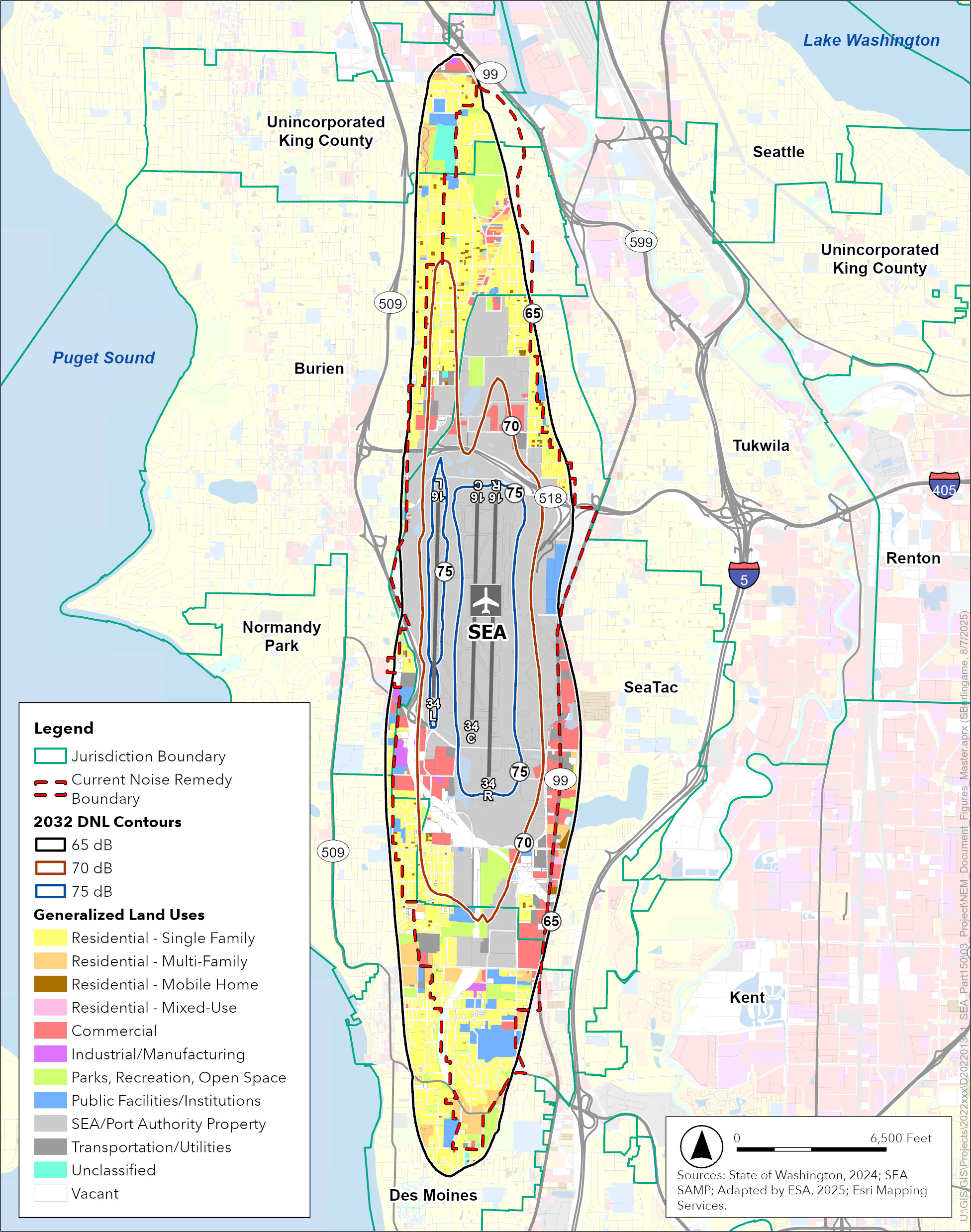
2032 DNL Noise Contours with Existing Land Use and Noise Remedy Boundary — Sea-Tac Airport
This GIS map depicts the 2032 Day-Night Average Sound Level (DNL) noise contours (65, 70, and 75 dB) for Seattle-Tacoma International Airport (SEA), overlaid with generalized land use classifications and the current Noise Remedy Boundary. Sourced from the State of Washington (2024) and SEA SAMP, adapted by ESA in 2025, the map covers surrounding jurisdictions including Burien, SeaTac, Tukwila, Normandy Park, Des Moines, and unincorporated King County. -
 2025-01-01
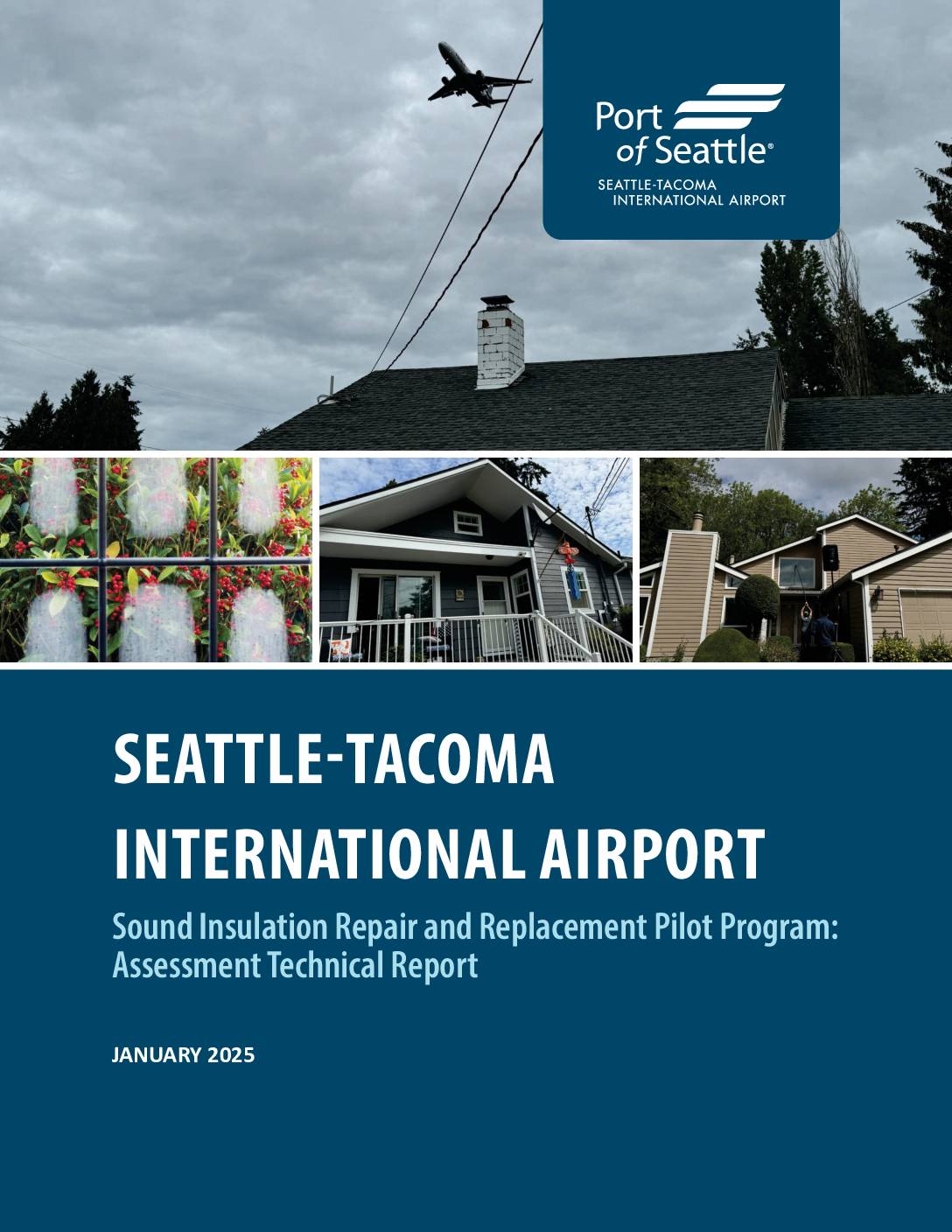
Seattle-Tacoma International Airport Sound Insulation Repair and Replacement Pilot Program: Assessment Technical Report
★ 32This January 2025 technical report, prepared by Environmental Science Associates for the Port of Seattle, documents a pilot program assessing the condition and effectiveness of sound insulation previously installed in homes near Seattle-Tacoma International Airport. The report covers resident surveys, research into the expected useful life of sound insulation building materials, acoustic testing methods, and test results from selected homes. It aims to inform future decisions about repairing or replacing aging noise-reduction treatments in affected neighborhoods. -
2024-12-19
Approval of Noise Compatibility Program Update, Naples Municipal Airport (APF), Naples, Florida
Action Notice. Summary The Federal Aviation Administration (FAA) announces its findings on the Noise Compatibility Program (NCP) Update submitted by the Naples Airport Authority (NAA) for the Naples Municipal Airport (the Airport). On December 9, 2021, the FAA determined that Noise Exposure Maps (NEMs) submitted by the NAA were in compliance with applicable requirements. The -
 2024-12-19
FAA Approval of Noise Compatibility Program Update, Naples Municipal Airport (APF), Naples, Florida
The FAA approved a Noise Compatibility Program (NCP) Update for Naples Municipal Airport in Naples, Florida, effective December 9, 2024. The approved measures include a residential sound insulation program, land use planning recommendations, purchase of avigation easements, and several community outreach and monitoring initiatives. One proposed measure related to revised flight procedures was not acted upon at this time, as it requires further FAA review. -
 2024-12-13
City of Des Moines Letter to Port Of Seattle: Comments on SAMP Draft Environmental Assessment
The City of Des Moines, Washington submitted formal comments to the Port of Seattle in December 2024, raising concerns about the environmental and health impacts of Seattle-Tacoma International Airport's planned growth. The city warns that by 2032, annual flight operations will increase by nearly 20%, expanding the noise exposure zone and raising the number of residents affected by significant aircraft noise from roughly 14,000 to nearly 22,000—with most of that burden falling on Des Moines residents. The letter calls on the Port and FAA to extend public comment periods, pursue meaningful noise mitigation measures such as sound insulation for homes and schools, and engage more collaboratively with impacted communities rather than treating public review as a formality. -
 2024-12-12
City of Des Moines Comment Letter on Seattle-Tacoma SAMP Draft Environmental Assessment
The City of Des Moines submitted formal comments to the Port of Seattle in December 2024, expressing serious concerns about the Seattle-Tacoma International Airport's Sustainable Airport Master Plan and its projected growth in flight operations. The letter warns that by 2032, a nearly 20% increase in annual flights will significantly expand noise exposure for Des Moines residents, with the population affected by harmful noise levels rising by roughly 37% even without the proposed expansion. The city calls on the Port and FAA to extend public review periods, develop meaningful noise mitigation measures such as sound insulation programs, and collaborate more genuinely with neighboring communities rather than treating public input as a regulatory checkbox. -
 2024-12-12
Four-City Joint Comment Letter on Seattle-Tacoma International Airport SAMP Draft Environmental Assessment
Four cities near Seattle-Tacoma International Airport — Burien, Normandy Park, SeaTac, and Des Moines — submitted formal comments in December 2024 objecting to the airport's Sustainable Airport Master Plan Environmental Assessment. The cities warn that planned growth will increase annual flight operations by nearly 20% by 2032, expanding the noise impact zone and exposing an estimated 22,000 residents to significant aircraft noise, up from about 14,000 in 2022. They call on the Port of Seattle to extend public review periods, improve its sound insulation program, and take proactive steps to protect the low-income and minority communities most burdened by airport noise. -
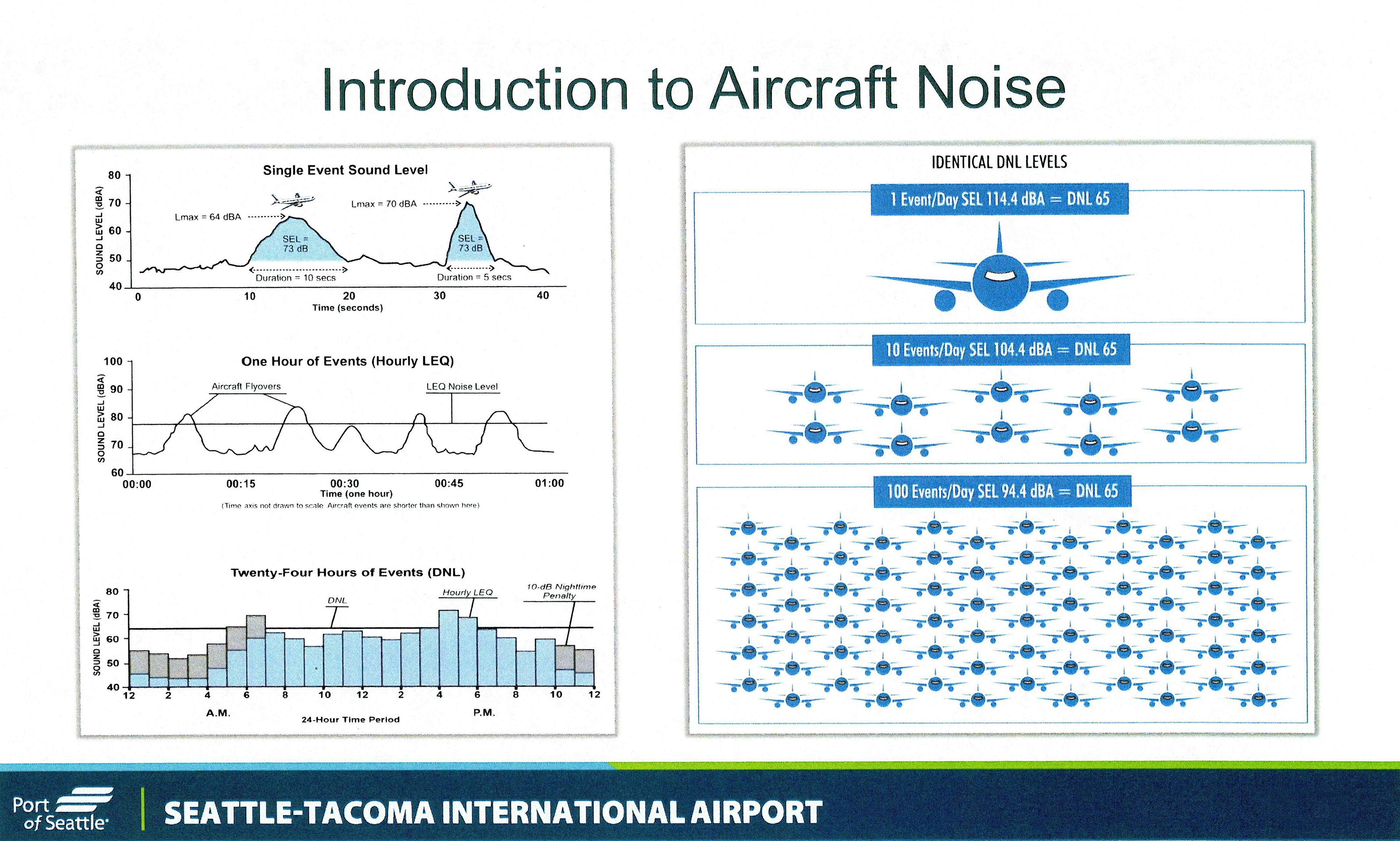
SEL and DNL 65 Noise Metrics Educational Slide — Port Of Seattle Part 150 Study
An educational slide produced by the Port of Seattle for Seattle-Tacoma International Airport explaining aircraft noise metrics, including Single Event Sound Level (SEL), Hourly LEQ, and Day-Night Level (DNL). The slide illustrates how varying numbers of daily flight events (1, 10, or 100) can produce identical DNL 65 noise levels, and includes charts showing sound levels over time periods ranging from seconds to 24 hours. -
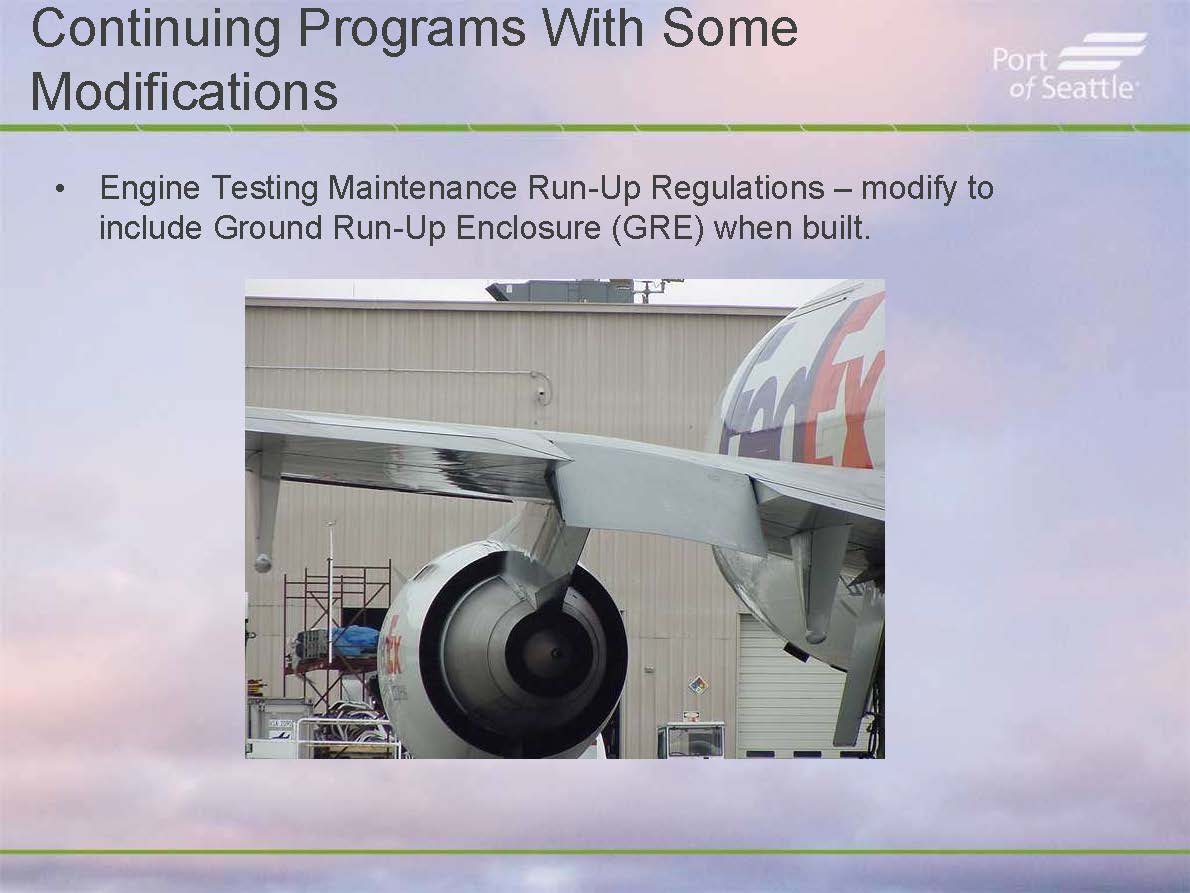
Part 150 09.24.2013_Commission_Presentation_Page_06
A Port of Seattle presentation slide titled 'Continuing Programs With Some Modifications' describes modifying Engine Testing Maintenance Run-Up Regulations to include a Ground Run-Up Enclosure (GRE) when built. The accompanying photo shows a FedEx aircraft undergoing engine maintenance outside a hangar at Seattle-Tacoma International Airport. -
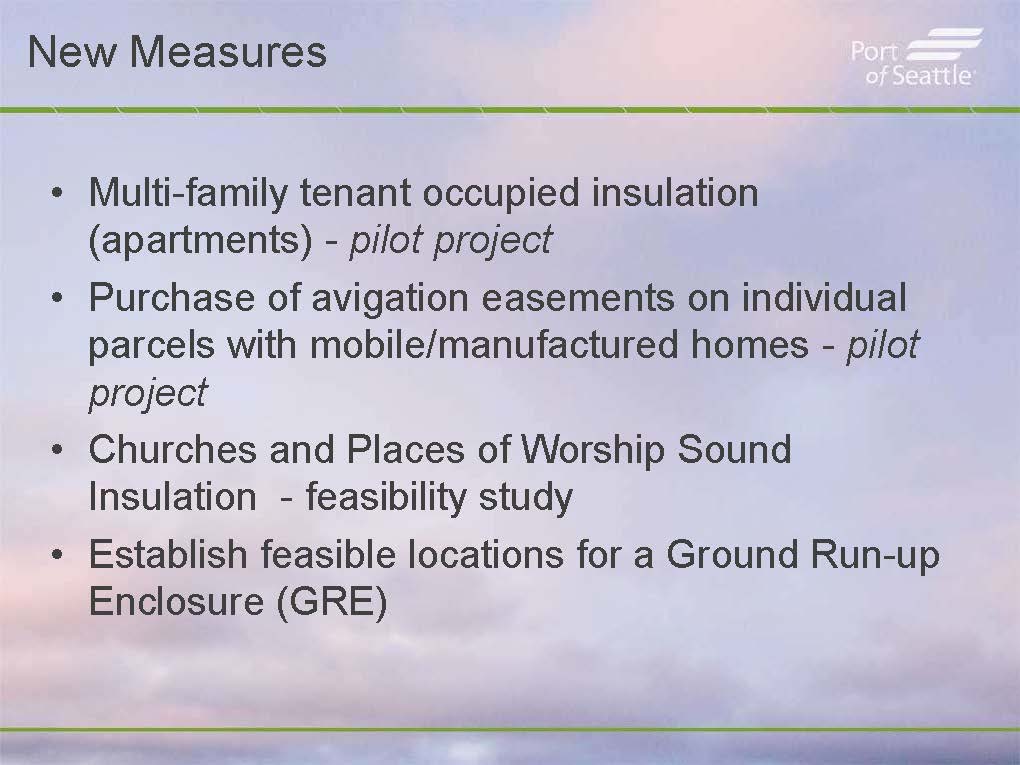
Part 150 09.24.2013_Commission_Presentation_Page_10
A Port of Seattle presentation slide titled 'New Measures' outlines four noise-mitigation initiatives: a multi-family tenant-occupied insulation pilot project for apartments, purchase of avigation easements on mobile/manufactured home parcels (pilot project), a feasibility study for sound insulation of churches and places of worship, and establishing feasible locations for a Ground Run-up Enclosure (GRE).