TagPart 150(269)
-
 2024-05-22
Part 150 Noise and Land Use Compatibility Study Update: Highline Forum Presentation
The Port of Seattle presented an update on the Part 150 Noise and Land Use Compatibility Study to the Highline Forum in May 2024. This federally required study, governed by FAA guidelines, maps aircraft noise contours around Seattle-Tacoma International Airport and identifies areas where noise levels exceed 65 decibels, helping determine which properties qualify for sound insulation and other mitigation measures. Airports that complete an FAA-approved Part 150 Study become eligible to receive federal Airport Improvement Program grants covering 80% of qualifying noise reduction projects. -
 2024-05-13
Part 150 is SAMP Part #1
Attend June 5, 6 and 8 workshops to learn about new noise boundaries Sea-Tac Airport is undertaking a Part 150 Study, a section of FAA regulations governing community noise impacts. These studies take several years to complete, but you should care now and attend the June 5, June 6 or June 8, Workshops for a -
 2024-05-13
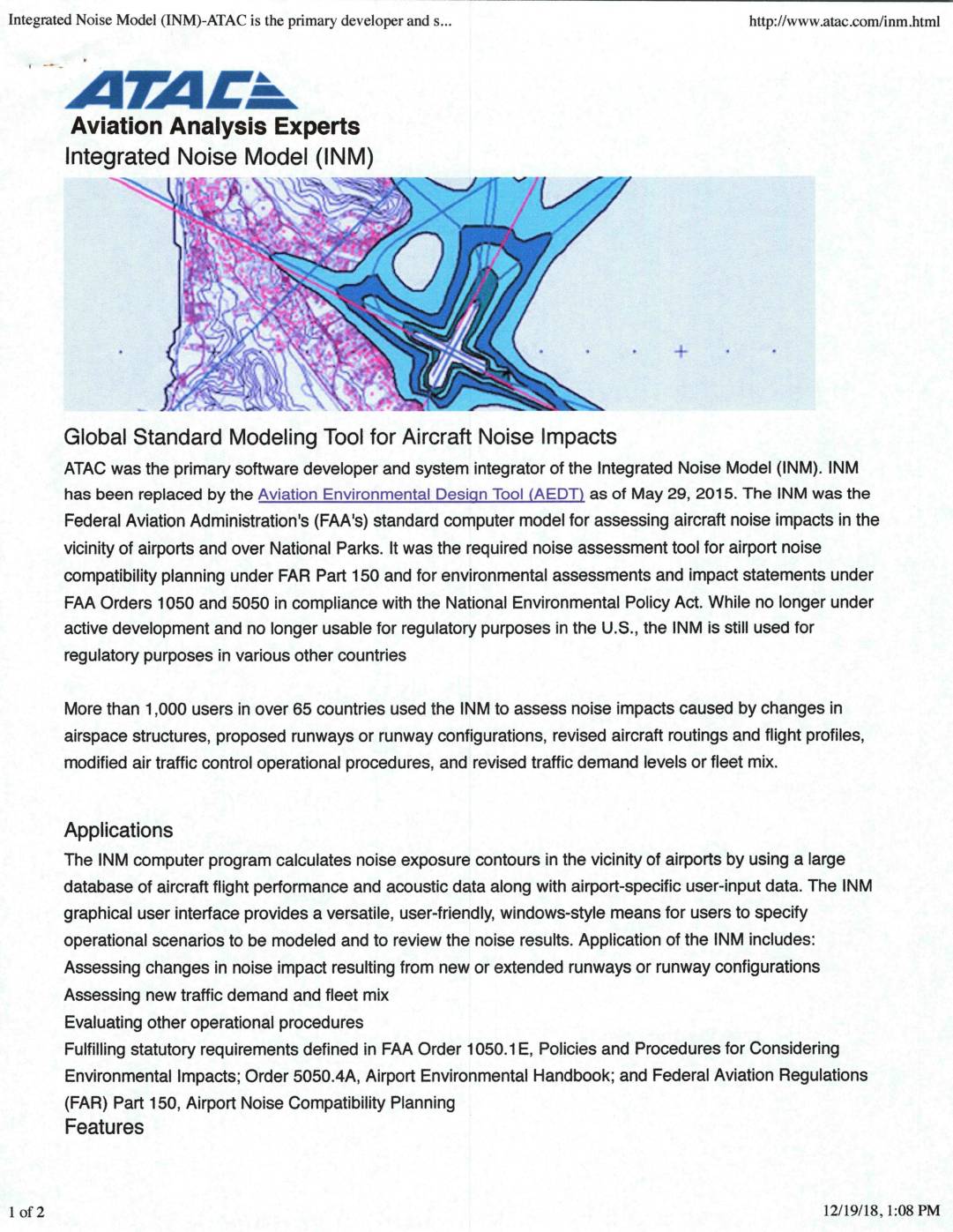
Integrated Noise Model (INM)
The Integrated Noise Model (INM), developed by ATAC Corporation for the FAA, was the standard computer tool used to assess aircraft noise impacts near airports like Sea-Tac, calculating noise exposure contours and predicted sound levels at sensitive locations such as schools and hospitals. It was required for airport noise compatibility planning under FAR Part 150 and environmental reviews under the National Environmental Policy Act until it was replaced by the Aviation Environmental Design Tool (AEDT) in May 2015. Though no longer valid for regulatory use in the U.S., the INM was used by over 1,000 users in 65 countries to evaluate the noise effects of runway changes, flight routing, air traffic procedures, and shifts in aircraft fleet mix. -
 2024-05-13
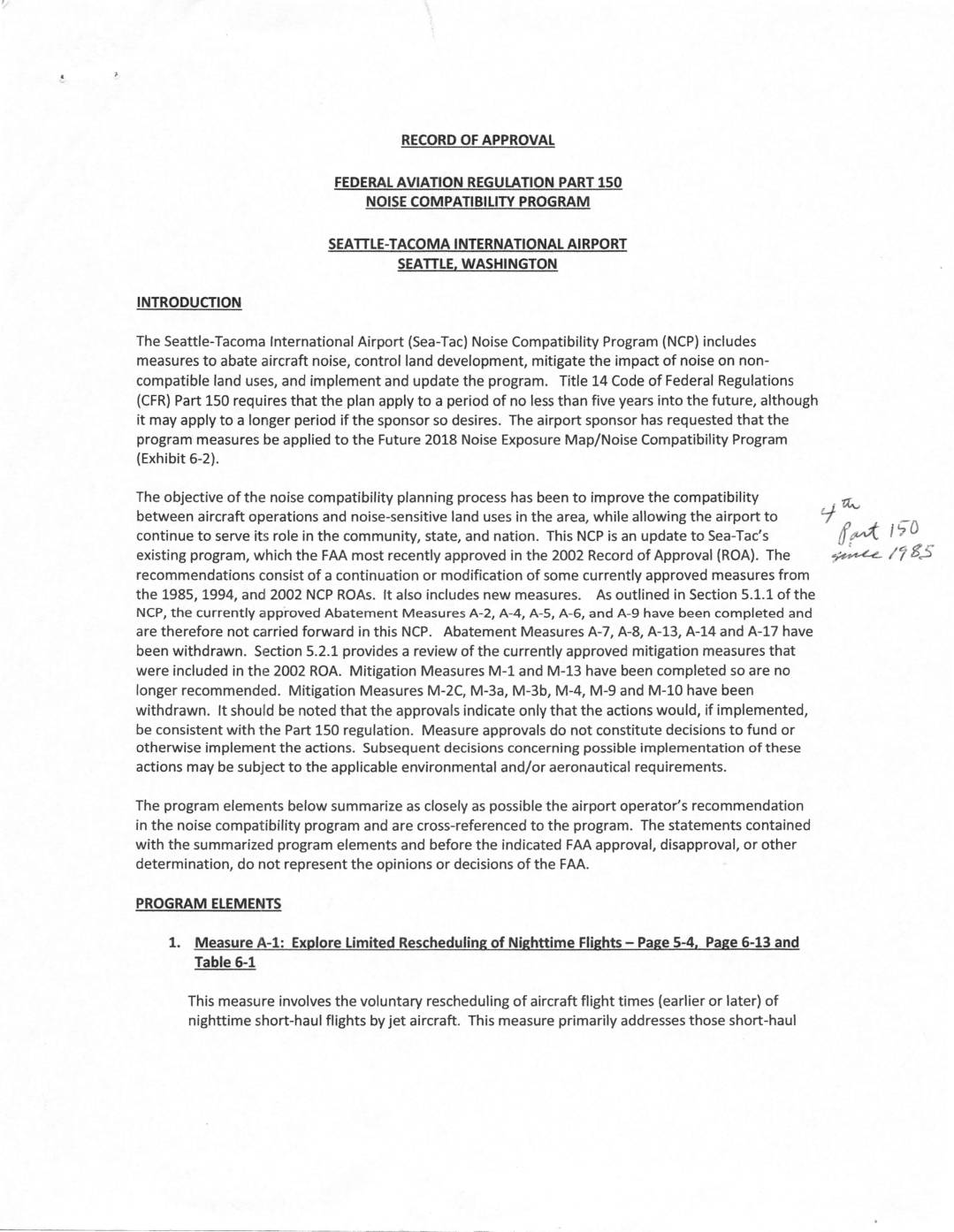
Record of approval: Federal Aviation Regulation Part 150 noise compatibility program, Seattle-Tacoma International Airport, Seattle, Washington
This document is the FAA's Record of Approval for Seattle-Tacoma International Airport's Noise Compatibility Program, which outlines measures to reduce aircraft noise and manage land use around the airport. It covers both new and updated measures, including voluntary rescheduling of nighttime flights, preferential runway use during nighttime hours, and a Fly Quiet Program to encourage airlines to follow noise abatement procedures. The FAA approved most measures as continuations of previously approved programs dating back to 1985, while disapproving the engine maintenance run-up regulations. -
 2024-05-11
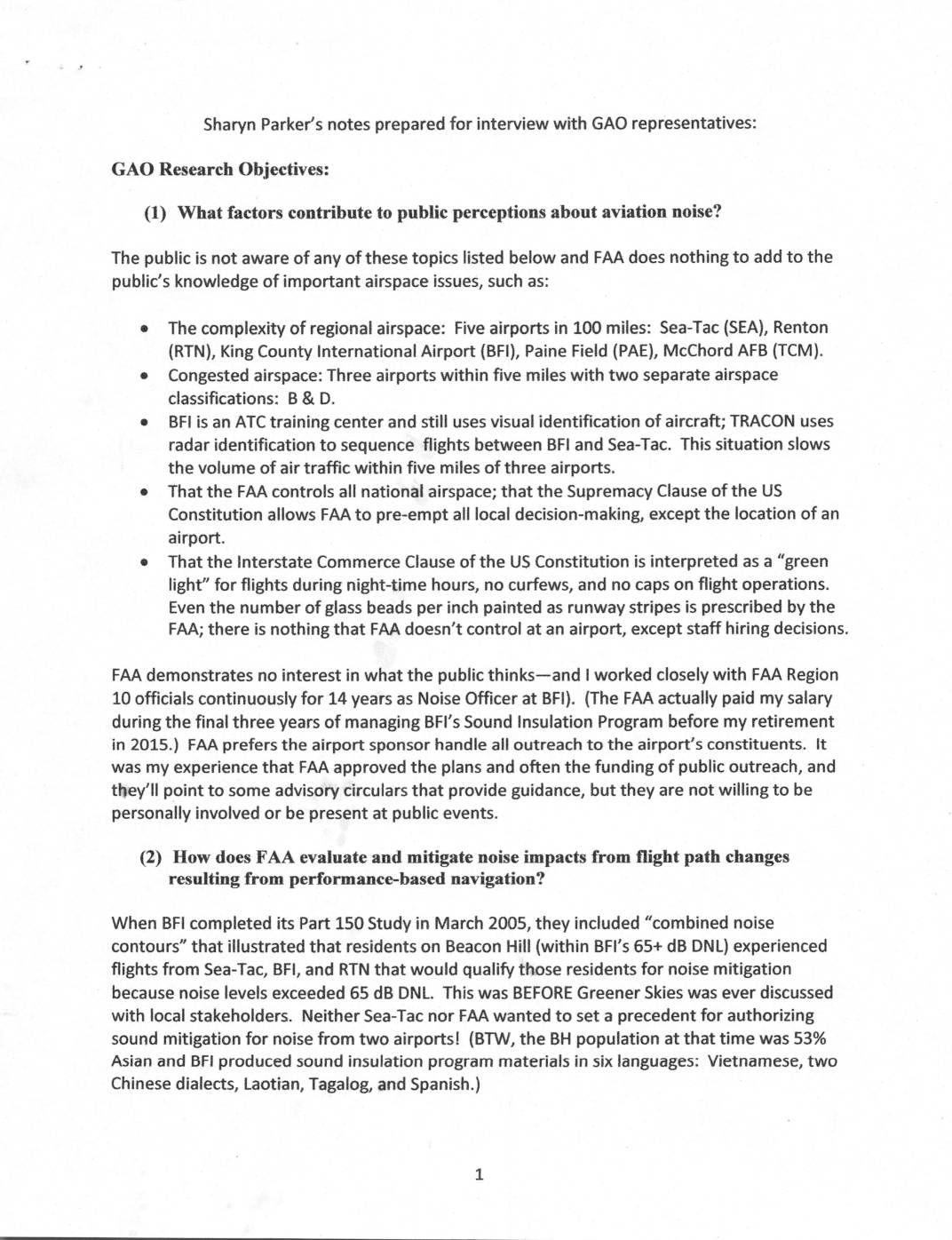
Sharyn Parker’s notes prepared for interview with GAO representatives
Former King County International Airport (BFI) Noise Officer Sharyn Parker's prepared notes for a GAO interview outline significant concerns about FAA regulatory failures and Sea-Tac Airport's inadequate noise mitigation practices in the Seattle region. Parker argues that the FAA has consistently failed to require Sea-Tac to update noise exposure maps, enforce timely sound mitigation programs, or conduct meaningful public outreach — particularly for minority communities disproportionately affected by flight path changes like the Greener Skies/RNP initiative. The notes also highlight contradictions between Sea-Tac's deliberately low flight-operation projections in its Part 150 noise studies and the far higher growth figures used in its capital development plans. -
2024-05-09
Part 150 Noise Workshops!
The Part 150 program sets the noise boundary. If your home is inside, you get sound insulation (aka a Port Package). If not, you don't. Show up to these public workshops June 5 and June 6. -
 2024-05-07
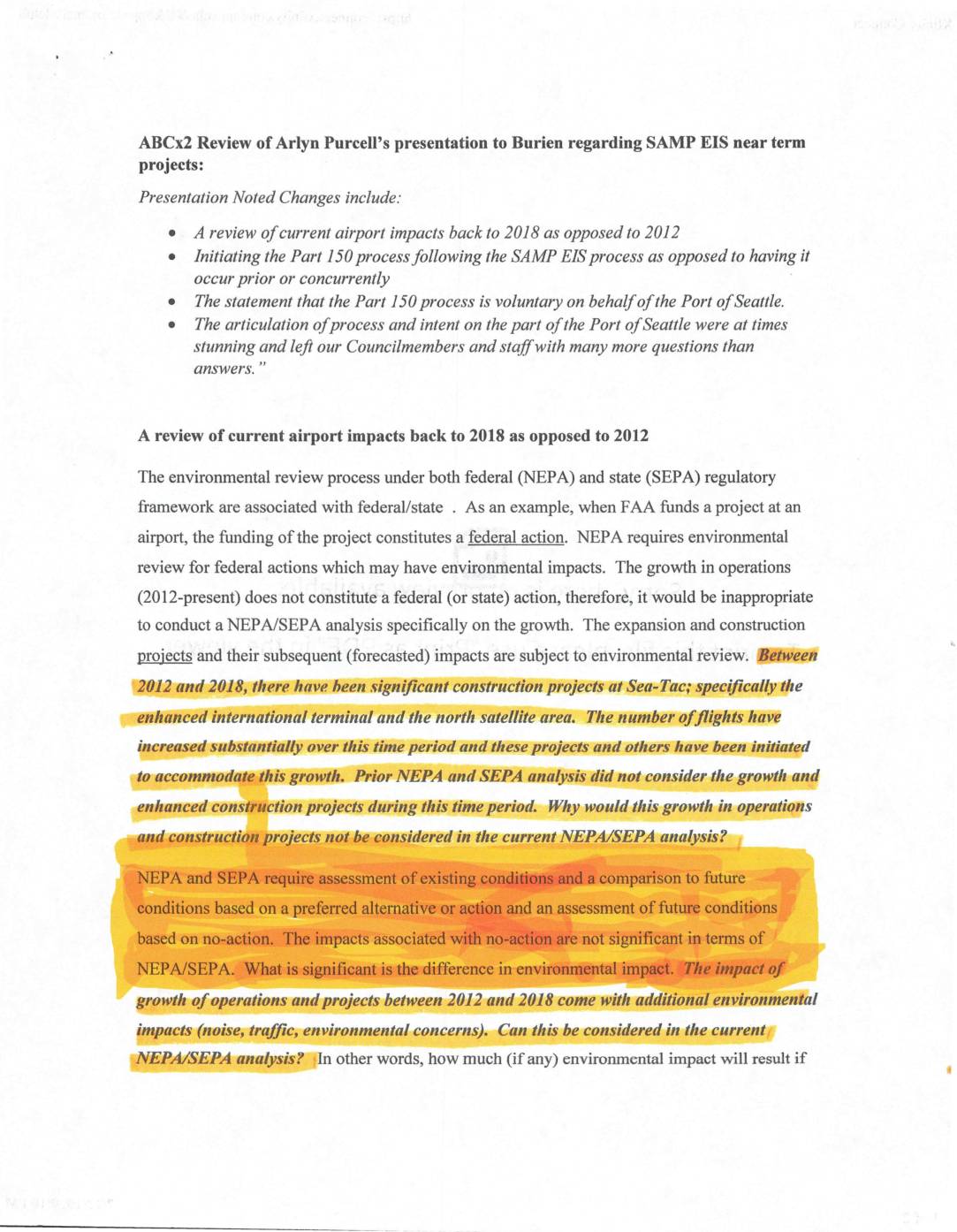
ABCx2 review of Arlyn Purcell’s presentation to Burien regarding SAMP EIS near term projects
This document is a review by ABCx2 of a Port of Seattle presentation to the city of Burien regarding the Sea-Tac Airport Master Plan (SAMP) Environmental Impact Statement. It raises concerns about the Port's decision to limit its environmental review of airport impacts to 2018 rather than 2012, questions whether significant construction growth and flight increases during that period were properly analyzed under federal (NEPA) and state (SEPA) environmental law, and challenges the Port's characterization of the FAR Part 150 noise abatement process as purely voluntary. The document also examines potential consequences if the Port fails to meet noise mitigation commitments tied to federal funding. -
 2024-05-07
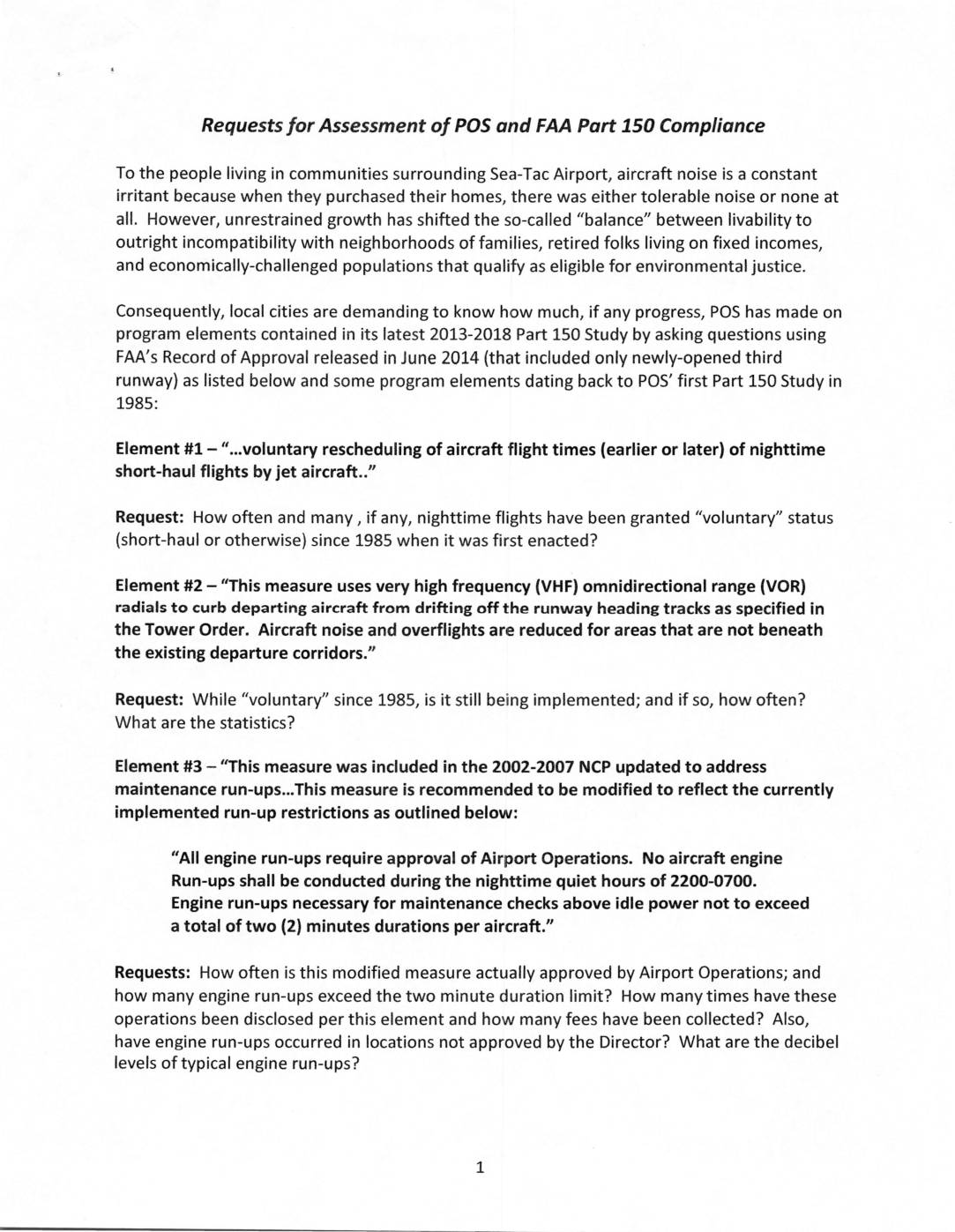
Requests for assessment of POS and FAA Part 150 compliance
Local communities surrounding Seattle-Tacoma International Airport are demanding accountability from the Port of Seattle (POS) regarding its compliance with FAA Part 150 noise mitigation measures, some dating back to 1985. The document raises detailed questions about ten specific program elements — including voluntary flight rescheduling, engine run-up restrictions, noise abatement corridors, the Fly Quiet Program, and home sound insulation — asking for data on how consistently and effectively each measure has actually been implemented. Critics argue that despite decades of commitments, key noise reduction tools such as a Ground Run-Up Enclosure have been quietly dropped, while growing air traffic continues to harm residential neighborhoods and environmentally vulnerable populations. -
 2024-05-06
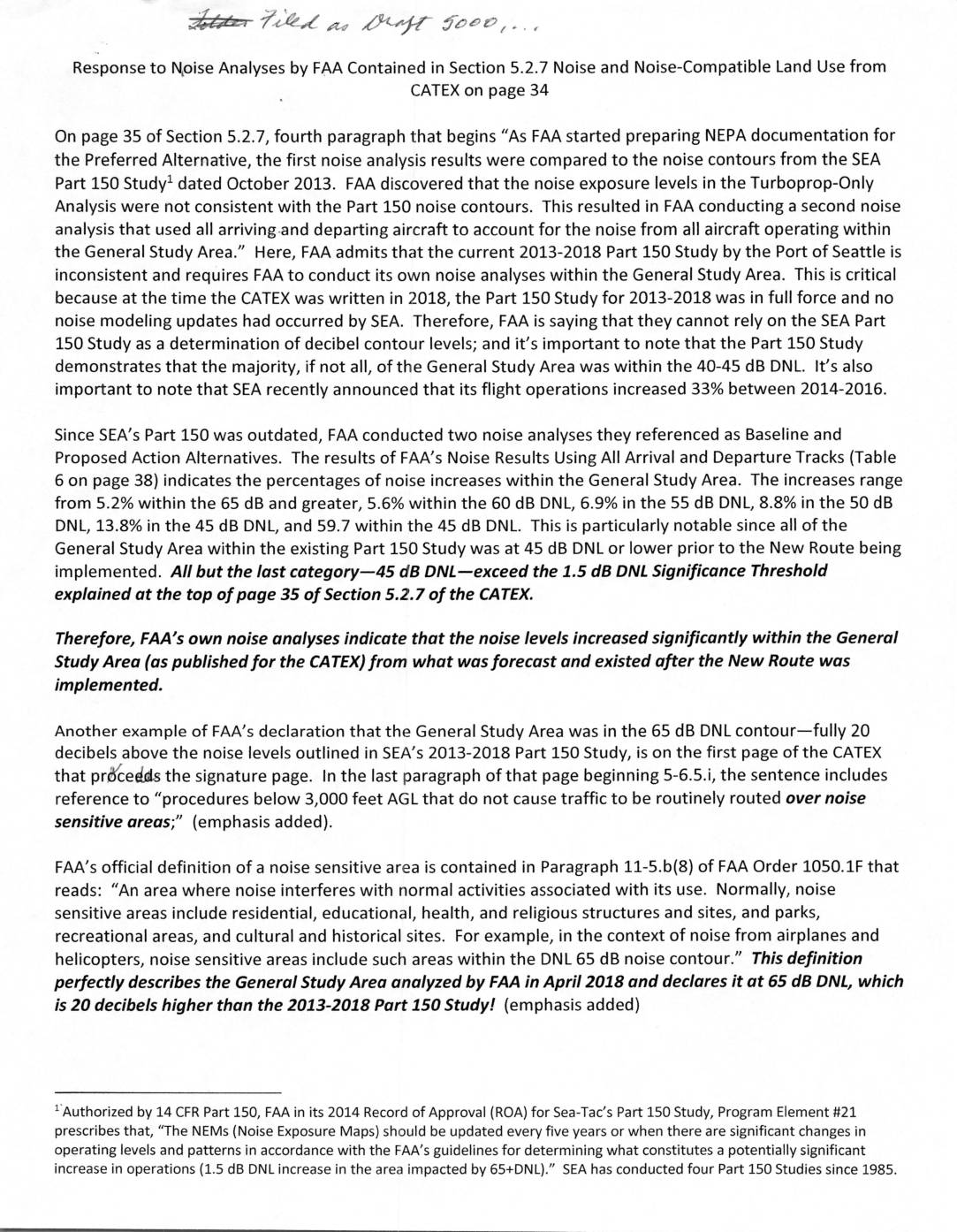
Response to noise analyses by FAA contained in Section 5.2.7 noise and noise-compatible land use from CATEX on page 34
The Quiet Skies Coalition challenges the FAA's Categorical Exclusion (CATEX) for new turboprop flight routes over Burien, Washington, arguing that the FAA's own noise analyses show significant increases in noise levels that exceed the agency's 1.5 dB DNL significance threshold — contradicting the FAA's claim of no environmental impact. The coalition contends that the FAA's reliance on an outdated 2013-2018 Sea-Tac Part 150 noise study, which failed to account for a 51% increase in airport operations, led to inaccurate noise assessments and improper use of a categorical exclusion. Community members and the City of Burien are urged to join legal and political efforts to challenge the FAA and Port of Seattle's authority over flight path decisions affecting residents from Shoreline to Federal Way. -
 2024-05-06
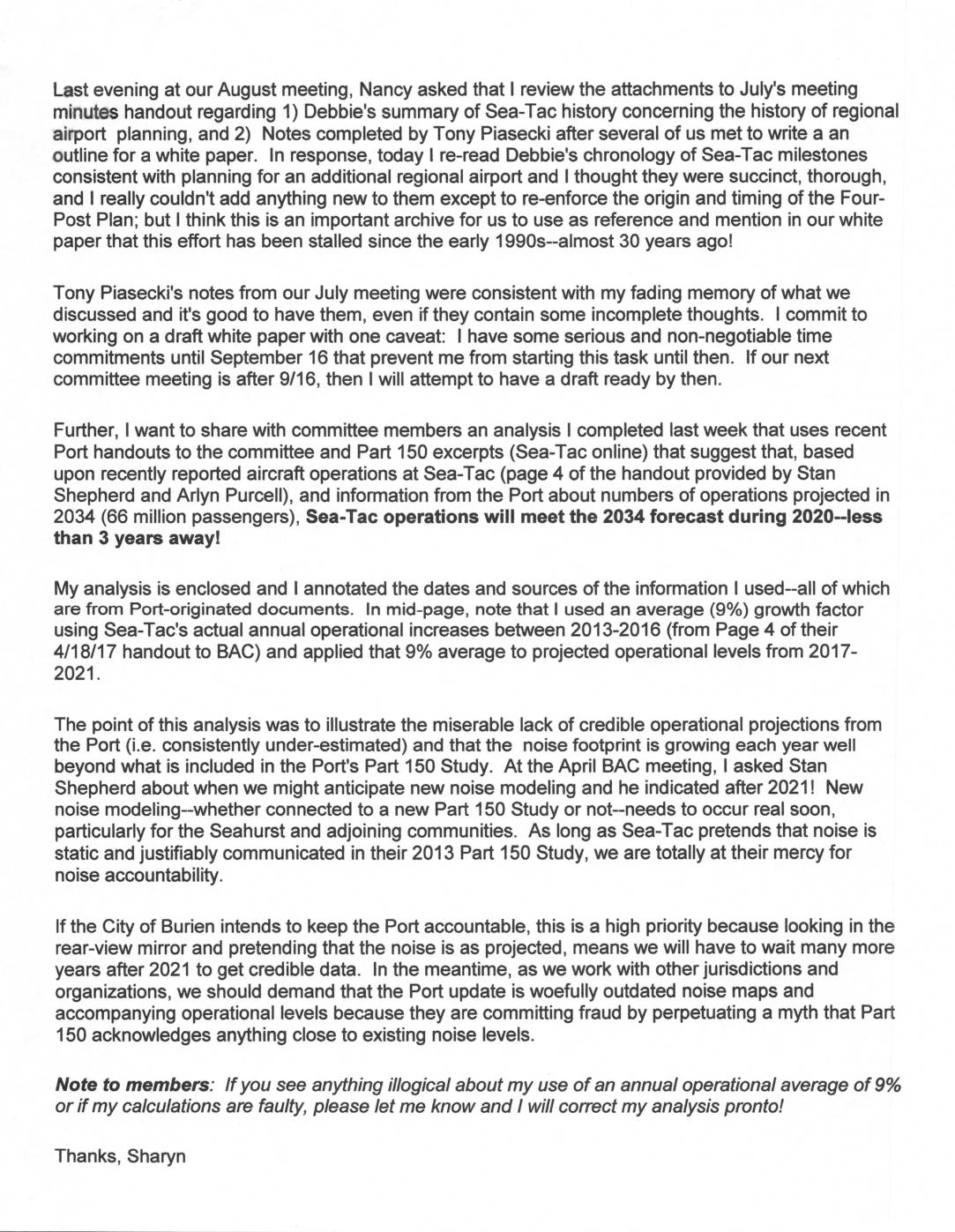
Sharyn’s analysis of Sea-Tac operational levels and noise modeling concerns
A Burien Airport Committee member named Sharyn argues that Sea-Tac Airport's 2013 Part 150 noise study is dangerously outdated, as actual flight operations have been growing at roughly 9% per year — far outpacing the Port's own projections. Her analysis suggests Sea-Tac will reach its 2034 capacity forecast as early as 2020, meaning real noise impacts on surrounding communities like Seahurst are already well beyond what official noise maps show. She calls on the City of Burien to demand that the Port update its noise modeling immediately rather than waiting until after 2021.