TagPart 150(269)
-
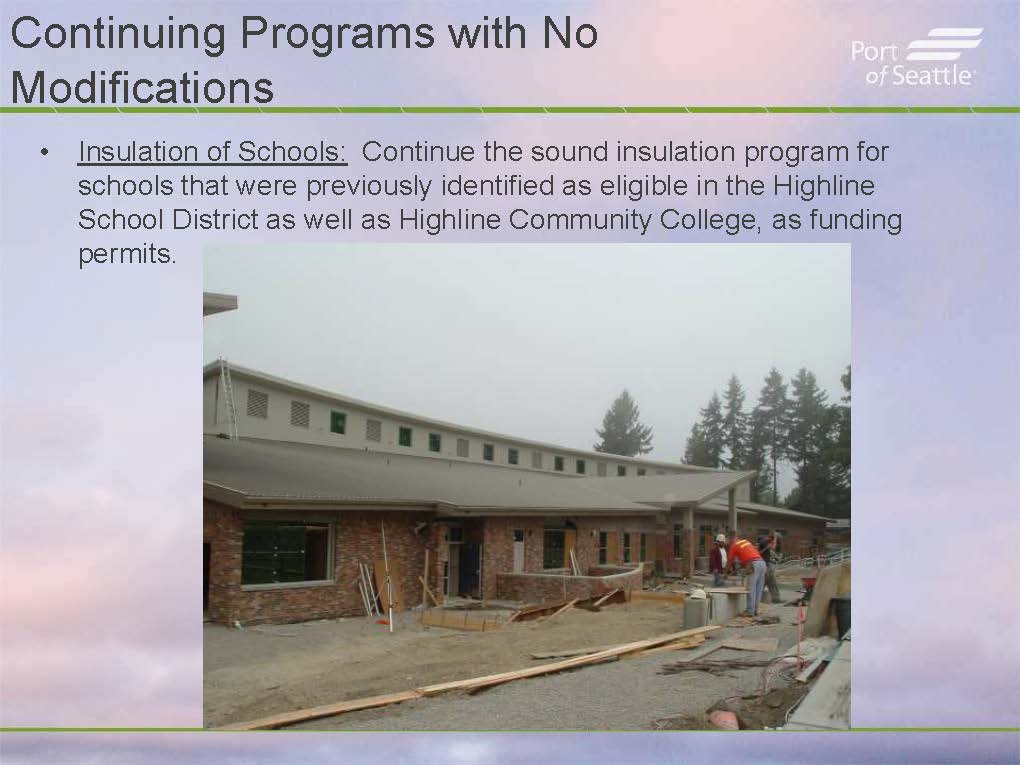
Part 150 09.24.2013_Commission_Presentation_Page_09
A Port of Seattle presentation slide titled 'Continuing Programs with No Modifications' describes the continuation of a sound insulation program for schools previously identified as eligible in the Highline School District and Highline Community College, as funding permits. The slide includes a construction photo showing workers outside a single-story brick school building undergoing sound insulation work. -
Part 150 09.24.2013_Commission_Presentation_Page_08
A Port of Seattle presentation slide listing four continuing noise abatement programs at Sea-Tac Airport that require no modifications: Use of VOR Radials to Curb Aircraft Drifting from Noise Abatement Tracks, Preferential Runway Use (nighttime north flow corridor), Use of Flight Management System Procedures, and Use of Ground Equipment (gate power and conditioned air to reduce auxiliary power unit usage). -
 2024-06-13
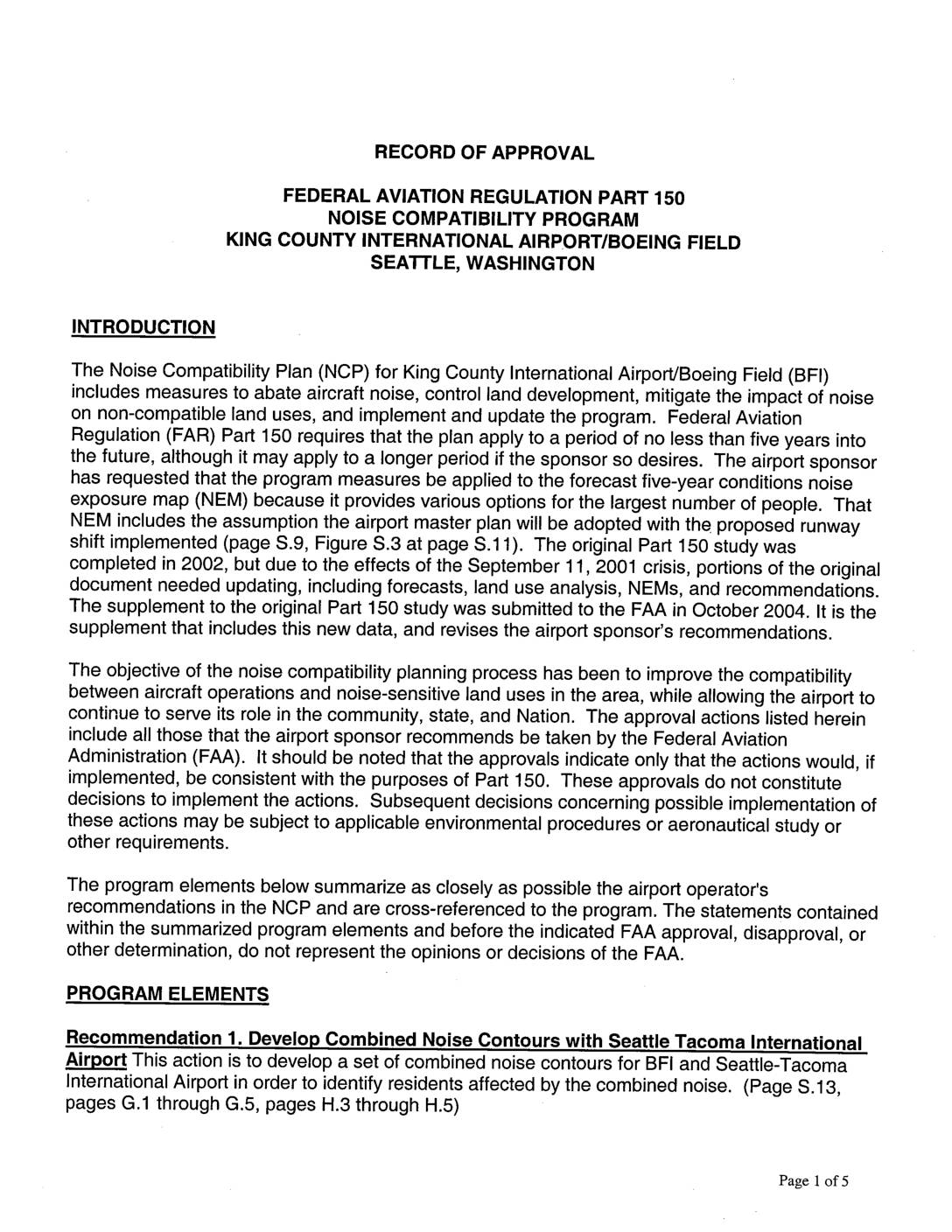
Record of Approval: FAA Part 150 Noise Compatibility Program, King County International Airport/Boeing Field
This document is the FAA's official Record of Approval for King County International Airport/Boeing Field's (Boeing Field/BFI) Noise Compatibility Program under Federal Aviation Regulation Part 150. It outlines six key recommendations to reduce aircraft noise impacts on nearby residents, including developing combined noise contours with Seattle-Tacoma International Airport, implementing quieter flight approach and departure procedures, and upgrading noise monitoring systems. The FAA reviewed and issued determinations on each recommendation, approving most measures on a voluntary basis while noting that approvals do not constitute commitments to implement the actions. -
 2024-06-10
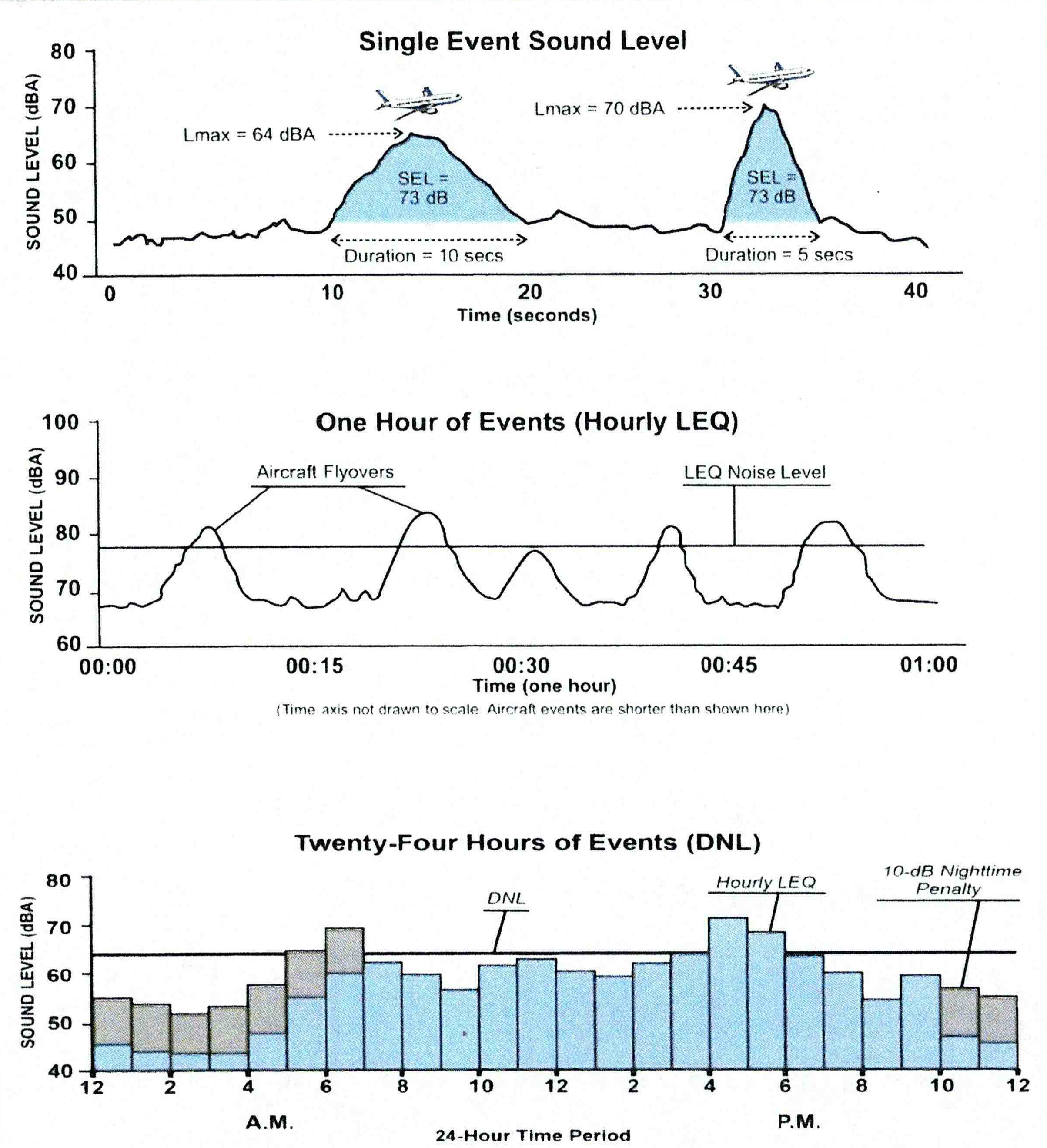
SEL, Hourly LEQ, and DNL Aircraft Noise Measurement Diagram — Part 150 Study Technical Review Committee Meeting #1
Three-panel educational diagram illustrating how aircraft noise is measured and averaged across different time scales: Single Event Sound Level (SEL) showing two aircraft flyovers with Lmax and duration annotations, Hourly LEQ showing cumulative noise over one hour, and Day-Night Level (DNL) showing 24-hour noise distribution with a 10-dB nighttime penalty applied during nighttime hours. No source organization or document identifier is visible. -
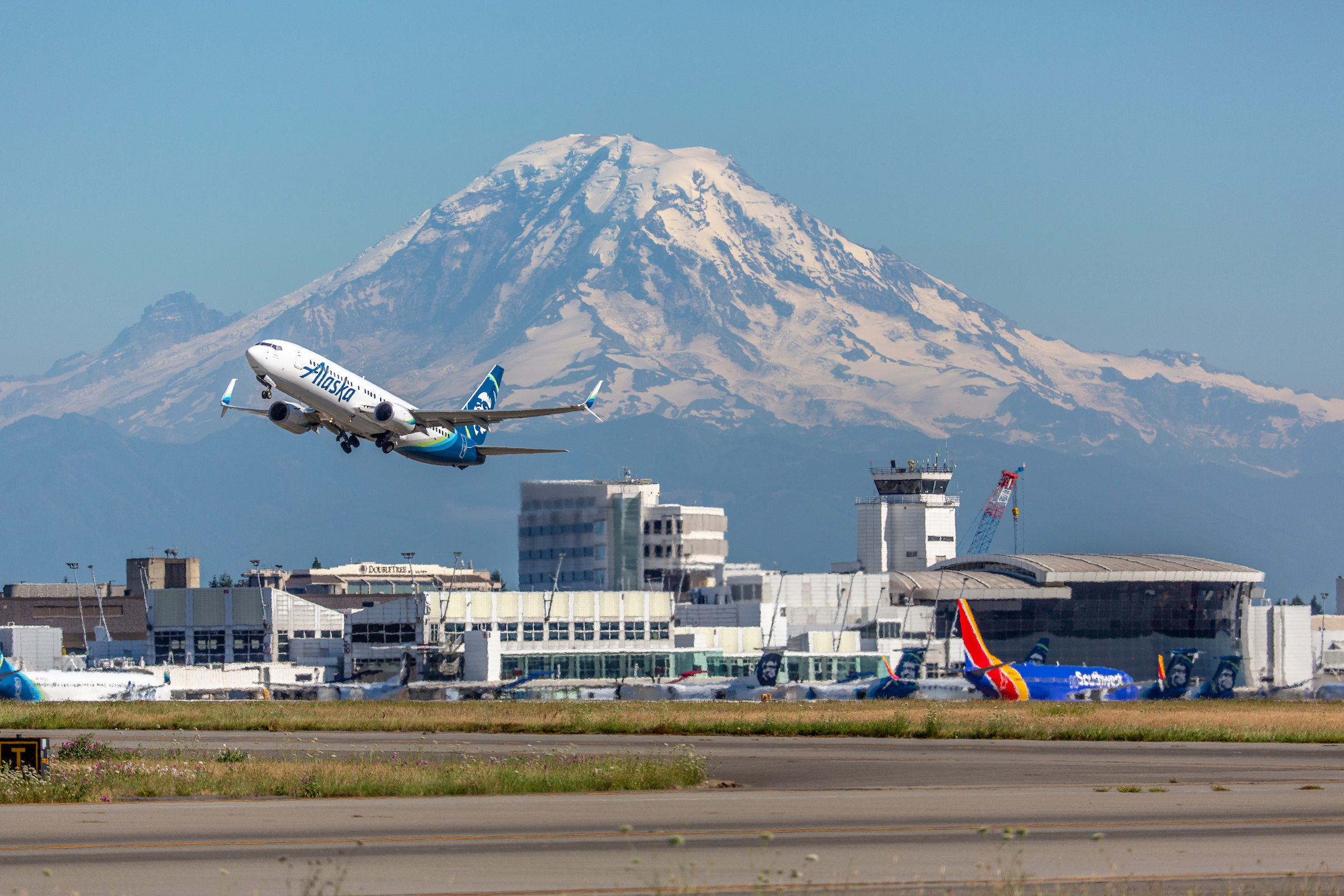
Part 150 Noise Study Workshop (3)!
Attend a workshop where the Port of Seattle will answer questions about this important study. The Part 150 program determines the noise boundary around the airport and opportunities for noise mitigation such as sound insulation. Saturday 10:00AM-12:00PM Glacier Middle School <a style="font-weight: inherit;" href="https://www.google.com/maps/place/2450+S+142nd+St,+SeaTac,+WA+98168/@47.4771754,-122.2999698,17z/data=!3m1!4b1!4m6!3m5!1s0x54904313e187ced5:0x2d39413c9853420e!8m2!3d47.4771754!4d-122.2999698!16s%2Fg%2F11cpgcgnql?entry=ttu">2450 S 142nd St., SeaTac, WA 98168</a> -
Part 150 Noise Study Workshop (2)!
Attend a workshop where the Port of Seattle will answer questions about this important study. The Part 150 program determines the noise boundary around the airport and opportunities for noise mitigation such as sound insulation. <td>6:00PM - 8:00 PM</td> </tr> <tr> <td>Location:</td> <td>Gregory Heights Elementary School <a style="font-weight: inherit;" href="https://www.google.com/maps/place/16201+16th+Ave+SW,+Burien,+WA+98166/@47.4583586,-122.3561792,17z/data=!4m6!3m5!1s0x5490449487dc7485:0x76156cc4d118ae49!8m2!3d47.4583586!4d-122.3561792!16s%2Fg%2F11bw4cncmq?entry=ttu">16201 16th Ave. SW, Burien WA 98166</a></td> </tr> -
Part 150 Noise Study Workshops!
Attend a workshop where the Port of Seattle will answer questions about this important study. The Part 150 program determines the noise boundary around the airport and opportunities for noise mitigation such as sound insulation. <td>6:00PM - 8:00 PM</td> </tr> <tr> <td>Location:</td> <td>Gregory Heights Elementary School <a style="font-weight: inherit;" href="https://www.google.com/maps/place/16201+16th+Ave+SW,+Burien,+WA+98166/@47.4583586,-122.3561792,17z/data=!4m6!3m5!1s0x5490449487dc7485:0x76156cc4d118ae49!8m2!3d47.4583586!4d-122.3561792!16s%2Fg%2F11bw4cncmq?entry=ttu">16201 16th Ave. SW, Burien WA 98166</a></td> </tr> -
 2024-06-05
Appendix F Public Outreach
The Port of Seattle held public workshops in June 2024 to kick off an update to the Seattle-Tacoma International Airport Part 150 Noise Study, gathering community input from residents and other interested parties near the airport. The workshops were promoted through a wide range of online publications, social media, and community outreach channels, with materials available in multiple languages including Spanish, Somali, Vietnamese, and Chinese. A follow-up workshop on Draft Noise Exposure Maps was scheduled for September–October 2025. -
2024-06-05
Appendix F Public Outreach
The Port of Seattle held public workshops in June 2024 to kick off an update to the Seattle-Tacoma International Airport Part 150 Noise Study, gathering community input from residents and other interested parties near the airport. The workshops were promoted through a wide range of online publications, social media, and community outreach channels, with materials available in multiple languages including Spanish, Somali, Vietnamese, and Chinese. A follow-up workshop on Draft Noise Exposure Maps was scheduled for September–October 2025. -
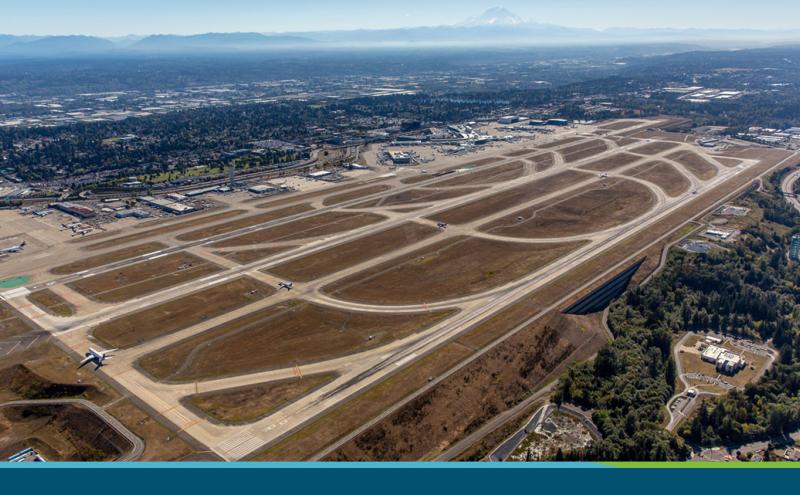
Sea-Tac Airport Aerial View Showing Parallel Runways and Terminal Facilities
Aerial photograph of Seattle-Tacoma International Airport (Sea-Tac) showing its parallel runway configuration, taxiways, terminal facilities, and surrounding communities. Mount Rainier is visible on the horizon to the southeast, confirming the Pacific Northwest location.