TagNoise(262)
-
 1991-01-01
Part 150 Noise Exposure Map 1991 — Ldn 65 Contour Area and Population
Text states that the Ldn 65 noise contour contains approximately 14,128 acres and 67,000 people. This figure relates to the noise impact area around Sea-Tac Airport as defined by the Day-Night Average Sound Level (Ldn) metric. -
 1990-03-16
Day Night Average Sound Level (DNL): The Descriptor of Choice for Airport Noise Assessment
This 1990 FAA document explains why the Day Night Average Sound Level (DNL) was chosen as the standard metric for measuring airport noise. DNL averages noise exposure over a full 24-hour period, applying a penalty for nighttime flights, and has been adopted by multiple federal agencies—including the EPA, DOT, HUD, and DOD—as the most reliable way to assess how aircraft noise affects surrounding communities. The FAA formally incorporated DNL into federal regulation through FAR Part 150, Airport Noise Compatibility Planning, in 1981. -
 1990-01-08
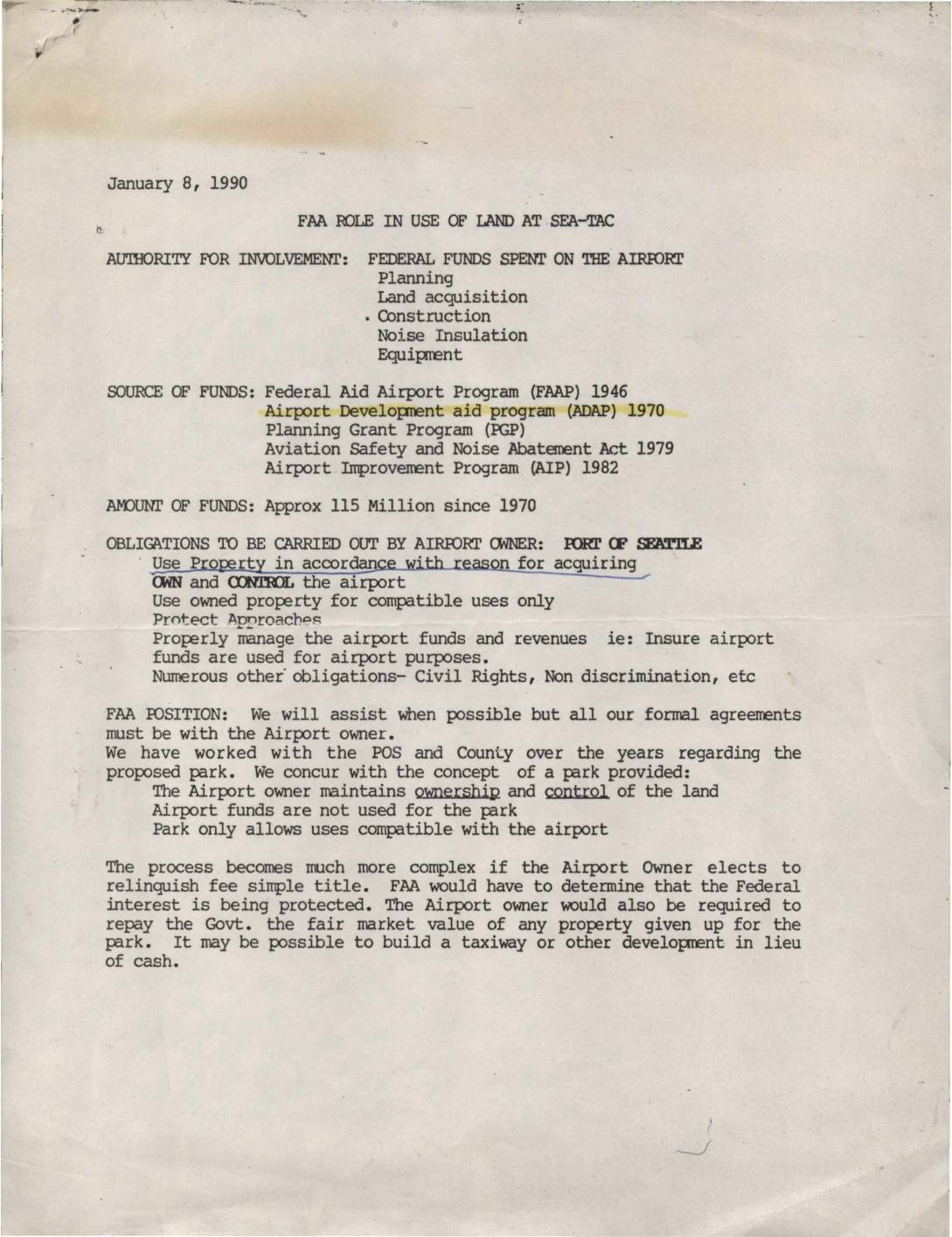
FAA role in use of land at Sea-Tac
★A January 1990 FAA briefing document outlines the agency's role in land use at Seattle-Tacoma International Airport, explaining that federal involvement stems from approximately $115 million in federal funds spent on the airport since 1970 for planning, land acquisition, construction, and noise insulation. The FAA supported the concept of a park on airport land, provided the Port of Seattle maintained ownership and control, airport funds were not used for the park, and only compatible uses were allowed. The document also details Sea-Tac's noise mitigation efforts, including over $50 million in federal grants to acquire roughly 750 noise-impacted land parcels and more than $7 million to insulate 323 homes near the airport. -
 1990-01-01
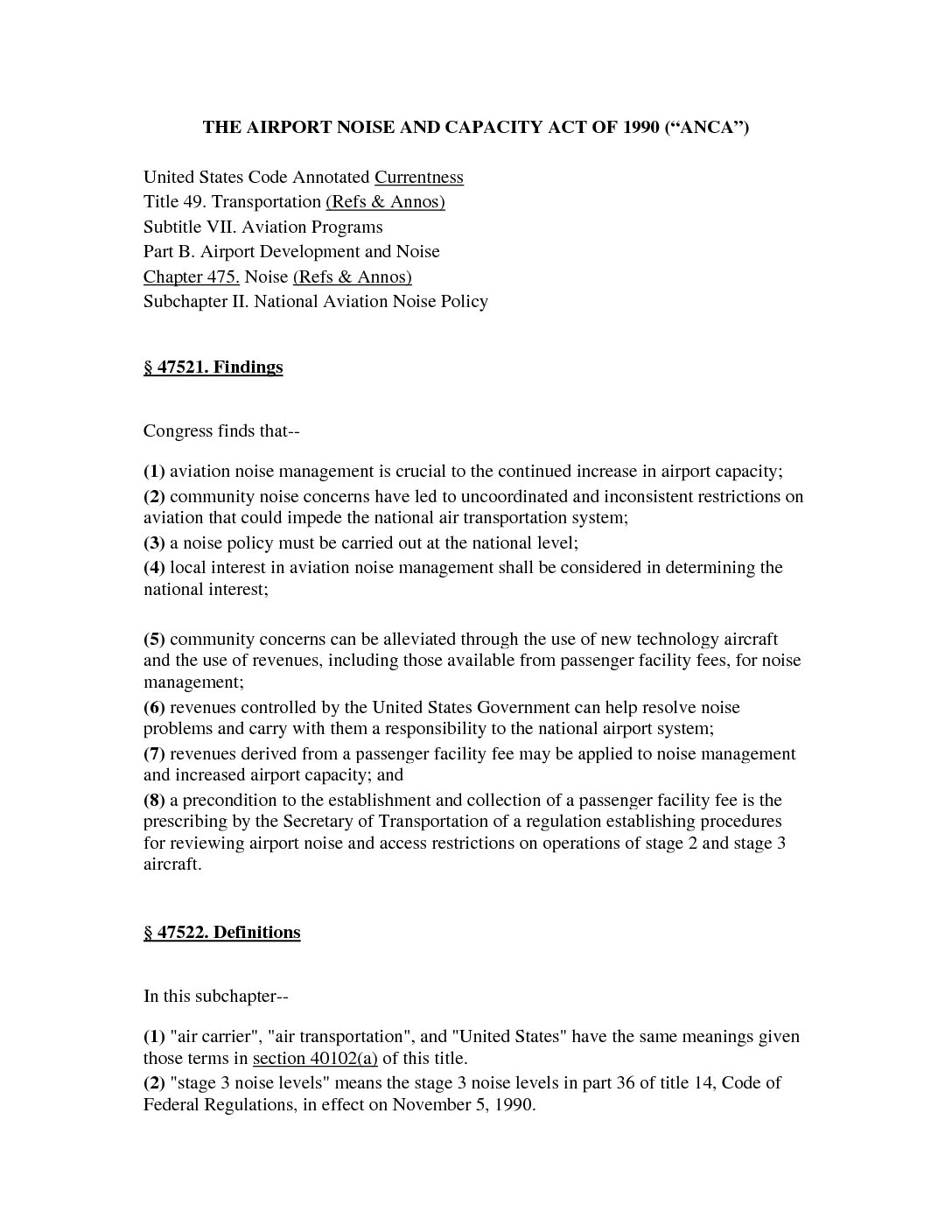
ANCA Airport Noise and Capacity Act of 1990 cover page
This is a page from the United States Code Annotated showing the Airport Noise and Capacity Act of 1990 (ANCA), Title 49, Subtitle VII, Chapter 475, Subchapter II. It includes Congressional findings (§ 47521) on aviation noise management and national noise policy, and definitions (§ 47522) including 'stage 3 noise levels' as defined in 14 CFR Part 36 effective November 5, 1990. -
 1988-10-25
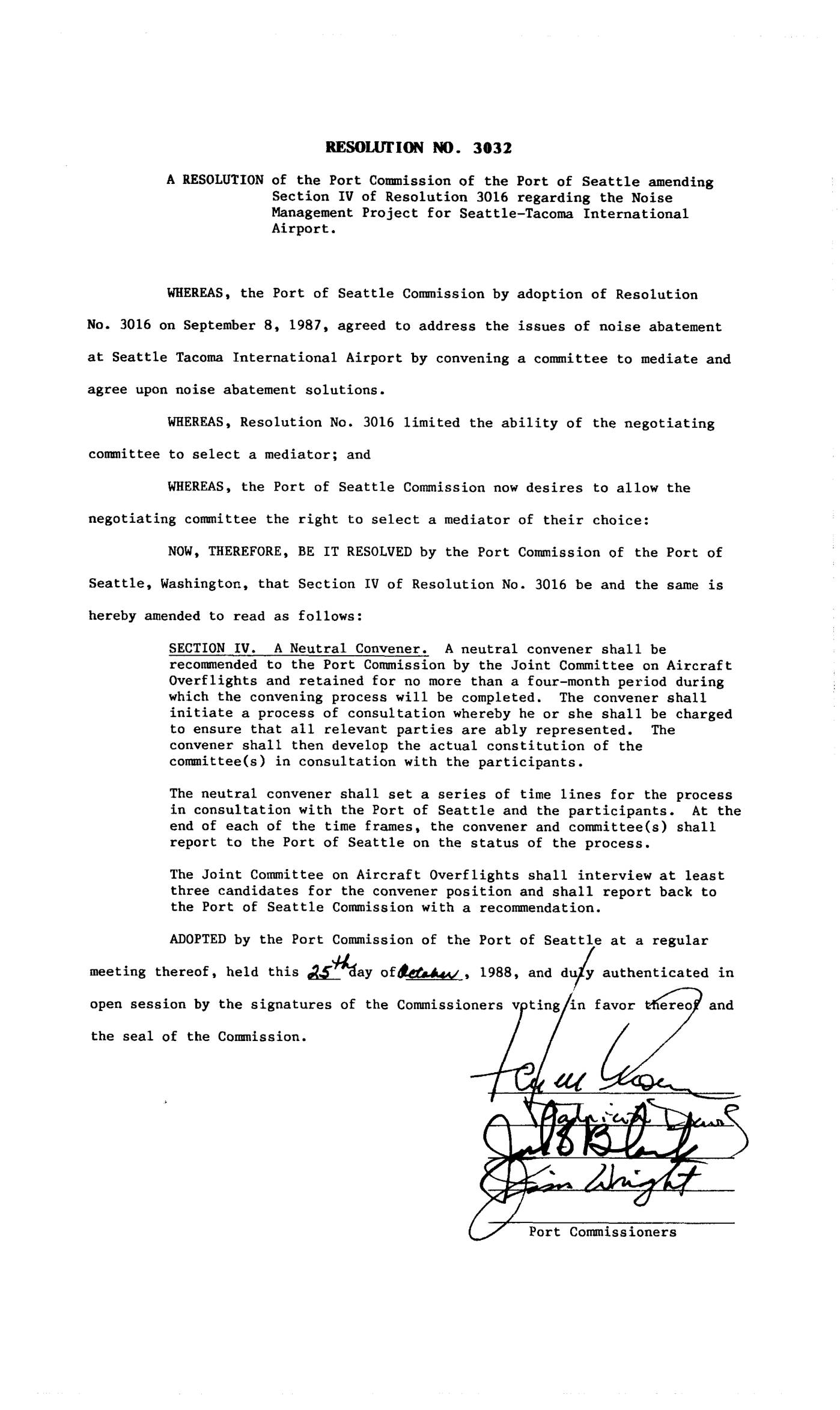
Resolution No. 3032: Amending Section IV of Resolution 3016 regarding the Noise Management Project for Seattle-Tacoma International Airport
Resolution No. 3032, adopted by the Port of Seattle Commission on October 25, 1988, amends an earlier resolution (No. 3016) concerning noise management at Seattle-Tacoma International Airport. The key change gives the negotiating committee—known as the Joint Committee on Aircraft Overflights—the freedom to select their own neutral convener (mediator) from at least three interviewed candidates, rather than being restricted as under the previous rules. The chosen convener would be retained for up to four months to organize a mediation process, ensure all relevant parties are represented, and report regularly to the Port Commission on progress. -
 1984-07-19
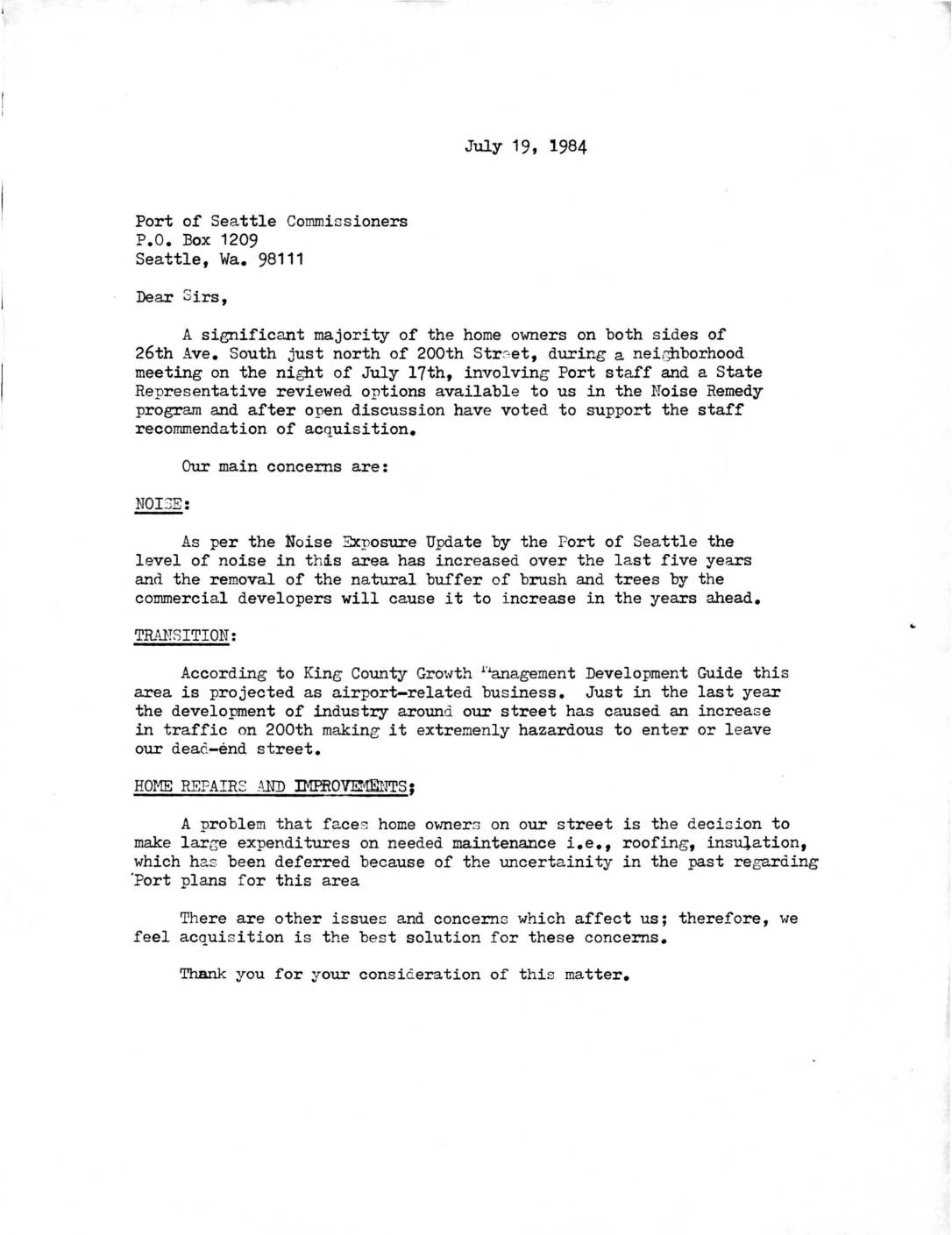
Letter to Port Of Seattle Commissioners supporting acquisition on 26th Ave. South
In July 1984, homeowners on 26th Ave. South near Seattle-Tacoma International Airport wrote to Port of Seattle Commissioners supporting the acquisition of their properties under the Noise Remedy program, citing increasing aircraft noise, growing industrial traffic hazards, and uncertainty that had delayed home maintenance. A separate letter from the Port's Director of Aviation to an airline captain acknowledged that non-compliance with existing noise abatement procedures — such as aircraft flying lower or turning sooner than prescribed — was a significant community concern, and noted that the Port was developing computer software using FAA radar data to automatically detect and report such violations. -
 1984-06-22
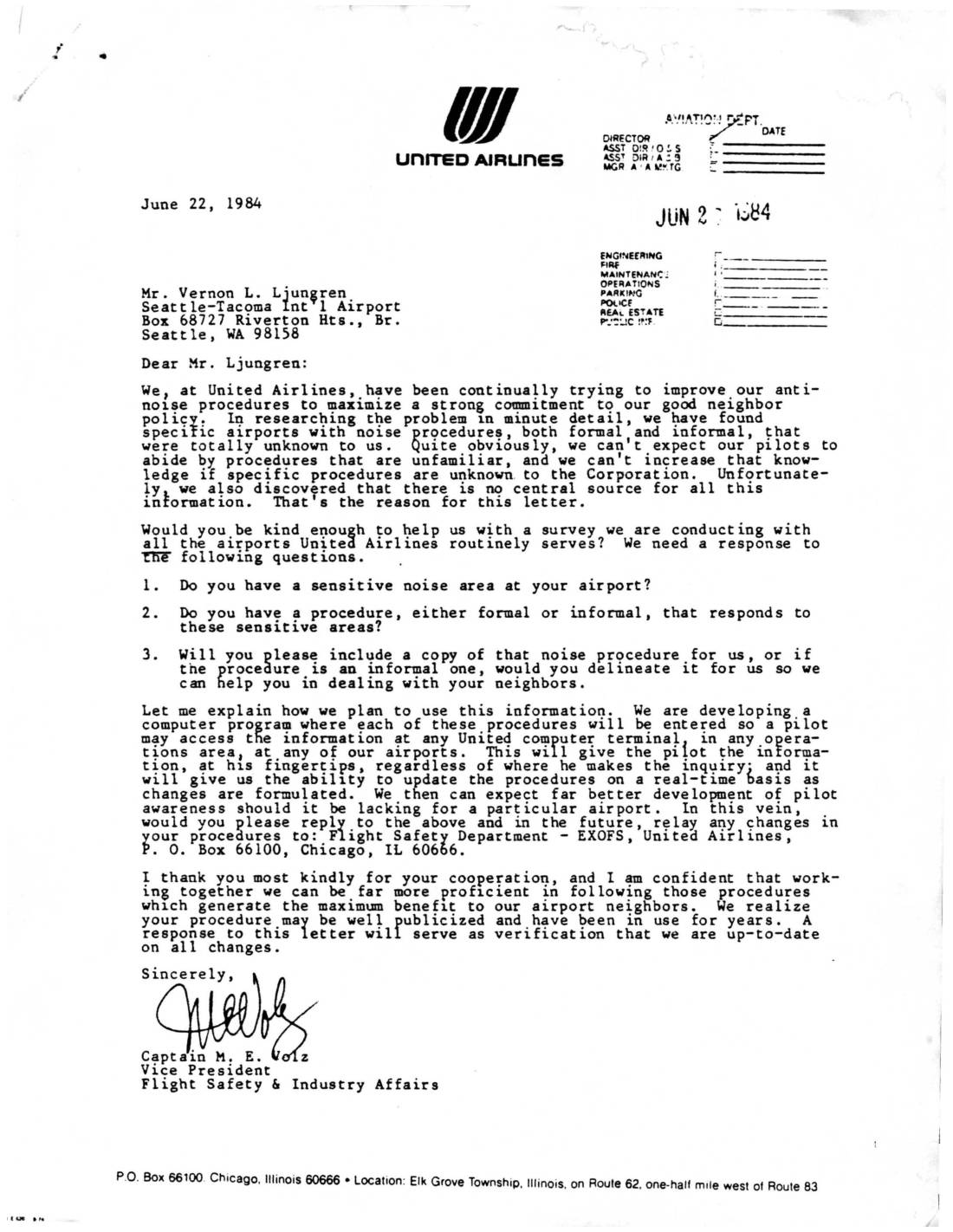
Letter from United Airlines to Mr. Vernon L. Ljungren, Seattle-Tacoma Int’l Airport, Regarding Noise Abatement Procedures Survey
In a June 22, 1984 letter to Seattle-Tacoma International Airport, United Airlines Vice President Captain M. E. Volz requested information about the airport's noise-sensitive areas and any formal or informal noise abatement procedures in place. The airline was conducting a survey of all airports it served in order to build a computer database of noise procedures accessible to pilots at any United Airlines terminal. United Airlines asked Sea-Tac to provide copies or descriptions of its noise procedures and to send future updates to the Flight Safety Department in Chicago. -
 1984-02-28
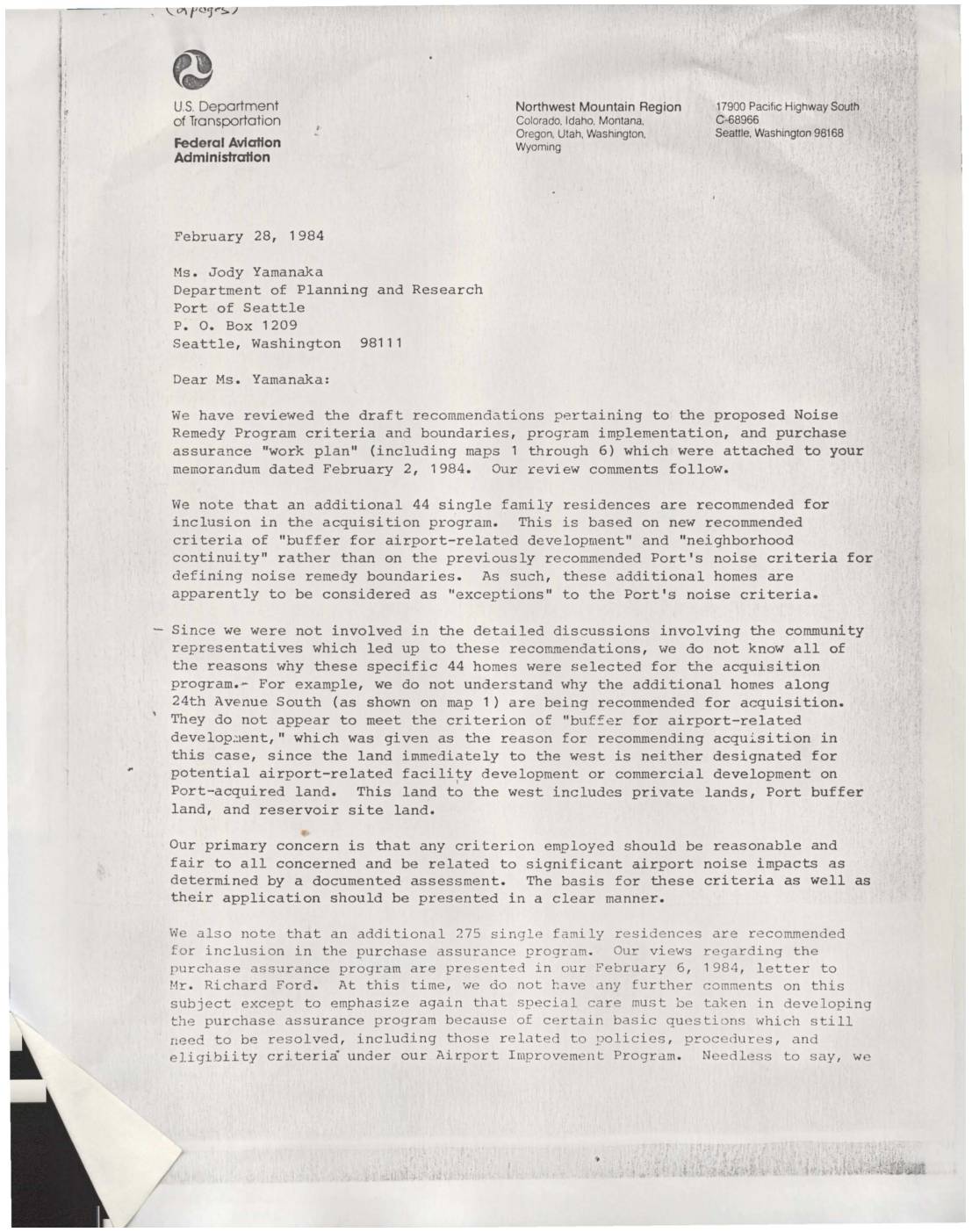
FAA review letter on proposed Noise Remedy Program criteria and boundaries
In this February 28, 1984 letter, the FAA's Northwest Mountain Region reviewed the Port of Seattle's proposed Noise Remedy Program for Sea-Tac Airport, raising concerns about the criteria used to add 44 homes to an acquisition program and 275 homes to a purchase assurance program. The FAA questioned whether the new criteria of 'buffer for airport-related development' and 'neighborhood continuity' were sufficiently justified, particularly for homes along 24th Avenue South. The agency urged that all criteria be reasonable, clearly documented, and tied to measured noise impacts, and cautioned against finalizing the purchase assurance plan before key federal policy questions were resolved. -
 1983-09-28
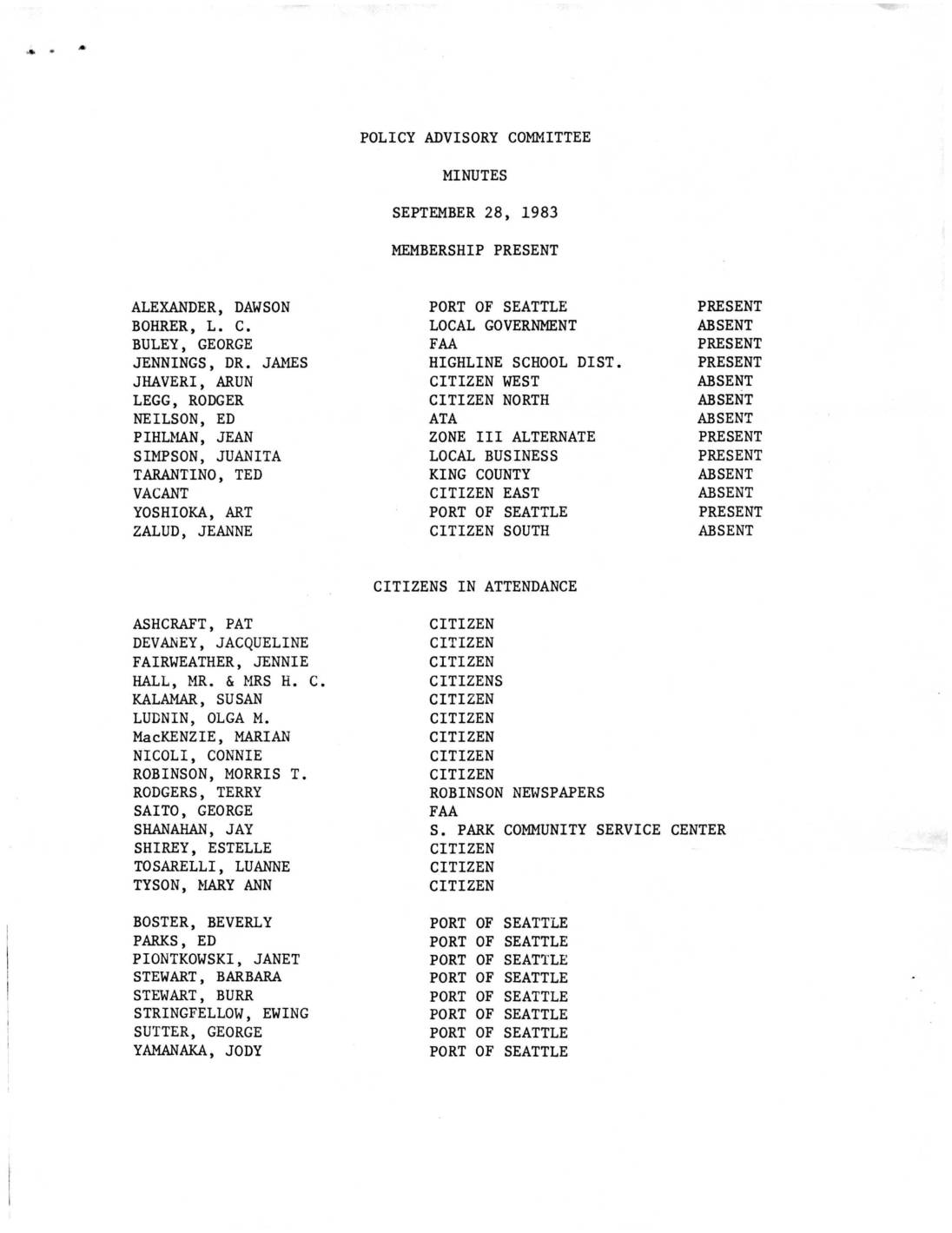
Policy Advisory Committee minutes, September 28, 1983
Minutes from the September 28, 1983 Policy Advisory Committee meeting at Sea-Tac Airport cover updates on noise reduction efforts, including new aircraft departure procedures, expanded noise monitoring stations, and a study on noise insulation and building codes. The committee also reviewed the 20-year Airport Master Plan, which will identify surplus Port-owned land that could be repurposed for commercial development or parks, and received updates on facilities improvements such as a new taxi holding area, completed runway safety zones, and the expanded South Satellite International Terminal. -
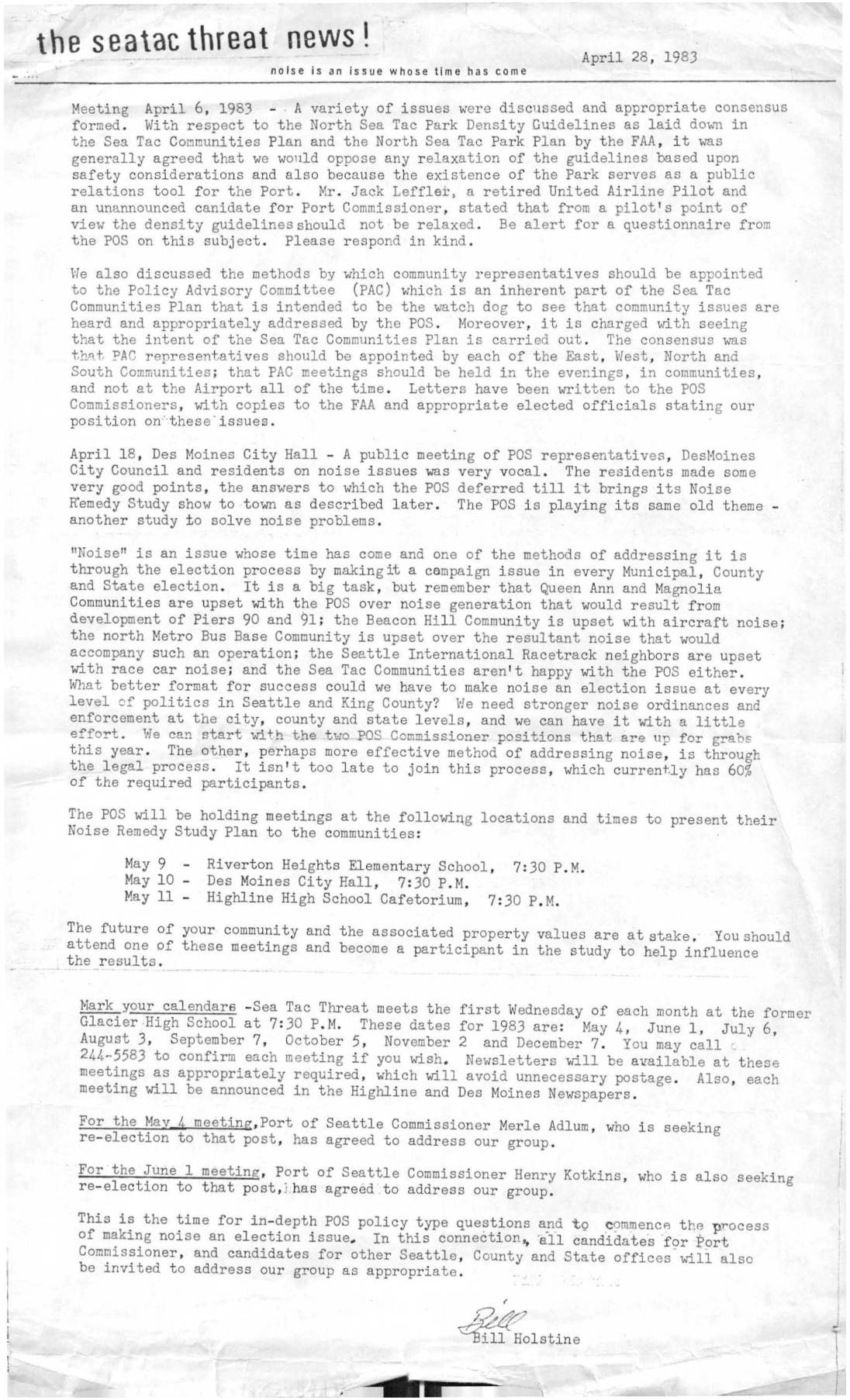 1983-04-28
Sea-Tac Threat News: Noise Is an Issue Whose Time Has Come
This April 1983 newsletter from the SeaTac Threat community group outlines residents' opposition to airport noise and related Port of Seattle (POS) policies. It covers meetings where members agreed to resist relaxed density guidelines near North SeaTac Park, push for community-appointed representatives on the Policy Advisory Committee, and make noise a key issue in upcoming municipal, county, and state elections. The newsletter also announces a series of public meetings where the POS will present its Noise Remedy Study Plan, urging residents to attend and participate.