TagNoise Abatement Procedures(92)
-
 1989-12-01
Draft environmental assessment for proposed changes to air traffic arrival and departure routes at Seattle-Tacoma International Airport
This 1989 FAA draft Environmental Assessment examines proposed changes to arrival and departure flight routes at Seattle-Tacoma International Airport, aimed at reducing air traffic congestion and improving airspace efficiency. The document identifies a key inefficiency: during good weather and peak demand, south-landing capacity (42 aircraft/hour) was significantly lower than north-landing capacity (56 aircraft/hour), largely due to a requirement routing turbojet aircraft through Elliott Bay. The assessment traces the issue back to noise abatement procedures established since 1970 that prioritized limiting jet overflights in certain Seattle metropolitan areas over operational efficiency. -
 1989-12-01
Draft Environmental Assessment for Proposed Changes to Air Traffic Arrival and Departure Routes at Seattle-Tacoma International Airport
This 1989 draft Environmental Assessment, prepared by the FAA's Air Traffic Division, evaluates proposed changes to arrival and departure flight routes at Seattle-Tacoma International Airport. The changes aimed to reduce air traffic congestion and improve airspace efficiency, particularly during peak demand periods when south-arrival capacity (42 aircraft/hour) lagged significantly behind north-arrival capacity (56 aircraft/hour). The inefficiency was linked to a requirement routing turbojet aircraft through Elliott Bay, a legacy of noise abatement agreements with local governments and the Port of Seattle dating back to 1970. -
 1984-07-09
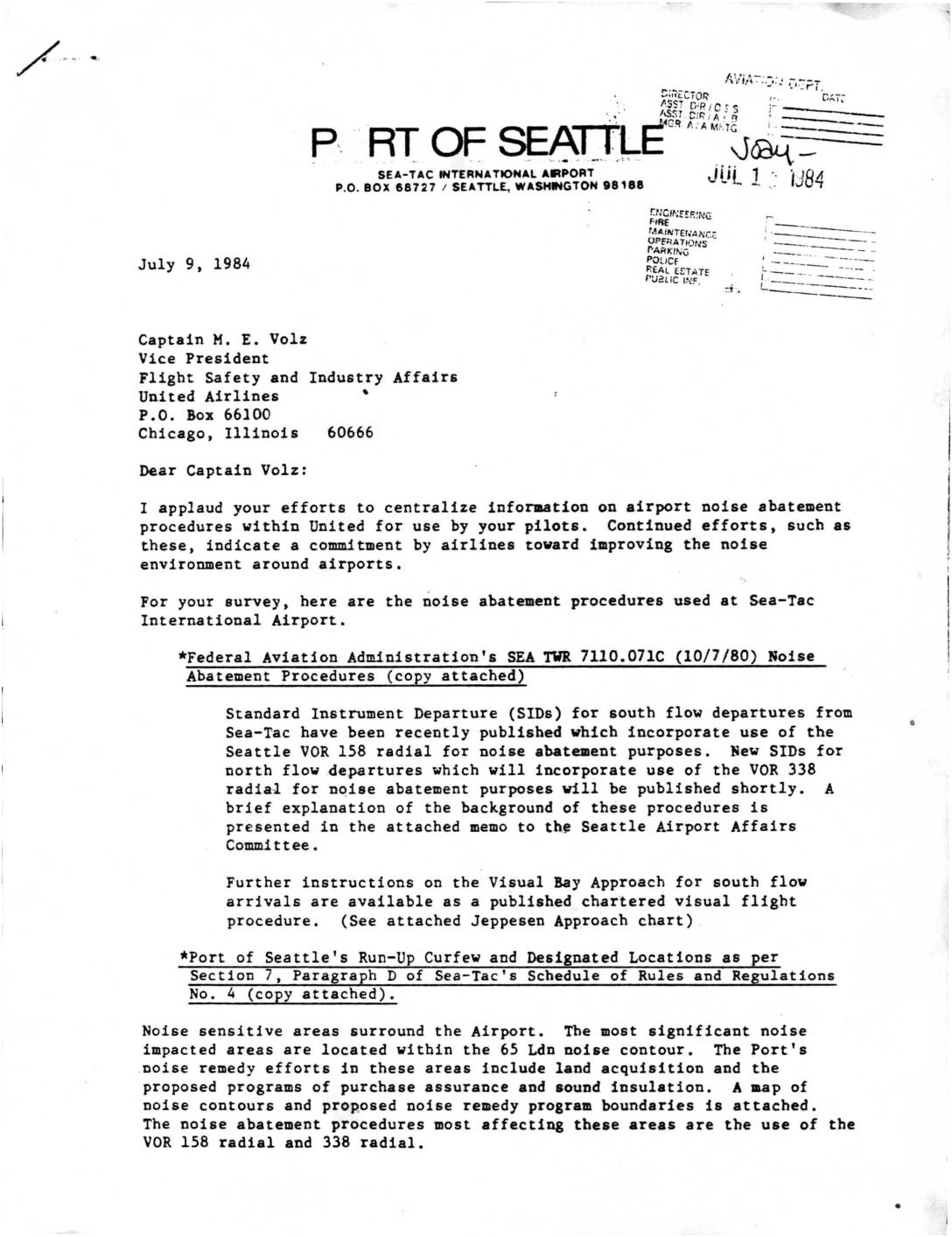
Port Of Seattle Letter to United Airlines on Sea-Tac Airport Noise Abatement Procedures
A July 9, 1984 letter from Port of Seattle to United Airlines Vice President Captain M. E. Volz outlines the noise abatement procedures in use at Seattle-Tacoma International Airport. The procedures include FAA-established Standard Instrument Departure (SID) routes using the Seattle VOR 158 and 338 radials to minimize noise over surrounding communities, a Visual Bay Approach for south flow arrivals, and a Run-Up Curfew with designated engine run-up locations. The letter also notes that the most noise-impacted areas fall within the 65 Ldn noise contour, where the Port was pursuing land acquisition, purchase assurance, and sound insulation programs as remedies. -
 1984-06-22
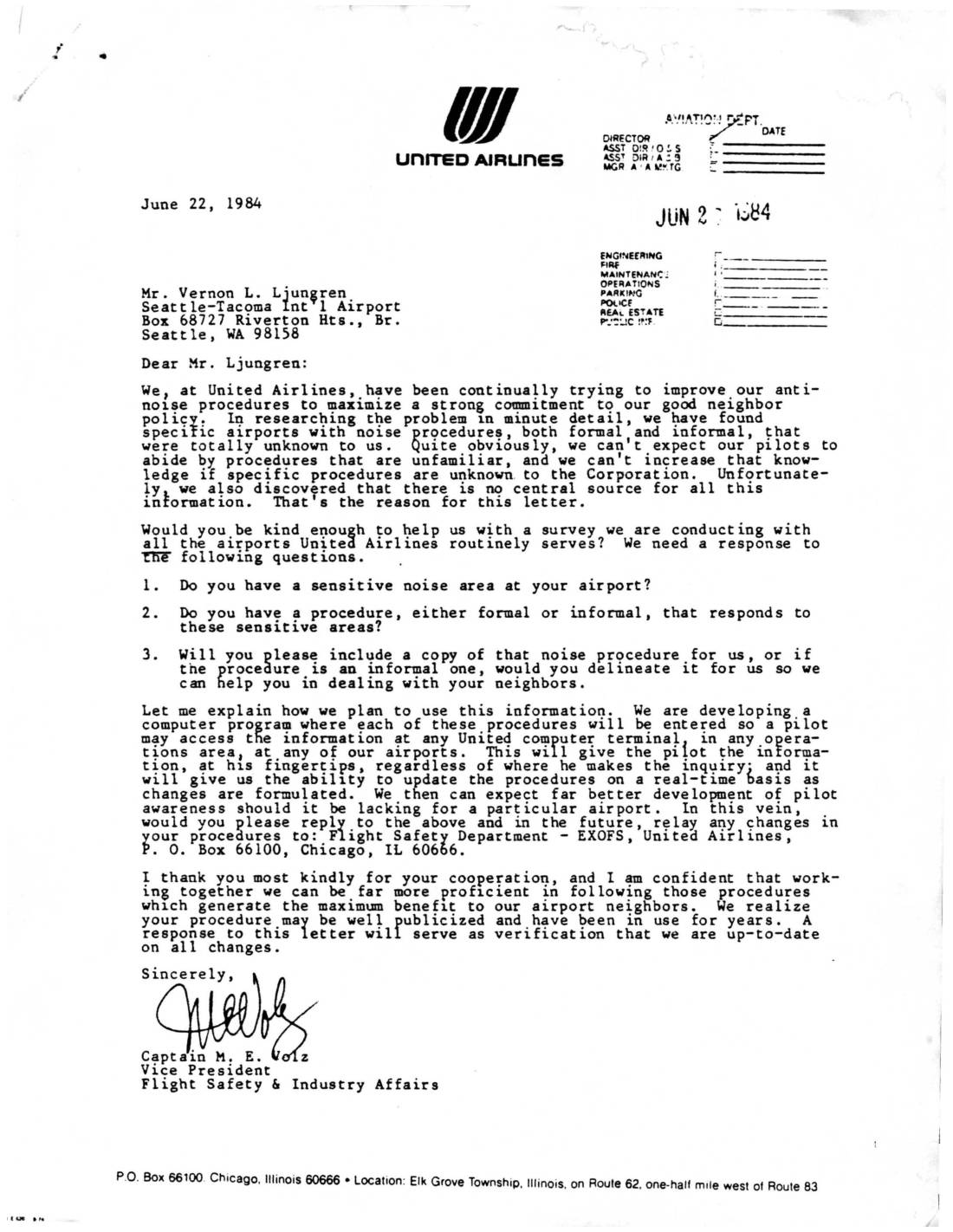
Letter from United Airlines to Mr. Vernon L. Ljungren, Seattle-Tacoma Int’l Airport, Regarding Noise Abatement Procedures Survey
In a June 22, 1984 letter to Seattle-Tacoma International Airport, United Airlines Vice President Captain M. E. Volz requested information about the airport's noise-sensitive areas and any formal or informal noise abatement procedures in place. The airline was conducting a survey of all airports it served in order to build a computer database of noise procedures accessible to pilots at any United Airlines terminal. United Airlines asked Sea-Tac to provide copies or descriptions of its noise procedures and to send future updates to the Flight Safety Department in Chicago. -
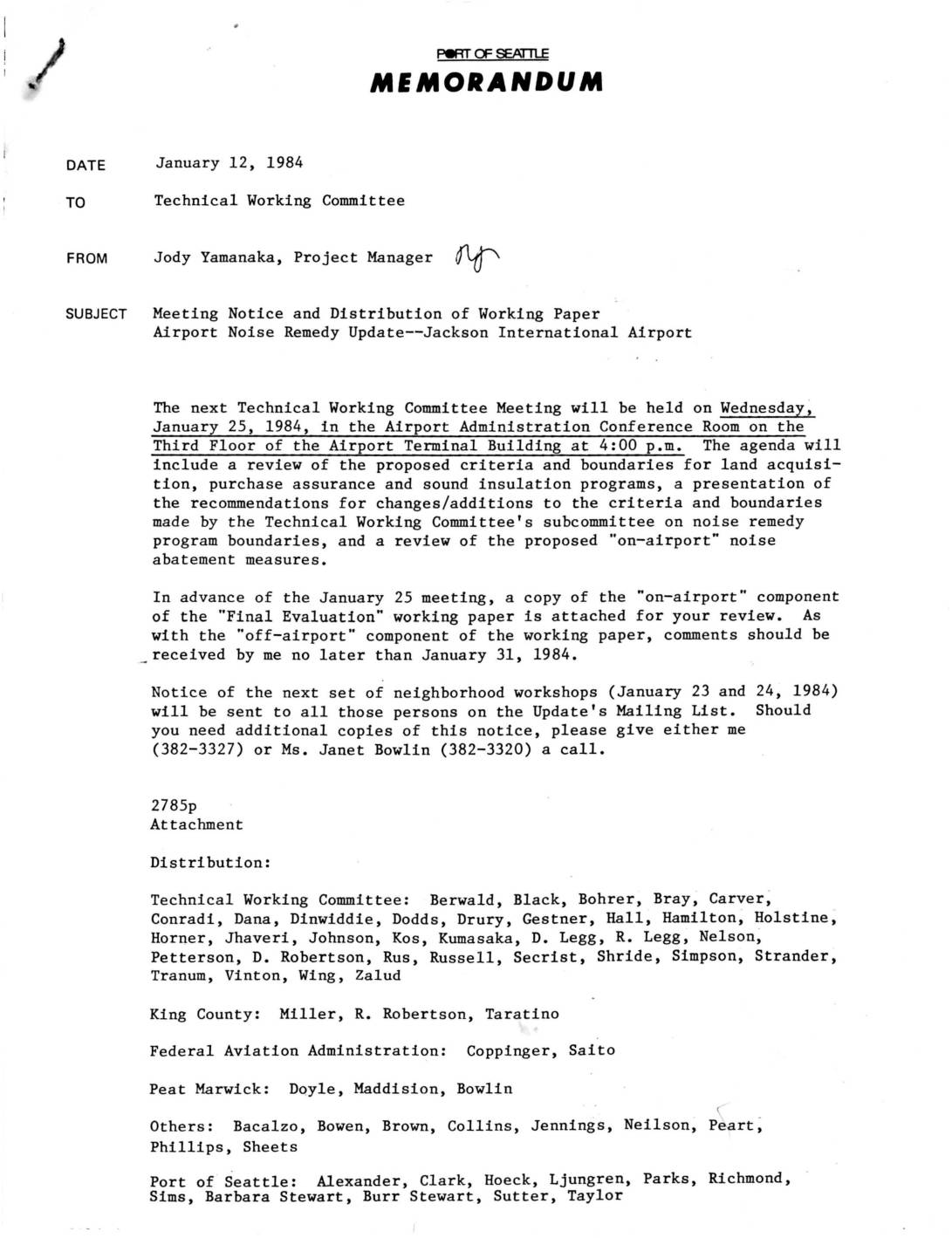 1984-01-12
Airport Noise Remedy Update – Meeting Notice and Working Paper Distribution
A January 1984 Port of Seattle memorandum notifies the Technical Working Committee of an upcoming meeting on January 25 to review noise remedy programs for Jackson (Sea-Tac) International Airport, including land acquisition, purchase assurance, and sound insulation proposals. Attached is a draft chapter evaluating on-airport and off-airport noise abatement measures against ten criteria, such as airspace compatibility and aircraft safety. The document outlines which measures were recommended for implementation following an initial screening process described in an earlier chapter. -
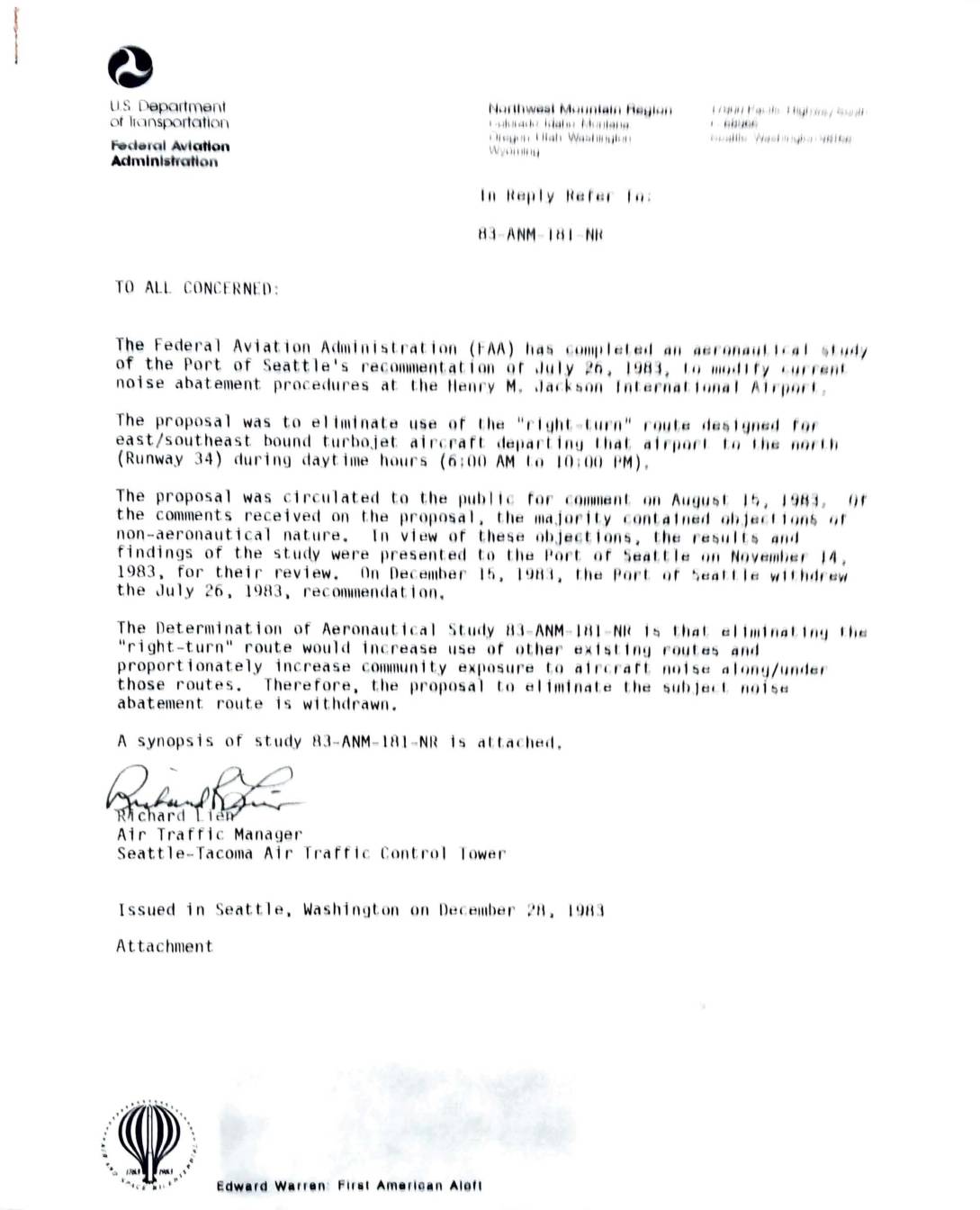 1983-12-28
Aeronautical study 83-ANM-181-NR synopsis: Noise abatement procedures at Henry M. Jackson International Airport
In December 1983, the FAA completed an aeronautical study of a proposal by the Port of Seattle to eliminate the 'right-turn' departure route for eastbound turbojet aircraft leaving Sea-Tac Airport (Runway 34) during daytime hours. The study found that removing this route would simply shift aircraft noise to other communities, increase airline operating costs by an estimated $1.5 million annually, and raise fuel consumption, without providing a net noise reduction benefit. As a result, the Port of Seattle withdrew its proposal and the FAA declined to eliminate the existing noise abatement route. -
 1983-08-05
Noise control and compatibility planning for airports
This 1983 FAA Advisory Circular (AC 150/5020-1) provides guidance for airports on noise control and land-use compatibility planning under FAR Part 150 and the Aviation Safety and Noise Abatement Act of 1979. It outlines a standardized system for measuring airport noise, identifying compatible and incompatible land uses near airports, and developing Noise Exposure Maps and Noise Compatibility Programs. Participation in the program is voluntary, and it aims to reduce existing noise conflicts around airports while preventing new incompatible development through cooperation among airport operators, planners, and community members. -
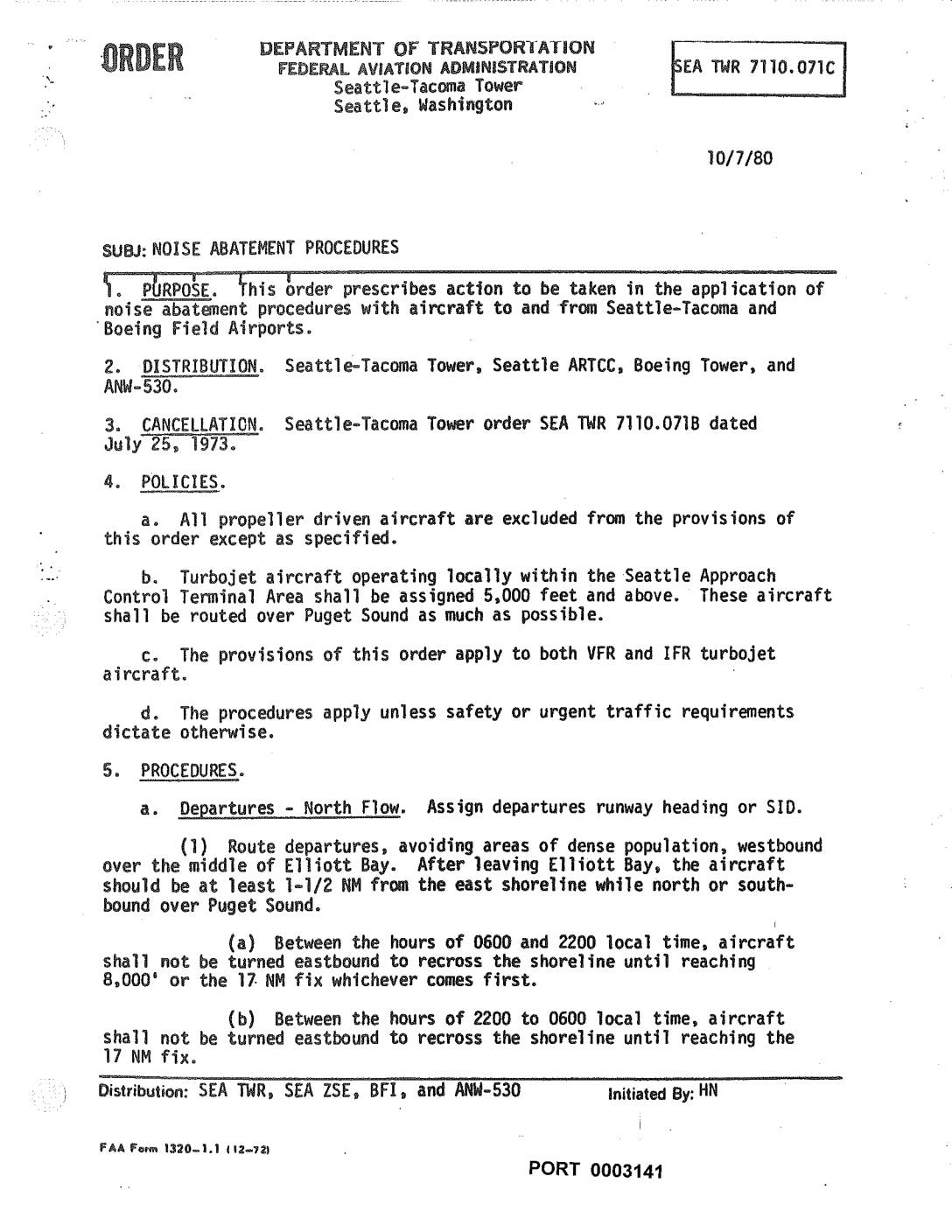 1980-10-07
SEA TWR 7110.071C: Noise Abatement Procedures, Seattle-Tacoma Tower
This 1980 Federal Aviation Administration order establishes noise abatement procedures for aircraft operating to and from Seattle-Tacoma International Airport and Boeing Field. It directs turbojet aircraft to fly over Puget Sound and Elliott Bay whenever possible, sets altitude and distance restrictions before aircraft can turn toward populated shoreline areas, and defines preferred takeoff and landing runways to minimize noise impact. The procedures apply to both VFR and IFR turbojet flights, with stricter nighttime rules between 2200 and 0600 local time. -
 1979-11-01
Airport Noise Control Procedure Manual
This 1979 Airport Noise Control Procedure Manual, approved by Oregon's Department of Environmental Quality, outlines the procedural steps required for compliance with noise control regulations for airports (OAR 340-35-045). It describes how the Department calculates Noise Impact Boundaries for non-air-carrier airports, including the flight operational data and mapping information needed to make accurate assessments. The manual was issued under the authority of ORS Chapter 467 and was designed to minimize the administrative burden on smaller airport facilities. -
 1975-01-01
Potential Aircraft Noise Impact Programs for the Vicinity of Sea-Tac International Airports
This draft planning document outlines sixteen potential programs to address aircraft noise impacts near Seattle-Tacoma International Airport, ranging from government acquisition and demolition of affected properties to zoning changes and development controls. Each program is described along with a pros-and-cons analysis to help community members and decision-makers evaluate the options. The programs include measures such as converting noisy areas to open space, offering purchase assistance to affected homeowners, granting noise easements, soundproofing buildings, and providing property advisory services.