TagNEPA(390)
-
 2024-10-01
Chapter 3: Affected Environment — Seattle-Tacoma International Airport Environmental Assessment for the Sustainable Airport Master Plan Near-Term Projects
This draft Environmental Assessment from October 2024 examines the existing conditions around Seattle-Tacoma International Airport (SEA) as part of the Sustainable Airport Master Plan Near-Term Projects. Using 2022 as the baseline year, it describes SEA's location on approximately 2,800 acres in the City of SeaTac, situated 12 miles south of downtown Seattle and surrounded primarily by residential neighborhoods. The study covers a General Study Area of 3,692 acres to identify where proposed airport development actions could have direct or indirect environmental impacts on nearby communities. -
 2024-10-01
Seattle-Tacoma International Airport Environmental Assessment for the SAMP Near-Term Projects: Chapter 2 — Alternatives
This draft Environmental Assessment chapter from October 2024 outlines the process used to evaluate alternatives to proposed construction and expansion projects at Seattle-Tacoma International Airport (SEA). Using a two-step screening process, planners assessed public suggestions — such as building a new airport, using high-speed rail, or limiting growth — against the project's core purpose of serving 56 million annual passengers at an optimal level of service, rejecting most suggestions as unfeasible or insufficient. A No Action Alternative is also included, which assumes none of the proposed improvements would be built, though several independent projects already underway or planned by 2032 would still proceed. -
 2024-10-01
Seattle-Tacoma International Airport Environmental Assessment for the Sustainable Airport Master Plan Near-Term Projects: Chapter 1, Introduction and Purpose & Need
The Port of Seattle is preparing an Environmental Assessment for 31 near-term improvement projects at Seattle-Tacoma International Airport (SEA), covering upgrades to taxiways, runways, terminals, and support facilities. The projects, expected to be operational by 2032, aim to reduce crowding, long lines, and flight delays that have grown as passenger demand has increased. The Federal Aviation Administration (FAA) will review the findings to determine whether the projects will significantly impact the surrounding environment, potentially affecting noise levels for nearby communities. -
 2024-09-24
Appendix D: Biological Resources — Biological Evaluation and Section 7 Consultation Request, SEA SAMP Near-Term Projects
The FAA submitted a Biological Evaluation to support an informal consultation under the Endangered Species Act for near-term construction projects at Seattle-Tacoma International Airport, all expected to be completed by 2032. The projects aim to expand passenger and cargo capacity, upgrade taxiway layouts, and increase fuel storage including sustainable aviation fuel. The evaluation assessed potential impacts on 14 species, determining that several—including Chinook salmon, bull trout, and killer whales—may be affected but not likely adversely, while the remaining species, such as the marbled murrelet and North American wolverine, would face no effect. -
 2024-09-20
SEA Airport’s Sustainable Airport Master Plan (SAMP) Frequently Asked Questions
The Port of Seattle's Sustainable Airport Master Plan (SAMP) outlines 31 near-term construction projects at Seattle-Tacoma International Airport, including a second terminal with 19 gates, new cargo facilities, and roadway changes, all aimed at serving up to 56 million passengers annually by 2050. A federal environmental review (NEPA) is underway to assess potential impacts, with a 45-day public comment period opening October 21, 2024, allowing community members to submit feedback online, by mail, or at public libraries in Burien, Des Moines, and SeaTac. A separate state-level environmental review (SEPA) will follow once the federal process is complete. -
 2024-09-20
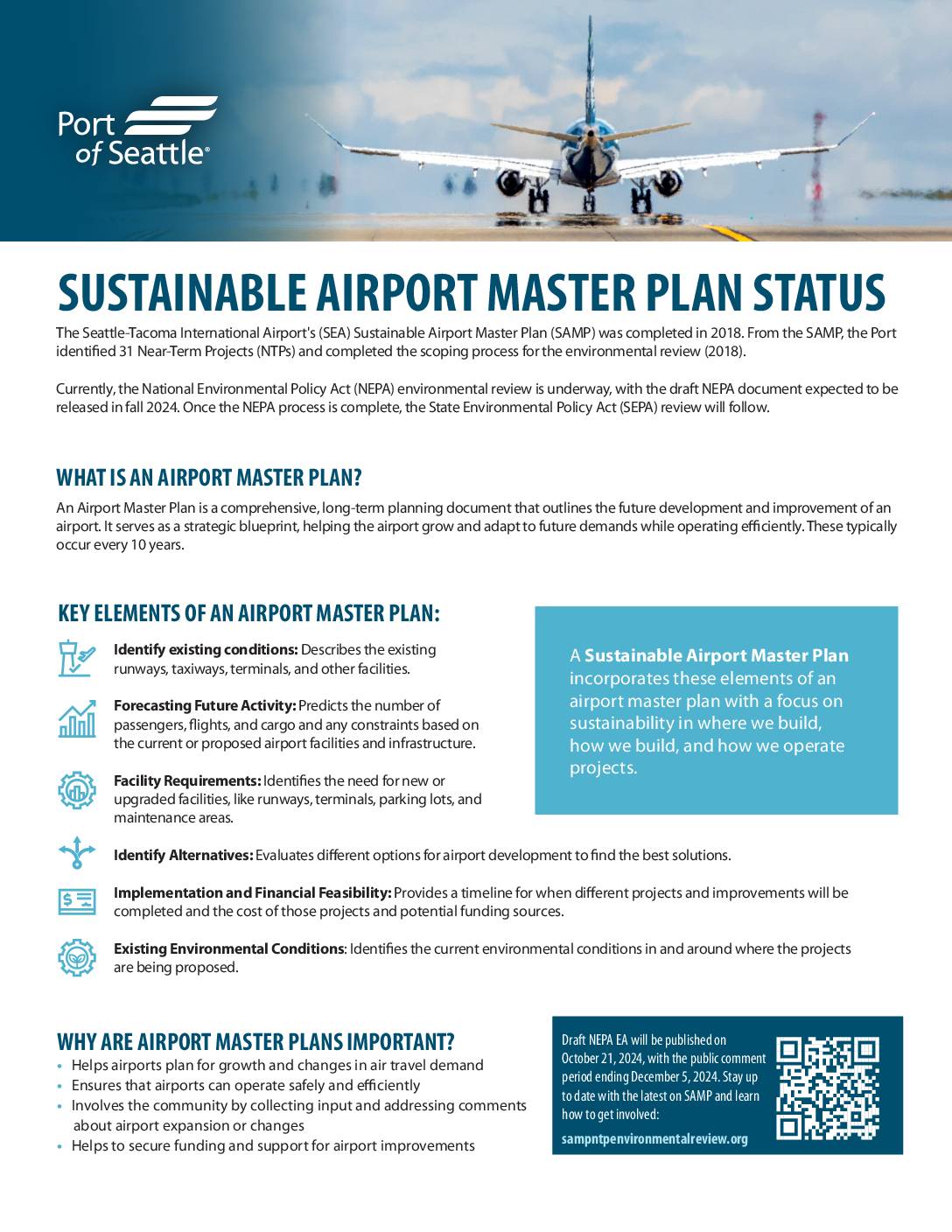
Sustainable Airport Master Plan: Environmental Review and Airport Master Plan Fact Sheet
Seattle-Tacoma International Airport's Sustainable Airport Master Plan (SAMP), completed in 2018, outlines 31 near-term development projects and is currently undergoing a federal environmental review (NEPA) process, with a draft Environmental Assessment published in October 2024. The review evaluates potential impacts on air quality, water resources, noise, and other environmental factors before any projects move forward. Once the federal NEPA process concludes, a Washington State-level environmental review (SEPA) will follow. -
 2024-09-20
Press Release: Port Of Seattle Draft Environmental Assessment for SAMP to Be Released Oct. 21
The Port of Seattle announced the release of a draft Environmental Assessment (EA) for Seattle-Tacoma International Airport's Sustainable Airport Master Plan (SAMP) on October 21, 2024, covering 31 near-term development projects including a second terminal, elevated busway, and new cargo facilities. The plan addresses projected regional population growth of one million people by 2035. Members of the public were invited to submit comments on potential environmental impacts during an open comment period running from October 21 to December 5, 2024. -
 2024-09-09
Appendix L: Surface Transportation Existing Conditions Report — SAMP NTP Environmental Review
This technical report analyzes existing surface transportation and traffic conditions around Seattle-Tacoma International Airport as part of the Sustainable Airport Master Plan (SAMP) Near-Term Projects Environmental Review. It examines 108 intersections — including signalized, stop-controlled, and uncontrolled locations — along key travel routes connecting the airport to surrounding communities, focusing on weekday PM peak-hour traffic volumes. The study also includes freeway analysis of SR 518 and I-5 ramps and segments at the request of WSDOT. -
 2024-09-09
SAMP NTP Environmental Review: Affected Environment — Surface Transportation Existing Conditions Report
This report analyzes existing traffic conditions around Seattle-Tacoma International Airport as part of the Sustainable Airport Master Plan (SAMP) Near-Term Projects Environmental Review. It examines 108 intersections—including 63 signalized, 41 stop-controlled, and 4 uncontrolled—along key routes connecting the airport to surrounding communities, focusing on the weekday PM peak hour (4–6 p.m.). Freeway segments of SR 518 and I-5 were also evaluated at WSDOT's request to provide a comprehensive picture of surface transportation conditions in the airport study area. -
 2024-07-02
FAA CZMP Negative Determination Letter: Seattle-Tacoma International Airport Near-Term Projects
The FAA issued a Negative Determination in July 2024, concluding that planned near-term construction and equipment-relocation projects at Seattle-Tacoma International Airport are not likely to cause effects on Washington State's coastal zone. The 31 Near-Term Projects—drawn from the airport's Sustainable Airport Master Plan—include taxiway extensions, blast pad expansions, and high-speed runway exits, with FAA involvement limited to relocating navigational aids and adjusting flight procedures on airport property. The Washington State Department of Ecology was asked to concur with this finding under the Coastal Zone Management Act.