Skip to content
  • STNI
  • Statistics
    • Ops and Passengers
      • King County International Airport (Boeing Field) Annual Operations
    • Financials
    • Aviation fuel uplift in the State of Washington 2018 – 2025
      • Aviation Fuel Uplift at Sea-Tac Airport
    • Air Quality Monitoring
    • Flight Tracking
      • Flow and Flight Tracks
      • Five Year Comparison
      • Busiest Hours and Days
    • SEL Noise Reports & Graphs
      • About The Permanent Noise Monitors
      • Minutes of Quiet by Noise Monitor
      • Noise Events mapped
      • Noise Events (SEL)
    • Runways
    • Employees
    • Real Estate
      • Port Properties and Trees mapped
    • Parking
  • Events
  • Protest
    • Regular Events
    • Legislation 2026
    • Complain about a particular flight
    • Advocacy Organizations
    • Media Outlets
    • People
    • The Port of Seattle
      • Commission Meetings
      • Public Records Requests
      • StART
      • Highline Forum
    • Contact Your Electeds
  • Resources
    • FAQs
      • FAA Occurrences/Accidents/Indents
    • The unSustainable Airport Master Plan
      • SAMP Public Comment Template
        • Two versions of Appendix K: NEPA/SEPA 2018 vs 2023
      • SAMP NTP: 31 projects by the numbers
      • SEPA Draft EIS (2026)
      • SAMP Record of Decision/FONSI (2025)
      • SAMP Draft EA (October 2024)
      • 2018 Scoping
    • Port Packages
      • Port Package Property Costs
      • Port Packages mapped
      • The Port Package Explainer
      • So you want a (first-time) Port Package? Start here
      • Port Package Looker Upper
      • How do I determine if I have a Port Package or Avigation Easement?
      • Progress on Port Package Update legislation
      • Having a Port Package Problem?
      • Port Package Site Visit Follow-Up
    • Document Library
    • Explainers
      • The Airport Law Cheat Sheet
      • The Grant Explainer
    • External Articles
    • History
      • Timeline
      • The Sea-Tac Communities Plan
        • Sea-Tac Communities Plan – Planning Maps
      • PSRC Third Runway Decision Process
    • Studies
    • Videos
  • Stories
  • Mission
  • Subscribe
  • Contact
Scroll down to content

Get InformedStay Informedx

I understand that you will never share my information with anyone, you will only use it to keep me updated on relevant events and that I may unsubscribe at any time.

STNI

STNISea-Tac Noise.Info

  • Solve for Sea-Tac. Solve for every airport.
  • Since 2016, working to obtain justice for everyone living under the flight path.
  • Less Noise. Cleaner Air. Better Public Health. Compensation.
  • Everything you think you know about the airport is wrong.

TagKCIA(63)

King County International Airport (Boeing Field) is a major regional facility with its own Part 150 program and FAA Roundtable

Advanced Search Options

  • Dates
  • Media
    • External Articles
    • Images
    • PDFs
    • Video
    • Audio
  • Order By
  • 2008-11-01

    King County International Airport Sound Insulation Program Homeowner’s Handbook

    The King County International Airport Sound Insulation Program, launched in 2005, offers free noise-reduction improvements to qualifying single-family homes (4-plex or smaller) located within the airport's noise mitigation area. Funded primarily by the FAA with a 5% match from King County, the program installs sound insulation upgrades to reduce the impact of aircraft noise inside residences. Homeowners who qualify must complete an eight-step participation process, including attending a briefing, signing a program contract, and granting an avigation easement.
    TagsBoeing Field, KCIA, King County, Noise Mitigation, Sound Insulation
  • 2006-08-29

    Plane Noise Could Get Louder

    SUMMER AT DUWAMISH HEAD. A view of Mount Rainier at sunset from a passing ferry as summer enters its final month. Planes on approach to Boeing Field fly near these houses and condos on Harbor Drive at the edge of Elliott Bay. Photo by Amber Trillo. By Tim St. Clair 08/29/2006 King County officials are
    CategoriesFrom The Web TagsKCIA, West Seattle Herald
  • 2006-02-27

    PSRC General chronology: Regional commercial airport capacity decisions in the Central Puget Sound Region

    This document traces the history of commercial airport capacity and noise policy decisions in the Central Puget Sound region from 1973 to 2006, focusing on Sea-Tac Airport. It covers key milestones such as the Port of Seattle's various noise mitigation programs, agreements with the Highline School District, and debates over building a third runway and expanding Boeing Field. The chronology highlights the ongoing tension between meeting growing air travel demand and addressing the noise impacts on surrounding communities and schools.
    TagsAlaska Air, Boeing Field, KCIA, King County, King County International Airport, PSRC, Puget Sound Regional Council, Southwest Airlines, Third Runway, Timeline
  • 2005-10-11

    Plan won’t fly: Sims kills Southwest’s Boeing Field hopes

    By JENNIFER LANGSTON AND GORDY HOLT,SEATTLE POST-INTELLIGENCER REPORTERS Oct 11, 2005 King County Executive Ron Sims on Tuesday rejected proposals by Southwest Airlines and Alaska Airlines to move to Boeing Field, saying the combined service would have required taxpayers to fund expensive roadwork and noise-insulation projects around the airport. Sims said the initial proposal from Southwest
    CategoriesFrom The Web TagsBrett Fish, CASE, KCIA, King County International Airport, Seattle PI
  • 2005-10-11

    Statement of King County Executive Ron Sims Regarding the Rejection of Proposals by Southwest Airlines and Alaska Airlines to Move Commercial Passenger Service to King County International Airport (KCIA)

    In October 2005, King County Executive Ron Sims rejected proposals from Southwest Airlines and Alaska Airlines to move commercial passenger service to Boeing Field (King County International Airport). Southwest had proposed an $130 million, 8-gate terminal for up to 85 flights per day, while Alaska Airlines followed with a $150 million proposal for up to 100 flights per day, but the competing proposals together would have required costly environmental review, significant public funding, and were projected to cause major noise and traffic impacts on surrounding neighborhoods. Sims concluded that while either proposal alone might have been feasible, accommodating both was impossible under his criteria of no taxpayer subsidies and no significant noise or traffic harm to communities.
    TagsAlaska Air, Boeing Field, KCIA, King County, Southwest Airlines
  • 2005-10-11

    Statement of King County Executive Ron Sims Regarding the Rejection of Proposals by Southwest Airlines and Alaska Airlines to Move Commercial Passenger Service to King County International Airport (KCIA)

    King County Executive Ron Sims announces rejection of both Southwest Airlines and Alaska Airlines proposals to relocate commercial passenger service to King County International Airport (KCIA), also known as Boeing Field. Southwest Airlines had proposed a $130 million 8-gate terminal for up to 85 flights per day; Alaska Air Group proposed a $150 million 8-gate
    TagsAlaska Air, Boeing Field, KCIA, King County, Southwest Airlines
  • 2002-11-04

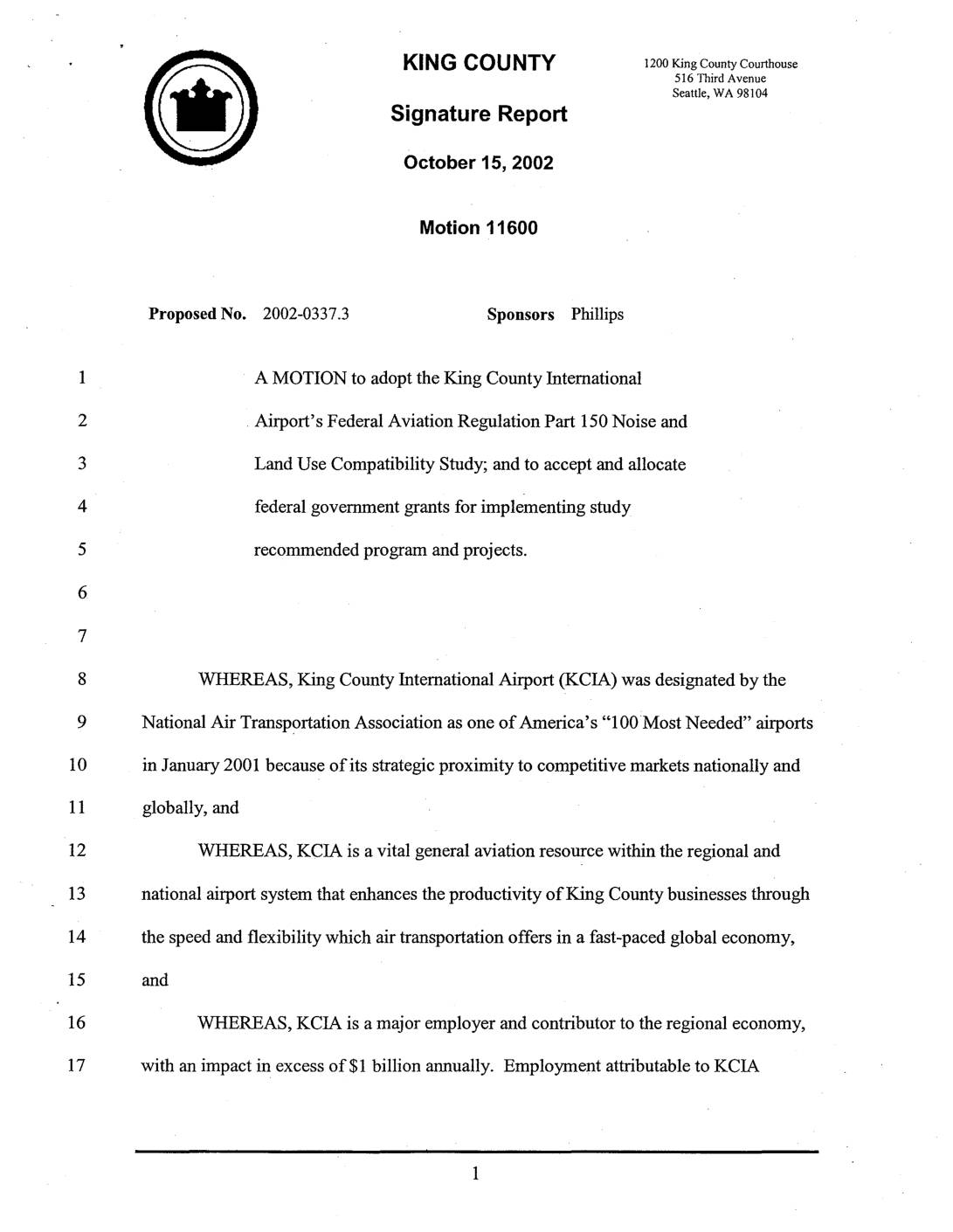
    KCIA draft master plan and SEPA/EIS and NEPA/EA executive office briefing

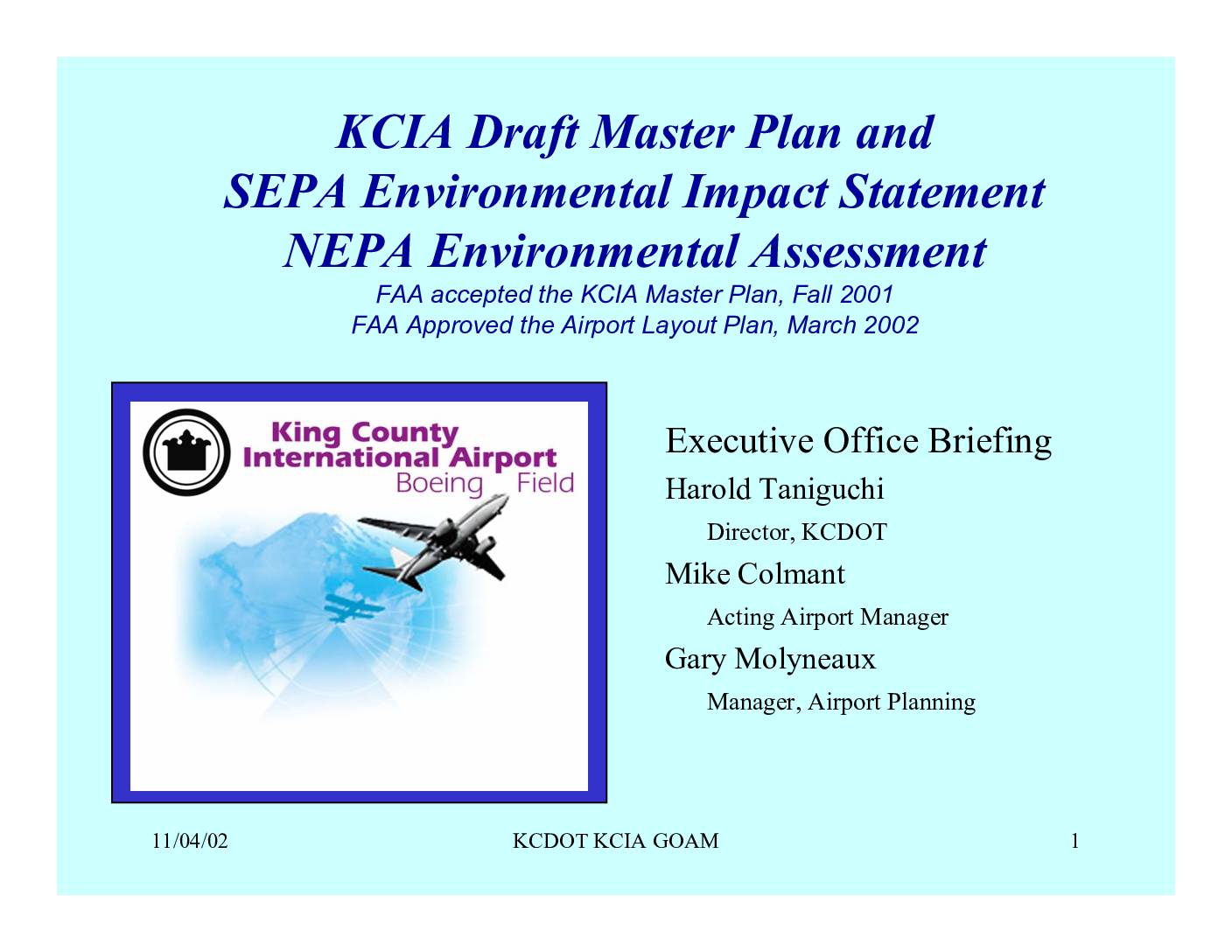
    This 2002 executive briefing presents the draft Master Plan and environmental review documents (SEPA/EIS and NEPA/EA) for King County International Airport (Boeing Field), located five miles south of downtown Seattle. The airport, which covers 594 acres and hosts 150 tenant businesses and 479 based aircraft, recorded approximately 290,000 flight operations in 2001. The FAA accepted the Master Plan in Fall 2001 and approved the Airport Layout Plan in March 2002, setting the stage for future development and noise impact assessments.
    TagsEnvironmental Impact Statement, KCIA, Master Plan, NEPA, RCAA, SEPA
  • 2002-05-16

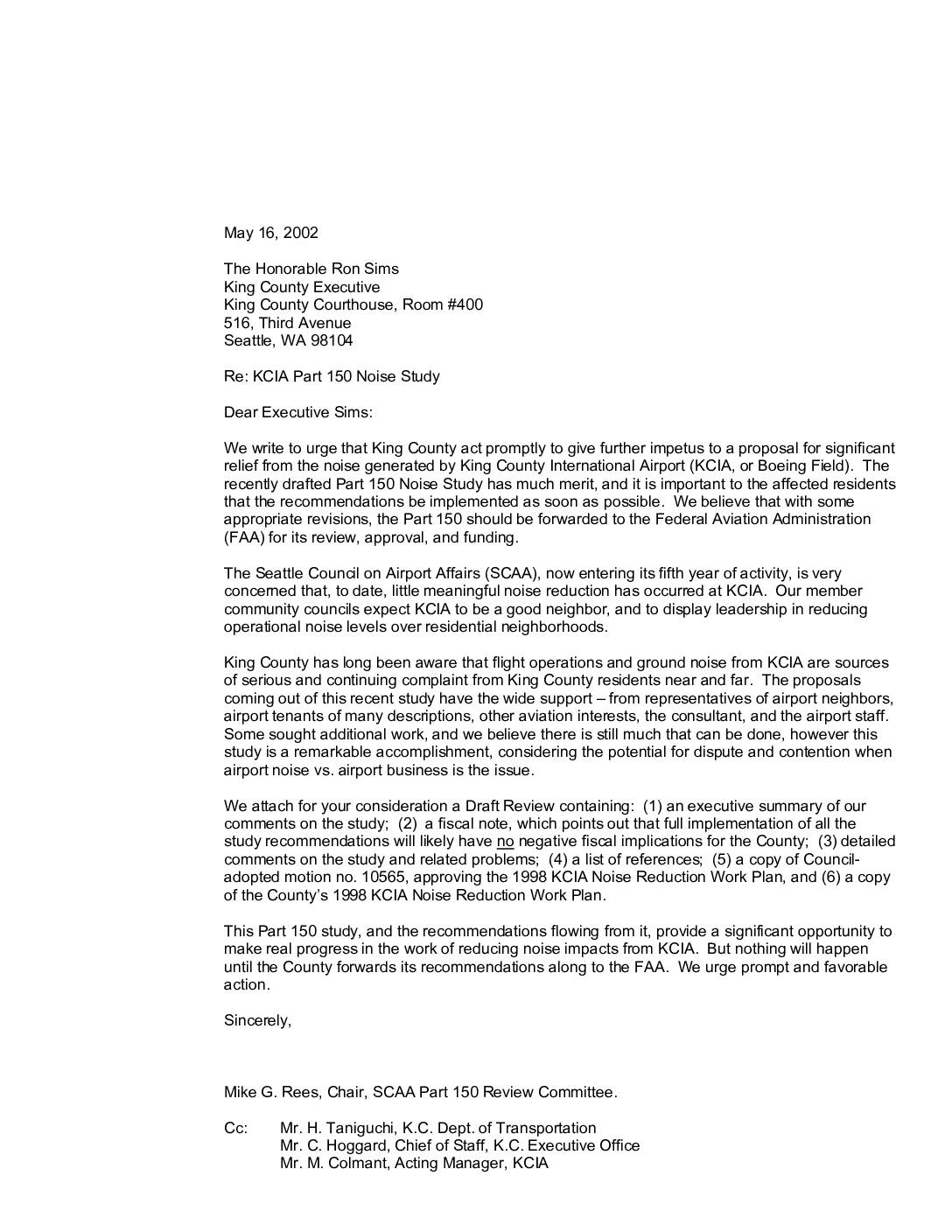
    SCAA draft comments to the King County International Airport proposed Part 150 noise study

    In May 2002, the Seattle Council on Airport Affairs (SCAA) urged King County Executive Ron Sims to advance the King County International Airport (Boeing Field) Part 150 Noise Study to the FAA for review, approval, and federal funding. The letter highlights years of unresolved noise complaints from nearby residents and outlines a draft review covering fiscal impacts, detailed comments, and prior noise reduction plans. The SCAA emphasized that implementing the study's recommendations would likely carry no negative fiscal implications for the county, but that progress depended on the county promptly forwarding its proposals to the FAA.
    TagsFAA, KCIA, King County, Part 150, RCAA
  • 1998-03-01

    Truth in Aviation: The newsletter of the Regional Commission on Airport Affairs, Vol. 5, No. 1, Spring 1998

    This 1998 newsletter from the Regional Commission on Airport Affairs covers several controversies surrounding Sea-Tac Airport's expansion, including a 24% cost overrun on the new parking garage, Port staff admitting they lack the capacity to manage over 100 simultaneous expansion projects, and the Highline School District launching an independent study of airport noise impacts on classrooms after failed negotiations with the Port. Additional issues covered include a proposed wetlands destruction permit for the third runway site, plans to extend King County International Airport's runway closer to Georgetown neighborhoods, and legal battles over city comprehensive plans that opposed airport expansion.
    TagsHighline Schools, KCIA, Miller Creek, RCAA, Regional Commission On Airport Affairs, Sea-Tac Airport, Third Runway
  • 1982-10-27

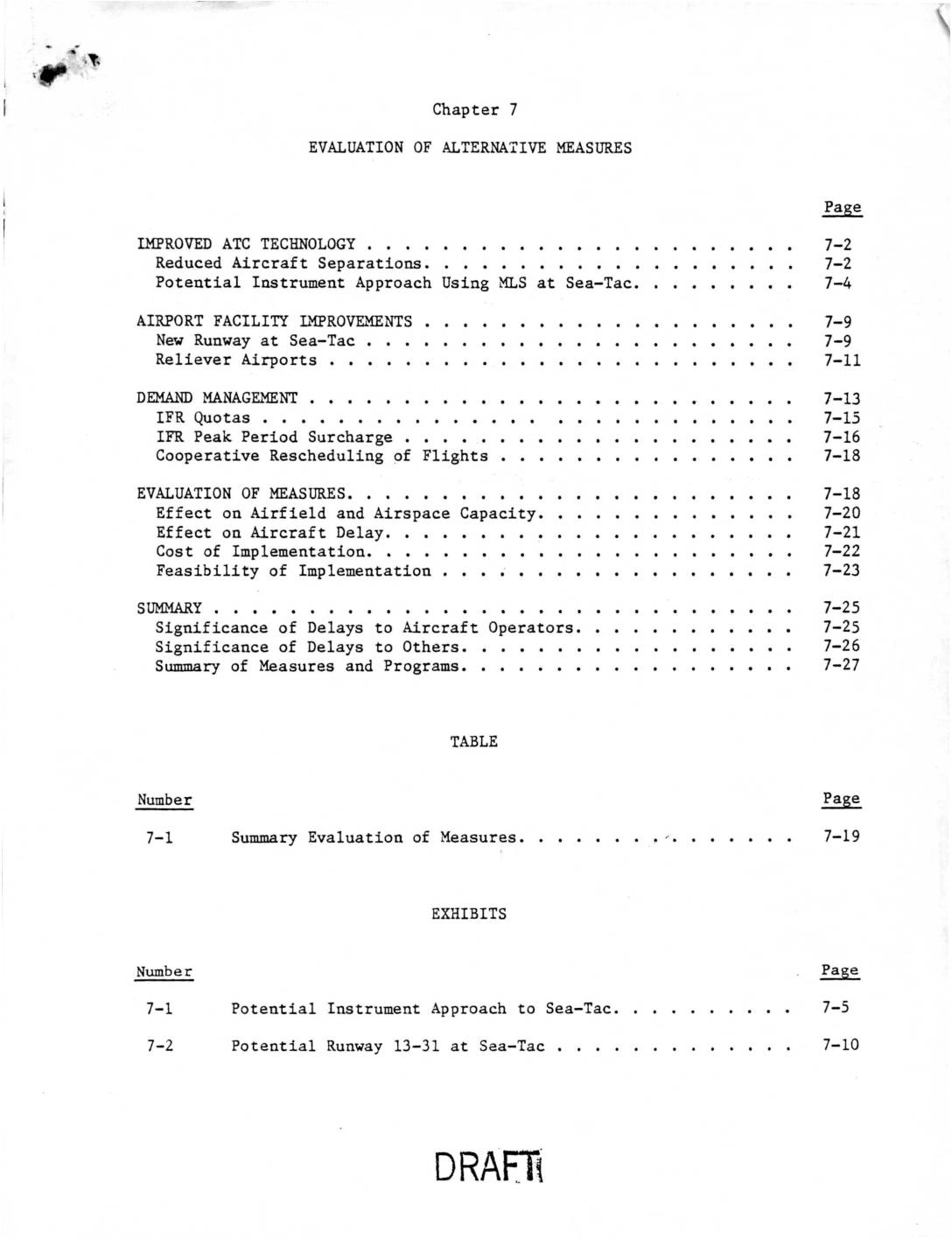
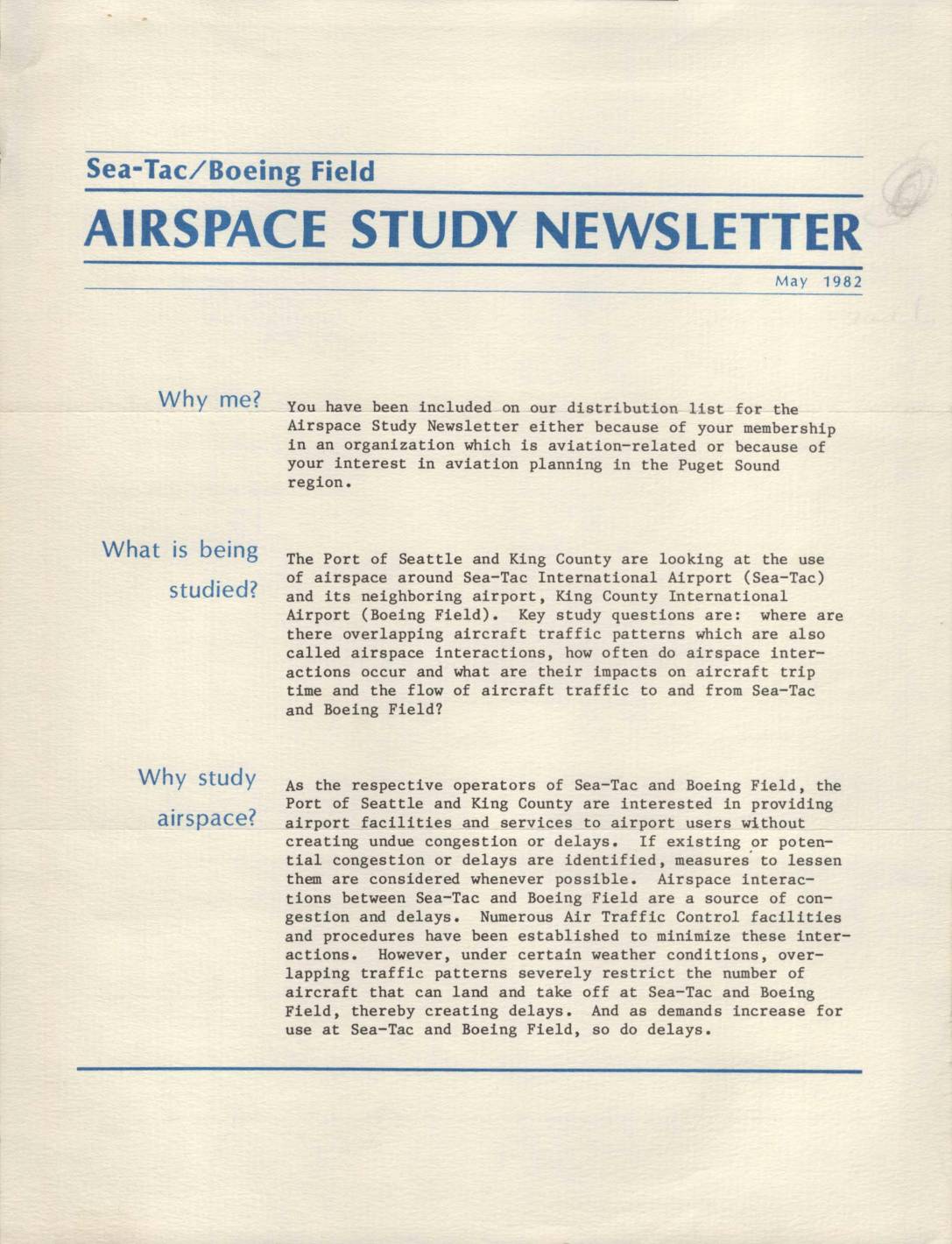
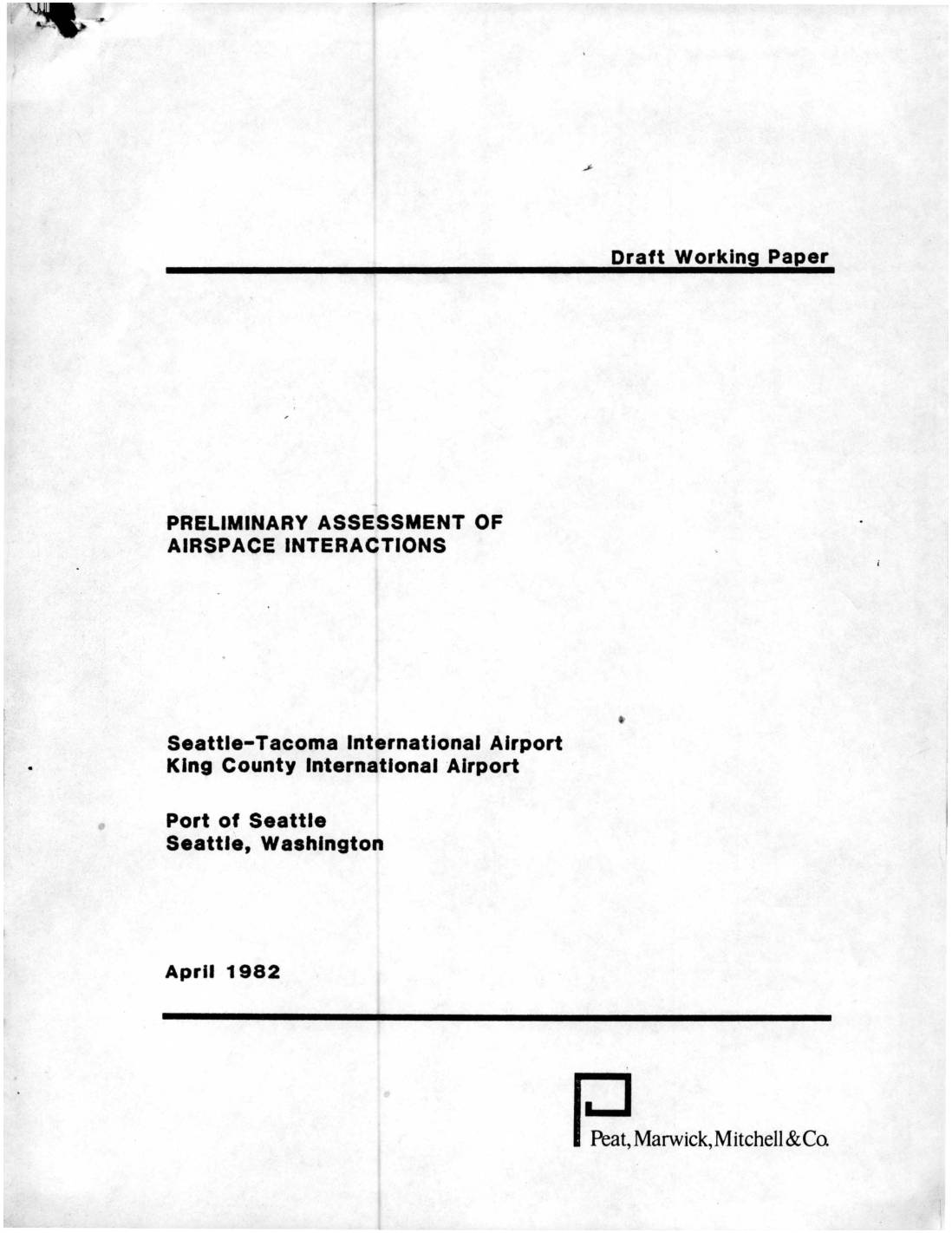
    Evaluation of Alternative Measures: Chapter 7, Shared Airspace Study

    This draft chapter evaluates alternative measures to reduce growing aircraft delays caused by airspace interactions between Seattle-Tacoma International Airport (Sea-Tac) and Boeing Field, which are projected to worsen significantly between 1990 and 2000. Three main approaches are examined: improving air traffic control (ATC) technology to allow reduced aircraft separations, expanding airport facilities through new runways or reliever airports, and managing demand through flight quotas or peak-period pricing. The chapter concludes that a combination of these measures will likely be necessary, and that action should begin immediately since implementation could take until 1990 when the delays are expected to become critical.
    TagsAir Traffic Control, Airspace Study, Boeing Field, KCIA, Sea-Tac Airport

Posts pagination

Page 1 … Page 3 Page 4 Page 5 Page 6 Page 7
Sidebar On/Off

Upcoming Events

  • StART SEA Stakeholder Advisory Round Table
    Add to CalendarMWednesday Aug 26, 5:00pm - 7:00pm
    Zoom (Virtual Meeting)
    START meetingagenda 2026826 final 0 pdf

    Meeting Objectives Introduce the primary feedback themes identified by StART members regarding StART’s Operating Procedures and determine areas that may warrant future discussion. 5:00 PM – Welcome Meeting Management Welcome Lead: Andrés Mantilla, Facilitator, Uncommon Bridges; Wendy Reiter, Airport Managing Director, POS 5:15 PM – Dinner: All participants eat. 5:30 PM – StART Operating Procedures

    [...]
  • Commercial Aviation Work Group
    Add to CalendarMThursday Sep 3, 10:00am - 1:30pm
    Virtual Meeting (Zoom)
    Cawg agenda sep 3 26 virtual pdf

    Meeting Agenda 10:00 a.m. – 10:15 a.m. | Welcome – Evan Nordby, Chair a. Introductions and Agenda Reviewb. Status of appointments and non-voting member invitationsc. Other updates as necessary 10:15 a.m. – 11:00 a.m. | Is it practical and legal to operate the western Washington [Puget Sound] airports as a single airport system? – Consultant

    [...]

[See all...]


Help study childhood asthma. Get free HEPA filter!

read more...

Issues

Sea-Tac Airport is currently undergoing the largest and longest expansion in its history, collectively known as the Sustainable Airport Master Plan (SAMP). Some of it you can already hear, but you’re probably not aware of what it all means. Here’s what you need to know.
read more...

Read This!

As the source for federal transportation grants, the Puget Sound Regional Council was charged with developing a system to meet the growing need for commercial aviation. When the search for a second airport failed, they authorized the Port of Seattle to build the Third Runway, with a mandate to develop a noise abatement and mitigation program. In their effort to stop the Third Runway, the ACC argued over every detail of the Port's efforts--including property buyouts and sound insulation. The dispute was meant to be settled by a three member Expert Arbitration Panel. This is their final report. It finds 2-1, that the Port's program was insufficient in several respects. Despite that, funding for the Third Runway was approved by the PSRC, and the 'Port Package' program, proceeded largely unchanged. Expert Arbitration Panel's final decision finding that the Port of Seattle had not shown sufficient reduction in real on-the-ground noise impacts to satisfy noise reduction conditions required for approval of a third runway at Sea-Tac International Airport. The majority decision concluded the Port's noise abatement programs were insufficient despite being impressive in scope.
continue...

The Podcast!

Subscribe to the only podcast devoted to policies, politics, history, impacts for people living under the flight path everywhere. It’s definitely not just about noise!
  • Sea-Tac Noise.Info
  • Connect with STNI

    • Subscribe
    • Port Package Problem?
    • Donate
    • Podcast
    • Socials
      • Facebook
      • X (Twitter)
      • Bluesky
      • Instagram

    "Ultrafine Particles Near Airports" — , 2016

  • Learn

    • Frequently Asked Questions
    • Explainers
    • Youtube
    • Research Requests
    • Make a complaint
  • Goals

    Fulfill the promises of 1976:
    • Compensation
    • Reduced noise
    • Improved air quality
    • Environmental remediation
Login/Register
©2026•Data Privacy

Message

We use cookies to provide basic functionality. We also provide access to search engines in order to provide site analytics. We do not sell or share your data.
V V