TagGeneral Aviation(50)
-
 2023-03-19
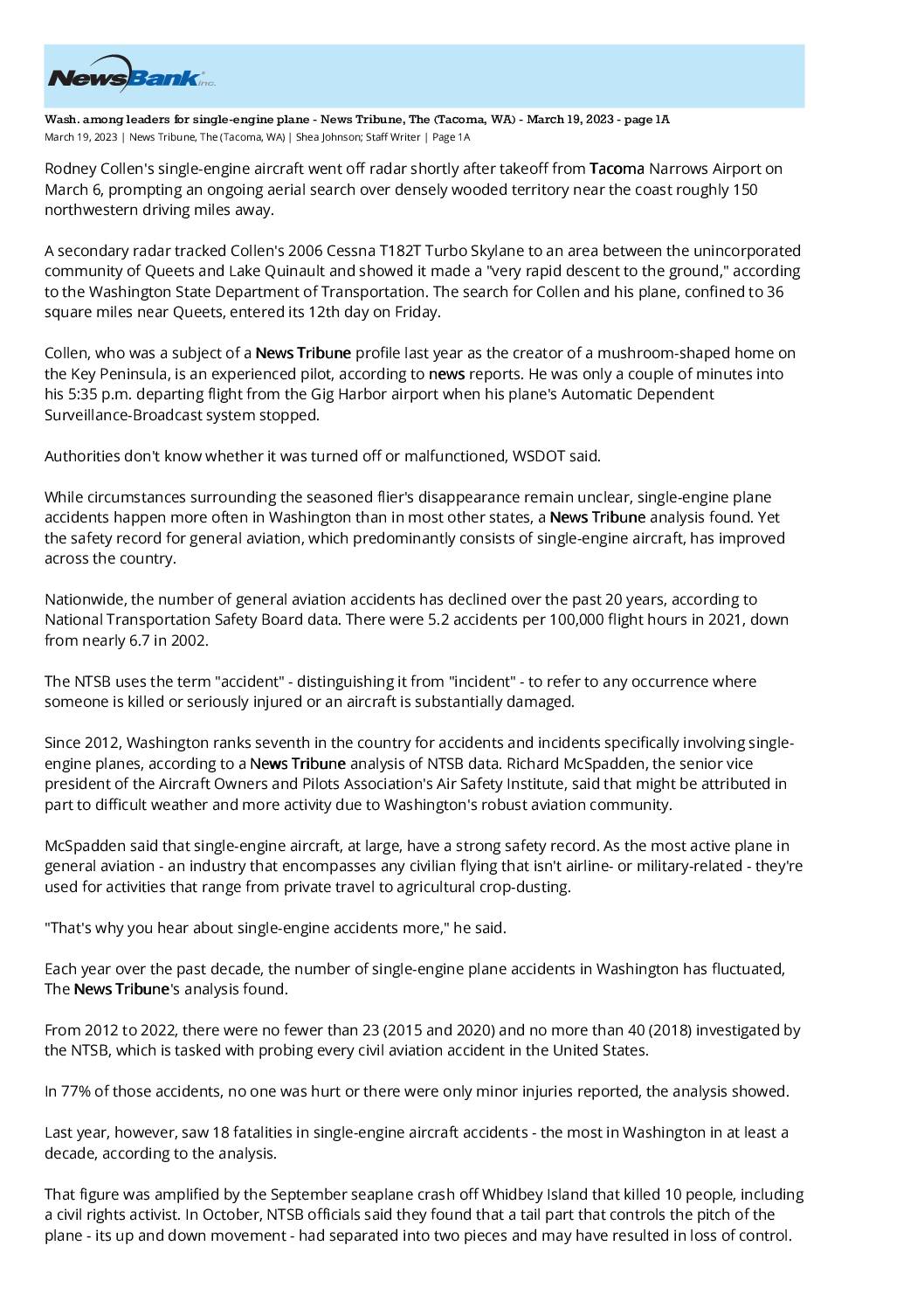
Wash. among leaders for single-engine plane accidents
A March 2023 News Tribune article reports on the disappearance of pilot Rodney Collen, whose single-engine Cessna T182T went off radar shortly after departing Tacoma Narrows Airport on March 6, 2023, prompting a search near Queets, Washington. The article uses the incident as a starting point to examine Washington State's ranking as one of the top states for single-engine plane accidents, drawing on NTSB data showing the state ranks seventh nationally since 2012. Experts attribute the higher accident rate to challenging weather conditions and a robust aviation community, while noting that overall general aviation safety has improved nationwide over the past two decades. -
 2022-09-12
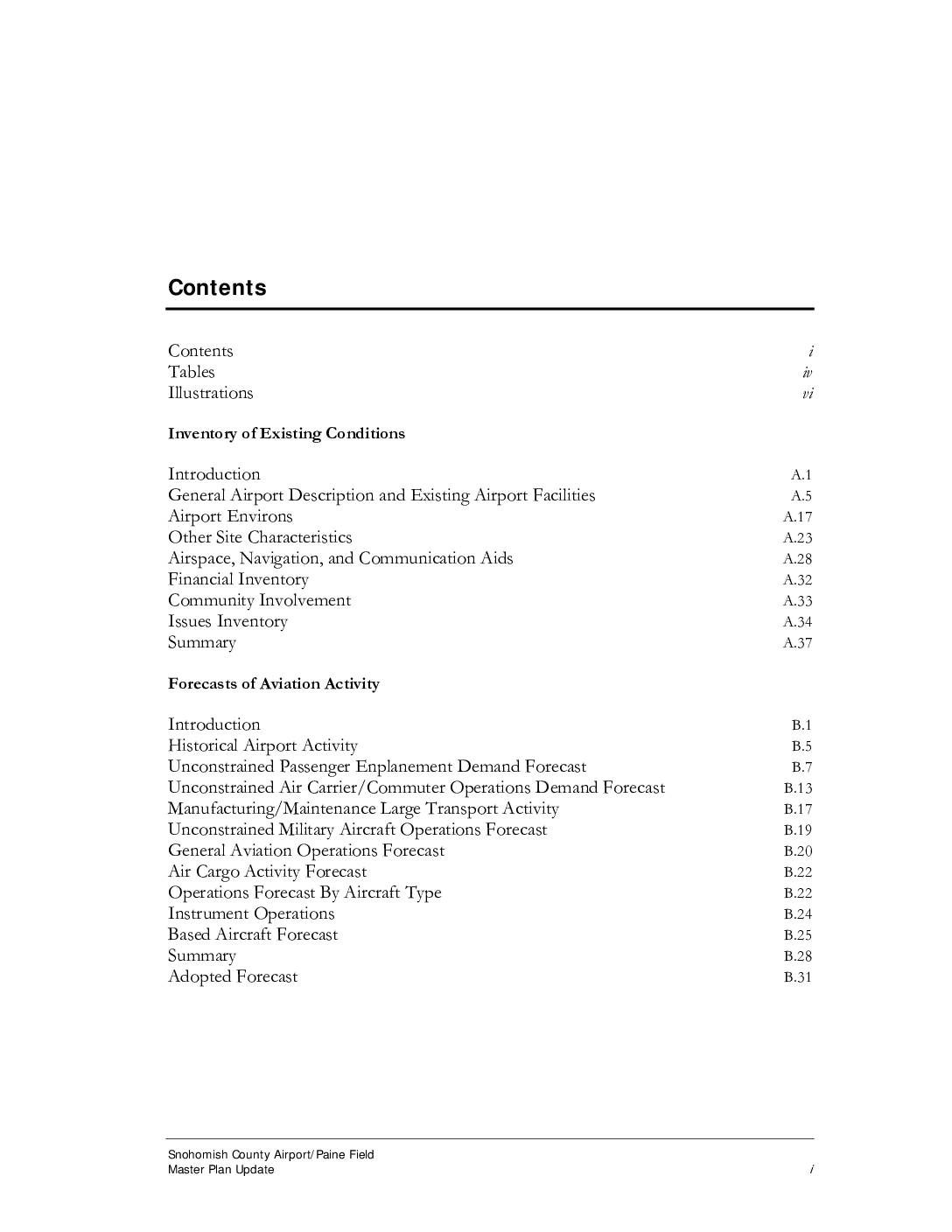
Snohomish County Airport/Paine Field master plan update
This document is the Master Plan Update for Snohomish County Airport/Paine Field, covering a comprehensive range of planning topics including existing airport conditions, aviation activity forecasts, capacity analysis, facility requirements, and a long-term development program. It outlines airfield and landside infrastructure needs, environmental considerations, and financial planning strategies for the airport's future growth. Note that this plan pertains to Paine Field in Snohomish County and does not directly address noise policy at Seattle-Tacoma International Airport. -
 2022-09-12
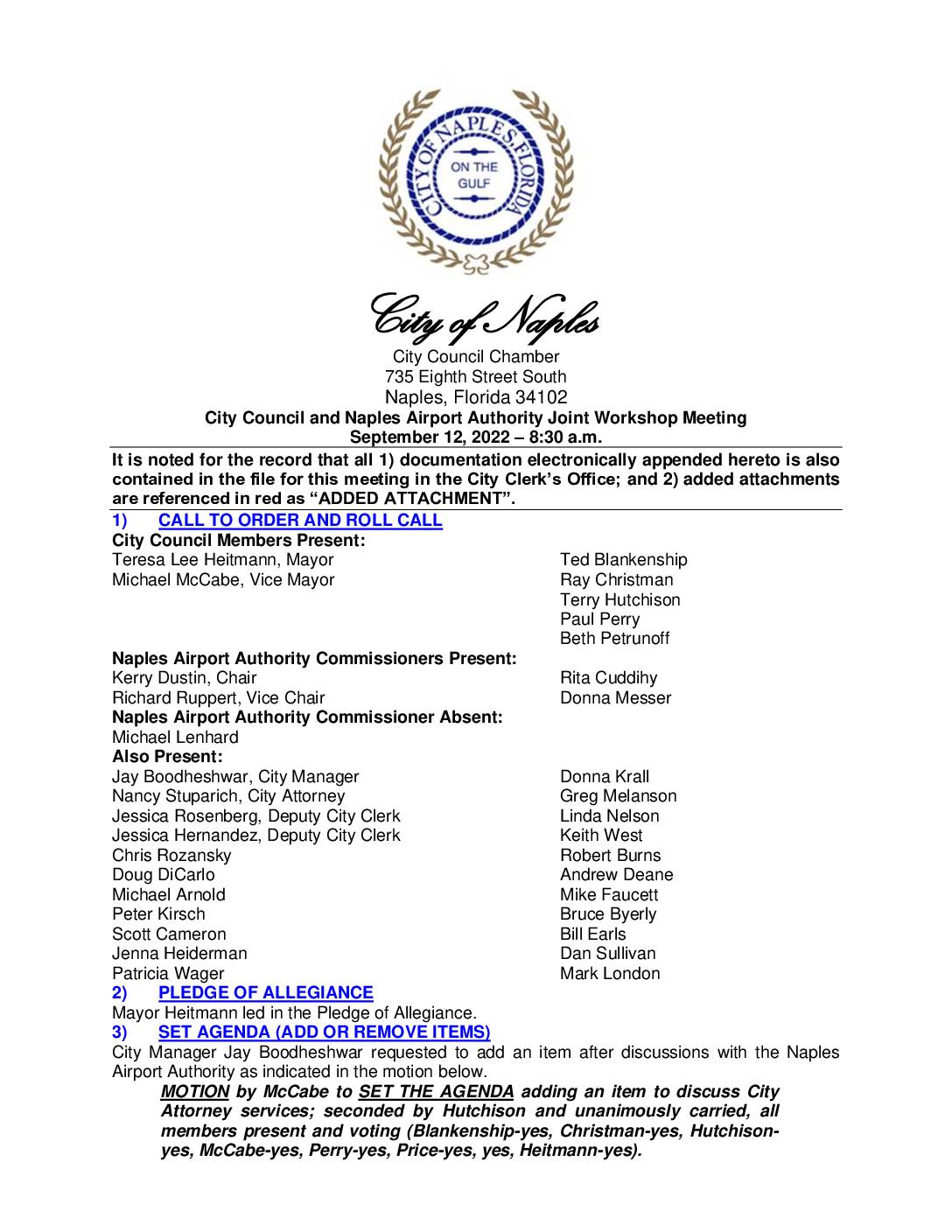
City of Naples City Council and Naples Airport Authority Joint Workshop Meeting Minutes – September 12, 2022
Minutes from a September 12, 2022 joint workshop between the Naples, Florida City Council and Naples Airport Authority cover discussions on the Airport Master Plan, noise reduction efforts, and community concerns about increasing jet traffic. Key topics included raising aircraft flight path ceilings to reduce noise, the possibility of reclassifying Naples as a Class C airport, and whether the Master Plan's growth projections were already outdated given a 40% surge in jet traffic. Residents and neighborhood association representatives called for equitable distribution of noise impacts and urged immediate action rather than waiting for a formal noise study to be completed. -
General Aviation Moves Closer to an Unleaded Future
The FAA’s approval of the use of G100UL fuel in all piston aircraft directly addresses the industry’s long-standing goal of finding solutions that can be used for the entire GA piston fleet. Related To: Aircraft Owners and Pilots Association (AOPA) The FAA on Sept. 1 signed on supplemental type certificates to allow General Aviation Modifications Inc.’s -
It’s a bird! It’s a plane! Yes, that pilot really did just flip off Whatcom County
BY DAVID RASBACH UPDATED AUGUST 30, 2022 3:36 PM Flight tracking data shows a pilot traced the image of a hand raising a middle finger over Whatcom County Monday morning, Aug. 30. FLIGHTAWARE.COM Courtesy to The Bellingham Herald Ever have one of those days — especially on a Monday? One where you just wanna flip -
 2022-07-28
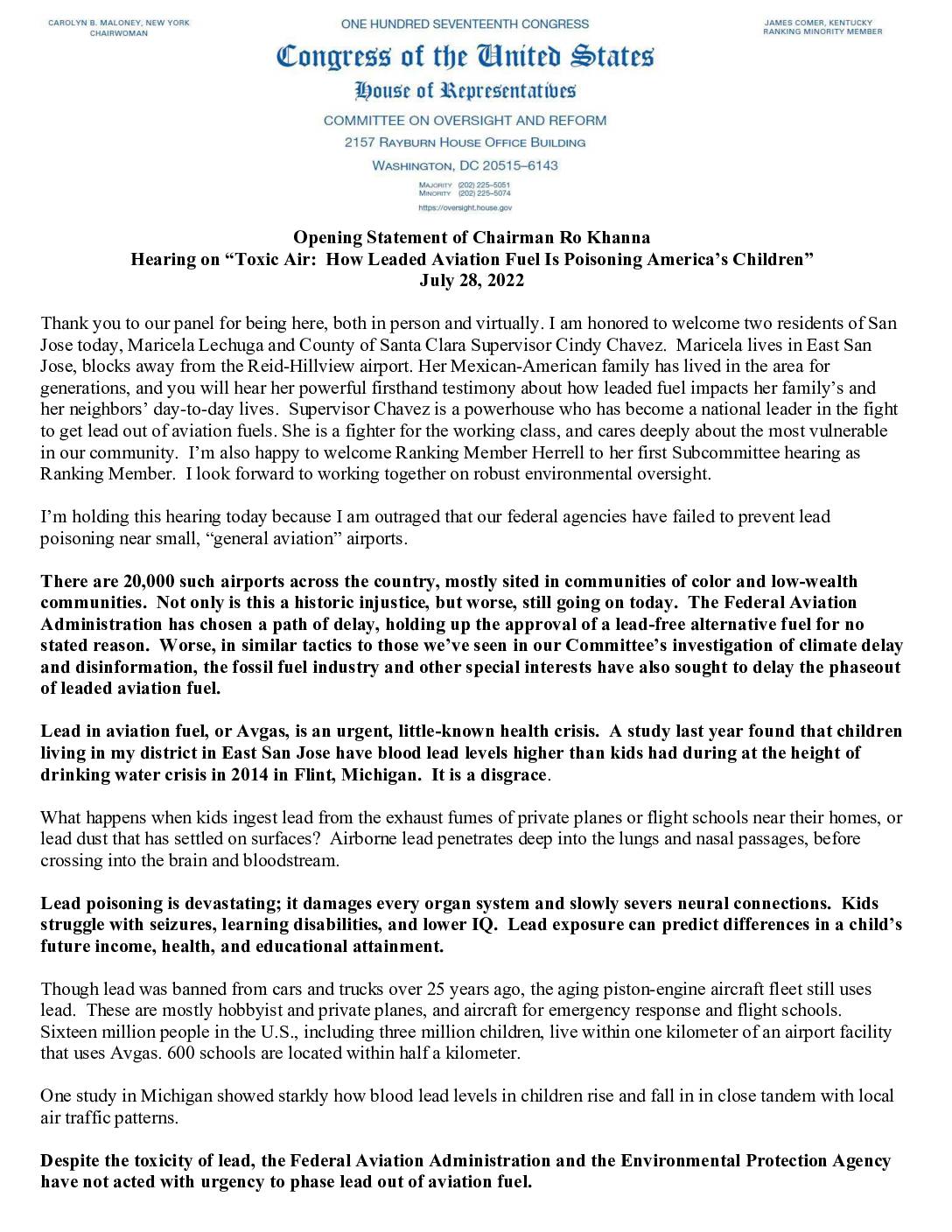
Opening Statement of Chairman Ro Khanna: Hearing on “Toxic Air: How Leaded Aviation Fuel Is Poisoning America’s Children”
In a July 2022 congressional hearing, Chairman Ro Khanna highlighted the health dangers of leaded aviation fuel (Avgas) still used in small general aviation aircraft, noting that children near airports in communities of color face blood lead levels exceeding those seen during the Flint water crisis. The statement criticizes the FAA and EPA for failing to act urgently on phasing out leaded fuel, despite the existence of viable unleaded alternatives, and accuses oil companies and aviation industry groups of deliberately delaying the transition. Khanna calls on federal agencies to accelerate approval of lead-free fuel options, involve affected communities in decision-making, and use infrastructure funding to support the switch to unleaded aviation fuel. -
 2022-02-09
Commercial Aviation Coordinating Commission report to legislative transportation committees
The Washington State Commercial Aviation Coordinating Commission's 2022 report to the Legislature identifies six existing airports — including Paine Field, Bremerton National, and Tacoma Narrows — as candidates for expanded aviation capacity, while also exploring potential greenfield sites for a new airport. The report summarizes public input showing that a majority of respondents support building new aviation capacity despite environmental costs, and outlines the Commission's guiding principles of public benefit, economic feasibility, environmental responsibility, and social equity. The Commission's final recommendations are expected by February 15, 2023. -
 2021-08-03
Leaded aviation gasoline exposure risk at Reid-Hillview Airport in Santa Clara County, California
This 2021 report by Mountain Data Group, commissioned by Santa Clara County, examines the health risks posed to children living near Reid-Hillview Airport in California due to lead emissions from leaded aviation gasoline. It analyzes statistical associations between children's blood lead levels and factors such as residential distance from the airport, aircraft traffic, and fuel sales. Note that while this report focuses on lead exposure from aviation fuel at a California airport, it does not address noise policy or Sea-Tac Airport operations. -
 2021-05-01
Private jets: can the super rich supercharge zero-emission aviation?
A 2021 study by Transport & Environment found that private jets are 5 to 14 times more polluting per passenger than commercial aircraft, and 50 times more polluting than trains, with European private jet CO2 emissions rising 31% between 2005 and 2019. Just 1% of people are responsible for 50% of global aviation emissions, with private jets disproportionately used for very short trips under 500km where aircraft are least fuel-efficient. The report calls for urgent decarbonization policies targeting the private jet sector, noting that high-speed train alternatives already exist on the majority of the most popular private jet routes. -
 2020-06-01
Regional Aviation Baseline Study: Working Paper 2 — Airport Needs Analysis
This June 2020 working paper, prepared by WSP for the Puget Sound Regional Council, analyzes the aviation needs of the greater Seattle-Tacoma region across commercial passenger service, air cargo, and general aviation. It evaluates current airport performance, benchmarks regional airports against comparable systems, and identifies infrastructure challenges and opportunities to meet future demand. The study assesses system-wide requirements and multimodal access needs to guide long-term regional aviation planning.