TagGeneral Aviation(50)
-
 2009-07-01
Appendix A: Detailed table of the Washington State airports
This document is an appendix from Washington State's 2009 Aviation System Plan, listing detailed information about airports across the state. It catalogs each airport by site number, name, city, and service level classifications under both federal (NPIAS) and state systems, covering facilities ranging from major commercial airports like Seattle's Boeing Field to small rural seaplane bases. The table includes nearly 100 airports of varying types and service levels throughout Washington State. -
 2009-07-01
Washington Aviation System Plan: Chapter 2 — Washington Public Airports
Washington State operates 138 public-use airports, with Seattle-Tacoma International (Sea-Tac) serving as the primary commercial hub, handling approximately 15 million passengers in 2007 and ranking among the top 20 busiest airports in the nation. The state's aviation system supports over 17 million scheduled passengers and 3.7 million aircraft operations annually, contributing an estimated 171,000 jobs and $18.6 billion in sales output. General aviation is also highly active in Washington, making it the fourth busiest state in the nation for general aviation flight hours. -
 2009-07-01
Washington Aviation System Plan: Chapter 3 — Statewide Activity
Washington State's aviation system serves over 17 million scheduled passengers and 600,000 tons of air cargo annually, with Seattle-Tacoma International Airport among the 20 commercial service airports statewide. The state's population and economy are projected to grow steadily through 2030, driving continued increases in aviation demand across commercial, cargo, and general aviation sectors. Economic growth in Washington is expected to outpace the national average, reinforcing the critical role airports play in jobs, commerce, and quality of life. -
 2009-07-01
Washington Aviation System Plan, Chapter 4: Regional Activity
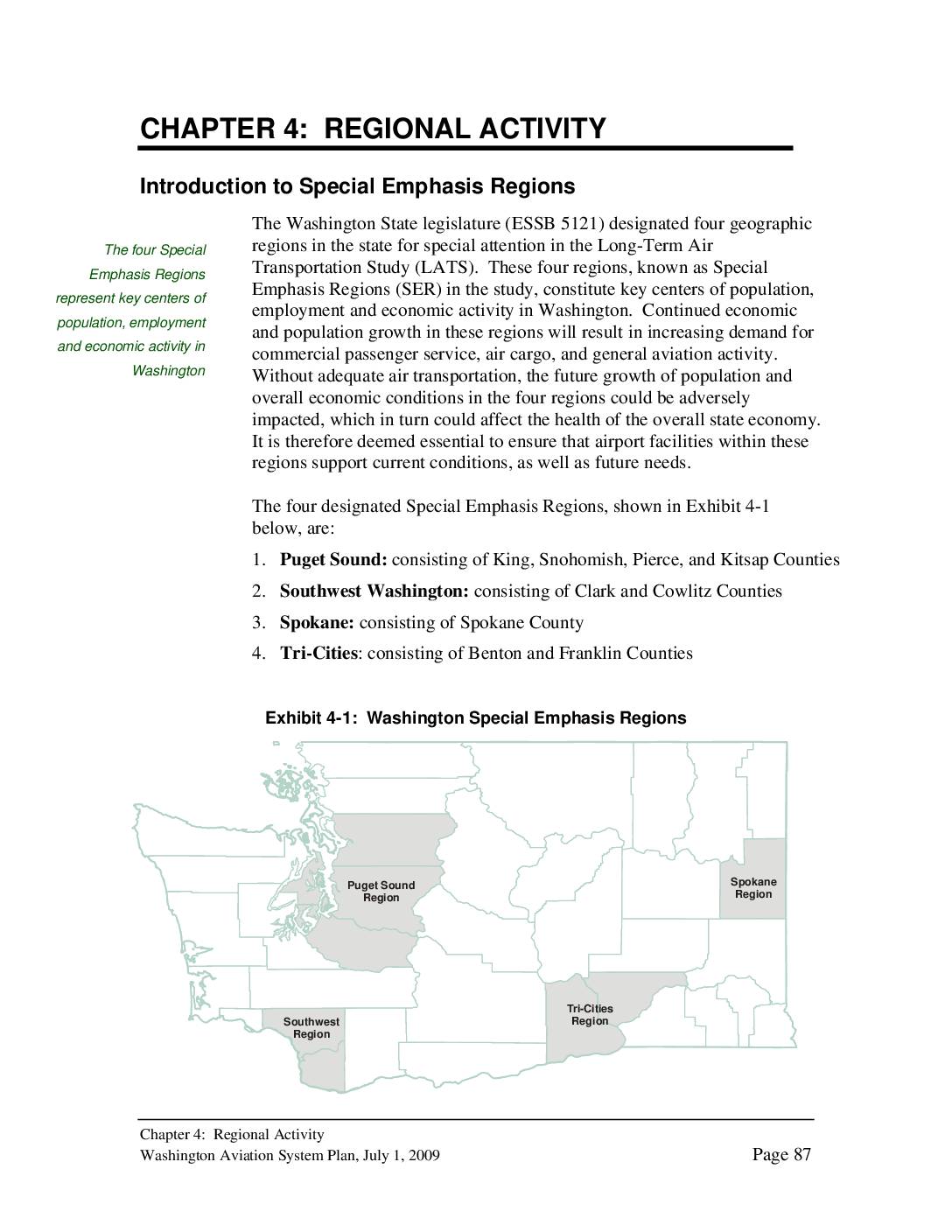
The Washington Aviation System Plan identifies four Special Emphasis Regions in the state, with the Puget Sound region — encompassing King, Snohomish, Pierce, and Kitsap Counties — standing out as the busiest aviation area. The region is home to Seattle-Tacoma International Airport, the state's primary commercial airport, along with 27 other public-use airports serving commercial, general aviation, and seaplane operations. As of 2005, the Puget Sound region housed approximately 55 percent of Washington's total population, driving significant demand for air service and making adequate airport capacity a key economic priority. -
 2009-07-01
Chapter 5: Aviation Trends — Washington Aviation System Plan
This chapter from Washington State's 2009 Aviation System Plan examines commercial aviation trends affecting the state's airports, set against a turbulent national backdrop. U.S. major airlines suffered $27 billion in cumulative operating losses between 2001 and 2005 due to post-9/11 demand drops, soaring fuel costs, and intense competition from low-cost carriers, before returning to profitability in 2006. In response, legacy carriers restructured costs, reduced domestic capacity, and leaned more heavily on regional airline partners, contributing to rising passenger load factors across the industry. -
 2009-07-01
Washington Aviation System Plan, Chapter 9: Alternate Airports Assessment
A 2009 Washington State aviation planning study assessed which existing airports could absorb overflow demand from airports projected to hit capacity limits by 2030, with Sea-Tac International among those forecast to exceed both airfield operations and passenger terminal capacity. The analysis evaluated potential alternate airports within roughly 60 miles of Sea-Tac based on factors such as available capacity, runway length, and highway access, while noting that free-market decisions by airlines and passengers would ultimately determine how traffic is distributed. The study was intended as a first-level screening, with more detailed environmental and operational analyses expected before any formal relief airport designations could be made. -
 2005-10-21
ESSB 5121, Statewide air transportation capacity study summary brief
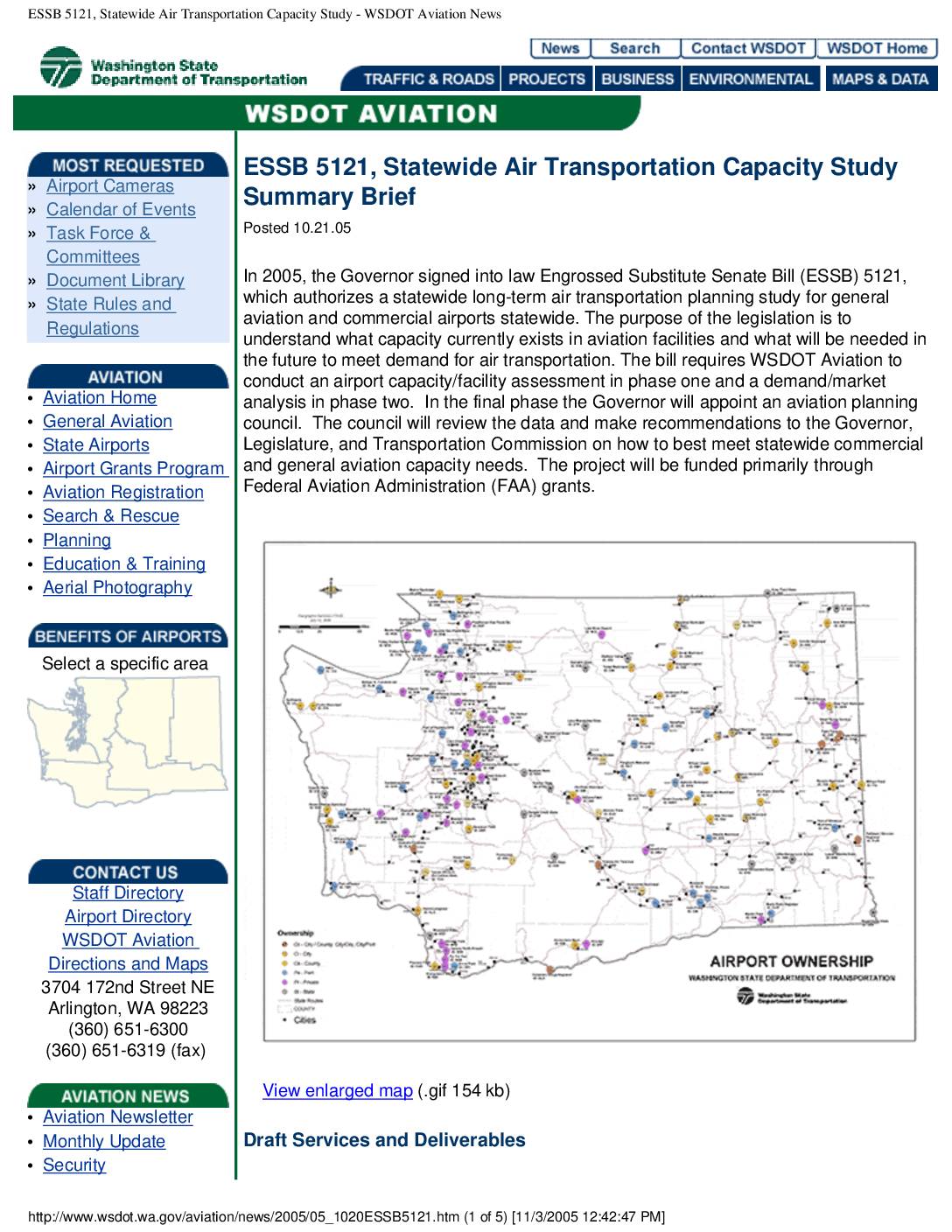
In 2005, Washington State passed ESSB 5121, directing the Washington State Department of Transportation (WSDOT) to conduct a multi-phase statewide air transportation capacity study covering both commercial and general aviation airports. The study required an assessment of existing airport facilities and capacity (Phase 1, due July 2006), followed by a 25-year demand and market forecast analysis with focused attention on the Puget Sound region (Phase 2, due July 2007). A 10-member Governor-appointed aviation planning council would then review the findings and make recommendations on how to meet the state's long-term aviation capacity needs, including identifying sites for future airport facilities. -
 1995-07-01
EXH AR038694: STIA Capacity Enhancement Plan Update
Seattle-Tacoma International Airport (STIA) Capacity Enhancement Plan Update, July 1995, AR 038694. Prepared jointly by the U.S. Department of Transportation, Federal Aviation Administration (FAA), Port Of Seattle, and airlines and general aviation community serving Sea-Tac Airport. Document covers airport capacity planning and enhancement initiatives. -
 1979-04-12
Initial development of the Westside General/Corporate Aviation Facility, Sea-Tac International Airport: Final environmental impact statement
This April 1979 Final Environmental Impact Statement, prepared by the Port of Seattle's Planning and Research Department, evaluates the proposed initial development of a general and corporate aviation facility on the west side of Sea-Tac International Airport. The document was issued in compliance with Washington State's Environmental Policy Act of 1971 and incorporates findings from an earlier 1977 EIS related to a Weyerhaeuser corporate aviation facility on the same site. It was distributed to government agencies, citizen groups, and interested individuals to assess the environmental effects of the proposed development. -
 1968-02-01
APA – Planning The Airport Environment
This 1968 report by the American Society of Planning Officials examines the major planning challenges posed by airports, particularly in light of rapid growth in air transportation and the introduction of new jet aircraft. It summarizes methods and tools planners can use to achieve environments compatible with airport operations, viewing airports as transportation facilities, nuisances,