TagGeneral Aviation(50)
-
 2019-10-10
Regional Aviation Baseline Study: Technical Workshop #2 Presentation
This document presents the agenda and materials for the second technical workshop of the Regional Aviation Baseline Study, held on October 10, 2019. The workshop covered key aviation metrics across commercial service, air cargo, general aviation, and multimodal access, as well as an analysis of regional aviation needs including capacity versus demand, challenges, and opportunities by sector. A regional airspace analysis and discussion of next steps were also included. -
 2019-07-01
Regional Aviation Baseline Study: Working Paper 1 — Airport and Aviation Activity
This 2019 Working Paper, prepared by WSP for the Puget Sound Regional Council, examines airport and aviation activity across the greater Seattle-Tacoma region as part of a Regional Aviation Baseline Study. It covers commercial aviation, general aviation, and air cargo trends and forecasts, along with multimodal access and economic context for the region's airports. The study establishes baseline data and metrics to inform future regional aviation planning and policy decisions. -
 2017-07-01
Washington Aviation System Plan (WASP): Executive Summary
The Washington Aviation System Plan (WASP), completed in July 2017 by the Washington State Department of Transportation (WSDOT), is a statewide assessment of Washington's public-use airports covering both commercial and general aviation facilities. The plan evaluates how individual airports perform and interact as a system, identifies needed improvements, and develops policy recommendations to support communities, economic activity, and emergency services across the state. Funding was provided by the Federal Aviation Administration (FAA), and the plan builds on the earlier 2009 Long-term Air Transportation Study (LATS). -
 2015-07-01
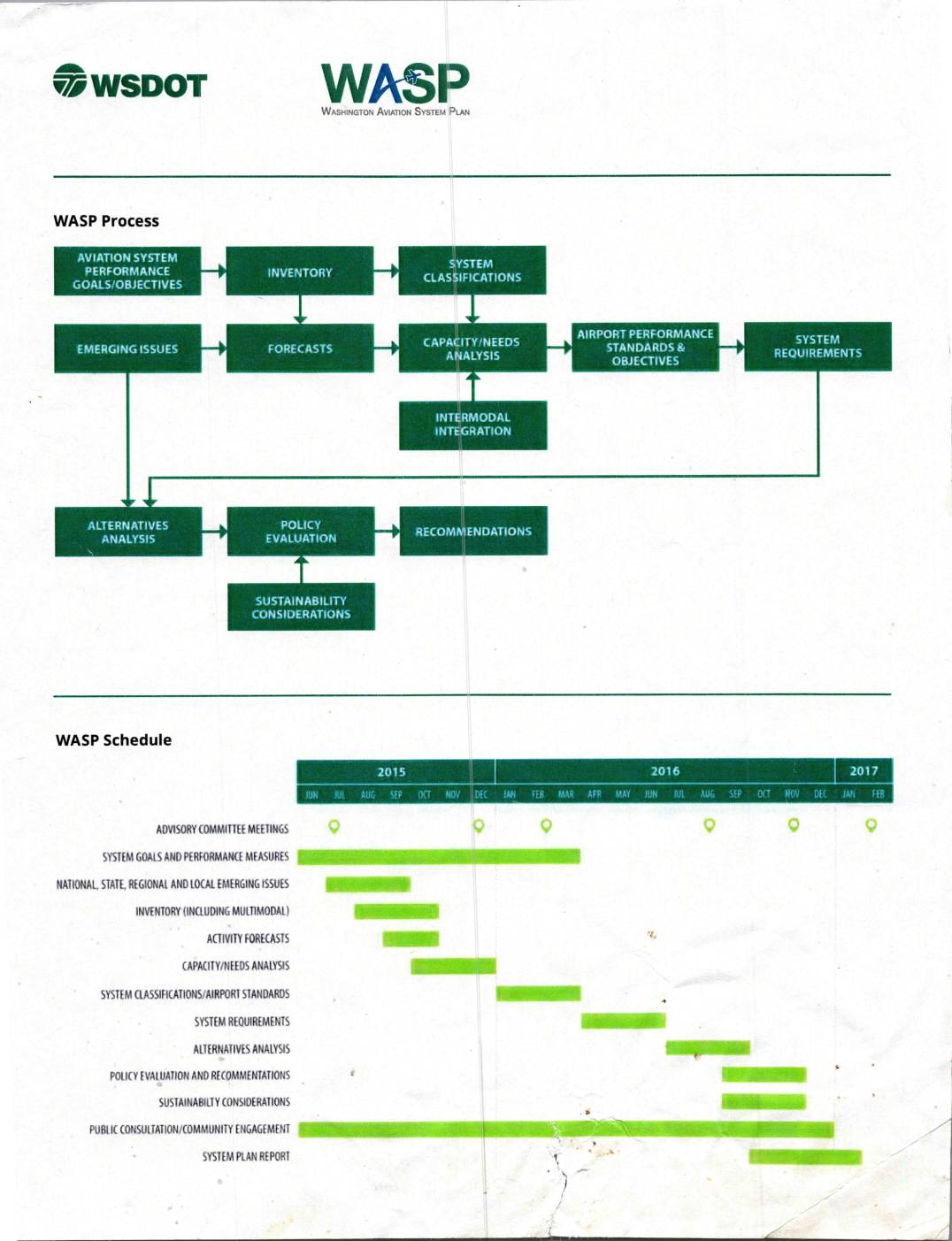
Washington Aviation System Plan Update: WASP Process and Schedule Flyer
The Washington State Department of Transportation (WSDOT) launched an update to the Washington Aviation System Plan (WASP) in July 2015, aimed at studying the performance of Washington's entire aviation system and identifying needed airport improvements. The plan involves analyzing aviation user requirements, airport capacity, and emerging issues such as unmanned aircraft systems, aviation fuels, and airport infrastructure funding challenges. A broad advisory committee representing airports, airlines, government agencies, and aviation associations was assembled to guide the process, which was scheduled for completion by early 2017. -
 2014-12-31
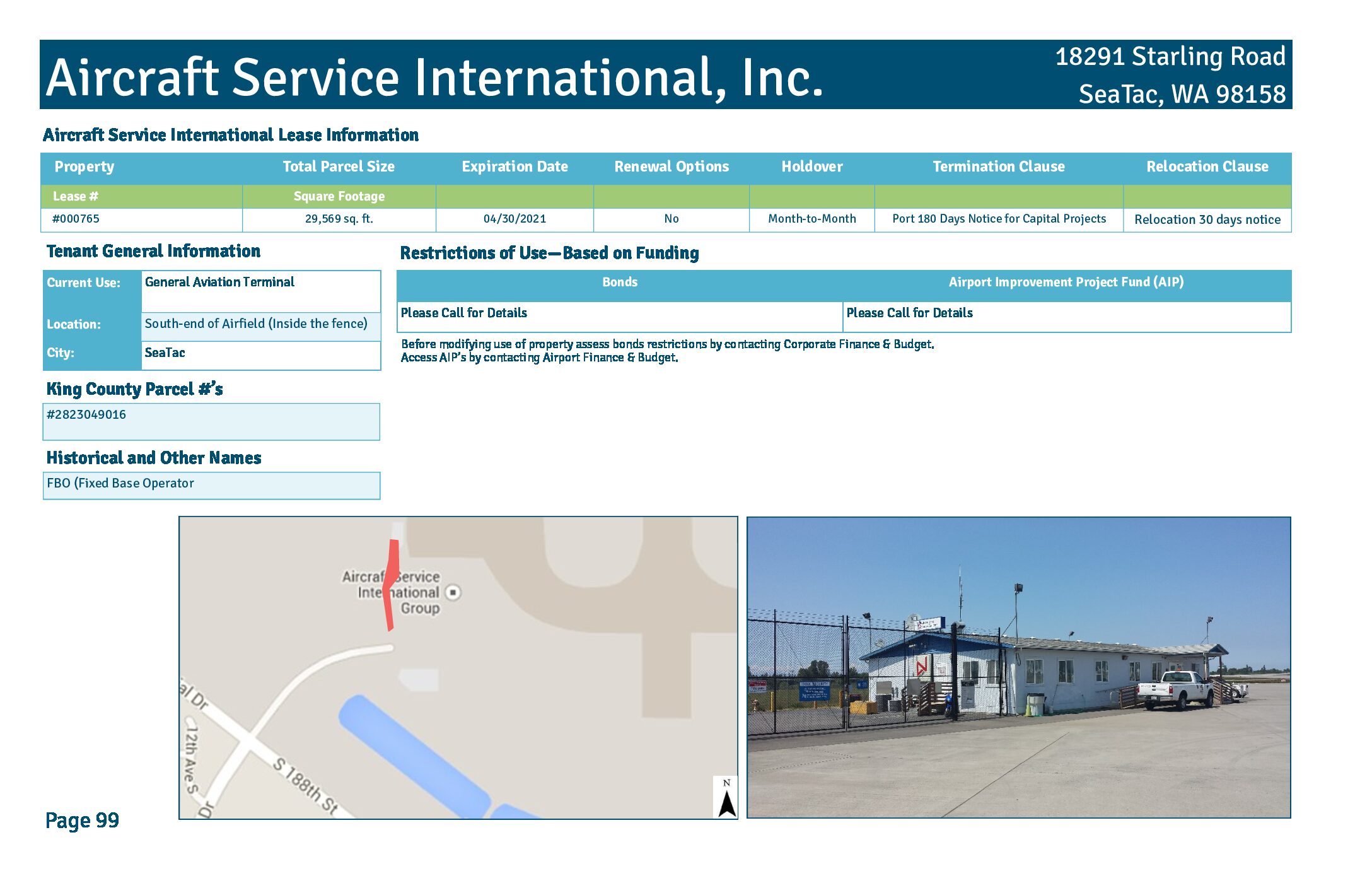
Aircraft Service International, Inc. lease information
Aircraft Service International, Inc. leases 29,569 square feet at 18291 Starling Road in SeaTac, WA (Lease #000765), located at the south end of the Sea-Tac Airfield inside the security fence, where it operates as a Fixed Base Operator (FBO) providing general aviation terminal services. The lease expired April 30, 2021, with no renewal options, transitioning to a month-to-month holdover arrangement, and includes a termination clause requiring 180 days notice for capital projects and a 30-day relocation notice. Parties seeking to modify the property's use must consult Corporate Finance & Budget regarding bond restrictions and Airport Finance & Budget regarding Airport Improvement Project (AIP) funding conditions. -
 2012-07-02
FAA NextGen for airports
This Federal Aviation Administration document describes how the NextGen air traffic modernization program benefits both general aviation and commercial airports through improved GPS-based approach procedures, ADS-B surveillance technology, and more efficient departure queue management systems. Key upgrades include WAAS/LPV approaches that allow aircraft to land in low-visibility conditions without expensive ground equipment, and surface surveillance tools to better track aircraft and vehicles on the ground. The document also outlines plans to optimize airspace procedures across 21 metropolitan areas to reduce delays and improve safety. -
Feds keep little-used airports in business
ByThomas Frank, USA TODAY September 16, 2009, 9:15 PM WILLIAMSBURG, Ky. — One of the USA’s newest airports has a 5,500-foot lighted runway, a Colonial-style terminal with white columns, and hundreds of acres for growth. But Kentucky’s Williamsburg-Whitley County Airport lacks one feature: airline passengers. Built using $11 million in federal money, the airport is used -
 2009-07-01
Washington Aviation System Plan: Executive Summary
The Washington Aviation System Plan (2009) outlines the state's strategy for maintaining and improving its 138 public-use airports over the next 25 years, highlighting aviation's critical role in Washington's economy and transportation network. The plan was developed through the Long-Term Air Transportation Study (LATS), a three-phase process authorized in 2005, which assessed existing airport capacity and projected future needs amid challenges such as population growth, limited funding, and land use conflicts. A ten-member Aviation Planning Council was appointed to translate study findings into actionable recommendations for both commercial and general aviation across the state. -
 2009-07-01
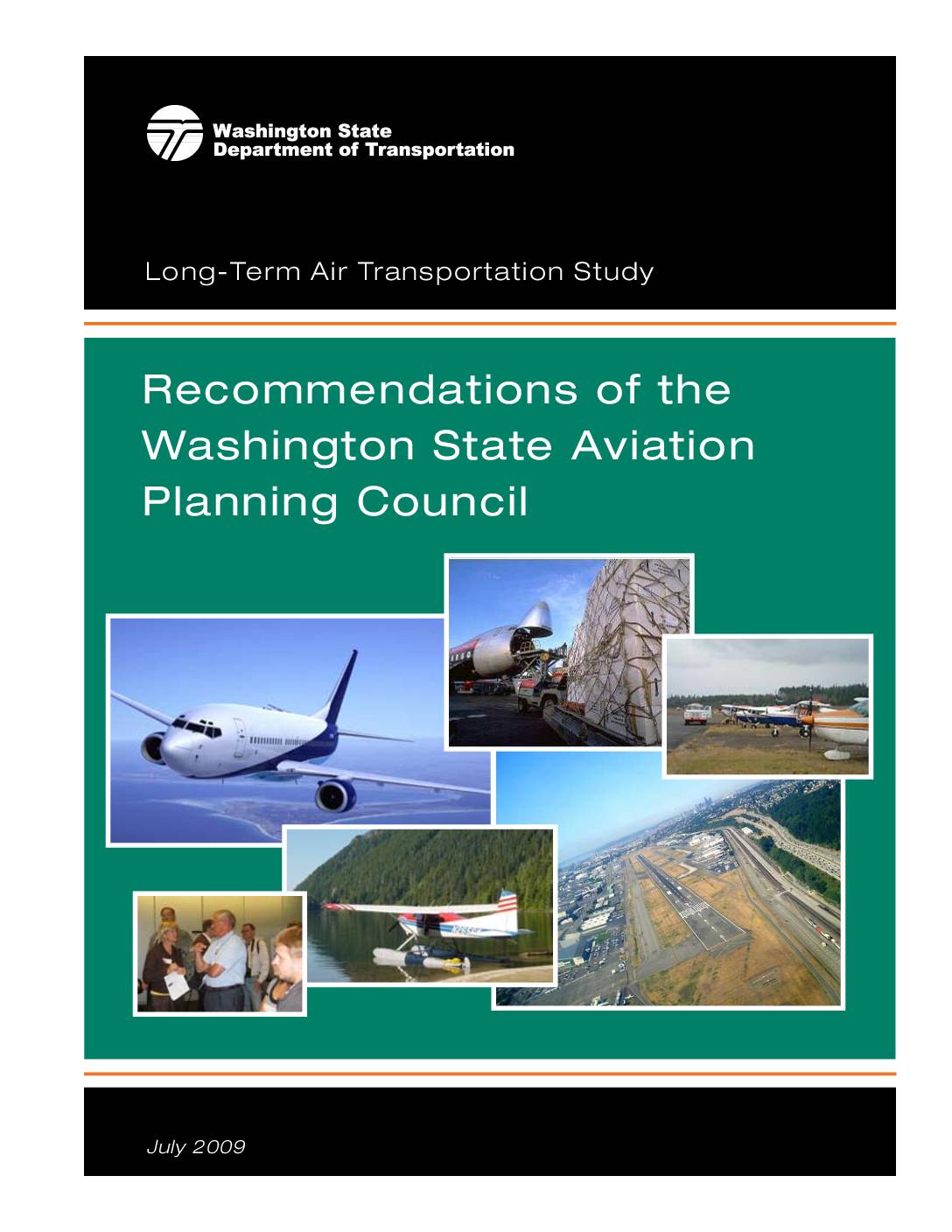
Recommendations of the Washington State Aviation Planning Council: Long-Term Air Transportation Study
The Washington State Aviation Planning Council's 2009 Long-Term Air Transportation Study (LATS) presents recommendations to Governor Gregoire on the future of Washington's aviation system, which had shrunk from 141 to 138 public-use airports with at least two more at risk of closing. The study warns that over the next decade, 12 airports will approach or exceed capacity limits, while land use encroachment and limited resources threaten the system's viability. Public outreach showed strong support for investing in advanced technology and safety improvements, and greater efficiency in existing airports rather than building new ones.