TagFAA(793)
-
 1997-05-01
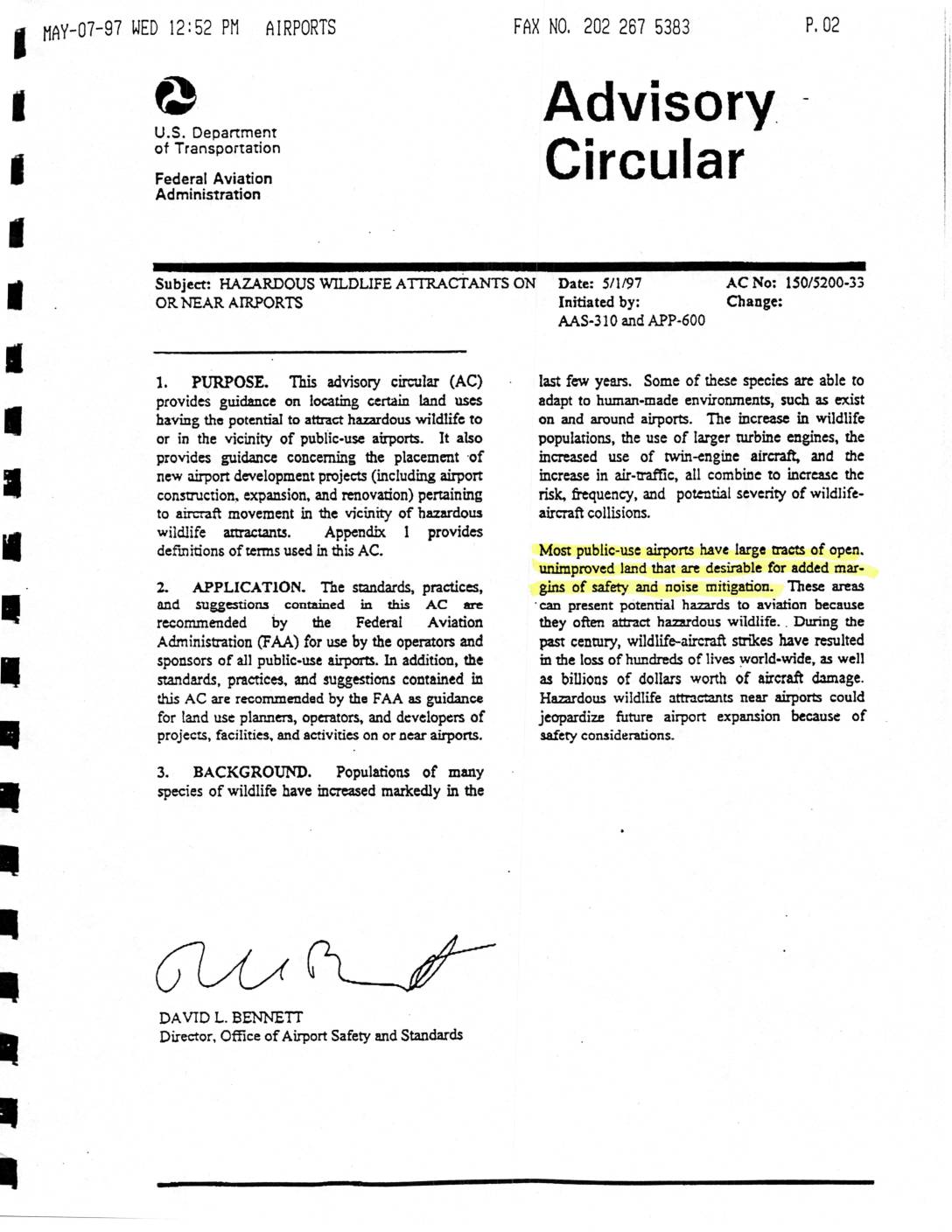
Advisory circular: Hazardous wildlife attractants on or near airports
This 1997 FAA Advisory Circular provides guidance on identifying and managing land uses near public airports that attract hazardous wildlife, such as waste disposal sites, wastewater treatment facilities, and wetlands. It recommends minimum separation distances — 5,000 feet for piston-powered aircraft airports and 10,000 feet for turbine-powered aircraft airports — between wildlife attractants and aircraft movement areas. The document notes that gulls, waterfowl, and raptors are among the most common wildlife involved in damaging aircraft strikes, and urges airport operators, land use planners, and developers to avoid practices that increase wildlife hazards near airports. -
 1997-05-01
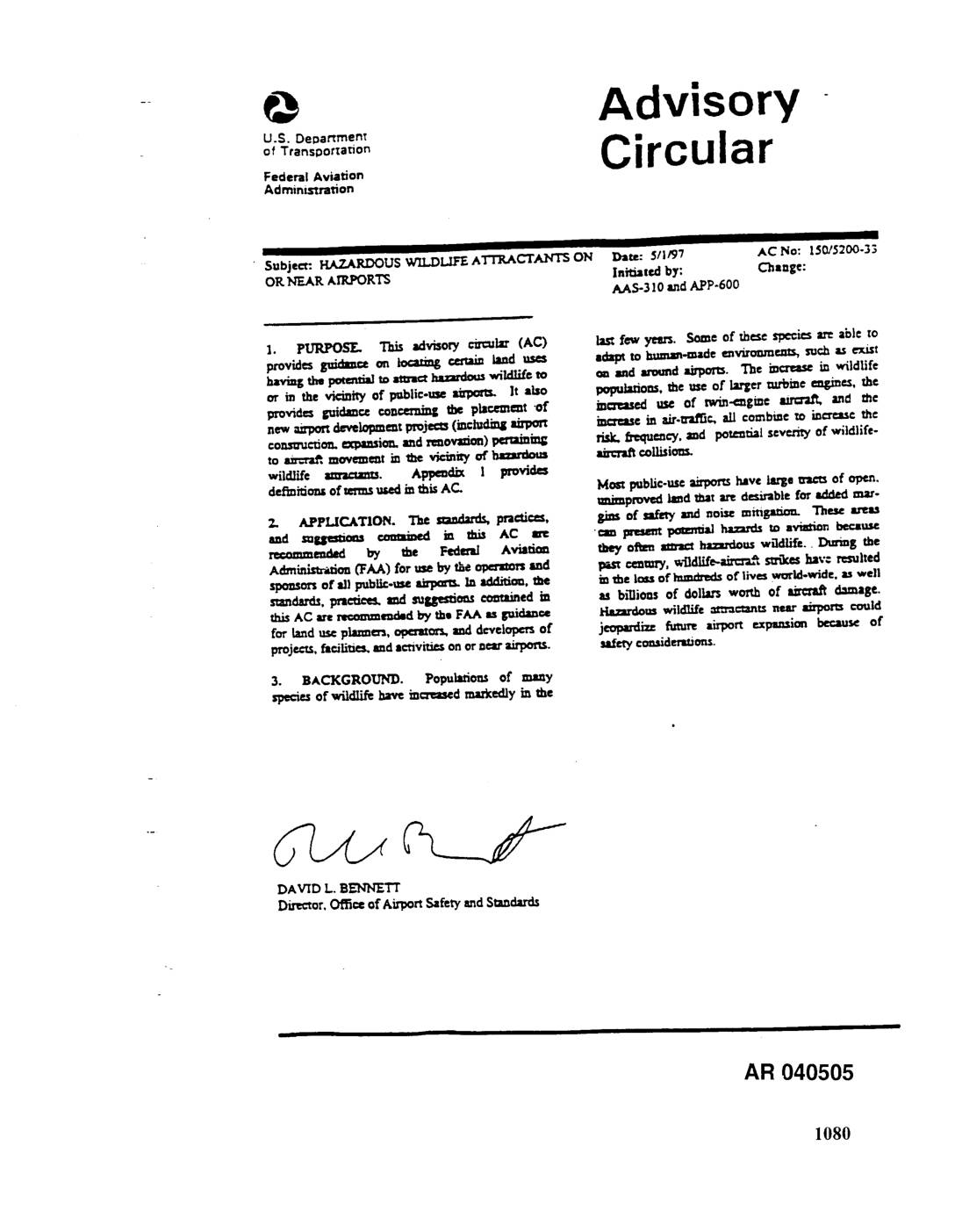
EXH AR1080: Advisory Circular AC 150/5200-33 — Hazardous Wildlife Attractants On or Near Airports
FAA Advisory Circular AC 150/5200-33, dated 5/1/97, initiated by AAS-310 and APP-600, signed by David L. Bennett, Director of Office of Airport Safety and Standards. Provides guidance on locating land uses that attract hazardous wildlife to or near public-use airports. Covers siting criteria: 5,000 feet separation for piston-powered aircraft airports, 10,000 feet for turbine-powered aircraft -
 1997-05-01
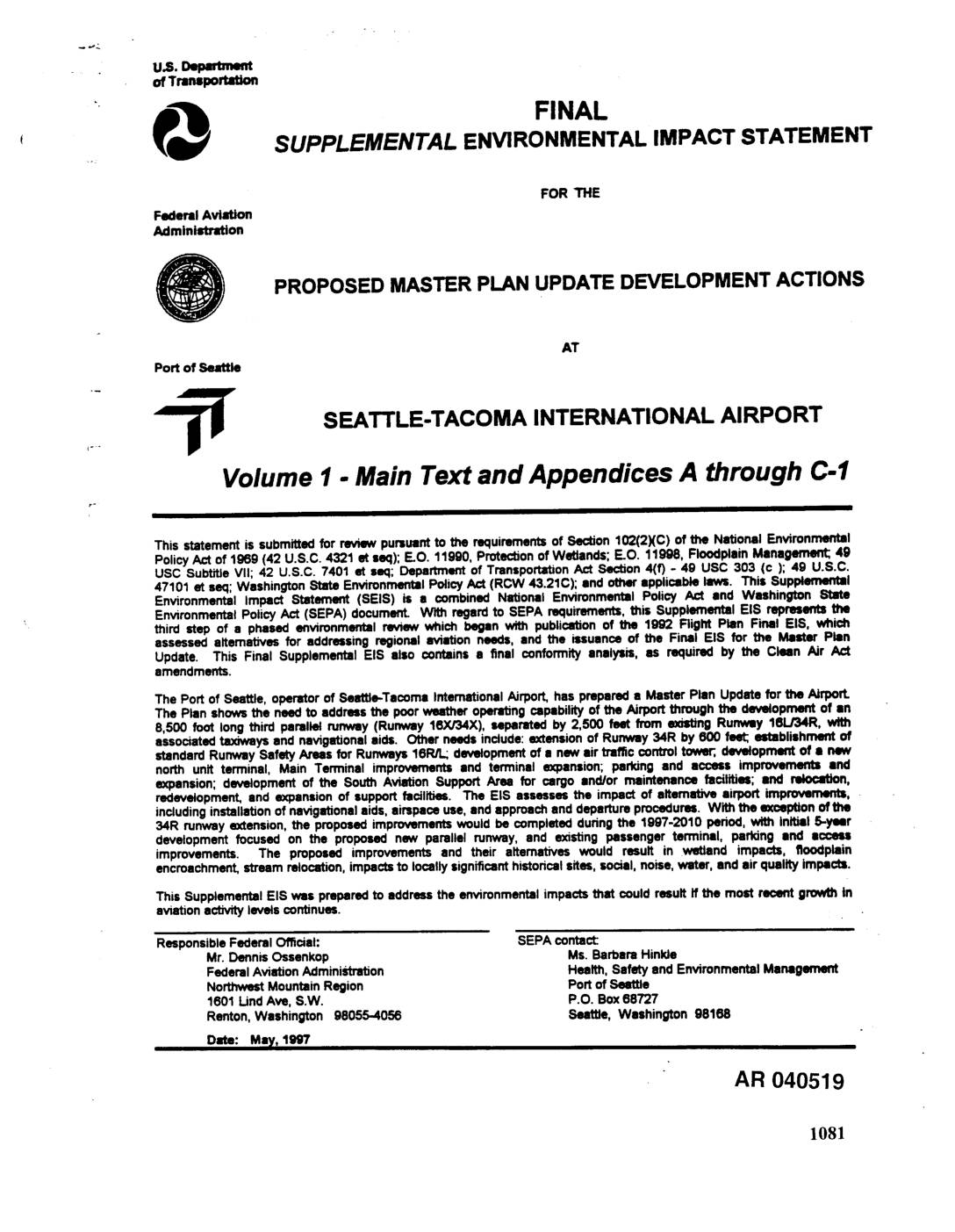
EXH AR040519: Final Supplemental Environmental Impact Statement for Proposed Master Plan Update Development Actions at Seattle-Tacoma International Airport
Final Supplemental Environmental Impact Statement (SEIS) dated May 1997, prepared jointly by the FAA Northwest Mountain Region (responsible official Dennis Ossenkop) and Port Of Seattle (SEPA contact Barbara Hinkle), for proposed Master Plan Update development actions at Seattle-Tacoma International Airport. Covers proposed 8,500-foot third parallel runway (Runway 16X/34X) located 2,500 feet west of existing Runway -
 1997-04-21
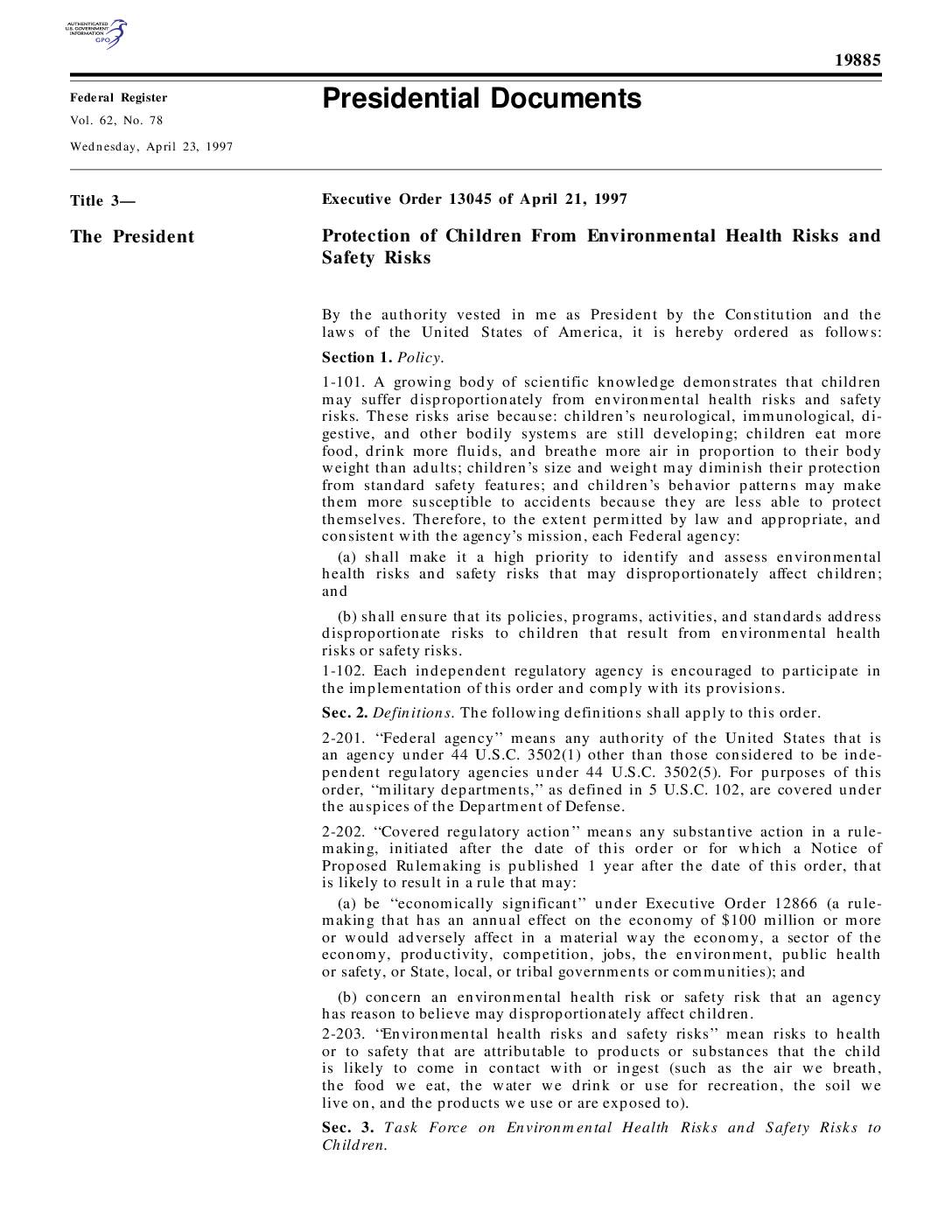
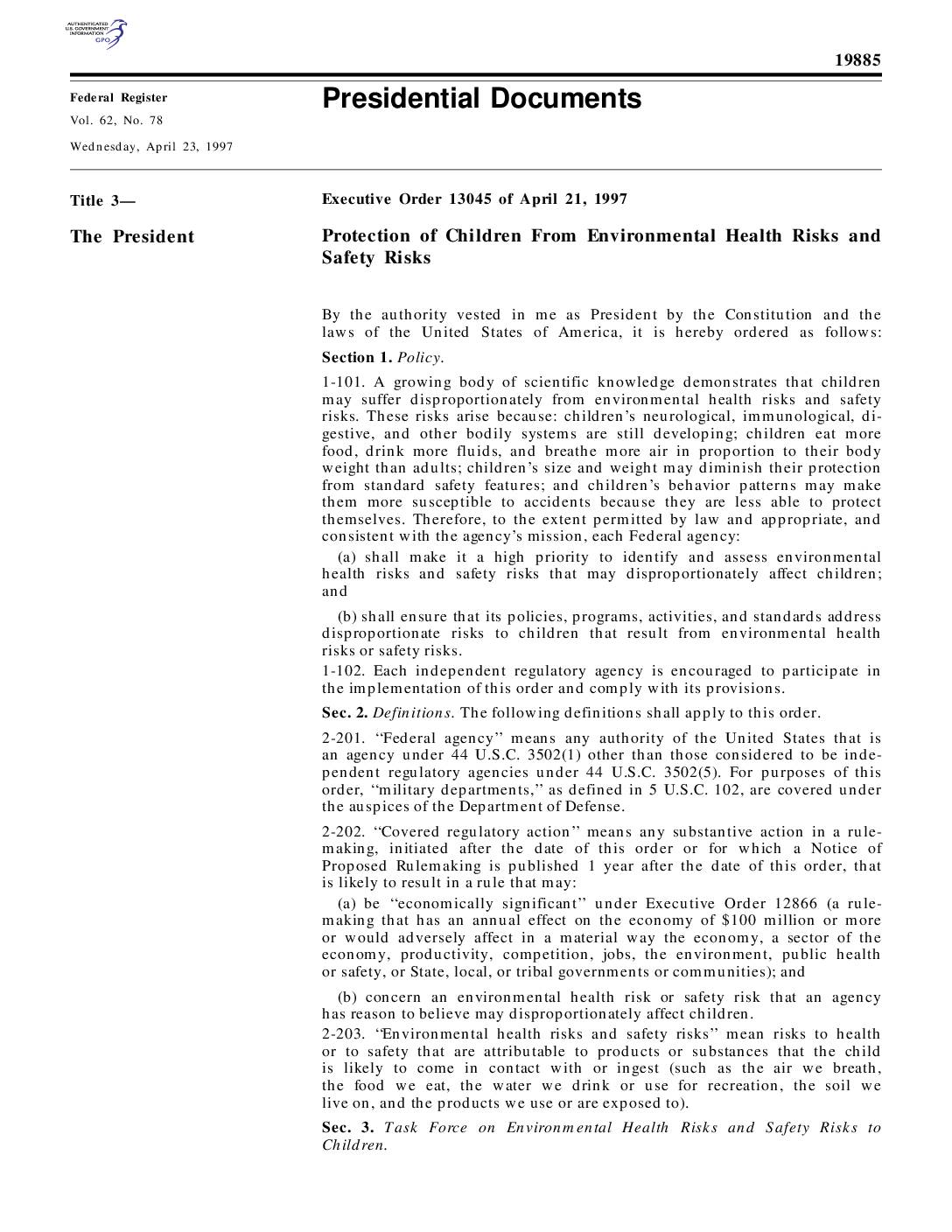
Executive order 13045 protection of children from environmental health risks and safety risks
Executive Order 13045, signed by President Clinton in April 1997, directs federal agencies to identify and address environmental health and safety risks that disproportionately affect children, recognizing that children are more vulnerable due to their developing bodies and behaviors. The order establishes a Task Force co-chaired by the Secretary of Health and Human Services and the EPA Administrator to coordinate federal research and recommend protective strategies. It also requires agencies to evaluate the effects of significant regulations on children's health and safety before those rules take effect. -
 1997-04-21
Executive order 13045 protection of children from environmental health risks and safety risks
Executive Order 13045, signed by President Clinton in April 1997, directs federal agencies to identify and address environmental health and safety risks that disproportionately affect children, recognizing that children are more vulnerable due to their developing bodies and behaviors. The order establishes a Task Force co-chaired by the Secretary of Health and Human Services and the EPA Administrator to coordinate federal research and recommend protective strategies. It also requires agencies to evaluate the effects of significant regulations on children's health and safety before those rules take effect. -
 1996-10-01
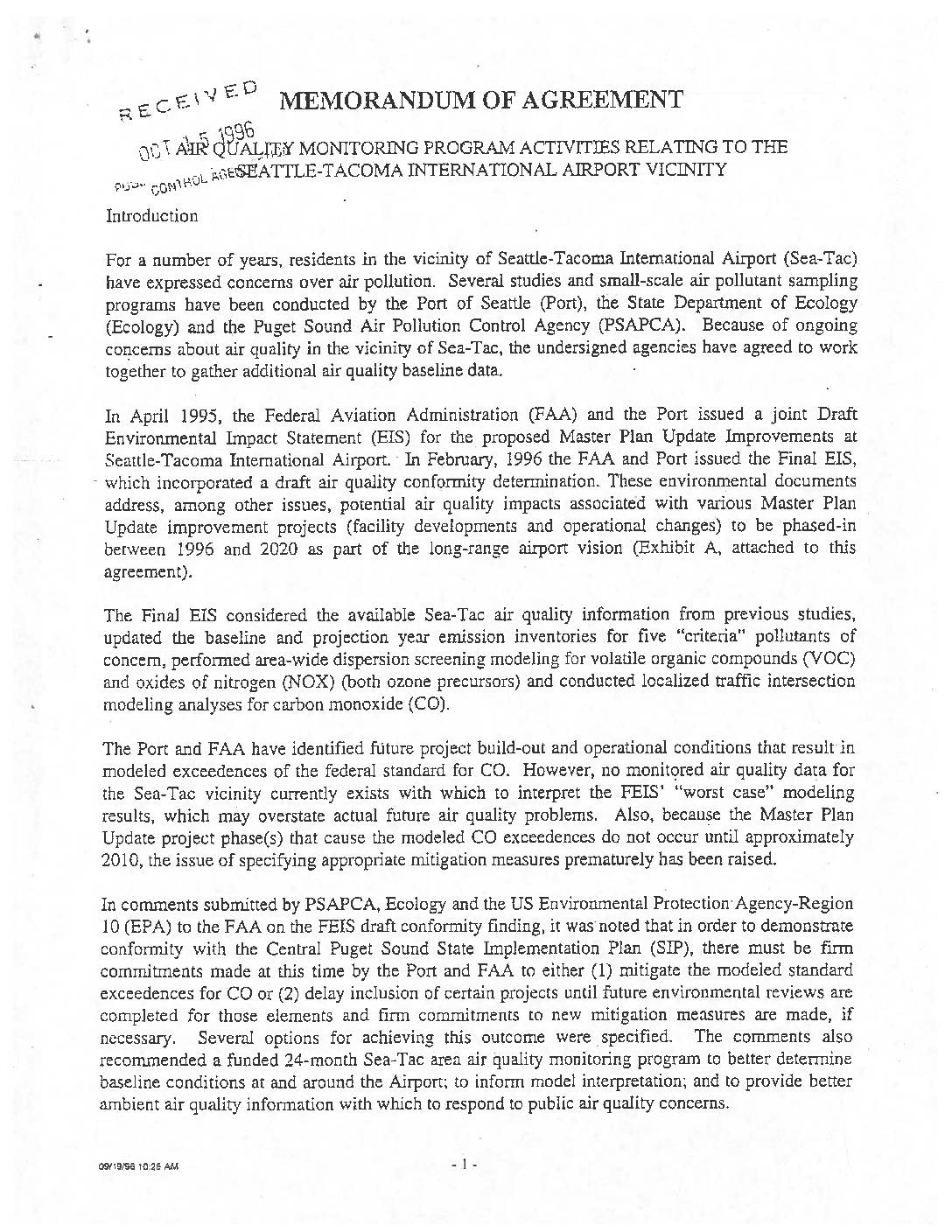
Memorandum of Agreement: Air Quality Monitoring Program Activities Relating to the Seattle-Tacoma International Airport Vicinity
This 1996 Memorandum of Agreement establishes a 24-month air quality monitoring program near Seattle-Tacoma International Airport, involving the Port of Seattle, FAA, EPA, Washington State Department of Ecology, and the Puget Sound Air Pollution Control Agency. The program, funded at $195,000, focuses on measuring carbon monoxide, nitrogen oxides, and aircraft fuel particle residue to establish baseline air quality data and evaluate potential pollution impacts from planned airport expansion projects. The Port agreed not to proceed with expansion elements projected to cause carbon monoxide standard violations until monitoring is complete and, if necessary, mitigation measures are identified. -
 1996-09-19
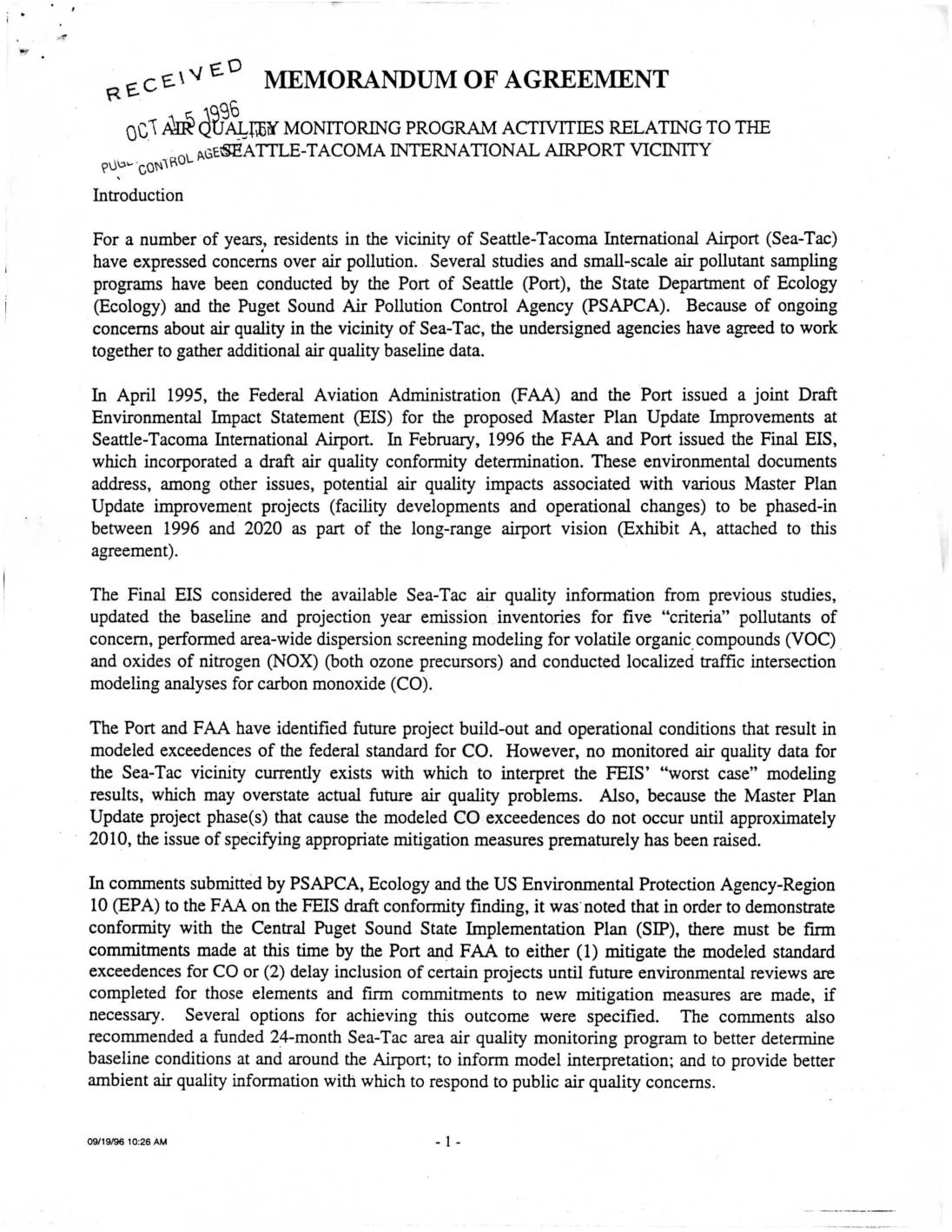
Memorandum of Agreement: Air Quality Monitoring Program Activities Relating to the Seattle-Tacoma International Airport Vicinity
A 1996 Memorandum of Agreement between the Port of Seattle, FAA, EPA, Washington State Department of Ecology, and the Puget Sound Air Pollution Control Agency established a 24-month air quality monitoring program near Seattle-Tacoma International Airport. The $195,000 program was designed to measure carbon monoxide, nitrogen oxides, and aircraft fuel particle residue in order to establish baseline pollution data and assess the accuracy of earlier 'worst case' air quality models from the airport's Final Environmental Impact Statement. The Port agreed not to proceed with Master Plan expansion projects projected to cause CO standard exceedances until monitoring was complete and, if necessary, appropriate mitigation measures were identified. -
 1996-03-27
Appendix E: Comments Concerning the Final Environmental Impact Statement — Sea-Tac Airport Master Plan Update
Appendix E of the Final Environmental Impact Statement (FEIS) for the Seattle-Tacoma International Airport Master Plan Update, containing public agency comment letters dated March–April 1996. Includes: (1) Highline Water District letter from Keith A. Harris to Dennis Ossenkop (FAA Northwest Mountain Region) and Barbara Hinkle (Port Of Seattle Health, Safety and Environmental Division), raising unanswered -
1996-03-27
Appendix E: Comments Concerning the Final Environmental Impact Statement — Sea-Tac Airport Master Plan Update
Appendix E contains public comments submitted in response to the Final Environmental Impact Statement (FEIS) for the Seattle-Tacoma International Airport Master Plan Update. Commenters include the Highline Water District, the Washington State Department of Ecology, the U.S. Public Health Service, and the Washington State Department of Natural Resources, raising concerns about groundwater contamination, the handling of aircraft de-icing glycols, storm water runoff, and surface mining permit requirements for borrow sites on Port of Seattle property. The agencies generally called for stronger mitigation measures and clearer answers to environmental questions before approving the proposed airport expansion. -
 1996-03-18
Testimony of Dr. Stephen Hockaday before the Subcommittee on Aviation of the House of Representatives Committee on Transportation and Infrastructure
In 1996 congressional testimony, Dr. Stephen Hockaday argued against building a costly third runway at Seattle-Tacoma International Airport, contending that the Port of Seattle greatly overstated the frequency of poor weather conditions that would require it. He presented evidence that true instrument flight conditions occur less than 8% of the year—not the 44% the Port claimed—and that existing navigation technologies like Localizer Directional Aid approaches could address capacity needs at far lower cost. Hockaday warned that spending half a billion dollars on a runway used only 15% of the time would divert resources from better long-term regional aviation solutions.