TagFAA(238)
-
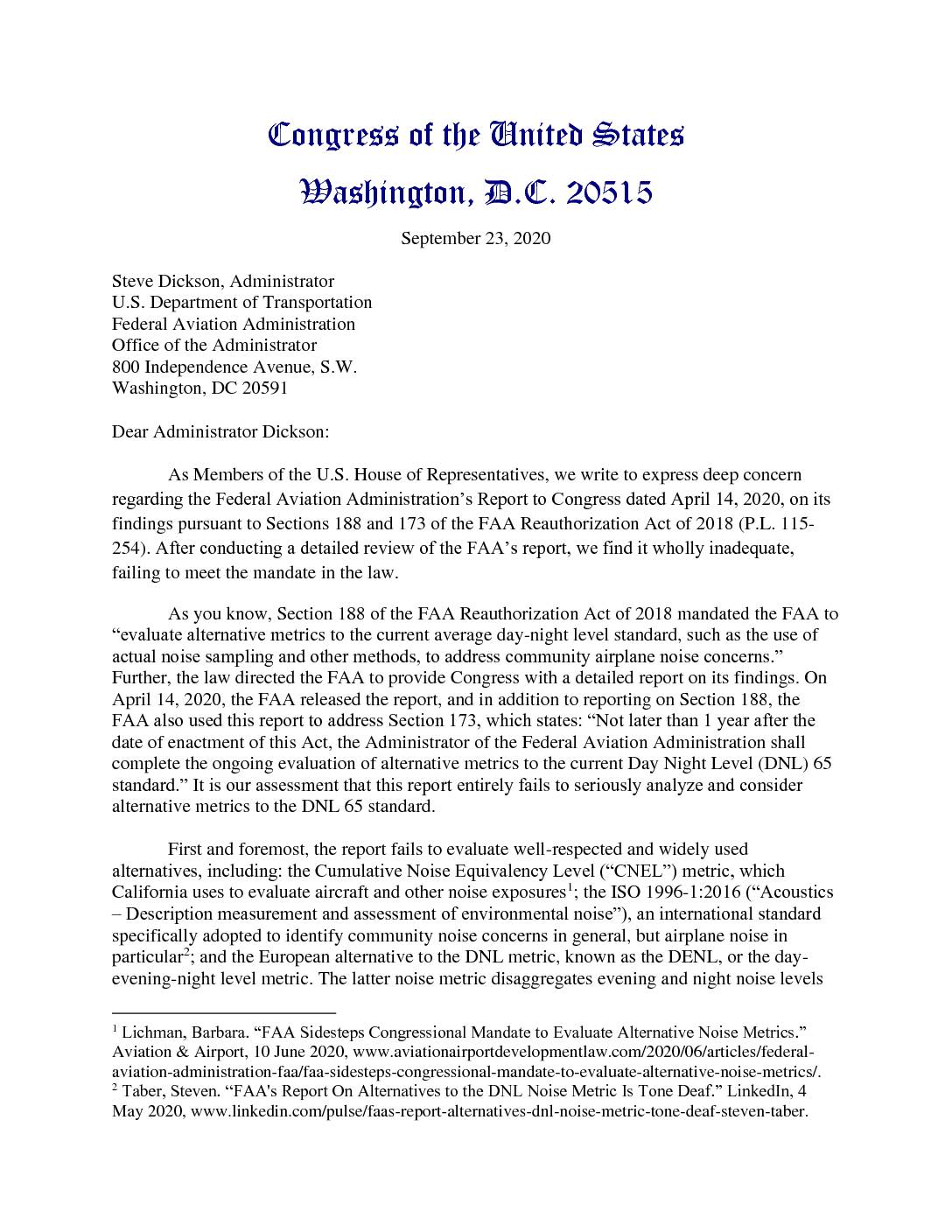
Congressional Quiet Skies Caucus Letter To FAA Administrator Steve Dickson re DNL65
Currently, FAA law has extremely complicated rules for establishing a noise boundary around airports. (A noise boundary is a geographic area inside which there is a certain acceptable noise level.) This is referred to as the DNL65. and it has several major flaws. The FAA Reauthorization Act Of 2018 attempted to address these flaws in several ways. This letter, from a caucus of Congressmen engaged on airport community issues complains to the Administrator that the spirit of the law is not being adhered to and demands that he make attempts to put his agency into compliance. The language is fairly technical, however there are a couple of basic points they raise: First, that the noise boundary be determined by actual noise measurements (currently the noise boundaries are 'modeled' and those calculations often do not reflect in any way the lived experience for residents.) Second, that the 'acceptable' noise level of sixty five decibels (hence DNL65) has been determined to be far too high to conform with current understandings of healthy living. -
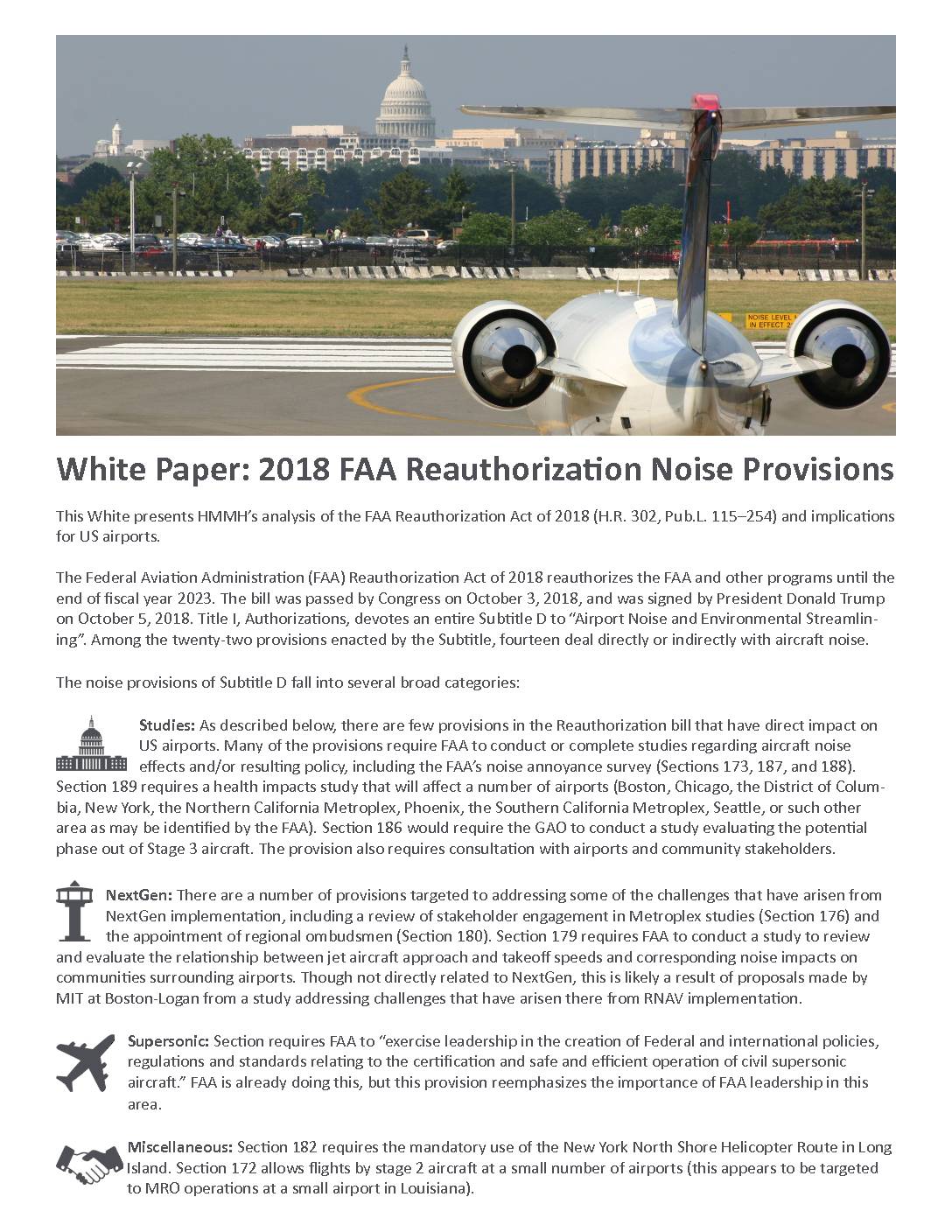
White Paper: FAA Re-authorization Act 2018
White Paper: 2018 FAA Reauthorization Noise Provisions This White presents HMMH’s analysis of the FAA Reauthorization Act of 2018 (H.R. 302, Pub.L. 115–254) and implications for US airports. The Federal Aviation Administration (FAA) Reauthorization Act of 2018 reauthorizes the FAA and other programs until the end of fiscal year 2023. The bill was passed by Congress on October 3, 2018, and was signed by President Donald Trump on October 5, 2018. Title I, Authorizations, devotes an entire Subtitle D to “Airport Noise and Environmental Streamlin- ing”. Among the twenty-two provisions enacted by the Subtitle, fourteen deal directly or indirectly with aircraft noise. The noise provisions of Subtitle D fall into several broad categories: Studies: As described below, there are few provisions in the Reauthorization bill that have direct impact on US airports. Many of the provisions require FAA to conduct or complete studies regarding aircraft noise effects and/or resulting policy, including the FAA’s noise annoyance survey (Sections 173, 187, and 188). Section 189 requires a health impacts study that will affect a number of airports (Boston, Chicago, the District of Colum- bia, New York, the Northern California Metroplex, Phoenix, the Southern California Metroplex, Seattle, or such other area as may be identified by the FAA). Section 186 would require the GAO to conduct a study evaluating the potential phase out of Stage 3 aircraft. The provision also requires consultation with airports and community stakeholders. NextGen: There are a number of provisions targeted to addressing some of the challenges that have… -
 2020-09-02 00:00
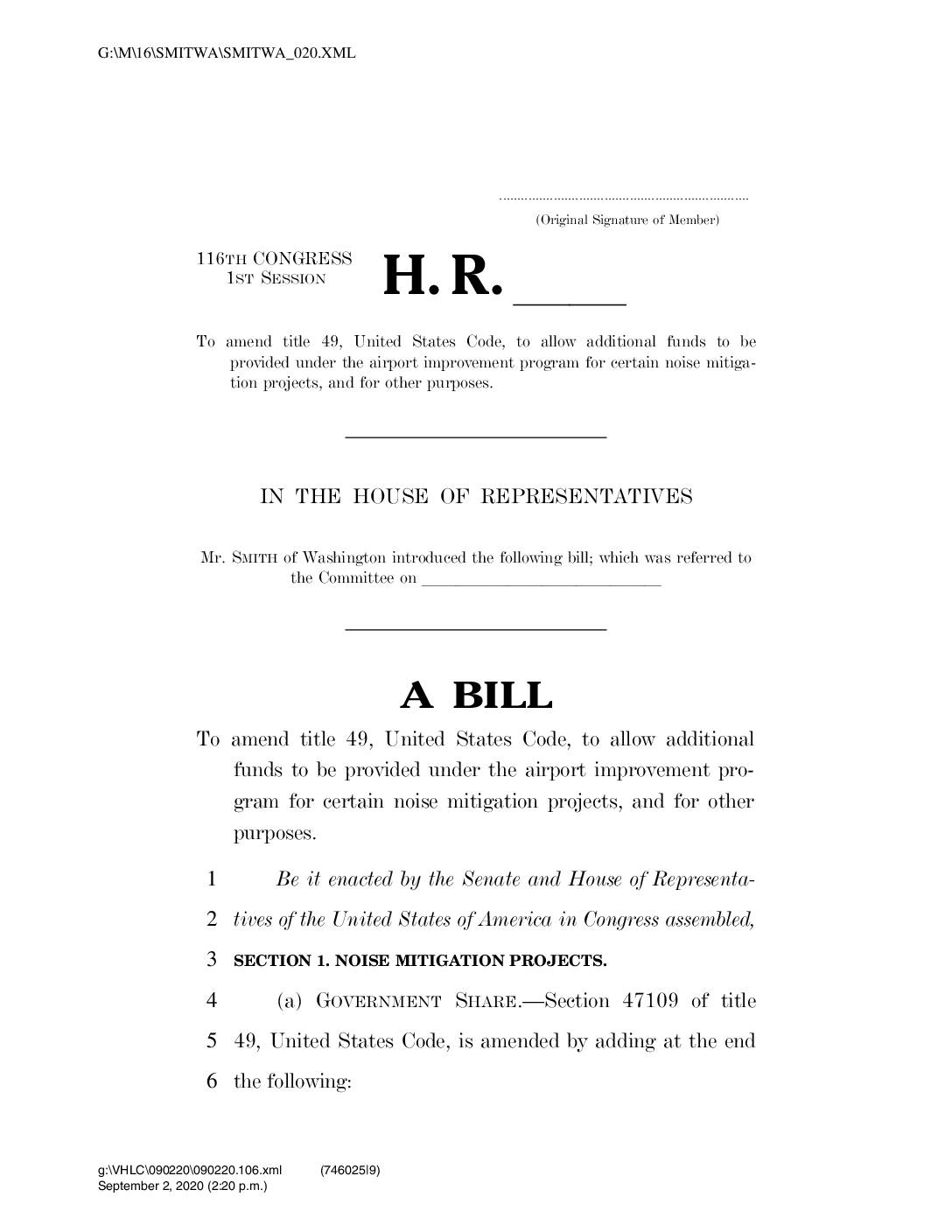
Airport Improvement Program Noise Mitigation Projects Bill
To amend title 49, United States Code, to allow additional funds to be provided under the airport improvement program for certain noise mitiga- tion projects, and for other purposes. IN THE HOUSE OF REPRESENTATIVES Mr. SMITH of Washington introduced the following bill; which was referred to the Committee on llllllllllllll A BILL To amend title 49, United States Code, to allow additional funds to be provided under the airport improvement pro- gram for certain noise mitigation projects, and for other purposes. Be it enacted by the Senate and House of Representa-1 tives of the United States of America in Congress assembled, 2 SECTION 1. NOISE MITIGATION PROJECTS. 3 (a) GOVERNMENT SHARE.—Section 47109 of title 4 49, United States Code, is amended by adding at the end 5 the following: 6 VerDate Mar 15 2010 14:20 Sep 02, 2020 Jkt 000000 PO 00000 Frm 00001 Fmt 6652 Sfmt 6201 C:USERSKEANDERSONAPPDATAROAMINGSOFTQUADXMETAL7.0GENCSMITWA September 2, 2020 (2:20 p.m.) G:M16SMITWASMITWA_020.XML g:VHLC�90220�90220.106.xml (746025|9) -
New aircraft-noise rule would do little to quiet the skies: government report
By Jon Hemmerdinger 24 August 2020 A ban on aircraft that do not meet new noise standards would do little to reduce overall aircraft noise and would impose costly requirements on airlines and aerospace manufacturers. That is according to a 20 August report from the US Government Accountability Office into the likely impact of a -
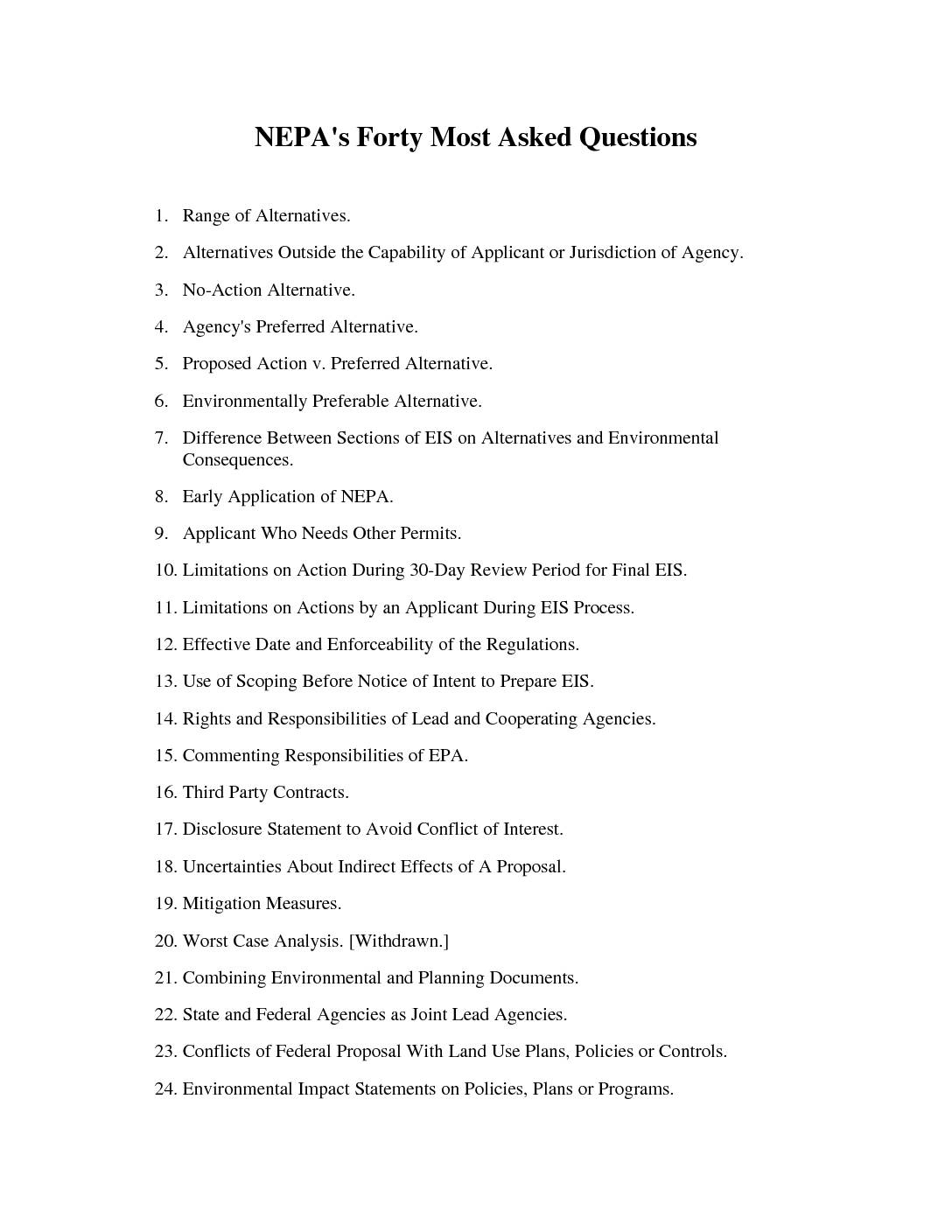
NEPA Forty Most Asked Questions
2. Alternatives Outside the Capability of Applicant or Jurisdiction of Agency. 3. No-Action Alternative. 4. Agency's Preferred Alternative. 5. Proposed Action v. Preferred Alternative. 6. Environmentally Preferable Alternative. 7. Difference Between Sections of EIS on Alternatives and Environmental Consequences. 8. Early Application of NEPA. 9. Applicant Who Needs Other Permits. 10. Limitations on Action During 30-Day Review Period for Final EIS. 11. Limitations on Actions by an Applicant During EIS Process. 12. Effective Date and Enforceability of the Regulations. 13. Use of Scoping Before Notice of Intent to Prepare EIS. 14. Rights and Responsibilities of Lead and Cooperating Agencies. 15. Commenting Responsibilities of EPA. 16. Third Party Contracts. 17. Disclosure Statement to Avoid Conflict of Interest. 18. Uncertainties About Indirect Effects of A Proposal. 19. Mitigation Measures. 20. Worst Case Analysis. [Withdrawn.] 21. Combining Environmental and Planning Documents. 22. State and Federal Agencies as Joint Lead Agencies. 23. Conflicts of Federal Proposal With Land Use Plans, Policies or Controls. 24. Environmental Impact Statements on Policies, Plans or Programs. 25. Appendices and Incorporation by Reference. 26. Index and Keyword Index in EISs. 27. List of Preparers. 28. Advance or Xerox Copies of EIS. 29. Responses to Comments. 30. Adoption of EISs. 31. Application of Regulations to Independent Regulatory Agencies. 32. Supplements to Old EISs. 33. Referrals. 34. Records of Decision. 35. Time Required for the NEPA Process. 36. Environmental Assessments (EA). 37. Findings of No Significant Impact (FONSI). 38. Public Availability of EAs v. FONSIs. 39. Mitigation Measures Imposed in EAs… -
CFR Title 14 Part 161 NOTICE AND APPROVAL OF AIRPORT NOISE AND ACCESS RESTRICTIONS
Title 14: Aeronautics and Space PART 161—NOTICE AND APPROVAL OF AIRPORT NOISE AND ACCESS RESTRICTIONS Contents Subpart A—General Provisions §161.1 Purpose. §161.3 Applicability. §161.5 Definitions. §161.7 Limitations. §161.9 Designation of noise description methods. §161.11 Identification of land uses in airport noise study area. Subpart B—Agreements §161.101 Scope. §161.103 Notice of the proposed restriction. §161.105 Requirements for new entrants. §161.107 Implementation of the restriction. §161.109 Notice of -
Missed opportunity or necessary avoidance? FAA Noise Metrics Report to Congress
TOPICS:16hr2020 Report to Congress (“Report”)April 14average day-night level standardBarbara LichmanCDNLCNELconcentrated noise impact pointsLAeqLdenLmaxNAnoise metricsPart 150SELTA Posted By: Cynthia Schultz June 16, 2020 Share this article: Missed opportunity or necessary avoidance? Cynthia Schultz, PE While it would be easy to take the FAA to task for ignoring the congressional mandate, it is not so easy -
FAA Sidesteps Congressional Mandate to Evaluate Alternative Noise Metrics
Posted in Federal Aviation Administration (FAA) In the FAA Reauthorization Act of 2018, Pub. L. 115254, § 188, Congress required the Federal Aviation Administration (“FAA”) to “evaluate alternative noise metrics to current average day-night level standard, such as the use of actual noise sampling to address community airplane noise concerns.” In its April 14, 2020 -
Aviation Noise & Emissions Symposium 2020
The 2020 UC Davis Aviation Noise and Emissions Symposium will focus on defining the challenges that face the noise and emissions industry over the next few years and discussing real-world solutions. Symposium Presenters will share ground-breaking efforts being undertaken by elected officials, airports, consultants, communities, and the FAA to mitigate noise and environmental impacts of -
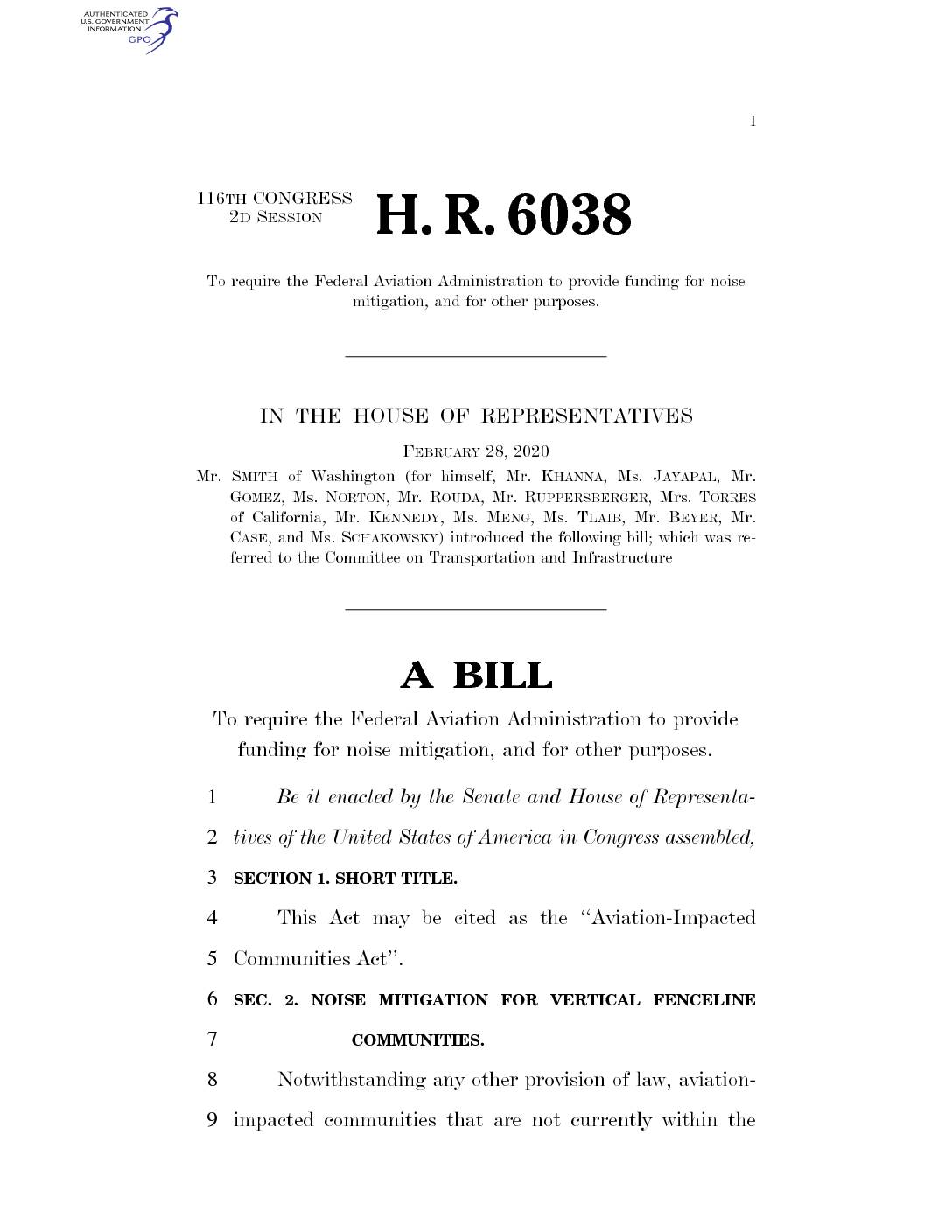
HR 6038 Aviation-Impacted Communities Act (2020 version)
An earlier version of this bill was introduced into the 115th Congress as HR6168