TagEnvironmental Protection Agency(42)
-
 2000-01-01
EXH AR043247: Preliminary Data Summary — Airport Deicing Operations
EPA report (EPA 821-R-00-001, January 2000) presenting a preliminary data summary of airport deicing operations. Covers aircraft and pavement deicing/anti-icing fluids including ethylene glycol-based compounds, fluid types, fluid application methods, variables affecting fluid use, nonchemical deicing methods, and NPDES/Clean Water Act wastewater concerns. Data collected via 1993 screener questionnaire, airport/vendor/POTW mini-questionnaires, EPA site visits, EPA -
 1997-06-01
EXH AR041138: Water Quality Criteria for Copper — A Need for Revisions to the National Standard
Article by John C. Hall, William T. Hall, and Charles J. Simmons published in Water Environment & Technology (June 1997) arguing that EPA’s 1984 and 1993 copper water quality criteria should not be applied directly to municipal effluents (POTWs) because dissolved copper in biologically treated effluents is complexed with organic and inorganic matter and is -
 1997-04-21
Executive order 13045 protection of children from environmental health risks and safety risks
Executive Order 13045, signed by President Clinton in April 1997, directs federal agencies to identify and address environmental health and safety risks that disproportionately affect children, recognizing that children are more vulnerable due to their developing bodies and behaviors. The order establishes a Task Force co-chaired by the Secretary of Health and Human Services and the EPA Administrator to coordinate federal research and recommend protective strategies. It also requires agencies to evaluate the effects of significant regulations on children's health and safety before those rules take effect. -
 1996-10-01
Memorandum of Agreement: Air Quality Monitoring Program Activities Relating to the Seattle-Tacoma International Airport Vicinity
This 1996 Memorandum of Agreement establishes a 24-month air quality monitoring program near Seattle-Tacoma International Airport, involving the Port of Seattle, FAA, EPA, Washington State Department of Ecology, and the Puget Sound Air Pollution Control Agency. The program, funded at $195,000, focuses on measuring carbon monoxide, nitrogen oxides, and aircraft fuel particle residue to establish baseline air quality data and evaluate potential pollution impacts from planned airport expansion projects. The Port agreed not to proceed with expansion elements projected to cause carbon monoxide standard violations until monitoring is complete and, if necessary, mitigation measures are identified. -
 1996-07-01
EXH AR033736: Soil Screening Guidance: User’s Guide, Second Edition
EPA Soil Screening Guidance: User’s Guide, Second Edition (Publication 9355.4-23, EPA/540/R-96/018), published July 1996 by the U.S. Environmental Protection Agency Office of Emergency and Remedial Response (OERR), Office of Solid Waste and Emergency Response. This Superfund guidance document provides soil screening levels (SSLs) and methodologies for evaluating contaminated soil at Superfund sites, including statistical approaches -
 1996-04-01
EXH AR033734: Soil Screening Guidance: User’s Guide
EPA Superfund publication 9355.4-23 (April 1996), ‘Soil Screening Guidance: User’s Guide,’ issued by the United States Environmental Protection Agency Office of Solid Waste and Emergency Response, Washington DC 20460. Exhibit AR033734. Includes Table C-4 presenting metal Kd values (L/kg) as a function of pH for metals including arsenic (Ag), barium (Ba), beryllium (Be), cadmium (Cd), -
 1994-08-01
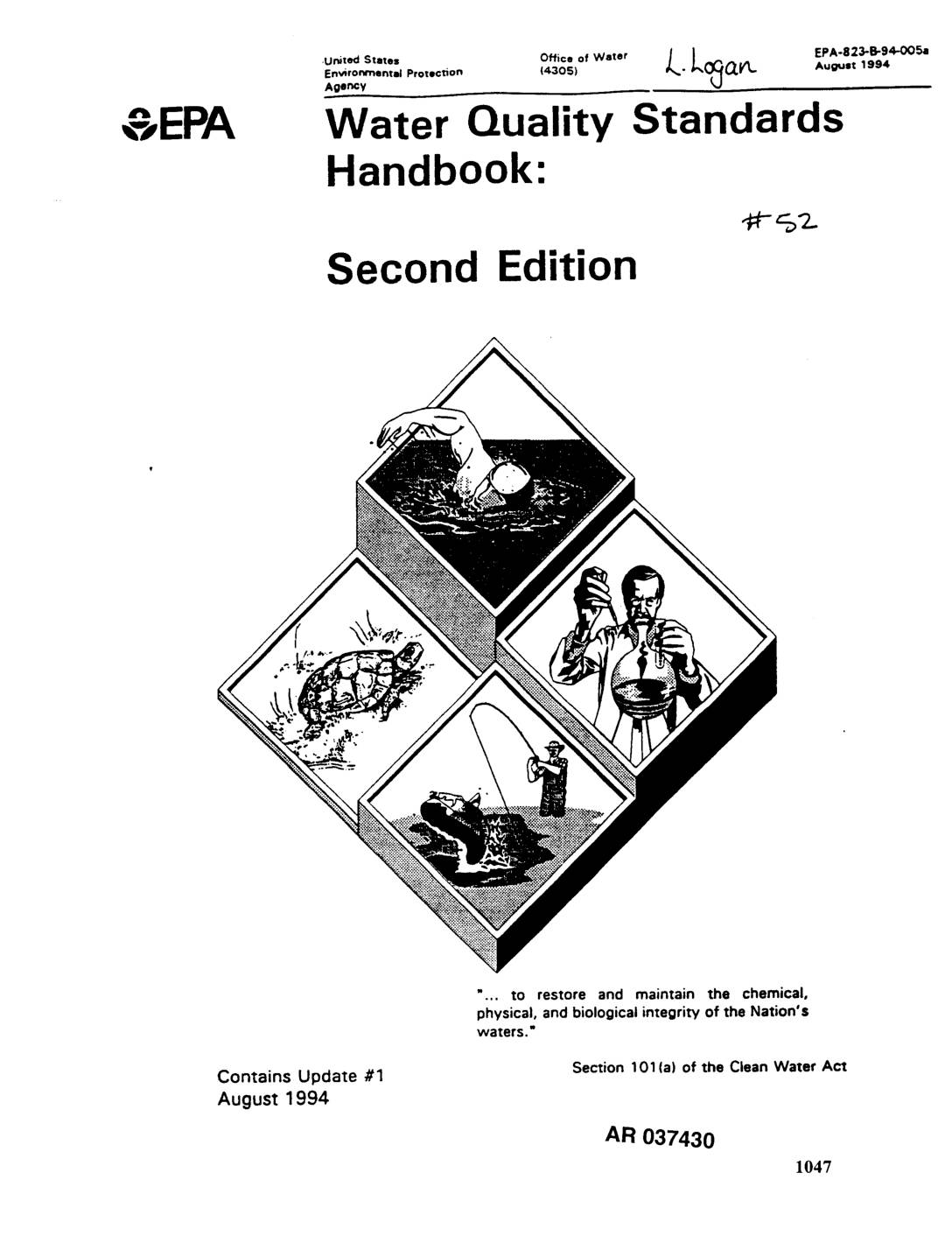
EXH AR037430: EPA Water Quality Standards Handbook: Second Edition — Appendix L, Interim Guidance on Determination and Use of Water-Effect Ratios for Metals
EPA Water Quality Standards Handbook, Second Edition (EPA-823-B-94-005a), August 1994, published by the EPA Office of Water (4305). Includes Appendix L: Interim Guidance on Determination and Use of Water-Effect Ratios for Metals, and a February 22, 1994 memorandum (EPA-823-B-94-001) from Tudor T. Davies, Director, Office of Science and Technology, to Water Management Division Directors Regions -
 1993-04-01
Estimation and Evaluation of Cancer Risks Attributed to Air Pollution in Southwest Chicago: Final Summary Report
Final Summary Report submitted to U.S. EPA Region 5 Air and Radiation Division by ViGYAN Inc., April 1993, estimating and evaluating cancer risks attributed to air pollution in southwest Chicago. The report assesses cancer risk from air pollutants in the southwest Chicago area, prepared under EPA contract for regional air quality and public health assessment. -
 1984-10-01
EXH AR037232: Guidelines for Deriving Numerical Aquatic Site-Specific Water Quality Criteria by Modifying National Criteria
EPA-600/3-84-099, published October 1984 by the U.S. EPA Environmental Research Laboratory, Duluth, Minnesota. Authored by Anthony R. Carlson, William A. Brungs, Gary A. Chapman, and David J. Hansen from EPA Environmental Research Laboratories in Duluth MN, Narragansett RI, Corvallis OR, and Gulf Breeze FL. Provides protocols for deriving numerical aquatic site-specific water quality criteria by -
 1984-01-01
EXH AR037276: Ambient Water Quality Criteria for Copper – 1984
EPA document EPA 440/5-84-031 establishing ambient water quality criteria for copper, published by the U.S. Environmental Protection Agency Office of Water Regulations and Standards, Washington D.C., pursuant to Section 304(a)(1) of the Clean Water Act of 1977 (P.L. 95-217). Authored by Robert W. Andrew (freshwater) and John H. Gentile (saltwater) at Environmental Research Laboratories in